
Growing Mint on Balcony: A Small-Space Pot Guide
Growing mint on balcony railings gets you endless tea and mojito leaves from a single pot. Here’s my balcony herb garden mint setup, with real zone 6b results.
I’ve kept mint going on a shaded north-east balcony in zone 6b for about eight years. Some pots thrived, some died, and one turned into a tangled mess I’m still embarrassed about. Everything below comes from those pots.
Table of Contents
Why Mint Is the Ultimate Balcony Herb (And Why It Must Live in a Solo Pot)
Quick Answer: Mint (Mentha spp.) grows well in containers because the pot cages its aggressive underground runners (rhizomes). It must live alone, since those runners will smother any plant sharing the container within one season.
My first year, I put mint in one big planter with parsley and thyme because it looked pretty on day one. By August there was no parsley, no thyme, just mint, and I had to dig the whole thing out. Learned that the hard way.
The same trait makes growing mint on apartment balcony space easy, as long as you give it a pot of its own. If you’re planning a whole herb setup, my cozy balcony kitchen garden layout shows where a solo mint pot fits.
Mapping the Ideal Balcony Microclimate: Morning Sun, Afternoon Shade, and North-Balcony Success

Give mint 3-5 hours of gentle morning sun, or bright dappled shade the rest of the day. A north or east balcony is actually better than a scorching west railing, because leaves grown with less heat come out softer and sweeter, and the pot doesn’t dry out by noon. Mine gets sun until about 11 a.m. and the leaves never go leathery.
Basil wants far more sun than mint, so put it at the sunnier end of the balcony (my basil on balcony guide covers that).
Choosing Culinary Mint Varieties for Pots: Spearmint, Peppermint, Mojito, Chocolate, and Pineapple Mint
| Variety | Best For | Watch Out For |
|---|---|---|
| Spearmint (Mentha spicata) | Cooking, savory dishes, cocktails | Bullies slower mints |
| Cuban Mojito (Mentha × villosa) | Mojitos, summer drinks | Needs a warm start in spring |
| Peppermint (Mentha × piperita) | High-menthol tea | Flavor fades if it flowers |
| Chocolate mint | Desserts, hot chocolate | Slower growth |
| Pineapple mint (variegated) | Garnish, fruit salads | Least cold-tolerant of the bunch |
Essential Prep: Wide Containers, Moisture-Locking Soil, and Runner Barriers
Before you plant anything, get these four things sorted:
- A wide, bowl-shaped pot (10-12 inches across, 8 inches deep)
- A water-holding soil mix, covered below
- A spot at least 6 inches from every other pot
- A spare larger planter if you want to try the sunken-pot trick
Why Wide, Bowl-Shaped Pots (10–12 Inches Wide by 8 Inches Deep) Beat Tall Narrow Cylinders
Mint spreads sideways through the top 6 inches of soil on shallow stolons, so it doesn’t care about depth. Wide 12-inch bowls, hanging baskets, and railing troughs all work far better than tall skinny pots.
I tried Mojito mint in a 6-inch tall cylinder once (cute, cheap, total waste of money). It was a solid mat of white roots in six weeks and dried out twice a day in July.
The “Sunken Nursery Pot” Trick and the 6-Inch Air-Gap Rule to Stop Escaping Runners

Sink a plastic nursery pot into a bigger mixed planter, with the rim sitting about an inch above the soil. The plastic wall blocks the rhizomes, and you can still grow flowers around it. Lift the pot out in spring and trim any roots poking through the drainage holes.
Also keep mint pots at least 6 inches from their neighbors. Long aerial stems arch over and root wherever they touch soil, and I’ve pulled mint out of my rosemary pot more than once.
The Moisture-Sponging, Rich Balcony Potting Soil Recipe for Mint (pH 6.0–7.0)
My mix, by volume:
- 40% peat-free coco coir
- 20% fine vermiculite
- 20% perlite
- 15% screened compost
- 5% worm castings
It holds steady moisture without turning soggy, and the pH lands between 6.0 and 7.0 without any fiddling.
Step-by-Step Guide: Planting, Propagating, and Establishing Balcony Mint
Quick Answer: Skip seeds. Buy a nursery starter or root a cutting, loosen the roots, plant into fresh mix, and pinch it back at week two for a bushy pot.
Step 1: Why You Should Buy a Nursery Starter or Root a Cutting (Never Sow Mint Seeds)
Peppermint and Mojito mint are sterile hybrids or don’t grow true from seed, so you often get tasteless, hairy wild mint. A $4 nursery plant (as of fall 2026) clones the exact flavor you wanted.
A grocery-store stem works too. Drop it in a glass of water and it roots in about 7 days.
Step 2: Teasing Out Circling Rhizomes and Potting Up With a 1-Inch Mulch Blanket
Slide the plant out of its nursery pot and loosen the tangled white outer runners so they point outward into fresh soil. Plant it at the same depth, water thoroughly, then add a 1-inch layer of fine pine bark or coco chips on top. Side Note: Don’t pack the mix down hard or water will pool on top instead of soaking in.
Step 3: Pinching the Growing Tips at Week Two to Force Dense Lateral Bushiness
At week two, snip the top 2 inches off every upright stem, right above a pair of leaf nodes. Each cut sends out two new side branches, and the pot gets about twice as dense in 14 days. It feels wrong, but do it anyway.
Step 4: The Annual Spring “Pie-Slice Root Division” to Stop Pots From Going Woody and Sparse
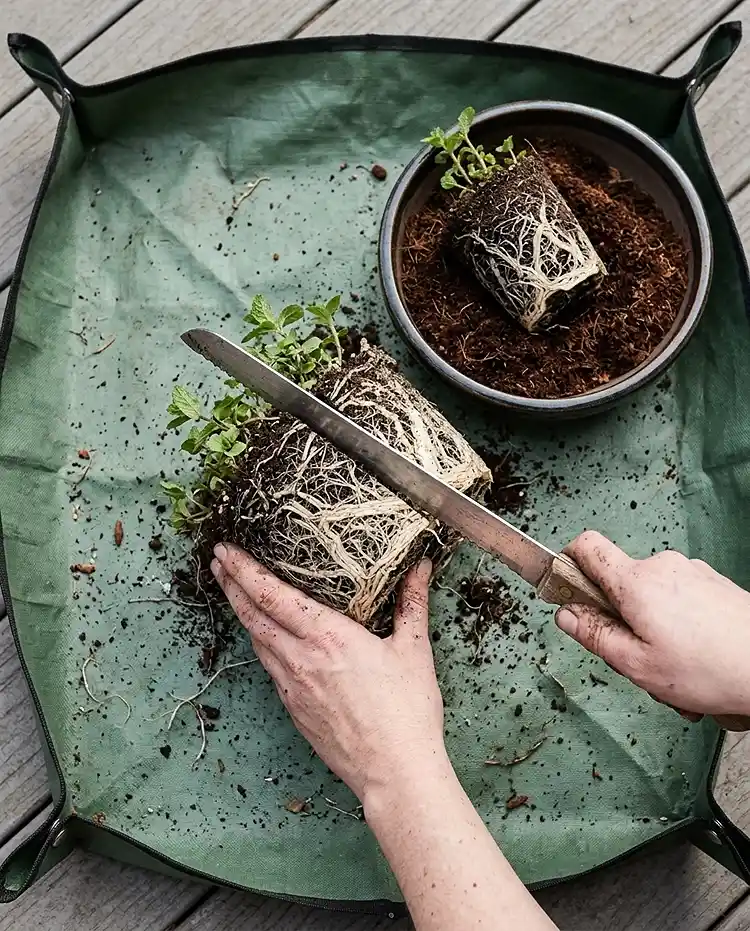
This is the best trick I know for long-lived container mint. After about 12 months the runners form a solid mat and the plant chokes itself.
Each spring, slide the root ball out, slice it into quarters with a serrated bread knife, and repot just one quarter in fresh soil. Give the rest to a friend or compost it.
Mastering Ongoing Care: Watering, Harvesting for Yield, and Winterizing
Morning Watering Rhythms and Diluted Organic Nitrogen Feeding Chart
Keep the soil as damp as a wrung-out sponge, with a morning soak daily in summer. Feed monthly with half-strength fish emulsion or worm tea, and no more than that, because heavy feeding dilutes the menthol oils.
| Season | Watering | Feeding |
|---|---|---|
| Spring | Every 2-3 days | Monthly, half strength |
| Summer | Daily, mornings | Monthly, half strength |
| Fall | Every 3-4 days | Stop by September |
| Winter | Once a month | None |
The “Mid-Summer Crew-Cut” Rejuvenation Harvest and Winter Survival Down to −20 °F (−28.9 °C)

In July, shear the whole pot down to 2 inches above the soil. Two weeks later you get a fresh flush of tender baby leaves, and I do it before flower buds show.
Mint is hardy in Zones 3-8, so it can stay outside on a freezing balcony all winter and sprout back in March. Check your zone on the USDA Plant Hardiness Zone Map. In Zones 3-5, wrap the pot in burlap, because a frozen-solid pot is harder on roots than cold air.
Common Problems & Solutions
Bare, Woody Center Stems With Leaves Only Around the Outer Pot Rim (“The Donut Effect”)
Runners migrate toward the pot wall as the center soil gets exhausted and compacted. Pull the root ball out, cut away the dead center core, and replant the healthy outer runners in the middle with fresh compost.
Mint Rust (Orange-Yellow Pustules Under Leaves) and Powdery Mildew in Humid Corners
Powdery mildew is dusty white and rust is bright orange blisters, usually on lower stems. For mild mildew, shear the stems to the soil line and give the pot more airflow. If it’s systemic mint rust (Puccinia menthae), throw the plant out and sterilize the pot.
Spider Mites, Aphids, and Flea Beetles Riddling Leaves on Hot, Dry Balconies
Drought-stressed mint against a hot brick wall attracts two-spotted spider mites and jumping flea beetles. Hit the pot with a sharp blast from the shower wand, shear the infested tops, and keep the soil moist. No sprays, so the flavor stays clean.
Mint Losing Its Signature Peppermint or Mojito Flavor (“Flavor Drift” and Flowering Stress)
Once mint bolts into purple flower spikes, the leaves turn bitter. Pinch off buds the moment you see them.
The other cause is two varieties sharing one pot, where vigorous spearmint crowds out delicate peppermint. Use separate pots.
Frequently Asked Questions About Growing Mint on Balcony
How big of a pot does mint need on an apartment balcony?
A pot 10-12 inches wide and at least 8 inches deep (about 3 gallons) works well. Anything smaller than 8 inches gets choked with circling white rhizomes in about 6 weeks and dries out twice a day in summer heat.
Can I plant two different kinds of mint (like spearmint and peppermint) in the same pot?
Not really. The roots won’t ruin each other’s flavor, but the more aggressive grower, usually plain spearmint, crowds out and strangles slower types like chocolate or pineapple mint within two months.
Will my potted balcony mint survive outside over a freezing winter?
Yep, mint is hardy down to Zone 3 (-30 degrees F). Cut the frost-killed stems to 1 inch in November, tuck the pot against the balcony wall, and water once a month during thaws for a good March comeback.
How do you harvest mint so the plant keeps growing bushier?
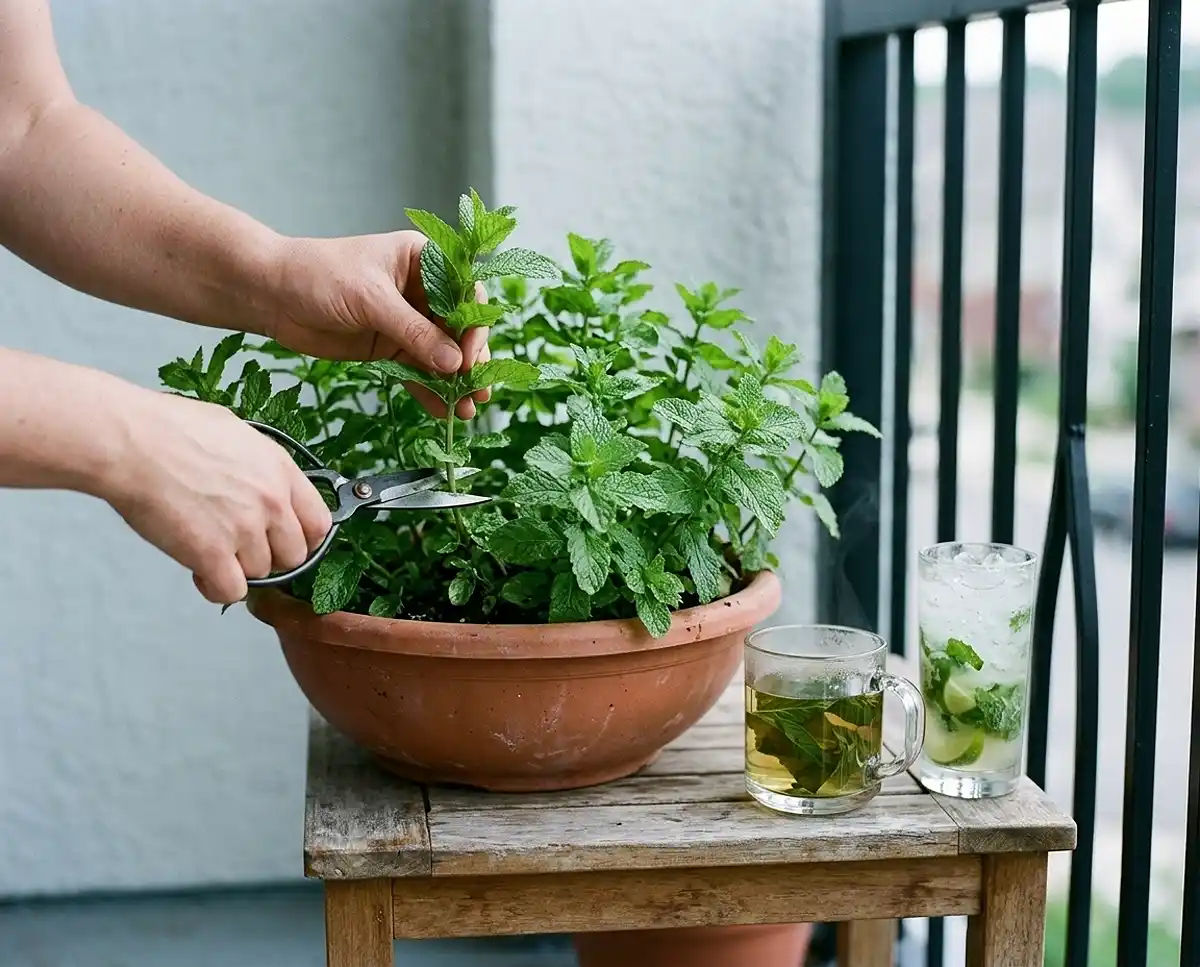
Don’t pick bottom leaves off a standing stem. Use clean kitchen scissors to snip whole stems ¼ inch above a pair of lower leaf nodes, taking up to one-third of the plant at a time. Or shear the pot to 2 inches before it flowers to trigger double branching.
Key Takeaways
- Growing mint on balcony space works best in a wide, 10-12 inch bowl, alone in its own pot.
- Buy a starter or root a cutting, and pinch the tips at week two.
- Use water-holding mix and keep soil evenly damp, with morning waterings in summer.
- Split the root ball into quarters each spring and repot one piece.
- Shear in July, pinch off flower buds, and leave the pot outside through winter in Zones 3-8.