
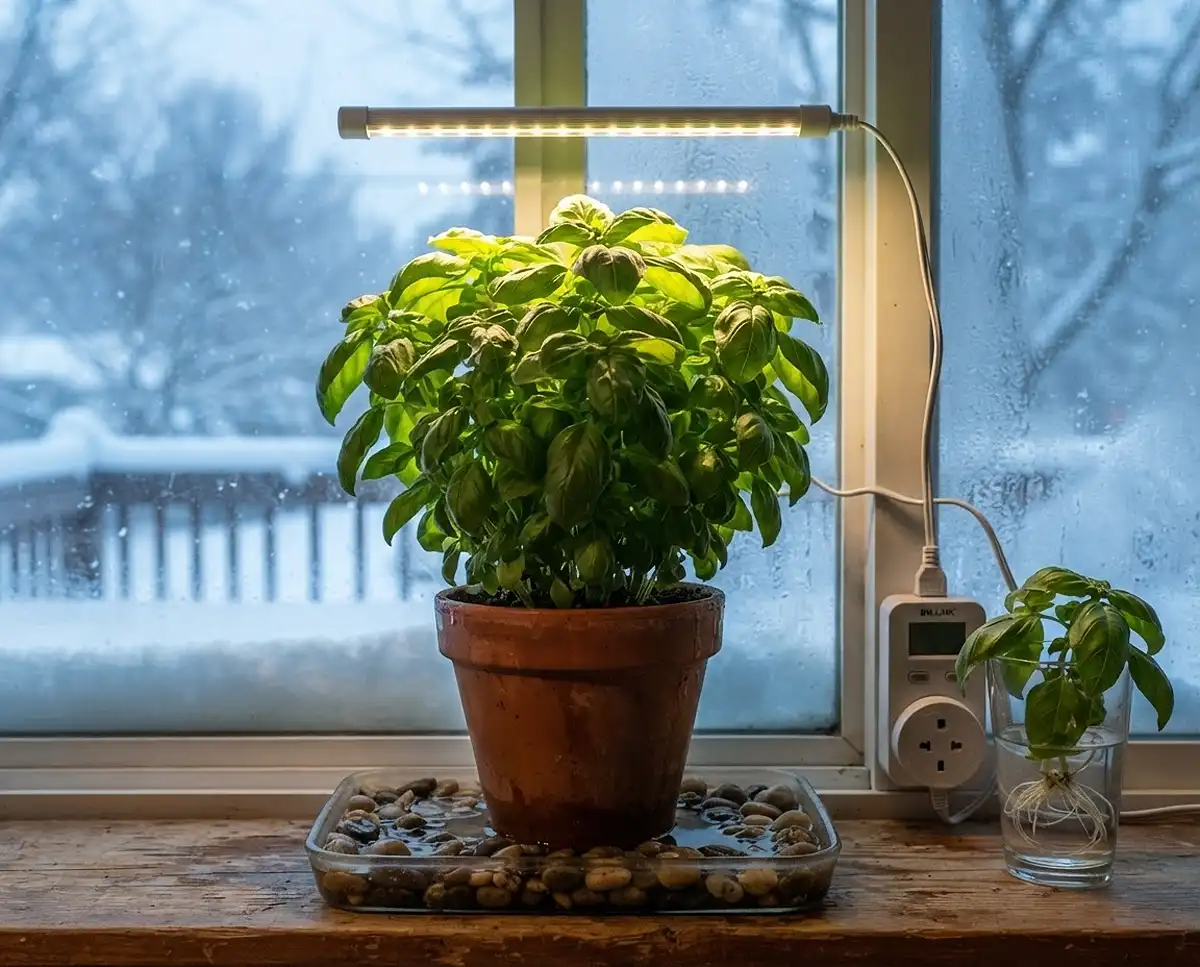
Growing Basil Indoors in Winter
Growing basil indoors in winter works, but only if you fake a tropical summer. Here’s the basil plant care routine that keeps my pots harvestable from November to March.
I garden on a north-facing balcony in zone 6b, so I’ve killed my share of basil the hard way. This guide covers what actually worked, as of winter 2026.
Table of Contents
The Challenge of Growing Basil Indoors in Winter
Basil is a tender tropical herb, and it hates cold. Temperatures around 50°F (10°C) can blacken the leaves, according to University of Illinois Extension.
A centrally heated apartment in January isn’t cold, but it’s dark and bone dry. Basil wants heat, humidity, and hours of strong light.
So your job isn’t just keeping it alive. You’re rebuilding a small patch of tropics on a shelf, and every step below serves that goal.
Preparing for the Winter Transition
Good basil plant care indoors starts in early autumn, before the first cold night. Look at your outdoor basil honestly: is it healthy, or is it flowering, woody, and chewed up?
That answer decides your method. A tired plant rarely survives the move, but a fresh cutting almost always does.
Deciding Between Cuttings, Seeds, or Mature Plants
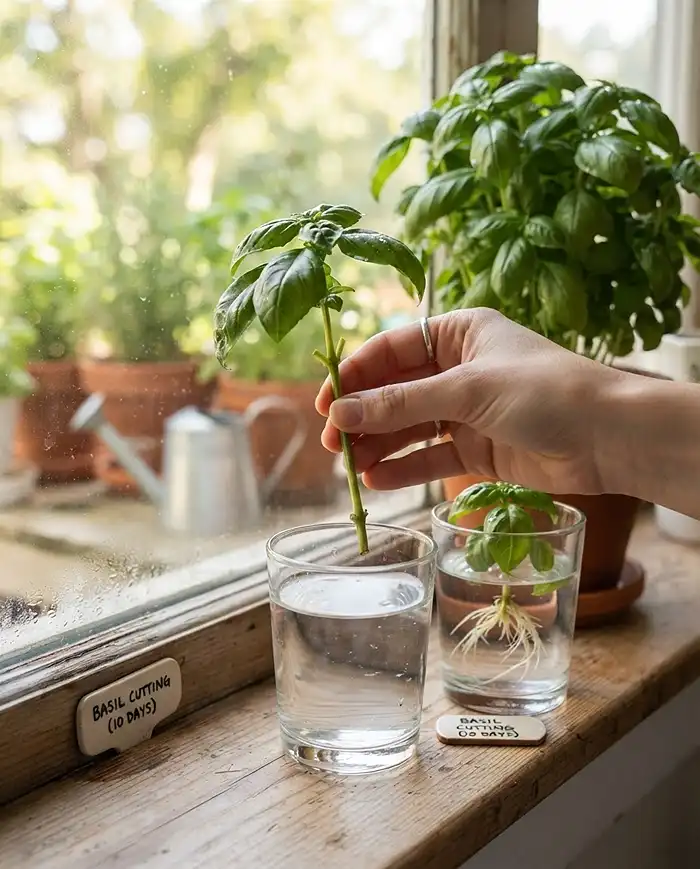
Quick Answer: Four-inch softwood cuttings rooted in water are the safest way to bring basil indoors. They take less space than a mature plant and leave pests and exhausted roots behind.
Snip a 4-inch stem just below a leaf pair and strip the lower leaves. Set it in a glass of room-temperature water on a bright sill. Roots show up in 7 to 14 days.
Seeds work too, and Illinois Extension notes that a first harvest takes about 4 to 5 weeks. But cuttings from a plant you already like give you a head start.
Last October I dug up a huge Genovese from my planter. It dropped half its leaves within a week. The ‘Emily’ cuttings I took the same day were pumping out new growth by Thanksgiving.
The Mandatory Pest Quarantine Protocol
Quick Answer: Wash every plant you bring inside with a Castile soap and neem oil solution. Indoors, aphids and spider mites have no predators, so a few dormant pests can explode into an infestation.
- Mix 1 teaspoon liquid Castile soap and 1 teaspoon cold-pressed neem oil into 1 quart of warm water.
- Spray the tops and undersides of every leaf, plus the stems.
- Rinse the plant lightly after 30 minutes if it’s sitting in strong sun.
- Keep it away from your other houseplants for 10 to 14 days, and repeat the spray once.
Skip the quarantine and you’ll pay for it later. I did once, and spider mites hitched a ride into my whole indoor herb garden.
Setting Up the Perfect Indoor Microclimate
Modern heated homes are hostile to tropical herbs. Air is dry, light is weak, and temperatures swing near windows.
Get three numbers right: hours of light, room temperature, and humidity. Everything else is detail.
Lighting Requirements and LED Grow Lights
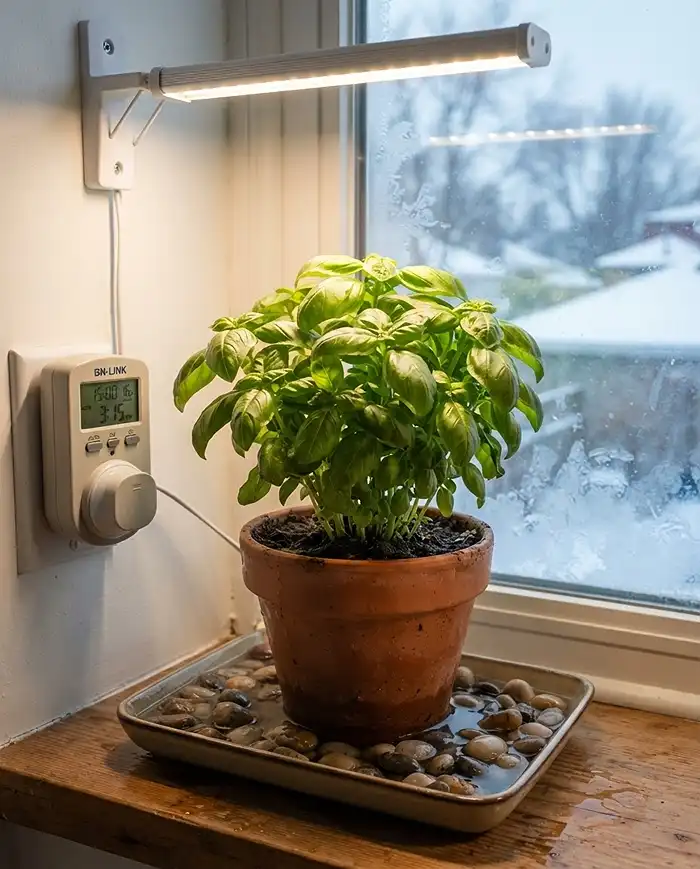
Quick Answer: Basil needs 6 to 8 hours of direct light daily. A winter windowsill rarely delivers that, so add a full-spectrum LED grow light for 12 to 14 hours a day to prevent pale, leggy growth.
Hang the light 6 to 12 inches above the plant tops, depending on its wattage. Put it on a cheap outlet timer so you never have to remember.
My north-facing balcony door gets almost nothing from December to February. Without a light, my basil stretched into tall, flavorless stems within two weeks. With one, the leaves stayed dark green and aromatic.
Temperature and Humidity Management
Quick Answer: Keep the room above 65°F (18°C) day and night. Set the pot on a pebble tray to raise humidity slightly around the leaves, and keep it away from heating vents.
Fill a shallow tray with pebbles and add water until it sits just below the top of the stones. The pot must rest on the pebbles, never in the water.
Be realistic here. A pebble tray adds a modest bump in local humidity, not a rainforest. It helps most when you group several herbs together.
| Factor | Target | Watch Out For |
|---|---|---|
| Light | 6-8 hours direct, or 12-14 hours under LED | Pale, stretched stems |
| Air temperature | Above 65°F (18°C) | Cold glass at night |
| Humidity | Pebble tray, grouped plants | Heating vents nearby |
Essential Gear for Indoor Basil Care
Indoor basil mostly dies from drowning, not neglect. The right pot and soil are your insurance.
Herbs in pots have nowhere for extra water to go, so drainage isn’t optional. It’s the whole game.
Choosing the Right Pot and Drainage Setup
Quick Answer: Use an unglazed terracotta pot with a drainage hole and a deep, glazed drip tray. Terracotta pulls excess moisture out of the soil, which protects roots from cold, stagnant water.
Choose a pot 6 to 8 inches wide and at least 6 inches deep. Empty the tray 15 minutes after every watering.
Last January I lost a Genovese in a glazed ceramic pot with a tiny drainage hole. I watered every Sunday out of habit, and the roots turned to brown mush by February.
Formulating a Fast-Draining Indoor Soil Mix
Quick Answer: Mix 50% sterile indoor potting soil, 30% perlite, and 20% coarse horticultural sand. This blend drains quickly and holds enough air for basil roots to breathe.
| Ingredient | Share | Job |
|---|---|---|
| Sterile indoor potting soil | 50% | Holds nutrients and some moisture |
| Perlite | 30% | Creates air pockets |
| Coarse horticultural sand | 20% | Speeds drainage |
Skip garden soil. It compacts in pots and can carry pests. For more on containers, see our container gardening for beginners guide.
Step-by-Step Guide to Winter Basil Setup
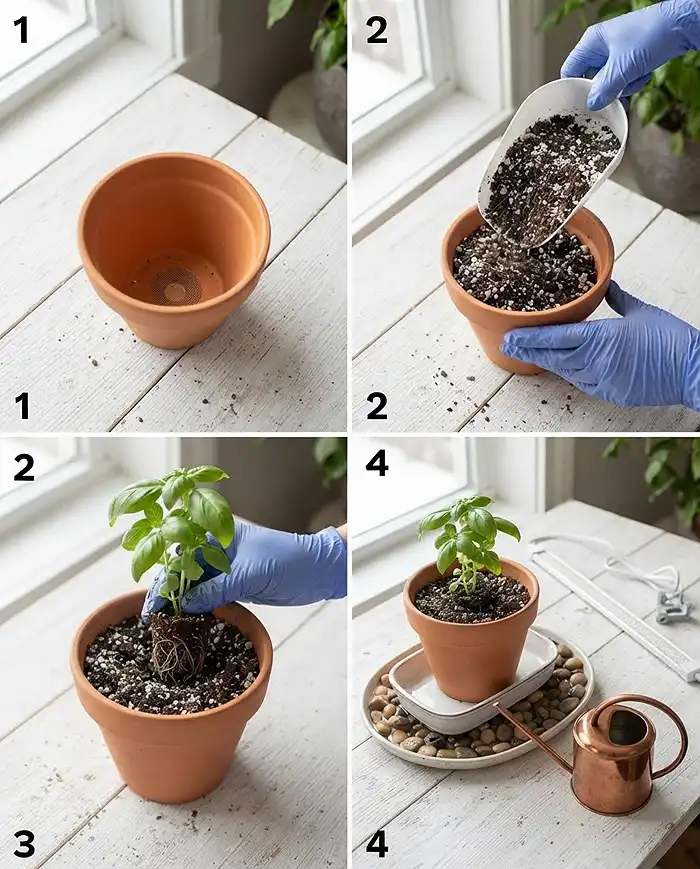
Here’s the exact order I follow every time I set up winter herbs indoors. Do it in one afternoon.
- Mix the soil recipe above in a bucket and dampen it lightly so it clumps slightly in your hand.
- Fill the terracotta pot to within an inch of the rim.
- Plant rooted cuttings or nursery transplants at the same depth they grew before, with the crown level with the soil.
- Set the pot on the pebble tray, directly under the grow light.
- Water deeply until it drains from the bottom, then empty the drip tray.
- Wait until the top inch of soil feels dry before watering again.
New to indoor growing in tight spaces? Our beginner small space gardening guide covers the basics.
Harvesting and Pruning for Continuous Growth
In winter, basil has limited energy. Every harvest should push the plant to branch and make leaves, not stretch upward.
Never strip the plant bare. NDSU Extension advises picking only about three-fourths of the leaves at a time.
The Pinching Technique for Bushy Growth
Quick Answer: Pinch stems just above a leaf pair each time you harvest. The plant then sends out two new side shoots from that spot, so it grows bushy instead of tall and spindly.
Use your fingernails or clean scissors. Take the top 2 to 3 inches of a stem and leave about 4 leaves below the cut, as suggested by WVU Extension.
Pinch off flower buds the moment you spot them. A flowering basil plant stops making good leaves and turns bitter.
Winter Fertilization Rules
Quick Answer: Cut your summer fertilizer rate in half during winter. Feed once a month with diluted liquid kelp or fish emulsion, because the plant’s slower metabolism can’t use much more.
Dilute to half the label strength. Pour it on damp soil, never dry, so the roots don’t burn.
Overfeeding gives you soft, weak growth that attracts aphids. I learned that with ‘Dolly’ one dark February.
Common Problems and Solutions
Most winter basil failures come down to water or pests. Learn the signs, and you can fix them fast.
Yellowing Leaves and Root Rot
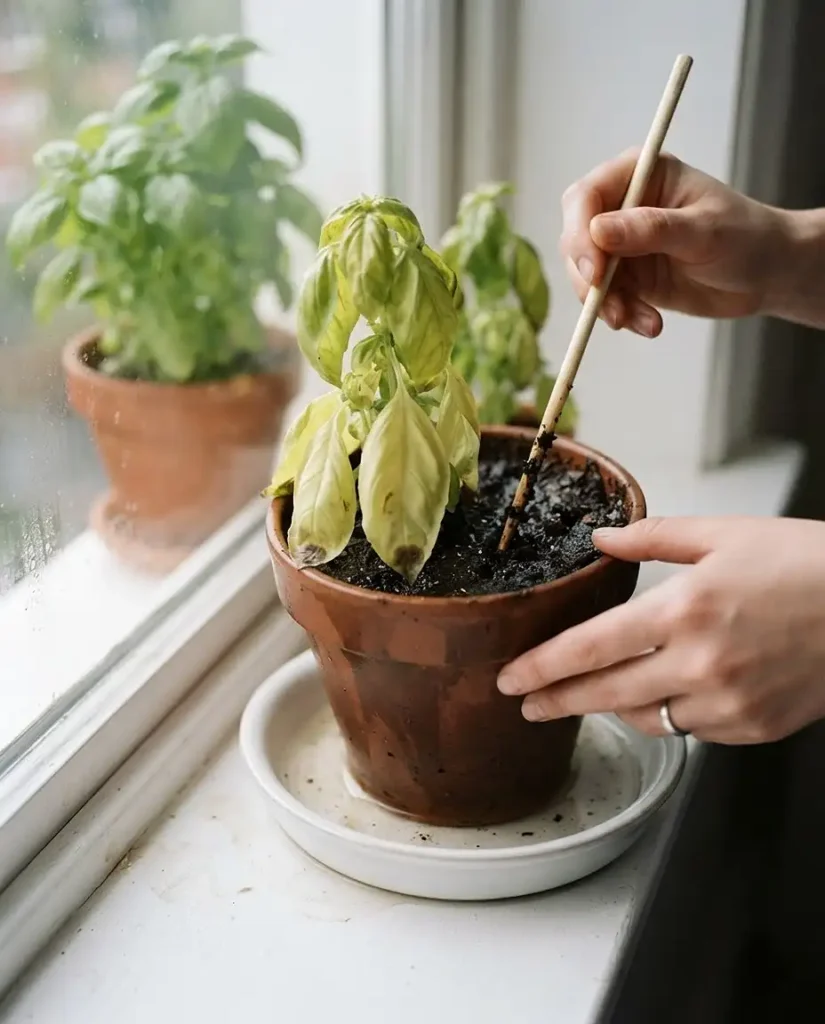
Quick Answer: Yellow lower leaves usually mean overwatering and early root rot. Stop watering completely, lift the pot off its tray, and let the soil dry out before you water again.
Poke 4 or 5 gentle holes through the soil with a wooden chopstick to add air. Don’t stab near the main stem.
If the roots are already brown and slimy, take a fresh cutting from the healthy top growth. Root it in water and start over.
Fungus Gnats and Spider Mites
Quick Answer: Kill fungus gnats with Bacillus thuringiensis (BTI) mosquito dunks and yellow sticky traps. Remove spider mite webbing with a damp cloth, then spray with neem oil.
- Fungus gnats: Soak a piece of BTI dunk in water for an hour, then water the soil with it. Lay yellow sticky traps flat on the soil.
- Spider mites: Wipe leaves and stems, then spray the undersides with neem oil every 5 to 7 days for three weeks.
For more on fitting plants into limited space, see our balcony gardening for beginners guide.
Frequently Asked Questions
Can I put my basil on a drafty winter windowsill?
Not if the window is drafty. Single-pane glass radiates freezing temperatures at night, which can chill and damage basil. Pull the pot a few inches away from the glass, or move it to a tabletop under a grow light if the drafts are severe.
Why are my indoor basil leaves curling downward?
Downward curling usually means light stress or very dry air. Raise the grow light a few inches so it isn’t too close to the leaves, and refill the pebble humidity tray right away.
How long will a basil plant live indoors?
Basil is technically a tender perennial, but it turns woody, bitter, and less productive after about a year. Replace indoor plants or propagate fresh cuttings from them every spring.
Key Takeaways
- Growing basil indoors in winter means rebuilding a warm, bright, humid microclimate, not just moving a pot inside.
- Take 4-inch cuttings instead of hauling in a mature plant, and quarantine everything with Castile soap and neem oil.
- Give basil 12 to 14 hours under a full-spectrum LED grow light and keep the room above 65°F (18°C).
- Use terracotta, a fast-draining 50/30/20 soil mix, and water only when the top inch is dry.
- Pinch above a leaf pair at every harvest and feed only once a month at half strength.