
Growing Basil on Balcony
Grocery basil dead in a week? Growing basil on balcony railings is easy once you know why. Any basil plant balcony setup needs six sunny hours and the right pot.
I’m a former community-garden coordinator. Now I grow food on a sunny rooftop terrace in zone 7a [a USDA band where winter lows hit 0 to 5°F]. I get 8 hours of direct sun and constant wind.
My basil lives in glazed pots, 10-gallon buckets, and one railing box. Here’s my plan for growing basil on apartment balcony space, from pot choice to pruning. Find your own zone on the USDA Plant Hardiness Zone Map.
Table of Contents
Growing Basil on Balcony Microclimates: Heat, Sun, and Wind
Short Answer: Basil (Ocimum basilicum) is a heat-loving tropical annual. Give it 6 to 8 hours of direct sun and shelter from high-rise wind. Wait to move pots outside until nights stay above 50°F (10°C). Warm, protected corners beat exposed railings every time.
Basil loves sun but hates wind. Gusts pull water from leaves faster than roots can replace it, which is desiccation [drying out].
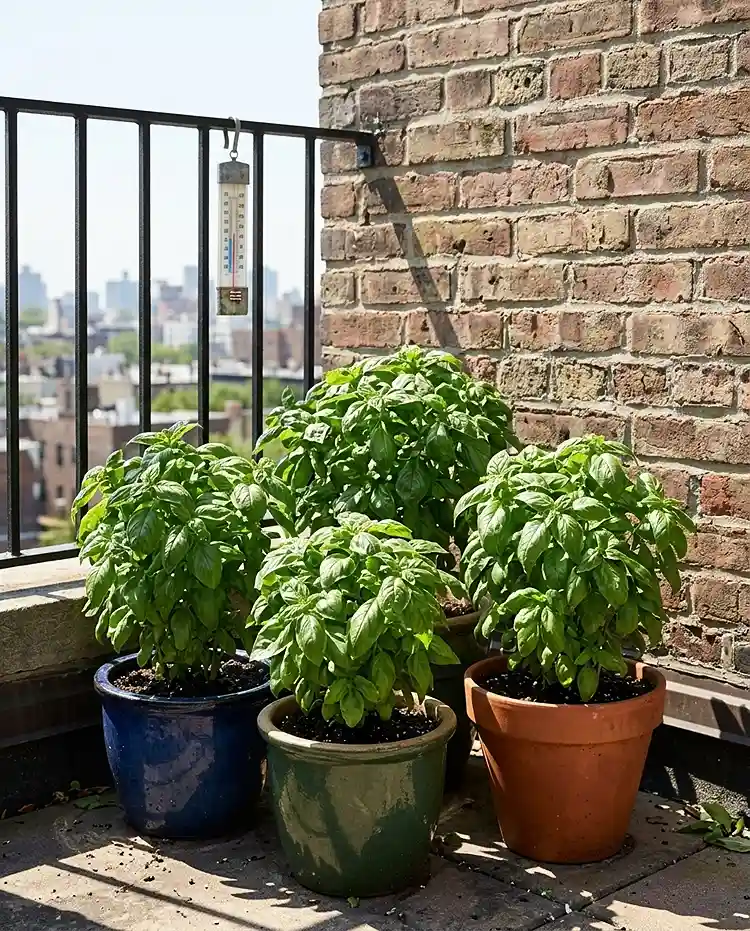
Last June, I parked four ‘Genovese’ seedlings on an open railing. By day five, the leaf edges were crisp, and I lost three of the four. I slid the next batch against the brick wall, and every plant lived.
Mapping the 6-to-8-Hour Sun Zone and the 50°F Night Rule
Pick a south-, east-, or west-facing spot with at least 6 hours of direct sun. Then wait. Don’t carry pots outside until night lows stay above 50°F (10°C), because cold nights blacken the leaves.
An $8 min-max thermometer clipped to the railing beats guessing. Wind makes ledges colder than the forecast says.
Choosing Balcony-Friendly Basil Varieties
Classic Genovese makes the best pesto. Lettuce-Leaf basil gives you big, cupped leaves for sandwiches. Both want wind shelter, while compact types shrug off breezy spots.
As of summer 2026, ‘Prospera’ and ‘Rutgers Devotion’ seed is easy to find. Check the packet for downy-mildew resistance.
| Variety | Best For | Balcony Strength |
|---|---|---|
| Genovese | Pesto | Classic flavor; needs wind shelter |
| Lettuce-Leaf | Wraps, sandwiches | Big cupped leaves; needs shelter |
| ‘Spicy Globe’ or ‘Bonsai’ Greek | Small pots, garnish | Compact globes handle wind |
| ‘Siam Queen’ Thai | Stir-fries, curries | Loves heat and hot west walls |
| ‘Prospera’ or ‘Rutgers Devotion’ | Mildew-prone summers | Downy-mildew resistant |
Essential Prep: Pot Depth, Soil Mix, and Companion Rules
Short Answer: Give each basil plant an 8-to-10-inch-deep pot, a moisture-holding soil mix, and neighbors that drink as much as it does. Think tomatoes and peppers, not rosemary or thyme. A wrung-out-sponge soil that drains freely keeps fragile roots from drying out or suffocating.
Use this quick checklist before you plant anything:
- Pot: 8 to 10 inches deep, in resin, glazed ceramic, or a self-watering planter.
- Soil: coco coir, perlite, vermiculite, compost, and worm castings.
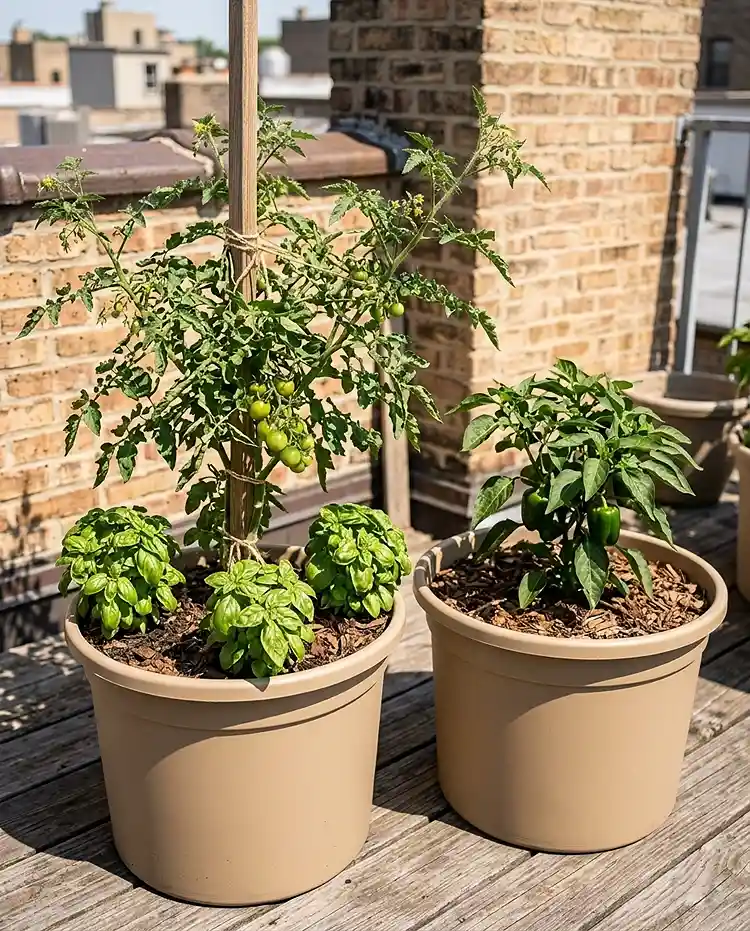
- Good neighbors: tomatoes and bell peppers.
- Bad neighbors: rosemary, thyme, and sage.
Why 8-to-10-Inch-Deep Pots Beat Tiny Windowsill Cups
One basil plant grows an 8-inch root ball. Inside a 4-inch nursery pot, that root ball dries out in hours. My cup-sized pots wilted by 2 p.m. every sunny day.
Deep resin, glazed ceramic, or sub-irrigated railing planters buffer afternoon heat. They hold water far longer.
The Moisture-Sponging Basil Potting Soil Recipe (pH 6.0 to 7.0)
Mix this blend by volume. It stays damp like a wrung-out sponge but still drains freely:
- 40% peat-free coco coir
- 20% perlite [white volcanic glass that keeps soil airy]
- 15% fine vermiculite
- 15% screened compost
- 10% worm castings for steady nitrogen
Balcony Companion Planting: Tomatoes and Peppers Yes, Rosemary No
Plant basil around the rim of a 10-gallon tomato or bell pepper pot. They share the same daily water and sun needs.
Rosemary, thyme, and sage want dry, gritty soil. Put basil in that trough, and one of them will die. If you want more herb-and-veggie pairings, see this cozy balcony kitchen garden guide.
Step-by-Step: From Seed, Starter, or Grocery Pot to Balcony Bush
Short Answer: Start with whatever you have. Split a crowded grocery pot into solo clusters, sow seed in 70°F soil, or pot up nursery starts. Then harden off [gradually expose seedlings to outdoor conditions] for 7 days. Basil also roots from 4-inch cuttings in water within a week.
Step 1: Split a Crowded Grocery-Store Pot Into 5 Planters
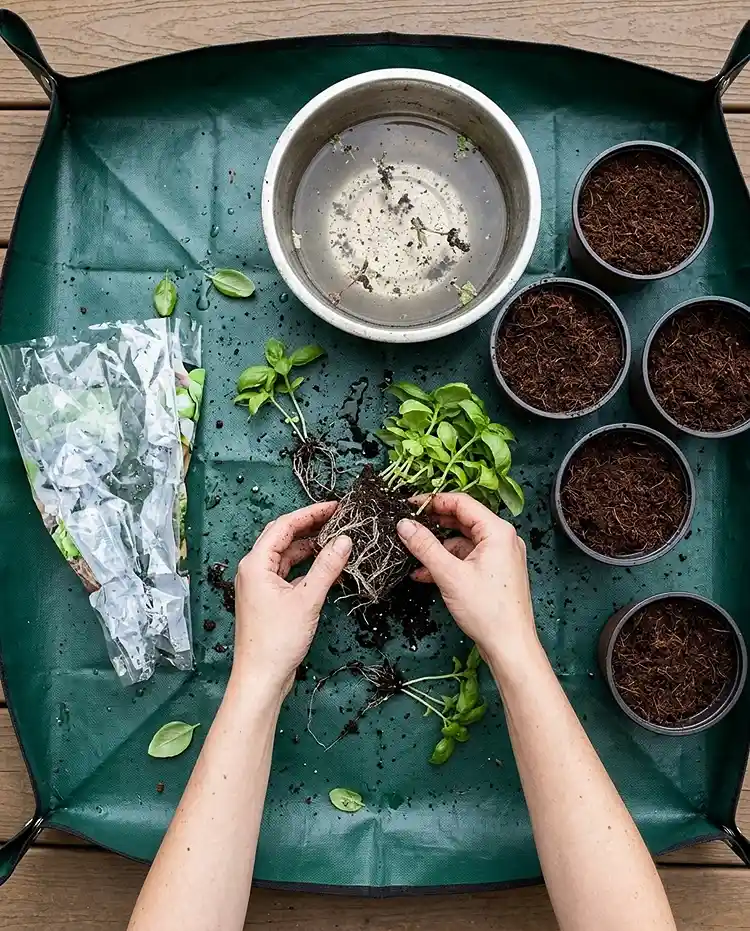
That $3 pot holds 20-plus seedlings crammed into one peat plug. They starve each other, so the pot dies within a week.
Soak the root ball in lukewarm water for 10 minutes. Gently tease it into 5 or 6 clusters, and plant each one 6 inches apart.
In May, I split one supermarket ‘Genovese’ pot into five 8-inch planters. By late June, I was cutting a packed cup of leaves every 10 days.
Step 2: Direct-Sow Seeds or Pot Up Nursery Transplants
Press seeds just 1/4 inch deep into warm 70°F (21°C) soil. They sprout in 5 to 7 days.
Set nursery transplants flush with the soil line. Top the pot with a 1-inch layer of fine pine bark or coco mulch.
Step 3: The 7-Day Hardening-Off Schedule
This routine prevents white sunscald and wind-tattered leaves. Start in dappled floor shade, then climb toward the sunny railing.
| Days | Where to Put the Pot | Time Outside |
|---|---|---|
| 1 to 3 | Dappled shade on the floor | 2 to 4 hours |
| 4 to 5 | Morning sun, wind-sheltered | 4 to 6 hours |
| 6 to 7 | Full sun on the railing | All day |
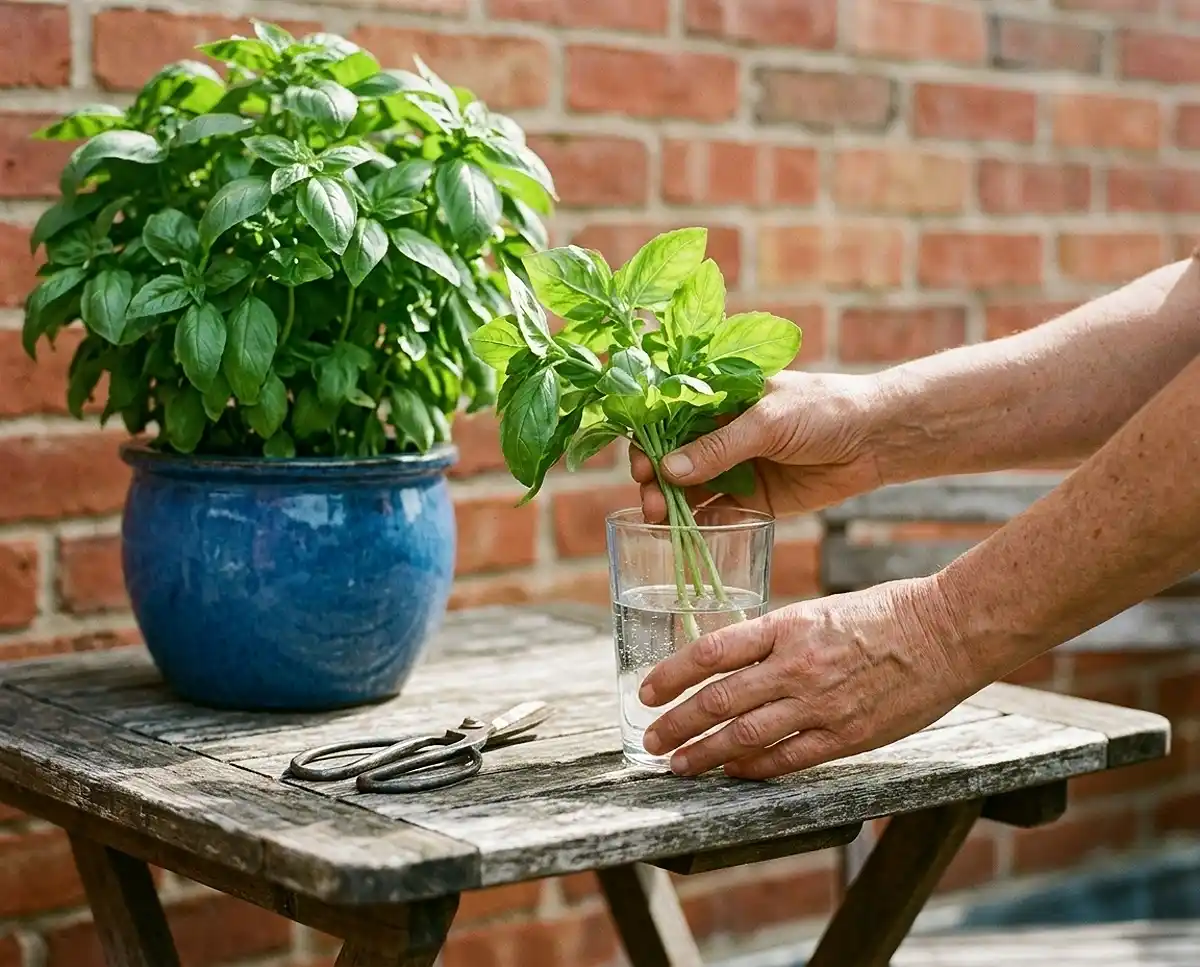
Step 4: Water-Root 4-Inch Cuttings for Free Plants
Snip a 4-inch non-flowering stem just below a leaf node. Strip the bottom leaves and drop the stem into a shot glass of water.
In about 7 days, you’ll see 2-inch white roots. Pot them up for mid-summer succession plants.
Pot-to-Kitchen Pruning and Harvesting for Double the Yield
Short Answer: Prune by cutting the main stem just above a pair of leaf nodes, never by plucking single leaves. Each cut forces two new branches. Start once the plant has three sets of true leaves, about 6 inches tall. Expect cups of pesto leaves every two weeks.
Why You Should Never Pluck Individual Outer Leaves
Picking big bottom leaves one by one creates a “candy cane stalk.” It’s bare, woody, and tall. The plant bolts [flowers and goes to seed] almost right away.
The reason is apical dominance [the main tip’s hormones suppress side branching]. Cut the tip, and the plant branches. Leave it, and the plant stretches.
The Snip-Above-the-Double-Node Rule
A node is the bump where a pair of leaves meets the stem. Tiny baby shoots hide in the axils [the angle between leaf and stem]. Follow these steps:
- Wait for 3 sets of true leaves, about 6 inches tall.
- Find the second pair of leaf nodes from the top.
- Snip the main stem 1/4 inch above that pair.
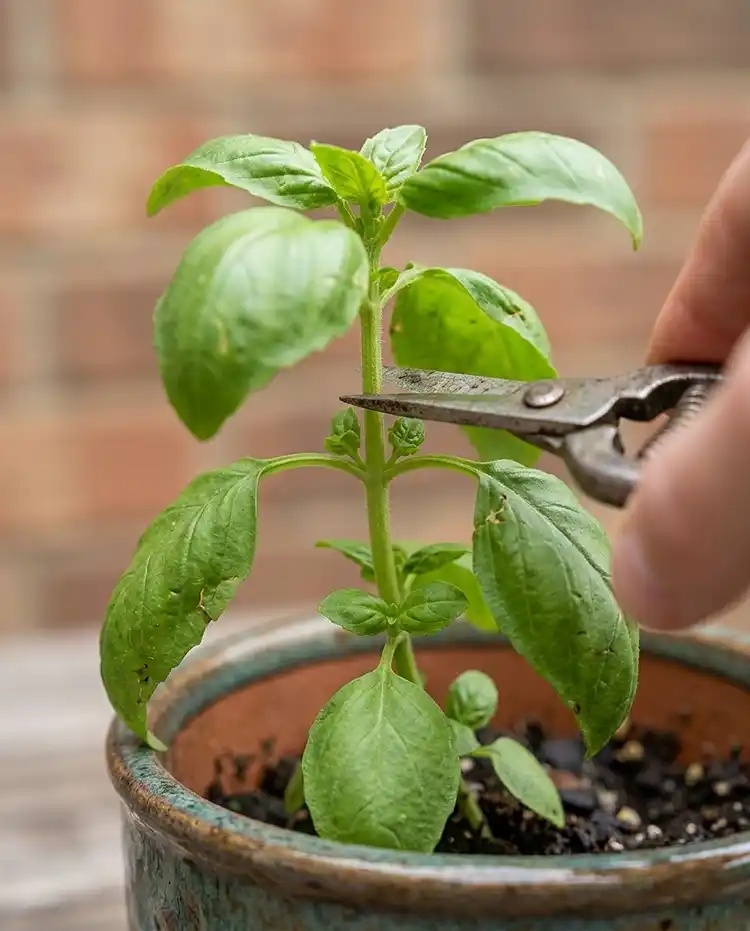
In early July, I did this to a 6-inch ‘Prospera’ in a 10-inch glazed pot. Two new branches appeared within days. By August, that one pot gave me 2 cups every 12 days.
Morning Watering, Bi-Weekly Feeding, and Keeping Cuttings Fresh
| Task | When | How |
|---|---|---|
| Water | 7:00 AM | Soak the soil base; keep leaves dry |
| Feed | Every 14 days | Diluted fish emulsion or worm tea; skip high-phosphorus bloom foods |
| Store cut stems | After harvest | Countertop glass of water at room temperature |
Never refrigerate basil. The cold turns it black within hours.
Common Problems and Solutions
Short Answer: Bitter, woody, yellow, or bug-eaten basil usually has a fixable cause. Bolting turns leaves bitter, age makes stems woody, mildew or cold causes yellowing, and beetles or aphids chew holes. Catch each early, and you can save the plant without harsh chemicals.
Premature Bolting: Bitter, Licorice-Like Leaves
Root-bound pots and afternoon heat stress trigger flower hormones, which ruin the sweet flavor. Pinch off flower buds the day they appear. Cut flowering stems back by half, down into leafy lower nodes.
Woody Brown Lower Stems and Yellowing Bottom Leaves
Lower stems lignify [turn woody] with age or low nitrogen. Prune just above the lowest green, leafy node, never into bare brown wood.
Top-dress with worm castings, and start fresh cuttings in July.
Downy Mildew vs. Fusarium Wilt
Cold or nutrient yellowing is harmless. Downy mildew is not. Look for purple-gray spores on leaf undersides, stopped by the veins. Fusarium wilt shows up as sudden wilting with brown-streaked stems.
Prevent mildew by spacing pots for airflow and never wetting leaves at night. Plant resistant ‘Prospera’ seed.
Japanese Beetles, Aphids, and Slugs
Skip the toxic sprays on culinary leaves. Hand-pick beetles into soapy water in the morning, and blast aphids off with a water stream.
Spray insecticidal soap [potassium salts of fatty acids] at dusk.
Frequently Asked Questions
How many basil plants do I need on my balcony to make homemade pesto regularly?
Grow 4 to 6 Genovese plants, spaced 6 inches apart across two 12-inch pots or one 24-inch railing box. That gives you about 2 packed cups of leaves every 10 to 14 days. Never strip any plant past one-third of its foliage.
Why does my balcony basil droop every afternoon even when I watered it in the morning?
Lift the pot. If it feels feather-light, the container is too small, so upsize to a 10-inch pot with coco-coir soil. If the soil is still heavy and damp, it’s temporary heat-transpiration wilt, so give it 30% afternoon shade on a hot west wall.
Can I bring my balcony basil pot indoors for the winter to keep it alive?
Old, woody summer bushes struggle indoors. Instead, take 4-inch green stem cuttings in September and root them in fresh, sterile soil. Grow them on a south windowsill with a full-spectrum LED grow bulb for 12 hours a day.
How often should you water potted basil on a sunny apartment balcony?
Basil loves steady moisture and hates drying out completely. In mild 65°F to 75°F (18°C to 24°C) weather, water every 2 to 3 days whenever the top inch feels dry. During 85°F+ (29°C) heat waves, soak it every morning.
When can I put basil outside on my balcony in spring?
Wait until night lows stay above 50°F (10°C). In my zone 7a that’s usually mid-May, though last-frost dates shift every year. Harden the plants off for 7 days before leaving them out.
Can I grow basil on a balcony that only gets a few hours of sun?
Basil wants 6 hours of direct sun, but 4 hours of morning sun can work with slower growth. Try compact Greek types like ‘Spicy Globe’ and expect fewer leaves. Mint or chives tolerate shade better.
Quick Recap
- Growing basil on balcony railings works best with 6 to 8 hours of sun, wind shelter, and 50°F nights.
- Use 8-to-10-inch-deep pots filled with a coco coir, perlite, and compost mix.
- Split crowded grocery pots into 5 or 6 clusters, planted 6 inches apart.
- Snip above the double node, and never pluck single outer leaves.
- Water at 7 a.m., feed every 14 days, and pinch flower buds the day they appear.