
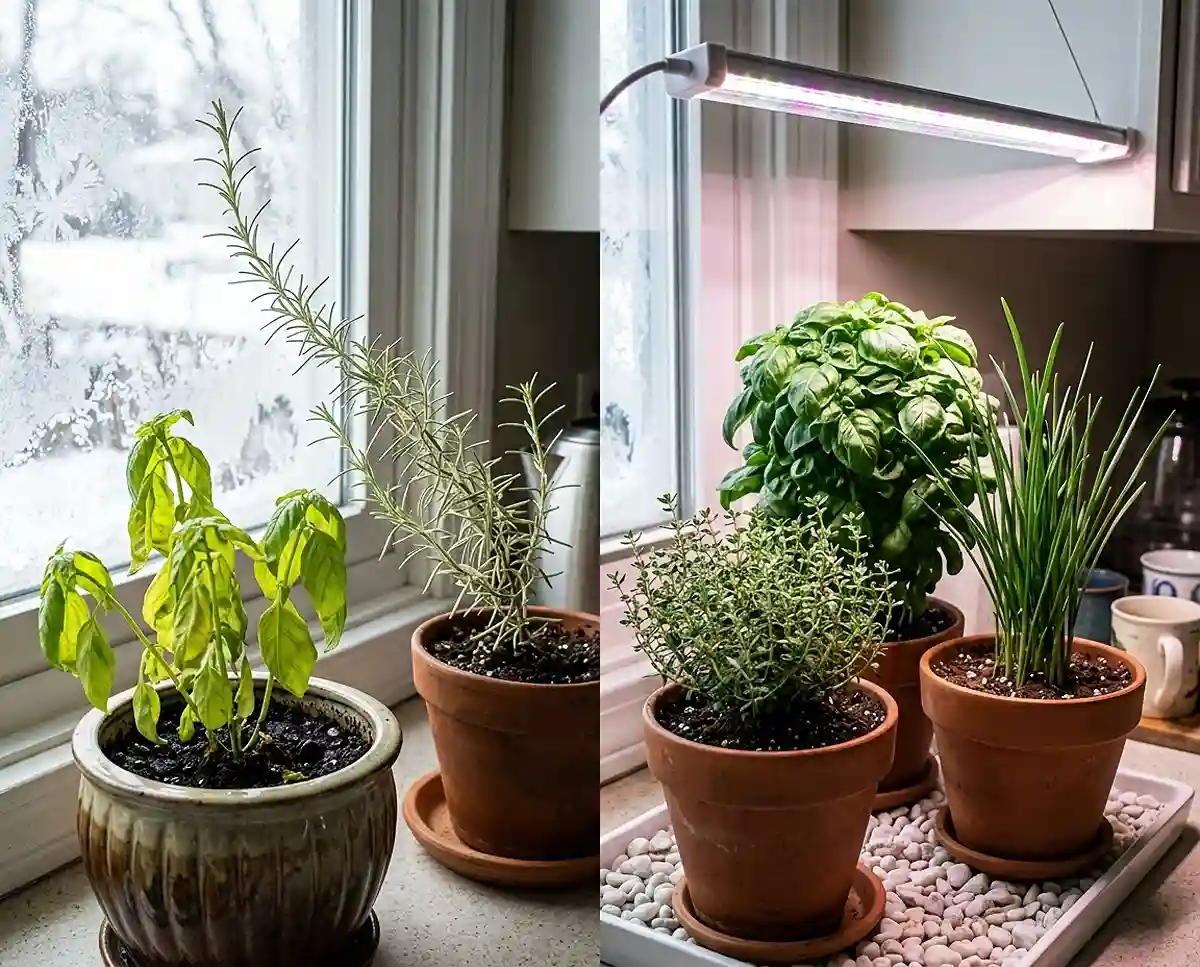
Why Indoor Herbs Die
Why indoor herbs die: overwatering killed 5 of my 14 test pots, and weak light stunted six more. Here are the common problems with indoor herbs and the fixes.
I garden on a south-facing concrete patio in zone 8b. Before first frost (November 22), I moved 14 herb pots inside. Eight sat in a south window. Six went under LED lights. I tracked all of them for 16 weeks, through the 2025-26 winter.
Table of Contents
The Reality of Growing Herbs Indoors
Verdict: Indoors is hostile to sun-loving herbs. Light, water, air, and soil all work against them. Fix those four and most plants survive.
Most culinary herbs are Mediterranean. They want 6 to 8 hours of direct sun, dry roots, and moving air. A typical kitchen gives them 2 hours of weak light, still air, and a saucer of standing water.
That mismatch sinks most of the plants in an indoor herb garden. Light is the biggest limit, according to Iowa State Extension’s indoor herb guide. A second round with the fixes below lost 1 of 14 pots.
Reason 1: The Death by Overwatering (Root Rot)
Verdict: Overwatering kills more indoor herbs than anything else. Pots without drainage holes turn into swamps. Water only when the top inch of soil is dry.
Test notes: Genovese basil in a decorative pot with no drainage hole, watered every 3 days, collapsed in 11 days. Roots were brown and slimy. The same cultivar in a 6-inch (1.5-quart) pot with holes, watered weekly, gave 4 harvests.
This is one of the classic herb garden mistakes. The same trap shows up in these common container gardening mistakes.
Mistake to avoid: Leaving water in the saucer. Empty it 20 minutes after watering.
Why Indoor Herbs Die Slowly: Yellow Leaves and Mushy Stems
Root rot (roots decaying in waterlogged soil) looks like drought at first. The plant wilts, so people water more. That finishes it.
- Lower leaves turn yellow, soft, and droopy, not crispy.
- The stem base feels mushy or looks dark brown.
- The soil smells swampy or sour.
- The pot still feels heavy 4 days after watering.
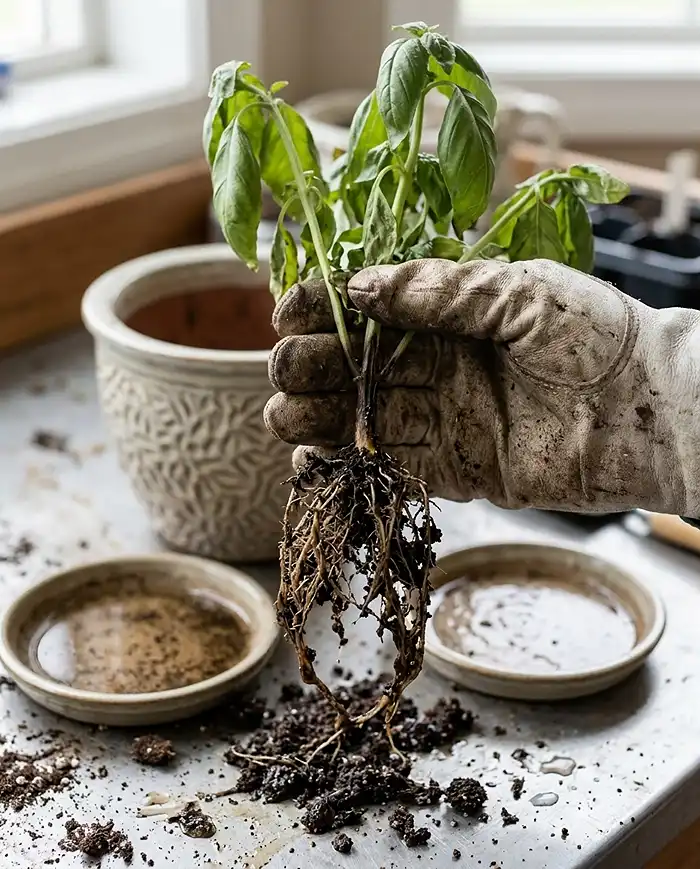
Slide the plant out to confirm. Healthy roots are white and firm. Rotten roots are brown and slimy.
The Fix: Improving Drainage and Repotting
- Slide the herb out and shake off the soggy soil.
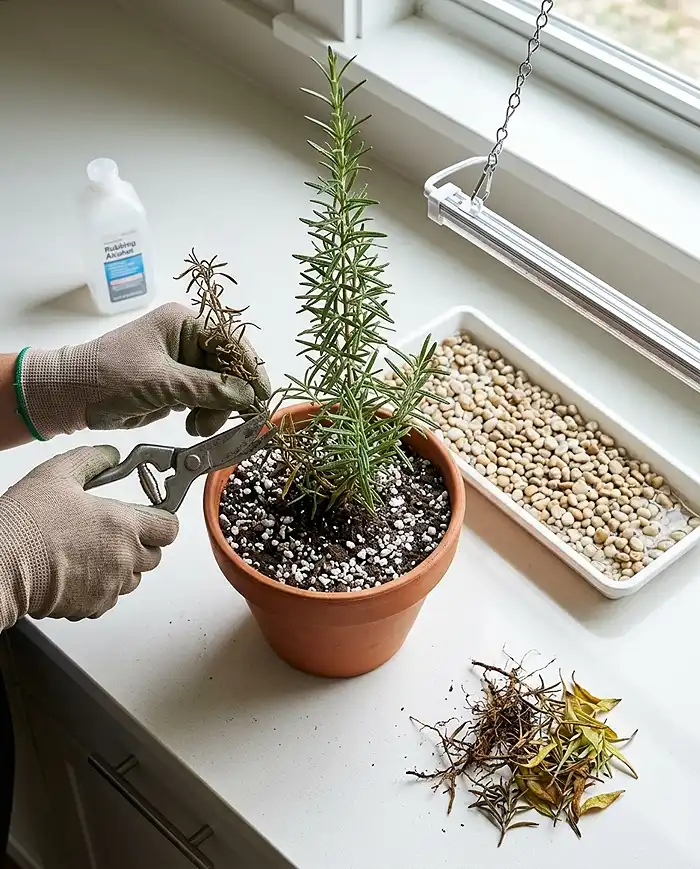
- Trim brown, mushy roots with shears wiped in rubbing alcohol.
- Let the remaining white roots air out for 30 minutes.
- Repot in fresh, barely damp mix in a pot with drainage holes.
- Skip watering for 5 days, then switch to the finger test.
I saved 3 of 5 rotted plants this way. Thyme ‘English’ and rosemary ‘Tuscan Blue’ bounced back. Basil with over half its roots gone never recovered. Don’t bother.
Reason 2: Starvation from Insufficient Light
Verdict: Most windows give herbs less light than they need. A full-spectrum LED fixes that reliably. Hang it 6 to 12 inches above the plants for 12 to 14 hours.
Test notes: Rosemary ‘Tuscan Blue’ in a south window got about 4 hours of direct light in December. It grew 3 inches of pale stem in 6 weeks. Under an LED at 8 inches, it added 1.5 inches of compact growth.
Low-E glass (energy-efficient window coating) can cut the light and UV reaching the sill. Winter days are short, too. Herbs need that light to make their aromatic oils.
Recognizing Leggy Growth and Stretching
Etiolation (pale, stretched growth from low light) is easy to spot. Leaves sit 2 or more inches apart on thin, weak stems. The whole plant leans toward the glass.
Flavor drops too. Pinch a leaf and sniff. If you smell little, light is your problem, not water.
The Fix: South-Facing Windows and LED Grow Lights
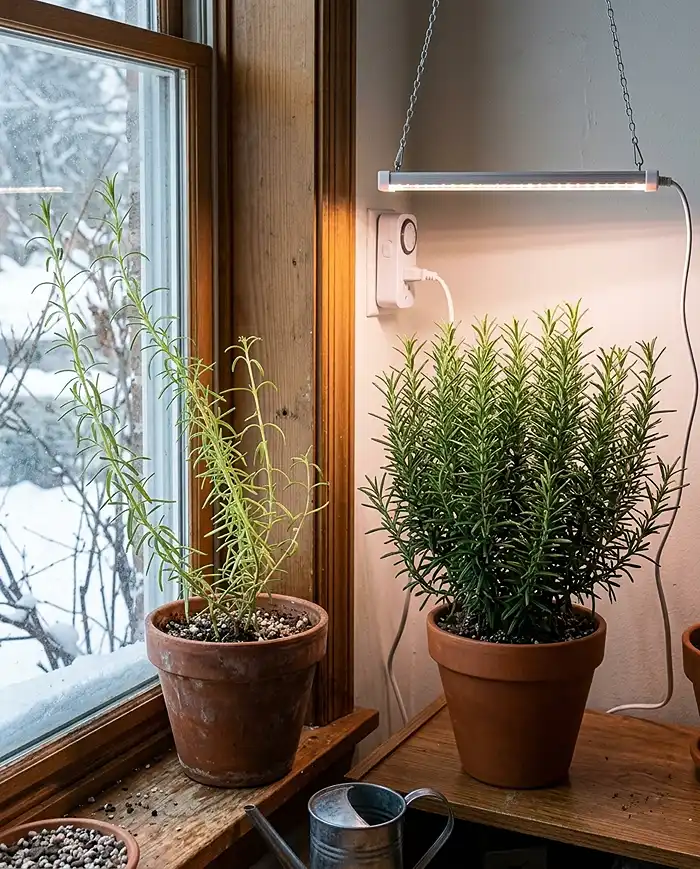
I grew Genovese basil in three setups for 6 weeks. The table shows what happened.
| Setup | Daily light | Result |
|---|---|---|
| South window, 2 feet back | About 3 hours | 9 inches tall, pale, sparse |
| South window, at the glass | About 5 hours | 7 inches, fair color, some stretch |
| LED, 8 inches above canopy | 13 hours | 5 inches, dark green, dense |
As of the 2026 season, basic full-spectrum LED bulbs fit standard lamps and run about $10 to $15. Put the light on an outlet timer. Skip anything mounted 24 inches up. Mine did almost nothing.
Reason 3: The Threat of Dry Indoor Air
Verdict: Heating and air conditioning drop indoor humidity below 30 percent. Basil and cilantro suffer first. Use a pebble tray and keep pots away from vents.
Test notes: Cilantro ‘Calypso’ sat near a heating vent at 28 percent humidity. Edges crisped in 9 days. It bolted by week 5. That one failed because I moved it too late.
Spotting Crispy Edges from Winter Heating
Look for brown, crispy leaf margins and curling tips. The plant is losing water through its leaves faster than the roots can replace it. Soft-leaved herbs show it first.
Check the soil before you water. If it’s damp, the problem is air, not thirst.
The Fix: Pebble Trays and Ambient Humidity
- Fill a tray with 1 inch of gravel.
- Add water to just below the top of the stones.
- Set the pot on the gravel, base dry, never sitting in water.
- Refill every 3 days.
- Keep pots 3 feet from vents and radiators.
Trays lifted humidity around my pots from 28 to about 38 percent. Skip misting. Wet leaves in still air gave my sage mildew within 2 weeks.
Reason 4: Using the Wrong Soil and Fertilizer
Verdict: Dense, peat-heavy potting mix suffocates herb roots. Cut it 50/50 with perlite. Feed at half strength every 6 weeks, no more.
The Suffocation of Heavy Potting Soil
Peat-heavy mix compacts over time. Roots lose oxygen, and moisture sits against the crown (where stem meets soil). That’s how herbs in pots rot from the base up.
Test notes: Straight bagged mix stayed wet 9 days in a 6-inch pot. My 50/50 mix dried to the top inch in 4 days. If your mix already looks like brick, read these soil problems in pots and how to fix them.
The Fix: Creating a Fast-Draining Herb Mix
- 1 part standard potting soil
- 1 part perlite or coarse sand
- Target soil pH of 6.0 to 7.0
- Fertilizer: half-strength 10-10-10, every 6 weeks
Mistake to avoid: Weekly feeding. It left a white salt crust on my parsley soil and burned the leaf tips. Flush the pot with plain water and wait 6 weeks.
Step-by-Step Revival Protocol for Dying Herbs
Verdict: Stabilize first, fix the cause second, and feed last. Most plants with green stem bases can be saved if you act within a few days.
- Check roots, soil moisture, and light to find the cause.
- Move the plant to your brightest spot or under the LED.
- Cut off dead and diseased growth.
- Water by finger test only. No fertilizer for 4 weeks.
Panic feeding is one of the common gardening mistakes that finishes off a weak plant.
Pruning Dead Foliage and Correct Harvesting
Wipe your shears with rubbing alcohol first. Remove every dead or diseased leaf. Then cut just above a node (the point where leaves meet the stem).
That cut forces two new shoots. Genovese basil cut above the second node branched into 4 stems in 3 weeks. Never take more than a third of the plant at once.
Common Problems & Solutions
Verdict: Stressed herbs attract mildew and gnats. Better airflow and drier topsoil solve both.
Powdery Mildew on Mediterranean Herbs
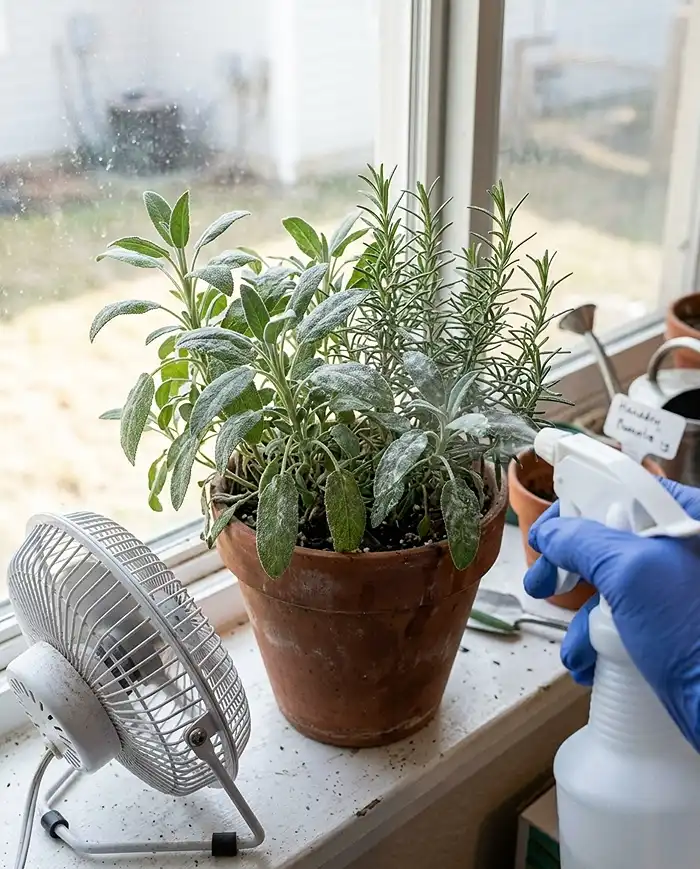
Stale air gives rosemary and sage a white, dusty coating. Spray with dilute neem oil (1 teaspoon per quart of water) every 7 days. Add a small oscillating fan on low for 4 hours a day.
That cleared my sage in 12 days.
Swarms of Fungus Gnats in the Soil
Tiny black gnats breed in constantly damp topsoil. Let the top 2 inches dry fully between waterings. Lay yellow sticky traps flat on the soil.
Two traps caught about 40 gnats in the first week.
People Also Ask
Why do supermarket potted herbs die so fast?
Grocery herbs are packed with 20 or more seedlings in a 3-inch pot of wet peat. Divide the clump into 3 or 4 sections and repot each in a 6-inch pot with a 50/50 mix within 2 days. My undivided supermarket basil lasted 10 days, while divided plants lasted 3 months.
How often should I water my indoor herbs?
Use the finger test, not a calendar. Water only when the top inch of soil feels completely dry. In my trial that meant every 3 to 4 days for basil and every 6 to 8 days for rosemary.
Can I save a completely dried-out basil plant?
If the stems are still green and bendy, bottom-water the pot in 2 inches of water for 1 hour, then trim dead tips. If the main stem is brittle and snaps, the plant is dead. I revived 2 of 3 dried-out basils this way.
Which herbs are easiest to keep alive indoors?
Thyme and chives survived in 4 of 4 pots in my trial, even in a plain south window. Rosemary is next, provided you never overwater it. Basil and cilantro were the pickiest.
Do indoor herbs really need a grow light?
In zone 8b winters, my south window gave 3 to 5 hours of direct light, and most herbs need 6 to 8. A full-spectrum LED run 12 to 14 hours a day closed that gap. Summer sun on a south sill can be enough without one.
The Short Version
- Why indoor herbs die: usually too much water first, too little light second.
- Use pots with drainage holes and water only when the top inch is dry.
- Hang a full-spectrum LED 6 to 12 inches above the plants for 12 to 14 hours.
- Mix potting soil 50/50 with perlite, use a pebble tray, and feed at half strength every 6 weeks.