
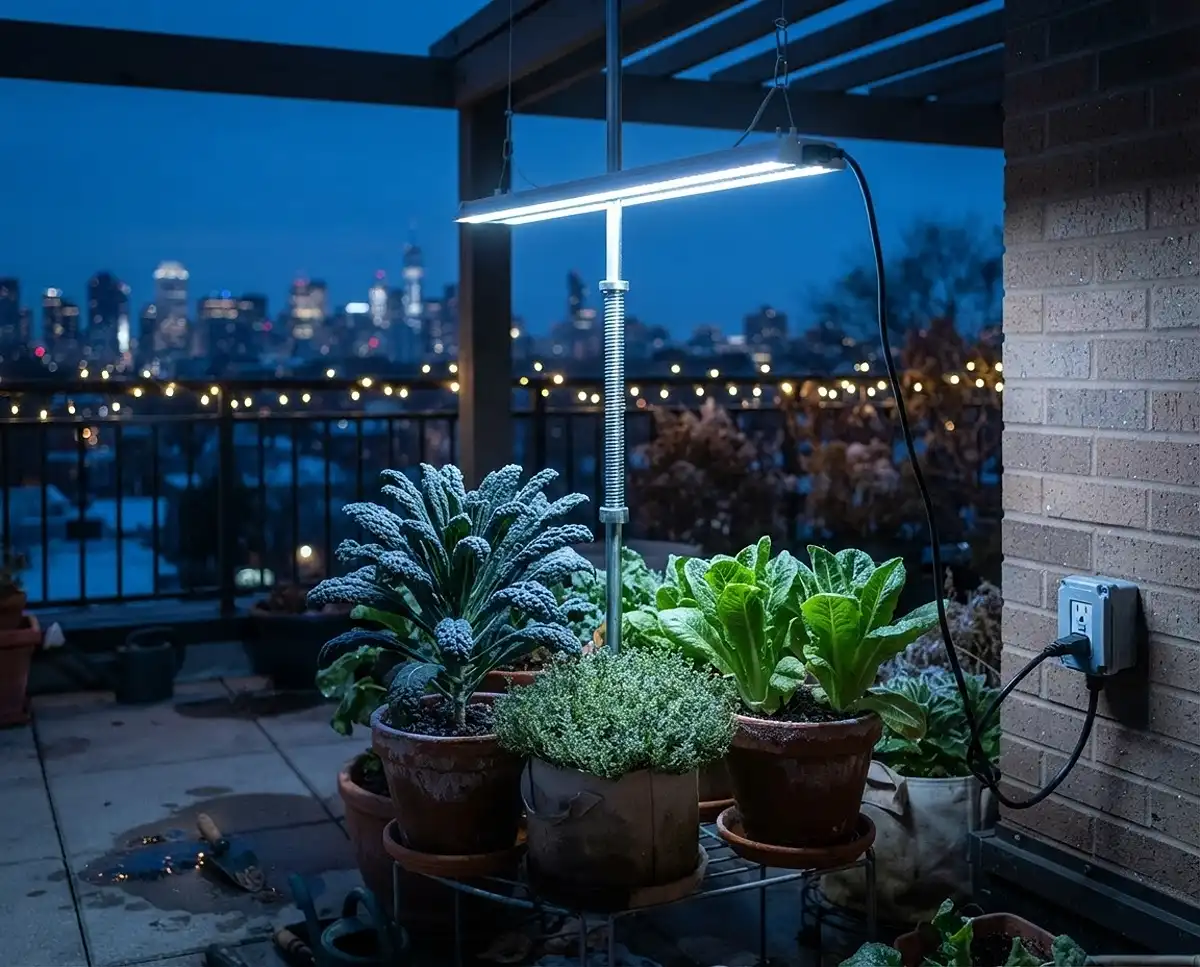
Winter Balcony Garden Lighting for Short Days
It’s 4:45 p.m. and my rosemary is already in the dark. The right winter balcony garden lighting fixed that, and it can work on your small balcony garden too. Here’s how I light my rooftop containers.
I garden on a sunny, south-facing rooftop terrace in zone 7a. My containers range from 5-gallon fabric pots to 12-inch terracotta, and December sun reaches them for about 5.5 hours.
I’ve spent 12 years helping renters and first-timers grow in tight spaces. This guide shows how to pick safe fixtures, install them without drilling, and fix problems fast. New to tiny spaces? Start with these small space gardening basics.
Table of Contents
Winter Balcony Garden Lighting: Beating the Light Deficit
Short Answer: Winter days shrink to under ten hours, and the low sun barely reaches your balcony pots. Less light slows photosynthesis [how plants turn light into sugar]. Supplemental lighting fills that gap and keeps container plants healthy instead of merely hanging on.
On my terrace, June brings about 13 hours of direct sun. December brings 5.5. That gap is why winter containers stall, yellow, and sulk.
Plants burn light like fuel. When the tank runs low, growth slows and roots go sluggish. Cold-hardy plants shrug off frost, but they still can’t photosynthesize in the dark.
The fix is smaller than you’d think. A few well-placed LEDs, a timer, and some winter balcony ideas for cozy ambient glow can turn a gloomy corner into a working garden.
Assessing Your Balcony’s Winter Sun Exposure
Short Answer: Record how many hours of direct sun each corner of your balcony gets in midwinter. Check at 9 a.m., noon, and 3 p.m. for a week. My rule of thumb: under four hours of direct sun means you need supplemental light for most plants.
Direct sun means shadow-free light hitting leaves, not bright shade. Jot the hours on a sticky note by the door. Repeat on a cloudy day too, because overcast skies cut light sharply.
Tracking the Low Winter Sun Angle
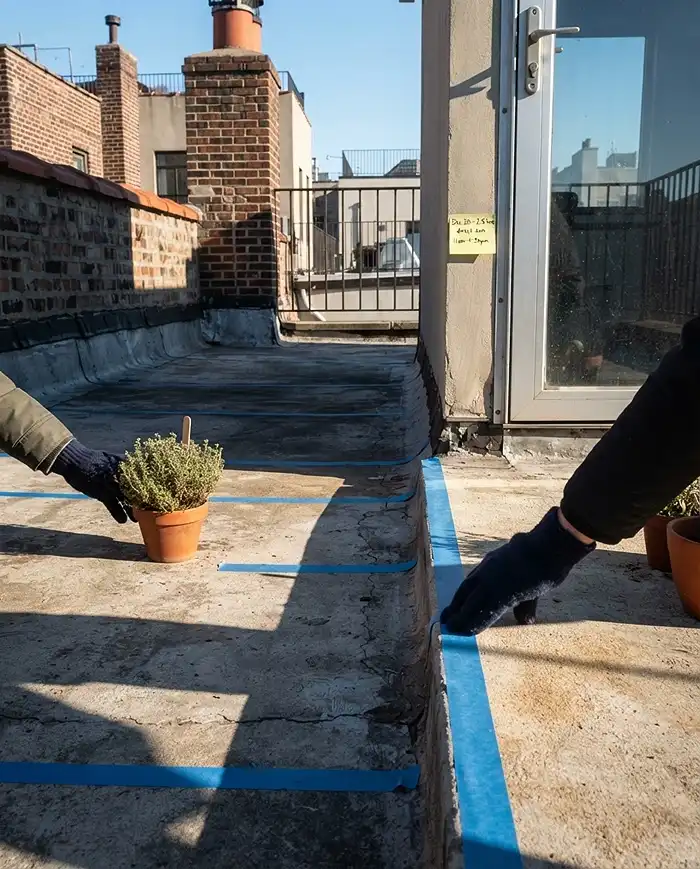
Short Answer: At my latitude, winter noon sun sits only about 28 degrees above the horizon, so neighboring buildings throw long shadows. Photograph your balcony every hour on a clear day, then mark shadow edges to see where light actually lands.
Last December I taped shadow edges on my terrace floor each hour. A neighbor’s chimney was shading my left rail all morning.
I slid my ‘German Winter’ thyme pot three feet to the right and gained 2 hours 15 minutes of direct sun. Free light beats bought light.
Calculating Supplemental DLI (Daily Light Integral) Needs
Short Answer: DLI [daily light integral, the total light a plant receives each day] is measured in mol/m²/day. Dormant perennials need about 3 to 6, hardy herbs 6 to 10, and leafy greens 10 to 12. Subtract your balcony’s natural DLI from the target, and your LEDs fill the gap.
The Purdue Extension guide to daily light integral explains how to measure it. Even a rough estimate from your sun-hour notes beats guessing.
| Plant group | Target DLI | Winter lighting approach |
|---|---|---|
| Dormant perennials (lavender, sedum) | 3 to 6 | Natural light is usually enough |
| Cold-hardy herbs (thyme, parsley) | 6 to 10 | 4 to 6 hours of LED on short or cloudy days |
| Leafy greens (kale, lettuce) | 10 to 12 | 6 to 10 hours of LED daily |
Choosing the Right Winter Lighting for Balconies
Short Answer: Pick outdoor-rated, full-spectrum LEDs with an IP65 or higher rating, a cold-rated cord, and a GFCI-protected plug. Skip anything labeled indoor-only. As of winter 2026, IP65 LED grow bars are easy to find and cheap to run.
Use this checklist before you buy:
- Weather rating: IP65 or higher
- Safety listing: UL or ETL approval for wet locations
- Cord: marked W, meaning outdoor-rated
- Spectrum: full-spectrum white, around 4000K to 5000K
- Mounting: adjustable hooks or clamps, so you can change height
Full-Spectrum LED Outdoor Grow Lights vs. Ambient Lighting
Short Answer: Full-spectrum LEDs deliver the red and blue wavelengths plants use for photosynthesis, so they keep plants alive. Warm-white string lights are decorative only. Use grow lights for plant health, ambient lights for cozy atmosphere, and never count one as the other.
| Feature | Full-spectrum LED | Warm-white string lights |
|---|---|---|
| Feeds photosynthesis | Yes | No |
| Main job | Plant survival and growth | Mood and evening glow |
| Best placement | 12 to 18 inches above plants | Railings and lanterns |
I run both. A grow bar keeps my thyme alive, and warm strings make January evenings livable. For softer glow, try balcony lantern ideas like LED pillar candles in sealed lanterns.
More inspiration lives in these balcony garden lighting ideas.
Ensuring IP65+ Weatherproofing and Safety Ratings
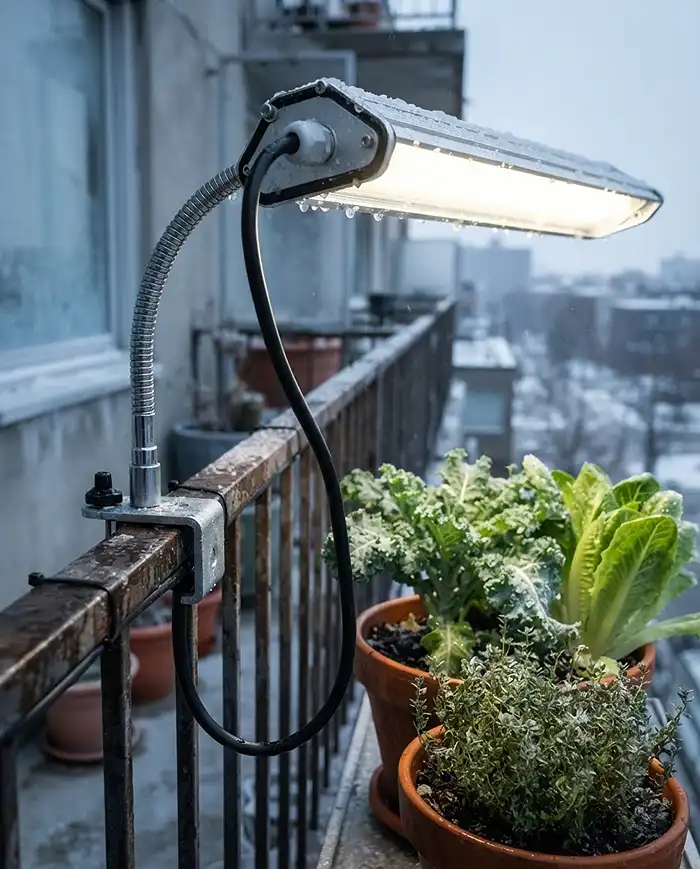
Short Answer: IP65 means a fixture is dust-tight and survives water jets, which covers sleet and snowmelt. For winter, choose IP65 or higher, plus a wet-location listing. Splash-proof ratings aren’t enough once ice forms in the seams.
Two Januarys ago, I hung an indoor LED bar over my ‘Lacinato’ kale. Sleet got inside the housing and the GFCI tripped twice overnight.
The dark stretch plus 12°F nights killed five of my eight plants. Now I buy IP65 bars only, and I leave a drip loop [a downward curve in the cord so water drips off before the plug].
Battery, Solar, or Plug-In: Powering Your Lights Safely
Short Answer: Plug-in LEDs on a GFCI-protected outlet are the most reliable winter choice. Solar panels collect little energy under cloudy winter skies, and cold drains batteries fast. If battery is your only option, use lithium AA cells and swap them weekly.
- Solar: weak output in December and fades with snow cover
- Battery: convenient, but capacity drops fast below freezing
- Plug-in with GFCI: steady power and built-in shock protection
A 24-watt bar on a 12-hour timer uses about 0.29 kWh per day. That’s pocket change for reliable light.
Step-by-Step Guide to Installing Winter Balcony Lights
Short Answer: Locate your outlet, mount lights with tension poles or railing clamps, route cords with covers, plug into a GFCI outlet, then add a timer. Nothing needs drilling, so your lease stays safe. Test everything in daylight before you rely on it.
These no-drill mounts worked for me:
- A tension pole wedged between floor and ceiling
- Railing clamps with a flexible gooseneck arm
- A freestanding plant stand with an overhead arm
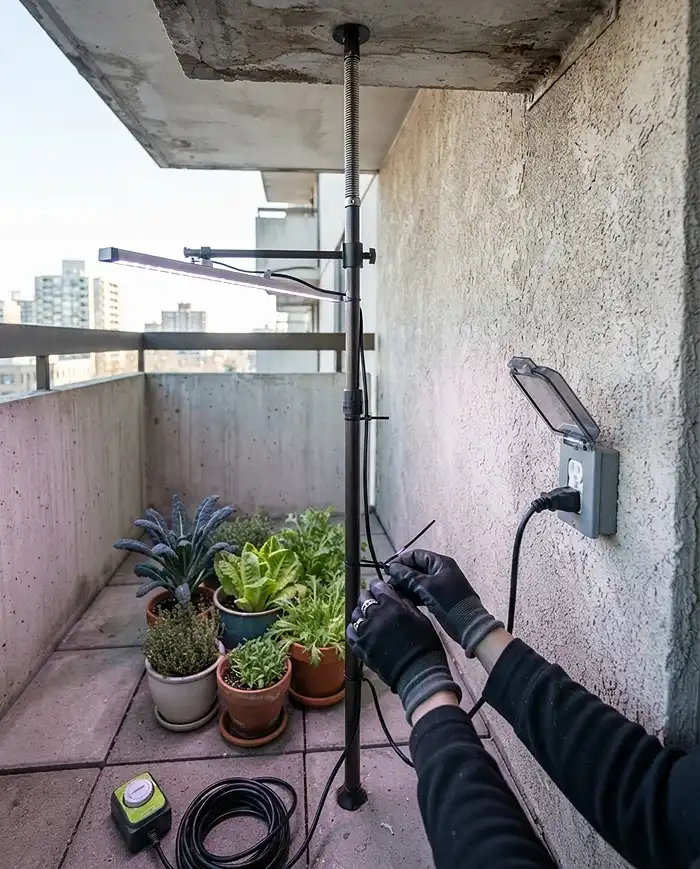
Check your lease for rules on electrical cords and railing attachments before you start.
Safely Routing Outdoor Cables in Freezing Temps
Short Answer: Use cords marked W for outdoor use, such as SJTW, which stay flexible in cold. Secure them with UV-rated zip ties every 12 inches, cover walkways with cord covers, and leave a drip loop at each plug so meltwater can’t reach connections.
Cheap vinyl cords stiffen in hard freezes and crack when bent. Lay cords flat, avoid tight corners, and keep every plug off the floor and inside a weatherproof cover.
Positioning Lights for Maximum Canopy Coverage
Short Answer: Hang LED panels or bars 12 to 18 inches above the plant canopy [the topmost leaves]. That distance spreads light evenly without scorching leaves. Aim the fixture straight down, and raise it as plants grow so every pot gets equal coverage.
Most 24-inch bars cover roughly a two-by-two-foot patch from that height. Check your fixture’s coverage chart, then group pots tightly beneath it.
Setting Up Automated Timers for Photoperiod Consistency
Short Answer: Plug lights into an outdoor-rated mechanical timer or smart plug and set a fixed 10 to 14 hour photoperiod [the daily light-and-dark cycle]. Consistency matters more than precision. Timers keep plants on schedule when you work late, travel, or forget.
Last winter my ‘Winter Density’ romaine sat in a 12-inch pot on a 7 a.m. to 7 p.m. timer. Soil temperature hovered near 45°F.
It reached harvest size in 58 days. The unlit pot beside it was still palm-sized at day 90.
Maintaining Balcony Lighting in Freezing Weather
Short Answer: Check your winter lights weekly. Brush off snow, wipe the lenses clean, and inspect gaskets and plugs for cracks. Check fixture height too. Press the GFCI test button monthly. Five minutes of upkeep prevents nearly every cold-weather failure I’ve seen on my rooftop.
Protecting Bulbs and Connections from Snow and Ice
Short Answer: Brush snow off fixtures with a soft broom, never chip ice, and inspect waterproof gaskets weekly during freezes. Water expands as it freezes, so a hairline gasket crack can widen overnight. Replace any fixture with a cracked or flattened seal.
A heavy snow load can dim your light and trap moisture against the housing. I use a soft-bristled broom and gentle strokes. Chipping ice cracks lenses and gaskets, so if ice has welded a fixture to its mount, unplug it and wait for a thaw.
Water expands about 9 percent as it freezes. That’s enough to pry open a tired gasket. Keep plugs off the floor, inside weatherproof covers, and check every seal after each hard freeze.
Adjusting Light Height as Plants Go Dormant or Grow
Short Answer: Check plant height monthly. Raise lights as growth picks up, and lower them once a plant drops leaves or goes dormant. Keep a 12 to 18 inch gap above the canopy so light stays even and leaves stay safe.
Winter growth is slow, so I raise my bar only once or twice a season. Leafless perennials need little, so I lower the fixture and cut the hours.
Pair this with a watering check, since cold plants drink less. These balcony gardening for beginners tips cover the basics.
Common Problems & Solutions
Short Answer: Most winter lighting problems come down to two things: moisture in the electrics and light that’s too intense for the plant. Both are fixable in an afternoon. Identify the symptom, find the cause, and adjust before the next cold snap arrives.
GFCI Outlets Tripping Due to Moisture or Snowmelt
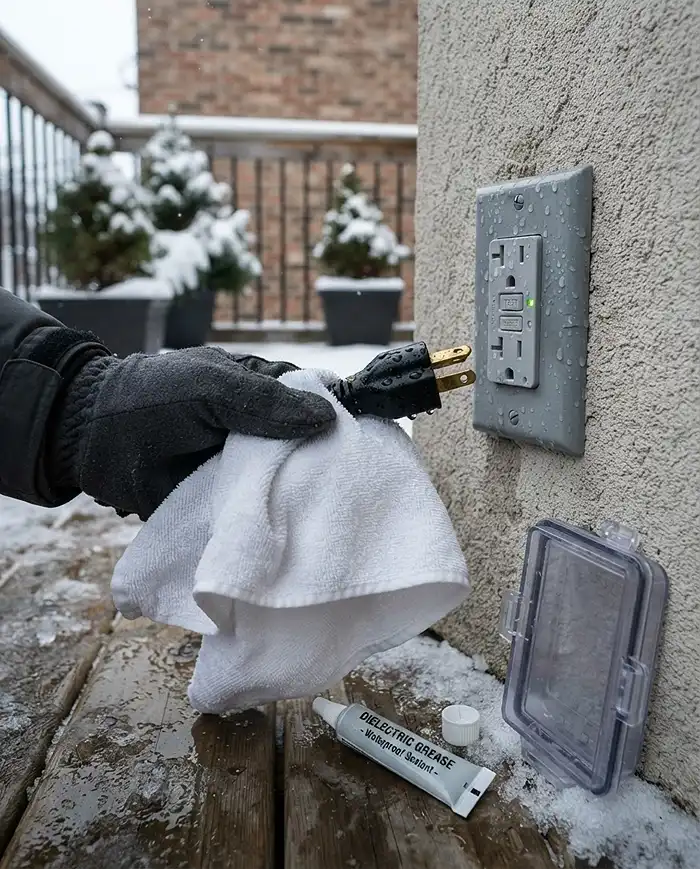
Short Answer: A tripping GFCI [ground-fault circuit interrupter, an outlet that cuts power when it senses leaking current] usually means moisture in a plug, socket, or fixture seam. Unplug everything, dry the connections, and shield plugs inside a weatherproof socket box.
- Unplug everything and dry plugs, sockets, and fixture seams with a towel.
- Inspect cord jackets and gaskets for cracks or gaps.
- Apply dielectric grease to plug contacts and gasket edges.
- Seal connections inside a weatherproof socket box or in-use cover.
- Reset the GFCI. If it trips again, replace the fixture.
Plants Suffering from Light Burn Despite Cold Weather
Short Answer: Light burn shows up as bleached or crispy upper leaves, even in freezing weather. LEDs run cooler than older bulbs, but intensity can still scorch. Raise the fixture 3 to 6 inches, dim it if possible, and watch for new growth.
Burned leaves won’t recover, so trim them. Judge success by new leaves, which should stay green and flat. If the damage keeps spreading after a week, raise the light again.
Frequently Asked Questions
Can I use regular indoor grow lights on an outdoor balcony?
No. Indoor grow lights lack the sealed housings and gaskets needed to shed sleet, snow, and winter humidity. Moisture inside a fixture can cause a short, electric shock, or fire. Buy fixtures rated IP65 or higher, and plug them into a GFCI-protected outlet.
How many hours of supplemental light do winter balcony plants need?
Aim for 10 to 12 hours of total light, natural plus artificial, to keep plants dormant and steady. For active growth, such as winter greens, aim for 14 to 16 hours. Count the daylight you already get, then let a timer supply the rest.
Will leaving balcony grow lights on at night confuse my plants?
Yes, it can. Plants need a dark period for respiration [using stored sugars for growth and repair], and nonstop light disrupts their daily rhythm. Run lights during daylight hours and let the balcony go dark at night.
Do LED grow lights work in freezing temperatures?
Yes. LEDs generally handle cold well, but cheap drivers and cords can fail below freezing. Check the fixture’s operating temperature range, and keep the power supply dry and off the ground.
Do I need grow lights for a small balcony garden in winter?
Only if your plants need active growth or get under four hours of direct sun. Dormant perennials and hardy evergreens often do fine on natural light. Start with one IP65 LED bar over your most valuable pots, then expand if stems get leggy.
Quick Recap
- Map your sun hours and shadows before you buy anything.
- Choose IP65-or-higher full-spectrum LEDs on a GFCI-protected plug.
- Hang lights 12 to 18 inches above the canopy and set a 10 to 14 hour timer.
- Check cords, gaskets, and light height every week or month, as needed.
- Good winter balcony garden lighting keeps your small balcony garden growing through the darkest weeks.