
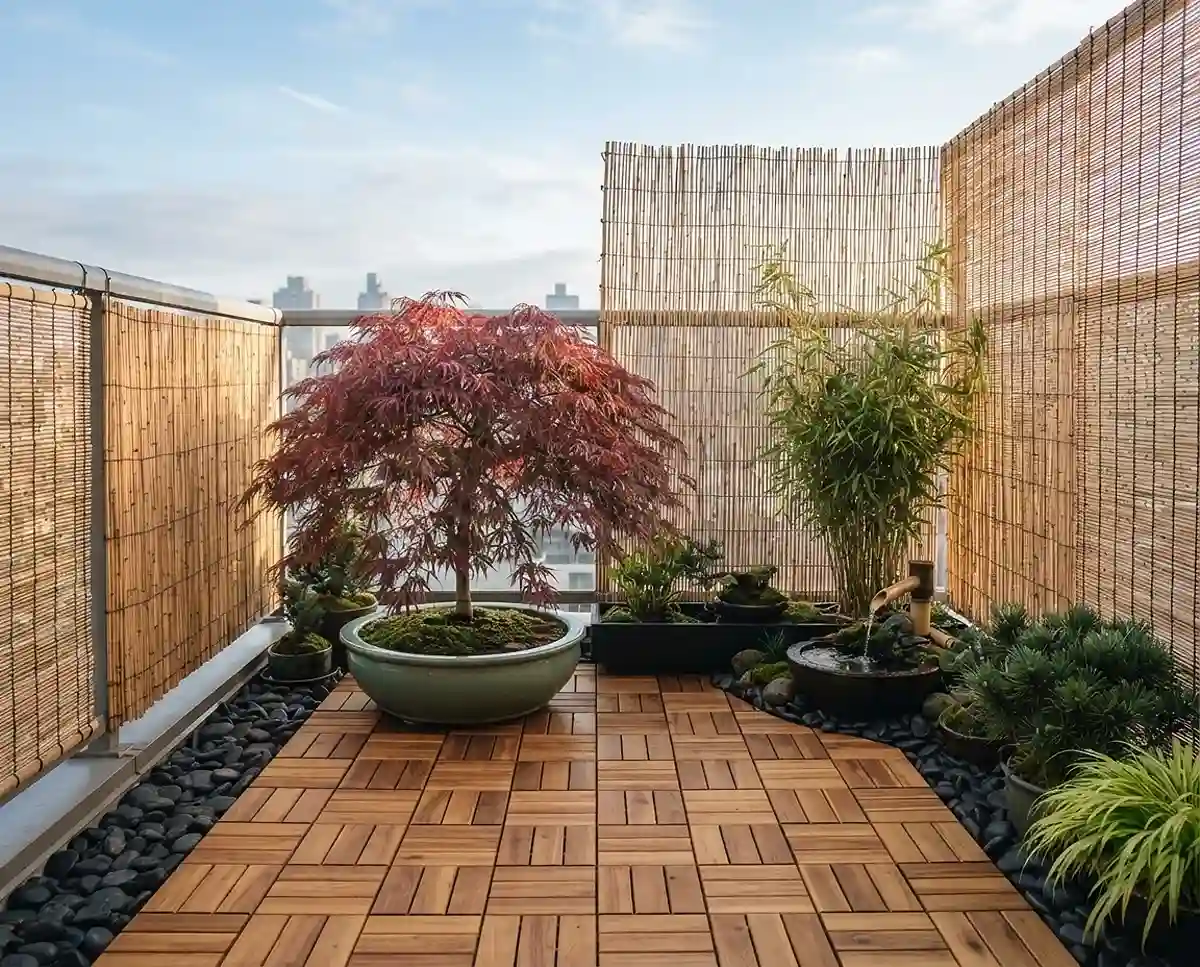
Japanese Balcony Garden Ideas
Your balcony feels like a storage closet with a view. Try a Japanese balcony garden: a minimalist balcony garden that feels like a quiet Kyoto courtyard. I grow on a sunny zone 7a rooftop, all in containers, and I’ve coached renters for 12 years.
Table of Contents
Embracing Zen: The Essence of a Japanese Balcony Garden
Short Answer: You don’t need an estate to capture a Kyoto courtyard. Strict minimalism and container-friendly Asian plants can turn a concrete slab into a calm sanctuary. That’s the whole recipe for a small balcony garden.
Japanese designers borrow big landscapes in miniature. Mountains become stones, rivers become gravel, and forests become one good tree.
Core Design Principles of Traditional Japanese Gardens
Short Answer: Traditional Japanese gardens copy vast natural landscapes in miniature. On a small balcony, that means restraint: fewer objects, deliberate placement, and respect for empty space. Every stone, pot, and plant should earn its spot. Use these balcony garden ideas as your filter.
Asymmetry, Balance, and Wabi-Sabi
Short Answer: Wabi-sabi [finding beauty in imperfection] favors uneven, natural arrangements over rigid rows. Group your pots in odd numbers, like three or five, at different heights. Balance comes from visual weight, not matching pairs. A chipped glaze or crooked trunk is a feature, not a flaw.
Try this: set a tall pot left of center, a mid-size pot slightly behind it, and a low bowl off to the right.
Enclosure and Hide-and-Reveal (Miegakure)
Short Answer: Miegakure [hide and reveal] means you never see the whole garden at once. Put taller plants or a bamboo screen near your seating to block part of the view. Visitors slowly discover the space, which makes a tiny balcony feel bigger.
Stand at the door and place one pot so it hides the far corner.
Planning Your Balcony’s Microclimate and Layout
Short Answer: Audit your balcony before buying anything. A microclimate [the local mix of sun, wind, and heat around your space] decides what survives. Traditional Japanese forest plants are sensitive, and urban concrete bakes them fast. A balcony gives you little room for guessing.
New to balconies? This balcony gardening for beginners guide covers wind, weight, and watering basics.
Sun Exposure for Shade-Loving Plants
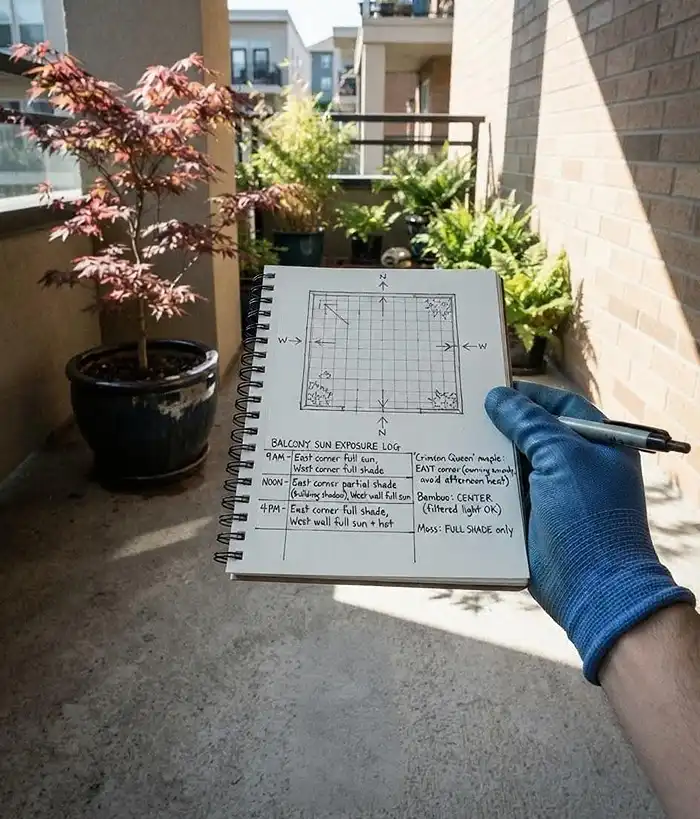
Short Answer: Map your sunlight hours before choosing plants. Maples and ferns are understory plants [species that grow beneath taller trees], so they want an east- or north-facing spot. Gentle morning sun is fine; hot afternoon sun burns foliage. Check at 9 a.m., noon, and 4 p.m. for a week.
I learned this the hard way. My first July, I set a ‘Crimson Queen’ maple in a 14-inch glazed pot against a west wall. Ten days later, half its leaves had crisped. I moved it behind a screen, and it leafed back out by September.
- Note the sun at 9 a.m., noon, and 4 p.m. for seven days.
- Mark spots that get strong sun for under four hours total.
- Give maples and ferns the east- or north-facing corners.
Weight Limits for Stones and Water Features
Short Answer: Renters, this one matters. Check your balcony’s load limit before adding stones or water. Ask your building manager, then add up everything wet. Choose lightweight faux-stone resin basins or pumice instead of granite, and you’ll get the same look without risking the structure.
| Material | Approximate weight |
|---|---|
| Water | 8.3 lb per gallon |
| Saturated potting mix | 40-60 lb per cubic foot |
| Granite boulder | About 165 lb per cubic foot |
| Pumice rock | Roughly 30-55 lb per cubic foot |
Many residential codes allow 40 to 60 pounds per square foot. Ask your landlord for your exact limit, then add up every wet pot.
Essential Hardscaping Materials for a Zen Aesthetic
Short Answer: Before any plant arrives, anchor the style with natural textures: bamboo, wood, and stone. These three materials do most of the work. Think of them as the stage, with plants as the actors who arrive later. Keep each material in one tone, such as warm cedar and dark stone.
Bamboo Screens and Natural Textures
Short Answer: Line your railings with rolled bamboo fencing or woven reed screens. They hide the urban backdrop right away and create the sheltered feel of a Tsuboniwa [a small, enclosed courtyard garden]. Attach them with zip ties so you can remove them when you move.
River Stones and Wooden Decking
Short Answer: Cover the concrete with interlocking Hinoki or cedar deck tiles, but leave a border channel around the edges. Fill that channel with smooth black river stones to suggest a dry riverbed. The tiles click together, so nothing gets drilled or glued.
Keep the stones about one inch deep. It saves weight and lets rain drain.
Miniature Water Basins (Tsukubai)
Short Answer: A tsukubai [a low stone water basin] with a bamboo spout adds running water, which masks traffic noise. Use a small, self-contained basin and a recirculating solar pump. Pick resin to keep weight down. The gentle trickle makes a balcony feel far from the street.
Best Container Plants for a Japanese Aesthetic
Short Answer: Choose slow-growing, container-friendly plants that copy Asian landscapes: a maple, a clumping bamboo, and one structural evergreen. Three strong specimens beat a dozen small pots, and big containers keep roots cool, moist, and happy. Here’s my short list, tested on a zone 7a rooftop.
New to potting? This container gardening for beginners walkthrough covers drainage and soil.
Dwarf Japanese Maples (Acer palmatum)
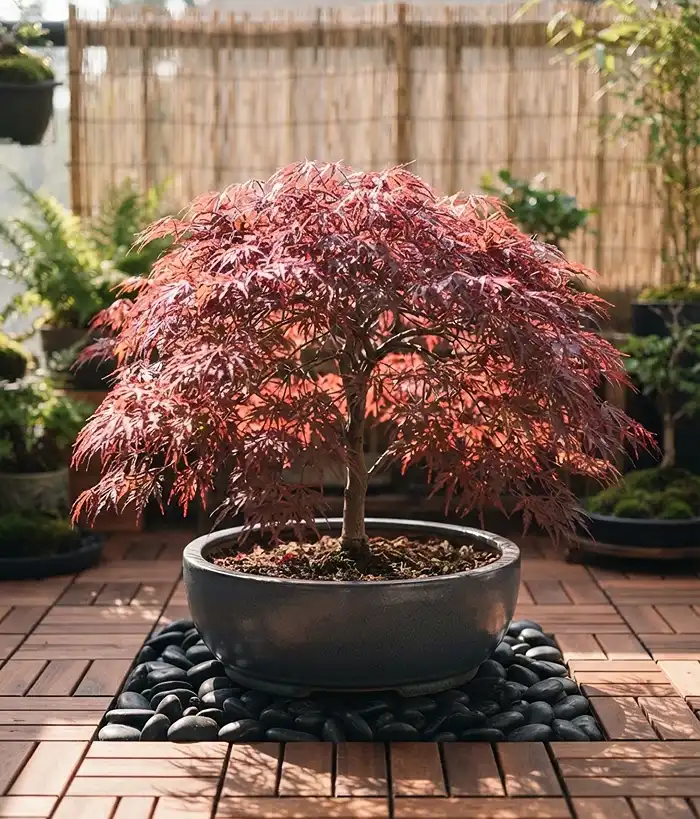
Short Answer: Deeply lobed dwarf Japanese maples like ‘Crimson Queen’ or ‘Kiyohime’ make the best focal point. Plant them in wide, shallow pots with acidic, well-draining soil. Both stay compact for years. Start with a 14- to 18-inch pot, and aim for soil around pH 5.5 to 6.5.
Non-Invasive Clumping Bamboo
Short Answer: Plant cold-hardy clumping bamboo like Fargesia rufa in a deep, rectangular resin trough. Clumpers [bamboo that grows in a tight clump instead of running] stay put. You get a whispering evergreen privacy screen that sways in the wind without breaking its container.
Last April, I planted a Fargesia rufa in a double-walled resin trough, 24 inches long and 18 inches deep. By October, it had sent up about a dozen new culms [bamboo stems]. Now the wind makes a soft rustle that covers the street.
Bonsai Evergreens and Moss Substitutes
Short Answer: Add one structural evergreen, like Dwarf Alberta Spruce or a potted juniper, for year-round bones. For the look of moss, top-dress [spread a thin layer over the soil] with Irish moss (Sagina subulata) or creeping thyme. Both tolerate normal container watering and balcony wind.
In May, I top-dressed a 12-inch shallow bowl with Sagina subulata ‘Aurea’. Six weeks later, it had covered the bare soil like a tiny green lawn. It browns if I skip watering for two days, so I don’t skip.
Keep spruce away from hot glass, since reflected heat invites spider mites.
Step-by-Step Zen Balcony Assembly
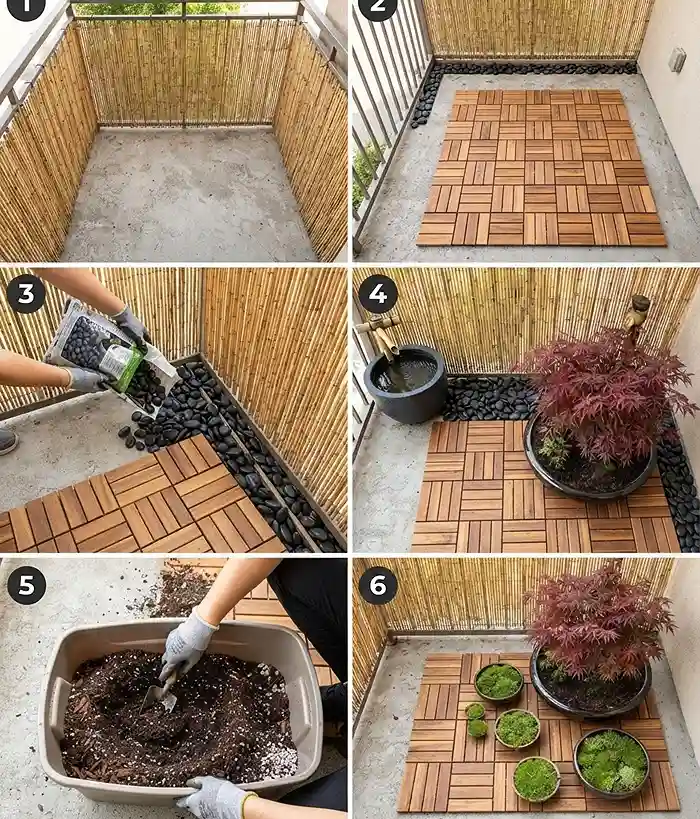
Short Answer: Build in this order: screens, flooring, heavy pieces, soil, then small accents. Doing the heavy work first keeps you from dragging a full pot across fresh decking. Follow these five steps and your layout stays asymmetric and uncluttered.
Tiny footprints need tidy planning, so this beginner small space gardening guide pairs well with these steps.
- Hang the screens. Secure bamboo or reed panels along the railing.
- Lay the floor. Click the deck tiles together, then fill the border channel with river stones.
- Place the heavy pieces. Set the tsukubai and anchor maples, then recheck your weight total.
- Blend the soil. Mix equal parts pine bark fines, quality potting mix, and perlite for acidic, fast drainage.
- Stage the accents. Add smaller plants last, in odd numbers, with gaps between them.
Seasonal Care and Aesthetic Pruning
Short Answer: Adjust your routine with the seasons so plants keep their intentional shapes. Prune evergreens in late spring and early summer, water more in July heat, and shelter maples before hard freezes. Small, steady tweaks beat dramatic rescues. Aim for a quick 10-minute check each week.
Niwaki Cloud Pruning Techniques
Short Answer: Niwaki [Japanese garden tree pruning] shapes evergreens into airy foliage “clouds” on a visible trunk. Thin the crowded inner branches aggressively, then trim the outer tips lightly. You’re sculpting negative space, not just trimming length. Use sharp bypass snips and remove no more than a third per season.
Winterizing Delicate Maples and Ceramics
Short Answer: Protect potted maples from deep freezes by moving them flush against a heated apartment wall. Wrap glazed ceramic pots in burlap so the root ball can’t freeze solid and crack the pot. Water lightly before the first hard freeze, and check the soil weekly.
As of fall 2026, I start this in mid-October. My zone 7a first frost usually lands between late October and early November. You can confirm yours on the USDA Plant Hardiness Zone Map.
Common Problems & Solutions
Short Answer: Most Japanese balcony problems come down to too much sun or too little water movement. Both are easy to diagnose and quick to fix once you know the signs. Here are the two I see most. Treat them early and your maple and basin stay beautiful.
Sun Scorch on Maple Foliage
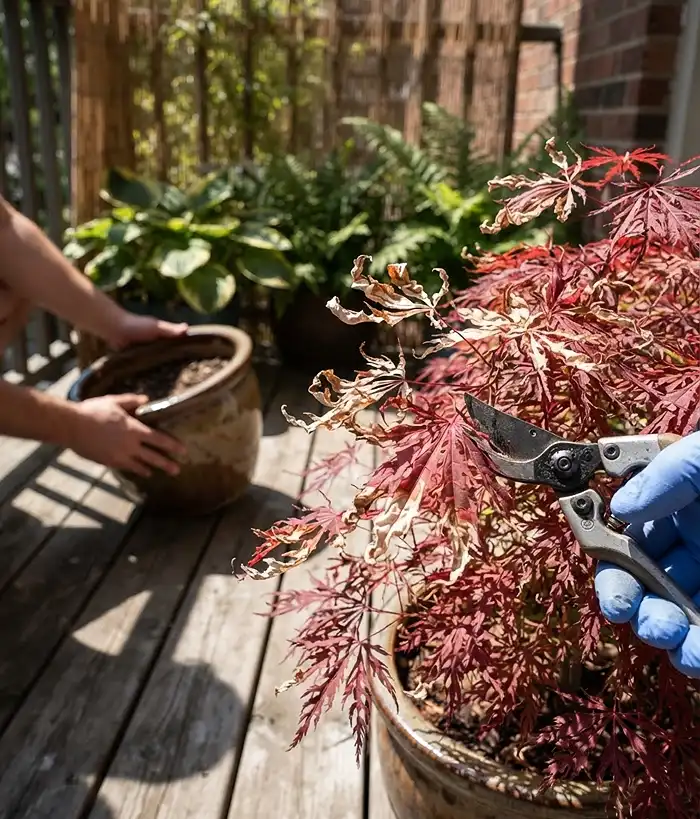
Short Answer: Sun scorch shows up as crispy, bleached, white or brown leaf tips on Acer palmatum. Move the tree behind a bamboo screen to block harsh afternoon UV. Trim the damaged tips, keep watering steady, and expect fresh leaves within weeks.
Algae in Standing Water Features
Short Answer: Stagnant water in a tsukubai breeds green algae and mosquitoes in peak summer. Keep the recirculating pump running constantly, and add a few drops of natural barley straw extract. Both steps are gentle on pets, birds, and plants. Top off evaporated water every few days.
- Run the pump all day, every day.
- Add barley straw extract following the label.
- Scrub the basin monthly with a soft brush.
Japanese balcony garden FAQs
Can I grow real moss on a concrete balcony?
Real woodland moss needs steady, high humidity that a breezy balcony can’t provide. Use look-alike groundcovers like Scotch moss (Sagina subulata ‘Aurea’) instead. They tolerate normal container watering and still give you that soft green carpet.
How many plants should I use for a minimalist look?
Stick to the rule of three or five. Choose a few well-pruned specimen plants and surround them with negative space. A crowd of small pots destroys the calm.
How do I stop bamboo from cracking its pot in winter?
Plant bamboo only in thick, flexible, double-walled resin troughs. Rhizomes [underground stems] push outward with real force, and brittle terracotta or ceramic can shatter during a freeze. Water well before winter so the roots stay insulated.
Do Japanese maples grow well in pots on a balcony?
Yes, if you pick a dwarf type like ‘Kiyohime’ and give it a wide pot with acidic, well-draining soil. Shelter from hot afternoon sun is the key. In zone 7a, protect the pot during deep freezes.
Can renters build a Japanese balcony garden without damaging anything?
Absolutely. Use zip-tied bamboo screens, click-together deck tiles, pumice, and resin basins, so nothing gets drilled or glued. Check your lease and load limit first, and everything lifts out when you move.
How often should I water container Japanese maples?
Check the top inch of soil daily in summer and water when it feels dry. In winter, about once a week is usually enough. Never let the root ball dry out completely.
Quick Recap
- Group pots in odd numbers and leave generous empty space around them.
- Screen the railings with bamboo and cover the floor with click-together tiles.
- Place maples in east- or north-facing spots, out of hot afternoon sun.
- Check your weight limit, then choose resin and pumice over granite.
- Keep your Japanese balcony garden simple: three strong plants, one water feature, and steady seasonal care.