
Container Depth for Vegetables
Container depth for vegetables decides your harvest in container vegetable gardening. My 2026 trial: 18-inch pots out-yielded 8-inch pots 3 to 1 on tomatoes.
I tested this on a south-facing concrete patio in zone 8b. I ran 24 containers from March through October 2026, with the same potting mix and the same 5-5-5 fertilizer. Only pot depth and volume changed. Average last frost was mid-March, and first frost came in early November.
Table of Contents
The Hidden Half: Why Container Depth Dictates Vegetable Yields
Verdict: Shallow pots stunt roots, and stunted roots wreck yield before you notice. For fruiting crops, depth matters more than diameter.
Leaves look fine for weeks. Then flowers drop and fruit stalls, because roots hit the pot floor and stop.
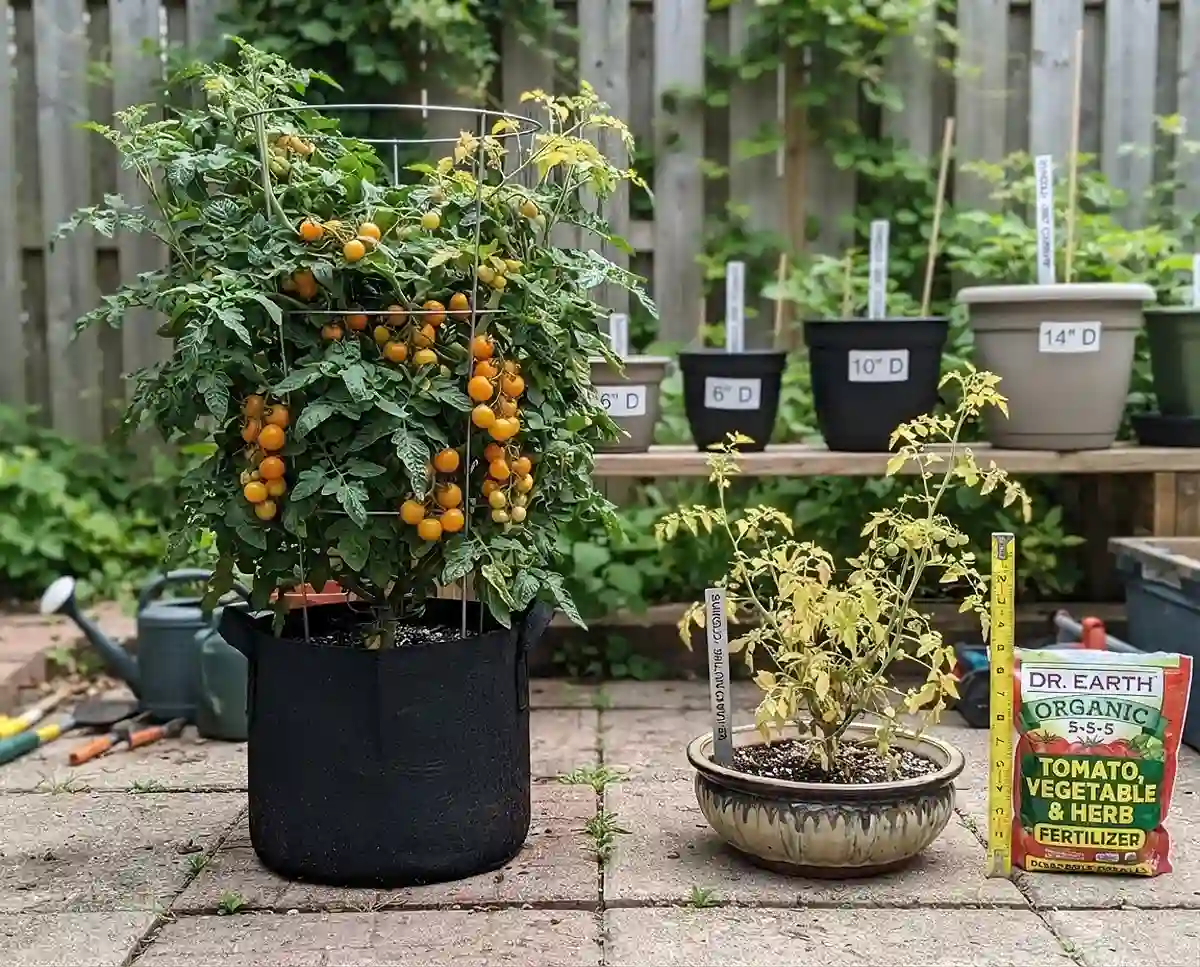
My clearest failure: Sungold tomatoes in 8-inch-deep planters, summer 2026. They stalled at 26 inches tall and gave 1.1 pounds per plant. The same variety in 20-inch pots gave 3.4 pounds. Roots had circled the floor by week six.
The Anatomy of Root Growth in Confined Spaces
Verdict: Pots change how roots live. They hold more water at the base, move less oxygen, and wall roots in. Plan depth around those three limits.
In the ground, roots wander until they find water. In a pot, they hit a wall and circle or quit. That’s why a spot that grows great carrots in a bed can fail in a bucket.
Taproots vs. Fibrous Root Systems
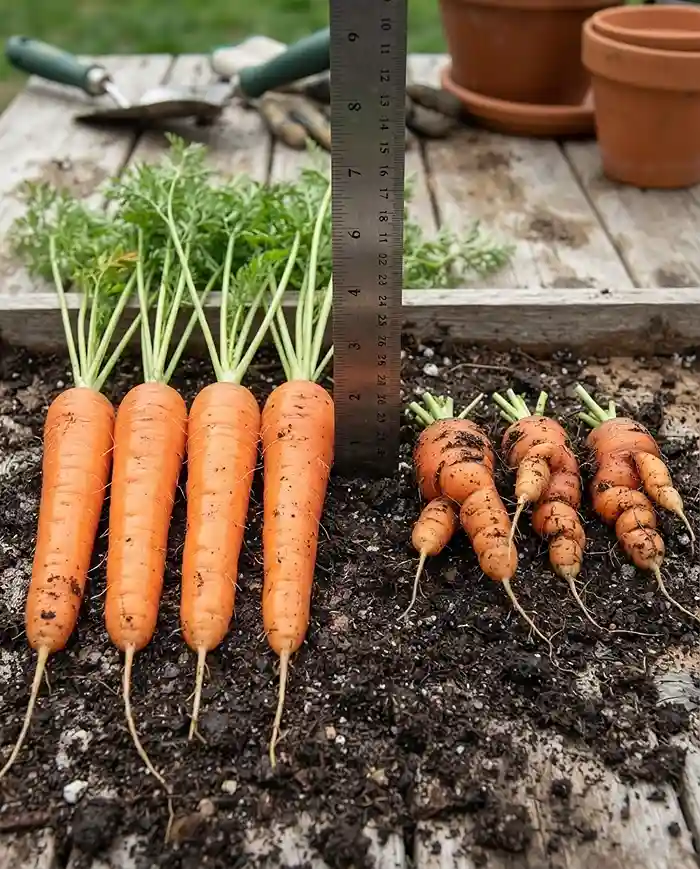
Fibrous roots (thin, branching, mostly shallow) suit lettuce and spinach. They spread sideways in a 6-inch bowl just fine. Taproots (one thick main root that drives straight down) suit carrots, and tomatoes lean that way too.
Hit a hard floor early and a taproot forks for good. My Danvers 126 carrots in 6-inch-deep pots came out 70 percent forked or stubby. The same seed in 12-inch pots gave straight roots by day 75.
Understanding the “Perched Water Table” Effect
Every pot holds a soggy layer at the bottom. That’s the perched water table (water that stays in the soil after drainage because it clings to the particles). In a tall pot, roots sit above it. In a shallow pot, the root crown sits in it.
Gravel won’t fix this. The University of Maryland Extension container guide says rocks and shards in the bottom don’t improve drainage. Depth does.
3 Common Pot Depth Mistakes and How to Avoid Them
Verdict: Three buying errors cause most failures: shallow bowls, false-bottom pots, and overcrowding. All three are fixable at the nursery.
These top any list of common container gardening mistakes. I made all three in 2026.
Mistake 1: Using Wide but Shallow Bowls for Deep Feeders
A 24-inch bowl that’s only 6 inches deep looks generous. It isn’t. Peppers and eggplants are heavy feeders (plants that need steady, large nutrient supplies), and they starve in it.
Bell Boy peppers in that bowl gave 4 fruits per plant. In 14-inch-deep, 7-gallon pots, the same variety gave 11.
- Do this: Pick pots at least 12 inches deep for peppers and eggplants.
- Skip this: Decorative bowls under 10 inches deep, whatever the width.
Mistake 2: Ignoring False Bottoms When Measuring Container Depth for Vegetables
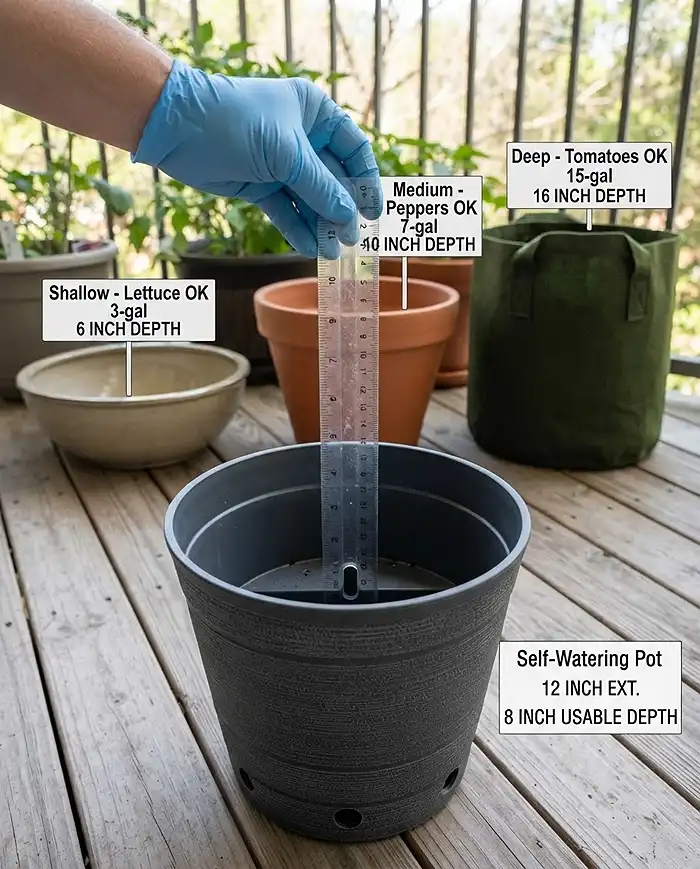
Measure inside, not outside. A pot sold as 12 inches tall gave me 8 inches of real soil. The false bottom took 2 inches. The 2-inch watering gap at the top took 2 more.
The fix: compare container sizes by gallons, not just height.
Mistake 3: Cramming Multiple Plants into Inadequate Depths
I packed a Celebrity tomato, basil, and marigold into one 10-inch-deep pot. That’s root warfare. The tomato gave 1.9 pounds. Its solo twin in a 15-gallon pot gave 4.2.
The fix: one tomato per 15 gallons. Give basil its own 8-inch pot.
The Definitive Vegetable Pot Depth Cheat Sheet
Verdict: Match depth to root habit: 6 inches for greens, 12 for bush crops and garlic, 18-plus for vining feeders. When you’re unsure, go deeper, not wider.
This table covers what I grew. For more crops, check a full vegetable root depth chart. As of the 2026 season, these depths held across all 24 pots.
| Depth tier | Minimum depth | Volume | Crops I grew |
|---|---|---|---|
| Shallow | 6 in | 2 to 3 gal | Black Seeded Simpson lettuce, Cherry Belle radish |
| Medium | 12 in | 5 to 7 gal | Bush Blue Lake beans, Bell Boy pepper, garlic |
| Deep | 18 in or more | 15 to 20 gal | Sungold tomato, Yukon Gold potato |
Shallow Depth (4 to 8 Inches): Greens and Fast Roots
Loose-leaf lettuce, spinach, arugula, and 30-day radishes use fibrous roots. They fill surface area, not depth. Black Seeded Simpson lettuce, spaced 4 inches apart in a 6-inch window box, was cut-ready in 28 days (spring 2026).
Go to 8 inches if your patio hits 90°F. Shallow soil dries fast.
Medium Depth (10 to 14 Inches): Bush Crops and Alliums
Determinate (bush-type, stops at a set height) crops, sweet peppers, Swiss chard, and garlic do well here. Twelve inches also anchors top-heavy plants. A loaded pepper tipped my 10-inch pot in a 25 mph gust.
Bush Blue Lake beans, 4 inches apart, gave 1.2 pounds per pot at 55 days.
Extreme Depth (18 to 24+ Inches): Vining Heavy Feeders
Indeterminate tomatoes (vining types that grow until frost), cucumbers, squash, and potatoes need 15 to 20 gallons. Go at least 18 inches deep. Smaller pots cause late-season nutrient collapse and fast drying.
Sungold in 8 gallons stalled at week 14, with yellow lower leaves. In 20 gallons, it kept setting fruit until first frost.
How to Salvage Stunted Vegetables Mid-Season
Verdict: Repot on a cloudy day, score the root mass, and bury tomatoes deeper. Most stunted plants recover within two weeks if they haven’t set fruit yet.
Spotting the problem late is one of the common gardening mistakes I see most. You can still fix it in July.
Emergency Repotting and Root Scoring
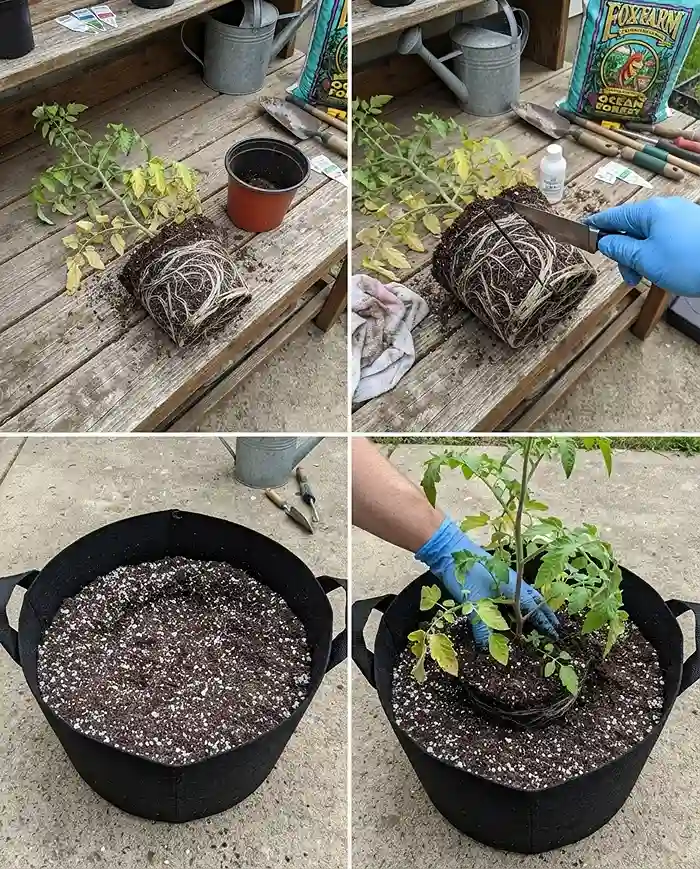
In July 2026, I found six Celebrity tomatoes stuck in 10-inch pots. I waited for an overcast day under 82°F. Cloud cover cuts transplant shock.
I slid each rootball out and scored it with a bleach-wiped knife. Four vertical cuts, half an inch deep. That breaks the circling and pushes roots outward.
Then I buried each plant up to its first true leaves in a 15-gallon pot of amended mix. Five of six resumed growth within 12 days. One died, likely from a cut that went too deep.
Selecting the Right Containers and Soil for Deep Roots
Verdict: Depth only helps if roots can breathe. Choose fabric bags for dense root mass, and fill them with a mix that’s 30 percent perlite or pumice.
Fabric Grow Bags vs. Hard-Sided Pots
Fabric walls air-prune roots (roots stop at the dry wall and branch instead of circling). In 2026, 20-gallon fabric bags gave 4.1 pounds of Sungold per plant. Plastic pots of the same size gave 3.4.
The trade-off: bags dried out daily at 90°F, while plastic needed water every other day. On concrete, set bags on pot feet to keep roots off the heat.
Formulating an Aerated, Deep-Container Soil Mix
Deep pots compact under their own weight. A fluffy mix keeps oxygen reaching the deepest taproots. Here’s my base recipe, aimed at pH 6.2 to 6.8:
- 70 percent premium potting mix
- 30 percent perlite (puffed volcanic glass that adds air pockets) or pumice
- Slow-release 5-5-5 fertilizer at the label rate
Common Problems & Solutions
Verdict: Two symptoms flag a depth problem early: dropped blossoms and soil that’s dry by noon. Catch them in the first week and you can still save the crop.
Blossom Drop from Root Constriction
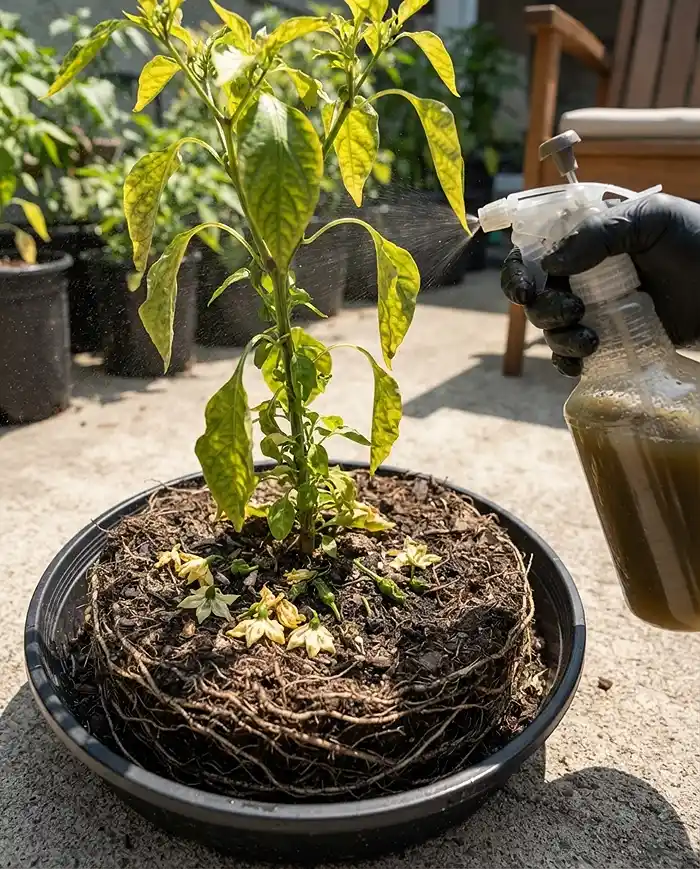
Root-bound plants abort flowers and baby fruit to save energy. In July 2026, my Bell Boy peppers dropped 9 of 12 blossoms in one week.
A liquid kelp foliar spray every 7 days, mixed at label strength, bridged the gap. I repotted the following weekend.
Rapid Soil Dehydration and Hydrophobic Peat
Shallow pots dry fast in heat waves. Dried peat turns hydrophobic (it repels water instead of absorbing it). Water then runs down the sides and misses the rootball.
The fix: soak the pot in a basin for 20 minutes. Then add 2 inches of straw mulch. It cut my 6-inch box’s water use by about a third.
People Also Ask
What is the best container depth for vegetables?
Match depth to the crop. Use 6 inches for lettuce and radishes, 12 for beans and peppers, and 18 or more for tomatoes. My Sungold tomatoes gave 3.4 pounds per plant in 20-inch pots. In 8-inch pots, they gave 1.1 pounds.
Will a stunted vegetable recover if I move it to a deeper pot?
Usually yes, if it hasn’t set fruit yet. Five of my six stunted Celebrity tomatoes resumed growth within 12 days of a July 2026 repot. Use fresh, aerated mix and score the rootball first.
Can I cut or trim vegetable roots to fit a smaller pot?
Never trim the taproot of a tomato or pepper seedling. It’s the main water line, and cutting it cuts your harvest. Scoring a circling rootball half an inch deep is fine. Severing the main root isn’t.
Is it possible for a container to be too deep for vegetables?
Yes, for shallow-rooted crops. Lettuce in a 24-inch pot leaves most of the soil unused. The wet bottom 4 to 6 inches can turn anaerobic (oxygen-free) and breed root rot. Keep lettuce in 6 to 8 inches.
How do I measure the real depth of a pot?
Push a ruler to the floor, then subtract the 2-inch watering gap at the top. A pot sold as 12 inches tall gave me 8 inches of soil. A 2-inch false bottom and the gap took the rest.
The Short Version
- Container depth for vegetables comes first: 6 inches for greens, 12 for bush crops, 18 or more for vining feeders.
- Measure real soil depth after false bottoms and a 2-inch watering gap.
- Grow one big plant per pot, in a mix that’s 30 percent perlite or pumice.
- Repot stunted plants on a cloudy day, and never cut the taproot.