
Ornamental Grasses for Balcony Gardens
Ornamental grasses for balcony gardens are the secret weapon most small-space gardeners overlook. Pair them with late-season bloomers and you get a display that’s genuinely dramatic — structural, wind-animated, and still going strong when your neighbors’ petunias have given up.
Table of Contents
The Architectural Appeal of Grasses and Late Blooms on a Balcony
There’s a specific moment in late August when a balcony garden can either look exhausted or absolutely alive. The difference, in my experience, almost always comes down to structure.
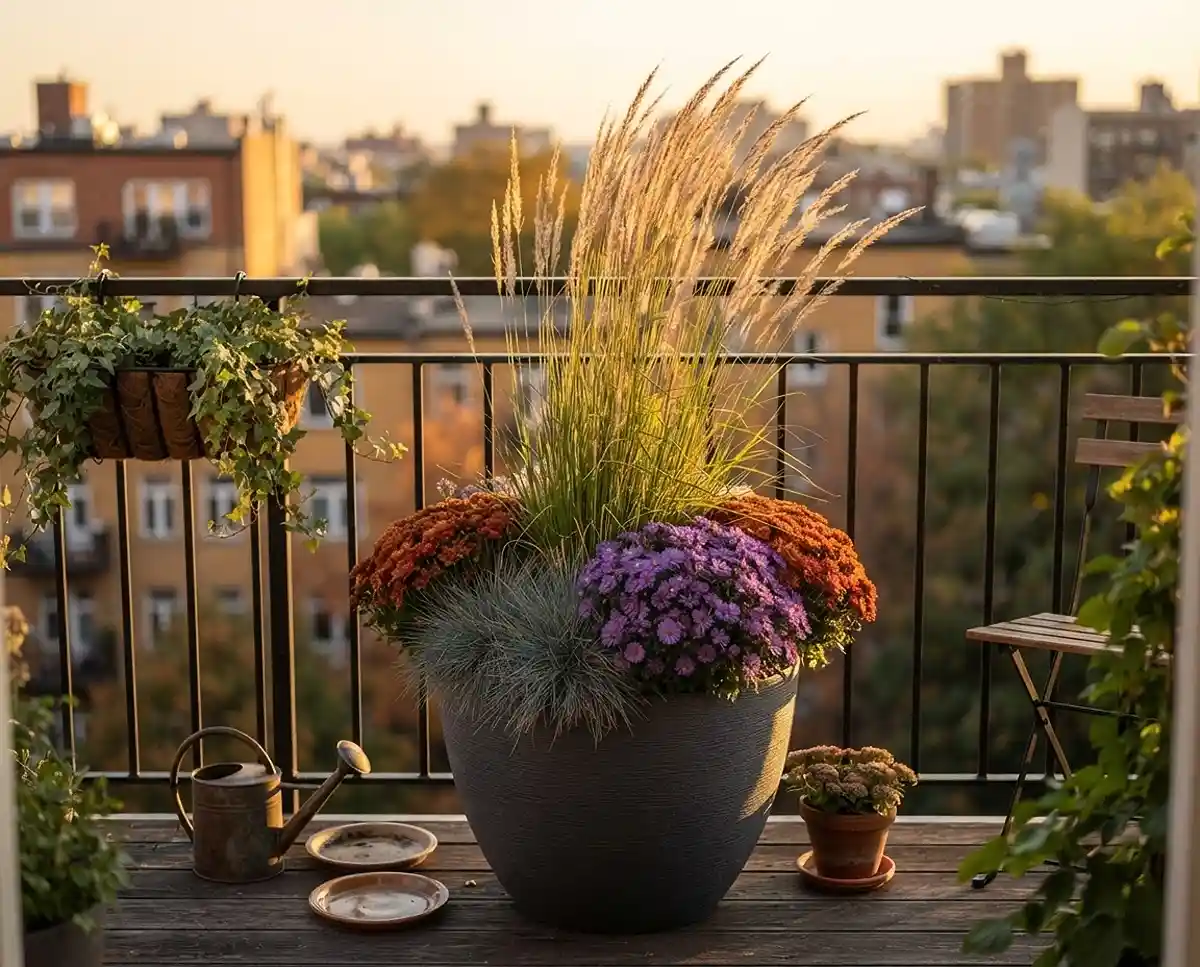
Ornamental grasses bring that structure. Their vertical plumes catch every gust, creating movement that no flower alone can replicate. Pair them with the saturated purples of autumn asters or the warm bronze of garden mums, and the contrast is genuinely striking.
I grow a 5-foot ‘Karl Foerster’ Feather Reed Grass in a 20-gallon pot on my east-facing balcony in zone 6b. By late September, its feathery seed heads catch the low-angle morning light and look like something out of a high-end landscape design — zero exaggeration.
This combination works because the grasses supply the vertical “thriller” role while the dense, mounding late-bloomers provide contrasting weight at soil level. The result is a layered, textural planting that keeps performing well into October.
Assessing Your Late Season Balcony Microclimate
Before you plant a single grass blade, spend a week honestly auditing your outdoor space. Ornamental grasses and late bloomers need the right conditions to establish strong roots before cold sets in — and balconies have surprisingly unique microclimates.
Two factors matter most heading into autumn: shifting sun angles and wind exposure. Get these right and the rest follows.
Tracking the Shifting Sun Angles
Quick Answer: In late summer and autumn, the sun’s arc drops significantly lower in the sky. A spot that got 8 hours of sun in July may only get 4-5 hours by October. Map your balcony’s light exposure in September, not June, before placing sun-loving grasses.
I made this mistake my first season of small space gardening — positioned my Purple Fountain Grass based on summer sun patterns, then watched it sulk once the adjacent building started casting afternoon shade in September.
Ornamental grasses and most late bloomers need a minimum of 6 hours of direct light. Watch your balcony at 9am, noon, and 3pm on a September day. Mark which spots actually hit that threshold. That’s where your tallest grasses and heaviest bloomers go.
Pro Tip: East facing balcony plants often get strong morning sun but lose it by early afternoon — perfect for Japanese Forest Grass and Japanese Anemones, which prefer that gentler exposure.
Wind Load and Evaporation Rates
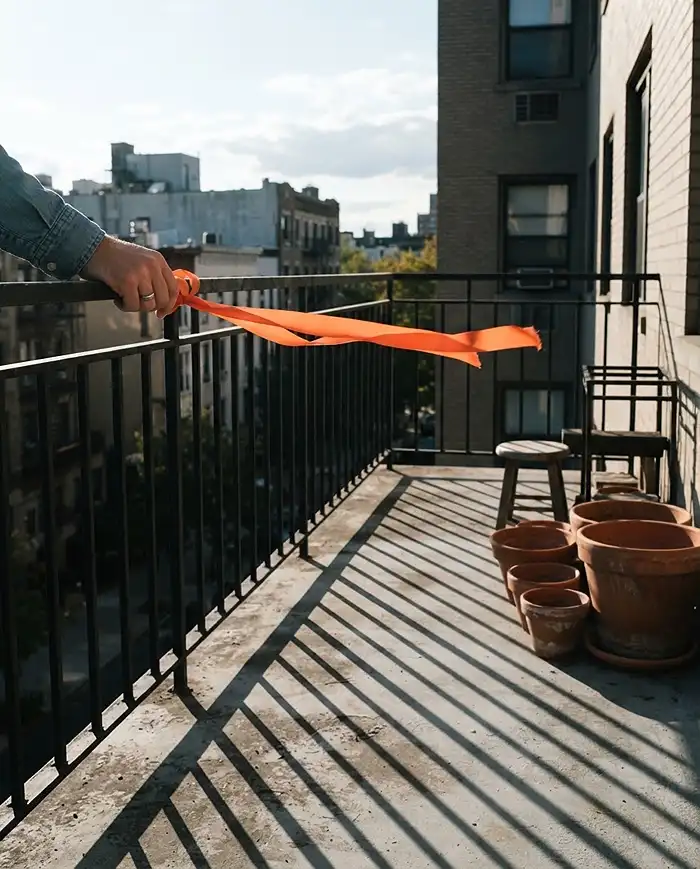
Quick Answer: High-rise balconies above the 5th floor typically experience wind speeds 2-3x faster than ground level. Grasses handle this beautifully — but the wind rapidly dries out container soil and can snap brittle flower stems.
Use heavy, low-profile pots (resin or glazed ceramic) in your windiest corners. A 15-gallon fabric pot that works great on a ground patio will tip over and dry out within hours on an exposed balcony.
I lost an entire pot of Japanese Anemones in 2023 to a single gusty October night — stems snapped clean. Now I stake anything taller than 18 inches with bamboo canes before September.
Pro Tip: Grasses actually buffer wind for neighboring flowers when planted upwind. Position your tallest grass at the balcony’s exposed edge to act as a living windbreak.
Best Ornamental Grasses for Balcony Containers
Not every grass behaves well in a pot. The ones below have proven track records in containers and give you a clear choice based on the look you’re after — tall and dramatic, or low and textural.
Tall Thrillers: Purple Fountain Grass and Feather Reed Grass
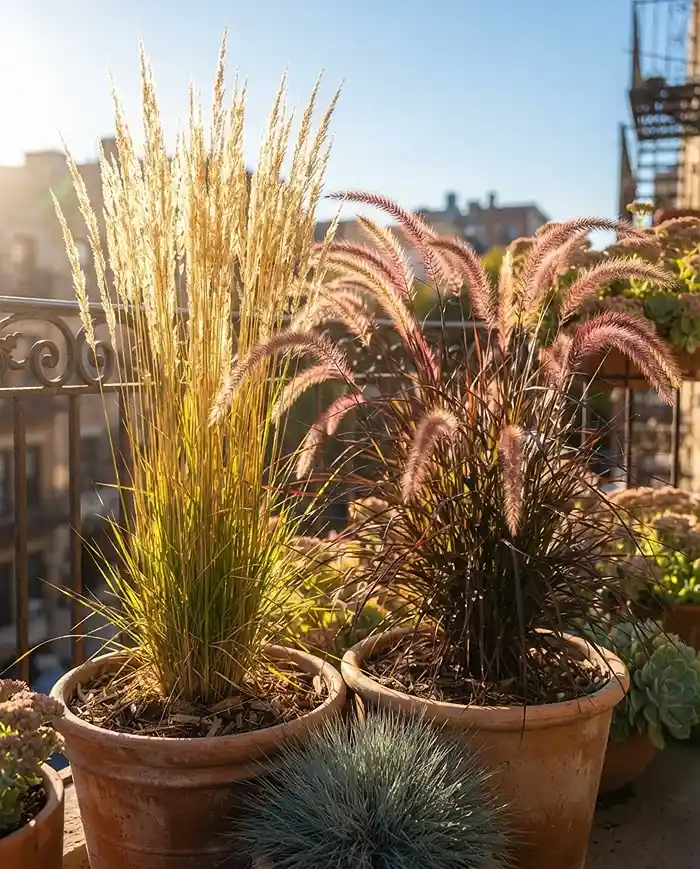
Quick Answer: For drama and height, Purple Fountain Grass (Pennisetum setaceum ‘Rubrum’) and ‘Karl Foerster’ Feather Reed Grass are the top two ornamental grasses for balcony containers. Both reach 3-5 feet and produce showstopping plumes.
‘Rubrum’ delivers deep burgundy blades and arching rosy plumes from midsummer through hard frost. It thrives in full sun and handles heat well — ideal for south-facing balconies. Treat it as an annual in zones below 9.
‘Karl Foerster’ is the cold-hardy workhorse. It’s reliably perennial in zones 4-9, stays upright even in wind, and produces narrow golden seed heads that look stunning dusted with frost. I keep mine in a 20-inch-wide, 18-inch-deep pot — anything smaller and it goes rootbound by August.
Plant these off-center in large floor pots for a modern asymmetrical look. They’re your vertical anchors — everything else layers around them.
Pro Tip: ‘Karl Foerster’ stays attractive all winter, so don’t cut it back in fall — leave the dried stalks for structure and cut to 4 inches in early March.
Low-Profile Fillers: Blue Fescue and Hakonechloa
Quick Answer: Blue Fescue (Festuca glauca ‘Elijah Blue’) and Japanese Forest Grass (Hakonechloa macra ‘Aureola’) are the best compact grasses for balcony containers. Use Blue Fescue in full sun and Hakonechloa in partial shade.
‘Elijah Blue’ forms tight 8-10-inch silvery-blue mounds that contrast brilliantly against warm-toned flowers like orange mums or rust-colored coneflowers. Its spiky texture softens hard terracotta edges beautifully.
Hakonechloa ‘Aureola’ is the shade solution for apartment balcony gardeners who don’t get direct afternoon light. Its cascading golden-green blades drape over pot edges like a waterfall. In September it blushes pink — genuinely one of the most elegant plants in small space gardening.
Pro Tip: Plant Blue Fescue in groups of three smaller 6-inch pots clustered at the base of a tall grass — it looks far more intentional than a single specimen.
Top Late-Blooming Flowers to Pair with Grasses
The goal is visual balance: the airy verticals of the grasses need dense, mounding floral masses to anchor the design. These late-season bloomers deliver exactly that, and most keep going until genuine frost.
Vibrant Asters and Japanese Anemones
Quick Answer: Native purple asters (Symphyotrichum spp.) and Japanese Anemones (Anemone x hybrida) peak in late summer and autumn — exactly when most other flowers are fading. They’re perfect mid-level fillers in mixed balcony containers.
Asters in rich violet or deep pink create a dramatic color pop against the silver-green of Blue Fescue blades. They’re also magnets for migrating butterflies in September and October, which turns your balcony into an actual wildlife moment.
Japanese Anemones bring a more delicate, romantic quality — pale pink or white single blooms on wiry 2-foot stems. They thrive in the partial shade that east facing balcony plants often deal with, making them unusually versatile for tiny garden ideas on less-sunny exposures.
Pro Tip: Buy asters in late summer already in bud — early-planted ones often get leggy by the time they bloom. A late August purchase gives you immediate impact.
Classic Garden Mums and Coneflowers
Quick Answer: Garden Chrysanthemums and Echinacea (Coneflowers) are the most reliable heavy bloomers for late-season balcony containers. Place them directly at the base of tall grasses to ground the container’s visual weight.
Garden mums come in a huge color range — I reach for deep burgundy or burnt orange to complement bronze grass blades — and they bloom reliably from September through the first hard frost. Look for tight-budded plants, not ones already fully open.
Coneflowers are the drought-tolerant workhorse here. They pair especially well with Blue Fescue since both prefer drier conditions and full sun. As the petals fade, the spiky seed heads remain attractive all winter.
These solid, mounding plants solve the “too much air, not enough substance” problem that plagues grass-only balcony arrangements. They’re the visual anchors that make the whole design feel finished.
Pro Tip: In zone 5 and below, treat garden mums as annuals — they rarely overwinter reliably in pots. Spend on a great display and compost them after frost rather than fighting to save them.
Choosing the Right Containers for Deep Roots
Container selection makes or breaks this style of planting. Ornamental grasses have aggressive root systems that will crowd out companion flowers fast if you give them too small a pot. Match the volume to the plant, not the aesthetic.
Depth Requirements for Ornamental Grasses
Quick Answer: Tall ornamental grasses need containers at least 14-18 inches deep and 16-20 inches wide. Anything shallower and the grass roots will outcompete companion flowers within a single season.
I learned this painfully with a ‘Karl Foerster’ I planted in a beautiful but shallow 10-inch pot. By July the asters I’d planted alongside it were yellowing and stunted — the grass had colonized every cubic inch of soil. I repotted into an 18-inch-deep container and both plants thrived.
For compact grasses like Blue Fescue, 10-12 inches of depth is sufficient. But for anything over 3 feet, don’t compromise on depth. The root ball needs room to anchor the plant against wind, too.
Pro Tip: Add a layer of gravel at the bottom of deep pots to improve drainage without adding soil volume — roots stay healthier and pots stay lighter.
Insulated Resin vs. Terracotta Pots
Quick Answer: Double-walled resin pots protect late-season roots from rapid temperature swings — critical in zones 5-7. Reserve unglazed terracotta for drought-tolerant combos like Blue Fescue and Coneflowers that need fast drainage.
| Container Type | Best Pairing | Watch Out For |
|---|---|---|
| Double-walled resin | Feather Reed Grass + Asters or Mums | Can retain too much moisture if drainage holes are small |
| Unglazed terracotta | Blue Fescue + Coneflowers | Dries out fast in wind; check daily in summer |
| Glazed ceramic | Hakonechloa + Japanese Anemone | Heavy — ensure balcony load rating allows it |
| Heavyweight fabric grow bags | Purple Fountain Grass (annual) | Tips over easily in wind above 3rd floor |
Step-by-Step Planting and Styling Guide
Timing matters here. For late-season displays, plant in late August to early September — the plants need 4-6 weeks to settle roots before the first frost. Check your container planting guidance for your specific zone.
Follow this sequence for best results:
- Fill the large pot two-thirds full with a fast-draining organic mix — aim for 25-30% perlite to prevent waterlogging in the slower-draining autumn weather.
- Set the grass root ball slightly off-center (about one-third from the pot edge) for a modern asymmetrical composition rather than a formal centered look.
- Pack late-blooming flowers tightly around the base of the grass, filling the remaining space. Tight planting looks intentional and fills in faster.
- Top-dress with a 2-inch layer of bark mulch to slow moisture loss and insulate roots as temperatures drop.
- Water thoroughly until water runs from drainage holes, then don’t water again until the finger test confirms dryness 2 inches down.
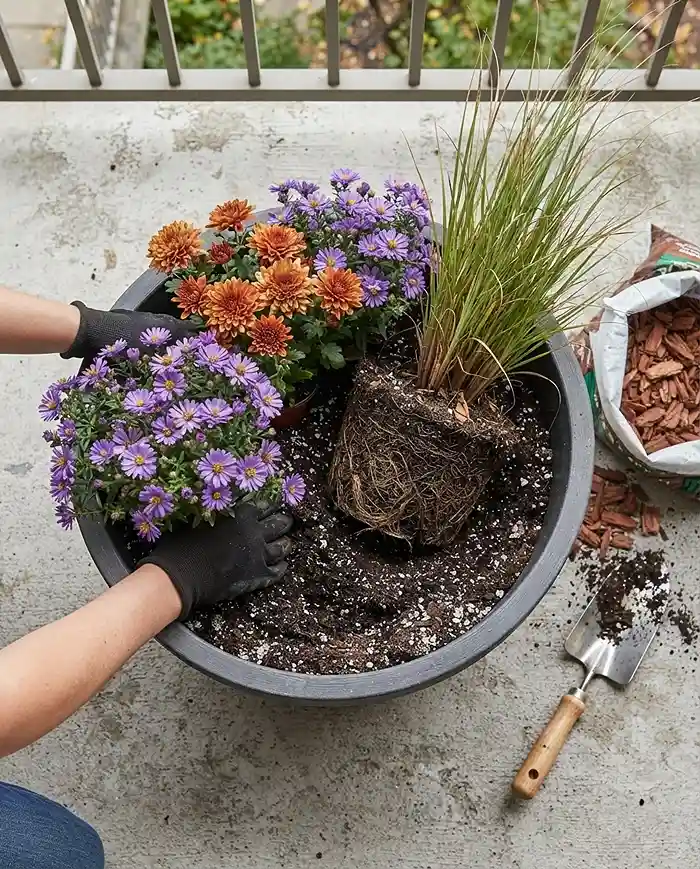
For styling, think in threes: one tall grass, one mid-level bloomer, one low-spreading filler. That layered structure reads as intentional rather than random, and it’s the foundation of most professional small balcony garden designs.
Maintenance for Late-Season Textural Gardens
Mixed-species containers need a different maintenance rhythm than single-plant pots. The root competition is real, and it intensifies as autumn progresses. Adjust your routine accordingly.
Watering Routines for Mixed Pairings
Quick Answer: As weather cools, surface soil stays damp longer but roots deeper down can still be dry — especially under a dense grass root ball. Use the finger test: push 2 fingers 2 inches into the soil. Water only when it feels dry at that depth.
Grass roots consume moisture faster than the companion flowers, so the flower roots near the edge of the pot often dry out first. Tilt your watering can toward the pot’s edges, not just the center, to reach those zones.
In September and October, I typically water my mixed containers every 3-4 days rather than the daily summer schedule. But a warm, windy October day can flip that — always verify rather than assuming a schedule.
Pro Tip: Stick a moisture meter in the center of the pot (under the grass crown) — that’s the last place to dry out, and it tells you the true status of the whole container.
The “Comb and Trim” Method for Grass Care
Quick Answer: Deadhead fading flowers every 5-7 days to force continuous blooming. For the ornamental grasses, simply “comb” through the blades with gloved fingers to pull away dead brown material without cutting into the living crown.
The combing method sounds fussy but takes under 2 minutes per pot. Run gloved fingers from the base upward in the direction of growth. Dead blades release easily; healthy ones don’t. You’ll remove the brown dieback that makes grasses look shabby without harming next season’s growth.
For flowers like asters and mums, cut spent blooms back to the next bud cluster. This is standard deadheading — remove the finished flower, not the whole stem. Each cut triggers 2-3 new buds in healthy plants. Don’t skip this step if you want continuous color.
Common Problems and Solutions
Even a well-planted container can run into trouble by mid-autumn. Here are the two issues I see most often — and how to fix them quickly.
Root-Bound Grasses Choking Flowers
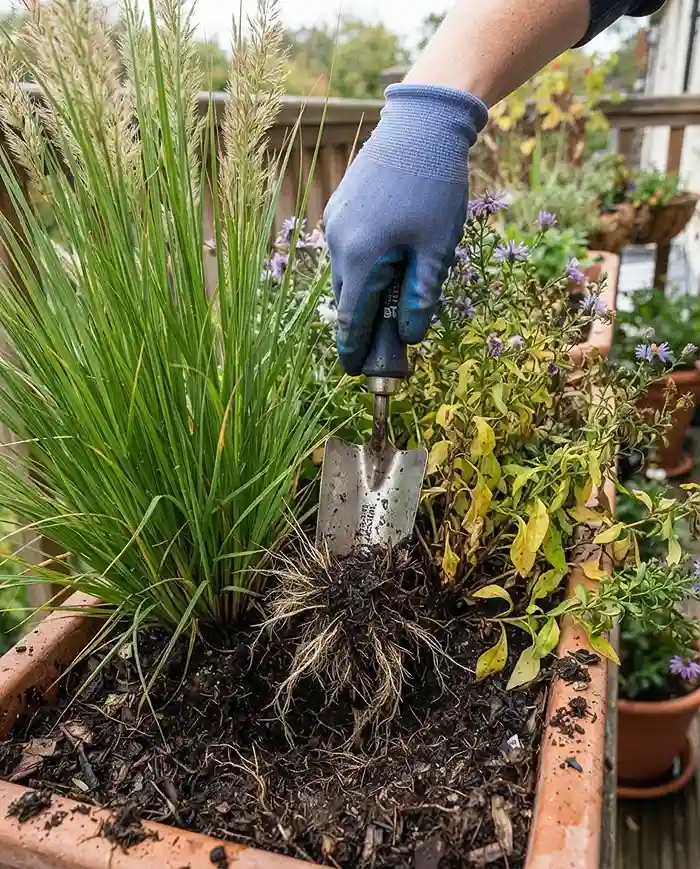
Quick Answer: If your companion flowers suddenly stunt, turn yellow, and stop blooming mid-season while the grass looks fine, root strangulation is the likely cause. The grass has colonized the soil and is starving the flowers of water and nutrients.
The fix is surprisingly low-tech: drive a long knife or narrow trowel blade vertically into the soil between the grass and the flowers, working around the full circumference. This severs aggressive surface roots and temporarily restores nutrient access to the blooms.
It’s a temporary measure — by next season, you’ll need to divide the grass or move to separate containers. But mid-season it buys another 6-8 weeks of bloom from plants that would otherwise give up.
Rust and Powdery Mildew in Autumn Air
Quick Answer: Orange rust spots on grass blades and white powdery coating on flower leaves both spike in cool, damp autumn air with poor circulation. Treat with a potassium bicarbonate spray and thin inner foliage for airflow.
I had a severe powdery mildew outbreak on my container asters in October 2022 — the whole center of the plant went gray and mushy within a week of consecutive foggy mornings. I’ve since started thinning the inner stems by about 25% in early September to prevent the stagnant air pockets where mildew thrives.
Mix 1 tablespoon of potassium bicarbonate per gallon of water and spray affected foliage in the morning so it dries before evening. Repeat weekly. It’s an organic option that actually works, unlike baking soda, which can damage leaves at higher concentrations.
Frequently Asked Questions
Can ornamental grasses survive the winter in a balcony pot?
Many ornamental grasses are cold-hardy perennials that overwinter well in large containers. Leave the dried stalks intact through winter — they insulate the crown and provide visual interest. ‘Karl Foerster’ is reliably perennial in zones 4-9 in containers. Purple Fountain Grass is only perennial in zones 9-11 and should be treated as an annual elsewhere.
Do I need to cut back my balcony grasses in the fall?
No. Do not cut ornamental grasses back in autumn. The foliage protects the crown from freezing winds and provides winter interest on your balcony. Wait until early spring — typically late February to early March — then shear the clump down to 3-4 inches above soil level before new green growth emerges.
How often should I fertilize late-blooming balcony flowers?
Avoid fast-acting, high-nitrogen liquid fertilizers from mid-August onward. They push tender new growth that frost will damage. Instead, work a slow-release, phosphorus-rich granular fertilizer or compost into the soil at planting time. This supports the final floral flush without creating soft, frost-vulnerable growth.
What size pot do I need for ornamental grasses on a balcony?
Tall ornamental grasses like ‘Karl Foerster’ or Purple Fountain Grass need a container at least 14-18 inches deep and 16-20 inches wide. Compact varieties like Blue Fescue can manage in 10-12 inch pots. Never go smaller — undersized pots lead to rootbound plants within a single season.
Which ornamental grasses work best for east facing balcony plants?
Hakonechloa macra ‘Aureola’ (Japanese Forest Grass) is the top pick for east-facing balconies with morning sun and afternoon shade. Japanese Anemones and asters also perform beautifully in this light. Avoid full-sun grasses like Blue Fescue or Purple Fountain Grass in east-only exposures — they’ll grow poorly and fade.
Key Takeaways
- Ornamental grasses for balcony containers work best when paired with dense, mounding late-bloomers — the contrast between airy verticals and solid floral masses is what creates a sophisticated, layered design.
- Audit your balcony’s September light and wind patterns before planting — late-season sun angles and high-altitude gusts are often very different from summer conditions.
- Match container depth to grass size: minimum 14-18 inches deep for tall varieties. Shallow pots lead to root competition that chokes companion flowers by midsummer.
- Don’t cut grasses back in autumn. Leave stalks intact for winter interest and crown insulation, then shear to 3-4 inches in early spring before new growth starts.
- Small balcony garden success with mixed containers comes down to the finger test — always check soil moisture 2 inches deep, especially under dense grass root masses that dry unevenly.
Before you buy a single plant, avoid the most common mistakes by checking out beginner apartment gardening mistakes — many of them apply directly to container grass gardens.