
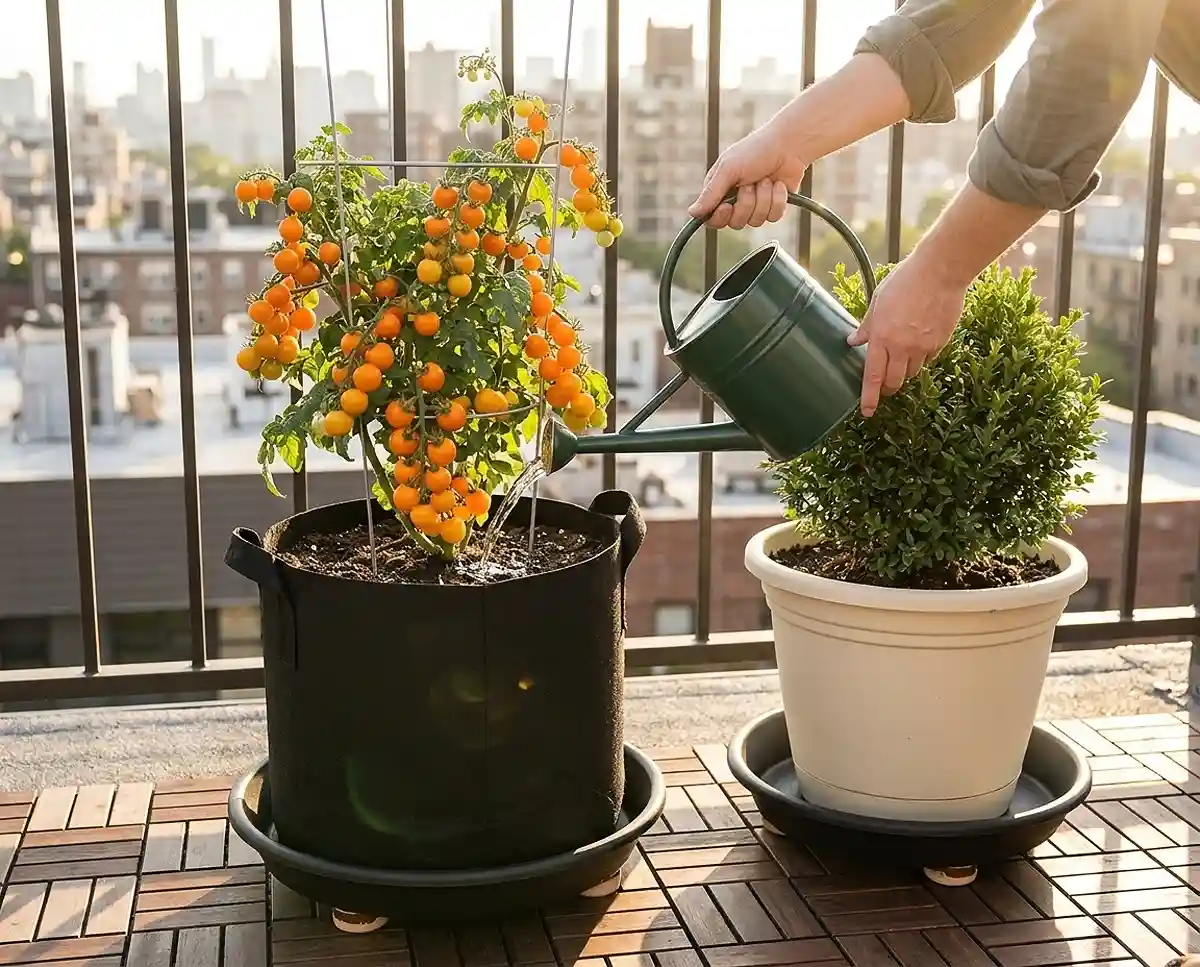
Pots vs Grow Bags Balcony Showdown
My first balcony tomato dripped muddy water onto my downstairs neighbor. Pots vs grow bags balcony choices matter, and balcony grow bags fixed that mess. Not always, though. Rigid pots win plenty of fights too. I garden on a sunny zone 7a rooftop terrace, in containers from 5-gallon bags to 20-inch resin planters.
Table of Contents
The Balcony Container Dilemma: Why Material Choice Makes or Breaks Your Garden
Short Answer: Rigid pots hold water and anchor against wind. Fabric grow bags breathe, weigh almost nothing, and fold flat. On an upper-floor balcony, wind, heat, and downstairs runoff decide the winner. Match the container to your microclimate first and your plants second.
Here’s the tension. Rigid pots (plastic, terracotta, ceramic, fiberglass) hold moisture and stand up to gusts. Non-woven fabric bags let air and water pass through every wall. That’s great for roots, but it changes how you water and where runoff lands.
On my rooftop, wind tipped one lightweight pot twice in a single week. Downstairs runoff is the quieter problem. Both show up on a balcony far faster than in a backyard.
Renting? Your lease may limit weight and drainage, so skim these renter-friendly balcony planter solutions too.
Quick-Glance Comparison Scorecard: Weight, Cost, Lifespan, and Root Health
Short Answer: Fabric grow bags win on weight, root aeration, and winter storage. Rigid pots win on water retention, polish, and wind stability. Durability is close overall, since quality bags last 4 to 6 seasons. Here’s the side-by-side for a typical 5-gallon balcony container.
| Balcony metric | Rigid pots | Fabric grow bags |
|---|---|---|
| Empty weight (5 gal) | 1 to 2 lb for resin or plastic; 10+ lb for terracotta or ceramic | Under 1 lb |
| Winter storage footprint | Bulky, even when stacked | Folds into a shoebox |
| Water retention | High; dries slowly | Low; often needs daily water in July |
| Root aeration | Low; roots circle the wall | High; roots air-prune |
| Aesthetic polish | Polished, many finishes | Casual unless hidden in an outer planter |
| 5-year durability | Resin and fiberglass hold up; terracotta can crack in freezes | 4 to 6 seasons for thick, UV-stabilized bags |
As of fall 2026, shop for 300 to 400 GSM bags [GSM means grams per square meter, a measure of fabric thickness]. Look for UV-stabilized stitching. Thinner bags tend to wear out faster.
How Balcony Microclimates (High-Rise Wind, Concrete Heat, and Shade) Impact Each Container
Short Answer: Fabric suits humid, shady balconies and scorching afternoon heat, because evaporation cools the roots. Rigid pots suit dry, wind-whipped high-rise balconies, where fabric would need constant watering. Reflected concrete heat falls in between, so add mulch and shade cloth either way.
The Why: Concrete and railings radiate heat long after sunset. Wind strips moisture from porous walls fast. Shade slows evaporation, which can leave rigid pots soggy for days.
Try This: At 3 p.m., press your palm on the balcony floor. If you can’t hold it there for five seconds, pick fabric for vegetables and add shade cloth.
Pots vs Grow Bags Balcony Face-Off: Root Science, Drainage, and Weight
Short Answer: Fabric walls dry out root tips and cool soil through evaporation. Rigid walls steer roots into circles and trap heat. Drainage differs too: fabric weeps clear water from every side, while a single drainage hole can flush soil unless screened. Weight depends mostly on soil volume.
Root Architecture: “Air-Pruning” in Fabric Grow Bags vs. Root Circling in Rigid Pots
Short Answer: Roots that reach a fabric wall hit dry air and stop growing at the tip. The plant then branches behind it, building many fibrous feeder roots. Smooth plastic or glazed ceramic walls send roots spiraling around the pot, where they tangle and strangle themselves.
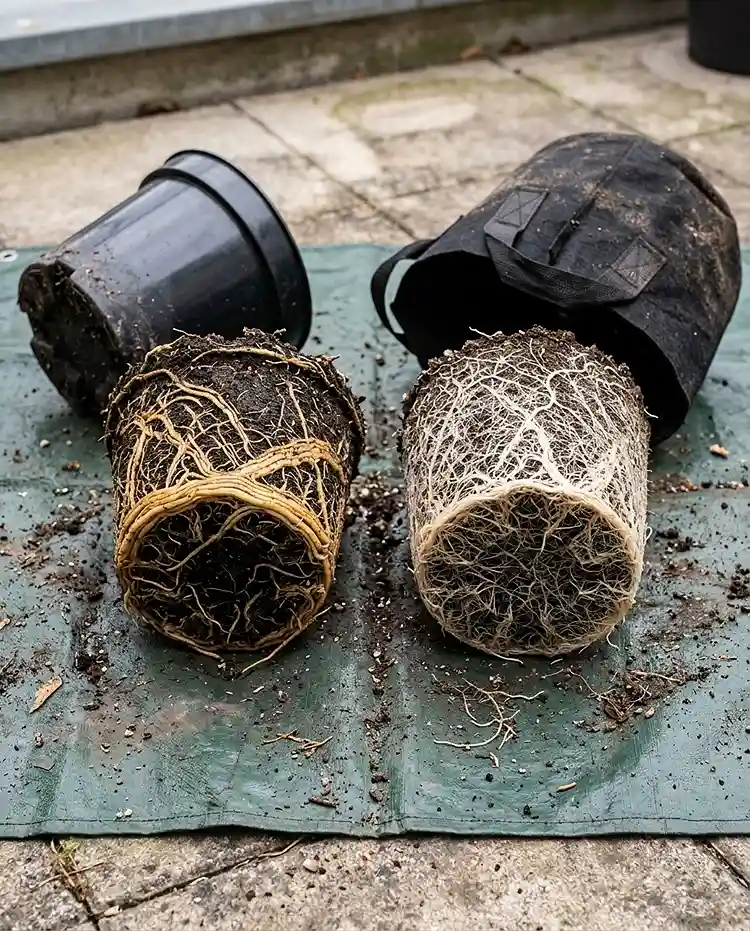
This is air-pruning [a root tip dries out at a breathable wall and stops lengthening]. It matters most for long-lived plants like trees and shrubs. For annual vegetables, the benefit is real but smaller than product ads suggest.
Researchers at Colorado State University examined how fabric and black plastic containers affect root circling and root quality in nursery trees.
Root-Zone Temperature Regulation in Direct Afternoon Balcony Sun
Short Answer: Damp fabric walls cool the soil through evaporation. Expect soil 10°F to 15°F (5.5°C to 8.3°C) cooler on 95°F (35°C) days. Dark plastic and metal pots absorb radiant heat and can cook the outer roots. Light colors and shade help, but fabric cools best.
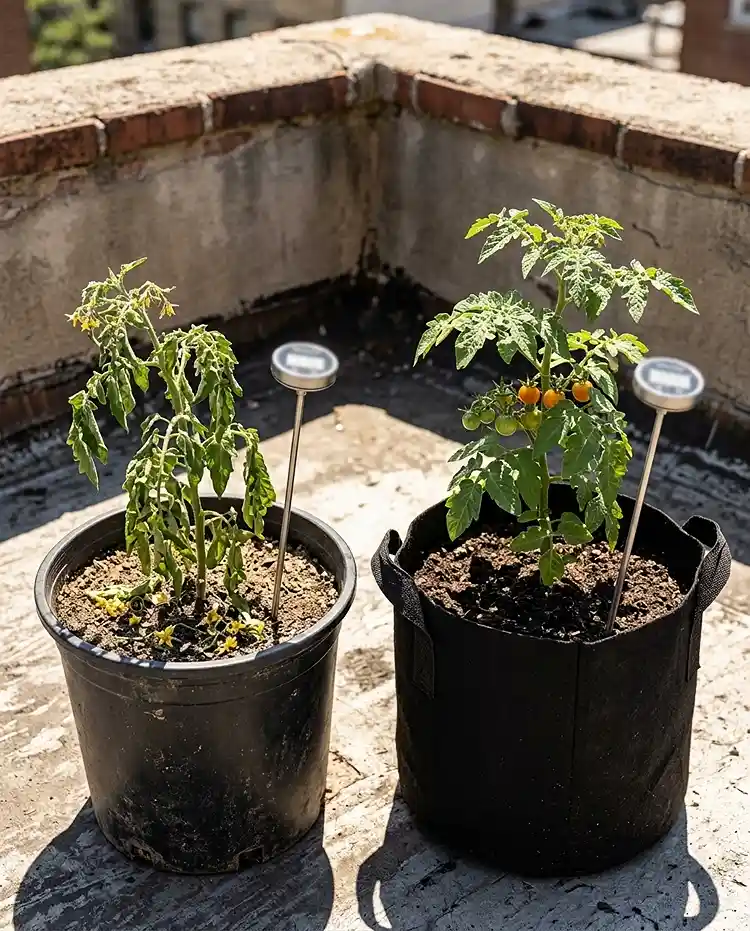
What Happened to Me: Summer 2024, I grew ‘Sun Gold’ cherry tomatoes in a black 5-gallon plastic pot on my hottest corner. At 3 p.m., my probe thermometer read 104°F in the soil. A twin plant in a 7-gallon fabric bag read 91°F.
By Labor Day, the plastic pot gave me 41 tomatoes. The fabric bag gave 112. My mistake was assuming tomatoes love heat, so roots must too. Now I swap dark pots for fabric or white resin and add shade cloth in July.
Balcony Drainage, Downstairs Leaks, and Structural Weight Limits
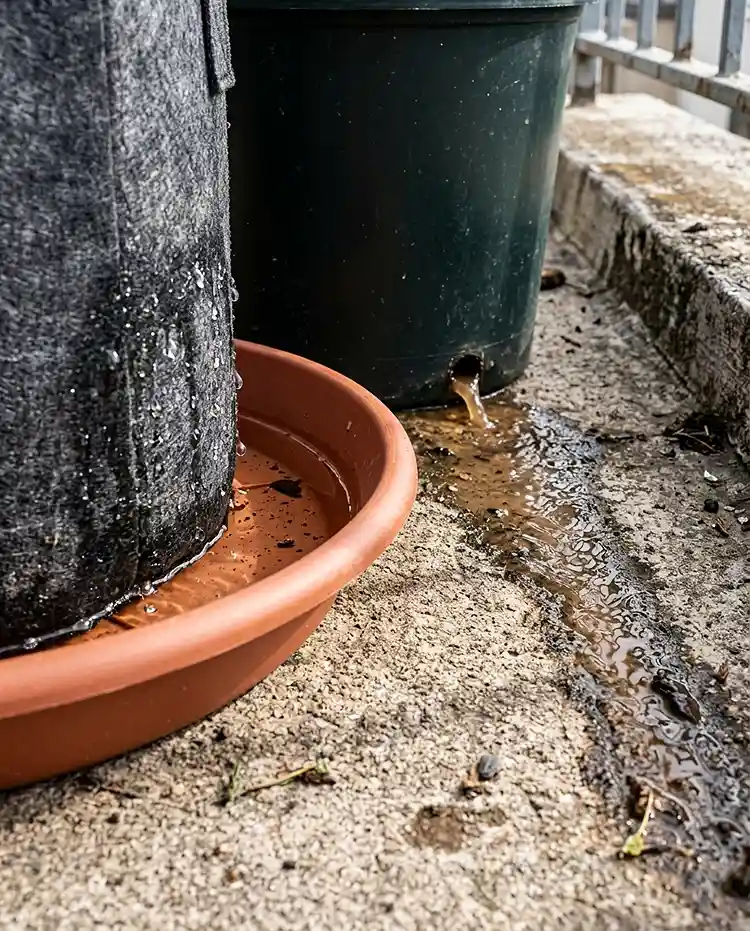
Short Answer: Fabric bags act like coffee filters, passing clear water from every side and holding back soil. Single-hole rigid pots drain from one spot and can flush muddy sediment unless you add a screen. Either way, use a wide saucer, and weigh your soil before loading a balcony.
Try This: A 10-gallon bag holds about 1.3 cubic feet. Wet mix weighs roughly 45 pounds per cubic foot, so expect about 60 pounds.
That’s roughly 55 pounds per square foot of footprint. Confirm your balcony’s load rating with your landlord or building manager.
Need to cut weight? Compare these lightweight balcony planters before you buy.
Matching Pots vs. Grow Bags to Specific Balcony Plants
Short Answer: Choose fabric for heavy-feeding annual vegetables that you’ll pull out in fall. Choose rigid pots for permanent shrubs, trees, and railing flowers that need weight and moisture. Combine both when looks matter. This container comparison keeps you from buying the wrong container twice.
When Fabric Grow Bags Win: Tomatoes, Potatoes, Root Crops, and Annual Veggies
Short Answer: Fabric bags in the 7 to 15-gallon range suit tomatoes, peppers, ‘Parisian’ carrots, and hilled potatoes. Some growers report up to 25% higher yields from air-pruned roots, though results vary. Bags also fold flat in November, which saves precious closet space.
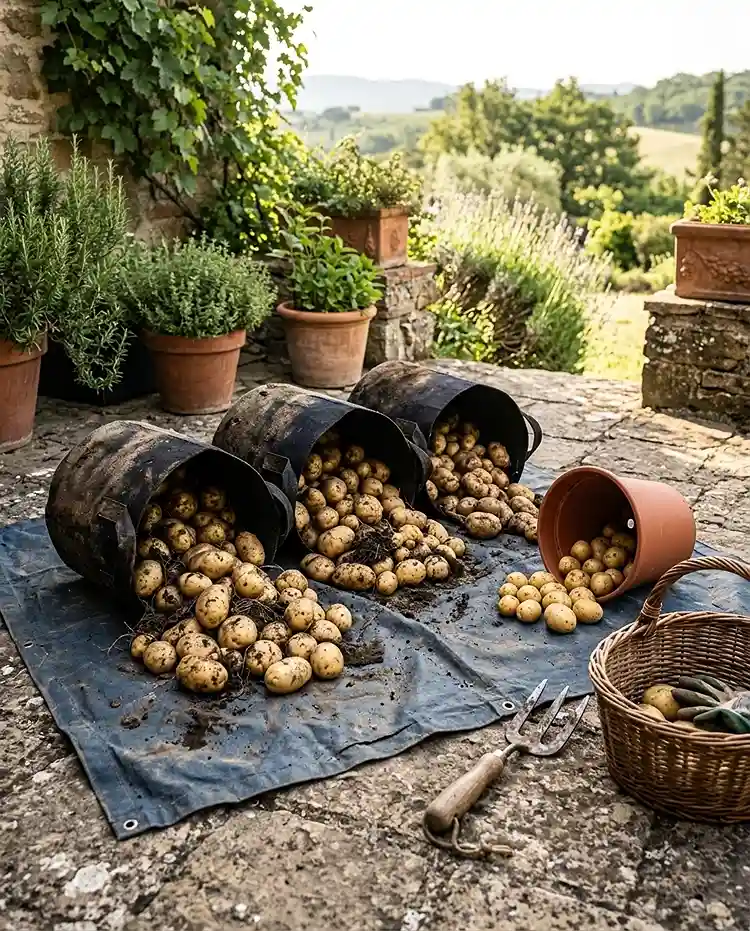
Both determinate [bush-type, ripens in one flush] and indeterminate [vining, produces until frost] tomatoes do well in 10-gallon bags. Hilled potatoes [soil mounded up the stems as they grow] love the extra room.
What Happened to Me: In mid-March 2025, I planted ‘Yukon Gold’ seed potatoes in three 10-gallon fabric bags. I harvested about 100 days later, on June 25. Each bag gave 4.5 pounds. A 12-inch plastic pot gave 1.5.
When Rigid Pots Win: Permanent Shrubs, Tall Privacy Screens, and Cascading Railing Flowers
Short Answer: Choose fiberglass, resin, or terracotta for multi-year evergreens, dwarf trees, clumping bamboo, and railing flowers. Their rigid walls hold their shape, their base weight resists wind, and they hold moisture longer. Soft fabric tips over when top-heavy plants catch a gust.
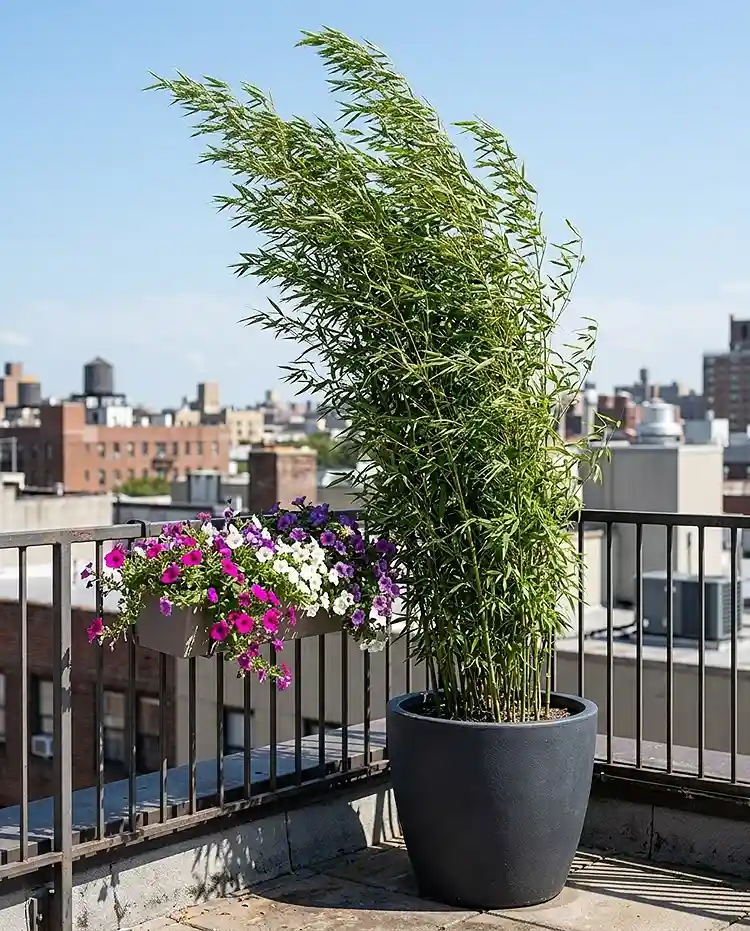
Clumping bamboo [stays in a tight clump instead of spreading] gets top-heavy fast. A 20-inch fiberglass planter keeps it upright in a stiff breeze. Cascading petunias also need a rigid pot that clamps to a railing.
Browse these balcony railing planters for sizes that match your rail.
The “Cachepot Hybrid” Trick: Hiding Breathable Grow Bags Inside Decorative Outer Planters
Short Answer: Plant in a 5-gallon fabric bag, then nest it inside a slightly wider basket, crate, or fiberglass urn. Raise the bag on pot feet for a 1-inch air gap. You get air-pruned roots and a polished look from the outside.
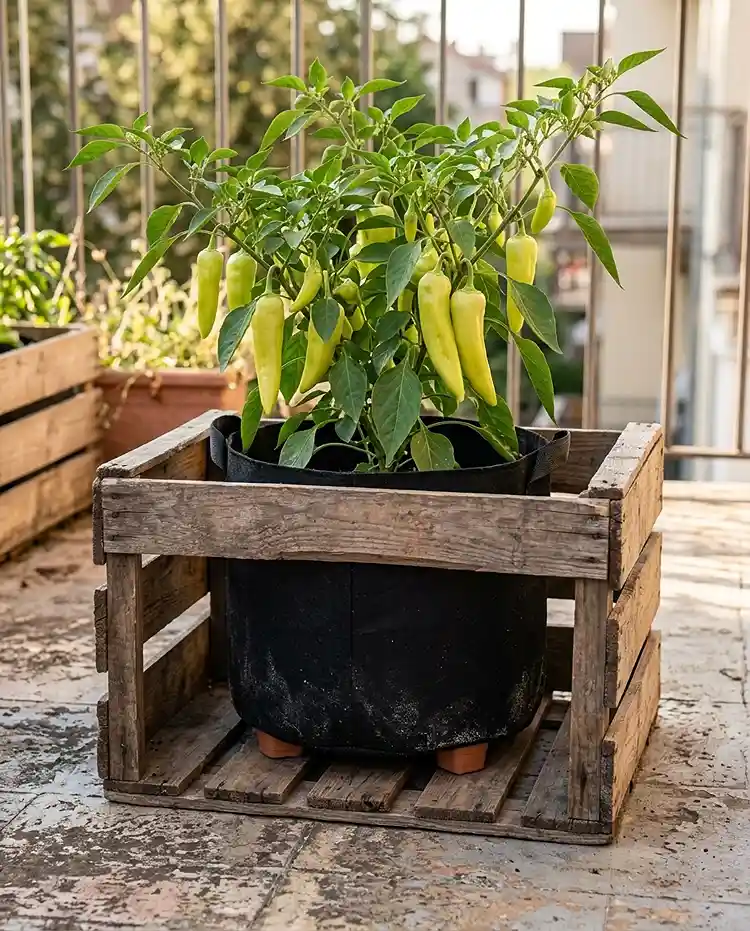
A cachepot [a decorative outer pot that hides a plain inner one] is an old designer trick. Fabric needs airflow, so never wedge the bag tight against the outer wall. Never let it sit in drained water either.
In summer 2025, I grew a ‘Sweet Banana’ pepper this way inside a wooden crate. It gave 14 peppers by early August. Nobody who visited my terrace guessed the plant was growing in a bag.
Essential Setup: Custom Potting Soil Recipes and Containment Gear for Both
Short Answer: Fabric bags dry faster, so give them a moisture-holding mix. Rigid pots hold water, so give them a fast-draining mix. Pair both with oversized saucers, pot feet, and stable supports so runoff and tipping never become your downstairs neighbor’s problem. Get these right and most watering troubles disappear.
Soil Recipe Adjustments: Moisture-Locking Mix for Grow Bags vs. Fast-Draining Mix for Rigid Pots
Short Answer: In fabric bags, add coco coir, vermiculite, and compost to counter evaporation from every wall. In rigid pots, add about 30% coarse perlite plus pine bark fines to prevent waterlogging at the bottom. These two bucket recipes keep each container’s quirks in check.
Fabric grow bag mix (by volume):
- 50% quality potting mix
- 20% coco coir [shredded coconut husk fiber that holds water]
- 10% vermiculite [mineral flakes that hold water and air]
- 20% finished compost
Rigid pot mix (by volume):
- 50% quality potting mix
- 30% coarse perlite [puffed volcanic glass that improves drainage]
- 20% pine bark fines
Choosing Oversized Drip Trays, Pot Feet, and Support Stakes for Soft-Sided Bags
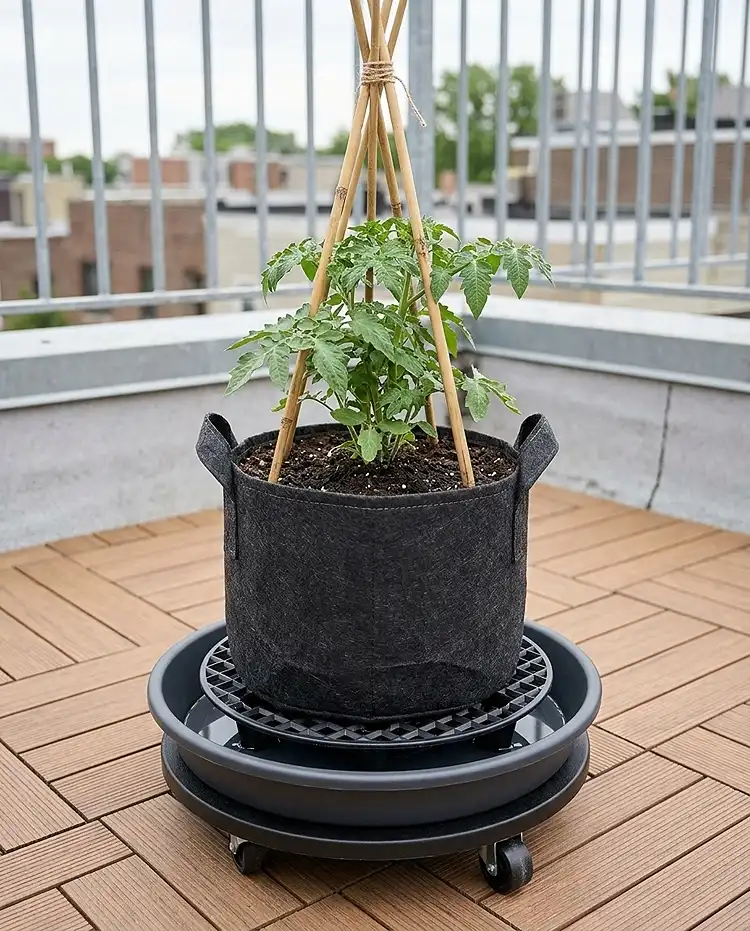
Short Answer: Buy saucers 2 inches wider than a grow bag’s diameter to catch weeping from the sides. Lift bags on plastic grid risers so wet bottoms don’t rot deck tiles. Anchor bamboo teepees deep in the soil, since soft walls can’t hold stakes alone.
- Saucer 2 inches wider than the bag and about 3 inches deep
- Plastic grid risers under every bag
- Bamboo stakes pushed to the bottom and tied in a teepee
- Wheeled plant caddy for 10-gallon bags and larger
Seasonal Maintenance, Watering Schedules, and Winter Storage Comparison
Short Answer: Fabric bags need water daily in July and every two to three days in spring and fall. Rigid pots buffer longer gaps between drinks. In winter, sanitize and fold bags, while perennials left outside need extra insulation across USDA zones 3 to 9.
Watering Frequency Chart: Daily Summer Soaks in Grow Bags vs. Multi-Day Buffering in Pots
Short Answer: A 5-gallon fabric bag in full July sun needs a morning soak every day, or a bottom-soak in a tray. A 5-gallon double-walled resin pot can go 2 to 3 days between drinks. Spring and fall gaps are longer for both.
| Season and weather | 5-gallon fabric bag | 5-gallon double-walled resin pot |
|---|---|---|
| Cool spring (about 60°F) | Every 2 to 3 days | Every 4 to 5 days |
| Early summer (about 80°F) | Every 1 to 2 days | Every 3 days |
| July sun (95°F) | Daily, mornings | Every 2 to 3 days |
| Fall (about 65°F) | Every 2 to 3 days | Every 4 to 6 days |
Try This: Poke a finger 2 inches into the soil. If it’s dry, water. If it’s damp, wait.
Overwintering Perennials and Sanitizing Folded Grow Bags at Season’s End
Short Answer: At season’s end, empty the bag and brush off soil. Soak it in a 10% vinegar solution, dry it fully, and fold it into a shoebox. Perennials left outdoors in fabric bags need burlap wind-wrapping, because insulated resin pots protect roots better.
- Empty the bag and brush off loose soil
- Soak in one part white vinegar to nine parts water, or diluted hydrogen peroxide
- Rinse and dry completely before folding
- Store the folded bag in a shoebox indoors
In zones 3 to 5, move perennials against the building wall. In zones 6 to 9, burlap and mulch usually do the job.
See Penn State Extension’s advice on overwintering container plants.
Common Problems & Solutions
Short Answer: Three problems show up again and again with fabric bags and rigid pots. Water runs out the sides. Algae and salt crusts mar the walls. Floppy bags collapse when you move them. Each one has a simple, cheap fix you can finish in an afternoon.
Grow Bags Drying Out on the Outer Edges and Repelling Water Out the Sides
Short Answer: Pour water too fast onto a dry bag and it gushes out the felt walls before reaching the center. Fix it three ways. Add a 2-inch mulch ring, pulse-water slowly at the stem base, or bottom-water in a deep boot tray.
Green Algae, White Salt Crusts, and Mildew Stains on Fabric Grow Bag Walls
Short Answer: Tan and gray felt bags grow green algae in shade and white mineral rings in sun. Choose black or dark green UV-treated, BPA-free polypropylene bags. Scrub the exterior with a stiff brush, and lift bags onto risers so walls dry between waterings.
Floppy Grow Bag Walls Collapsing When Moving Plants or Anchoring Tall Trellises
Short Answer: Lifting a wet 10-gallon bag by its handles can crack the root ball and loosen stakes inside. Place large bags on wheeled plant caddies before filling them with soil. Use external cage frames instead of stakes inside the soft walls.
Frequently Asked Questions
Are black fabric grow bags safe for growing vegetables in hot balcony sun?
Yes, if they’re food-grade, BPA-free non-woven polypropylene (PP) or PET felt. Those materials are chemically inert, so they’re fine for organic vegetables. Unlike solid black plastic pots, the porous weave cools roots through evaporation instead of trapping heat.
How many years do fabric grow bags last on an outdoor balcony?
Quality bags made from 300 to 400 GSM non-woven felt with UV-stabilized stitching typically last 4 to 6 growing seasons. Empty them, dry them, and store them indoors over winter. Thinner bags wear out sooner in strong sun.
Do fabric grow bags leak dirty water onto balcony floors?
They work like a giant coffee filter, so nearly all soil stays inside and mostly clear water seeps out. It still weeps from every side, though. Set each bag in a wide, 3-inch-deep vinyl saucer on pot risers to keep water from dripping downstairs.
Should a beginner balcony gardener start with pots or grow bags?
Start with a 50/50 mix. Use 5 to 10-gallon fabric bags for summer vegetables like tomatoes, peppers, potatoes, and herbs, since they’re hard to overwater. Use lightweight fiberglass or resin pots for railing flowers and year-round evergreens.
Do grow bags need more water than plastic pots?
Yes. Fabric walls lose moisture from every side. A bag in July sun usually needs water daily, while a resin pot may wait two or three days. A mulch layer and a coco coir mix help bags hold moisture longer.
Can you put a grow bag inside a decorative pot?
Yes. Nest a 5-gallon bag inside a slightly wider basket, crate, or urn. Raise it on pot feet for a 1-inch air gap. That keeps the airflow roots like and hides the fabric.
Quick Recap
- Pick by microclimate first: fabric for humid, shady, or hot-afternoon balconies, rigid pots for dry, windy ones.
- Apply the pots vs grow bags balcony rule of thumb: fabric for annual vegetables, rigid for shrubs, trees, and railing flowers.
- Raise every container on risers and set it in a saucer 2 inches wider.
- Water fabric bags daily in July sun, and check rigid pots every 2 to 3 days.
- Sanitize, dry, and fold bags for winter, and wrap outdoor perennials in burlap.