
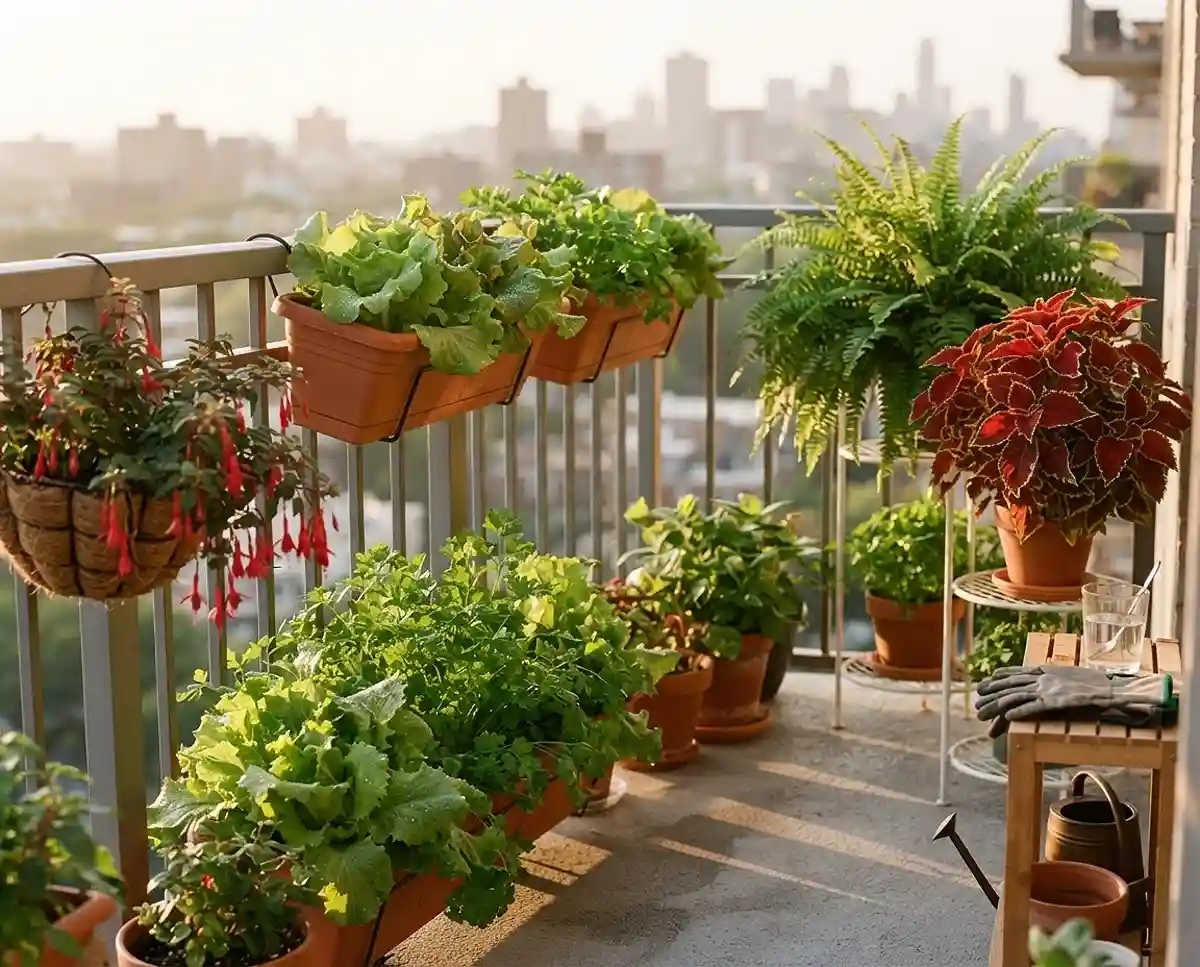
East Facing Balcony Plants: Best Choices for Small Spaces
East facing balcony plants thrive where other gardens struggle. You get cool, direct morning sun and a shady reprieve all afternoon — the gentlest microclimate in urban gardening. If you’ve been told your balcony is “too shady,” read on.
Table of Contents
The Magic of East-Facing Balconies: Morning Sun and Afternoon Shade
An east-facing balcony is arguably the most forgiving setup for small space gardening. The sun hits early, warms the containers gently, then retreats before the hottest part of the day.
That afternoon shade is a gift. It prevents soil from baking dry, keeps cool-season edibles from bolting, and protects delicate blooms from bleaching out. South- and west-facing balconies demand constant watering and sun-tough plants. East-facing? Far more forgiving.
I grow herbs and leafy greens on an east-facing balcony in zone 6b, and spring 2024 was the first season I didn’t lose a single lettuce plant to heat. The afternoon shade made the difference.
Analyzing Your East-Facing Microclimate
Before buying a single plant, spend one week mapping your actual light. What you assume and what’s real are often very different — especially in urban spaces where adjacent buildings chop up the light window.
Tracking the Morning Sun Window
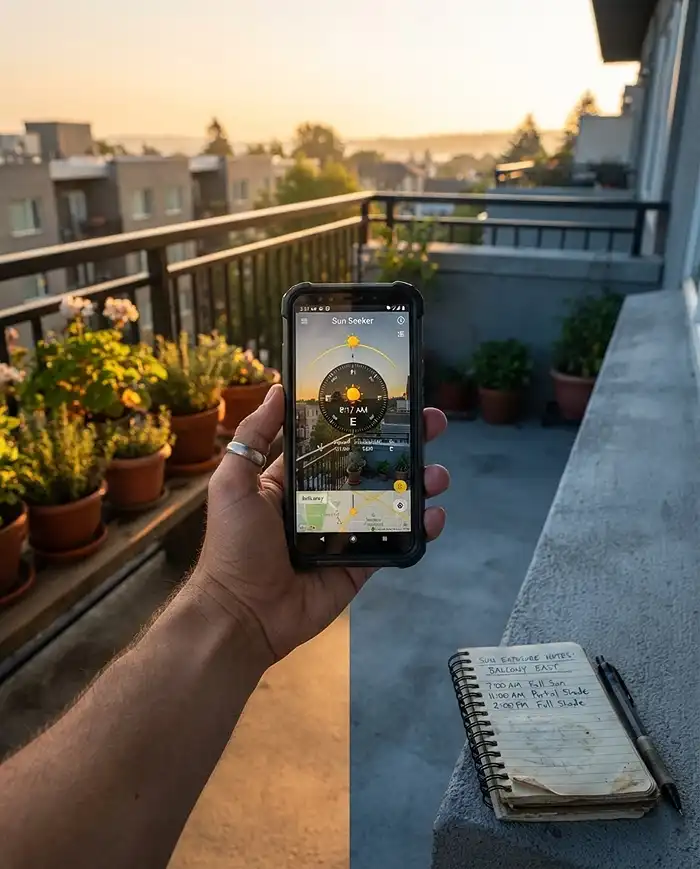
Quick Answer: True east-facing balconies receive 3 to 5 hours of direct morning sun, classifying them horticulturally as “partial shade” or “partial sun.” Map your exact window before choosing plants.
Set an alarm for sunrise and check every 30 minutes. Note exactly when direct sun hits your railing and when it disappears behind the roofline or a neighboring building.
Most east-facing spaces in cities get a 3- to 4-hour window of direct light. That’s enough for herbs, leafy greens, ferns, fuchsias, and begonias — but not for tomatoes or peppers.
Pro Tip: Track your light window in late spring, not midsummer — the sun angle shifts and your window can shrink by 30 to 45 minutes by August.
Temperature Swings and Moisture Retention
Quick Answer: Morning sun dries overnight dew naturally, which keeps fungal diseases in check. Afternoon shade dramatically slows soil evaporation, keeping roots cool and reducing watering frequency.
The early warmth is enough to evaporate dew from leaves — which is exactly what prevents powdery mildew and other fungal problems. But once the sun moves off, your containers cool down fast.
In peak summer, I measure soil temps on my east-facing balcony at around 68-72°F by 2pm. A south-facing pot in the same city? Easily 85°F or more. That cooler root zone is why shade-lovers thrive here.
Essential Supplies for Small East-Facing Balconies
Tiny garden ideas only work with the right hardware. The right containers and soil mix will make or break your east-facing setup before you plant a single thing.
Space-Saving Containers and Railing Pots
Quick Answer: Use over-the-railing saddle planters, tiered corner stands, and hanging baskets to maximize vertical space and push plants as close to the eastern light source as possible.
Saddle planters hang over the railing and put your plants right at the light source — critical when you’re only working with 3 to 5 hours of sun. Go for ones rated for at least 10 lbs to handle wet soil safely.
Tiered plant stands in corners free up floor space and create a layered display. Put your most light-hungry plants on top, shade-tolerant ferns at the bottom.
- Over-railing saddle planters: 8-12 inch width fits most railings
- Hanging baskets: 12-14 inch diameter ideal for trailing fuchsias
- Tiered corner stands: 3-shelf units hold 6-9 pots in a 2×2 foot footprint
- Window boxes: 24-36 inch lengths work well for leafy greens along the railing
Pro Tip: Confirm your railing’s weight rating before loading saddle planters — most apartment balcony railings handle 50-75 lbs distributed load, but check with your building manager.
Formulating the Right Soil Mix
Quick Answer: Blend premium organic potting soil with 30% perlite. This guarantees drainage even without afternoon sun to evaporate excess moisture. Garden soil is a hard no — it compacts and causes root rot.
Because your containers won’t get that afternoon bake-dry, poorly draining soil stays wet for days. That’s root rot territory. A perlite-heavy mix drains fast and stays aerated.
My recipe: 70% quality potting mix (I use Fox Farm Ocean Forest) + 30% coarse perlite. For ferns and moisture-lovers, I adjust to 80/20. For herbs, sometimes 65/35.
Best Ornamental Plants for East-Facing Balconies
These plants don’t just tolerate partial shade — they actually prefer it. Full sun would scorch them. Your east-facing setup is their ideal home.
Flowering Beauties: Fuchsias, Begonias, and Impatiens
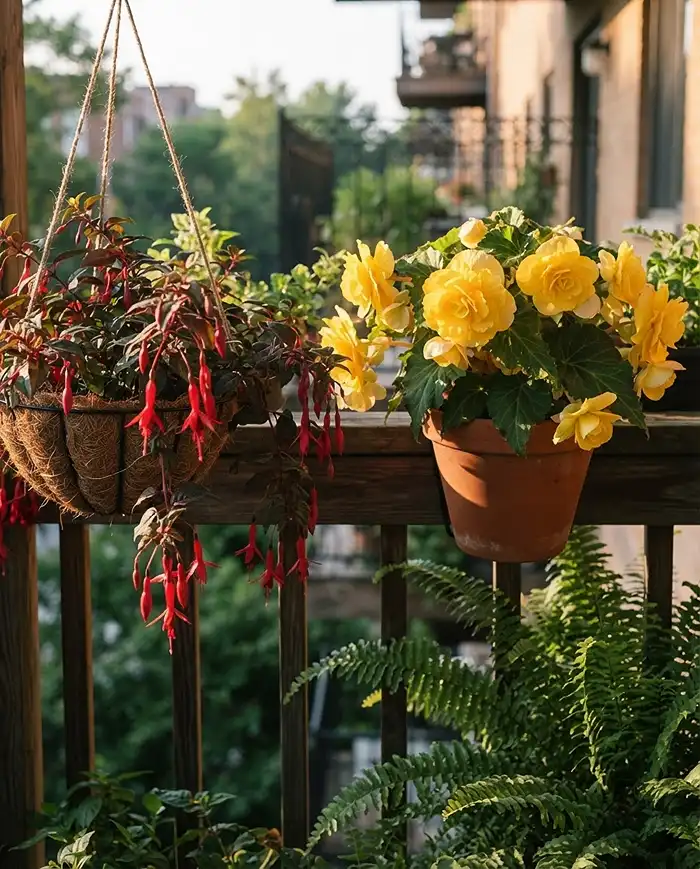
Quick Answer: Trailing Fuchsias, tuberous Begonias, and New Guinea Impatiens are the three workhorses of east-facing balcony color. All bloom prolifically in cool morning light and fade fast in afternoon heat they won’t receive.
Trailing Fuchsias like ‘Gartenmeister Bonstedt’ are made for hanging baskets on east-facing balconies. The pendulous blooms in deep red and purple practically glow in morning light. I’ve had baskets flower continuously from May through October in zone 6b.
Tuberous Begonias are the showstoppers — blooms that rival roses, in shades from white to neon orange. Varieties like ‘Illumination Salmon’ or ‘Non Stop Yellow’ perform beautifully in railing planters with morning sun.
New Guinea Impatiens handle slightly more sun than standard impatiens, making them perfect for the brighter end of your light window. They bloom non-stop without deadheading [removing spent flowers].
Pro Tip: Deadhead your fuchsias every 10-14 days to keep them producing new buds — left alone, they redirect energy into seed production and slow down flowering.
Striking Foliage: Ferns, Coleus, and Caladiums
Quick Answer: Boston Ferns, Coleus, and Caladiums build lush visual depth without relying on flowers. Their bold leaf textures and colors look best in the soft, directional quality of morning light.
I once tried a Boston Fern on a south-facing sill in summer 2022 — it was fried within three weeks. Moved it to my east-facing balcony and it doubled in size by September. These plants were born for this light.
Pair the feathery fronds of ‘Dallas’ or ‘Kimberly Queen’ ferns with the neon foliage of Coleus like ‘Wizard Scarlet’ or ‘Kong Rose’. The contrast in texture and color creates a display that carries all season.
Caladiums — especially ‘White Queen’ or ‘Red Flash’ — add dramatic heart-shaped leaves in pink, white, and deep red. They need warmth to establish but genuinely thrive in dappled conditions once growing.
- Boston Fern (‘Kimberly Queen’): more upright, handles outdoor conditions better than standard types
- Coleus (‘Wizard’ series): compact, heat-tolerant once established, dozens of color combos
- Caladium (‘Candidum’): white and green, brightest option for darker corners
- Heuchera (‘Caramel’ or ‘Palace Purple’): hardy perennial foliage that returns each year
Best Edibles for an East-Facing Balcony Garden
This is where east-facing balconies really shine. Cool-season edibles that bolt and turn bitter in full sun stay productive all summer long in morning-only light.
Leafy Greens: Lettuce, Spinach, and Arugula
Quick Answer: Lettuce, spinach, and arugula thrive with 3 to 4 hours of morning sun. Afternoon shade delays bolting [going to seed] by 3 to 6 weeks compared to full-sun growing, keeping leaves sweet and productive longer.
Sow loose-leaf varieties densely in 8-inch deep window boxes — ‘Black Seeded Simpson’ lettuce, ‘Bloomsdale’ spinach, and ‘Astro’ arugula are my reliable standbys. You can start cutting outer leaves in 30-40 days.
The afternoon shade is the secret weapon here. In summer 2023, I harvested lettuce on my east-facing balcony through the end of July — weeks longer than any south-facing container I’ve grown in. The cooler root zone delays the heat stress that triggers bolting.
For a cut-and-come-again setup, sow every three weeks from early spring through May. You’ll have overlapping harvests all season without dedicating more space.
Pro Tip: Once daytime temps consistently hit 80°F, switch to heat-tolerant lettuce varieties like ‘Nevada’ or ‘Jericho’ — they hold out 2 to 3 weeks longer before bolting even in warm nights.
Morning-Sun Herbs: Parsley, Cilantro, and Mint
Quick Answer: Parsley, cilantro, and mint produce tender, flavorful growth with just 3 to 4 hours of morning sun. Mint must be potted individually to contain its spread.
Broad-leaf herbs like flat-leaf parsley (‘Giant of Italy’) and cilantro (‘Slow Bolt’) actually prefer the cooler conditions of an east-facing balcony. Full afternoon sun makes cilantro bolt within weeks. Here, it stays leafy and productive.
Mint is the exception to planting in shared containers — it will take over everything. Give it a dedicated pot and it’ll reward you with more mint than you could ever use. ‘Mojito’ mint and ‘Kentucky Colonel’ spearmint are excellent choices.
| Plant | Min. Sun Hours | Container Size | Best Variety |
|---|---|---|---|
| Loose-leaf lettuce | 3 hours | 8-inch depth | Black Seeded Simpson |
| Spinach | 3 hours | 8-inch depth | Bloomsdale Long Standing |
| Arugula | 3 hours | 6-inch depth | Astro |
| Flat-leaf parsley | 3-4 hours | 10-inch pot | Giant of Italy |
| Cilantro | 3-4 hours | 10-inch pot | Slow Bolt |
| Mint | 3 hours | 12-inch pot (solo) | Mojito or Kentucky Colonel |
| Trailing Fuchsia | 3-4 hours | 12-14 inch basket | Gartenmeister Bonstedt |
| Tuberous Begonia | 3-4 hours | 10-12 inch pot | Non Stop Yellow |
| Boston Fern | 2-3 hours | 10-inch pot | Kimberly Queen |
| Coleus | 2-4 hours | 8-10 inch pot | Wizard Scarlet |
Step-by-Step Guide to Planting Your East-Facing Space
Getting the setup sequence right prevents problems before they start. Don’t rush to plant — spend 30 minutes on prep and you’ll avoid weeks of troubleshooting.
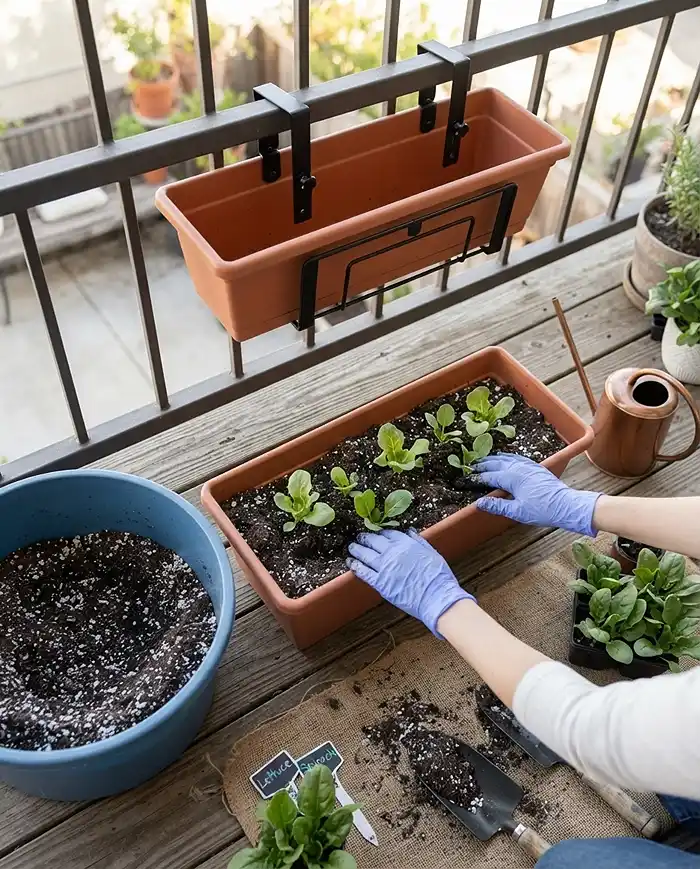
- Secure your railing hardware first. Mount saddle planters and hanging basket brackets before mixing any soil. Check that all fixtures are tight and rated for the weight.
- Mix your soil in a separate bin. Combine potting mix and perlite before filling containers — mixing in the pot is messy and uneven.
- Fill containers to 1 inch below the rim. This prevents soil from washing out during watering.
- Plant transplants at the same depth as their nursery pots. Burying the stem encourages rot in partial shade conditions where soil stays moist longer.
- Position the most sun-hungry plants on the outermost railing edge where they’ll catch the first and last rays of morning sun.
- Water thoroughly after planting until water drains from the bottom. Then use the finger-test method going forward — no automatic watering schedules the first week.
If you’re new to container gardening, check out this guide on beginner small space gardening before you start — it covers the core skills that will set you up for success.
Maintenance and Seasonal Care for East-Facing Gardens
The slower evaporation rate of an east-facing balcony changes your maintenance rhythm. Water less, fertilize lighter, and you’ll avoid the most common mistakes.
Watering Routines for Slower Afternoon Evaporation
Quick Answer: Use the finger-test method — push your finger 2 inches into the soil and water only if it’s bone dry. East-facing containers typically need watering every 2 to 4 days in summer, not daily.
This is where new balcony gardeners go wrong most often. They apply a south-facing watering schedule — daily deep soaking — to plants that simply don’t dry out that fast. Overwatering is the number one killer of balcony plants in partial shade.
In summer heat, I water my east-facing railing boxes every 2 to 3 days. Hanging baskets dry out faster because of air circulation — check those daily in July and August. Ferns especially will wilt fast if their basket dries completely.
For more on avoiding the most common pitfalls, see this list of apartment gardening mistakes beginners make — overwatering is near the top.
Fertilizing Light Feeders and Shade Lovers
Quick Answer: Apply half-strength, water-soluble organic fertilizer every 2 to 3 weeks. Plants in partial shade have a slower metabolic rate and can’t process heavy synthetic fertilizer doses without leaf burn.
I use fish emulsion at half the label rate, every 2 weeks from May through August, then taper off in September. Kelp extract is another excellent option — it promotes root health rather than forcing fast top growth.
Avoid granular slow-release fertilizers in partial shade containers. Without full sun driving rapid growth, the nutrients accumulate in the soil and can cause salt burn on roots. Liquid feeding gives you precise control.
Common Problems and Solutions
East-facing balconies have a specific set of problems. Knowing what to look for means you catch issues early, before they become plant losses.
Leggy Growth from Insufficient Light
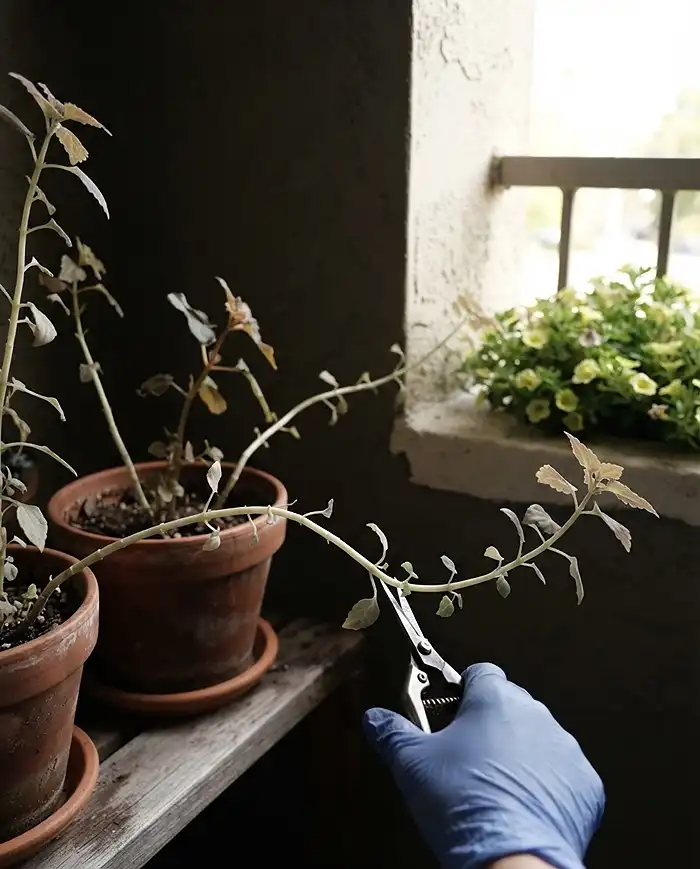
Quick Answer: Leggy, pale, weak stems (called etiolation) happen when plants are too deep in shaded corners. Pinch back the stretched growth and move pots to the outermost railing edge immediately.
Etiolation is your plant reaching desperately for light it can’t find. Stems grow long and thin, internodes stretch out, and leaves turn pale yellow-green. It looks like the plant is sick — it’s actually starved for sun.
The fix is two-part: aggressive pinching back to healthy growth nodes, and repositioning. If the outer railing is taken, consider a wall-mounted arm bracket to push the pot further into the light zone.
Pro Tip: Plants showing leggy growth are already stressed — hold off on fertilizing for 2 weeks after repositioning to avoid compounding the stress with nutrient push.
Powdery Mildew and Fungal Diseases
Quick Answer: Powdery mildew — white, dusty spores on leaves — appears when morning sun is obstructed and air circulation is poor. Treat with an organic potassium bicarbonate spray and thin inner foliage aggressively.
I lost a beautiful coleus display in late August 2022 to powdery mildew after a neighbor’s new awning blocked my morning sun by about an hour. The lack of that drying light was enough to create the damp conditions mildew loves.
Potassium bicarbonate spray (1 tablespoon per gallon of water) applied weekly will halt an active outbreak. But the real fix is restoring airflow — thin out crowded foliage, remove any leaves touching the wall, and space containers so air moves freely between them.
The Royal Horticultural Society’s guide on powdery mildew covers identification and organic treatment options in detail.
Frequently Asked Questions
Can I grow tomatoes on an east-facing balcony?
Large, indeterminate tomatoes need 6 to 8 hours of intense sun and won’t perform on an east-facing balcony. However, compact micro-tomato varieties like Tumbling Tom or Tiny Tim can succeed if placed on the absolute brightest outer railing edge where they catch the full morning sun window.
Do I need to protect plants from morning chill?
Eastern balconies warm up quickly once the sun rises, so established plants rarely need protection. However, keep a lightweight horticultural fleece on hand in early spring to protect tender seedlings from unexpected late frosts before sunrise. Remove it once the sun hits to prevent overheating.
How often should I water east facing balcony plants?
There is no single schedule, but east-facing containers typically need watering every 2 to 4 days in summer — far less than south or west-facing pots. Hanging baskets dry faster and may need daily checks in July and August. Always use the finger-test: water only when the top 2 inches of soil are bone dry.
What is the best soil mix for east-facing containers?
Use 70% premium organic potting mix blended with 30% coarse perlite. This ensures fast drainage even without afternoon sun to evaporate excess moisture. Never use garden soil in containers — it compacts and causes root rot in the slower-drying conditions of partial shade.
Which herbs grow best with only morning sun?
Parsley, cilantro, and mint all thrive with 3 to 4 hours of morning sun and actually produce more tender, flavorful leaves than they would in full afternoon sun. Cilantro especially benefits from afternoon shade, which delays bolting by several weeks. Keep mint in its own pot to prevent it from overtaking shared containers.
Key Takeaways
- East facing balcony plants thrive with 3 to 5 hours of cool morning sun — map your exact light window before buying anything.
- Use 70% potting mix and 30% perlite for drainage; without afternoon sun, heavy soil stays wet and causes root rot.
- The best ornamentals for this exposure include trailing Fuchsias, tuberous Begonias, Boston Ferns, Coleus, and Caladiums.
- Cool-season edibles — lettuce, spinach, arugula, parsley, and cilantro — outperform in morning-only light and stay productive weeks longer than in full sun.
- Water every 2 to 4 days using the finger-test method, and fertilize at half-strength every 2 to 3 weeks to match the slower metabolic rate of partial-shade plants.
Ready to put this into practice? Start with the apartment gardening tips for beginners guide to cover the fundamentals before your first planting day.