

Balcony Corner Garden Ideas for a Cozy Space
The best balcony corner garden ideas turn dead, awkward space into a fragrant outdoor retreat — without sacrificing seating room. Pair aromatic herbs with cascading flowers and that ignored corner becomes the coziest spot on your floor.
Table of Contents
Transforming Dead Space into a Cozy Balcony Corner
I grow herbs on a southeast-facing balcony in zone 7a, and the corner used to collect folding chairs and forgotten coffee cups. Then I wedged a quarter-circle tiered stand into it, added creeping thyme and Calibrachoa, and that corner became the first place I head every morning.
The trick is treating the corner as a destination, not leftover space. A compact chair angled toward the plants, string lights woven through trailing foliage, and a handful of fragrant herbs turns a 4-square-foot nook into a proper small balcony garden sanctuary.
You don’t need a green thumb or a big budget. You need the right containers, the right plants, and an honest look at what your corner’s environment actually offers.
Assessing Your Corner’s Unique Microclimate
Balcony corners are their own micro-worlds. Two walls meeting at 90 degrees create conditions that the open railing never sees — different light exposure, different airflow, and totally different humidity levels.
Skipping this step is how gardeners end up with leggy lavender and moldy mint. Spend one week observing before you buy a single plant.
Mapping Sunlight and Shadow Patterns
Quick Answer: Track sunlight in your corner at 8 AM, noon, and 4 PM for three days. A corner with 6+ hours of direct light suits Mediterranean herbs. Under 3 hours means you need shade-tolerant plants.
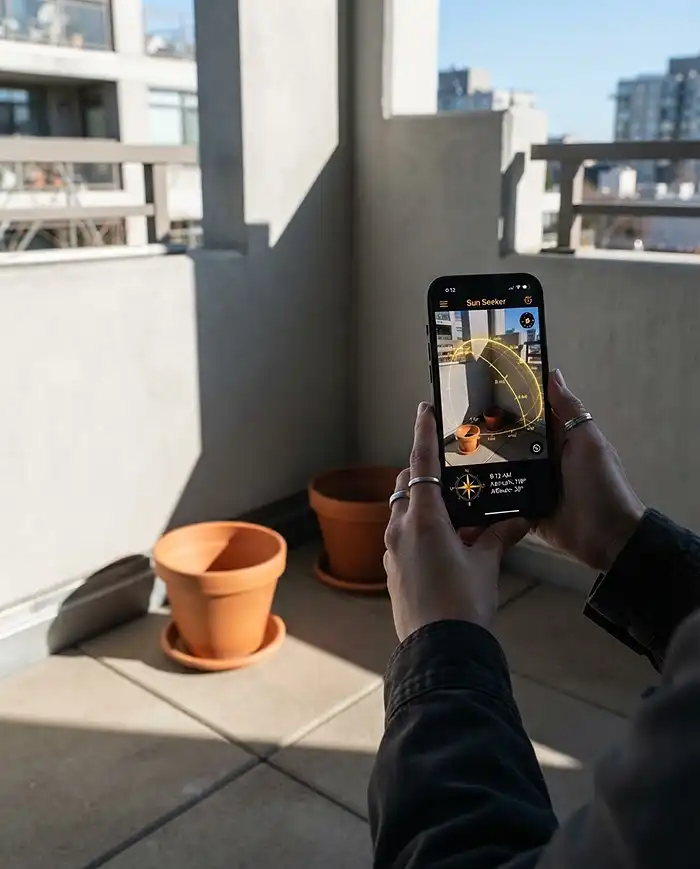
I use a free app called Sun Surveyor to map shadows before I commit to any layout. My southeast corner gets blazing morning sun until about 11 AM, then drops into full shade by mid-afternoon.
That pattern is perfect for herbs like thyme and chives — they get their morning sun fix, then rest during the hottest part of the day.
- 6+ hours direct sun: lavender, rosemary, thyme, Calibrachoa, portulaca
- 3-6 hours partial sun: mint, basil, sweet alyssum, lobelia
- Under 3 hours shade: creeping Jenny, fuchsia, trailing English ivy
Pro Tip: South and west corners in the Northern Hemisphere run hotter and drier than north and east corners — plan your watering schedule around that, not generic “water twice a week” advice.
Managing Wind Eddies and Stagnant Airflow
Quick Answer: Corner walls either trap wind into a damaging eddy or block it entirely, creating humid stagnant air that causes fungal disease. Hold a damp ribbon at corner height on a breezy day to see exactly what’s happening.
My first summer on this balcony, I lost two pots of sweet basil to powdery mildew before I understood why — the corner behind my chair had zero airflow. The walls deflected every breeze.
Exposed corners on upper floors face the opposite problem. Wind eddies can snap trailing stems and dry out containers in hours, not days.
- Stagnant corner: choose mildew-resistant varieties, space pots 4-6 inches apart, thin inner foliage monthly
- Windy corner: use heavier ceramic pots, select compact trailing varieties over long cascaders, stake stems loosely
Pro Tip: A small clip-on fan set to low and aimed at a stagnant corner for two hours each morning does more to prevent fungal disease than any spray treatment.
Best Container Strategies for Tight Corners
The container is the architecture of a corner garden. Get this right and the plants almost arrange themselves. Get it wrong and you’re constantly shuffling pots that don’t fit and knocking things over.
For apartment balcony garden ideas, the goal is vertical — build up, not out, so you keep the floor open for sitting.
Tiered Corner Stands for Vertical Growth
Quick Answer: A quarter-circle, 3-tier metal or bamboo plant stand fits a 90-degree corner exactly, uses zero floor space beyond the corner itself, and lets you grow 9-12 pots in a 2×2-foot footprint.
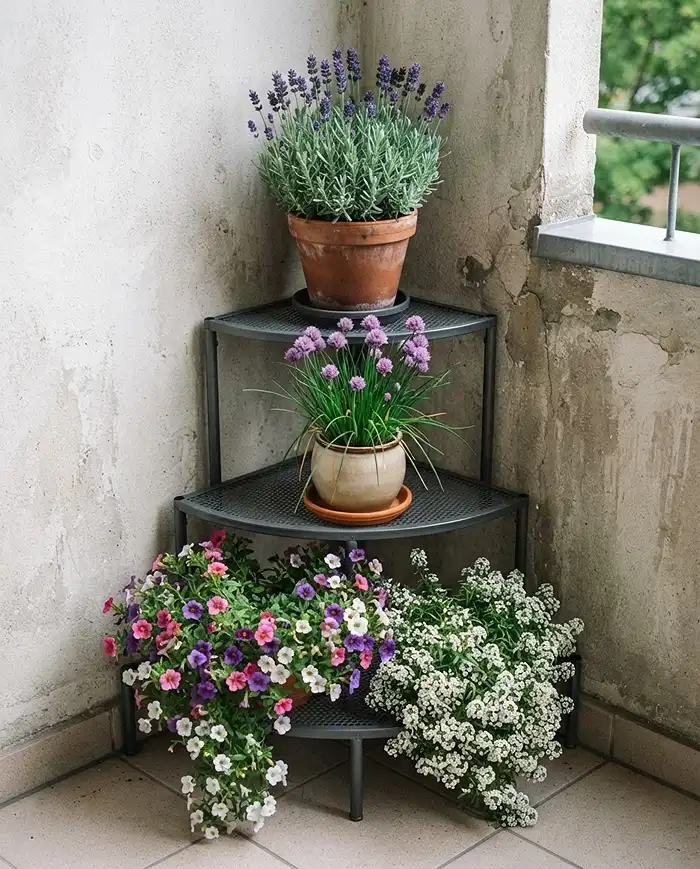
I switched to a powder-coated steel 3-tier corner stand (about 28 inches wide per side) two seasons ago and it changed everything. I put upright herbs — rosemary, a compact lavender ‘Hidcote,’ and chives — on the top two tiers where they catch the most light.
Trailing Calibrachoa and sweet alyssum go on the bottom tier, where they cascade down the front and soften the stand’s legs. The visual effect is a solid wall of green and color, not a collection of random pots.
Look for stands rated for at least 10 lbs per shelf. Wet soil is heavy, and cheap stands flex and tip. Check your balcony herb garden layout options for stand sizing guidance based on corner dimensions.
Pro Tip: Place a waterproof tray under each pot on the stand — overflow onto a neighbor’s balcony is a fast way to create conflict in an apartment building.
Hanging Baskets and Wall Pockets
Quick Answer: Ceiling-hung baskets and wall-mounted felt pockets move plants off the floor entirely, freeing up the stand for structural herbs while trailers cascade from above. This layered vertical approach is the fastest way to make a corner feel lush.
I added two macrame hanging baskets from a ceiling hook rated for 25 lbs last spring. In those baskets: trailing lobelia ‘Sapphire’ and a single pot of spearmint (contained — always contain mint, it will take over anything it shares soil with).
The effect at eye level when you’re seated is pure garden. You’re surrounded on three sides by foliage and fragrance, which is exactly what a cozy corner should feel like.
Felt wall pockets work well for lightweight herbs like chives, parsley, and small thyme varieties. Avoid them for anything that needs deep root space — basil and lavender will stall out in shallow pockets.
For more ideas on hanging setups, the railing planter ideas guide covers bracket options that also work on corner walls.
Pro Tip: Stagger basket heights by 8-12 inches so trailing stems from the higher basket don’t smother the plants in the lower one.
Selecting the Perfect Herbs and Trailing Flowers
Plant selection makes or breaks a corner display. You want contrast — upright against trailing, fine-textured against broad-leaved — and you want plants with compatible care needs so one watering routine serves the whole corner.
Aromatic Herbs for a Cozy Vibe
Quick Answer: Lavender gives upright structure and fragrance; creeping thyme trails softly over pot edges; contained mint releases scent every time you brush past. These three together cover all the sensory bases of a cozy herb garden.
For a classic small balcony herb garden, ‘Hidcote’ lavender (compact, 12 inches) is the anchor. It’s tidier than regular English lavender and handles container life well in zones 5-8.
Creeping thyme (‘Elfin’ or ‘Magic Carpet’) is genuinely one of the best balcony plants I’ve ever grown — it spills beautifully over pot edges, handles dry spells, and smells incredible when you pinch a sprig.
Always plant mint in its own container. I learned this the hard way when ‘Mojito’ mint consumed an entire mixed pot in one season.
Pro Tip: Brush your herbs gently with your hand each evening as you walk past — it releases volatile oils and makes the whole corner smell incredible.
Vibrant Trailing Spillers
Quick Answer: Calibrachoa (Million Bells), sweet alyssum, and lobelia are the three best trailers for an apartment balcony corner — they bloom continuously from spring through frost with minimal deadheading and cascade naturally over pot edges.
Calibrachoa ‘Superbells Lemon Slice’ was my 2024 summer experiment and it did not disappoint. It bloomed from May through October in zone 7a with nothing but regular watering and a half-strength liquid feed every two weeks.
Sweet alyssum adds honey-scented white foam that softens any arrangement. Lobelia ‘Cascade Blue’ gives rich color and genuinely trails 12-18 inches if you let it.
These three pair beautifully with herbs because they share the same “moderate moisture, full sun” preference.
Pro Tip: Cut Calibrachoa back by one-third in midsummer if it gets leggy — it’ll rebound fuller within two weeks and look better than it did in spring.
Companion Planting Rules for Herbs and Florals
Quick Answer: Match plants by water needs, not just aesthetics. Group drought-tolerant rosemary and thyme with portulaca. Keep moisture-loving basil, mint, and alyssum together. Never mix the two groups in the same pot.
| Pairing Group | Plants | Watering Frequency | Best Container Size |
|---|---|---|---|
| Dry-lovers | Rosemary, thyme, portulaca | Every 3-4 days | 8-10 inch pot |
| Moderate moisture | Lavender, Calibrachoa, lobelia | Every 2-3 days | 10-12 inch pot |
| Moisture-lovers | Basil, mint, sweet alyssum | Daily in summer heat | 10-12 inch pot |
This is the rule I follow without exception. The fastest way to kill a beautiful mixed pot is to pair a drought-tolerant herb with a thirsty flower — one of them always loses.
Step-by-Step Styling and Planting Guide
Setup order matters. Do this in the right sequence and the whole corner comes together in an afternoon.
- Place your seating first. Sit in the chair and note your sightlines. The tallest plants should frame your view, not block it.
- Position the tiered stand. Push it snugly into the corner. Test stability before adding any pots.
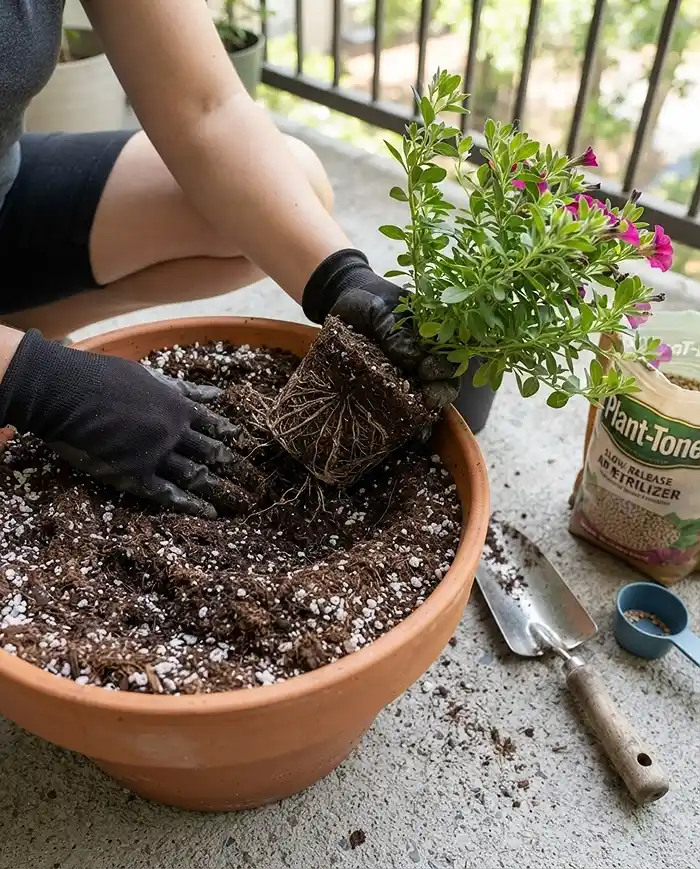
- Mix your potting soil. Use a peat-free potting mix cut with 20% perlite for drainage. Add a slow-release granular fertilizer at planting time.
- Plant trailers at the edge. When potting trailing flowers, gently spread roots outward and angle the plant slightly toward the pot’s rim so it cascades naturally rather than growing straight up.
- Install ceiling hooks and hang baskets. Do this after the stand is in place so you can judge the right height — baskets should hang at seated eye-level, roughly 4.5-5 feet from the floor.
- Add lighting last. Weave solar fairy lights through the stand tiers before the plants fill in — it’s nearly impossible to add them neatly once foliage is dense.
Pro Tip: Water every pot thoroughly right after planting, then wait 48 hours before checking moisture. This lets roots settle and gives you a realistic baseline for how fast each container dries out.
Maintenance Routine for a Flourishing Corner
A tightly packed corner garden needs a slightly different routine than an open balcony setup. Containers dry unevenly at different heights, and dense foliage hides problems until they’re serious.
Plan on 10-15 minutes every two to three days during peak summer. It’s not demanding — it’s mostly enjoyable, especially when it involves snipping fresh herbs for dinner.
Targeted Watering for Mixed Containers
Quick Answer: Use a long-spout watering can aimed directly at the soil surface, not the foliage. Check moisture by pressing your finger 1 inch into the soil — water when it comes out dry, hold off when it’s still damp.
Top-tier pots on a stand dry out 30-40% faster than bottom-tier pots because of increased heat and airflow at height. Water top shelves first and always check bottom pots separately — they may not need water at all.
Wet petals on Calibrachoa and lobelia invite botrytis (gray mold). A long-spout can that reaches under the foliage to the soil is worth every penny.
Pro Tip: Do the finger test before every watering session, not on a set schedule. Microclimate, season, and pot size all affect how fast soil dries, and schedules lead to both over- and under-watering.
Pruning and Deadheading for Continuous Blooms
Quick Answer: Pinch herbs back by one-third every 2-3 weeks to keep growth bushy. Deadhead [remove spent flowers] trailing bloomers weekly to prevent seed setting and force continuous new buds.
I harvest my thyme and chives aggressively — cut them back hard every few weeks for the kitchen, and they respond by pushing out dense new growth. Neglected herbs go woody and sparse within one season.
For trailers, run your fingers through the foliage weekly and snap off any brown or spent blooms. Sweet alyssum is the exception — give it a full shear to the base in midsummer and it will rebloom spectacularly within three weeks.
Pro Tip: Pinch herb tips in the morning when volatile oil content is highest — your hands will smell incredible for hours, and the cuttings are perfect for cooking.
Common Problems and Solutions
Two issues will catch most corner gardeners off guard. Both are preventable once you know what to look for.
Powdery Mildew in Stagnant Corners
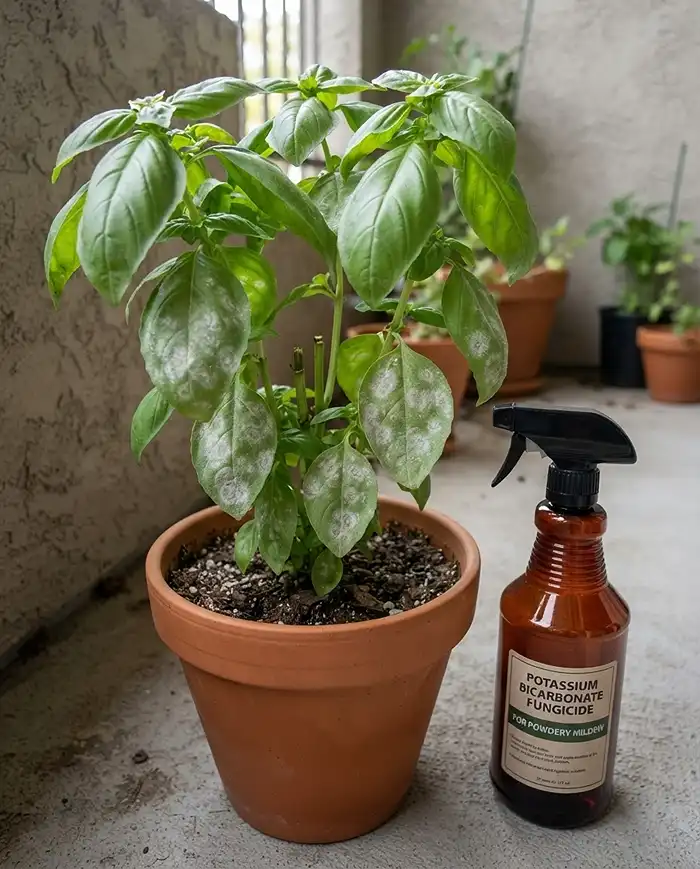
Quick Answer: Powdery mildew appears as white dusty patches on leaves and thrives where air barely moves. Treat immediately with a potassium bicarbonate spray and thin dense inner foliage to restore circulation.
It looks like someone dusted flour on your leaves. You’ll see it on basil and mint first, usually on inner leaves where air barely reaches. Catch it early and it’s easy to address.
Mix 1 tablespoon potassium bicarbonate with 1 gallon water and a few drops of dish soap. Spray the affected leaves, including undersides, on a calm morning. Reapply every 7 days until clear.
Then remove at least 20% of inner foliage to open up the plant’s structure and give air somewhere to move. Prevention is far easier than treatment — don’t let plants crowd each other in a stagnant corner.
The Royal Horticultural Society’s powdery mildew guide covers resistant cultivar recommendations worth bookmarking before you buy next season’s herbs.
Uneven Growth Reaching for the Sun
Quick Answer: Plants tucked into a corner stretch toward light in one direction — a condition called etiolation. Rotate freestanding pots 90 degrees every week to keep growth even and compact on all sides.
I noticed my ‘Hidcote’ lavender leaning dramatically toward the open balcony side by week three of the season. Weekly rotation fixed it completely by week six, and the plant is now a perfectly balanced mound.
Hanging baskets rotate naturally in the breeze, so they’re rarely a problem. It’s the pots on fixed tiered stands that need the most attention. Set a weekly phone reminder until it becomes habit.
For wall pocket plants, swap their positions monthly — move inner pockets outward and vice versa. They can’t be rotated, so repositioning is the only fix.
balcony corner garden ideas FAQs
Can I plant herbs and flowers in the exact same pot?
Yes, and it works beautifully — as long as both plants share the same sunlight and moisture needs. Pair thyme with portulaca for a dry-mix pot, or basil with sweet alyssum for a moisture-loving combo. Mismatched water needs will always favor one plant at the expense of the other.
How do I create a cozy ambiance in my balcony corner at night?
Weave warm-white solar LED fairy lights through the tiered shelving before plants fill in for the season. Add a small battery-operated outdoor lantern at floor level. The light will cast beautiful botanical shadows against the corner walls and make fragrant herbs even more noticeable after dark.
What are the best trailing plants for a deeply shaded balcony corner?
If your corner receives fewer than 2 hours of direct sun, skip the sun-loving herbs and focus on trailing English ivy, creeping Jenny, and fuchsia. All three cascade beautifully, tolerate deep shade, and keep a corner lush through the season without struggling.
What railing planter ideas work alongside a corner setup?
Long window-box style railing planters running along the balcony edge complement a corner garden perfectly. Use them for trailing lobelia and alyssum so the cascade effect extends beyond the corner. This creates a seamless wall of color from corner to railing. See our railing planter guide for bracket options.
How often should I fertilize herbs and trailing flowers in containers?
Feed every two weeks with a half-strength balanced liquid fertilizer from spring through late summer. Cut feeding to once a month in early fall and stop entirely in winter. Container plants exhaust soil nutrients quickly, and consistent feeding is what separates a thriving corner from a struggling one.
Key Takeaways
- The best balcony corner garden ideas start with a microclimate assessment — map your sun and airflow for one week before buying a single plant.
- A quarter-circle tiered stand is the single most space-efficient investment for a corner setup, letting you grow 9-12 pots in under 4 square feet of floor space.
- Match plants by water needs, not just looks — pairing thirsty basil with drought-tolerant rosemary always ends with one dead plant.
- Rotate freestanding pots 90 degrees weekly to prevent etiolation and keep growth balanced on all sides.
- Explore the full balcony railing herb garden setup guide to extend your herb garden beyond the corner along your full railing run.