

Maximize Balcony Harvest: Grow More in Less Space
Maximize balcony harvest with smart layering, vertical growing, and space-saving container ideas that help you grow more food in less space.
I grow vegetables on a 6-foot by 10-foot balcony in Atlanta, zone 7b, and last year it fed my family of three from May through October. If you want to maximize your balcony harvest, forget rows and start thinking in layers.
Traditional garden logic wastes a small balcony garden. Real yield comes from stacking crops vertically, timing your plantings so pots never sit empty, and picking cultivars bred to be productive in a container instead of a field. That’s the whole game, and I’ll walk through exactly how I do it.
Table of Contents
Transforming Your Balcony Into a High-Yield Micro-Farm
The mistake I made my first year was treating my balcony like a mini backyard garden: one tomato plant in one pot, spaced out like it had acres to spread into. It produced maybe 4 pounds of fruit all season.
The fix wasn’t more space. It was using the space I had more aggressively. Intensive urban gardening means every pot works double duty, every railing holds a planter, and nothing sits fallow between crops. Once I switched approaches, that same footprint produced over three times as much food.
Auditing Your Space for Maximum Productivity
Before you buy a single seed packet, map your balcony’s actual conditions. A high-yield garden has to match its microclimate, or you’ll end up with stunted tomatoes and bolted lettuce in the wrong spots.
Tracking Sun Hours for High-Yield Crops
Quick Answer: Track sun exposure for a full week before planting. Fruiting crops like tomatoes and peppers need 6 to 8 hours of direct sun; leafy greens tolerate 3 to 4 hours and can go in your shadier corners.
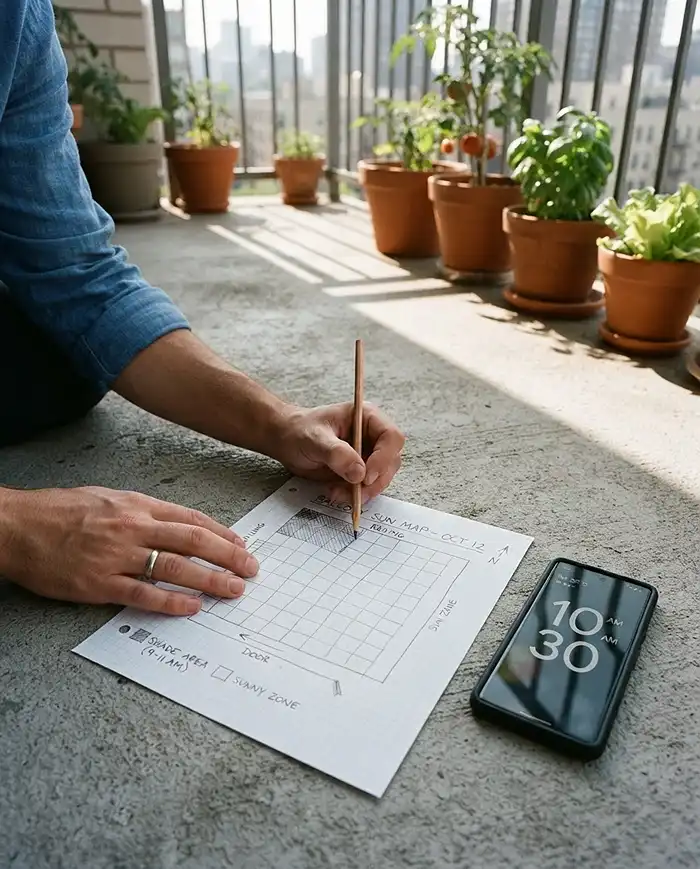
I check my balcony every two hours from 8 a.m. to 6 p.m. and jot down which spots are lit. My southwest corner gets 7 hours in July, so that’s where my ‘Micro Tom’ tomatoes and ‘Lunchbox’ peppers live. My north-facing end, shaded by the unit above, gets maybe 3 hours — perfect for mesclun and spinach.
Pro Tip: Re-check your sun map in early spring and again in midsummer. Deciduous trees and neighboring balconies change your shade pattern as the season goes on. For more on reading your specific light conditions, see our guide to light and space for small-space gardening.
Utilizing Vertical Real Estate and Railings
Quick Answer: Look past the floor. Saddle planters over railings and tension-rod poles between floor and ceiling can roughly double your usable planting area without adding a single square foot of footprint.
- Heavy-duty saddle planters (I use 24-inch galvanized steel ones) straddle the railing for shallow-rooted herbs and strawberries
- Tension rods rated for 15+ pounds hold hanging baskets of trailing cherry tomatoes like ‘Tumbling Tom’
- Over-the-door shoe organizers, repurposed with drainage holes, work for lettuce and radishes
- Wall-mounted grid panels hold clip-on pots for compact herbs
Real Example: I added two saddle planters to my railing in April 2025 and used them for ‘French Breakfast’ radishes and thyme. That’s 6 square feet of production I wasn’t using before, with zero loss of floor space.
The Core Strategies of Intensive Urban Farming
Expert container growers routinely pull three times the yield of a standard pot from the same square footage. The difference is timing and layering, not luck or fancier soil.
Succession Planting for Continuous Harvests
Quick Answer: Succession planting means sowing a new batch of fast-maturing crops every 2 weeks, so a fresh planting is ready right as the last one finishes. No pot sits empty.
| Crop | Sow Interval | Days to Harvest |
|---|---|---|
| Radishes (‘Cherry Belle’) | Every 10-14 days | 24-28 days |
| Bush beans (‘Mascotte’) | Every 3 weeks | 50-55 days |
| Loose-leaf lettuce | Every 2 weeks | 25-30 days |
| Scallions | Every 2-3 weeks | 60-70 days (or 21 for cut-and-regrow) |
I keep a paper calendar taped inside my patio door with sow dates penciled in. It sounds low-tech, but it’s the single habit that turned my empty-pot gaps into a rolling harvest. See our full breakdown on planning a small-space garden year-round for a longer seasonal calendar.
Pro Tip: Start your next succession batch in a small starter tray, not the final pot, so the current crop keeps producing while seedlings size up.
Companion Planting and Intercropping Edibles
Quick Answer: Intercropping pairs a fast, shallow-rooted crop with a slow, deep-rooted heavy feeder in the same pot, so you harvest two different crops from one container without them competing for the same root zone.
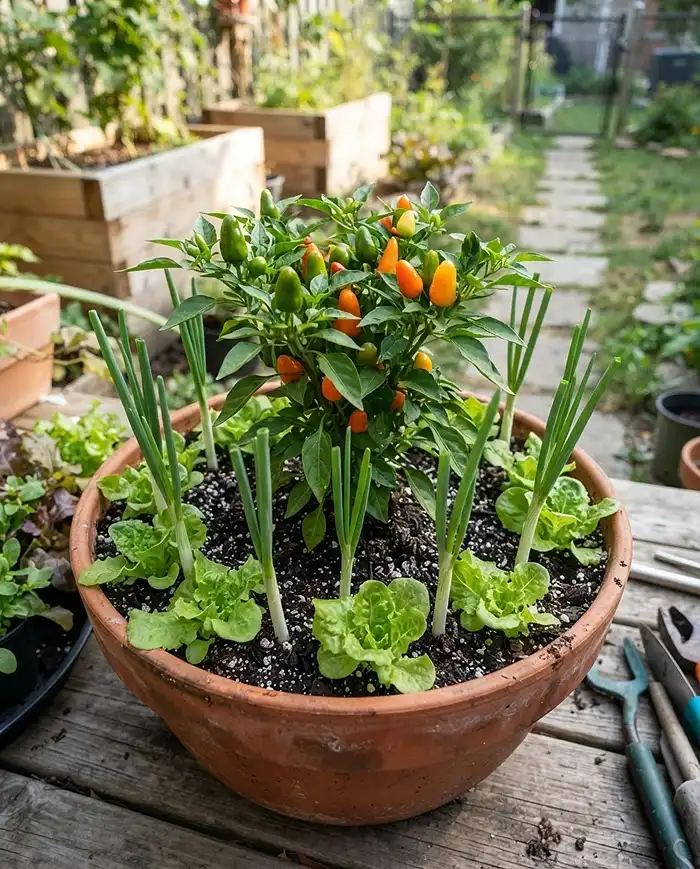
- Spinach or baby lettuce around the base of a young eggplant — harvested and gone before the eggplant’s roots need the space
- Scallions tucked around pepper plants — their narrow roots barely compete with the pepper’s taproot
- Bush basil under indeterminate tomatoes — shallow roots, and it helps with airflow at soil level
Real Example: I planted ‘Little Finger’ carrots around a ‘Black Beauty’ eggplant in a 15-gallon pot last June. I pulled the carrots in early August, a full 6 weeks before the eggplant’s roots filled that same soil.
Vertical Trellising for Heavy Vining Crops
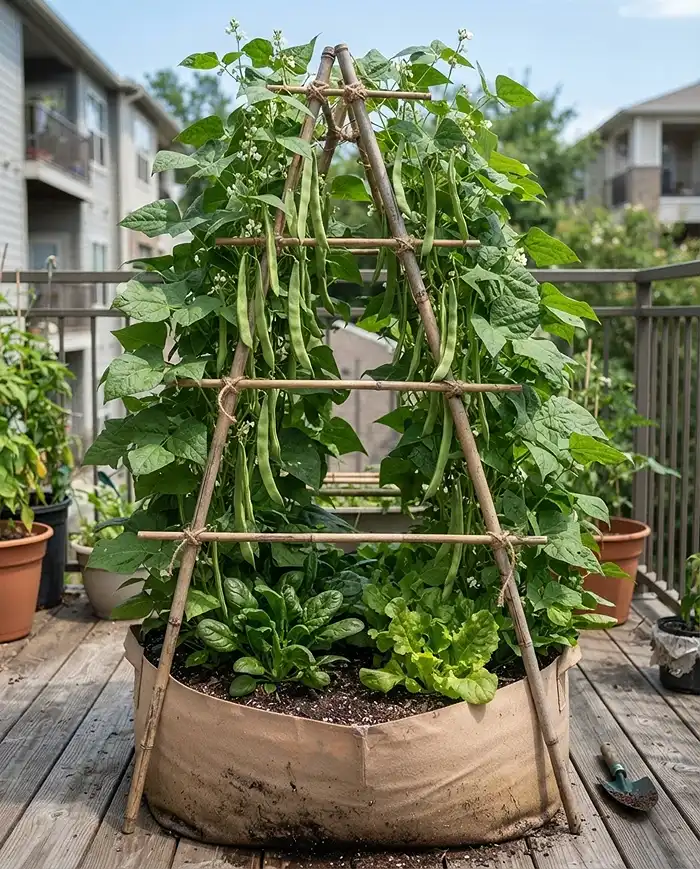
Quick Answer: Train vining crops like indeterminate tomatoes, pole beans, and cucumbers up an A-frame trellis or ceiling hook. Fruit stays off the soil, disease drops, and the ground-level space frees up for a second crop.
My A-frame trellis (built from three 6-foot bamboo stakes and twine) holds a ‘Fortex’ pole bean plant that produced over 4 pounds of beans from one 5-gallon pot. That’s the kind of yield you simply can’t get from a bean sprawled on the balcony floor.
Pro Tip: Tie vines loosely with soft garden twine, not zip ties. Stems thicken fast in midsummer and tight ties will girdle them. The University of Maryland Extension has solid guidance on staking and supporting container vegetables if you want more detail on hardware options.
Selecting the Most Productive Compact Cultivars
Genetics matter as much as technique. A standard field variety will outgrow a balcony pot and sulk instead of producing. Compact, container-bred cultivars are non-negotiable for tiny garden ideas that actually work.
High-Yield Bush Tomatoes and Mini Peppers
Quick Answer: Determinate “patio” varieties like ‘Micro Tom’ tomatoes and ‘Lunchbox’ mini peppers stay compact and bushy, which forces the plant to put energy into fruit instead of sprawling leaf growth.
‘Micro Tom’ tops out around 8 inches tall and still sets fruit heavily in a 12-inch pot — I got 40+ cherry tomatoes off one plant. ‘Lunchbox’ peppers stay under 18 inches and load up with sweet, snackable fruit from July through frost.
Pro Tip: Skip heirloom slicing tomatoes for container growing unless you have a truly large pot (20+ gallons). Their sprawling habit eats space you don’t have.
Cut-and-Come-Again Leafy Greens
Quick Answer: Loose-leaf mesclun mixes and ‘Lacinato’ kale can be harvested by the outer-leaf method — snip only the outside leaves and leave the center crown intact so it keeps regenerating new growth.
- Mesclun mix: sow densely, harvest with scissors when leaves hit 3-4 inches
- ‘Lacinato’ kale: take the bottom 2-3 leaves per plant weekly, never the growing tip
- ‘Red Sails’ lettuce: cut outer leaves, new ones fill in within a week
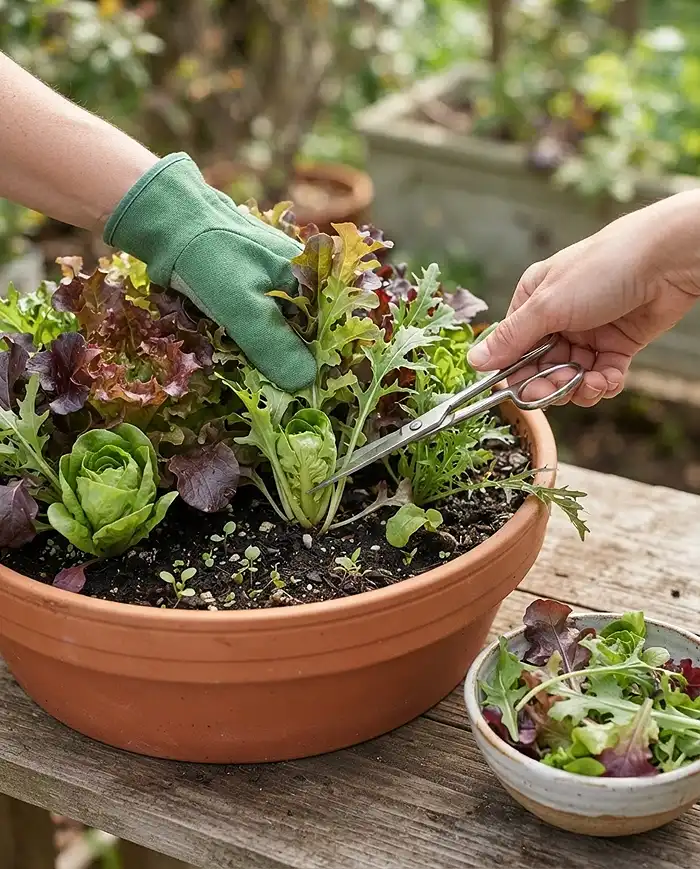
Real Example: One 12-inch pot of mesclun mix on my balcony gave me salad greens for 11 straight weeks last fall, just from cutting the outer leaves every 4-5 days.
Maximizing Soil Nutrition in Confined Containers
Intensive planting strips container soil of nutrients fast — sometimes within 3-4 weeks. If you’re pushing multiple crops per pot, your soil science has to keep up.
Building a Nutrient-Dense Potting Mix
Quick Answer: Blend a premium potting mix with 30% perlite for aeration, a generous layer of worm castings, and a slow-release granular organic compost. This gives multiple plants in one pot the nutritional baseline they need.
My go-to recipe: 60% quality potting mix, 30% perlite, and 10% worm castings, plus a scoop of slow-release organic fertilizer mixed into the top 4 inches. For more on building productive containers from scratch, see our guide to a productive container garden setup.
Aggressive Liquid Fertilization Schedules
Quick Answer: Feed intensively planted containers with a water-soluble organic fertilizer, like liquid kelp or fish emulsion, every 7 to 10 days during the growing season to replace nutrients flushed out by daily summer watering.
I feed every Sunday morning, half-strength fish emulsion, right after watering so it doesn’t burn the roots. Skipping even one feeding during a heat wave shows up within days as pale new growth.
Common Problems and Solutions
Pushing container plants to their limit means you’ll hit trouble faster than a relaxed garden would. Catching it early is the whole trick.
Nutrient Collapse and Stunted Growth
Quick Answer: Yellowing lower leaves or a purple tinge on stems signals nitrogen or phosphorus starvation from root competition. A fast-absorbing foliar feed spray, applied directly to the leaves, gives the plant an immediate rescue.
I keep a diluted seaweed foliar spray on hand specifically for this. It won’t fix the underlying soil issue long-term, but it buys the plant a week while you adjust your feeding schedule.
Overcrowding and Powdery Mildew
Quick Answer: Dense intercropped foliage blocks airflow and invites powdery mildew, especially in humid climates. Prune the bottom 12 inches of tall plants to restore ventilation without cutting into your harvest.
I lost half a cucumber plant to mildew in August 2024 because I let the lower leaves stay crowded against a neighboring pepper. Now I prune that bottom zone weekly, and it hasn’t come back.
maximize balcony harvest FAQs
How deep do containers need to be for maximum yield?
Shallow 6-inch planters work fine for salad greens and herbs. But fruiting crops like tomatoes and peppers need real root room, so plan on 15-to-20-gallon containers that are at least 18 inches deep for maximum yield.
Can I grow root vegetables and fruiting plants in the same pot?
Yes, this works well. Combine fast-maturing root crops like 30-day radishes or baby carrots with fruiting plants like peppers, and harvest the roots early in the season before the fruiting plant’s deep roots fully expand into that space.
How much food can one balcony realistically produce?
A well-planned 50-square-foot balcony using vertical trellises, railing planters, and succession planting can produce a continuous daily supply of fresh herbs, salad greens, and snacking vegetables from June through October.
How often should I water an intensively planted container?
During peak summer heat, densely planted containers often need water daily, sometimes twice a day for pots under 10 gallons. Check by pushing a finger 2 inches into the soil; if it’s dry, water until it runs from the drainage holes.
What’s the biggest mistake beginners make with balcony harvests?
Spacing plants as if they were in a full-size garden. Balcony growing works best when you plant intensively, layer crops vertically, and keep succession sowings going, rather than giving each plant the wide berth a field crop would get.
Conclusion
You don’t need more square footage to maximize your balcony harvest — you need to use the footage you have more intensively. Layer your space vertically, keep pots working on a succession schedule, and choose cultivars bred for containers instead of fields.
My own 60-square-foot balcony went from a handful of tomatoes to feeding three people daily through the season once I applied these urban gardening techniques. Start with your sun map, pick two or three strategies from this guide, and build from there as of this 2026 growing season.
Key Takeaways
- Map your exact sun hours before planting; fruiting crops need 6-8 hours, leafy greens tolerate 3-4
- Use vertical space aggressively: railing planters, trellises, and tension-rod poles roughly double usable area
- Succession sow fast crops every 2 weeks and intercrop shallow-rooted plants with deep-rooted heavy feeders
- Choose compact, container-bred cultivars like ‘Micro Tom’ and ‘Lunchbox’ peppers over standard field varieties
- Feed intensively planted containers every 7-10 days to maximize your balcony harvest all season long