

Fast Fall Root Vegetables in Pots for Quick Harvests
Fast fall root vegetables in pots give you a real harvest when most gardeners have already called it a season. I grow mine on a north-facing concrete patio in zone 6b, and deep containers have completely changed what’s possible.
The secret? You control the soil. No rocks, no compaction, no clay — just a perfectly tuned growing medium that lets roots plunge straight down. Here’s how to pull it off before the freeze arrives.
Table of Contents
The Advantage of Deep Patio Pots for Fall Root Crops
Ground beds in autumn are a gamble. Soil compacts over summer, rocks migrate up, and clay tightens with the cold. Root vegetables hit those obstacles and fork, twist, or just give up growing downward.
Deep patio pots eliminate all of that. You build the soil from scratch — fluffy, stone-free, and exactly the right texture. The container also absorbs and holds heat from sunny walls, extending your usable growing season by a couple of weeks on either end.
Fall container vegetable gardening also means you can move pots to a sheltered spot when a hard freeze is forecast. That flexibility alone is worth the switch from ground beds for late-season root crops.
I lost two entire carrot beds to compacted clay before I moved to containers. Since then, not a single forked root.
Understanding the Fall Planting Timeline for Quick Harvests
Fall planting isn’t spring planting in reverse — it’s a countdown. You’re working backward from your first hard freeze, not forward from a warm soil date. Get this math wrong and you’ll have seedlings in the ground when the freeze arrives.
The good news: most fast-maturing root crops for containers need only 25 to 50 days from seed to harvest. That gives you real flexibility even into late August or September in most zones.
Calculating Days to Maturity Before the Freeze
Quick Answer: Find your average first frost date, count backward by the seed packet’s days-to-maturity number, then subtract 10 more days as a buffer for slowing autumn light.
Autumn days are shorter, and plants grow slower as light fades. A radish that takes 28 days in July might take 35 days in September. That 10-day buffer accounts for this.
The Old Farmer’s Almanac frost date calculator is the fastest way to find your local first freeze date by zip code. Bookmark it — you’ll use it every season.
Example: Zone 6b average first frost is October 15. A 40-day turnip needs to go in the ground by September 5 at the latest (40 days + 10-day buffer = 50 days before frost).
The “Frost-Kissed” Sweetness Factor in Root Crops
Quick Answer: Light frosts actually improve radishes, beets, and turnips. Cold soil triggers the plant to convert stored starches into sugars — a biological antifreeze mechanism that makes the roots taste noticeably sweeter.
This is real plant science, not gardening folklore. The process is called cold-induced sweetening, and it’s the same reason carrots pulled after the first frost taste so much better than summer ones.
You want light frosts (28°F to 32°F) on your fall containers. That’s a feature, not a problem. What you want to avoid is the soil block itself freezing solid, which stops all root growth and can split beets and turnips.
I pulled a batch of ‘Hakurei’ turnips two days after a 29°F frost in October 2023. They were the sweetest I’ve ever grown — genuinely candy-like raw. Frost timing matters more than I realized.
Best Fast-Maturing Root Crops for Deep Containers
Not every root vegetable belongs in a pot. Long parsnips, giant storage carrots, and daikon radishes need more depth and time than fall container gardening can reasonably provide.
These four are proven performers — fast, compact, and genuinely suited to the restricted environment of a deep patio pot.
| Crop | Variety | Days to Harvest | Min. Pot Depth |
|---|---|---|---|
| Radish | Cherry Belle, French Breakfast | 25-30 days | 8 inches |
| Baby Turnip | Hakurei, Tokyo Market | 38-45 days | 10 inches |
| Short Carrot | Danvers 126, Paris Market | 55-65 days | 12 inches |
| Baby Beet | Early Wonder, Chioggia | 50-60 days | 12 inches |
Radishes: The 30-Day Instant Gratification Crop
Quick Answer: ‘Cherry Belle’ and ‘French Breakfast’ radishes go from seed to harvest in 25-30 days and thrive in cool autumn weather. They’re the fastest fast fall root vegetables in pots, period.
These aren’t the hot, pithy radishes of a July garden. Fall-grown radishes in cool soil are genuinely mild, crisp, and satisfying. The drop in temperature is the key.
Sow a new row every ten days from late August through mid-September for a continuous harvest. Each succession takes up barely any space, so you can layer multiple plantings in the same deep container.
‘French Breakfast’ grows slightly elongated and stays crisp longer after pulling. ‘Cherry Belle’ is round, uniform, and the better choice if you’re new to container vegetable gardening.
Pro tip: Sow radish seeds between slower-growing beet seedlings — by the time the beets need the space, the radishes are already harvested.
Baby Turnips: Sweet, Crisp, and Ready in 40 Days
Quick Answer: Japanese baby turnips like ‘Hakurei’ and ‘Tokyo Market’ mature in 38-45 days, reach golf-ball size, and can be eaten raw. They’re one of the best vegetables in pots for fall flavor.
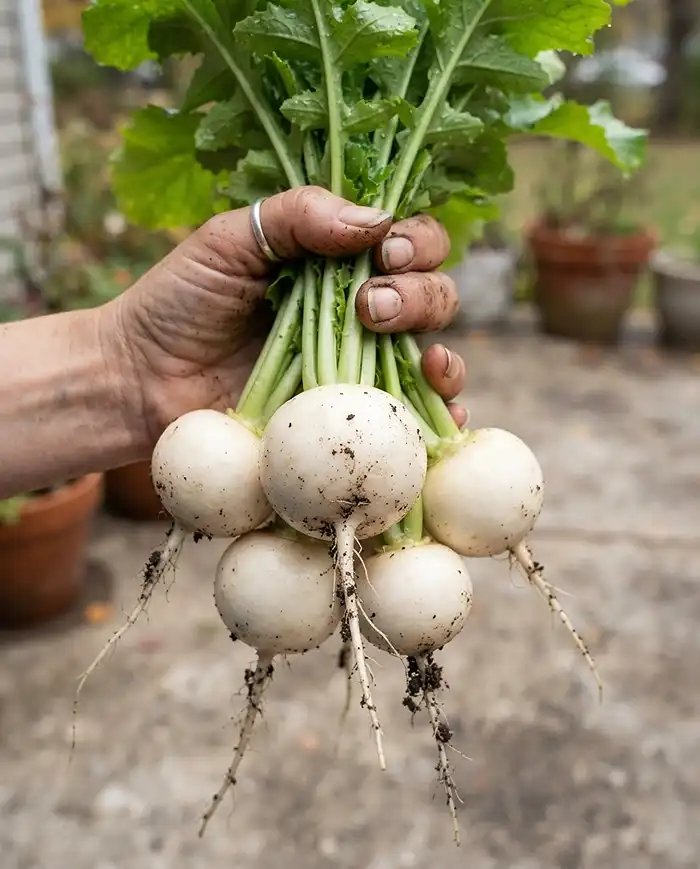
‘Hakurei’ in particular has earned devoted followers among container gardeners. The roots are smooth, ivory-white, and sweet enough to eat out of hand like an apple. No bitter edge at all.
These turnips max out at about 2-3 inches across, which means they don’t need as much depth as full-size storage turnips. A 10-inch pot works, though 12 inches gives them better room to develop.
Don’t overlook the greens. Baby turnip tops are tender enough to use raw in salads when young, or quickly sauteed with garlic when a bit more mature. You get two harvests from one plant.
Pro tip: ‘Hakurei’ bolt quickly in warm weather, so they’re genuinely better as a fall crop than a spring one — the cool air keeps them sweet and the roots from going pithy.
Short-Season Carrots: Danvers and Paris Market
Quick Answer: Use ‘Danvers 126’ (6-7 inches) or ‘Paris Market’ (round, 1.5 inches) for fall containers. Do not plant Imperator or Nantes types — their length will hit the pot bottom and fork badly.
This is where beginners most often go wrong. They buy whatever carrot seed is on the rack, plant a long variety, and pull a tangle of misshapen roots at the end of the season. The vegetable root depth chart is clear: long carrots need 16+ inches; short varieties work in 12.
‘Paris Market’ is almost spherical. It looks unusual but it’s genuinely delicious — dense, sweet, and perfectly sized for roasting whole. Kids love them.
Check our guide to deep vs. shallow root vegetables for pots if you want a full breakdown of which varieties fit which container depths.
Pro tip: Carrots germinate slowly and unevenly in cool soil. Cover the pot with burlap or a damp newspaper for the first week to hold moisture and warmth until sprouts appear.
Fast-Growing Baby Beets for Greens and Roots
Quick Answer: ‘Early Wonder’ beets are ready in 50-60 days and give you two harvests — nutritious leafy tops for salads and sweet roots below. They’re among the most versatile fast fall root vegetables in pots.
What most gardeners miss: beet greens are edible and excellent. Thinning your beet seedlings at 2 inches tall gives you a handful of baby greens for the kitchen. No waste, instant reward.
Beet seeds are actually seed clusters — each one can produce 2-3 plants. Thin ruthlessly. If you don’t, none of the roots will size up properly.
‘Chioggia’ beets are worth growing for the visual payoff alone — red and white concentric rings inside — and they mature at a similar speed to ‘Early Wonder’. Both handle light frost beautifully.
Pro tip: Soak beet seeds in warm water for 2 hours before sowing in cold fall soil. It softens the seed coat and speeds up germination by 3-5 days when soil temps are falling.
Essential Materials for Deep Container Success
Root vegetables can’t push through resistance. Everything about your container setup needs to make downward growth as easy as possible — the right pot depth, the right soil mix, and zero obstacles.
Get these foundations right and the crops more or less take care of themselves. Get them wrong and no amount of watering or fertilizing will fix a deformed harvest.
Sizing Your Deep Patio Pots Properly
Quick Answer: Use containers with a minimum depth of 12-14 inches for carrots and beets. Radishes and baby turnips can work in 8-10 inches. Width matters for yield — aim for at least 14 inches across.
Fabric grow bags are excellent for root crops. They air-prune roots naturally and prevent the circling you can get in rigid plastic pots. A 7-gallon fabric bag (roughly 12 inches deep and 14 inches wide) is a good baseline for a mixed fall container.
Large resin planters work well too — lighter than terracotta, retain moisture better than fabric in windy spots, and survive hard freezes without cracking.
See our full pot size guide for vegetables for exact container recommendations by crop type.
Pro tip: Elevate containers on pot feet or bricks. It improves drainage significantly and keeps the bottom from sitting in standing water after heavy autumn rain.
Formulating a Stone-Free, High-Aeration Soil Mix
Quick Answer: Blend premium sifted potting mix with 30% perlite and a handful of worm castings. This creates a zero-resistance medium that produces straight, unblemished roots every time.
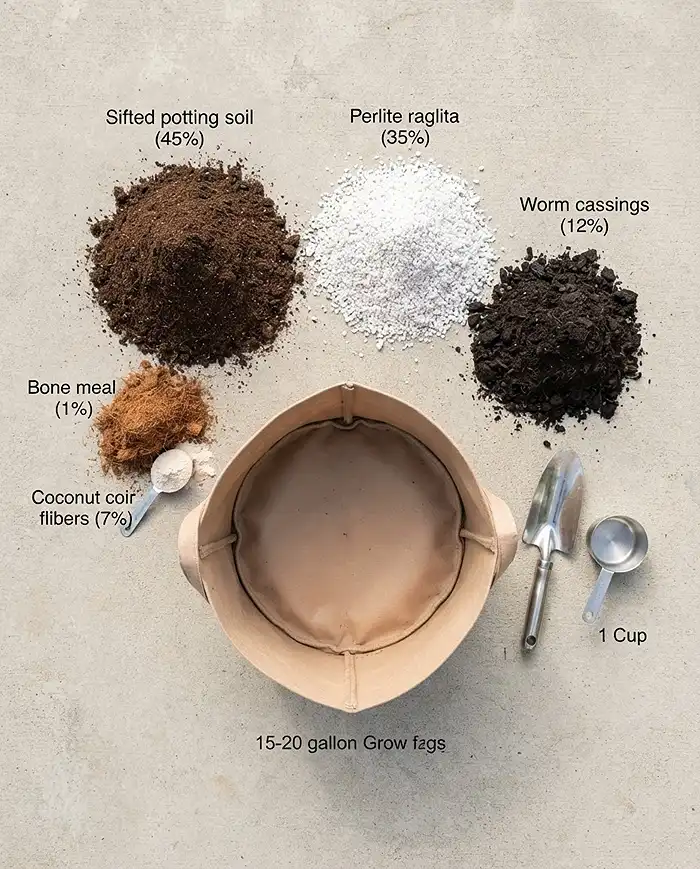
Don’t use straight garden soil or cheap potting mix with bark chunks. Bark pieces act exactly like rocks for a developing carrot — the root hits one and forks around it.
The perlite is non-negotiable. It keeps the mix aerated and prevents compaction as fall rains compact the surface. Without it, even a good potting soil will tighten over a 6-week growing period.
- 60% premium, fine-textured potting soil (sifted if chunky)
- 30% coarse perlite for aeration and drainage
- 10% worm castings for gentle, balanced nutrition
- Optional: 1 tablespoon bone meal per gallon of mix for phosphorus
Step-by-Step Seed Sowing and Spacing Guide
Root vegetables must be direct-sown. Do not start them in trays and transplant later — disturbing the taproot at any stage produces forked, stunted results. The seed goes directly into the final container, full stop.
Here’s how to sow for maximum yield in a limited space:
- Moisten the soil thoroughly before sowing — dry soil repels water from tiny seeds
- Plant seeds 1/2 inch deep in staggered rows or concentric circles
- Space holes 1 inch apart at sowing; thin to final spacing after germination
- Firm soil gently over seeds — good seed-to-soil contact speeds germination
- Cover with a thin layer of vermiculite to prevent surface crust formation
- Water with a gentle mist, never a heavy stream that displaces seeds
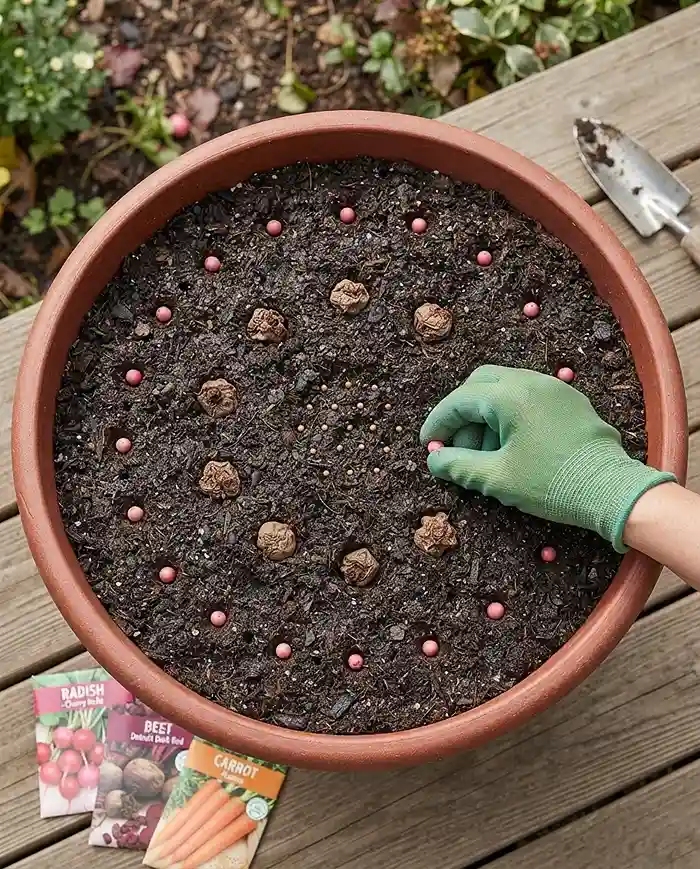
Staggered grids use space more efficiently than straight rows in a round or square container. Think of it like a honeycomb pattern — more plants, same footprint.
For a mixed container of vegetables in pots, sow radishes around the outer ring (they’ll harvest first), baby beets in the middle, and carrots or turnips in a central cluster.
Check our guide to the best root vegetables for container gardening for spacing charts by variety.
Autumn Maintenance and Care for Root Vegetables
Fall care is different from summer care. You’re not fighting heat and drought — you’re managing moisture, slowing evaporation, and helping plants push through increasingly short days. Adjust your routine accordingly as temperatures drop.
The Critical Importance of Thinning Seedlings
Quick Answer: Thin seedlings to 2-3 inches apart using scissors — never pull, which disturbs neighbors. Crowded roots will not swell, no matter what you do. Thinning is the single most important step most beginners skip.
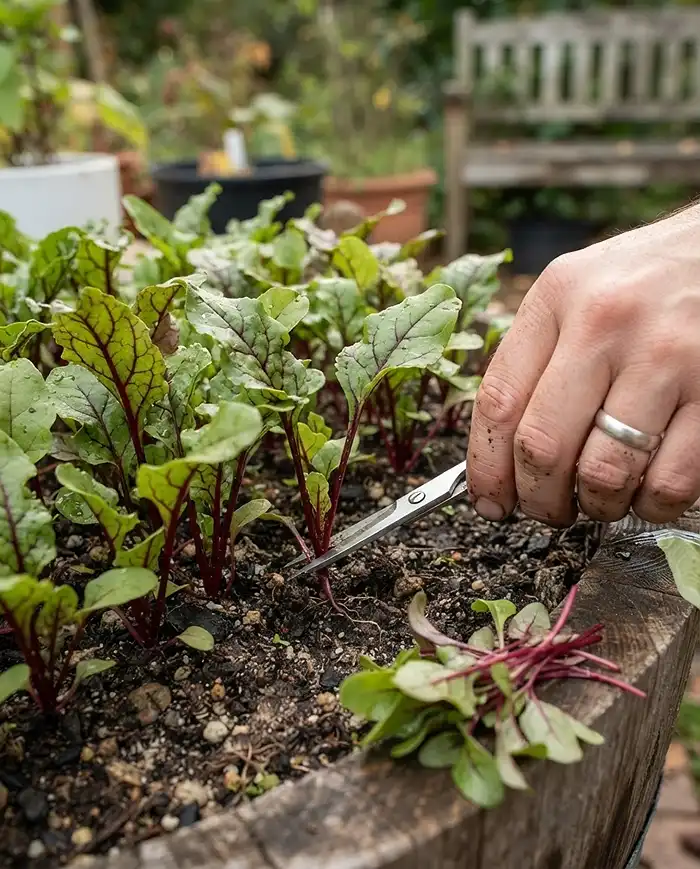
Use sterilized scissors to snip seedlings at soil level. Pulling creates a tug-of-war that disturbs the roots of the plants you’re keeping.
Thin in two stages. First pass at 1 inch tall — remove obvious clusters. Second pass at 2 inches tall — finalize spacing. Eating the thinnings as microgreens makes it easier to actually do it.
Pro tip: The baby seedlings you thin out are delicious. Drop radish and beet thinnings directly onto a salad — they have all the flavor of the mature plant in miniature.
Watering Protocols for Cooling Fall Temperatures
Quick Answer: Keep container soil consistently moist but not soggy. Let the top inch dry slightly between waterings. Boom-and-bust watering cycles — dry soil followed by heavy soaking — split radishes and turnips cleanly in half.
In summer, containers can need watering daily. In fall, every 2-3 days is often enough as temperatures drop and evaporation slows. Stick your finger two inches into the soil — if it’s damp, wait.
After heavy autumn rain, check that your containers are draining freely. Root vegetables in waterlogged soil rot quickly, and you may not notice until you pull the roots at harvest.
Pro tip: A 2-inch layer of straw mulch on the soil surface regulates moisture dramatically. It also insulates the soil from sudden temperature swings that cause radishes to bolt or crack.
Common Problems and Solutions
Most fall container root crop failures come down to two issues: wrong fertilizer type, and inconsistent moisture. Here’s how to catch both problems early.
“All Leaves, No Roots” Syndrome
Quick Answer: Lush leafy tops with no root development almost always means too much nitrogen. Switch to a low-nitrogen, high-phosphorus amendment like bone meal to redirect the plant’s energy downward.
Nitrogen drives leafy top growth. Phosphorus encourages root development. If you’ve applied a balanced or high-nitrogen liquid fertilizer, you’ve accidentally told the plant to build leaves instead of roots.
Stop nitrogen immediately. Work a tablespoon of bone meal into the top 2 inches of soil. Results won’t be instant, but root development should resume within a week or two for fast-maturing varieties.
The fix for next time: mix bone meal into your soil at planting and don’t add any additional liquid fertilizer at all. These fast crops simply don’t need it if the starting soil is good.
Cracked or Split Roots from Uneven Moisture
Quick Answer: Root splitting is caused by erratic watering — dry soil followed by sudden heavy moisture forces rapid cell expansion that cracks the root. A 2-inch straw mulch layer prevents this effectively.
The crack happens when a dry root suddenly absorbs a large volume of water and expands faster than the outer skin can stretch. It’s the same reason tomatoes split after rain.
Split radishes and turnips are still edible — just not pretty. But if you’re seeing it repeatedly, your watering schedule needs to become more consistent, and mulch is your best preventative tool.
fast fall root vegetables in pots FAQs
How late into fall can I plant root vegetables in pots?
You can sow seeds until about 4-6 weeks before your expected first hard freeze. That’s typically mid-September in zones 5-6 and early October in zones 7-8. Late-planted containers can be moved against a heated exterior wall to gain a few extra degrees and extend the season.
Do I need to fertilize root crops in the fall?
One application of slow-release, phosphorus-rich granular fertilizer mixed into the soil at planting is sufficient for fast-maturing fall crops. These short-lived plants don’t need liquid feeding during the growing period. Avoid any high-nitrogen fertilizer, which causes leafy growth at the expense of root development.
Can I leave the pots outside during a frost?
Yes. Radishes, beets, and turnips easily survive light frosts between 28°F and 32°F and often taste better afterward. During a sustained hard freeze below 25°F, drape a layer of horticultural fleece over the containers to prevent the soil block from freezing solid, which stops root growth entirely.
Key Takeaways
- Fast fall root vegetables in pots succeed because containers let you build a stone-free, high-aeration soil that ground beds can’t match.
- Always reverse-schedule your sowing date: first frost date minus days-to-maturity minus a 10-day light buffer equals your planting deadline.
- Choose compact varieties — ‘Cherry Belle’ radishes, ‘Hakurei’ turnips, ‘Paris Market’ carrots, and ‘Early Wonder’ beets — and avoid any long-rooted field types.
- Thin seedlings without mercy at 2-3 inches apart using scissors; crowded roots never swell, no matter how good the soil is.
- Light autumn frosts improve sweetness in all four crops — the cold converts starches to sugars, so a frost-kissed harvest is genuinely tastier than one pulled before the freeze.