
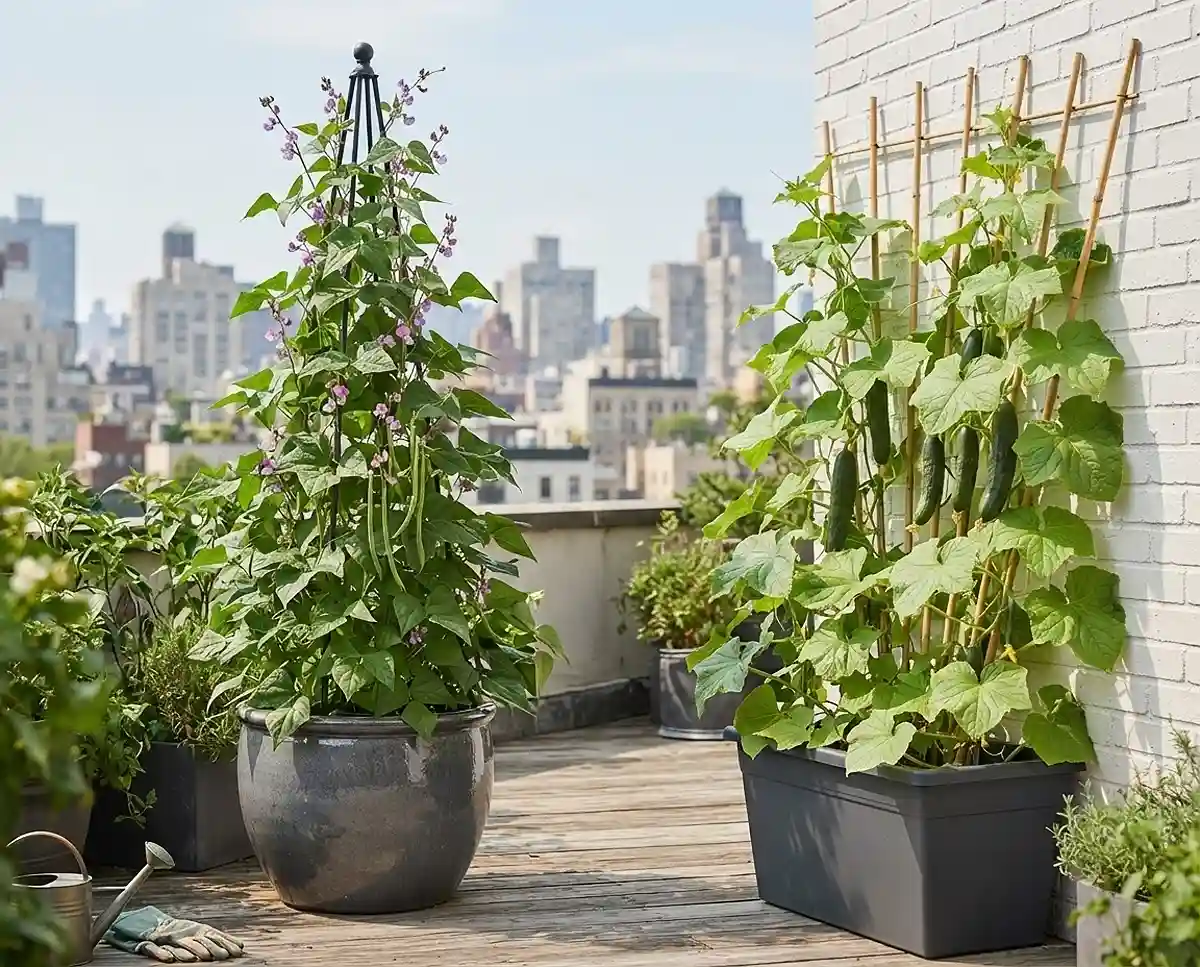
Container Trellis for Cucumbers and Beans
The right container trellis for cucumbers and beans isn’t just a nice-to-have — it’s the difference between a thriving harvest and a toppled pot. I grow Spacemaster cucumbers and Kentucky Wonder beans on a zone 6b rooftop terrace, and the trellis shape I choose every May directly determines my July yield.
Table of Contents
Why Trellis Shape Dictates Your Container Harvest Success
Vining crops in pots face a challenge that in-ground gardeners never deal with: every inch of growth adds leverage against a fixed, finite base. A poorly shaped trellis doesn’t just fall over — it takes your plant, your soil, and your season with it.
The right shape maximizes vertical sunlight exposure so leaves aren’t shading each other out. It separates stems enough to keep air moving, which is your first line of defense against fungal disease. And critically, it distributes the weight of heavy fruit across the structure rather than concentrating it at one point.
This is where vertical gardening in containers gets serious. Shape isn’t aesthetic — it’s structural engineering for your balcony or patio.
Understanding Vine Mechanics: Cucumbers vs. Climbing Beans
Before you buy a single trellis, understand this: cucumbers and pole beans climb in completely different ways. Put them on the wrong structure and you’ll spend the whole season fighting the plant instead of harvesting from it.
Matching the trellis design to how a vine naturally grips is the single biggest factor in building a low-maintenance container garden. Get it right and the plant does most of the work itself.
How Cucumbers Climb (Fragile Tendrils)
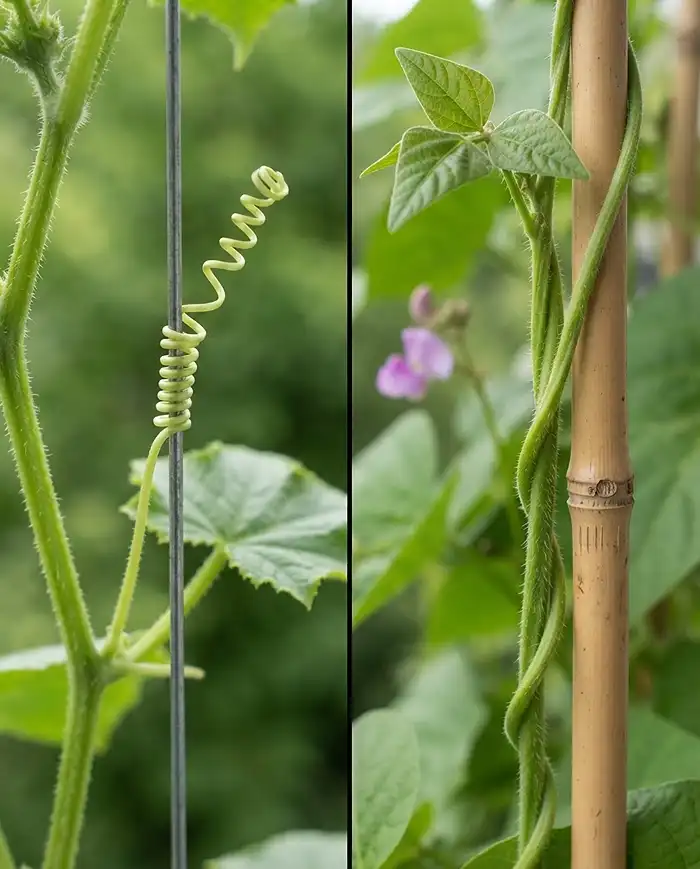
Cucumbers send out thin, coiling tendrils — delicate little hooks that reach out and grab whatever they can find. The catch? These tendrils can only grip structures with a diameter under about 2 inches.
Thick bamboo poles, wide wooden slats, or large-gauge wire are essentially invisible to a cucumber tendril. The plant can’t get purchase and just hangs there, leaving heavy fruit dragging stems toward the ground.
For cucumber in containers, you need a grid of narrow-gauge wire or thin twine spaced no more than 4 to 6 inches apart. This gives those searching tendrils something to find every few inches as the plant climbs. A flat fan or vertical wire grid nailed to the wall works perfectly for this reason.
How Pole Beans Climb (Twining Stems)
Pole beans are a completely different animal. They don’t use tendrils at all. Instead, the main stem itself spirals around whatever support it finds, like a vine wrapping a telephone pole.
This twining habit means beans need something vertical and substantial to grip. A thin twine grid actually works against them — the stem tries to spiral around it and ends up in a tangled mess.
For beans, you want a sturdy, vertical pole or thick bamboo stake of at least 3/4 inch diameter. An obelisk trellis with four solid legs is ideal. The bean stem spirals up each leg naturally, anchoring itself every few inches without any help from you.
Evaluating Pot Size and Wind Load Restrictions
A 5-foot trellis loaded with cucumber foliage in July acts like a sail. Before you install anything, do a quick audit of your space: Which direction does wind typically come from? Is there a wall, railing, or overhang nearby?
This spatial check is non-negotiable for balcony vertical garden setups where a tipping pot can become a falling pot.
Matching Trellis Height to Container Volume
Here’s the rule of thumb I follow every season without exception: a 5- to 6-foot trellis needs a minimum 15-gallon container with a heavy, wide base.
The physics are simple. A tall trellis creates a long lever arm. Wind pushes against the leafy canopy, that force transfers down to the trellis legs, and the legs try to rotate the pot. A lightweight 10-gallon pot tips. A heavy 15-gallon ceramic or concrete pot with a wide base resists that rotation.
For anything taller than 6 feet, move up to a 20-gallon container or brace the trellis against a fixed structure like a wall or railing. This is especially critical for space saving garden ideas where pots are near balcony edges.
| Trellis Height | Minimum Container Size | Recommended Material |
|---|---|---|
| Up to 4 feet | 10 gallons | Heavy plastic or ceramic |
| 4 to 6 feet | 15 gallons | Ceramic, concrete, or heavy resin |
| 6 feet and above | 20+ gallons | Concrete or wall-braced |
Counterbalancing Wind on Balconies and Patios
Even the right pot size isn’t always enough on a gusty rooftop or exposed balcony. I learned this the hard way in summer 2022 when a late-June storm flattened two of my bean pots — both in 15-gallon containers but with no ballast at the base.
The fix is dead simple: before adding any soil, pour 2 to 3 inches of coarse gravel or a few heavy bricks into the bottom of the pot. This lowers the center of gravity significantly, making the whole assembly far harder to tip.
This “sail effect” — a fully leafed-out trellis catching summer crosswinds — is the most underestimated risk in a balcony vertical garden. Don’t skip the ballast step. Check the RHS guide on container growing for windy spots for additional anchoring strategies.
The Best Trellis Shapes for Potted Vining Crops
Not every trellis shape works in a container. Some are designed for in-ground use and will never anchor properly in a pot. Here are the three shapes that actually work, each suited to a specific container type and growing situation.
The Obelisk (Pyramid) Trellis: Best for Wind Resistance
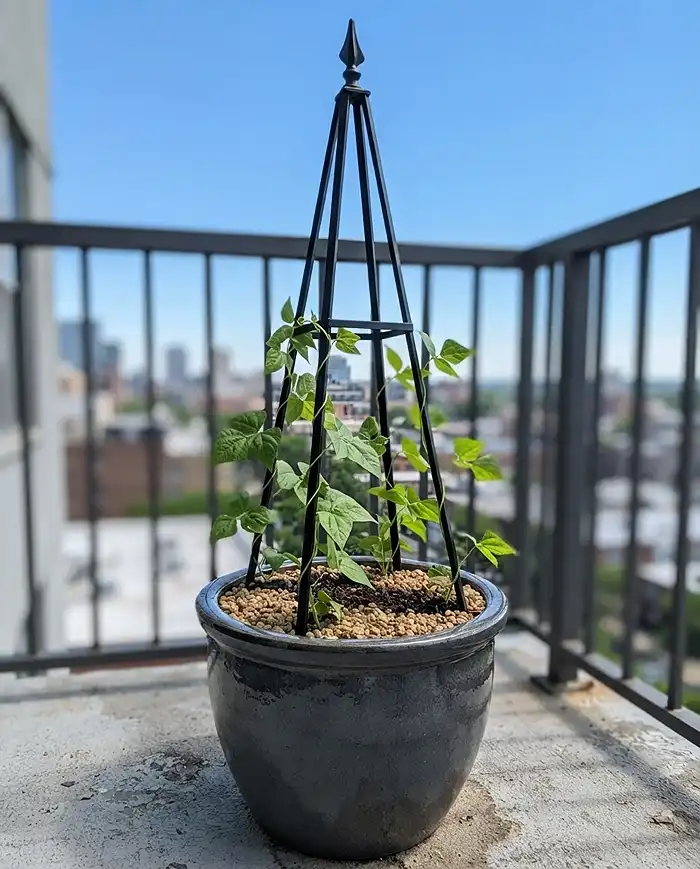
Quick Answer: An obelisk trellis with four inward-leaning legs is the most wind-resistant freestanding option for round 15-gallon pots. Its pyramidal shape distributes lateral force across all four legs simultaneously, making it nearly impossible to tip from a single wind direction.
The obelisk’s narrow footprint at the top and wide spread at the base mirrors good engineering logic. Wind hits the canopy and transfers force downward and outward — right where the legs are already pushing into the soil.
This shape is perfect for pole beans. Each vertical leg gives the twining stem exactly what it needs: a straight, sturdy pole to spiral around. A 5-foot obelisk in a 15-gallon round pot with gravel ballast is my go-to setup for Kentucky Wonder beans, and it has never tipped in three seasons of growing.
Pro tip: Look for obelisks with legs that extend at least 8 to 10 inches below the decorative structure — those extra inches buried in soil are what keep the whole thing upright.
The Flat Fan Trellis: Best for Wall Placement
Quick Answer: A flat fan trellis — shaped like a widening V or semicircle — is ideal for pots pushed against a balcony wall or fence. The flared top spreads cucumber vines laterally for maximum sun exposure and airflow.
The fan shape solves two problems at once. First, it keeps the pot tight to the wall, saving precious floor space. Second, the widening V encourages cucumber vines to spread out across the fan’s ribs rather than piling on top of each other.
Dense, overlapping foliage is where powdery mildew starts. A fan trellis naturally opens the canopy, which is why it’s my first recommendation for cucumbers specifically. I grow Spacemaster cucumbers on a 4-foot fan trellis mounted flush against a south-facing wall — airflow stays excellent all season.
The narrow-gauge wire ribs also give cucumber tendrils exactly the thin grip surface they need. This is one of those space saving garden ideas that genuinely earns its place on a small patio. Pair it with vertical wall planters for herbs alongside to maximize every square foot.
Pro tip: Angle the fan trellis legs forward by 10 to 15 degrees before inserting them in soil — this leans the canopy slightly away from the wall and gives you crucial air circulation behind the vines.
The A-Frame Trellis: Best for Rectangular Planters
Quick Answer: An A-frame trellis straddles a rectangular trough or EarthBox planter and provides the best structural rigidity of any freestanding container option. Heavy cucumbers hang freely underneath the canopy, staying straight and unblemished.
The A-frame’s triangular cross-section is inherently rigid — the same reason it’s used in roof construction. Unlike a flat trellis that can sway side to side, an A-frame locks itself in place once the two legs are buried in opposite ends of the planter.
The hanging harvest benefit is real. Cucumbers that dangle freely grow straight and develop evenly on all sides. They’re also far easier to spot at harvest — no digging through foliage required. I switched my Marketmore cucumbers to an A-frame over an EarthBox in 2023 and immediately noticed cleaner, straighter fruit.
Check the best cucumbers for containers to find compact varieties that won’t outgrow a 5-foot A-frame mid-season.
Pro tip: String horizontal twine lines every 6 inches across the A-frame’s legs to create a grid — this gives cucumber tendrils far more grabbing surfaces than two bare poles alone.
Step-by-Step Trellis Installation in Containers
Installation order matters more than most guides admit. Done wrong, your trellis will wobble and your roots will be damaged. Done right, the structure locks itself in place as the soil compresses around it.
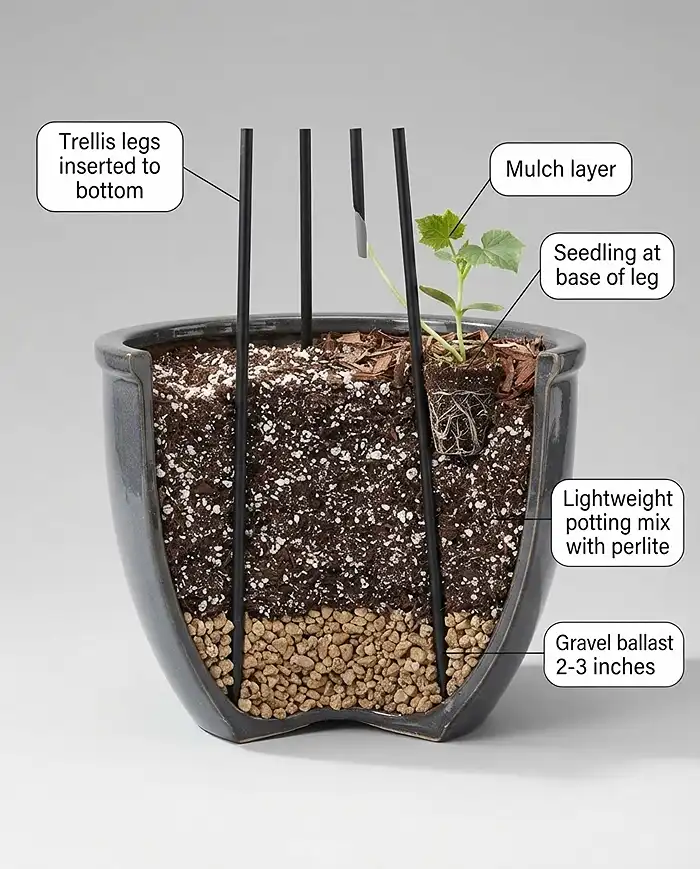
- Step 1 — Trellis first, soil second: Push the trellis legs all the way to the bottom of the empty container before adding any growing medium. This anchors the legs at maximum depth.
- Step 2 — Add ballast: Pour 2 to 3 inches of coarse gravel around and between the legs at the base of the pot. This locks the legs and lowers the center of gravity.
- Step 3 — Pack in potting mix: Use a perlite-rich potting mix (aim for 20 to 25% perlite) and press it firmly around the legs as you fill, layer by layer. This eliminates air pockets that allow the legs to shift.
- Step 4 — Plant at the base: Set seedlings directly at the foot of each trellis leg. Shorter distance to the support means faster, tidier climbing from day one.
Never try to install a trellis after the plant has started growing. You’ll blindly sever major root systems, stunt the plant, and likely snap brittle un-trained vines. The trellis goes in on day one — no exceptions.
Training and Maintaining Your Vining Vegetables
Installing the right trellis shape is step one. Keeping vines on it all season is an ongoing, hands-on task. Fast-growing summer cucumbers and beans can put on 3 to 4 inches of new growth per day in peak season.
Check your vines every morning. It takes 60 seconds and prevents the tangled mess that happens when you leave plants unattended for a week. For more ideas on making vertical growing effortless, the vertical herb ladder for small balconies shows how good structure makes daily maintenance almost automatic.
Directing New Growth and Securing Heavy Vines
Every morning during peak season, spend 60 seconds guiding new cucumber tendrils into the trellis grid. A tendril that misses the grid and grabs a neighboring stem will create a knot that tightens as fruit weight increases.
For heavy main stems — especially on mature cucumbers carrying full-sized fruit — use soft silicone plant ties or strips of upcycled pantyhose to attach the stem to the trellis. Avoid wire twist ties or anything rigid. Rigid ties cut into stems as they swell, causing a condition called girdling that can kill a branch overnight.
Silicone ties stretch with the stem and release easily when you need to adjust. I keep a roll clipped to my watering can so I never walk past a drooping vine without fixing it.
Pruning for Airflow and Disease Prevention
This is the one task most balcony gardeners skip, and it’s the main reason powdery mildew destroys container cucumber crops by August. The fix is aggressive and counterintuitive: remove foliage.
Strip every leaf and lateral shoot from the bottom 12 inches of the plant — all of it. These lower leaves never see direct sun, they collect moisture, and they’re where fungal spores land and establish. Removing them opens a critical airflow corridor at the base of the plant.
Beyond that, remove any dense, overlapping inner leaves that block airflow through the canopy. You’re not hurting production — fruit is set by the upper, sun-exposed leaves. You’re eliminating the humid microclimate that powdery mildew needs to spread.
Common Problems and Solutions
Even with the right trellis and a good installation, two mechanical problems show up repeatedly in container vertical gardening. Both are fixable in under 10 minutes once you know what you’re dealing with.
Trellis Tipping Over in Summer Storms
If a storm has already flattened your pot, act fast. Upright the container immediately, check if the root ball has pulled loose from the trellis legs, and re-firm the soil around the legs by hand before the roots have time to dry out.
To prevent it happening again: run a length of UV-resistant zip ties from the top of the trellis to a nearby balcony railing or a sturdy wall hook. This single anchor point transforms a freestanding trellis into a braced one and eliminates tipping risk almost entirely.
Don’t use regular zip ties — UV degrades standard nylon quickly in direct sun. Look for UV-stabilized outdoor zip ties or use stainless steel cable ties for a permanent fix.
Vines Sliding Down Smooth Metal Legs
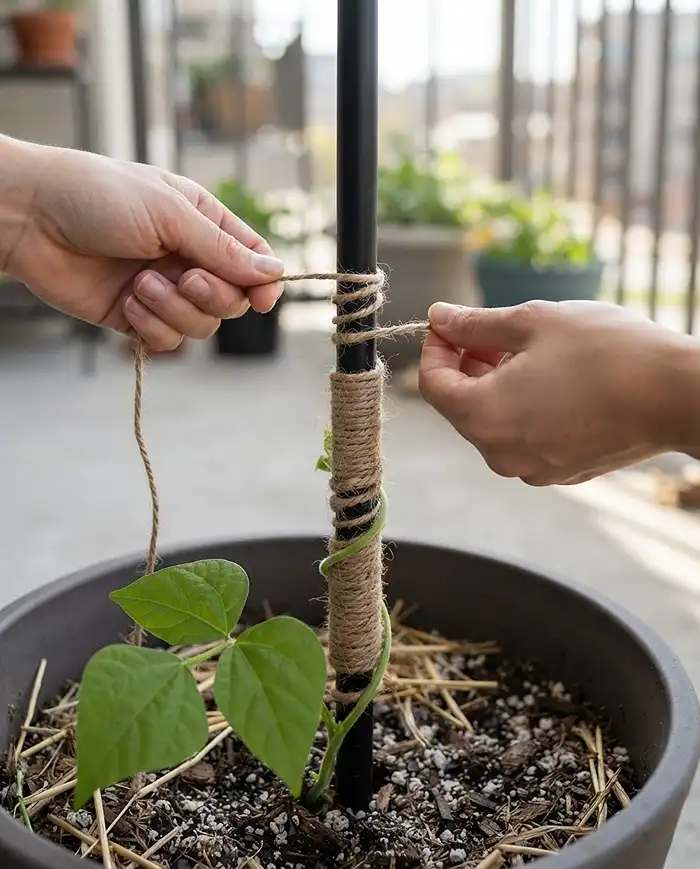
Powder-coated metal and plastic trellises look great, but their smooth surfaces give twining bean stems nothing to grip. The stem spirals and then just slides back down, leaving the plant unsupported.
The fix costs about two dollars: wrap the smooth legs tightly with rough jute twine from base to top, overlapping each wrap by about half. The rough texture gives bean stems the friction they need to spiral upward without slipping.
This also works for cucumbers — the textured surface gives tendrils an easier grip point, even when they miss the wire grid. One wrapping lasts an entire season before the twine degrades.
container trellis for cucumbers and beans FAQs
How tall should a trellis be for cucumbers in a pot?
A container trellis for cucumbers only needs to be 4 to 5 feet tall above the soil line. Vining cucumbers can grow 8 feet long, but you can simply drape excess vine back down over the top of the structure once it reaches the apex. There is no need for an 8-foot trellis in a container — the plant will use whatever height you give it.
Can I add a trellis after the plant has already started growing?
No — this is strongly discouraged. Pushing trellis legs deep into a pot mid-season will blindly sever major root systems and stunt the plant. It will also likely break brittle, untrained vines that have already set their growth direction. Install the trellis on day one, before any soil or plants go in.
Do I need to tie my climbing beans to the trellis?
Pole beans are natural, aggressive climbers that will twine around the structure on their own. The one exception: during their first week, place a single loose tie at the very base of each seedling to guide the stem toward the pole. After that first contact, the bean takes over and climbs without any help.
What potting mix works best for container trellises with cucumbers?
Use a perlite-rich potting mix with roughly 20 to 25% perlite by volume. This keeps the mix well-draining (cucumbers hate wet feet) while staying heavy enough to anchor trellis legs firmly. Avoid lightweight mixes marketed as ultra-light or balcony blends — they are too airy to hold trellis legs stable.
Can I grow cucumbers and beans on the same trellis in one pot?
Technically yes, but it is not recommended. Cucumbers need a narrow wire grid; beans need thick vertical poles. Combining them on one structure usually means neither plant is getting its ideal support. Growing them in separate pots with their own matched trellis will produce a significantly better harvest from both crops.
Key Takeaways
- The right container trellis for cucumbers and beans must match how each crop naturally climbs — tendrils for cucumbers need narrow grids; twining stems for beans need solid vertical poles.
- A 5- to 6-foot trellis requires a minimum 15-gallon, heavy-based container plus 2 to 3 inches of gravel ballast at the bottom to prevent tipping.
- Install the trellis before any soil or seedlings go in — mid-season installation severs roots and breaks vines.
- Obelisks suit round pots and beans; flat fan trellises suit wall-adjacent pots and cucumbers; A-frames suit rectangular planters and produce straight, hangable fruit.
- Strip the bottom 12 inches of foliage and prune dense inner leaves throughout the season to prevent powdery mildew — the most common killer of container cucumber crops.
Great post! Very informative and easy to understand. Thanks for sharing such valuable insights.
Thanks, glad it was helpful! The tendril-vs-twining difference seems small but makes all the difference once you see it in action.
Happy climbing this season!