

Balcony Herb Shelf Ideas for Stylish Apartments
The best balcony herb shelf ideas do two things at once: they grow real food and look genuinely good doing it. If your balcony feels cramped and chaotic, a tiered vertical shelf changes everything — fast.
I grow 14 herb varieties on a 4-foot-wide east-facing balcony in zone 6b. A three-tier ladder shelf gave me back my floor space and turned a cluttered corner into what my guests call my “outdoor kitchen.” Here’s exactly how I did it.
Table of Contents
Elevating Your Apartment with a Styled Balcony Herb Shelf
A well-arranged vertical herb shelf doesn’t just hold plants — it transforms your balcony into a fragrant, functional extension of your kitchen. It’s one of the smartest small balcony garden moves you can make.
The key insight most people miss: a shelf forces intentional design. You’re curating a display, not just stacking pots. That constraint is actually what makes it look so good.
Floor-based planters sprawl and compete for space. A tiered shelf stacks your herb garden ideas vertically, frees up room for a chair, and creates a visual focal point that makes even a 30-square-foot balcony feel considered and complete.
The fragrance payoff is real too. Rubbing past basil and lemon thyme every time you step outside is one of those small daily pleasures that genuinely improves your mood. And harvesting fresh herbs without leaving the apartment? That never gets old.
Assessing Your Balcony’s Microclimate for Tiered Growing
Before you buy a single pot, spend a day observing your balcony. A tiered shelf creates distinct micro-zones — the top shelf lives in a different world than the bottom one, and planting without understanding that is the number-one reason herb shelves fail.
Think of it as micro-zoning: each tier is its own growing environment. Sun, wind, and humidity all shift dramatically between levels. Map those zones first, then match your herbs to them.
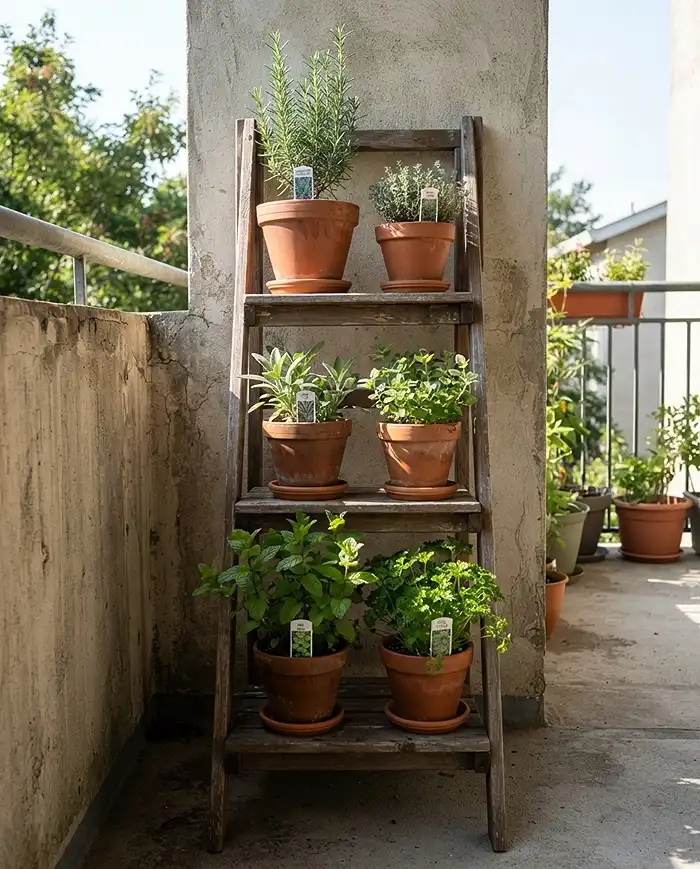
Mapping Sun Exposure Across Multiple Shelf Levels
Spend one full day watching shadows move across your balcony — morning, noon, and late afternoon. Note where direct sun hits, and for how long, at each height where your shelf tiers will sit.
The top shelf on a south or west-facing balcony can get 6-8 hours of direct sun. That’s perfect for rosemary, thyme, and oregano — your Mediterranean sun-worshippers. Place those up top.
The bottom shelf, blocked by railings and the tiers above, might get 2-3 hours of filtered light. That’s ideal for mint, chives, parsley, and cilantro. These shade-tolerant varieties will bolt and suffer on an exposed top tier in midsummer heat.
On my east-facing balcony, I get strong morning sun that fades by noon. My top tier holds lemon thyme and Greek oregano. Bottom tier holds a massive mint (in its own pot — always isolate mint) and flat-leaf parsley. Both are thriving as of summer 2025.
Wind Load and Structural Safety for Renters
This section isn’t optional reading. A fully loaded three-tier shelf with wet soil can weigh 60-80 pounds. On a high-rise balcony, wind gusts can tip an unsecured unit in seconds.
Wet potting soil weighs roughly 75 lbs per cubic foot. A 6-inch pot with moist mix weighs about 5-7 lbs. Multiply that across 9-12 pots and you see the problem.
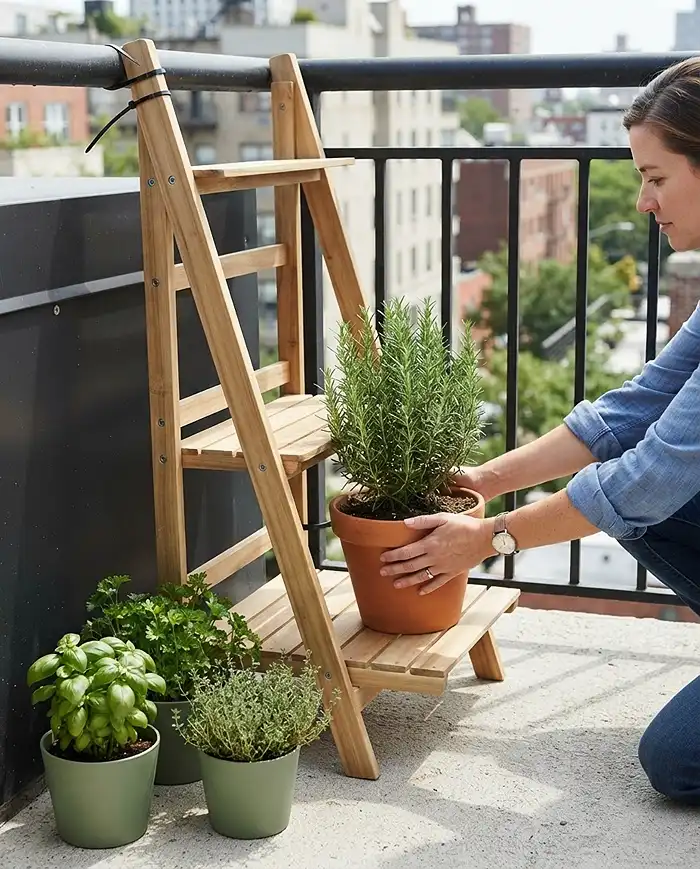
Secure tall leaning shelves to your railing using heavy-duty, UV-resistant zip ties — the thick 8mm variety rated for outdoor use. Use at least two tie points at different heights. Check them monthly; UV degrades plastic faster than you’d expect.
For freestanding units, position the heaviest pots strictly on the bottom shelf. This lowers the center of gravity and dramatically reduces tip risk. Never put large terracotta on the top tier of an unsecured unit on a windy balcony.
Choosing the Right Shelf Style and Material
Your shelf is permanent outdoor furniture. It needs to handle rain, UV, frost cycles, and the constant moisture of watering — while still looking sharp. Material choice determines how long it lasts and how much maintenance you’ll do.
Here’s a quick comparison of the most common options for apartment balcony garden ideas:
| Material | Best For | Watch Out For |
|---|---|---|
| Acacia / Teak Wood | Rustic or warm aesthetic; durable with sealing | Needs annual marine sealant; heavier |
| Powder-Coated Steel | Modern, minimal look; very strong | Can rust at chips; gets hot in direct sun |
| Resin / Polypropylene | Lightweight, renter-friendly, budget option | Less attractive; can crack in extreme cold |
| Bamboo | Eco-friendly, lightweight | Short lifespan outdoors without heavy sealing |
Leaning Ladder Shelves for Tight Corners
Leaning ladder shelves are the workhorse of the balcony garden ideas world for good reason. They require no drilling, lean against a wall or railing, and make excellent use of dead corner space.
Acacia and teak versions are the most durable hardwood options. Their graduated shelf depth — wider at the bottom, narrower at the top — is actually ideal for herb growing. Large mature rosemary goes on the wider bottom shelf; small seedling pots of basil fit perfectly up top.
Look for units with at least 12 inches of depth on the lower shelves. Anything narrower and you’ll struggle with pot stability, especially in wind.
I used a 5-tier acacia ladder shelf from a garden retailer for two full growing seasons before needing to reseal it. Cost me about $85 and it’s still solid. The graduated depth meant my large ceramic oregano pot sat flush on the base tier while small 4-inch herb pots lined the upper shelves perfectly.
Tension-Rod Systems and Renter-Friendly Wall Mounts
If your lease prohibits drilling, tension-rod plant poles and heavy-duty railing brackets are genuinely good alternatives — and they create a “floating” aesthetic that looks more modern than a standard ladder shelf.
Tension pole systems (sometimes called floor-to-ceiling plant stands) work by pressure between your floor and ceiling. They hold 20-40 lbs depending on the model. Pair with S-hook hanging pots for a clean, vertical display.
Railing-mount brackets clamp onto standard round or flat railings without screws. Look for ones rated for at least 15 lbs per bracket. They work best with lightweight resin or fiberglass pots — avoid terracotta here.
The Royal Horticultural Society’s balcony gardening guidance recommends always checking your building’s railing load rating before mounting anything — a practical step most renters skip.
Styling Your Herb Collection for Maximum Visual Impact
A beautiful herb shelf isn’t an accident. It’s the result of treating your plant arrangement like an interior designer would treat a shelf display — with intention, restraint, and a clear visual language.
The two levers that matter most are container consistency and plant arrangement. Get both right and even a cheap resin shelf looks expensive.
Curating a Cohesive Container Aesthetic
The fastest upgrade you can make: ditch the mismatched plastic nursery pots. Nothing undermines a carefully planned shelf faster than a rainbow of mismatched containers in three different materials.
Pick one material and stick to it across all tiers. Unglazed terracotta gives a warm, Tuscan aesthetic that suits Mediterranean herbs beautifully. Matte black fiberglass reads as modern and minimal — stunning against a white wall or dark railing.
You don’t need matching sizes. Varying pot sizes within the same material family creates rhythm and hierarchy, which is actually more visually interesting than uniform rows. Vary height with plant stakes or pot risers.
- Terracotta: Classic, porous (great drainage), heavy — use rubber pot feet to protect shelf surfaces
- Matte fiberglass: Lightweight, modern look — ideal for upper shelves and renter budgets
- Glazed ceramic: Beautiful but heavy — restrict to lower tiers only
- Resin: Most affordable, very light — a good base option if you’re just starting out
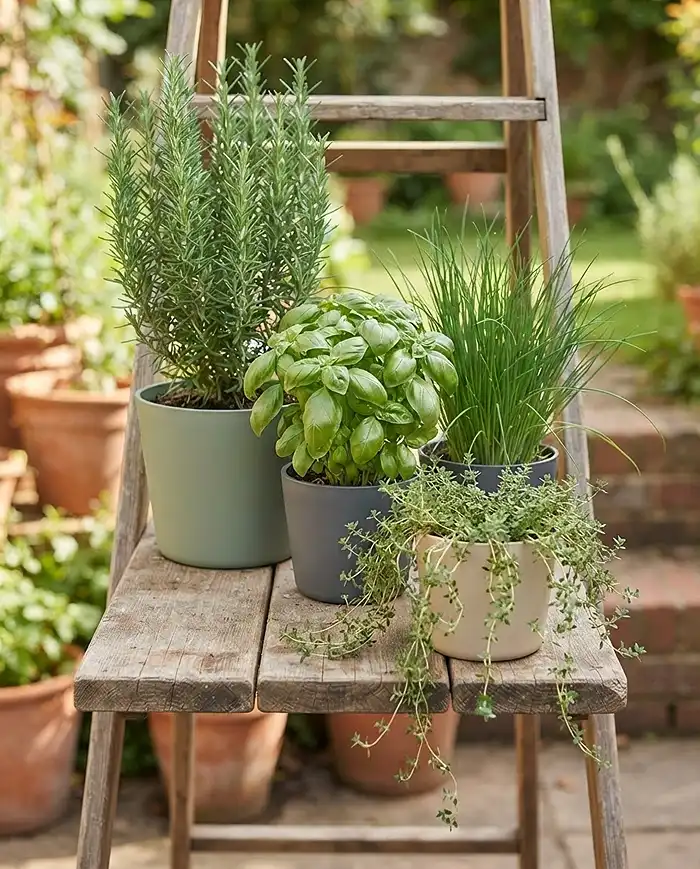
The Thriller, Filler, Spiller Herb Arrangement
This landscape design principle translates perfectly to tiered shelving. Every shelf tier should have visual movement — height variation, texture contrast, and something that softens the hard lines of the shelf edge.
Thrillers are your vertical anchors. Upright rosemary (try ‘Tuscan Blue’ — it grows tall and structured), lemongrass, or a standard basil plant in a tall pot. Place these toward the back or center of each tier.
Fillers are your mid-height, bushy plants that create density. Compact basil varieties like ‘Spicy Globe,’ chives, parsley, and marjoram are ideal. They fill visual gaps and give the shelf a lush, abundant look.
Spillers cascade over the shelf edge, softening hard lines and adding movement. Creeping thyme, trailing oregano, and prostrate rosemary are perfect. Position them at the front edge of each tier so they can drape naturally.
Explore more layout inspiration in our guide to balcony herb garden ideas for apartment growers.
Step-by-Step Guide to Planting and Organizing Your Shelf
Setup order matters. Do this in the wrong sequence and you’ll be lifting heavy, soil-filled pots at awkward angles and potentially destabilizing the whole unit.
- Mix your soil first: Blend standard potting mix with 20-30% perlite by volume. This reduces weight significantly and improves drainage — critical in containers that can’t self-regulate moisture.
- Prep each pot: Cover drainage holes with mesh or a coffee filter to prevent soil loss. Don’t use gravel — it actually impedes drainage in containers (this is a common myth).
- Pot your herbs individually: Never crowd multiple herb species into one pot unless they have identical water needs. Basil and rosemary together is a death sentence for one of them.
- Load the shelf from bottom up: Place the heaviest pots — large terracotta, mature rosemary — on the bottom tier first. Work upward with progressively lighter containers.
- Secure the unit before final arrangement: Tie off to the railing, check stability, then arrange for aesthetics. Don’t do this in reverse order.
For a deeper dive on which herbs thrive in containers, our complete guide to growing herbs in pots covers indoor and outdoor setups in detail.
One honest failure: my first season, I ignored the soil weight issue and loaded five large terracotta pots with standard bagged mix onto my top two tiers. The shelf bowed noticeably within a week and I had to re-pot everything into fiberglass. Switching to a perlite-heavy mix cut my total shelf weight by about 30%.
Maintenance Routine for a Pristine Herb Display
Tightly packed, elevated containers dry out faster than ground-level beds. They also have nowhere to drain except down onto the shelf or floor. Your maintenance routine needs to account for both.
Check soil moisture daily in summer — stick a finger 2 inches deep. If it’s dry, water. Elevated containers in full sun can need watering every day in peak heat. Don’t rely on a schedule; rely on the soil.
Drip-Free Watering and Targeted Feeding
The biggest aesthetic problem on multi-tier shelves is muddy water cascading from upper pots down onto lower foliage and the balcony floor. It stains wood shelves, marks floors, and damages lower plant leaves.
The solution is two-part: use glazed drip trays sized exactly to each pot, and water slowly with a long-spout watering can. A narrow spout lets you direct water precisely at the soil surface, not the leaves, reducing splash and overflow.
For feeding, a bi-weekly liquid kelp fertilizer works well for heavy-harvest herbs. Kelp is gentle, organic, and supports dense leafy growth without the nitrogen spike that makes herbs bolt.
Dilute to half the recommended rate for container herbs — they’re more concentrated than garden beds and over-fertilizing causes lush but flavorless leaves. I use a quarter-strength kelp feed weekly through the growing season with consistently good results.
Deadheading [removing spent flower heads] is essential for basil, cilantro, and mint. The moment these herbs flower, leaf production slows and flavor drops. Check every few days and pinch flower buds the moment they appear.
Common Problems and Solutions
Multi-tier setups have specific failure modes. Catch these early and your shelf stays both beautiful and productive through the full growing season.
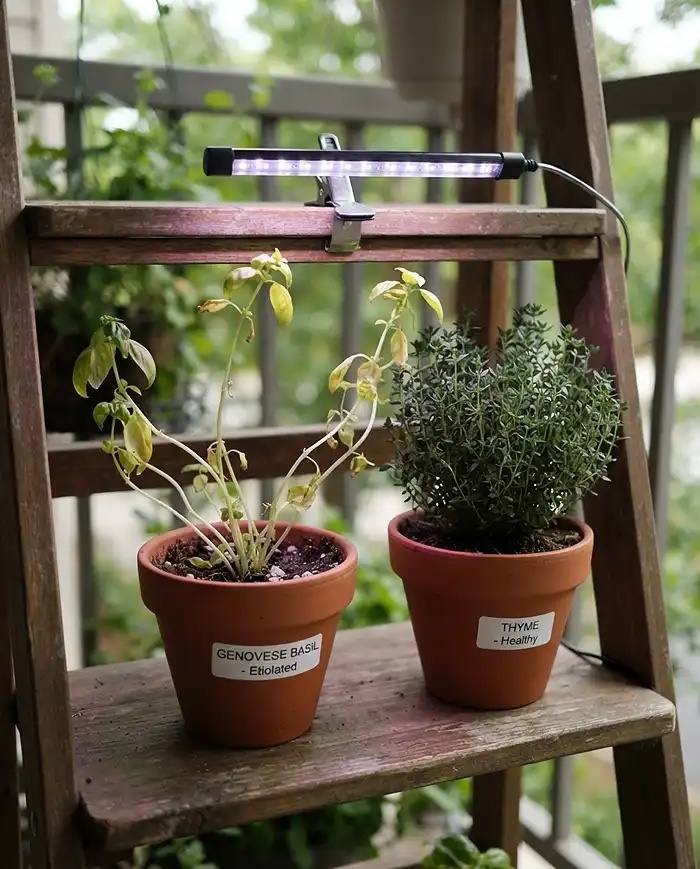
Leggy Herbs Reaching for Light (Etiolation)
Etiolation — weak, stretched growth caused by insufficient light — is the most common lower-shelf problem. Affected herbs look pale, spindly, and produce little usable foliage.
The fix is two-pronged. First, implement a weekly rotation schedule: move lower-shelf pots to the top for 3-4 days, then cycle them back. Second, aggressively pinch back the top growth nodes of affected herbs. This forces lateral branching and produces a much bushier, more productive plant.
If rotation isn’t enough, consider a small clip-on grow light for the bottom tier — a 10W full-spectrum LED bar can make the difference on a north-facing balcony.
Water Damage and Wood Rot on Shelving
Wooden ladder shelves and constant moisture are a difficult combination. Without protection, you’ll see gray discoloration and soft rot within one to two seasons.
Apply a marine-grade wood sealant (not standard decking sealant — marine-grade handles more sustained moisture) at the start of each season. Two coats on all surfaces, paying special attention to joints and end-grain cuts where water penetrates fastest.
Elevate every pot on rubber “pot feet” — small rubber discs that lift the pot 1/4 to 1/2 inch off the shelf surface. This breaks the seal between pot and wood, allows condensation to evaporate, and dramatically extends shelf life. A pack of 12 costs about $5 and is one of the best shelf investments you can make.
balcony herb shelf ideas FAQs
How much weight can a standard balcony ladder shelf hold?
Most commercial wooden ladder shelves are rated for 15 to 25 pounds per tier. Always verify the manufacturer’s stated weight limit before loading. Use lightweight resin or fiberglass pots on upper tiers to stay well within safe limits — wet potting mix adds significantly more weight than most people expect.
What are the best trailing herbs for the top shelf?
Prostrate rosemary, creeping oregano, and lemon thyme are ideal top-shelf spillers. All three are drought-tolerant, handle high wind and intense sun well, and naturally cascade over shelf edges. Avoid trailing mint on the top shelf — it needs more moisture than the exposed upper tier typically retains.
How do I overwinter potted herbs on a balcony shelf?
Above-ground pots freeze much faster than in-ground plants. In USDA zones below 7, move perennial herbs off the exposed shelf before the first hard freeze. Cluster them against the heated apartment wall, wrap pots in horticultural fleece, or bring them indoors entirely. Annual herbs like basil won’t survive regardless — compost them and start fresh in spring.
Can I grow herbs on a north-facing balcony?
Yes, but your herb selection must match the light. Mint, chives, parsley, and cilantro all grow reasonably well in 2-4 hours of indirect light. Mediterranean herbs like rosemary, thyme, and oregano need 6+ hours of direct sun and will struggle on a north-facing balcony without a supplemental grow light.
How many herbs can I realistically grow on a three-tier shelf?
A standard three-tier shelf (about 24 inches wide) can hold 9 to 12 individual pots comfortably, depending on pot size. Prioritize herbs you actually cook with — basil, parsley, chives, and thyme cover most kitchen needs and all grow well in containers.
Key Takeaways
- The best balcony herb shelf ideas start with mapping your microclimate — sun and wind vary dramatically between shelf tiers, so match herbs to zones before buying a single pot.
- Use a perlite-heavy potting mix (70/30 blend) to cut shelf weight by up to 30% while improving drainage in your small balcony garden containers.
- Container consistency is the fastest visual upgrade — one material across all pots transforms a shelf from cluttered to curated instantly.
- Apply the thriller-filler-spiller principle on every tier to create visual depth and movement that makes your apartment balcony garden ideas look professionally designed.
- Secure every freestanding shelf to your railing and place the heaviest pots on the bottom tier — aesthetics don’t matter if the whole unit tips over in a storm.
For more inspiration on layouts and plant choices, explore our full collection of apartment balcony garden ideas to find a setup that fits your space and style.