

Best Vegetables for Railing Planters in Small Spaces
The best vegetables for railing planters are shallow-rooted, compact varieties — loose-leaf lettuce, radishes, arugula, and dwarf tomatoes — that thrive in 6-to-10-inch containers straddling your balcony rail.
I grow on a west-facing balcony in zone 6b, and mounting saddle planters along my railing doubled my harvest without touching a single square foot of floor space. Here’s exactly how to pull it off.
Table of Contents
Maximizing Small Spaces with Railing Planter Vegetables
Most balcony gardeners treat the railing as a boundary. I treat it as prime real estate. A standard 6-foot railing can hold three to four planters — that’s roughly 12 to 16 inches of growing depth pointing straight into the sun.
The secret is choosing the right crops and the right hardware. Railing planters work with gravity, not against it, so once they’re locked in place, they’re remarkably stable. You get a continuous harvest of fresh greens and radishes without ever dragging a bag of soil through your living room again.
This guide covers productive container gardening for renters and small-space growers who want results, not decoration.
Assessing Your Balcony Railing and Microclimate
Before you buy a single planter, spend one week observing your railing. Note sun direction, wind strength at different times of day, and whether your lease says anything about exterior modifications. That 20-minute audit will save you from expensive mistakes.
Measuring Railing Width and Weight Limits
Grab a tape measure and note the exact top width of your railing — most are 1.5 to 2.5 inches wide. Round metal railings need saddle-style hardware; flat wood or square metal railings suit adjustable bracket boxes better.
Most residential balconies are engineered for 40 to 60 lbs per linear foot. A single wet planter box can hit 15 to 20 lbs, so stick to two or three boxes per railing section and always check with your building manager if you’re unsure.
If you’re renting, check your lease before anything goes over the exterior edge. Many agreements prohibit objects that could fall onto lower floors. Some buildings require written approval even for lightweight saddle planters.
Evaluating Wind Exposure and Sunlight
Railing planters sit higher than floor pots, which means more direct sun — but also more wind. Elevated exposure is brutal on soil moisture. A box that needs watering every two days at ground level may need it daily up on the rail.
Track your sun hours for one day before choosing crops. Fruiting vegetables like micro tomatoes and bush beans need a minimum of six full hours of direct light. Leafy greens tolerate four hours but produce faster with six.
If your balcony faces north or gets strong afternoon crosswinds, stick to compact greens. Wind above the third floor can snap tomato stems and knock over top-heavy plants, even in well-secured boxes.
Selecting the Safest and Best Railing Planters
The right hardware means your boxes stay on the railing through storms, not just sunny days. You don’t need to drill into masonry or compromise your deposit — modern railing planter systems are designed for exactly that.
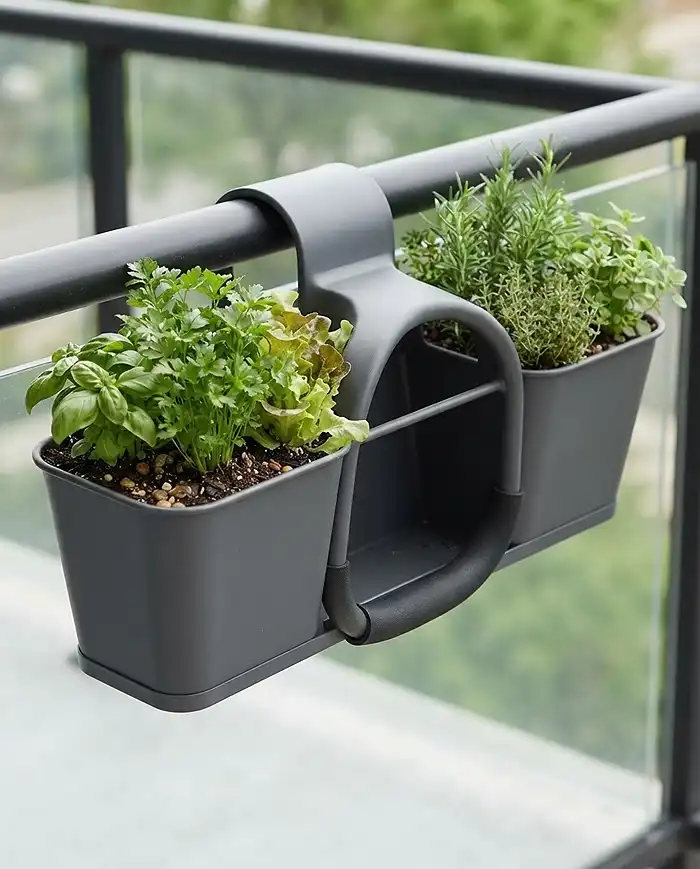
Saddle Planters vs. Adjustable Bracket Boxes
Quick Answer: Saddle planters drape over the railing using gravity and are the most secure option for round or irregular railings. Adjustable bracket window boxes lock flush against flat railings with screw-free tension hardware.
Saddle planters are the heavy-duty choice. They straddle the railing like saddlebags, with interior and exterior pockets that counterbalance each other. There’s no risk of tipping outward because the weight is distributed on both sides.
Bracket-style window boxes work better on flat wood or square metal railings. Look for locking brackets with rubber-coated feet — they grip without scratching and don’t require any tools to install or remove at season’s end.
| Planter Type | Best Railing Shape | Watch Out For |
|---|---|---|
| Saddle planter | Round, irregular, or thin metal | Uneven weight if one side is overpacked |
| Bracket window box | Flat wood or square metal | Brackets can slip on smooth painted railings |
| Hook-style box | Horizontal bar railings | Not suitable for round or angled tops |
Self-Watering Features for High-Exposure Areas
Quick Answer: Self-watering railing planters with internal reservoirs reduce watering frequency by up to 50% in exposed, windy locations — a major advantage for container vegetable gardening on upper-floor balconies.
UV-resistant resin planters hold up better than standard plastic in direct sun. After one season, cheap plastic boxes crack and fade; quality resin stays flexible and color-stable for three to five years.
The internal reservoir sits below a wicking layer of soil. Roots draw water upward as needed through capillary action, which keeps moisture more consistent than overhead watering. That consistency matters — irregular watering causes bolting in lettuce and bitter flavor in arugula.
I switched to self-watering saddle planters in spring 2024 and my ‘Black Seeded Simpson’ lettuce lasted two weeks longer before bolting compared to my standard boxes from the previous year.
The Best Vegetables for Railing Planters
Choosing the right crops is where most beginners go wrong. Standard vegetable transplants from a garden center are bred for raised beds, not 6-inch containers. You need shallow-rooted, compact, and fast-maturing cultivars — ideally varieties selected specifically for container and railing planter growing.
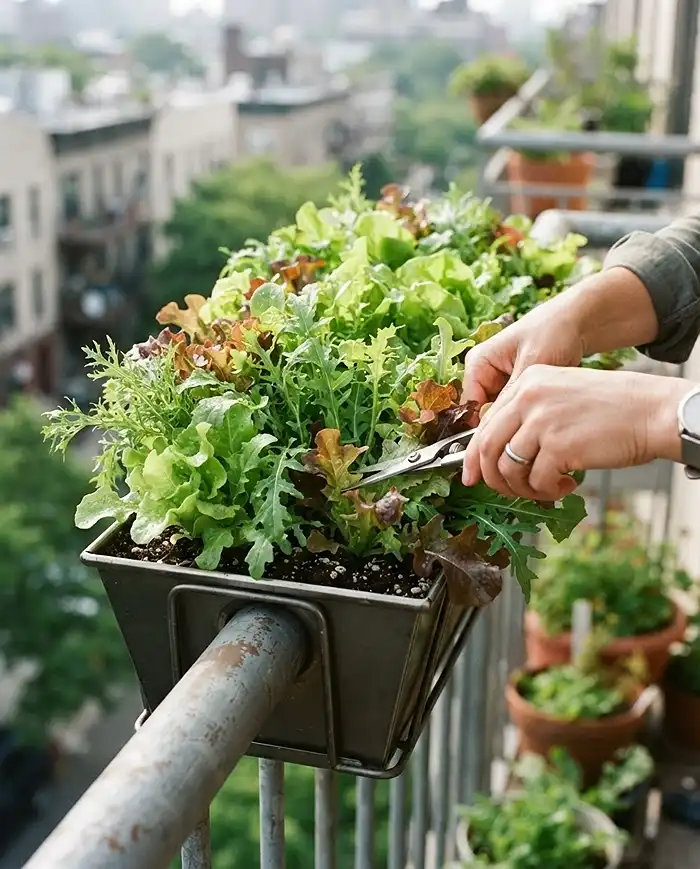
Cut-and-Come-Again Leafy Greens (Lettuce, Spinach, Arugula)
Quick Answer: Loose-leaf lettuce, baby spinach, and arugula are the top performers for railing planters. Their roots stay within 4 to 6 inches, they tolerate the soil fluctuations of elevated containers, and they regrow after cutting.
Sow a mesclun mix densely — about one seed per inch — across the full length of the box. Thin to 2 inches apart once seedlings hit 2 inches tall. You’ll have harvestable leaves in 21 to 30 days.
For heat-tolerant spinach, try ‘Tyee’ or ‘Space’ — both resist bolting longer than standard varieties. For arugula, any common cultivar works, but ‘Astro’ is milder if you find standard arugula too peppery.
The cut-and-come-again method works like this: snip outer leaves at the base when they hit 3 to 4 inches, leaving the central growing point intact. Done right, one sowing yields four to six harvests over six to eight weeks.
Fast-Maturing Root Crops (Radishes, Baby Carrots)
Quick Answer: ‘French Breakfast’ radishes mature in 25 days and need only 4 inches of depth. ‘Paris Market’ carrots are round rather than long, maturing in 55 to 65 days in just 6 inches of soil — ideal for shallow railing boxes.
The critical rule with root crops in containers: the planter depth must exceed the mature root length by at least 2 inches. For standard radishes, 6-inch planters are fine. For most carrots, you need 8 inches minimum.
I tried ‘Nantes’ carrots in a 6-inch saddle planter in summer 2023. Every single root forked or curled at the bottom because it hit the base of the box. Switched to ‘Paris Market’ the following spring and got perfect round roots every time.
- French Breakfast radish — 25 days, 4-inch depth minimum, sow every 2 weeks for continuous harvest
- Cherry Belle radish — 22 days, very compact, handles light shade better than most
- Paris Market carrot — 55 days, round 2-inch roots, needs 6-inch depth and consistent moisture
- Short ‘n Sweet carrot — 68 days, 4-inch roots, one of the best for container vegetable gardening
Compact Fruiting Vegetables (Bush Beans, Micro Tomatoes)
Quick Answer: ‘Micro Tom’ tomatoes grow to just 8 inches tall and produce marble-sized cherry tomatoes in 60 days. Determinate bush beans stay under 18 inches and don’t need staking — both stay wind-resistant in exposed railing boxes.
Micro Tom is the gold standard for railing planters. It was bred specifically for windowsill and container growing, so it handles root restriction without sulking. Expect 20 to 30 fruits per plant in a 10-inch-deep box.
For bush beans, choose determinate varieties like ‘Contender’ or ‘Provider’. They top out at 15 to 18 inches, produce a concentrated flush of pods over 2 to 3 weeks, and then you’re done — no ongoing management needed.
Avoid anything labeled “indeterminate” or “vining” for railing planters. Those plants will keep growing into a wind-catching sail that puts serious lateral stress on your mounting hardware.
Essential Supplies and Lightweight Soil Mix
Wet soil is heavy. A standard potting mix can add 1 lb per inch of depth per linear foot of box — and that’s before you water it. Choosing the right mix is a structural safety decision, not just a gardening one.
Formulating a Lightweight, Moisture-Retentive Potting Mix
Quick Answer: Blend premium organic potting soil (50%), coco coir (30%), and perlite (20%). This mix weighs roughly 30% less than straight potting soil when wet and drains fast enough to prevent root rot in high-exposure planters.
Coco coir holds moisture without compacting — critical in shallow boxes where roots have nowhere to go seeking water. Perlite improves aeration and dramatically reduces overall wet weight. Don’t skip it.
- 50% premium organic potting mix (avoid heavy garden soil or anything with compost as the primary ingredient)
- 30% coco coir bricks, rehydrated — one brick expands to fill roughly 2 gallons
- 20% coarse perlite — the larger particle size (grade 3) works best for drainage
- Optional: 1 tablespoon of granular slow-release fertilizer per gallon of mix for a season-long nutrient base
Pre-moisten the mix before filling your boxes. Dry coco coir repels water initially — trying to water bone-dry soil after planting wastes most of what you pour on.
Step-by-Step Guide to Planting on a Railing
Sequence matters here. Getting this wrong means heavy lifting over the edge of your balcony, which is both dangerous and unnecessary. Do it in order and you’ll never have to move a full, wet planter box once it’s mounted.
Step 1: Mount the empty hardware first. Saddle planters: drape over the railing and confirm fit before adding soil. Bracket boxes: attach and lock brackets to the railing while the box is empty and light.
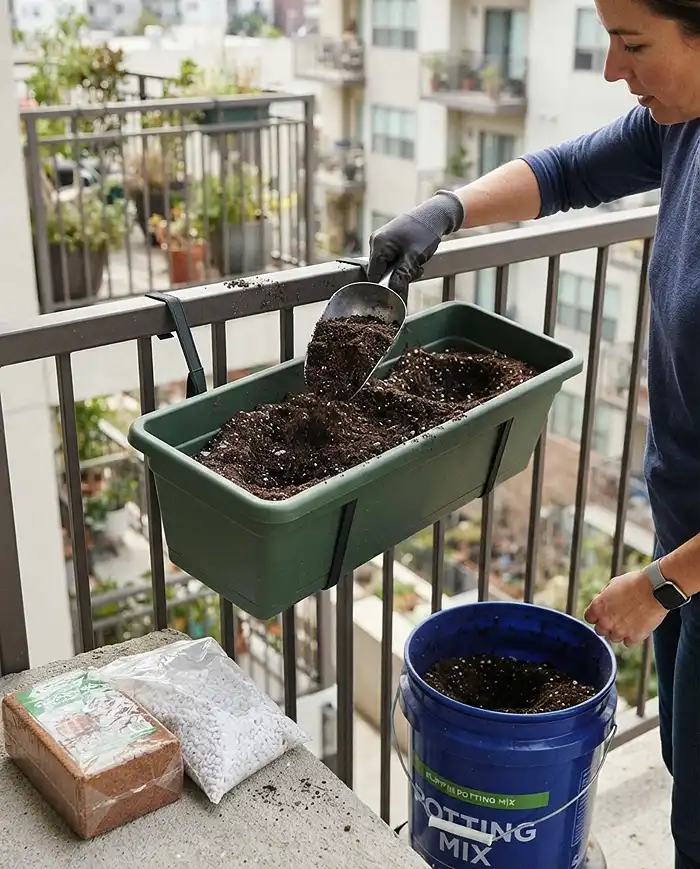
Step 2: Fill in place. Mix your soil on the balcony floor, not inside. Scoop it into the mounted boxes to about 75% capacity to allow for watering headroom.
Step 3: Plant transplants or direct-sow seeds. For transplants, firm them gently into the soil and water immediately. For seeds, sow at the depth listed on the packet and cover with a thin layer of vermiculite.
Step 4: Apply a 1-inch layer of straw mulch over the soil surface. This single step cuts evaporation by up to 40% and keeps the soil from blowing out during high winds. Keep mulch away from plant stems to prevent rot.
Maintenance and Care for Elevated Vegetables
Elevated vegetables in pots need more attention than their ground-level counterparts — but the routine is simple once it’s dialed in. The main goals are consistent moisture, regular feeding, and keeping things tidy so you don’t annoy your downstairs neighbors.
Watering Hacks for Fast-Drying Soil
Quick Answer: Do a daily finger test — push your finger 1 inch into the soil. If it’s dry at that depth, water immediately and thoroughly until a small amount drains through. Use a narrow-spout watering can and aim at the soil, not the leaves.
Watering the leaves of vegetables in pots spreads fungal issues fast in tight containers. It also drips down to the balcony below. Narrow-spout cans let you thread water right to the root zone without splash.
In peak summer, railing planters in full sun may need watering twice daily. If that’s not practical, this is when self-watering reservoirs pay for themselves. The University of Minnesota Extension’s container watering guide recommends checking exposed containers morning and evening during heat waves.
Liquid Fertilization for Shallow Root Systems
Quick Answer: Apply half-strength water-soluble organic fertilizer every 10 to 14 days throughout the growing season. Frequent watering in railing boxes flushes nutrients out of shallow soil fast — liquid feeding compensates for that constant loss.
Fish emulsion and kelp extract are both good choices. They’re gentle enough at half-strength to avoid burning roots in small containers, and they break down in the soil rather than building up salt deposits like some synthetic fertilizers.
Don’t skip feeding. I went six weeks without fertilizing my bush beans in summer 2023 and the leaves went pale and the pod set dropped significantly in the fourth week. A single round of fish emulsion brought them back within 10 days.
Common Problems and Solutions
Railing containers face specific failure modes that don’t show up in ground gardening. Catch these early and your crops recover fast. Ignore them and you’ll be replanting within two weeks.
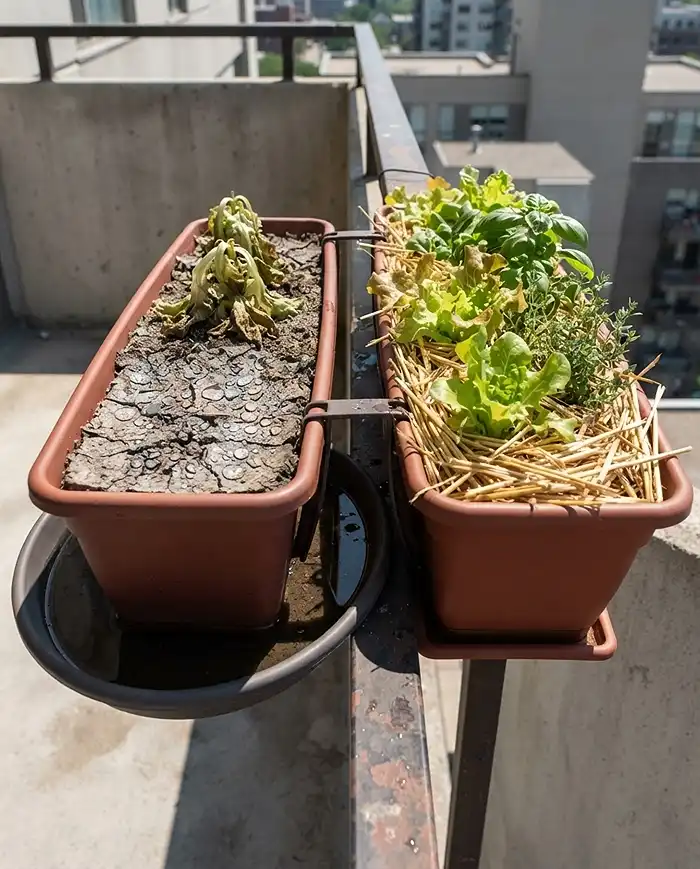
Soil Dehydration and Stunted Growth
Quick Answer: Hydrophobic soil — where water beads on the surface and runs off instead of soaking in — is the most common killer in railing planters. The fix is hydrogel crystals in the mix and heavy surface mulching.
Add hydrogel water-storing crystals at a rate of 1 teaspoon per gallon of potting mix when you first build your blend. They absorb water during irrigation and slowly release it between waterings, buffering against the extreme evaporation rates of elevated, sun-baked boxes.
If your soil has already gone hydrophobic, set the planter in a shallow tray of water for 20 minutes to rehydrate from the bottom up. Then top-dress with fresh straw mulch and begin daily finger-testing going forward.
Wind Damage and Soil Runoff
Quick Answer: Keep soil level 2 inches below the planter rim at all times. This prevents wind from blowing dry soil onto neighbors below and creates a buffer zone that stops water from washing over the edge during heavy watering.
For stem breakage on taller crops, plant dense and low-profile. A full row of cut-and-come-again lettuce creates mutual wind support — the plants lean on each other. Single, isolated transplants in the middle of a box are always most vulnerable.
If you’re above the fifth floor and regularly see winds above 20 mph, skip fruiting crops entirely and stick to leafy greens and radishes. They have a low center of gravity and their shallow stems don’t catch wind the way a tomato plant does.
vegetables for railing planters FAQs
How deep does a railing planter need to be for vegetables?
Shallow-rooted greens and radishes thrive in 6-inch deep planters. Fruiting crops like dwarf tomatoes or bush beans need a minimum of 8 to 10 inches of depth to support their root mass without stunting growth or causing root deformity.
Are railing planters safe for high-rise apartment balconies?
Yes, provided you use inward-facing bracket systems or secure saddle planters and double-secure them with heavy-duty UV-resistant zip ties. This eliminates risk of tipping during severe storms. Always verify your building’s weight limits and lease terms before installing.
Can I grow full-sized cucumbers or peppers in a railing box?
No. Full-sized indeterminate vining crops and large bell peppers produce too much top growth. That mass acts as a sail in wind, risking the plant uprooting or pulling the box off the railing entirely. Stick to compact dwarf cultivars.
What vegetables grow best in railing planters for beginners?
Start with loose-leaf lettuce and ‘French Breakfast’ radishes. Both germinate in under a week, need minimal fertilizer, and produce a harvest in under 30 days. They’re forgiving of inconsistent watering compared to fruiting crops.
How many railing planters can I safely mount on a standard balcony?
For a 6-foot railing section rated at 40 lbs per linear foot, two to three filled saddle planters is the safe maximum. Each wet planter weighs roughly 15 to 20 lbs. Space them evenly and never exceed your building’s rated load per linear foot.
Key Takeaways
- The best vegetables for railing planters are shallow-rooted and compact: loose-leaf lettuce, arugula, radishes, ‘Paris Market’ carrots, ‘Micro Tom’ tomatoes, and determinate bush beans.
- Always measure your railing width and verify building weight limits before mounting hardware — wet planters can hit 20 lbs each.
- Use a lightweight soil mix of 50% potting soil, 30% coco coir, and 20% perlite to keep structural load manageable and moisture retention high.
- Self-watering planters and daily finger-testing are the two most effective tools against soil dehydration in high-exposure railing containers.
- Feed every 10 to 14 days with half-strength liquid fertilizer — frequent watering flushes nutrients fast from shallow soil. See our guide to balcony railing herb gardens for companion planting ideas alongside your vegetables.