
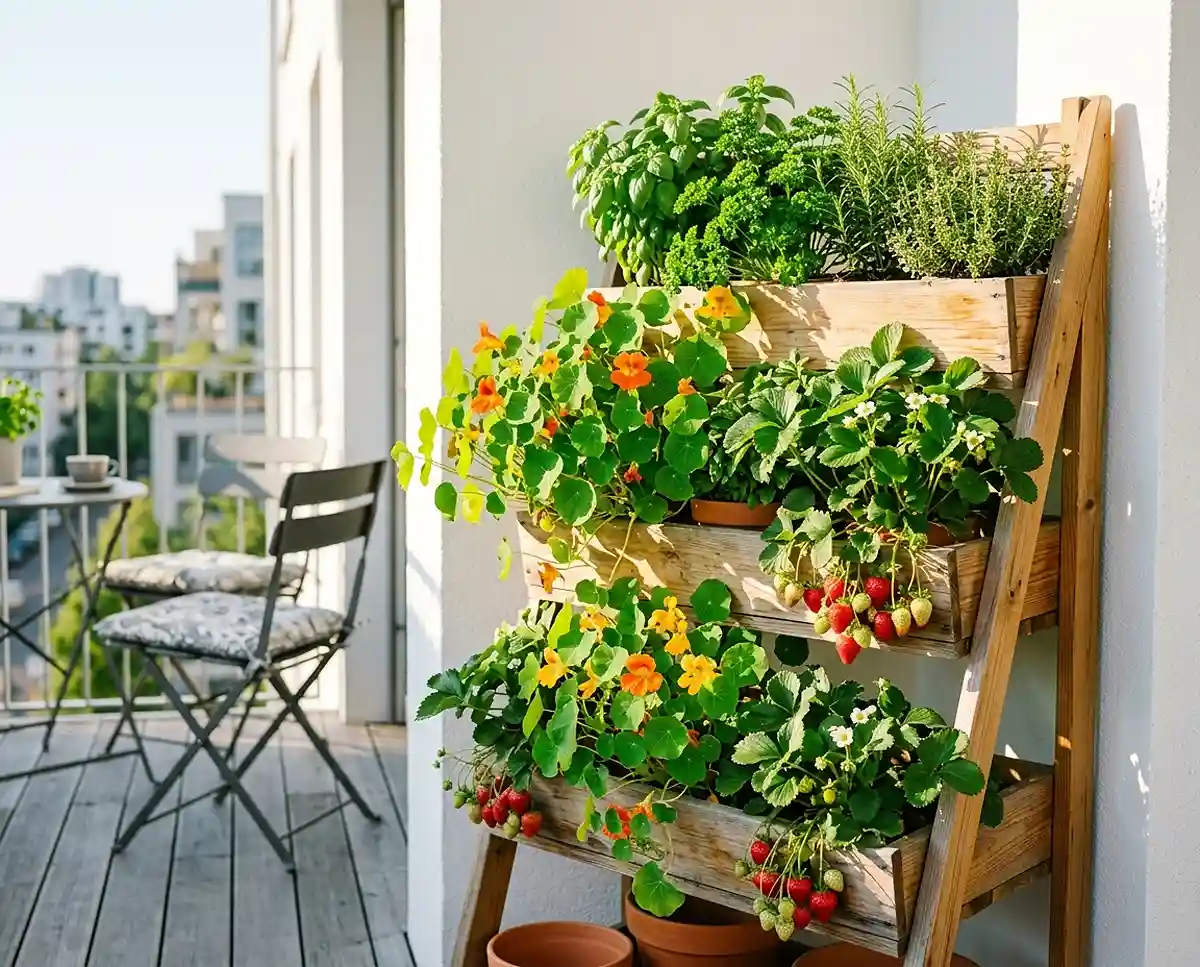
Tiered Planter Ideas for Tiny Balconies
Tiered planter ideas can triple your growing space without stealing a single extra square foot of floor — and if you’ve got a tiny balcony, that’s a game-changer. Pair vertical gardening with the right plant picks and your railing-sized patch becomes a real garden.
Table of Contents
Why Tiered Planters Are Genius for Tiny Balconies
Most small space gardening advice tells you to go bigger — bigger pots, bigger ambitions. But bigger pots eat floor space you don’t have.
Tiered planters work differently. They stack growing pockets upward, multiplying your planting area without expanding your footprint. A three-tier stand can hold nine plants in the space of one large pot.
That freed-up floor space matters. You keep a path to the door, a chair, maybe a small table. Your balcony stays functional while your balcony vertical garden quietly produces herbs, flowers, and greens all season.
The ideas ahead cover everything — the best tiered planter styles, what to grow in each tier, how to water without drowning the bottom level, and how to keep your setup stable when it’s fully loaded.
Planning Your Tiered Planter Setup
Before you buy anything, spend five minutes assessing what you’re working with. The wrong tiered planter in the wrong spot wastes money and frustrates you all season.
Three things matter most: available floor space, how much sun your balcony gets, and how much weight your balcony can safely hold. Nail these first and every other decision gets easier.
Measuring Space and Choosing a Footprint
Quick Answer: Measure your usable floor space, then subtract at least 24 inches for a clear walkway. Whatever’s left is your planter footprint.
Most balconies are 4–6 feet deep. A compact A-frame or ladder planter with a 12–18 inch base fits without blocking movement.
| Balcony Depth | Recommended Footprint | Best Shape |
|---|---|---|
| Under 4 ft | 12 inches max | Wall-mounted or railing planter |
| 4–5 ft | 12–16 inches | Ladder or A-frame |
| 6+ ft | Up to 24 inches | Corner stand or freestanding tier |
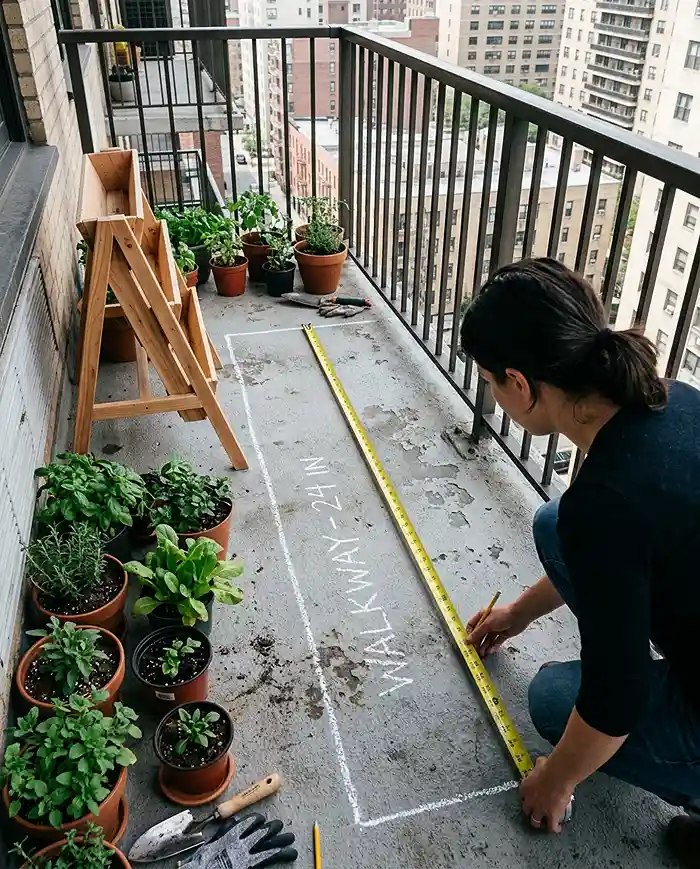
Real Example: My own balcony is 4.5 feet deep. I use a three-tier ladder planter with a 14-inch base tucked into the corner — still room for a folding chair and a small table beside it.
Pro Tip: Measure your doorway clearance too — some wider tier stands won’t fit through a standard balcony door once assembled.
Assessing Light and Stability
Quick Answer: Track sunlight across your balcony for one full day before positioning. Most edibles need 6+ hours; herbs survive on 4.
Check morning light versus afternoon light. South and west-facing balconies get the most direct sun. North-facing spots suit shade-tolerant greens and ferns.
- 6+ hours of direct sun: tomatoes, peppers, herbs, most flowers
- 4–6 hours: lettuce, spinach, parsley, mint
- Under 4 hours: ferns, impatiens, trailing ivy
For stability, always place your heaviest tier at the bottom and position the planter against a wall rather than near the railing edge. Use non-slip feet or rubber pads under the base.
Pro Tip: Check your building’s balcony weight limit — most are rated 40–60 lbs per square foot, but wet soil adds up fast.
Best Tiered Planter Ideas for Small Spaces
Not all tiered planters work the same way. Some are freestanding, some mount to walls, and some are DIY builds from materials you might already have. Here’s what actually works for small space gardening on a balcony.
The best tiered planter ideas share one trait: they make vertical gardening feel natural, not like a compromise. Each style below has a specific sweet spot — match the style to your space.
Corner Stands, A-Frames, and Ladder Planters
Quick Answer: Freestanding tiered designs are the easiest starting point — no drilling, no wall damage, and most are moveable.
| Style | Best For | Watch Out For |
|---|---|---|
| Corner stand | Dead corner space, 5+ pots | Heavy once loaded — hard to move |
| A-frame | Both sides accessible, herbs + flowers | Wide base on small balconies |
| Ladder planter | Flat against walls, modern look | Back-row pots shadowed by front tiers |
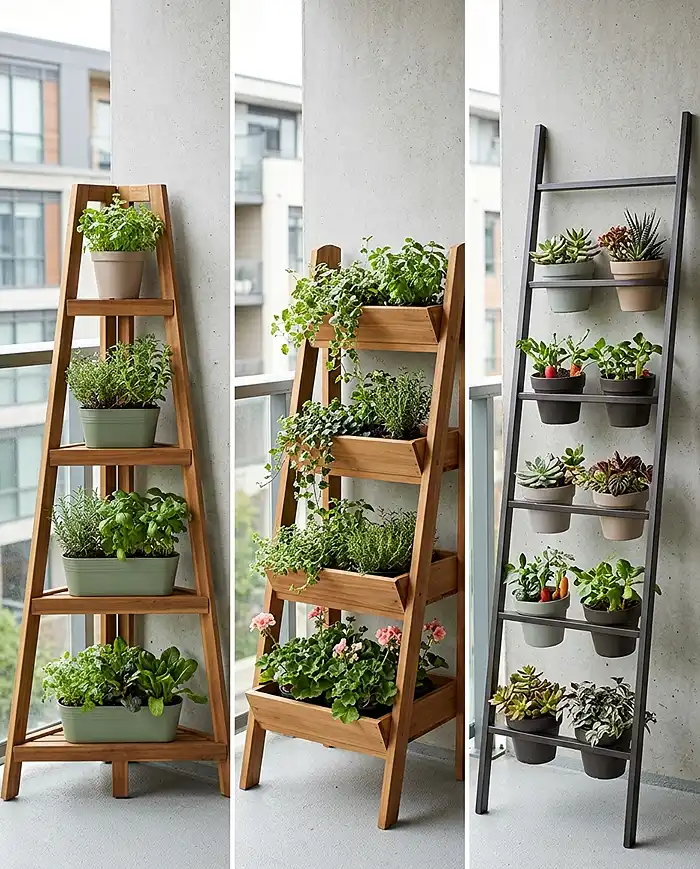
Real Example: I switched from an A-frame to a corner ladder stand last spring. The A-frame was sturdy but its wide base blocked half my balcony. The ladder planter slots into the corner and uses vertical space I was ignoring.
Pro Tip: Powder-coated steel ladder stands last longer outdoors than bamboo or untreated wood — worth the extra cost.
Stacking Pots, Strawberry Towers, and DIY Tiers
Quick Answer: Stacking systems and DIY builds give you the most flexibility for tight or oddly shaped balconies.
- Stacking pots: Interlocking terracotta or plastic pots create instant tiers — great for herbs and strawberries
- Strawberry towers: Tall, slim vertical planters with pockets all the way up — also perfect for herbs and trailing nasturtiums
- Pallet planter: Sand and seal a wooden pallet, staple landscape fabric to the back, fill with soil — instant wall garden
- Milk crate tiers: Stack crates on risers, line with coco coir — cheap, lightweight, surprisingly sturdy
Pro Tip: When building DIY tiers, offset each level by a few inches so water drains forward rather than pooling directly into the pot below.
What to Grow in a Tiered Planter
The best plants for tiered planters are ones that don’t mind shallow soil. Most commercial tier pockets hold 4–6 inches of growing medium — enough for herbs and greens, not enough for deep-rooted crops.
Think about your balcony vertical garden as three growing zones: top tier gets the most sun, middle tier gets filtered light, and bottom tier is the shadiest and stays wettest. Match plants to their zone and everything does better.
For more ideas on maximizing a productive balcony, the edible balcony garden guide at City Cultivator covers setup and plant selection in detail.
Herbs, Greens, and Compact Vegetables
Quick Answer: Herbs and leafy greens are the workhorses of tiered planting — shallow roots, fast growth, and you actually use them.
- Basil, parsley, chives: Top tiers, need 6+ hours of sun — harvest regularly to keep bushy
- Lettuce, spinach, arugula: Middle or lower tiers — prefer filtered afternoon light and stay cooler
- Compact peppers and dwarf tomatoes: Use a larger top tier or dedicate a full level — check out growing peppers in containers for variety picks
- Strawberries: Any tier, trail beautifully over the edge — pick ‘Albion’ or ‘Seascape’ for containers
- Radishes and green onions: Fast-maturing, shallow-rooted — perfect gap fillers between seasons
Pro Tip: Cut-and-come-again greens like lettuce and spinach give you multiple harvests from a single planting — ideal for small space gardening.
Flowers and Trailing Plants for Visual Appeal
Quick Answer: Trailing plants turn a functional tier stand into something that looks intentional. Use them in middle and lower tiers where they can cascade.
- Nasturtiums: Trail 12–18 inches, edible flowers, thrive in poor soil — zero fuss
- Lobelia: Spills over edges in blue, white, or purple — great for lower tiers in partial shade
- Calibrachoa (Million Bells): Compact, blooms all season, looks like trailing petunias
- Sweet potato vine: Fast-growing, dramatic foliage, fills gaps between blooms
- Bacopa: Tiny white flowers on delicate trailing stems — lasts all season with regular watering
Real Example: I filled the lower two tiers of my corner stand with trailing nasturtiums and lobelia last summer. By July they were spilling over every edge and the whole thing looked like a proper garden, not a plant storage rack.
Pro Tip: Mix one upright plant with one trailer per pocket — the contrast adds visual depth without crowding the roots.
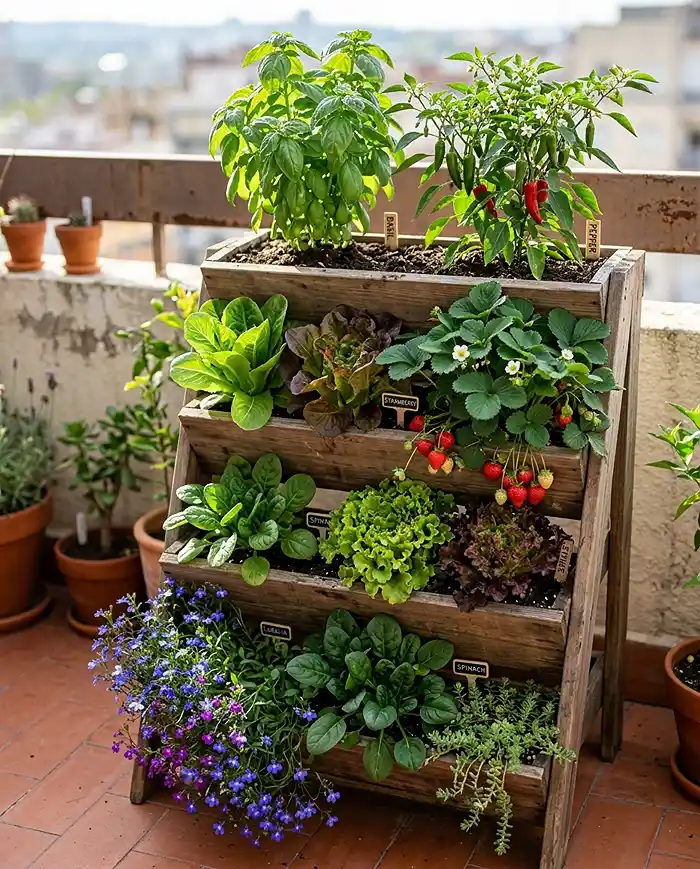
Positioning Plants by Tier for Best Growth
Quick Answer: Sun-hungry plants belong on top, shade-tolerant plants belong below. It’s that simple — and it works.
Top tiers sit above the shadow line cast by railings and neighboring structures. They catch the most direct light and also dry out fastest. Put your sun-lovers here.
- Top tier: Basil, peppers, tomatoes, marigolds, calibrachoa
- Middle tier: Parsley, lettuce, strawberries, compact herbs
- Bottom tier: Spinach, lobelia, ferns, trailing nasturtiums, mint
Mint deserves a special note — it’s invasive and will take over a shared pot. Keep it in its own container and place it on a lower tier where it gets some shade and stays cooler.
For crops that need support, like tomatoes or climbing beans, use the wall behind the tier stand. The container tomato support guide shows exactly how to stake without damaging your balcony.
Pro Tip: Rotate your tier stand 180 degrees every two weeks if it sits against a wall — it evens out light exposure and keeps plants growing upright rather than leaning.
Tools and Materials Checklist
Here’s what you need before you start setting up your tiered planter system:
- Tiered planter stand — sized to your footprint measurement
- Lightweight potting mix — not garden soil, which compacts and gets heavy
- Perlite or pumice — mix in 20% to improve drainage in shallow tiers
- Coco coir liners — for open-frame wire or pallet tiers to hold soil
- Slow-release fertilizer granules — blend into soil at planting time
- Non-slip rubber feet or pads — prevents tipping on smooth balcony surfaces
- Plant saucers — protects balcony floor from drainage water
- Cable ties or garden wire — for securing tiers to a railing if needed
Step-by-Step: Setting Up Your Tiered Planter
Set up your tier stand in its final position before adding any soil. Soil-filled tiers are heavy and awkward to move — position first, plant second.
Place the stand against a solid wall, away from high-wind spots. If your balcony is exposed, position the stand in a sheltered corner and use cable ties to loosely attach it to the railing as a backup anchor.
Filling and Planting Each Tier Correctly
Quick Answer: Fill tiers from the bottom up, firm the soil gently, and leave a 1-inch gap at the top of each pocket for watering without overflow.
- Mix potting soil with 20% perlite before filling any tier
- Fill bottom tiers first — the stand is most stable when weight is low
- Leave a 1-inch gap at the top of each pocket for water to pool briefly before absorbing
- Space plants so they have room to grow into the tier, not just fill it at planting time
- Press soil gently around roots — firm but not compacted
- Water each tier immediately after planting until water drips from the base
Real Example: First time I set up a three-tier stand, I filled and planted from the top down. By the time I reached the bottom tier, the whole thing was wobbling. Starting from the bottom fixed the stability problem immediately.
Pro Tip: Add a thin layer of gravel or bark mulch on top of each tier’s soil — it slows evaporation and stops soil from splashing out when you water.
Watering and Care for Tiered Planters
Watering tiered planters takes more attention than a single pot. Gravity does weird things — water rushes through upper tiers and can either waterlog lower ones or miss them entirely if it runs down the outside of the stand.
Water slowly and deliberately. A watering can with a narrow spout gives you more control than a hose. For hands-off watering, a drip irrigation system from the RHS irrigation guide can be adapted to tier stands using micro-tubing and individual drippers per pocket.
Feed every 10–14 days with a balanced liquid fertilizer during the growing season. Shallow tiers have limited soil volume and nutrients get flushed out quickly with regular watering. For a deeper dive into maximizing production in limited soil, the grow more food in less space guide covers soil management and feeding schedules.
Solving Uneven Water Flow Between Tiers
Quick Answer: Water the top tier slowly, wait 30 seconds, then move to each lower tier individually. Don’t rely on overflow from the top to water the levels below.
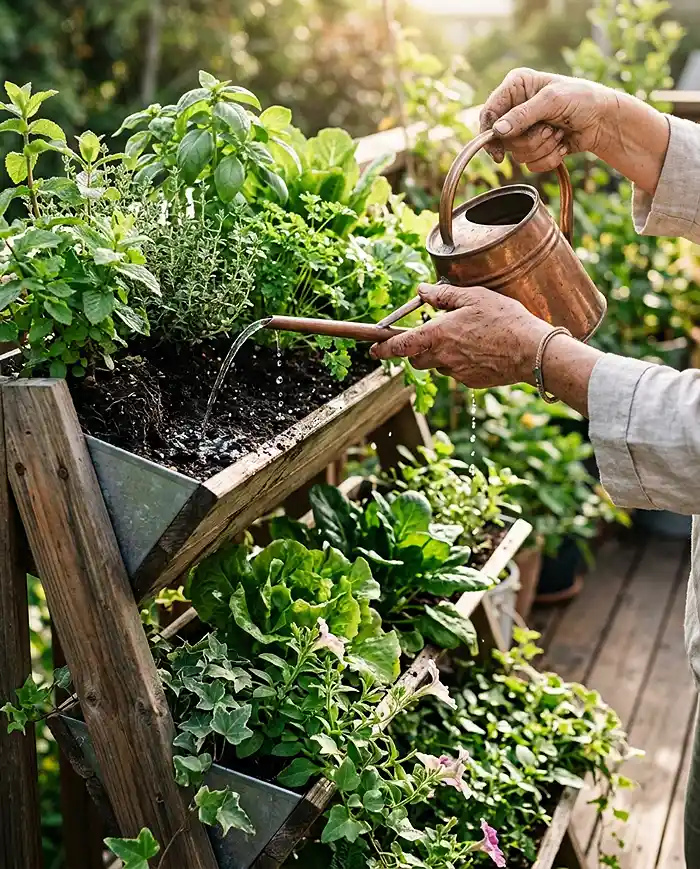
- Use a watering can at a slow, steady pour — not a fast dump
- Check bottom tier soil with your finger 30 minutes after watering — if it’s bone dry, it’s not getting enough
- Add moisture-retentive materials like coco coir or water crystals to lower tier soil mixes
- In hot weather, bottom tiers may actually dry out faster than top tiers due to reflected heat from the balcony floor
Pro Tip: Water in the morning — evening watering on a sheltered balcony keeps foliage damp overnight and invites fungal problems.
Seasonal Care and Refreshing Your Tiers
Tiered planters need a reset at least twice a year — spring and autumn — to stay productive. Shallow soil volume means nutrients deplete faster than in large ground-level containers.
In spring, remove spent plants, top up each tier with fresh potting mix, and blend in slow-release fertilizer before replanting. This is also the time to switch from cool-season crops (lettuce, spinach) to warm-season plants (basil, peppers, flowers).
In autumn, pull out frost-sensitive plants before the first freeze. Replace them with cold-hardy herbs like chives or parsley, or with ornamental cabbages and pansies that handle light frost well.
Every two years, replace all the soil in your tiers completely. Old potting mix compacts over time and loses drainage — plants in tired soil look stressed even when you’re watering and feeding correctly.
Common Problems and Solutions
Top Tiers Drying Out, Bottom Staying Wet
Quick Answer: This is the most common tiered planter problem. The fix is slowing down how fast you water and adjusting your soil mix.
- Water top tiers slowly to reduce runoff to lower tiers
- Add extra perlite to lower tier soil to improve drainage
- Use moisture-retentive coco coir in top tier soil to slow drying
- Check bottom tier drainage holes aren’t blocked by compacted soil
Pro Tip: Finger-test each tier individually every day until you learn your specific tier stand’s watering pattern — they all behave differently.
Lower Tiers Not Getting Enough Light
Quick Answer: Lower tiers are naturally shadier. Either accept it and plant shade-tolerant varieties, or rotate the stand regularly.
- Rotate the stand 180 degrees every 1–2 weeks to even out light exposure
- Plant lobelia, ferns, mint, and spinach in lower tiers — they prefer lower light
- Avoid tall, bushy upper-tier plants that cast heavy shade on lower levels
Pro Tip: White or light-colored walls behind your tier stand reflect extra light downward — worth considering if you’re painting your balcony wall.
Planter Tipping or Feeling Unstable
Quick Answer: An unstable tiered planter is a safety issue, not just an annoyance. Fix it before you load the tiers with plants and soil.
- Place heaviest pots in the bottom tier
- Add a paving slab or heavy stone on the base shelf if the stand has one
- Use cable ties to loosely secure the top of the stand to a railing or wall bracket
- Non-slip rubber feet under the base prevent sliding on smooth balcony tiles
Pro Tip: In high-wind zones, fill a few large plastic water bottles and place them behind bottom-tier pots as hidden ballast — cheap and effective.
Frequently Asked Questions
What can I grow in a tiered planter?
Herbs, greens, compact vegetables, flowers, and trailing plants all do well. Top tiers suit basil, peppers, and marigolds. Middle tiers work for lettuce, parsley, and strawberries. Lower tiers are best for shade-tolerant plants like spinach, lobelia, and mint. Stick to shallow-rooted varieties since most tier pockets hold only 4–6 inches of soil.
How do I water a tiered planter evenly?
Water each tier individually using a slow, steady pour — don’t rely on overflow from the top tier to reach the ones below. Use a watering can with a narrow spout for control. Add coco coir or moisture crystals to lower tier soil mixes to help retain water. Check each tier’s moisture separately with your finger 30 minutes after watering.
Are tiered planters good for small balconies?
Yes — they’re one of the best small space gardening solutions available. A three-tier stand can hold 6–9 plants in the footprint of one large pot. Choose a ladder or corner-style stand with a base under 18 inches and position it against a wall to keep your floor clear. Lightweight aluminum or powder-coated steel frames keep the overall weight manageable.
How do I stop a tiered planter from tipping over?
Load the bottom tier first and keep the heaviest pots there. Use rubber non-slip feet under the base. On exposed balconies, loosely secure the top of the stand to a railing or wall bracket with cable ties. You can also use hidden water-filled bottles as ballast behind bottom-tier pots in high-wind spots.
Key Takeaways
- Tiered planter ideas multiply your growing area upward without taking more floor space — the core principle behind effective small space gardening
- Measure your balcony footprint and light exposure before buying anything — the right tiered planter for your space beats the prettiest one that doesn’t fit
- Position sun-lovers on top tiers and shade-tolerant plants below for balanced vertical gardening across all levels
- Water each tier individually and slowly — top-down overflow watering leads to waterlogged lower tiers and dry upper ones
- Refresh soil each season and feed every 10–14 days to keep shallow-rooted plants in a balcony vertical garden consistently productive