

Container Depth Guide for Root Crops
This container depth guide for root crops gives you exact pot sizes, soil recipes & material comparisons. No guesswork. Grab the free cheat sheet now!
Here’s a secret most gardening blogs won’t lead with: the number-one reason container root vegetables fail isn’t bad seeds, poor sunlight, or even neglect — it’s the wrong pot depth. That’s it.
Optimal root depth is simply the minimum vertical soil column a root vegetable needs to fully develop without hitting the bottom, sitting in water, or starving for nutrients. Get the container depth for root crops right, and you’ve already solved about 80% of your problems before a single seed hits the soil.
This guide hands you the exact numbers, the soil mix recipe, and a side-by-side container material comparison so you can nail it on the first try. No guesswork, no wasted money on pots that are too small — or too big.
Table of Contents
Why Container Depth for Root Crops Matters More Than You Think
Let’s be real: most of us grab whatever pot is on sale at the garden center, toss in some soil, and hope for the best. I’ve done it. You’ve probably done it. And then we wonder why our carrots look like sad, twisted little fingers.
The truth is, most container failures come down to two invisible physics problems happening right inside your pot.
The “Perched Water Table” (And Why Your Drainage Holes Aren’t Enough)
Here’s something that genuinely surprised me when I first learned it: every single container — no matter how many drainage holes you drill — develops a saturated, waterlogged zone at the very bottom. It’s called a perched water table, and it exists because water molecules cling to the fine pores in potting mix and simply refuse to drip out into open air until the soil above is nearly soaked too.
In a shallow 6-inch pot, this soggy dead zone can swallow 30–40% of your total rooting space. That’s not a minor inconvenience — for beets and potatoes, which store dense carbohydrates in their roots, it’s basically an invitation for root rot to move in and set up camp.
The good news? Every depth recommendation in this guide already includes a 2-inch buffer for this effect. So when I say “12 inches,” I mean 12 inches — you don’t need to add extra.
Heat Buffering: Why Deeper Pots Keep Roots Cool
If you’re gardening on a balcony or patio — and let’s face it, that’s most of us doing the urban container gardening thing — your pots are probably baking on concrete. A 3-gallon pot on a south-facing balcony can hit 120°F at the root zone on a 90°F day. Roots don’t love that.
Bigger, deeper containers act like thermal batteries. They keep the root zone in that sweet 60–75°F range where taproots and tubers actually want to grow. And no, a wider but shallow tray doesn’t do the same job. Depth is depth — there’s no shortcut around it.
The Root Vegetable Soil Depth Chart You’ll Actually Use
Alright, let’s get to the part you probably scrolled here for. Every root crop fits into one of three depth tiers. Bookmark this table, screenshot it, tape it to your fridge — whatever works.
| Depth Tier | Minimum Container Depth | Key Crops | Recommended Pot Volume |
|---|---|---|---|
| Shallow | 6–12 in (15–30 cm) | Radishes, green onions, garlic | 2–5 gallons |
| Medium | 12–18 in (30–45 cm) | Carrots (Nantes, Chantenay), beets, turnips | 5–10 gallons |
| Deep | 18–36+ in (45–90 cm) | Potatoes, sweet potatoes, parsnips | 10–30 gallons |
Shallow-Rooting Crops: The Quick Wins (6–12 Inches)
Radishes are the gratification crop — 21 to 30 days from seed to plate with just a 6-inch pot. Green onions need about 8 inches for a nice white shank. Garlic’s a bit needier at 10–12 inches for full bulb development, but still firmly in “small pot” territory.
One thing people get wrong here: over-potting. I know it feels generous to give your radishes a massive deep container, but it actually backfires. The soil below the root zone stays wet for days, creating anaerobic pockets that breed fungal problems. Match your pot depth to the crop within a 2-inch margin and you’ll avoid a headache you didn’t even know was coming.
Medium-Rooting Crops: The Container Sweet Spot (12–18 Inches)
This is where growing carrots in containers gets really fun. Nantes varieties need 12 inches, Chantenay types only 10 (they’re shorter and conical — great for beginners), and Danvers need about 14 inches. Beets want 12 inches for both their taproot and lateral feeders. Turnips land at 12–14 inches.
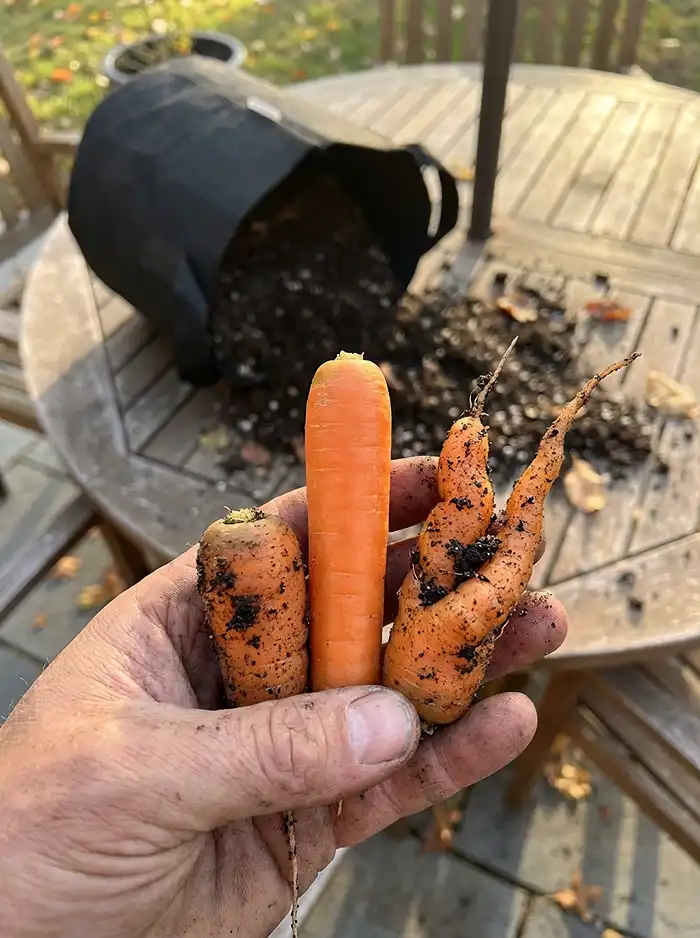
Here’s the practical magic: a standard 5-gallon bucket has an interior depth of roughly 14.5 inches. That means one cheap bucket from the hardware store fits almost every medium-tier root crop perfectly. If you’re just starting out and want the best pots for root vegetables without overthinking it, start here. For a full walkthrough on getting started, check out our guide on how to grow root crops in pots and containers.
Deep-Rooting Crops: Go Big or Go Home (18–36+ Inches)
Potatoes are the star of this tier, and they come with a fun trick. You don’t fill the whole container at once. Start with 6 inches of soil, plant your seed potato, and then add soil in 4-inch increments as the stems grow — this is called “hilling,” and it maximizes tuber production along the buried stem nodes. Total filled depth: 18–24 inches.
Sweet potatoes need 18+ inches of loose substrate plus room to spread horizontally. I’d say a 20-gallon fabric bag is the minimum unless you enjoy disappointment.
Parsnips are the divas of the root world. 18–24 inches of depth, non-negotiable. Their taproot forks the instant it touches literally anything — a pebble, a twig, a judgmental glance.
Container Depth for Root Crops Starts With the Right Soil Mix
A perfectly sized container filled with the wrong soil is still going to give you mediocre results. Standard bagged “potting soil” compacts under the weight of water in deep vessels within weeks, and compacted soil means stunted, forked roots.
The Mix That Actually Works
Here’s my go-to recipe by volume:
- 40% peat or coco coir — holds moisture without turning into a brick
- 30% perlite — creates air channels for drainage
- 20% vermiculite — retains nutrients and fine moisture
- 10% compost or worm castings — feeds your soil biology slowly
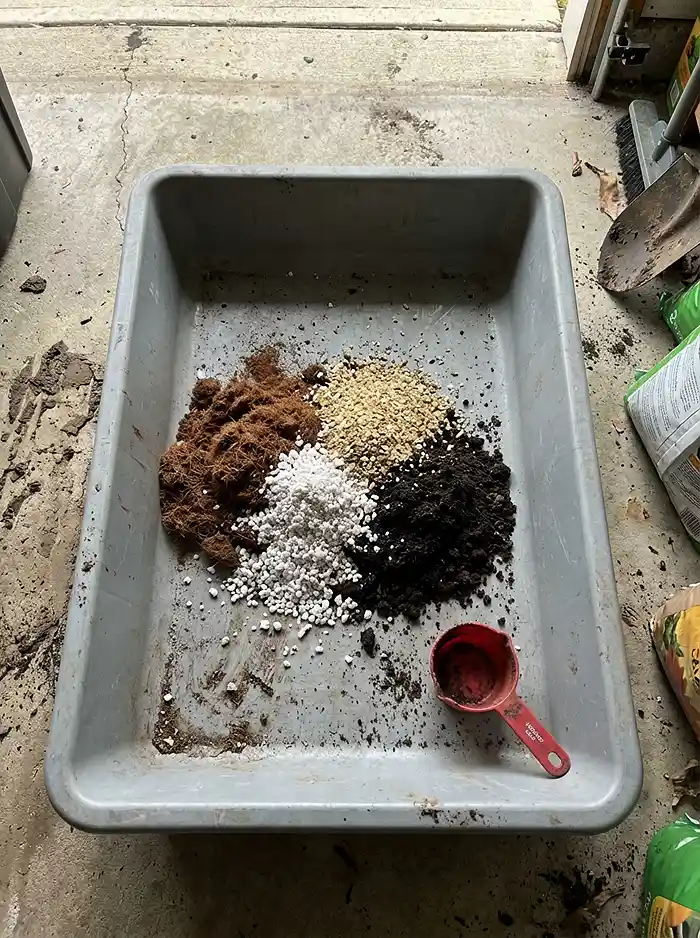
For deep containers (18+ inches): bump perlite to 35% and drop coir to 35%. The extra drainage compensates for higher water pressure at the bottom of tall soil columns.
Feed the Root, Not Just the Leaves
Here’s where a lot of container gardeners fumble. During weeks 1–4, your plants are building foliage, so a balanced fertilizer (10-10-10 or a 5-3-3 organic) works great. But once root bulking starts, you need to pivot to a phosphorus-heavy feed — something like 2-8-4 or 0-10-10.
Why? Too much nitrogen tells the plant to keep making leaves. Phosphorus and potassium tell it to pack starch and sugar into the root. It’s like the difference between your plant going to the gym versus going to the buffet — you want it building the root, not the canopy.
Choosing the Best Pots for Root Vegetables: A Practical Comparison
The container itself plays a bigger role than most people realize. Here’s an honest comparison — pros, cons, cost, and all.
| Material | Pros | Cons | Cost (10-gal) | Best For |
|---|---|---|---|---|
| Fabric Grow Bags | Air pruning, lightweight, stores flat | Dries fast, needs frequent watering | $5–$12 | Humid / mild climates |
| Plastic Pots | Cheap, retains moisture, easy to find | Overheats in sun, roots circle | $3–$8 | Temperate / shaded spots |
| Ceramic / Terracotta | Beautiful thermal buffering | Heavy, fragile, expensive at size | $20–$60 | Hot / arid (glazed) |
| Metal (Galvanized) | Indestructible, rodent-proof | Gets scorching hot, possible zinc leaching | $15–$40 | Cool climates only |
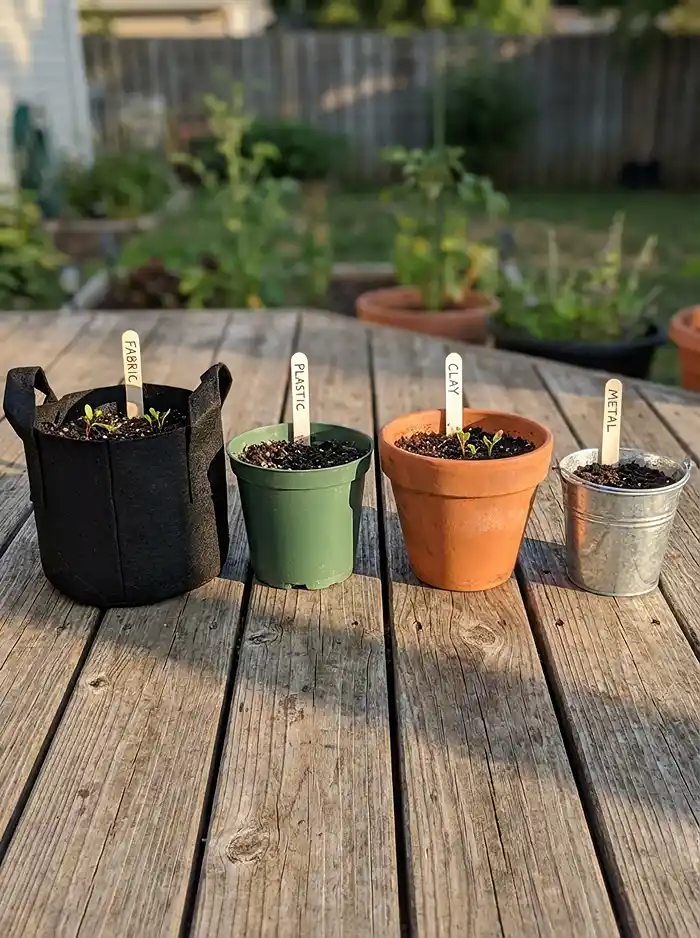
Fabric Bags and the Magic of Air Pruning
When a root tip hits the porous wall of a fabric bag, it dries out and stops growing outward, triggering lateral branching instead. You end up with a dense, bushy root system rather than roots circling helplessly around the pot walls. That’s fantastic for beets, turnips, and radishes.
But watch out with carrots and parsnips. Air pruning can stunt the main taproot if the bag’s diameter is too narrow. Use at least a 12-inch-wide bag for carrots and 14 inches for parsnips, and always add 2 inches of extra depth to offset the faster drying that fabric causes.
How Hot Does Your Pot Get?
Thermal conductivity ranks: metal > plastic > ceramic. A black plastic pot in full sun on concrete can push root-zone temps 15–20°F above the air temperature. A glazed ceramic pot? Maybe 3–5°F.
If you’re stuck with plastic in a hot spot, try these fixes: double-wall it (pot inside a pot with an air gap), wrap it in reflective material, or just elevate it on pot feet so air circulates underneath. According to Oregon State University Extension, container material and placement are among the most overlooked factors in container vegetable success.
Keeping Your Container Root Crops Happy: Water and Spacing
Watering: Think “Wrung-Out Sponge,” Not “Soaked”
Stick your finger 2 inches into the soil. It should feel like a wrung-out sponge — damp, not dripping. That’s your target, every time.
Here’s what happens when watering gets inconsistent: during a dry spell, the root’s cells stop expanding. Then you water heavily and those cells try to inflate all at once, cracking the root from the inside out.
That’s why your carrots split and your beets crack — it’s not a mystery disease, it’s just uneven watering. A drip system on a timer honestly solves this overnight, especially in deep containers where the moisture gradient matters.
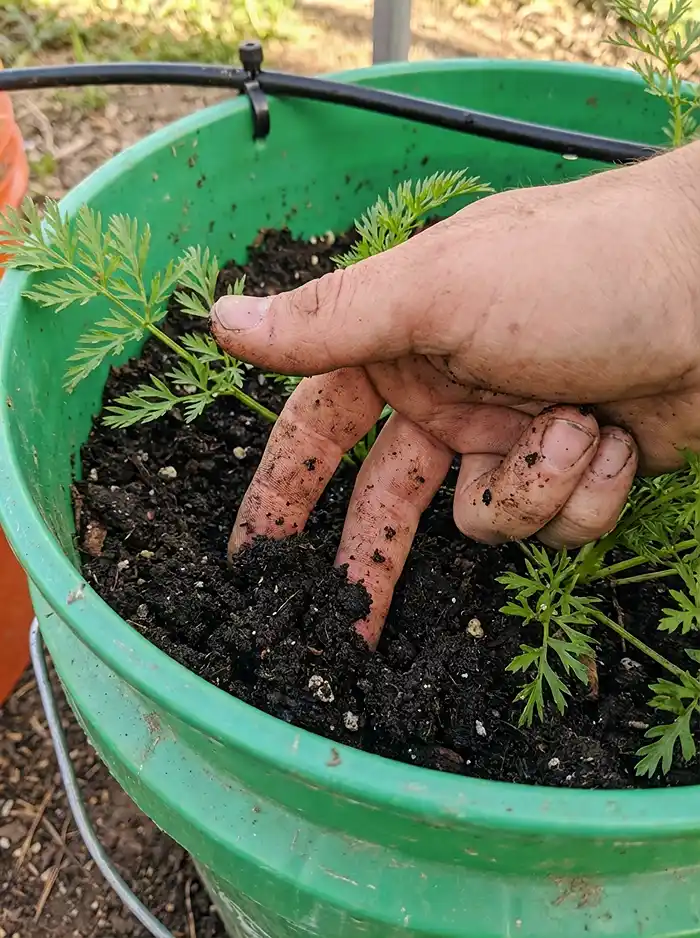
Spacing: Tight but Not Reckless
University extensions recommend 3-inch spacing for carrots and 4 inches for beets. The urban-intensive method pushes that to 2 inches for carrots and 3 inches for beets — and it works, but only if your soil mix is high-quality, you’re actively feeding, and your containers get 6+ hours of direct sun.
The tradeoff? More roots, slightly smaller individually. That’s a perfectly valid choice for a balcony garden where space is precious. Just know what you’re choosing.
Container Depth Guide for Root Crops: FAQ
Can I grow root vegetables in 5-gallon buckets?
Absolutely — 5-gallon buckets (~14.5 inches deep) work beautifully for carrots, beets, and turnips. Potatoes will technically grow in them, but you’ll get a small harvest. Bump up to 10 gallons or more for a potato crop that’s actually worth the effort.
Why are my container carrots forked?
Your carrot root tip hit something — a pebble, a chunk of bark, a compacted layer, or the container wall — and split. The fix is simple: use sifted, debris-free substrate and make sure your pot is at least 2 inches deeper than the variety’s mature root length.
Do I need to sanitize reused pots?
Yes, and it takes about 30 minutes. Scrub off old soil and mineral deposits, soak in a 10% bleach solution (1 part bleach, 9 parts water), rinse well, and air dry. This kills lingering fungal spores, bacteria, and root-knot nematode eggs that could wreck your next crop.
Your Next Move: Build a Modular Root Garden
If there’s one takeaway from this entire guide, it’s this: the root-to-volume ratio is your most reliable predictor of success. Match container depth and substrate quality to the crop’s rooting tier, and most common problems — rot, forking, stunting, splitting — simply don’t happen.
Here’s a starter setup that covers all three tiers without breaking the bank: a few 3-gallon bags for radishes and green onions (you’ll be harvesting these in weeks), a cluster of 5-gallon buckets for carrots and beets (your main season workhorses), and a couple of 15–20-gallon fabric pots for potatoes or sweet potatoes.
That’s a full root vegetable garden on a single patio. Not bad for a few buckets and some good soil.
Want to take the guesswork out completely? Grab our free Pot Size Calculator and download the printable root-depth cheat sheet — then pick up a container-optimized seed bundle and start growing this weekend.