
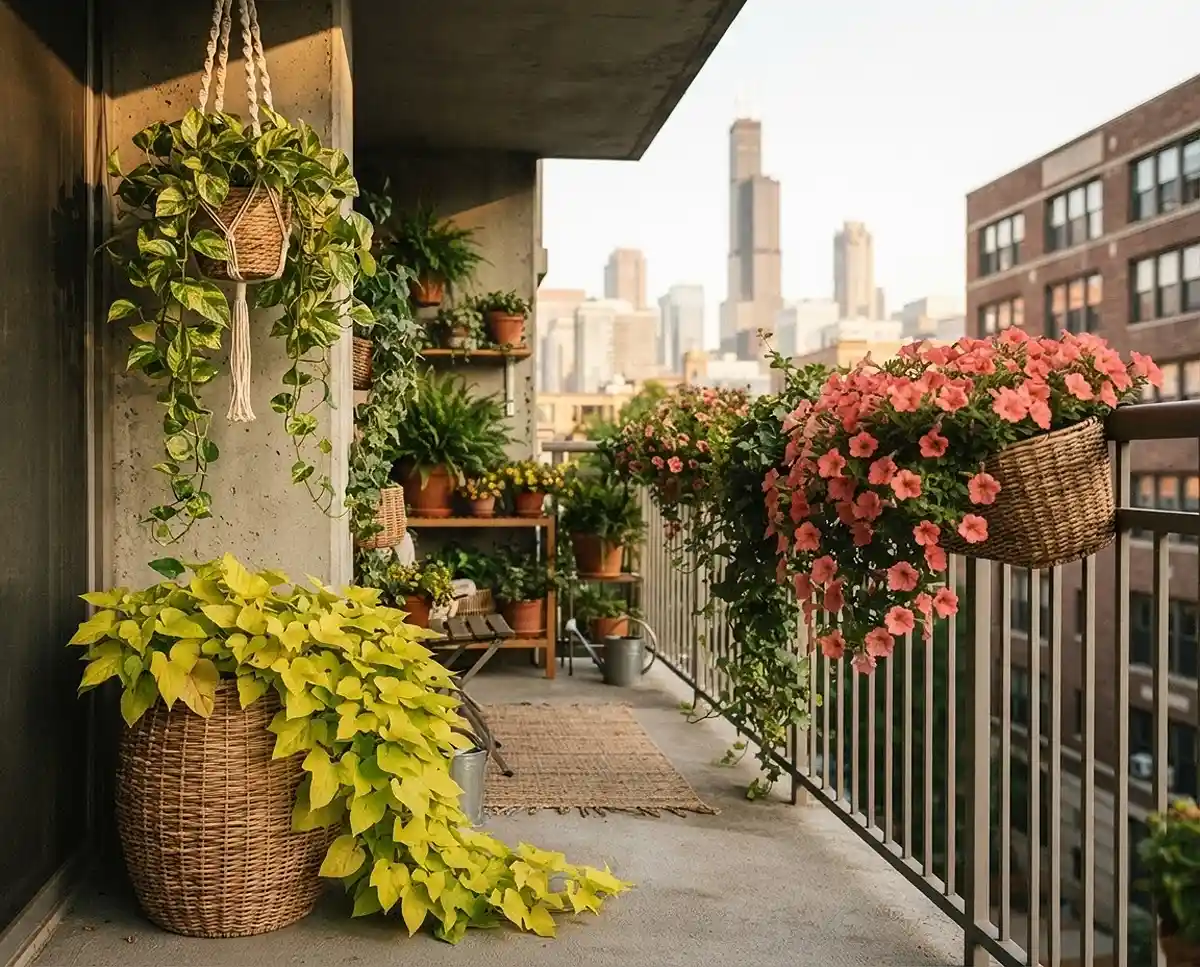
Trailing Balcony Plants: Basket Garden Ideas That Work
Want a lush, textured balcony without the concrete-box look? Trailing balcony plants paired with woven baskets are the fastest fix, and I’ve tested this combo for six seasons on my own railing.
Table of Contents
Elevating Balcony Design with Baskets and Trailing Plants
Concrete and metal railings dominate most apartment balconies, and nothing softens that faster than a woven basket spilling over with vines. I grow trailing balcony plants on a west-facing 5×9 balcony in Chicago, zone 6a, and the basket-plus-cascade combo changed how the whole space feels.
A plain plastic pot reads as utilitarian. A rattan basket with sweet potato vine pouring over the rim reads as intentional. That’s the whole trick behind good balcony garden ideas: texture on texture, vertical plus cascading, so the eye never lands on bare concrete.
This layered look works in almost any small balcony garden, whether you’ve got 12 square feet or a wraparound corner unit. You’re building depth with height and drape instead of square footage you don’t have.
Choosing the Right Basket Planters for Outdoor Use
Not every basket you’d put on a bookshelf belongs outside. Natural fiber baskets look gorgeous in photos, but rain, humidity, and UV exposure treat them very differently than a dry living room corner does.
Before you buy a single plant, match the basket material to how exposed that spot on your balcony actually is. This one decision determines whether your setup lasts one season or five.
Woven Materials: Rattan, Willow, and Seagrass
Quick Answer: Rattan and thick willow hold up best as structural floor baskets, while lightweight seagrass and jute belly baskets should stay under roof cover or an overhang, never in open rain.
| Material | Best For | Watch Out For |
|---|---|---|
| Rattan | Floor-standing structural pots | Fades faster in direct south sun |
| Willow | Larger corner or floor planters | Heavier when wet, needs a stand |
| Seagrass/jute | Covered, protected corners only | Molds fast in open rain or high humidity |
I learned this the expensive way. My first seagrass belly basket, holding a golden pothos, sat under an open railing gap and was moldy by week six of a humid Chicago July.
The Double-Potting Method for Basket Longevity
Quick Answer: Never plant directly into a woven basket. Keep the plant in a plastic nursery pot with drainage holes, then slip that pot inside the decorative basket as a cachepot.
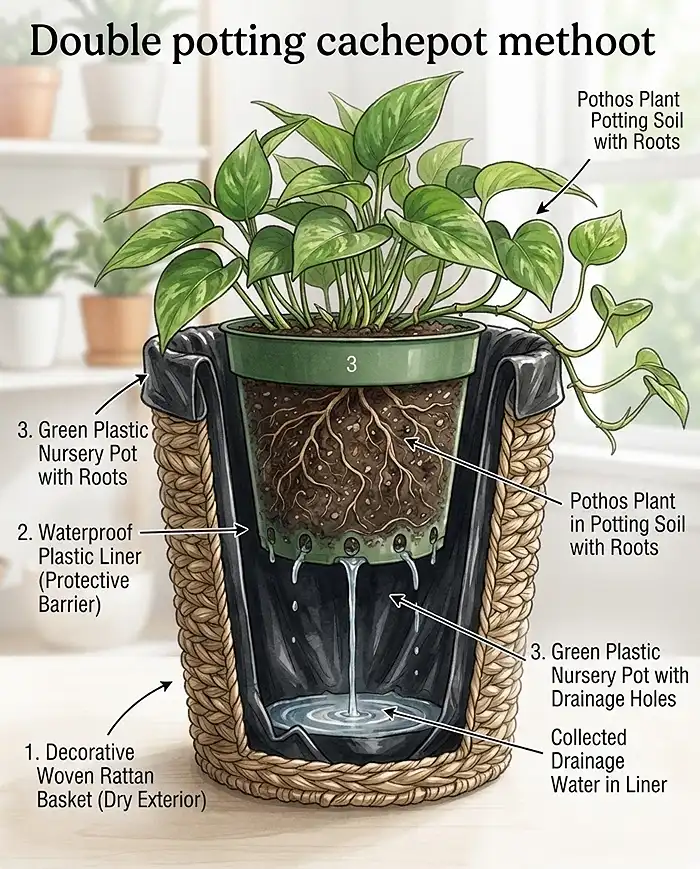
This “double-potting” method is non-negotiable for railing planter ideas and floor baskets alike. The plastic liner takes the moisture hit; the woven exterior stays dry and decorative.
Pro Tip: Line the inside of the basket with a heavy-duty contractor bag before inserting the nursery pot. It’s an extra buffer against splashback that most guides skip.
Assessing Your Balcony’s Microclimate for Cascading Plants
Hanging baskets and railing planters live in a harsher microclimate than floor pots. They’re higher up, more exposed to wind, and dry out faster because air moves around the entire container, not just the top.
Before choosing plants, spend two or three days actually watching your balcony. Note where sun lands at 9am, noon, and 5pm, and where wind funnels between buildings.
Mapping Sunlight for Trailing Foliage vs. Flowers
Quick Answer: Blooming trailing “spillers” need 5-6 hours of direct sun and belong on bright railings, while foliage vines like pothos and ivy handle low light and suit shaded ceiling corners.
- Track sun hours with your phone’s timer for one full day before planting
- South and west railings usually get full sun in most northern hemisphere apartments
- North-facing walls under an overhang are foliage-only territory
- East light suits partial-shade bloomers like fuchsia
My south railing gets brutal afternoon sun after 1pm, so that’s where the sweet potato vine goes. The shaded ceiling hook by my door holds pothos, which would scorch in that same spot.
Wind Protection for Hanging Baskets and Long Vines
Quick Answer: High-rise balconies act as wind tunnels, and gusts will whip long trailing vines into tangles or snap stems, so place baskets behind a solid wall section or a screen rather than an open railing gap.
I lost an 18-inch stretch of ivy vine to a single windy October night before I moved that basket six feet to a corner shielded by the building wall. Same plant, same light, completely different survival rate.
Pro Tip: If you’re above the fourth floor, treat every hanging basket as if it’s in coastal wind conditions, even inland.
Top Trailing Plants for Balcony Baskets
These are the trailing balcony plants I’ve grown across multiple seasons and would replant without hesitation, sorted by light needs so you can match them to the microclimate map you just made.
Sun-Drenched Spillers: Sweet Potato Vine and Portulaca
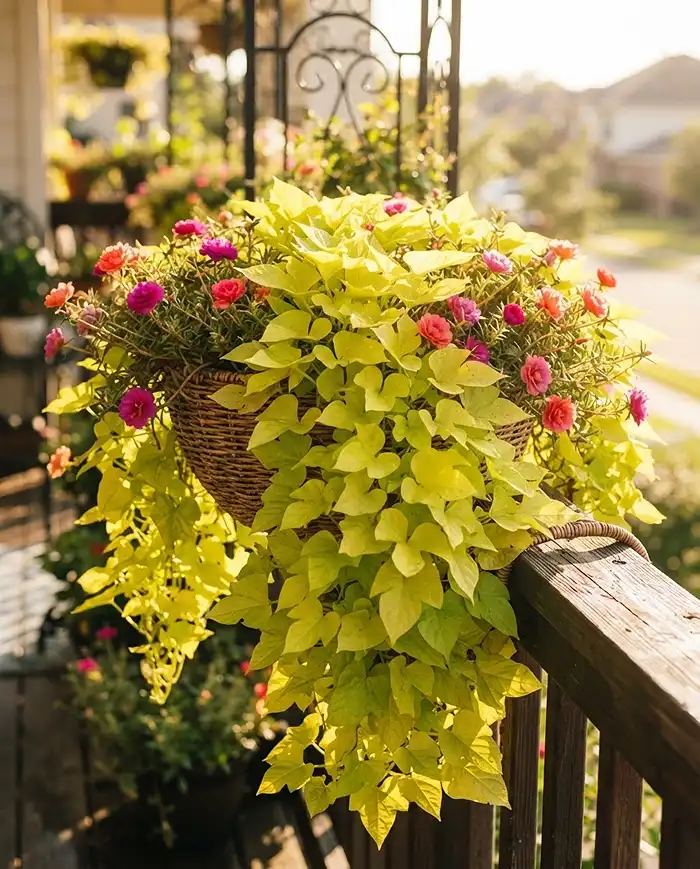
Quick Answer: Chartreuse sweet potato vine (Ipomoea batatas ‘Margarita’) and succulent-leaved portulaca are aggressive, sun-loving trailers that fill out a basket in under six weeks.
I plant one Margarita sweet potato vine plug per 14-inch rattan basket in mid-May, and by July it’s cascading 3 feet down the side. It doesn’t just trail; it drapes thick enough to hide the entire basket rim by midsummer.
Portulaca, sometimes called moss rose, handles neglect better than almost anything I grow. It’s my go-to for the hottest, driest railing spot where I forget to water for two days straight.
Shade-Tolerant Cascaders: English Ivy and Golden Pothos
Quick Answer: Golden pothos and English ivy tolerate low light and still cascade beautifully, making them the reliable choice for north or east-facing balcony corners.
Golden pothos is nearly indestructible in my experience. It sat through an entire rainy August with barely any direct sun and still pushed new trailing growth over the edge of a macrame hanger.
English ivy reads as more romantic against natural rattan or willow texture. I tuck it into the darkest corner of my balcony, where flowering plants would just sulk and stall.
Trailing Floral Displays: Fuchsia and Wave Petunias
Quick Answer: Wave petunias bring nonstop color in full sun, while bell-shaped fuchsias handle partial shade, and both pop visually against the earthy texture of a woven basket.
Wave petunias in a sunny basket are almost too easy; one Easy Wave Coral Reef plug fills a 12-inch pot solo by early summer. I pinch it back hard once around week four to keep it from getting leggy.
Fuchsia is pickier about heat, so I only use it on my partially shaded east corner, never the blasting south railing where the petunias thrive.
Step-by-Step Guide to Planting and Styling Baskets
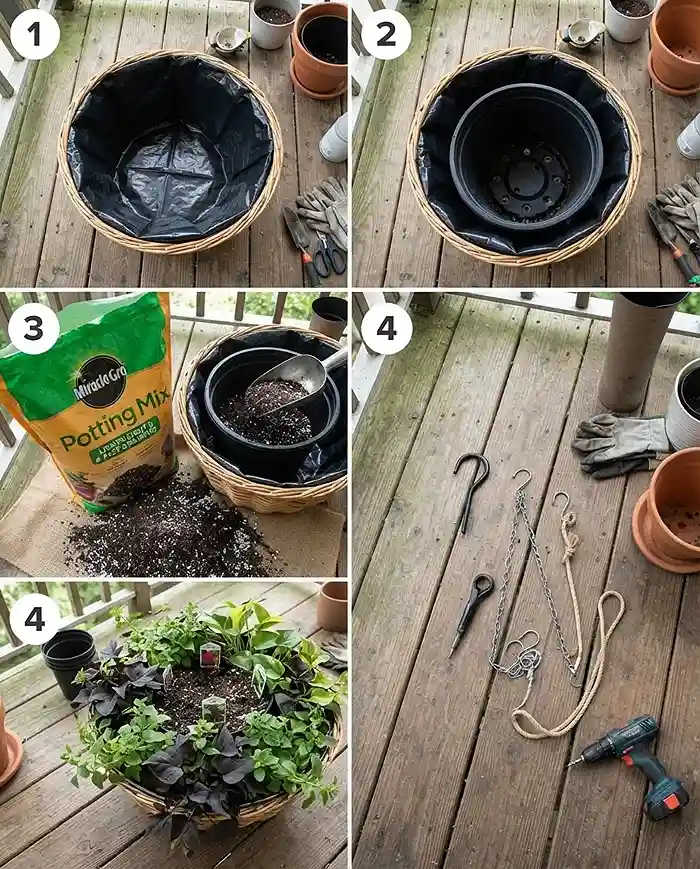
Here’s the exact setup process I follow every spring for a new round of apartment balcony garden ideas, in order:
- Line the basket interior with a heavy-duty plastic liner or contractor bag
- Choose a nursery pot with drainage holes, sized to sit just inside the liner
- Mix a lightweight potting soil with 30% perlite to cut hanging weight
- Plant nursery plugs close to the container edge so trailing stems reach outward immediately
- Slip the planted nursery pot into the lined basket as your cachepot
- Hang from a rated, heavy-duty ceiling hook, never a decorative cup hook
According to Clemson’s Home & Garden Information Center, soilless, lightweight mixes drain and hold water far better than regular garden soil, which matters even more once a basket is hanging overhead.
Maintenance Routines for Basket-Grown Trailing Plants
Trailing plants grow fast, and woven containers dry out faster than plastic. Your maintenance routine needs to shift once you switch from floor pots to hanging baskets and railing planters.
Deep Watering Strategies for Woven Containers
Quick Answer: Carry lightweight baskets to a sink or tub for a deep soak, let them drain fully for an hour, then return them to their decorative basket to keep the woven fibers dry.
I do this every three to four days for my sun-drenched sweet potato vine basket in peak summer. Watering in place with a can almost always leaves the woven exterior damp and speeds up mold.
Pro Tip: Water in the morning so any splashback on the basket exterior dries before evening humidity sets in.
Pruning Techniques to Encourage Bushy Cascades
Quick Answer: Pinch back the growth tips of trailing vines every two to three weeks to force lateral branching, which builds a dense cascade instead of a few thin, stringy runners.
I pinch my pothos and sweet potato vine right above a leaf node with clean fingernails or snips. Within a week, two new stems usually push out from that same point.
Untangling is part of this too. I gently separate crossed vine stems every watering session so nothing chokes itself out before it ever reaches full length.
Common Problems & Solutions
Two issues wreck most basket-heavy balcony garden ideas: moldy fibers and wind-tangled vines. Both are fixable once you know the cause.
Moldy Baskets and Rotting Bottoms
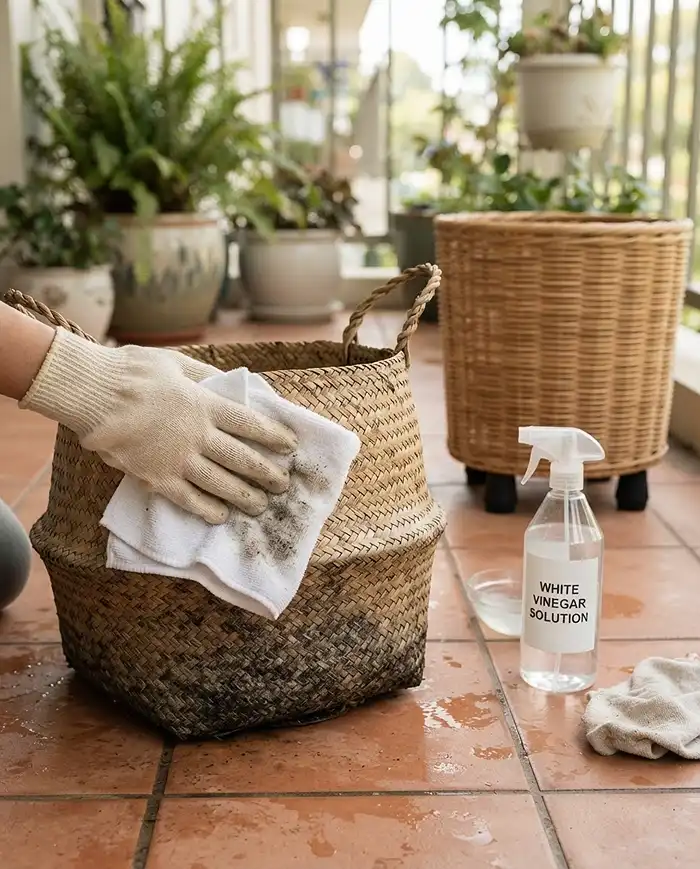
Quick Answer: Mold on natural seagrass or jute usually comes from high humidity plus sloppy watering; spot-clean the exterior with a diluted white vinegar solution and elevate floor baskets on rubber pot feet for airflow.
Mix one part white vinegar to four parts water, dab it on with a soft cloth, and let the basket dry fully in open air before it goes back near any plant.
Rubber pot feet under floor-standing rattan or willow baskets keep the base off wet decking, which stopped a recurring soft-bottom problem I had on my old apartment’s patio.
Tangled, Wind-Whipped Vines
Quick Answer: Strong balcony winds whip long trailing vines into knots or snap them against rough basket edges, so loosely secure the main vines to the basket rim with soft silicone plant ties.
I clip one tie every 8 to 10 inches along the vine’s main run, loose enough that the stem still has room to grow and drape naturally.
Pro Tip: Check ties monthly and loosen them as stems thicken, or you’ll girdle the vine by accident.
Frequently Asked Questions
Do I need to drill holes in decorative baskets?
No, never drill holes into the decorative basket itself. The plastic nursery pot sitting inside must have drainage holes, and you should manually dump out any excess water that collects in the basket’s plastic liner after watering.
How do I overwinter trailing plants in baskets?
Natural woven baskets disintegrate fast in snow and freezing rain, so bring the entire basket system indoors before the first frost. Plants like pothos and English ivy will happily double as lush winter houseplants near a bright window.
What is the best soil for hanging basket trailing plants?
Blend a premium organic potting soil with about 30% perlite and some water-retaining coco coir. This lightweight mix reduces the structural weight on ceiling hooks while preventing the rapid dehydration common in elevated containers.
Can I mix trailing plants and upright plants in the same basket?
Yes, this is the classic thriller-filler-spiller combo. Add one upright plant for height, a few mounding fillers around it, and let a trailing plant spill over the edge for the cascade effect.
Conclusion
Trailing balcony plants and textured baskets solve the same problem: they turn a flat, hard railing into something that actually feels grown, not decorated. Start with one basket, match it to your real light and wind, and expand from there.
For more setup ideas, check out these fall railing planter combinations, this guide to apartment balcony garden layouts, and more railing planter ideas for every season.
Key Takeaways
- Match basket material to exposure: rattan and willow for open floor spots, seagrass and jute for covered corners only
- Always double-pot: a plastic nursery liner inside the decorative basket protects the woven fibers
- Sort trailing balcony plants by light first, then style, so sun-lovers and shade-tolerant vines end up in the right spot
- Deep-water in a sink or tub and let baskets drain fully before rehanging
- Pinch growth tips every two to three weeks for a dense cascade instead of thin, stringy vines