

Pot Depth for Vegetables
Getting pot depth for vegetables right starts underground. A vegetable root depth chart tells you the exact vertical space a plant needs — and choosing the wrong container size means stunted yields, blossom drop, and frustrated gardeners.
Table of Contents
The Science of Root Depth in Container Gardening
Most gardeners obsess over leaves and fruit. Meanwhile, the real action is happening below the soil surface, where roots are working 24 hours a day to pull in water, oxygen, and dissolved nutrients.
Restrict that underground footprint and you don’t just slow a plant down — you trigger a biological panic response. I learned this the hard way in summer 2022 when I planted two ‘San Marzano’ tomato transplants into 5-gallon buckets on my zone 6b patio. By July, both were dropping blossoms mid-season.
The buckets were only 11 inches deep inside. Indeterminate tomatoes need at least 18 inches. The roots had hit the bottom, compressed, and the plants couldn’t pull enough calcium to set fruit. A shallow pot doesn’t just limit growth — it creates the conditions for fatal disease and total crop failure.
This is why reading a vegetable root depth chart before buying a single container is one of the highest-leverage moves you can make in small space gardening.
How to Decipher a Root Depth Guide
A root depth chart measures the minimum vertical and horizontal space a mature plant needs to efficiently extract water and nutrients from soil. These aren’t suggestions — they’re biological requirements.
Charts typically list two values: depth (how far roots grow straight down) and spread (how wide the root zone extends laterally). Both matter when choosing a container. A wide, shallow root system needs a different pot than a narrow, deep taproot.
Most charts use three depth categories. Here’s how to read them.
Shallow vs. Medium vs. Deep Root Systems
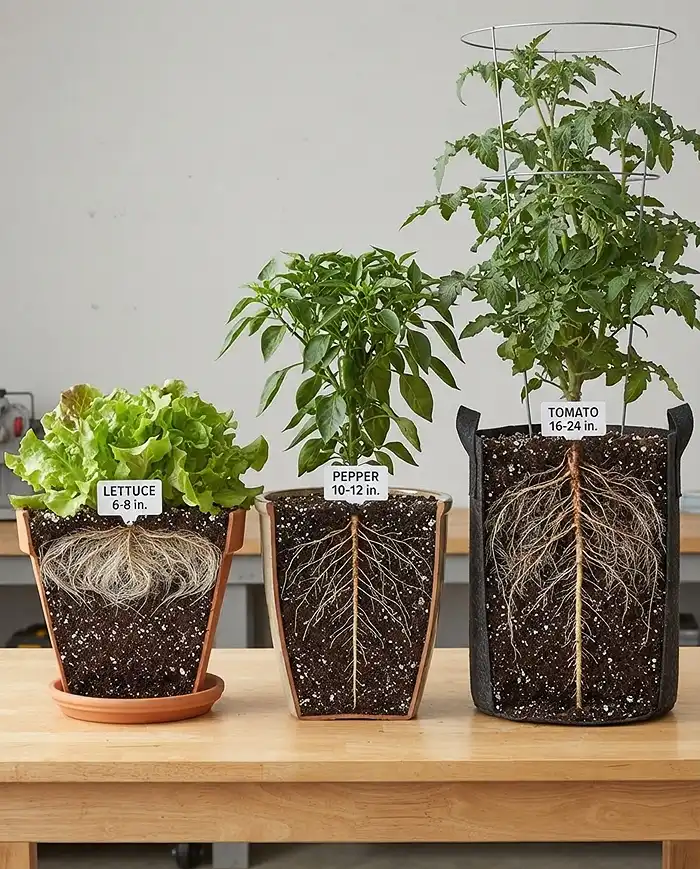
Quick Answer: Shallow roots grow 12-18 inches in open ground, medium roots 18-24 inches, and deep roots 24-36+ inches. Container gardeners can work with slightly less depth by using highly aerated, nutrient-dense potting mix that allows roots to extract more from less volume.
Here’s how the three categories break down in practice:
| Depth Category | In-Ground Range | Container Target | Example Crops |
|---|---|---|---|
| Shallow | 12-18 inches | 6-10 inches | Lettuce, spinach, basil |
| Medium | 18-24 inches | 10-14 inches | Peppers, bush beans, kale |
| Deep | 24-36+ inches | 18-24+ inches | Tomatoes, squash, potatoes |
The container target is lower than the in-ground range because rich, loose potting mix allows roots to work more efficiently than compacted native soil. Adding 20-30% perlite to your mix is the single biggest thing you can do to close that gap.
Fibrous Roots vs. Taproots in Confined Spaces
Quick Answer: Fibrous roots (like tomatoes and peppers) can adapt to wider, shallower containers if needed. Taproots (like carrots and parsnips) cannot bend or compress — they’ll permanently deform if they hit a hard bottom.
A good root depth chart will specify root type, not just depth. This detail changes everything about pot selection.
Fibrous root crops send out dense, branching networks that spread laterally. They’re more forgiving — if you’re a few inches short on depth, going wider often compensates. My ‘Shishito’ pepper plants have thrived for two seasons in wide 7-gallon fabric bags that are only 12 inches deep.
Taproot crops grow one primary root straight down. Carrots, beets, parsnips, and radishes are all in this group. These are the root vegetables in containers that demand you get the depth right from day one — there’s no lateral workaround when a taproot hits the bottom of the pot.
Matching Root Depth to Pot Dimensions
The practical challenge is translating chart measurements into gallon sizes you’ll actually find at a garden center. Container volume and depth aren’t the same thing, so this conversion step is critical.
A 5-gallon nursery pot is typically 11-12 inches deep and 12 inches wide. A 10-gallon pot is roughly 14-15 inches deep. A 15-gallon container hits around 16-18 inches of interior depth. Always measure the inside depth — not the outside height — before planting.
4 to 8 Inches: Shallow Greens and Herbs
Quick Answer: Crops with shallow root requirements — loose-leaf lettuce, spinach, arugula, cilantro — thrive in 1-to-3-gallon pots or 6-inch-deep window boxes. Prioritize wide surface area over depth.
These are the easiest crops for tiny garden ideas on balconies and windowsills. A single 24-inch window box can hold a 3-variety salad garden that produces cut-and-come-again harvests for months.
- Loose-leaf lettuce (‘Black Seeded Simpson’, ‘Oak Leaf’): 6-inch depth, 1-gallon pot minimum
- Spinach (‘Bloomsdale’): 6-8 inches, wide trays work perfectly
- Basil, parsley, cilantro: 6-8 inches, a 6-inch pot per plant
- Bush beans: 8-10 inches, 2-gallon minimum, wide preferred
Pro Tip: For cut-and-come-again greens, soil width matters more than depth — a 12×24-inch window box at 6 inches deep outperforms a 6-inch-wide deep planter every time.
10 to 14 Inches: Mid-Sized Fruiting Plants and Roots
Quick Answer: Crops like sweet peppers, standard carrots, and eggplants need 10-14 inches of usable depth. A 5-to-7-gallon container is the standard recommendation — but always verify the inside depth before buying.
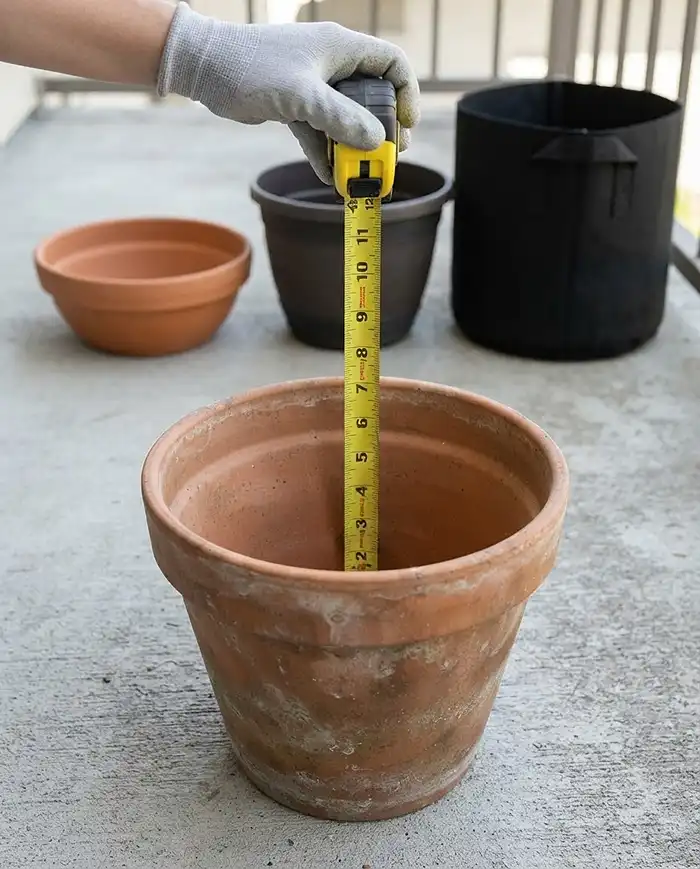
This is the trickiest category because “5-gallon” can mean different things depending on the pot’s shape. A squat, wide 5-gallon pot might only be 10 inches deep inside. A tall, narrow 5-gallon pot might be 14 inches.
- Sweet peppers (‘Lunchbox’, ‘Shishito’): 10-12 inches, 5-gallon pot
- Eggplant (‘Ichiban’): 12-14 inches, 5-to-7-gallon container
- Standard carrots (‘Danvers 126’): 12-14 inches, tall narrow pot required
- Beets (‘Detroit Dark Red’): 10-12 inches, 5-gallon works well
I’ve grown ‘Danvers 126’ carrots in 12-inch-deep terracotta pots with great results — but I always sift the bottom 4 inches of mix through a fine screen to eliminate clumping that deflects the taproot.
18 to 24+ Inches: Heavy Feeders and Vining Crops
Quick Answer: Indeterminate tomatoes, vining squash, and potatoes demand 18-24+ inches of usable depth. Use 15-to-20-gallon containers — anything smaller risks fatal mid-summer nutrient collapse when the root mass exhausts the available soil volume.
This is the category where undersizing causes the most visible failures. A ‘Cherokee Purple’ indeterminate tomato in a 5-gallon bucket will look fine in May. By August, you’ll have yellowing leaves, blossom drop, and a plant that’s pulling zero calcium from exhausted soil.
- Indeterminate tomatoes: 18-24 inches, 15-20 gallon minimum
- Determinate tomatoes (‘Patio’, ‘Bush Early Girl’): 14-16 inches, 10-gallon works
- Vining squash: 18-24 inches, 15+ gallon, train vertically to save space
- Potatoes: 16-24 inches, 15-gallon grow bag with fill-as-you-grow technique
Pro Tip: For potatoes, start with 6 inches of soil in a 20-gallon grow bag and add 4 inches of mix every time the plant grows 8 inches tall — this extends yield by 40% compared to static planting depth.
How Pot Shape and Material Alter Root Growth
Selecting the right depth is step one. But the shape and material of your container directly affects how efficiently roots use that space. Two pots with identical gallon volumes can produce drastically different results based on geometry and breathability alone.
This is a detail most vegetable container guides skip — and it’s why two gardeners with “the same setup” get completely different yields.
Wide Bowls vs. Tall Cylinders
Quick Answer: Match pot geometry to root architecture. Wide, shallow bowls suit fibrous-rooted greens and herbs. Tall, narrow cylinders — sometimes called “tree pots” or “deep pots” — are essential for taproot crops like carrots and parsnips.
A standard 5-gallon bucket is tall enough (12 inches) for medium-depth crops but too narrow for wide fibrous root systems like basil or lettuce. A wide, squat 3-gallon bowl with 8 inches of depth gives cut-and-come-again greens three times the lateral root space.
For carrots specifically, look for pots marketed as “root trainers” or “deep planters” — these run 14-18 inches deep and 8-10 inches wide. The University of California Cooperative Extension confirms that container shape is as critical as volume for taproot vegetable success.
Air Pruning in Fabric Grow Bags
Quick Answer: Fabric grow bags trigger “air pruning” — roots branch densely when exposed to oxygen at the bag’s edge rather than circling the container wall. This allows plants to thrive in slightly smaller volumes than rigid plastic pots require.
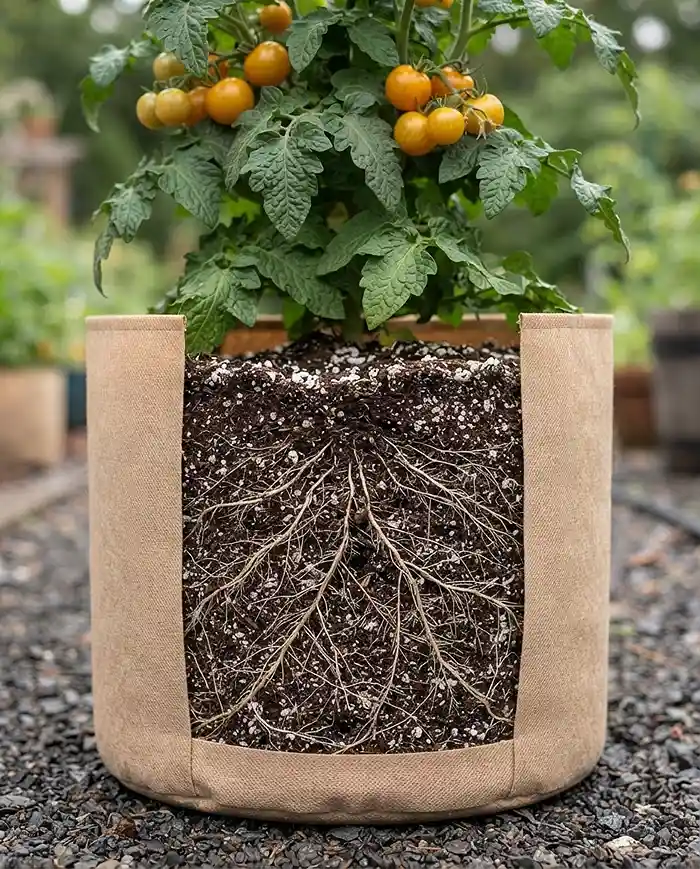
Here’s the biology: when a root tip touches the breathable wall of a fabric bag, it encounters oxygen and naturally desiccates at the tip. The plant responds by branching two or three new feeder roots laterally. The result is a dense, efficient root network rather than a single circling root.
In practice, I’ve grown ‘Sun Gold’ cherry tomatoes in 10-gallon fabric bags that performed comparably to neighbors using 15-gallon hard plastic containers. The air-pruned root system used the available soil volume about 30% more efficiently based on yield-per-gallon of potting mix.
This is a key advantage for beginner small space gardening setups where carrying or storing large containers is a real constraint.
Step-by-Step: Choosing Your Pot Based on Root Data
Here’s the exact process to go from “I want to grow vegetables” to “I have the right container for every crop.”
- List your target crops — write down every vegetable you want to grow this season.
- Cross-reference the root chart — look up each crop’s depth category (shallow, medium, or deep) and root type (fibrous or taproot). Use the City Cultivator root depth chart as your reference.
- Select container size by depth — shallow crops get 1-3 gallon pots, medium crops 5-7 gallons, deep crops 15-20 gallons. Verify the interior depth in inches at the nursery before purchasing.
- Choose fabric bags for deep crops where weight matters — 15-gallon plastic containers filled with wet soil weigh 40+ pounds. Fabric bags weigh less and perform better.
- Mix perlite-heavy soil — aim for 25-30% perlite in your potting mix to maximize aeration and water drainage in the restricted soil volume.
- Plant seeds or transplants at the right depth — and label each container with the expected root depth so you remember the watering needs of each crop.
This process takes 20 minutes of planning before you spend a dollar at the nursery — and it eliminates the most common container gardening failure mode entirely.
Common Problems and Solutions
Even with the right chart data, two structural mistakes send container vegetable gardens sideways. Both are diagnosable and fixable if you catch them early.
Root-Bound Plants and Stunted Yields
Quick Answer: A root-bound plant has exhausted its container volume. Signs include yellowing lower leaves, water running straight through without absorbing, and visible roots escaping through drainage holes. Emergency mid-season repotting can save the plant.
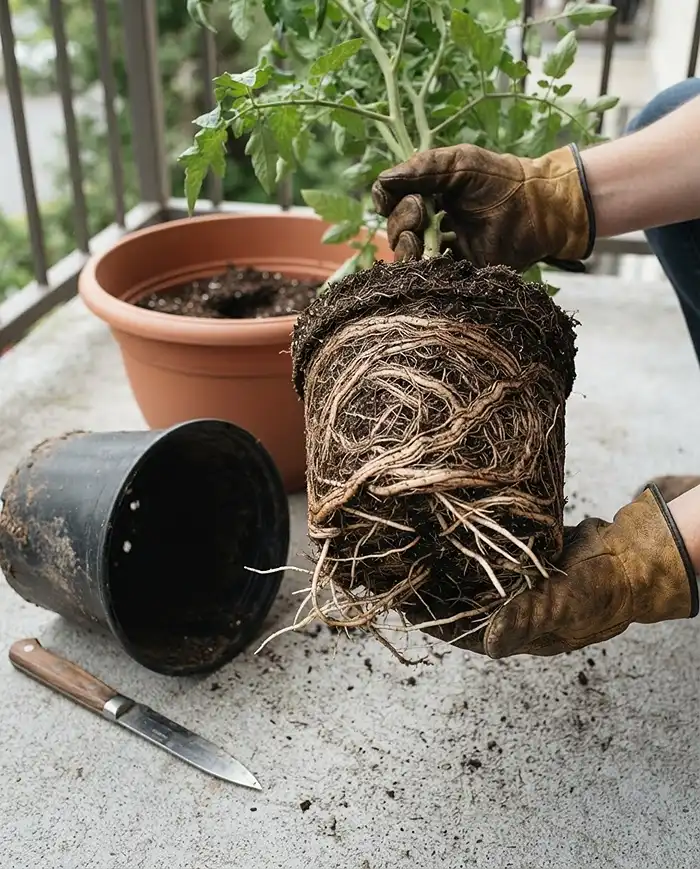
If you see these symptoms in July, don’t wait. Remove the plant, use a clean knife to score 4-6 vertical slits down the root ball (about 1 inch deep), and move it into a container that’s 4-6 inches larger in interior depth.
Scoring the root ball before repotting encourages new feeder root growth into the fresh soil volume. Water immediately with a dilute liquid fertilizer — the plant will be stressed and needs nutrients accessible at the root tips right away.
The Perched Water Table in Oversized Pots
Quick Answer: Placing a small, shallow-rooted seedling in a massive pot creates an anaerobic “perched water table” in the unused lower soil. That saturated zone starves roots of oxygen and causes fatal root rot — even with good drainage holes.
Physics causes this one: water doesn’t drain freely from the bottom of a large container until the soil column above it reaches saturation. A 2-inch lettuce seedling in a 20-gallon pot means 16 inches of constantly wet, unused soil beneath the tiny root zone.
The fix is to match pot size to plant stage, then size up as the plant matures — or simply use the root depth chart to select the appropriate pot from the start. For herbs and greens, also check out which herbs thrive in small-space containers to avoid this problem entirely.
pot depth for vegetables FAQs
Can I bend a taproot to fit a shallower pot?
Never bend or cram taproots (carrots, beets, parsnips) into a shallow container. Bending permanently deforms the edible root and severs the vascular tissue the plant uses to pull deep moisture. The resulting root will be stunted, forked, or completely inedible. Always match pot depth to the taproot’s full mature length listed on the chart.
Do I measure pot depth from the outside or inside?
Always measure from the inside soil line down to the drainage base. An ornamental pot listed as 12 inches tall may have a false bottom or decorative raised base that reduces usable depth to 8-9 inches. Subtract any top-watering gap (typically 1-2 inches) from your measurement to get the actual root space available.
What happens if a pot is way too deep for my plant?
A pot that’s far too deep for a shallow-rooted crop isn’t dangerous in the same way as too shallow — but it wastes expensive potting mix and creates risk. The unused lower soil stays saturated long after the surface dries, which can turn anaerobic and produce root rot before the shallow roots ever reach that depth. Match pot depth to plant stage.
How do I convert chart measurements to gallon pot sizes?
Use these rough conversions: 6-8 inches of interior depth = 1-3 gallon pot; 10-14 inches = 5-7 gallon; 16-18 inches = 10-15 gallon; 18-24 inches = 15-20 gallon. Always verify interior depth in person at the nursery, since pot shapes vary significantly within the same gallon rating.
Can I grow root vegetables in containers successfully?
Yes — growing root vegetables in containers works well when you match pot depth precisely to the mature root length. Short-rooted varieties are the easiest starting point: ‘Chantenay’ carrots (6-7 inches), ‘Chioggia’ beets (2-3 inch roots), and ‘Cherry Belle’ radishes (1 inch) all perform well in 12-inch-deep containers with loose, stone-free potting mix.
Key Takeaways
- Getting pot depth for vegetables right starts with a root depth chart — use it before you buy a single container, not after your plants start struggling.
- Always measure interior pot depth, not outside height — false bottoms and design lips can rob you of 2-4 inches of usable root space.
- Taproot crops (carrots, parsnips, beets) demand precise depth matching — fibrous root crops have more flexibility if you go wider.
- Fabric grow bags trigger air-pruning that boosts root efficiency, letting plants perform well in slightly smaller volumes than rigid plastic pots require.
- Too-big is a real problem too: oversized pots create a perched water table in the unused soil below shallow roots, triggering root rot even with good drainage.