

23 Balcony Kitchen Garden Ideas for Cluttered Storage
Bikes, boxes, and a mop bucket crowding your tomatoes? These balcony kitchen garden ideas turn that clutter into a productive apartment kitchen garden. I’ve spent 12 years helping renters grow food in tight spaces, and I’m sharing every trick that worked.
My rooftop terrace sits in zone 7a and gets about eight hours of direct sun. I grow in 5-gallon fabric pots, 10-gallon grow bags, and railing boxes.
Your balcony is probably smaller and shadier than mine. That’s fine. Every idea below works in a few square feet, and each one hides or houses something you already own.
Table of Contents
Reclaiming the Clutter Zone: Auditing Your Storage Balcony for Edible Production
Short Answer: Empty the whole balcony, sort items into keep, relocate, or toss, then move the keepers into one weatherproof bench or cabinet. That frees floor space, shows where sunlight lands, and lets you set heavy soil tubs over load-bearing corners before planting.
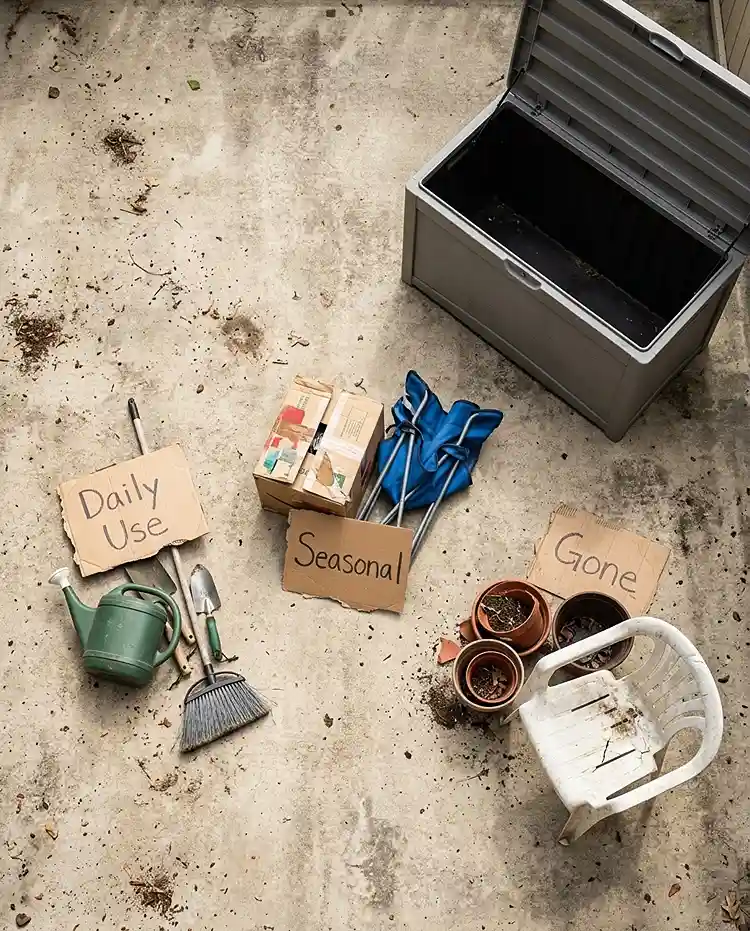
Here’s what’s happening on a storage balcony. Clutter eats floor space and blocks light, so plants get squeezed into leftover corners. Soil is also heavy, so a careless layout stresses one spot while the rest sits empty.
Pull everything out on a dry Saturday. Make three piles: daily use, seasonal, and gone. Daily-use gear goes in the bench. Seasonal items go to a closet or basement. Be ruthless. Every square foot you clear is a square foot of lettuce.
Mapping Sun Pockets, Weight Load Distribution, and Hidden Storage Zones
Check the light before placing anything. Note direct sun at 9 a.m., noon, and 3 p.m. on railings and walls. Six or more hours suits tomatoes and peppers. Three to four suits greens and herbs. This gives you an edible balcony layout built on real light, not guesses.
Keep heavy tubs over corners and along walls, where the structure is usually strongest. A wet 10-gallon pot can weigh 50 pounds or more, so ask your landlord about limits first. Then tuck bikes, boxes, and cleaning gear into a weatherproof bench.
Essential Prep: Dual-Purpose Storage Planters, Soil Mix, and Kitchen Garden Tools
Short Answer: You need light containers with drainage, a loose organic potting mix, and a few compact tools. Choose fabric pots and resin planters over heavy ceramic, because wet soil weighs plenty already. Keep a hand trowel, snips, and a watering can in your storage bench so everything lives together.
Containers heat up fast on a balcony. Dark plastic against a sunny wall can cook roots, while breathable fabric stays cooler and drains faster.
In July 2020, I grew ‘Sungold’ cherry tomatoes in black 5-gallon plastic pots against a west wall. My probe thermometer read 104°F in the soil. Half the blossoms dropped, and two plants gave me under two pounds. The next summer I switched to tan 10-gallon fabric pots. Soil stayed near 88°F, and I harvested six pounds.
Here’s your starter checklist. The University of Maryland Extension guide to container food gardening covers pot sizes and materials in more depth.
- Fabric pots, 5 to 10 gallons, for tomatoes, peppers, and eggplant
- Shallow resin troughs, 6 inches deep, for greens and herbs
- A weatherproof deck box or bench with a flat, sturdy lid
- Hand trowel, herb snips, and a 2-gallon watering can
- Deep-lip drip trays under every pot
- A sealed metal or resin bin for seeds and fertilizer
The Lightweight Organic Kitchen Potting Mix Recipe for High-Yield Edibles
This is the mix I use in every pot. It’s light, drains well, and feeds plants for weeks. Measure by volume, using any bucket as your “part.”
| Ingredient | Parts by volume | Job in the pot |
|---|---|---|
| Peat-free coco coir | 4 | Holds moisture, stays fluffy |
| Perlite | 2 | Adds air and drainage |
| Screened compost | 2 | Supplies nutrients and soil life |
| Worm castings | 1 | Gentle, steady feeding |
Stir in an organic slow-release vegetable fertilizer (5-5-5) at the container rate on its label. Rinse the coir first, since some brands hold salts. Moisten the mix until it feels like a wrung-out sponge.
23 Balcony Kitchen Garden Ideas That Turn Clutter Into Fresh Harvests
Short Answer: These 23 ideas swap dead storage space for edible plants by using benches, walls, rails, and overhead air. Each one keeps floors clear and gear reachable. Pick three that match your sun, then build your edible balcony layout around them, adding more as you learn what thrives.
A good apartment kitchen garden is mostly about using vertical space. Secure every rail, wall, or ledge planter with brackets or straps, and skip them anywhere a fall could hurt someone below.
Want a softer, more decorative look? See this guide to creating a cozy balcony kitchen garden.
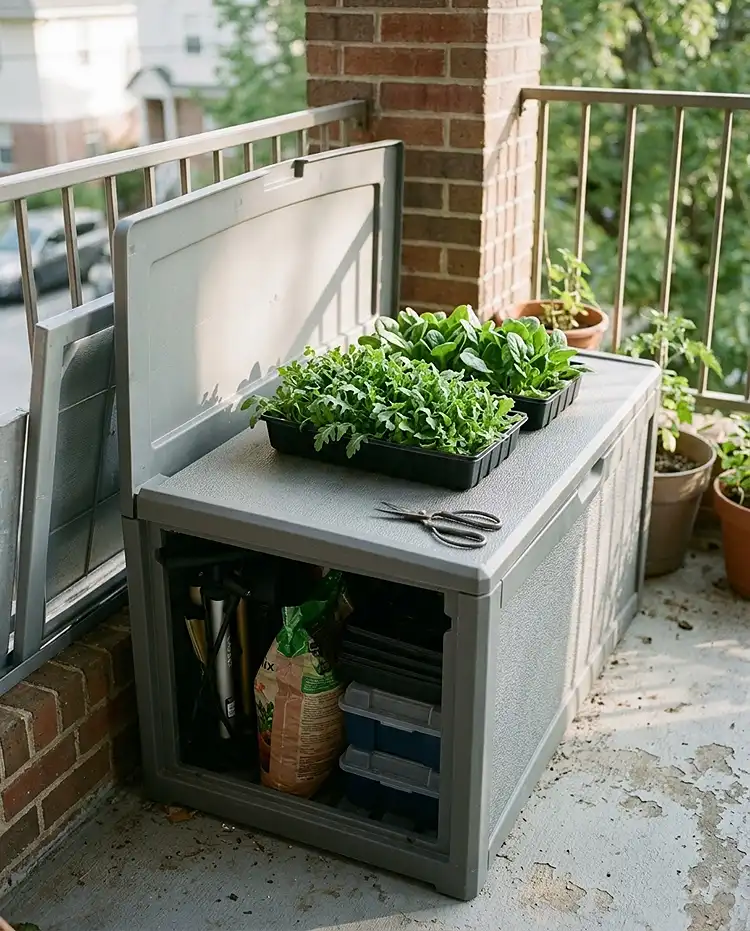
Idea 1: Weatherproof Storage Bench Topped with Shallow Salad Trough Boxes
Hide bikes and potting supplies inside a resin deck box. Then set two shallow trays of arugula and baby spinach on the lid. Cut-and-come-again greens [harvested leaf by leaf so the plant keeps growing] thrive in 5 to 6 inches of soil. Check the lid’s weight rating first.
Idea 2: Over-the-Door Canvas Pocket Planter Hiding the Utility Closet Door
Hang a felt pocket organizer over the storage closet door. Each pocket holds one thyme, oregano, chive, or parsley plant, and the felt breathes so roots stay healthy. Pockets dry out fast, so water daily in summer. For more layouts, browse these balcony herb garden ideas.
Idea 3: Heavy-Duty Baker’s Rack Utility Shelf Turned 4-Tier Microfarm
Turn a rust-proof wire baker’s rack into a four-tier microfarm. Keep tool bins and watering cans on the bottom shelves. Put dwarf tomatoes like ‘Tiny Tim’ and compact peppers on the sunny upper tiers. Anchor the rack to the wall or railing if wind hits your balcony.

Idea 4: Over-the-Rail Saddle Boxes of Prostrate Rosemary and Trailing Strawberries
Clamp saddle boxes over the rail. Plant everbearing alpine strawberries like ‘Alexandria’ in one and prostrate rosemary in another. Rosemary hates soggy roots, so don’t share a box. Both trail over the edge, and your floor stays clear. Fasten each box with brackets or straps.
Idea 5: Rolling Caster-Mounted Crate of Root Crops (Radishes, Beets, and Round Carrots)
Line a vintage crate with landscape fabric, drill drainage holes, and add locking casters. Sow ‘Parisian’ carrots, ‘Cherry Belle’ radishes, and ‘Detroit Dark Red’ beets. Roll it aside whenever you need the closet. In April 2025, one 16-inch crate gave me about 30 radishes in 24 days.

Idea 6: Wall-Mounted Pegboard Garden for Hanging Herb Pots and Pruning Shears
Mount a marine-varnished pegboard on the wall to hold hand trowels and snips. Clip small tin pots of mint, basil, and cilantro onto the same board. Can’t drill? Lean the board on a freestanding frame instead. Keep mint in its own pot, since it spreads.

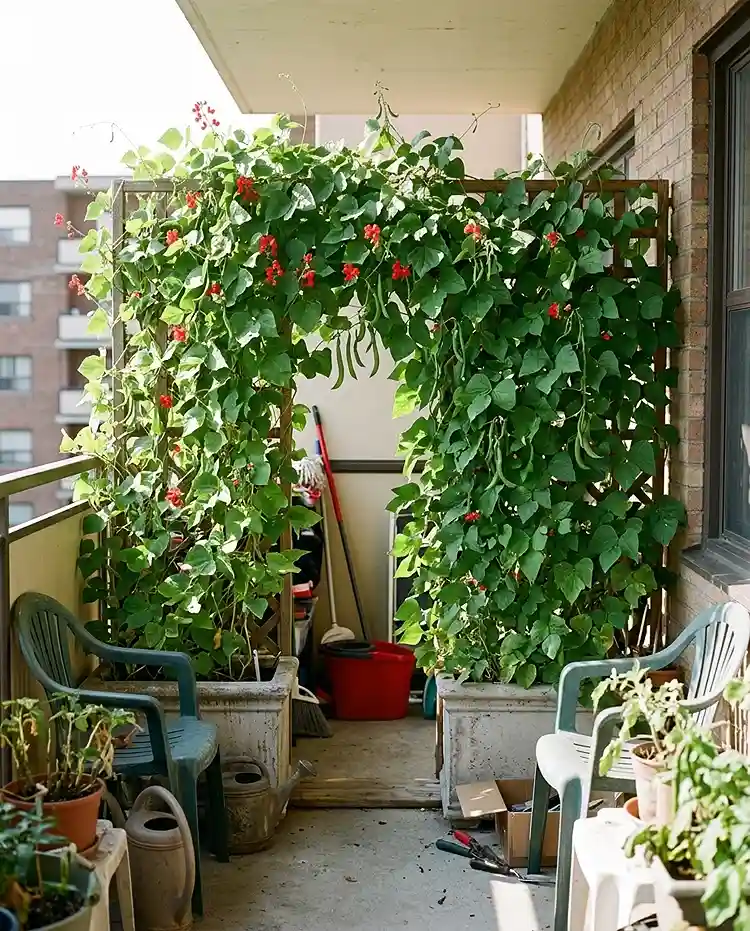
Idea 7: Corner Obelisk Planter Concealing Mop Buckets Behind Climbing Pole Beans
Place an L-shaped trough in the messiest corner and add a 6-foot trellis. Train ‘Kentucky Wonder’ pole beans or scarlet runner beans up it. The vines screen mop buckets and brooms within six to eight weeks. Pole beans keep producing as you pick, so check daily.
Idea 8: Stackable 5-Tier Vertical Tower of Leafy Greens and Culinary Herbs
A rotating five-tier tower fits an 18-inch footprint and holds 20 or more plants. Fill it with loose-leaf romaine and Genovese basil, right where that old stack of boxes sat. Water from the top and let it drain through. Turn it a quarter each week so every side gets light.
Idea 9: Hanging Colander Baskets of ‘Tumbling Tom’ Cherry Tomatoes Overhead
Hang colander baskets of ‘Tumbling Tom’ cherry tomatoes from overhead hooks. They use empty air and keep floors 100% clear. Line each colander with coir, and use hooks rated for 25 pounds or more, since a watered basket is heavy. One 12-inch basket gave me 3 pounds in August 2026.
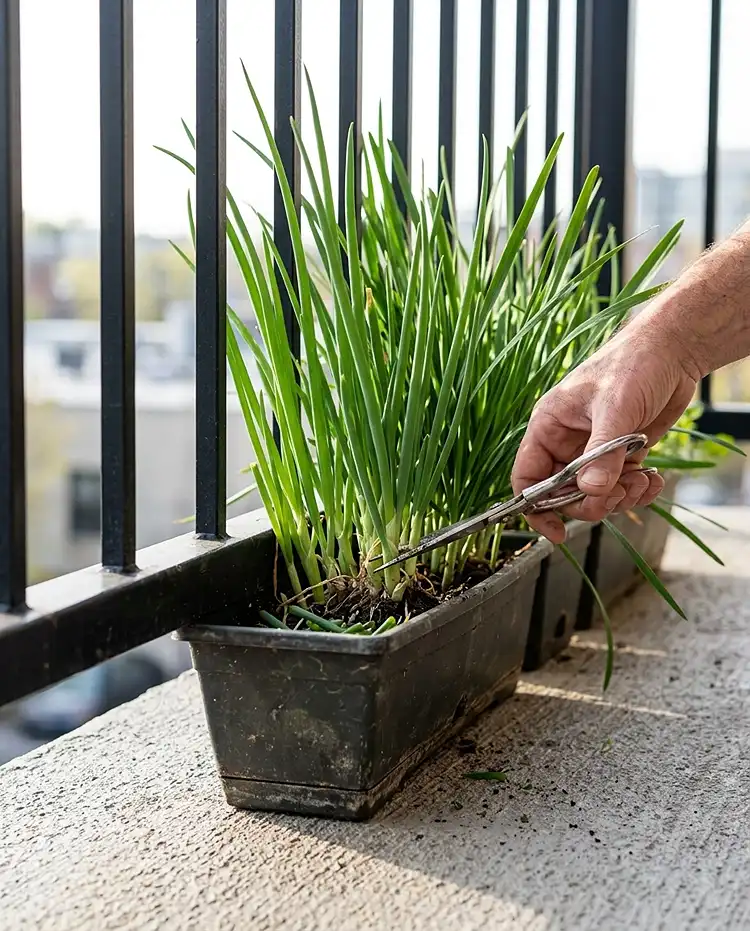
Idea 10: Narrow Under-Railing Toe-Kick Troughs for Scallions and Garlic Greens
Slide 4-inch-wide rectangular troughs beneath the bottom rail bar. That dead perimeter strip grows scallions and garlic chives nonstop. Trim scallions an inch above the roots and they regrow. Choose troughs at least 5 inches deep, and secure them against wind.
Idea 11: Folding Wall-Mounted Bistro Table Flanked by Magnetic Spice-Tin Planters
Mount a drop-leaf bistro table on the wall for coffee and prep. Stick magnetic spice-tin planters on steel siding or railings. Grow microgreens and lemon thyme you can snip while cooking. Poke drainage holes in each tin. Magnets only grip steel, so test your railing first.
Idea 12: Breathable 10-Gallon Potato and Sweet Potato Grow Bags Tucked Under Tables
Tuck 10-gallon grow bags beside or under a storage table. Fabric breathes, so roots stay cool. Plant ‘Yukon Gold’ or ‘Red Norland’ for new potatoes, or ‘Beauregard’ sweet potatoes, whose leaves are edible too. Plant after your last frost, and expect a few pounds per bag.
Idea 13: Shady North-Corner Asian Greens Station with Bok Choy, Tatsoi, and Mizuna
Turn that dim north corner into a stir-fry station. Shallow bowls of bok choy, tatsoi, and mizuna handle just 3 hours of sun and are ready in 30 to 45 days. Keep soil evenly moist. Harvest before heat makes them bolt [flower and turn bitter].
Idea 14: Espaliered Dwarf Citrus or Fig Tree Flattened Against a Sunny Brick Wall
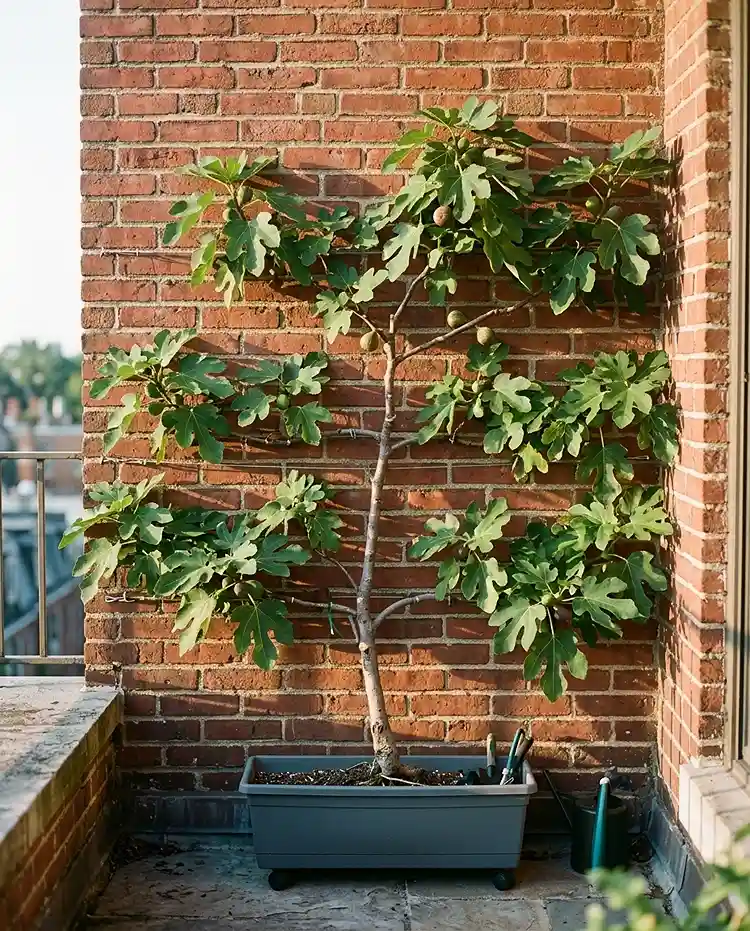
Espalier [train a plant flat against a wall] a dwarf ‘Meyer’ lemon or ‘Little Miss Figgy’ fig on a sunny brick wall. Tie branches to horizontal wires and the plant needs only about 10 inches of depth. In zone 7a, roll pots indoors or into an unheated garage before hard freezes.
Idea 15: Railing-Clamped Trellis Netting for Vertical Sugar Snap Peas and Mini Cucumbers
Stretch nylon trellis netting from a narrow floor trough to the top rail. Plant ‘Sugar Ann’ snap peas in cool weather and ‘Spacemaster’ cucumbers in summer. You get an edible privacy curtain. For more compact crops, see these small balcony vegetable garden ideas.
Idea 16: Upcycled Wine Rack Holding Horizontal Gutter Planters of Baby Lettuce
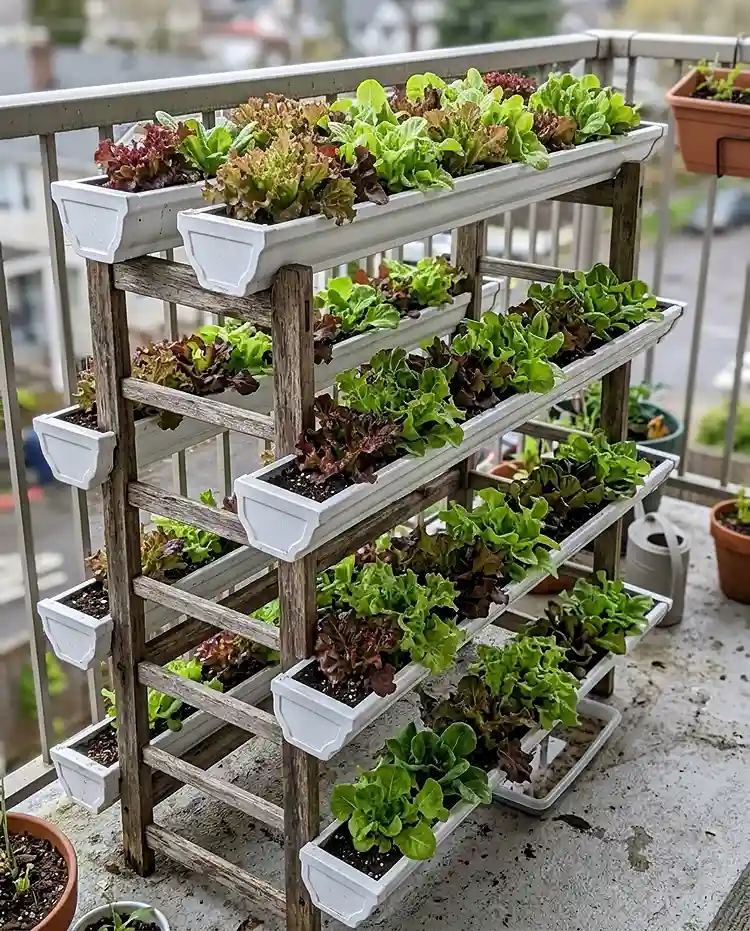
Convert a freestanding wine rack into a salad bar. Rest vinyl rain-gutter sections, drilled for drainage and fitted with end caps, across the rungs. Fill each with 4 inches of mix and sow baby lettuce. Tilt the gutters slightly so extra water drains into a tray.
Idea 17: Sunken Nursery Pots of Mint, Lemon Balm, and Chamomile for an Herbal Tea Bar
Sink individual nursery pots of mint, lemon balm, and chamomile into one long decorative trough. The pots contain the roots, so nothing takes over. Lift pots out to harvest or replace them. Steep fresh leaves in hot water, and your tea bar sits steps from the kettle.
Idea 18: Self-Watering Sub-Irrigated Tote for Thirsty Patio Eggplants and Chili Peppers
Use a closed-reservoir rolling tote [a sub-irrigated planter, watered from below] for ‘Patio Baby’ eggplants and jalapeños. It replaces messy saucers and keeps plants hydrated for several days. Both love heat, so roll it to the warmest wall. Top up the reservoir weekly in summer.
Idea 19: Ceiling-Hung Macramé Pods of Trailing Nasturtiums and Edible Violas
Hang lightweight macramé pods of trailing nasturtiums and edible violas near the edge. Nasturtium leaves taste peppery, and violas decorate cakes. Afternoon light keeps them blooming. Line each pod with coir, and confirm the hook can hold the watered weight.
Idea 20: Stacked Cedar Ladder Planter Separating Recycling Bins from the Seating Nook
Stand a stepped cedar ladder planter between the recycling bins and your seating. Fill the steps with ‘Bright Lights’ Swiss chard, ‘Lacinato’ kale, and dwarf bush beans. It becomes a living room divider, and the bins hide neatly behind it.

Idea 21: Windowsill Ledge Magnetic Troughs for Heat-Loving Thai Basil and Chili Peperoncini
Use the exterior window ledge, where glass radiates warmth. Magnetic or bracketed troughs hold Thai basil and ‘Peperoncini’ peppers, which ripen well in that warm pocket. Secure everything firmly. Skip this idea above ground level if a falling pot could hurt someone.
Idea 22: Indoor/Outdoor Countertop Sprout and Microgreen Trays on the Storage Cabinet
Stage mesh trays of radish, broccoli, and pea shoots on a waist-high outdoor cabinet. Radish and broccoli microgreens [tiny edible seedlings] are ready in 7 to 10 days. Bring trays under cover at night, and cover them with mesh if pigeons visit.
Idea 23: Overwintering Cold-Frame Topper Built Over a Wooden Storage Crate Planter
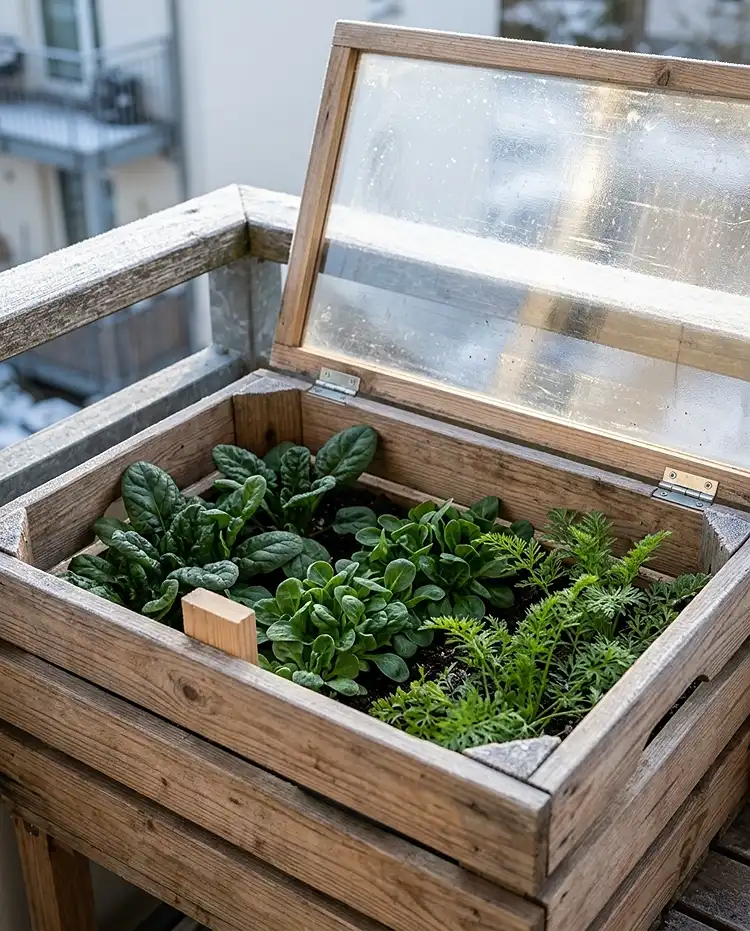
Attach a hinged polycarbonate lid to a deep wooden crate to make a cold frame [a mini greenhouse for cool seasons]. Harvest frost-sweetened spinach, mâche, and carrots right through winter in zones 5 to 8. Vent the lid on sunny days above 45°F.
Seasonal Planting, Harvesting, and Maintenance Routine for Kitchen Balconies
Short Answer: Water daily in summer, feed every two weeks, and sow something new every 14 days. Harvest outer leaves first, so the plant keeps producing. Spend ten minutes each weekend checking for pests and tidying storage. That small routine keeps a dense balcony productive from early spring until the first hard frost.
Here’s my weekend ten-minute loop:
- Poke a finger two inches into each pot and water if it’s dry
- Pick anything ripe, and pinch off yellow leaves
- Check leaf undersides for aphids and sticky residue
- Sow your next batch of radishes or lettuce
- Put tools back in the bench so the floor stays clear
Succession Sowing Calendar, Cut-and-Come-Again Harvesting, and Organic Feeding
Succession sowing [planting a fresh batch every couple of weeks] stops you from drowning in lettuce one week and starving the next. As of 2026, zone 7a last frost averages mid-April and first fall frost lands around late October. Check your own dates, since balcony microclimates run warmer.
| Month | Sow or plant | Harvest |
|---|---|---|
| March | Radishes, spinach, peas, arugula | Cold-frame greens |
| April | Lettuce, beets, carrots, scallions (radishes every 14 days) | Spinach, first radishes |
| May | Tomatoes, peppers, eggplant, basil, pole beans | Lettuce, radishes, herbs |
| June to July | Cucumbers, bush beans, shade lettuce | Herbs, greens, early tomatoes |
| August | Bok choy, lettuce, radishes, spinach | Tomatoes, peppers, cucumbers |
| September to October | Mâche, spinach, arugula under a cold frame | Peppers, eggplant, carrots, hardy greens |
For cut-and-come-again harvesting, snip outer leaves an inch above the crown [the base where leaves meet the roots]. Leave the center intact, and the plant keeps growing.
Feed every two weeks with liquid kelp or fish emulsion at the container rate on the label. Fish emulsion smells strong, so I switch to kelp in summer. Your neighbors will thank you.
Common Problems & Solutions
Short Answer: Crowded balconies share three problems: poor airflow that invites powdery mildew, missing pollinators, and messy soil that attracts gnats. Each has a cheap, fast fix you can start this weekend. Space pots away from walls, hand-pollinate in the morning, and line pots with mesh.
Poor Airflow Behind Storage Units Triggering Powdery Mildew on Squash and Peas
Stagnant corners between storage benches and walls trap humid air, and white fungal spores love it. Space pots 4 inches out from walls and prune lower leaves. If white dust appears, spray potassium bicarbonate [a baking-soda-style fungicide] following the label. Water the soil, not the leaves.
Lack of High-Rise Pollinators Causing Tomato, Pepper, and Zucchini Blossom Drop
Wind-blocked alcoves on upper floors miss bee traffic, so blossoms drop unfertilized. Each morning, tap flower clusters gently or dab each blossom with a small paintbrush. It takes 30 seconds. Interplant sweet alyssum nearby to lure hoverflies and small bees.
Soil Spills, Muddy Runoff, and Fungus Gnats Near Stored Household Items
Line pots with non-woven geotextile mesh so soil stays put. Top-dress with 1/2 inch of coarse horticultural grit to block fungus gnats [tiny flies whose larvae feed in damp soil]. Set every pot in a deep-lip drip tray, and store gear on a shelf above any splash zone.
Frequently Asked Questions
How do I fit bike storage and a kitchen garden on a tiny balcony?
Zone it vertically. Mount bikes on a no-drill tension rack, or tuck boxes inside a waterproof bench that fills the bottom 2 feet. Then dedicate railings, walls, and benchtops to edible containers. You keep the storage and gain a harvest.
Which kitchen garden crops give the highest yield in small pots?
Cut-and-come-again lettuce, cherry tomatoes, pole beans, radishes, and herbs like basil, chives, and thyme all produce for weeks. Herbs, lettuce, and radishes grow in pots under 10 inches wide. Tomatoes and pole beans need 5 gallons or more.
Can I grow a balcony kitchen garden with only 3 to 4 hours of sun?
Yes. Leafy greens like spinach, arugula, Swiss chard, and bok choy do well. So do radishes, beets, green onions, mint, parsley, cilantro, and chives. Skip tomatoes and peppers, which need six or more hours of direct sun.
How do I keep mice and pigeons out of my balcony garden?
Seal seeds and organic fertilizer in metal or heavy resin bins. Pick ripe tomatoes before dusk. Clip reflective bird tape or run taut nylon string about 4 inches above railing boxes so pigeons can’t land.
How much weight can an apartment balcony hold?
It varies by building. Many codes plan for around 60 pounds per square foot, but older buildings differ. Ask your landlord or property manager, and spread heavy pots over corners and along walls. Light mix and fabric pots cut the load.
What is the best soil for a balcony kitchen garden in containers?
Use a light, peat-free mix, never garden dirt. My blend is 4 parts coco coir, 2 parts perlite, 2 parts screened compost, and 1 part worm castings, plus an organic 5-5-5 fertilizer. It drains fast and stays fluffy all season.
Quick Recap
- Clear the floor first: move gear into a weatherproof bench and keep heavy tubs over load-bearing corners.
- Match crops to sun: six or more hours for tomatoes and peppers, three to four for greens and herbs.
- Use fabric pots and a light coir-based mix to keep weight down and drainage up.
- Pick three balcony kitchen garden ideas from this list, then sow something new every 14 days.
- Secure every rail, ledge, and hanging planter, and feed your plants every two weeks.