
15 Windy Balcony Garden Ideas That Put Stability First
Your basil just sailed off the rail again. These 15 windy balcony garden ideas put stability first, so your pots stay put.
I garden on a sunny zone 7a rooftop terrace, so I’ve tipped, snapped, and rescued plenty of pots. My terrace gets full sun from about 9 a.m. to 5 p.m. I run roughly 20 containers, from 6-inch nursery pots to 15-gallon troughs, along a steel railing.
The wind up there never quits, and it taught me every lesson below the hard way.
As of 2026, the USDA’s current hardiness map is the 2023 update, and my terrace sits in zone 7a. Pots run one to two zones colder than the ground, so my 7a pots behave like zone 6 or even zone 5. I flag any plant below that needs winter protection.
Table of Contents
Engineering a Stable Balcony: Physics, Load Limits, and Wind Zones
Short Answer: A stable setup rests on three habits: wide low pots, bottom-heavy ballast, and plants that bend with gusts. Wind speeds up as it climbs a building and swirls around outer corners. Stability beats looks here. Think low, wide, flexible.
The Why: A pot tips when gusts push harder on the leaves than the pot’s weight resists at its base. Wind also gains speed as it climbs a building. Corners create eddies [swirling pockets of turbulent air] that shove pots from odd angles.
What Happened to Me: In April 2025, my ‘Sungold’ cherry tomato stood 5 feet tall in a 5-gallon bucket. A 30 mph gust folded it over the rail and snapped the main stem.
I lost about three weeks of growth. Then I switched to wide fabric bags and shorter plants, and nothing has tipped in two seasons.
The “Base-Wider-Than-Height” Rule and Mapping High-Velocity Railing Corners
Short Answer: Choose containers whose base is at least as wide as they’re tall, like cubes and troughs. Skip tapered cylinders. Keep the outer 90-degree railing corners free of loose pots, because wind accelerates around them. Fill those spots with anchored, low planters instead.
| Container shape | Tip resistance | Verdict |
|---|---|---|
| 16-inch square cube | High | Best for corners and anchors |
| 36 x 14-inch trough | High | Best for railings and walls |
| Tapered cylinder | Low | Skip on exposed edges |
| Pedestal urn | Lowest | Skip entirely |
Try This: Walk your balcony on a breezy day with a ribbon. Wherever it whips hardest, usually the outer corners, plant nothing loose.

Balancing Wind Ballast Against Balcony Structural Weight Limits (40-60 lbs/sq. ft.)
Short Answer: Heavy ballast helps against wind but strains balconies. Many codes design for 40 to 60 pounds per square foot, so spread the weight. Place heavy troughs over load-bearing walls, not cantilevered outer edges. Group pots into interlocking clusters that resist tipping without adding dead weight.
The Why: As of 2026, model building codes design balconies for 1.5 times the live load of the area they serve. For apartments, that works out to 60 pounds per square foot. Some local codes still use 40, so ask your building manager.
Try This: A soaked 16-inch cube planter can top 100 pounds. Park the heaviest ones over load-bearing walls, not the outer edge. Cluster smaller pots so they lean on each other.
Essential Stability Hardware: Anchors, Permeable Windbreaks, and Non-Blowing Soil
Short Answer: Three things keep pots put: tie-downs, screens that let wind through, and a heavier mix. Skip solid walls and floaty perlite. Aim for screens at least 60 percent open, tether every container, and top-dress with pebbles. Together they stop tipping and the dust storm of potting mix across your deck.
Try This: Stock this checklist before gust season:
- UV-rated Velcro cinch straps for railing spindles
- Stainless steel cable ties as backup tethers
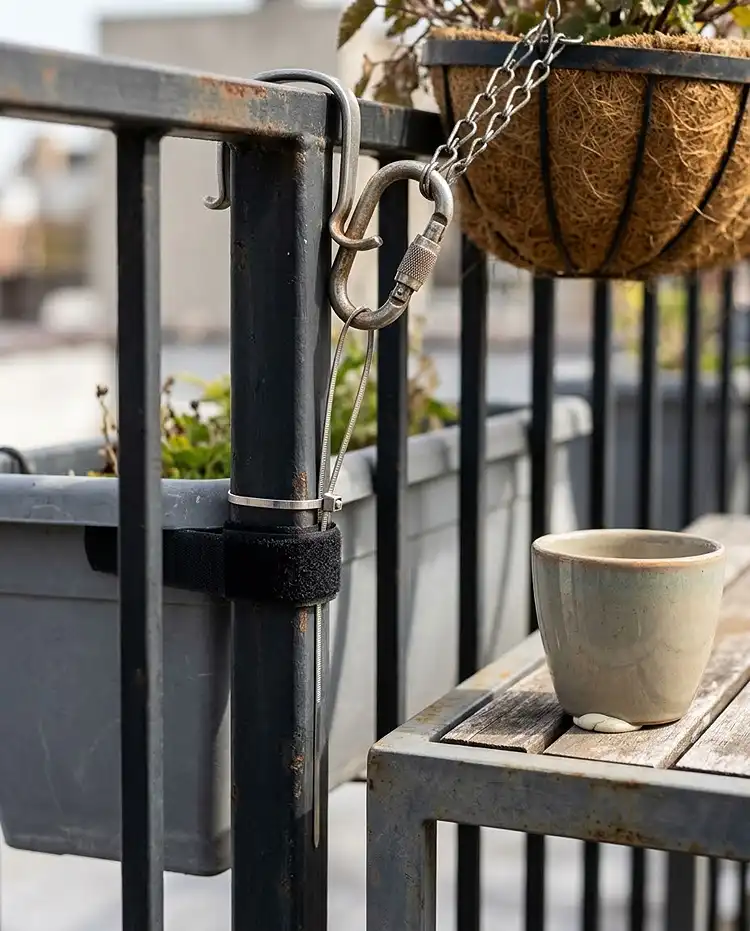
- Screw-gate carabiners and hooks rated for at least 25 pounds for hanging baskets
- Knitted HDPE mesh screens, 60 percent open or more
- Pumice and river pebbles for a heavier, grittier soil mix
Renter-Safe Tie-Downs: Stainless Steel Cable Ties, Velcro Straps, Quake Putty, and Locking Carabiners
Short Answer: Renters can lock planters down without drilling. Loop UV-rated Velcro straps around railing spindles. Press museum putty under small pots. Clip hanging baskets with screw-gate carabiners. Set leveling rubber shims under troughs. Add stainless cable ties as a backup tether near the edge.
- Velcro cinch straps: tether planters to railing spindles in under a minute.
- Museum putty: grips tabletop pots under about 5 pounds. It won’t hold heavier ones.
- Screw-gate carabiners: a locking gate can’t shake open like an S-hook.
- Rubber shims: level wobbly troughs so they stop rocking.
Want more no-drill ideas? See these renter-friendly balcony planter solutions.
The “Dust-Storm-Proof” Weighted Potting Mix Recipe (Pumice Over Perlite + Gravel Top-Dress)
Short Answer: Swap floaty white perlite for volcanic pumice, which is heavier than perlite and won’t float. A solid mix is composted pine bark, coco coir, pumice, and vermiculite, topped with a 1-inch layer of river pebbles. It drains well, stays put in gusts, and keeps the surface from blowing across your deck.
| Ingredient | By volume | Job |
|---|---|---|
| Composted pine bark fines | 3 parts | Structure and airflow |
| Coco coir | 2 parts | Steady moisture |
| Volcanic pumice | 2 parts | Grit, drainage, and a little extra weight |
| Vermiculite | 1 part | Holds water and nutrients |
| River pebbles | 1-inch top layer | Stops dust and splash |
15 Ideas That Lower, Widen, or Let Wind Through
Short Answer: These fifteen ideas pair tip-proof containers with flexible, low-drag plants. Each one lowers the center of gravity, widens the footprint, or lets wind pass through instead of pushing against it. Pick two or three that fit your space, anchor them first, then plant.
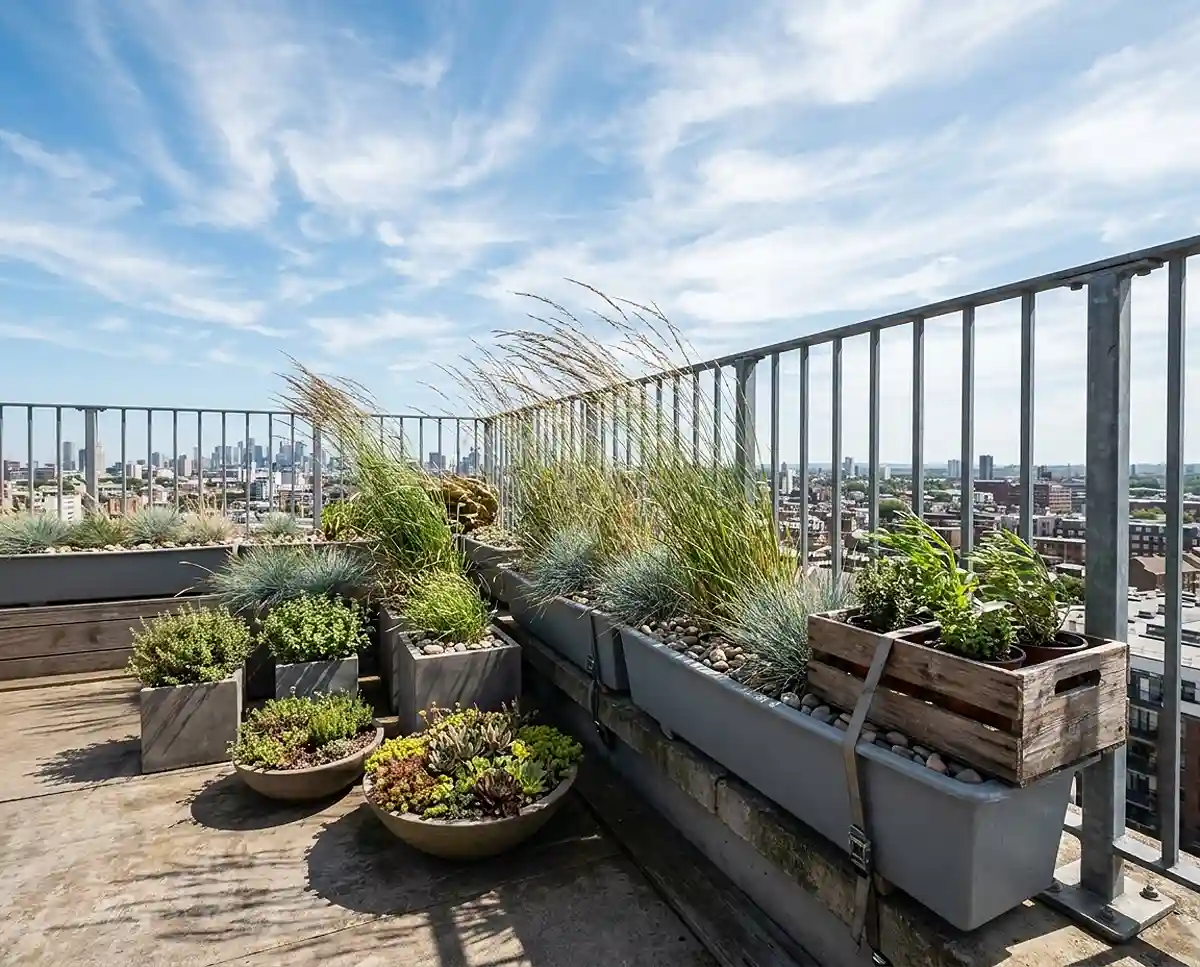
Idea 1: Low-Slung Fiberglass Trough “Living Windbreak” of Karl Foerster Grass and Blue Fescue
A 36-inch-long, 14-inch-wide fiberglass trough makes a living windbreak. Ballast the base with sealed water jugs or a fabric-wrapped layer of river rock, put a grittier mix above, and zip-tie it to the lower railing.
Plant Calamagrostis ‘Karl Foerster’ with blue fescue. The plumes bend instead of acting like a solid sail. Both are hardy in zone 7a.
In June 2025, I planted three ‘Karl Foerster’ in mine. By late July 2025, one reading on a handheld anemometer at my table showed the breeze had dropped from about 16 mph to 9 mph.

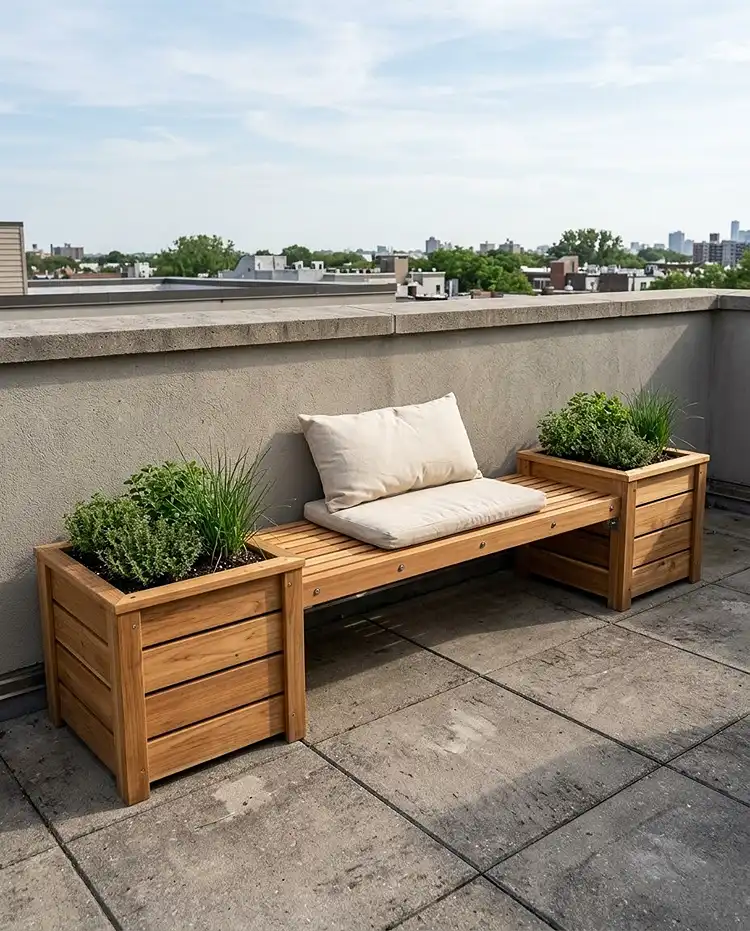
Idea 2: Interlocking “Planter-Bench” Bridge Anchored by Two Heavy Corner Cube Pots
Place two 16-inch square wooden planters at opposite ends of a balcony wall. Lay cedar bench slats across cleats fixed to the planters, not to the building, so both lock into one immovable 6-foot footprint.
Plant low herbs in the cubes. This build is heavy, so keep it over a load-bearing wall.
Idea 3: Sub-Rail “Toe-Kick” Troughs Tucked Behind a Solid Parapet Half-Wall
Set long, low window boxes on the floor against the inside of a solid parapet half-wall. They sit below the wind shear line [the height where gusts hit hardest], so little reaches them.
This idea needs a solid parapet. At an open steel railing, wind blows straight through, so a low trough there sits in the wind, not below it.
Plant bushy ‘Arp’ rosemary, one of the hardier cultivars, plus compact zinnias and salvias. In a pot at 7a, move the rosemary against a wall for winter.
Idea 4: Wide-Base Bowl of Aerodynamic Agave, Sempervivum (Hens & Chicks), and Sedums
Use a squat fiberstone bowl, 16 inches wide and 6 inches deep. Fill it with Sempervivum, Sedum ‘Angelina’, and a cold-hardy Agave parryi for a spiky center. These ground-hugging rosettes create almost no wind drag on exposed bistro tables or ledges.

Idea 5: Railing-Cinching Saddle Planters With Lower Stabilizer Bars and Trailing Lantana
Standard hook-over railing boxes tilt and flip in updrafts. Choose compression-fit saddle planters with bottom leveling brackets, then add a secondary zip-tie tether.
Pick saddle planters whose box sits on the balcony side of the rail, with only the clamp gripping the bars. That keeps the weight over your floor, not the street.
They safely hold cascading Lantana and Scaevola. Both are annuals in zone 7a, so replant each May.
Idea 6: Corner-Wedged A-Frame Ladder Stand Loaded With Heavy Bottom Ballast Tubs
Wedge a stepped cedar A-frame shelf into an inside 90-degree corner. Put two 12-inch resin pots of dwarf Mugo pine, such as ‘Mops’, on the bottom rung. That weight anchors the upper tiers of herbs. Resin won’t shatter if a gust knocks it over.
Mugo pine handles cold but struggles in hot rooftop sun. Give it afternoon relief with a spot shaded after 2 p.m. or a porous shade cloth.
Idea 7: Flat-Trained Wall Espalier of Star Jasmine on Tension Wires (Zero Tip Risk, Landlord Approval Needed)
Freestanding trellises act like sails, so train Trachelospermum jasminoides flat against the brick instead. Use masonry clips and aircraft cable above a low, wall-hugging trough. Drilling into masonry needs landlord approval.
Star jasmine is hardy only in zones 8 to 10, and a pot acts colder than the ground. Treat it as an annual, or bring it indoors before the first frost.
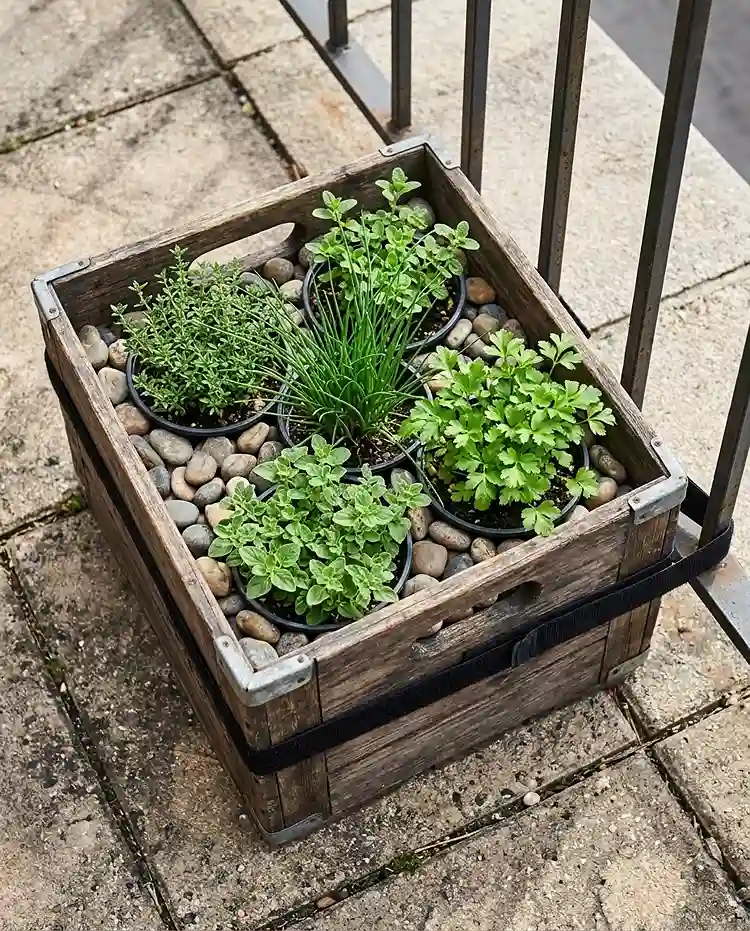
Idea 8: The “Crate-in-a-Crate” Grouping System for Small 6-Inch Herb and Salad Pots
Stop small nursery pots from bowling across the floor. Nest six 6-inch pots of thyme, chives, parsley, and oregano inside a heavy, wide wooden milk crate or galvanized tub. Fill the gaps with pebbles. Strap the crate to the railing, and six pots become one unit.
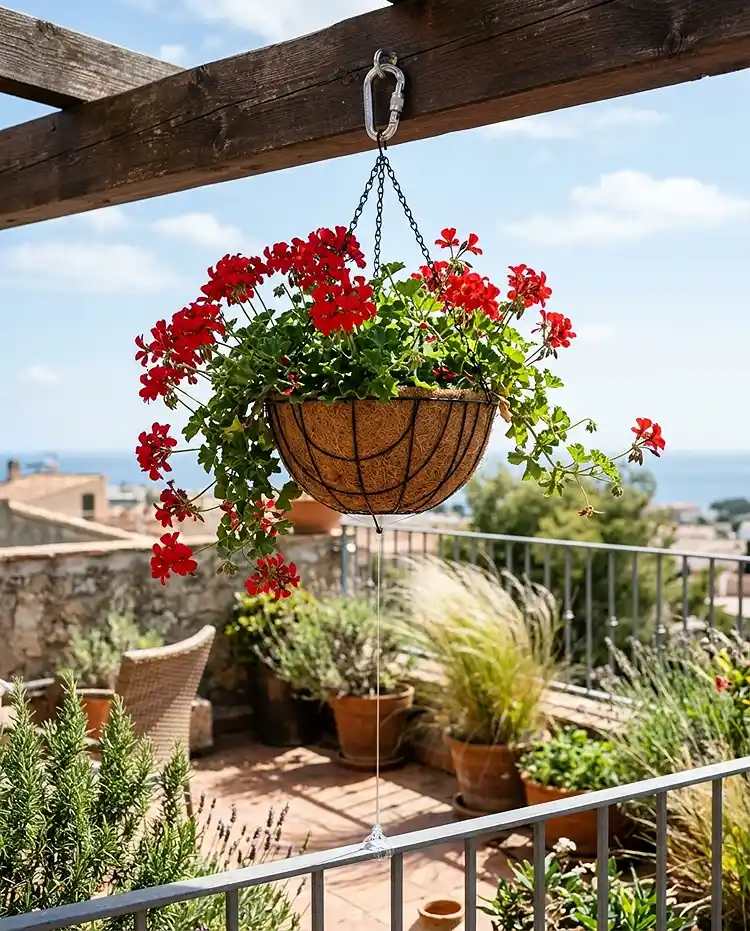
Idea 9: Carabiner-Locked Hanging Basket With a Bottom Railing Tether Line
Try the two-point storm rig. Hang the basket from a locking carabiner and hook rated for at least 25 pounds, then tie a clear nylon line from the basket bottom to a railing bar.
It stops the wild swinging that shreds ivy geraniums. Unclip it entirely before a storm.
Idea 10: Stocky Micro-Dwarf Tomatoes (‘Orange Hat’) in Squat 5-Gallon Fabric Grow Bags
Replace 6-foot staked cages with ‘Orange Hat’ micro-dwarf tomatoes. They stay roughly 6 to 12 inches tall and ripen about 60 days after transplanting. Move them out once soil hits 60°F.
A 1-gallon pot would do the growing, but the 5-gallon bag adds ballast. Fabric dries fast in wind, so it needs twice-daily checks in summer.
As of 2026, ‘Orange Hat’ seed is easy to find from heirloom sellers. Tie the bag handles to the railing, and tuck in a compact chili pepper beside them.

Idea 11: Slatted Cedar Privacy Planter With 60% Air-Gap Louvers and Clumping Bamboo
Build a planter-box screen with 1-inch-wide cedar slats and 1.5-inch gaps, which leaves the screen about 60 percent open. Gusts bleed through the gaps and Fargesia bamboo foliage instead of pushing on a solid wall.
Fargesia clumps don’t run, and most handle zones 6 to 9. In a pot at 7a, wrap the container for winter. For more screen plants, try these balcony privacy plants.
Idea 12: Shady Interior Wall Sanctuary of Leathery Cast Iron Plants (Aspidistra) in Square Cubes
Tuck square charcoal planters into the calmest leeward [sheltered from the wind] pocket beside your door. Plant stiff-stemmed Aspidistra elatior and Japanese holly fern (Cyrtomium falcatum).
Aspidistra is marginal in zone 7a, and a pot acts one to two zones colder. Wrap the container and push it against the wall, or bring it indoors. More shade help is in these balcony shade ideas.
Idea 13: Ground-Hugging Alpine Strawberry and Creeping Thyme “Living Carpet” Trough
Grow an edible carpet that never rises more than 6 inches above the pot rim. Interplant runnerless alpine strawberries such as ‘Mignonette’ (Fragaria vesca) with woody creeping lemon thyme in a low trough. Both are hardy in zone 7a, and neither catches much wind.
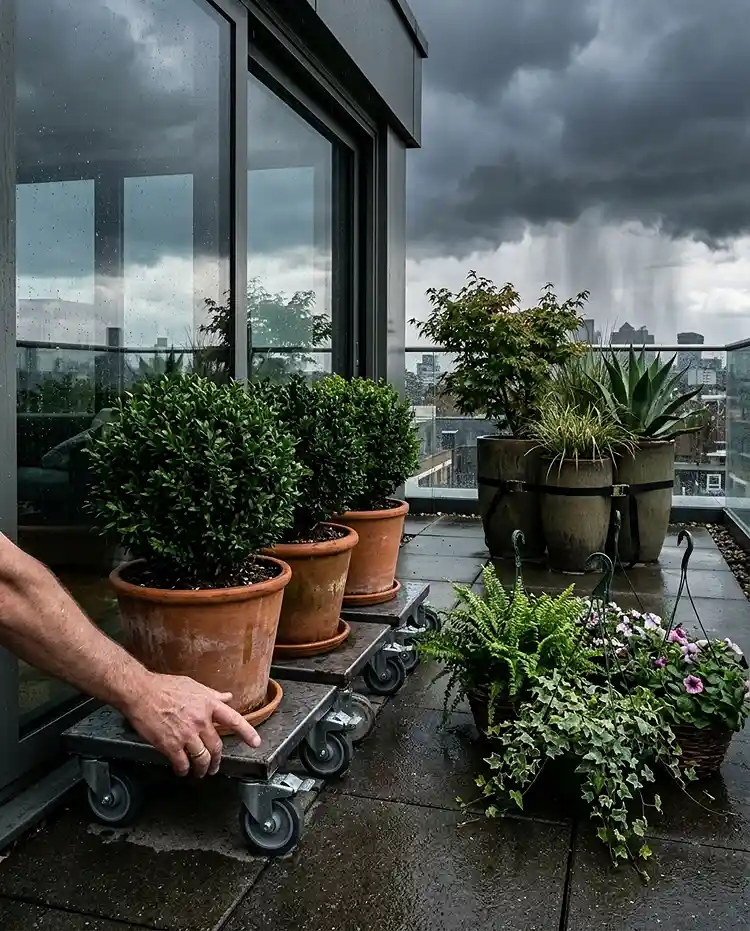
Idea 14: Heavy-Duty Wheeled Plant Caddy With 4 Locking Casters for Storm Relocations
Stage medium shrub pots on wide-wheelbase steel dollies with four locking casters. Before a gale, unlock the brakes and roll them flush against the door in 30 seconds. Try ‘Green Velvet’ boxwood (zones 5 to 9) or dwarf olive (zones 8 to 10, so bring it in for winter).
In October 2025, a 40 mph front hit. I rolled three boxwoods against the door in under two minutes and lost zero branches. In October 2024, before I had the dollies, I lost five.
Idea 15: Recessed Window-Ledge Magnetic & Clamped Tins for Balconies With Recessed Windows
This idea is for balconies with recessed windows, not open rooftop terraces. Use the wind-shielded exterior window recess if yours is about 6 inches deep.
Secure metal trough tins with C-clamps, and add neodymium magnets only where the surface is steel. Grow microgreens and small sedums. Tether every tin with a stainless cable tie so nothing can fall.
Mastering Wind-Safe Installation, Ballasting, and Storm-Prep Routines
Short Answer: Wind-safe gardening has three routines: ballast pots at the bottom, water deeply each morning, and lock everything down before storms. Each takes minutes. Together they keep heavy pots heavy and light pots tied. Do them every week in gust season, not only when forecasts look scary.
How to Ballast Lightweight Planters (The Sealed Water-Jug & River-Rock Method)
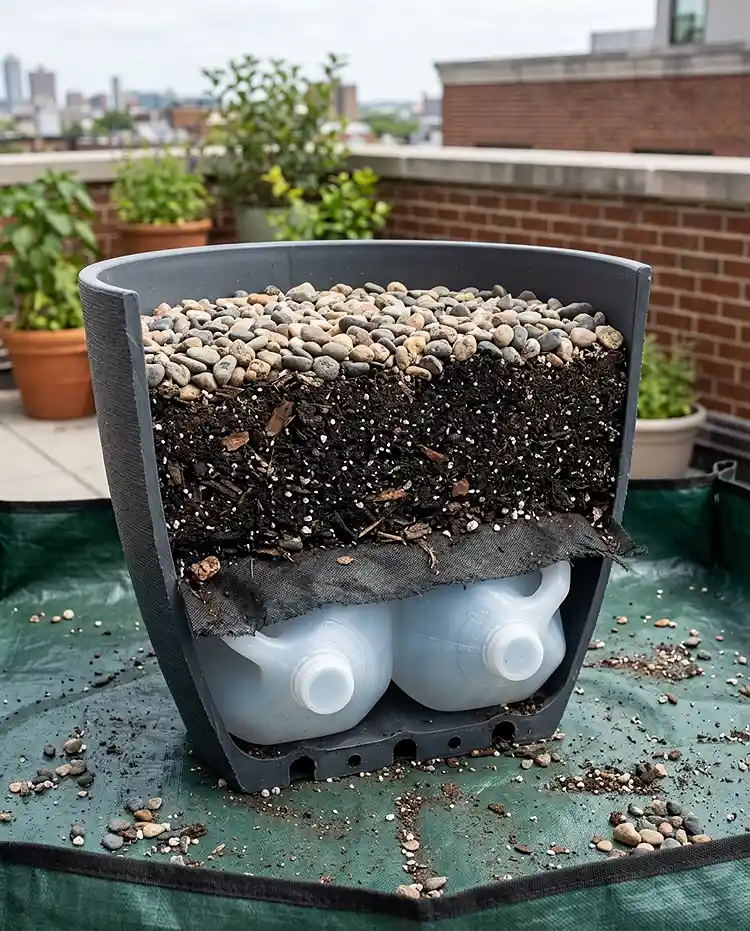
Short Answer: Ballast lightweight planters by adding weight at the very bottom. Set two sealed 1-gallon water jugs (about 17 pounds), or a layer of river cobbles in a fabric-wrapped bag, in the base. Fill above with a grittier mix, and keep drainage holes clear.
Try This: A 3-inch cobble layer in a 12-inch pot adds roughly 25 pounds. Keep it as a separate inner layer, wrapped in breathable landscape fabric, so it doesn’t mix into the soil.
The Trade-Off: Rock doesn’t hold water, and a loose drainage layer doesn’t improve drainage. It lifts the soggy zone into the soil just above it, so that soil stays wetter.
Use a grittier, pumice-rich mix above the ballast and water a little less often. You also lose some root space, so choose a deeper pot.
Keeping Soil Heavy With Morning Hydration + The 5-Minute Severe Weather Lockdown Protocol
Short Answer: Water deeply around 7 a.m. Wet soil is heavier, since a gallon of water weighs about 8 pounds. Bone-dry pots tip far more easily. Before a storm, unclip baskets, huddle tall pots in a corner, and strap them together. The whole routine takes five minutes.
Try This: Run this checklist when the forecast shows gusts over 25 mph:
- Unclip hanging baskets and set them on the floor
- Push tall pots into a corner huddle
- Strap each cluster together with Velcro
- Roll dollies against the door and lock all four brakes
- Bring in tins, tools, and lightweight decor
Common Problems & Solutions
Short Answer: Three problems do the most damage: solid screens that act like parachutes, wind-rocked stems, and fast-drying soil. Fixes are cheap. Swap solid screens for mesh that is at least 60 percent open, stake stems firmly, and use non-porous pots with mulch.
Solid Privacy Tarps and Trellises Acting Like Parachutes and Pulling Railings Down
A solid canvas tarp catches wind like a parachute. Pressure builds on the front, and violent eddies [swirling pockets of turbulent air] form behind the railing. Pressure plus eddies tug on the railing and everything tied to it.
Swap it for knitted HDPE mesh or slatted reed screens that are at least 60 percent open. This University of Florida extension guide to windbreak porosity explains why: turbulence on the sheltered side grows as porosity drops.
The guide covers farm tree windbreaks, so the same principle applies on a balcony. It recommends 40 to 60 percent porosity for crop protection and above 60 percent for structures or privacy screens.
For stylish options, see these renter-friendly balcony privacy ideas.
“Wind-Rocking” Loosening Stems at the Soil Line and Snapping Feeder Roots
Constant circular buffeting twists upright stems until a funnel-shaped hole wears into the soil collar. That severs the fine feeder roots below. Stake the plant with two parallel bamboo canes and a flexible figure-eight rubber tie. Then pack coarse gravel around the stem base to hold it steady.
Rapid Soil Desiccation and Crispy Wind-Burned Leaf Margins
Relentless wind strips the humid boundary layer [the thin film of moist air hugging each leaf] and dries pots fast. Switch to non-porous double-walled resin pots, mulch with 1 inch of river pebbles, and water deeply at 7:00 AM.
Fabric grow bags and terracotta dry fastest, so check them twice a day in July. Crispy leaf edges are your warning sign.
Frequently Asked Questions
What is the most stable pot shape that won’t blow over on a windy balcony?
Wide, flat-bottomed square cubes and low rectangular troughs are the most stable shapes. Their broad footprint resists rolling and tipping. Avoid tall narrow cylinders, goblet urns on pedestals, and V-shaped pots that taper to a narrow base.
How do I secure planters on a balcony railing so they can never fall downstairs?
Never balance loose window boxes on a flat railing ledge. Keep the weight on the balcony side of the railing, using clamp-on saddle brackets that grip the rail while the box sits inside the bars. Back them up with two UV-rated straps looped around the spindles. No drilling needed.
Is it better to use heavy ceramic pots or lightweight resin pots on a windy balcony?
Wide-base fiberglass or double-walled resin pots, ballasted with river rocks or sealed water jugs, are usually safer than ceramic or terracotta. The ballast keeps weight in the bottom 4 inches, which lowers the center of gravity. They also won’t shatter into sharp shards if a storm knocks them over.
What tall privacy plants won’t act like a wind sail and tip their pots over?
Skip dense, top-heavy broadleaf shrubs and standard trees on an exposed railing. Choose fine-textured ornamental grasses like Calamagrostis ‘Karl Foerster’, Miscanthus, or Muhlenbergia, or clumping Fargesia bamboo. Their narrow blades part and let much of the wind slip through.
How much weight can a balcony hold for planters?
Many building codes design balconies for 40 to 60 pounds per square foot of people and furniture, but rules vary by building. A soaked 16-inch planter can top 100 pounds, so spread heavy pots over load-bearing walls. Ask your building manager before adding ballast.
Should I water more often on a windy balcony?
Yes. Wind dries soil and leaves quickly, so check pots daily and water deeply around 7 a.m. Mulch with 1 inch of river pebbles and use non-porous pots to slow evaporation. Fabric bags and terracotta may need water twice a day in summer.
Quick Recap
- Choose wide, low containers whose base is at least as wide as they are tall.
- Ballast the bottom with sealed water jugs or fabric-wrapped river rock, use a grittier mix above, and respect your building’s weight limit.
- Tether every pot with UV-rated straps, cable ties, and locking carabiners. No drilling needed for these.
- Replace solid tarps with screens that are at least 60 percent open.
- Finish with 7 a.m. watering and a five-minute storm lockdown, and your pots will stay put.