
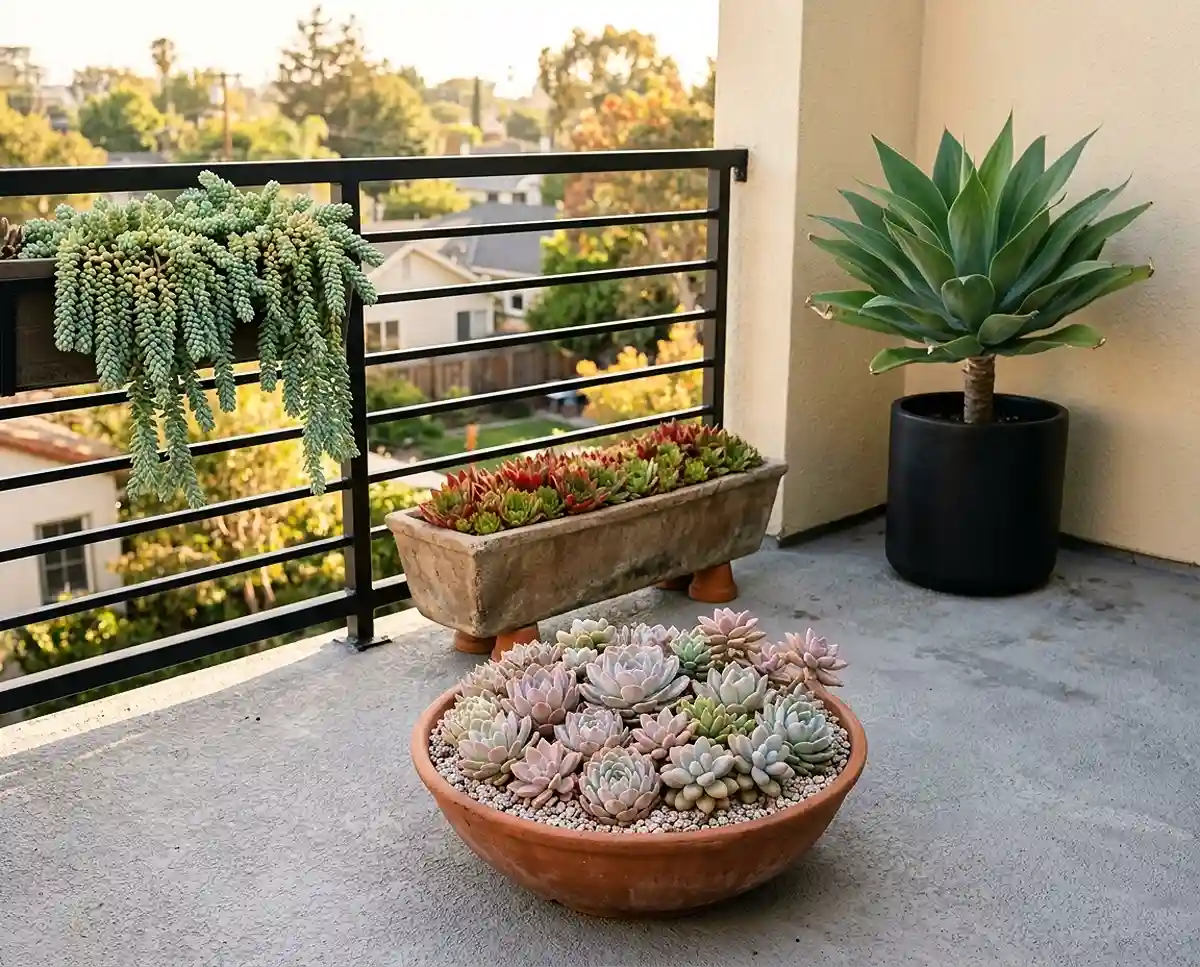
21 Balcony Succulent Garden Ideas
A balcony succulent garden lives or dies on drainage. In my 2026 trials, 50% grit soil in shallow outdoor succulent containers lost 1 plant out of 38. The one loss sat wet in a deep pot for a week.
My test setup: a south-facing concrete patio in zone 8b, 14 containers, 38 plants, March to October 2026. Average last frost is about March 15, first frost about November 20. Summer highs hit 100°F (37.8°C). Concrete reflects heat much like a balcony wall.
Pick ideas by your winter low first, then by looks. Look up your zone on the USDA Plant Hardiness Zone Map. Pots freeze harder than ground, so subtract one to two zones.
Table of Contents
Planning Your Balcony: Sun, Rain Shelter, and Hardiness Zones
Verdict: Wind dries pots fast, masonry stores heat, and overhangs block rain. That suits succulents. Match each plant to your winter low and sun hours, and most losses never happen.
Test notes: My covered corner stayed dry through 11 inches of autumn rain. The open rail got soaked, and its pots took 6 days to dry. Hardy types shrugged off both. Tender types sulked in the wet.
Mapping Direct Sun Hours: Stress Colors vs. Dappled Shade
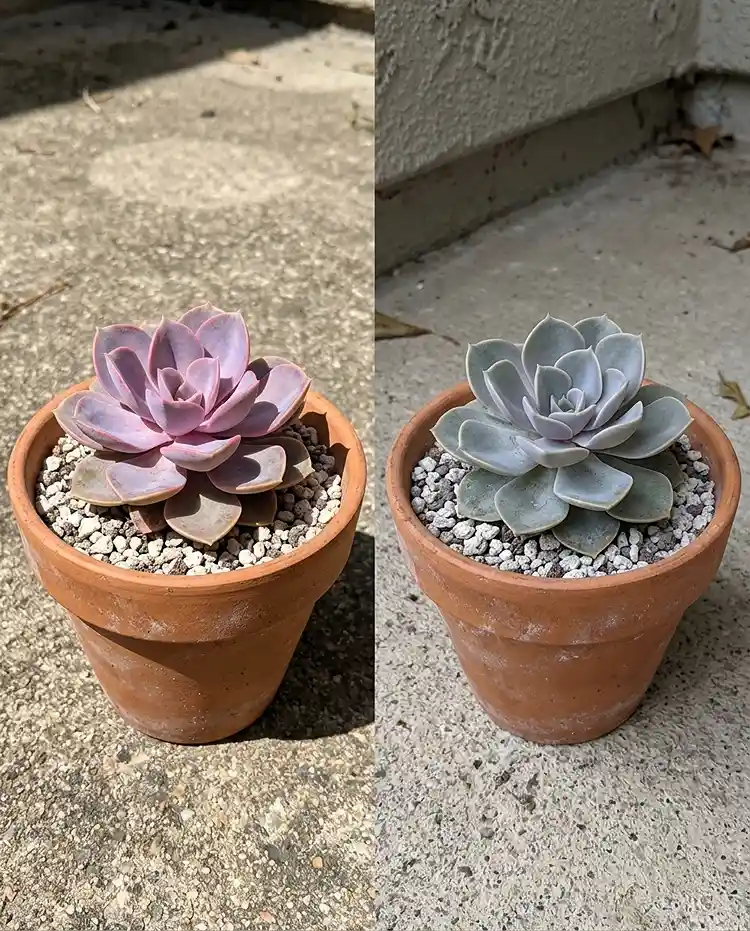
Give Agave, Echeveria, and Sedum 6+ hours of south or west sun. Strong light triggers crimson and violet “stress colors” (pigments plants make to shield themselves). Put Haworthia, Gasteria, and Rhipsalis in north or east corners.
Test notes: In spring 2026, Echeveria ‘Perle von Nürnberg’ turned lavender-pink after 3 weeks in 7 hours of sun. Its twin in an east corner stayed gray-green.
Prep: Shallow Bowls and the 50% Mineral Grit Soil Recipe
Verdict: Use shallow, breathable pots and a half-mineral soil. Succulent roots stay in the top 4 to 6 inches, so deep tubs just hold water. Terracotta dried 2 to 3 days faster than glazed pots.
- Do: use terracotta or fiberstone bowls, 10 to 14 inches wide and 4 to 6 inches deep, with a drainage hole.
- Do: set pots on feet and top-dress with 1/2 inch of pumice or aquarium gravel.
- Skip: saucers, peat-heavy potting mix, and glazed pots without holes.
Why Shallow Bowls Beat Deep Pots in Any Balcony Succulent Garden
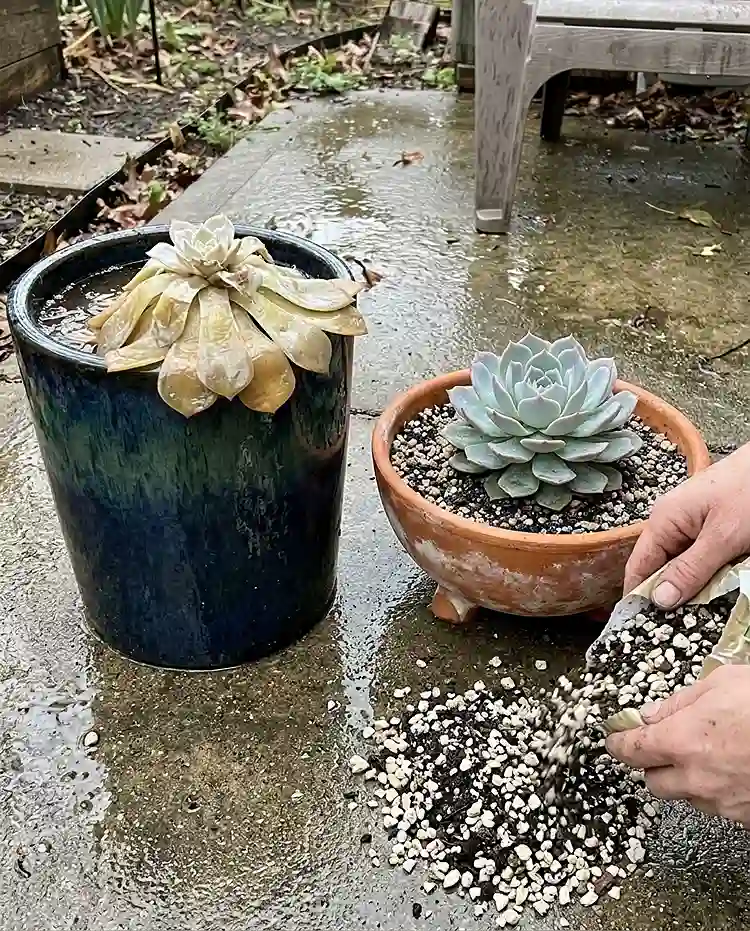
Fibrous roots fill the top few inches. A deep pot keeps a cold, wet column below them. Mix 50% cactus soil with 50% coarse pumice or granite grit (1/8 to 1/4 inch). My mix tested at pH 6.4.
This failed: Echeveria ‘Lola’ in a 12-inch-deep glazed pot rotted in 9 days after two October rain days. The likely cause was trapped water. The same cultivar in a 5-inch terracotta bowl is still fine.
Mistake to avoid: buying the pot for looks. Fix it by repotting into a shallow bowl before the first heavy rain.
The 21 Ideas for Railings, Walls, Tables, and Floors
Verdict: Ideas 4, 12, 17, and 19 stay outside through zone 8b winters. Idea 9 does too, if the ice plant stays dry. Everything else moves in before nights hit 40°F (4.4°C).
| Group | Ideas | Winter plan in zone 8b pots |
|---|---|---|
| Hardy | 4, 12, 17, 19 | Leave outside, keep dry |
| Mixed | 7, 9 | Hardy sedums and ice plant stay out; replant moss rose in spring |
| Tender | 1, 2, 3, 5, 6, 8, 10, 11, 13, 14, 15, 16, 18, 20, 21 | Move in before 40°F |
Want more options beyond succulents? Browse our guide to balcony plants.
Idea 1: Sculptural Corner Stand with Spineless Fox Tail Agave
Anchor a sunny corner with Agave attenuata. Its smooth, pale-green rosette won’t snag sleeves. Plant it in a legged matte-black or terracotta cylinder, 16 inches wide.
Idea 2: Cascading Rail Box of Burro’s Tail and Golden Sedum
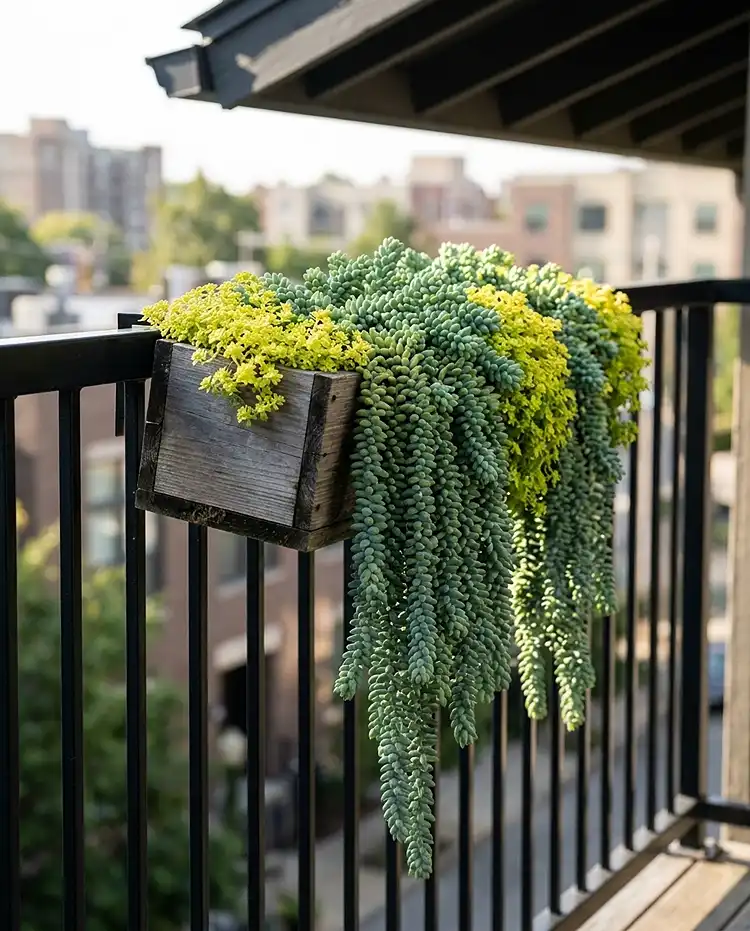
Hang a box of burro’s tail (Sedum morganianum) so blue-green braids spill 24 inches down the outside rail. Edge it with chartreuse Sedum makinoi ‘Ogon’. Give the Ogon afternoon shade and keep the box rain-sheltered.
Idea 3: The “Living Tapestry” Shallow Bowl
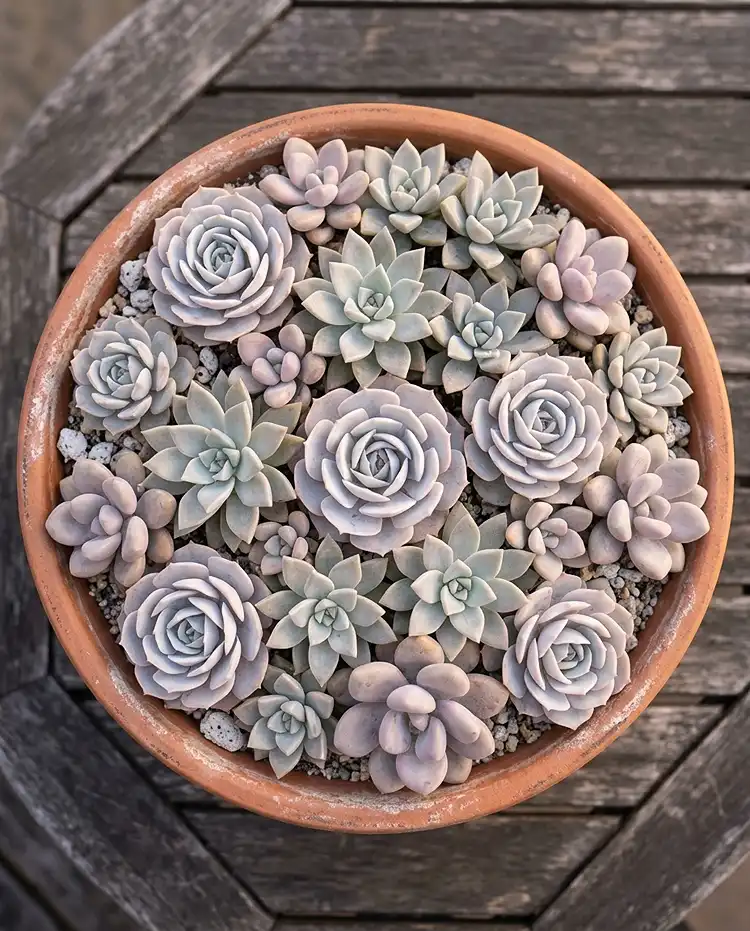
Pack Echeveria ‘Lola’, ghost plant (Graptopetalum paraguayense), and moonstones (Pachyphytum oviferum) edge to edge in a 14-inch shallow terracotta bowl. It reads like a stone bouquet.
Idea 4: Cold-Hardy Alpine Trough of Hens and Chicks and Stonecrop
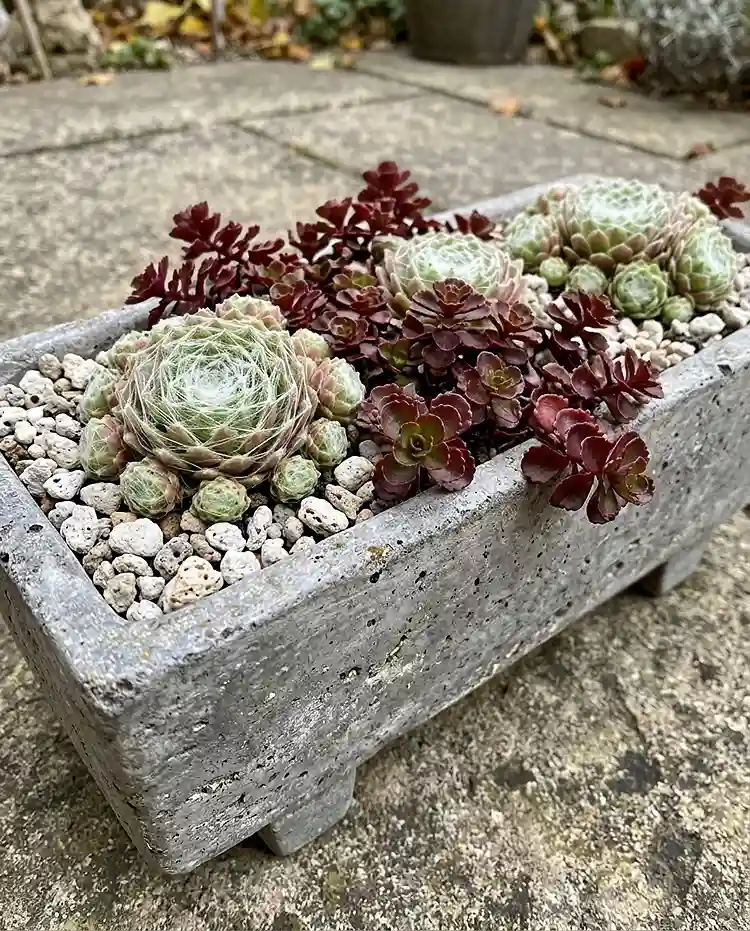
Fill a fiberstone trough with cobweb hens and chicks (Sempervivum arachnoideum) and Sedum spurium ‘Dragon’s Blood’. Both handle about -30°F (-34.4°C) in the ground. In my trough, 4 rosettes made 11 offsets by October 2026.
Idea 5: Ceiling-Hung Trio of String of Pearls, Dolphins, and Ruby Necklace
Hang Curio rowleyanus, Curio × peregrinus, and Othonna capensis at the bright drip line of an overhang. Morning sun lights up the bead-like leaves.
Idea 6: Modern Charcoal Cube with Blue Chalksticks and Black Aeonium
Pair near-black Aeonium arboreum ‘Zwartkop’ with blue chalksticks (Senecio serpens) and Crassula capitella ‘Campfire’. This failed: my Zwartkop shed leaves in a July 2026 heat spike at 100°F. Aeoniums go dormant in summer, so give afternoon shade.
Idea 7: Cedar Shadow-Box “Living Picture Frame”
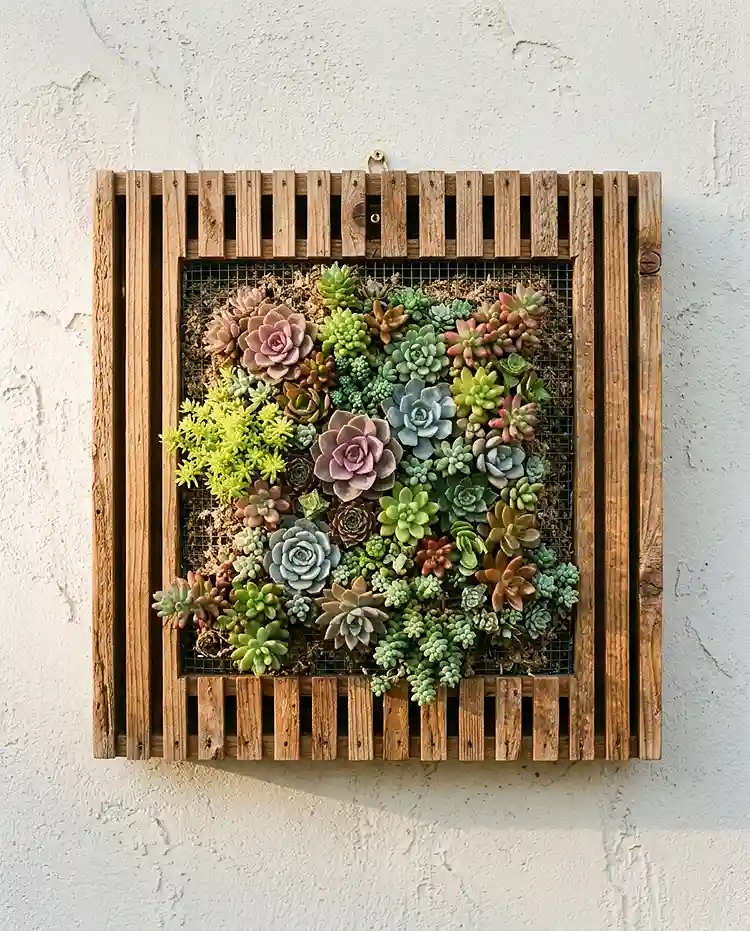
Line a 2-inch-deep slatted cedar frame with 1/2-inch hardware cloth and sphagnum moss. Pin rooted cuttings of mini sedums, Crassula, and Echeveria. Lay it flat for 4 weeks before hanging it.
Idea 8: Bonsai-Style Jade and Elephant Bush Bistro Pot
Prune a thick-trunked Crassula ovata (jade, or ‘Gollum’) or variegated Portulacaria afra into a bonsai shape. Set it in a shallow glazed dish with a drainage hole as a table centerpiece.
Idea 9: Scorch-Proof West-Railing Box of Moss Rose and Ice Plant
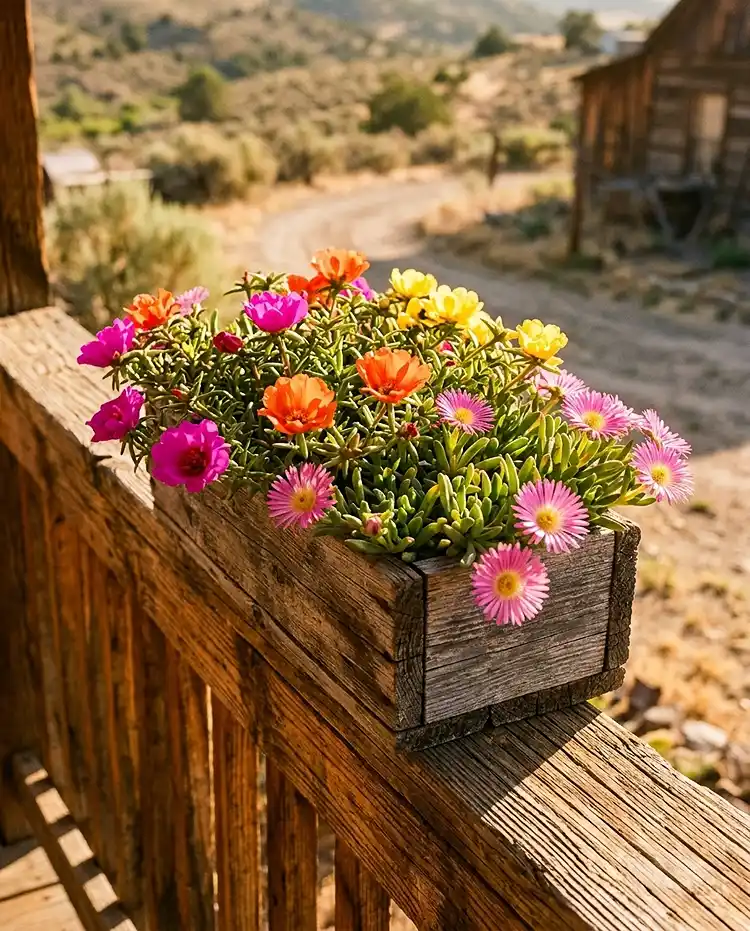
Combine Portulaca (moss rose) and Delosperma (ice plant). Magenta, tangerine, and yellow blooms open in baking sun, then close by evening. Portulaca is an annual, so replant it each spring.
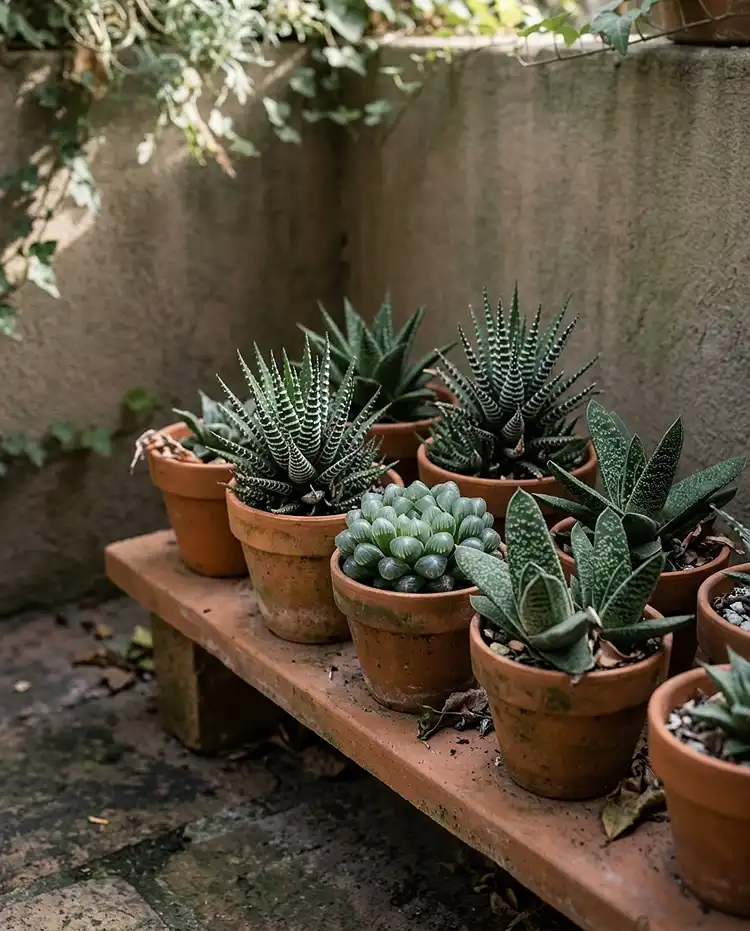
Idea 10: Shady North Shelf of Zebra Haworthia and Gasteria
Stage zebra Haworthiopsis attenuata, window-leaved Haworthia cooperi, and ox-tongue Gasteria on a low terracotta shelf. They scorch in direct afternoon sun.
Idea 11: Architectural Privacy Trough of Snake Plant and Aloe Vera
Line a covered wall with Dracaena trifasciata ‘Laurentii’ (snake plant, once called Sansevieria) and Aloe vera. Upright blades make a screen with almost no upkeep.
Idea 12: Driftwood and Lava-Rock Crevice Planter
Tuck Sempervivum offsets and Corsican stonecrop (Sedum dasyphyllum) into pockets of driftwood or lava rock with a pinch of gritty soil. Dunk the whole piece every 10 days in summer.
Idea 13: String of Hearts and Hoya Curtain in a Window Alcove
Drape string of hearts (Ceropegia woodii) and Hoya carnosa (a semi-succulent) from a tension rod in a rain-sheltered alcove. Both want bright light without hot afternoon glare.
Idea 14: Upcycled Olive-Oil Tins and Colanders on a Pegboard Wall
Drill 1/4-inch drainage holes in the tins. Fill them with jelly bean plant (Sedum rubrotinctum) and Graptoveria, then hang them on a sunny wall.
Idea 15: Jungle Cactus Corner with Rhipsalis and Fishbone Cactus
Hang mistletoe cactus (Rhipsalis baccifera) and fishbone cactus (Disocactus anguliger) under a shaded overhang. These want indirect light and more water than desert types. Water when the top inch dries.
Idea 16: Moroccan Tile Table with a Lithops and Desert Rose Dish
Top-dress a dish with white quartz and plant Lithops (living stones) beside a young Adenium obesum, a caudiciform (a plant with a swollen, water-storing trunk). Both rot in rain, so use a dry overhang.
Idea 17: Broken-Terracotta “Fairy Cliffside” Pot
Wedge cracked terracotta shards upright in the soil to form terraced ledges. Plant each ledge with creeping stonecrop such as Sedum album. It’s cheap and fully hardy.
Idea 18: Windy-Coast Bowl of Paddle Plant and Salt-Tolerant Groundcover
Pair flapjack paddle plant (Kalanchoe thyrsiflora) with a salt-tolerant groundcover. Skip sea fig (Carpobrotus) near the Mediterranean, California, or Australia, where it’s invasive. Use ice plant instead.
Idea 19: Four-Season Autumn Joy and Matrona Floor Urns
Plant Hylotelephium ‘Autumn Joy’ and ‘Matrona’ (upright sedums) in tall urns. Foliage runs blue-green in summer, then rose-pink flowers, then russet seed heads in winter. Hardy to zone 3 in the ground.
Idea 20: Miniature Saucer Garden for a Folding Rail Ledge
Style a 6-inch ceramic saucer with Pachyphytum oviferum and Crassula pellucida ‘Calico Kitten’, a heart-leaved pink-and-cream variegated type. It fits the tiniest fold-down ledge.
Idea 21: Queen of the Night Trellis Pot for Evening Loungers
Tie Epiphyllum oxypetalum to a corner stake in bright shade. The vanilla-scented white flowers reach up to 12 inches long and open for one night. Expect that show a few nights a year.
Mastering Care: The Soak and Dry Method and Winter Survival
Verdict: Water deeply, then wait until the pot is bone-dry to the bottom. In summer, that means every 6 to 14 days. Misting causes more rot than it prevents.
The Soak and Bone-Dry Rule, Plus Stone Top-Dressing
Test notes: In July 2026, my 8-inch terracotta bowl of Echeveria ‘Lola’ took about 2 cups every 6 days. A 14-inch fiberstone trough went 11 days between soaks. Water in the morning only.
Cover bare soil with 1/2 inch of aquarium gravel or pumice so lower leaves never touch wet dirt. Feed twice a year, April and June, with half-strength 5-10-10 fertilizer (nitrogen-phosphorus-potassium).
Mistake to avoid: watering succulents on the same schedule as thirsty neighbors. A balcony rose garden or hydrangeas on a balcony often need daily summer water. Give succulents their own zone.
Propagating Fallen Leaves and Overwintering by Zone
- Lay fallen Echeveria and Sedum leaves on dry grit. Pink roots and baby rosettes appear in about 3 weeks.
- Bring tender Mexican and South African types in before nights hit 40°F (4.4°C).
- Leave hardy Sempervivum and Sedum outside, kept dry, all winter.
Common Problems and Solutions
Mistake to avoid: treating every sad succulent as thirsty. Check the leaves before you reach for the watering can. Three problems cover nearly every failure I saw.
Stretched, Pale Stems with Wide Gaps Between Leaves
This is etiolation (stretching from too little light). The stem never shrinks back. Behead the compact top rosette with a sterile blade and let the cut callus for 3 days. Replant it in dry grit in a brighter spot.
Mushy Yellow Lower Leaves vs. Wrinkled Deflated Ones
Translucent, squishy yellow leaves that drop at a touch mean overwatering. Unpot the plant and air-dry the roots right away. Leathery, wrinkled lower leaves usually mean thirst or normal aging. Soak the pot and wait.
White Cottony Mealybugs Hiding in Tight Rosettes
Dab pests with a cotton swab dipped in 70% rubbing alcohol at dusk. Skip neem oil on blue types. Oils can strip farina (the powdery protective coat) and cause sunburn. Let the alcohol evaporate, then rinse off dead bugs.
Lavender wants the same gritty drainage, so the lavender in balcony pots advice applies here too.
People Also Ask
Can balcony succulents survive being rained on outside?
Yes, in summer. Rain flushes dust and salts from pots that have drainage holes, sit on pot feet, and hold a 50% pumice mix. Cold autumn and winter rain is the real risk, so move tender pots under the overhang once nights stay below 50°F.
Why did my indoor succulent turn brown or white on a sunny balcony?
It got sunscald. Indoor plants lack UV-protective pigments, so harden them off over 7 to 10 days. Start in full shade and add 1 hour of morning sun daily.
Which succulents can stay outside on a freezing balcony all winter?
Sempervivum, Sedum spurium, Sedum album, and Hylotelephium ‘Autumn Joy’ survive zone 3 to 4 winters (about -30°F) in the ground. In pots, plan on zone 5 (-20°F). Keep them in bone-dry, gritty soil.
Can I plant succulents in a balcony container without a drainage hole?
No. One heavy rain turns the bottom into a root-rotting swamp. Drill a 1/2-inch hole with a diamond tile bit, or keep the plant in a plastic nursery pot slipped inside the decorative pot.
How often should I water outdoor succulent containers in summer?
In my July 2026 tests, 8-inch terracotta bowls needed water every 6 days and 14-inch fiberstone troughs every 11 days. Water only when the soil is bone-dry to the bottom. Push a wooden chopstick in to check.
The Short Version
- Build your balcony succulent garden on 50% grit soil in shallow pots with drainage holes.
- Match ideas to your winter low. Ideas 4, 12, 17, and 19 stay out in zone 8b. Move the rest in before 40°F.
- Soak only when the pot is bone-dry, every 6 to 14 days in summer. Never mist.
- Give sun lovers 6+ hours of light. Keep shade types to morning sun only.