

14 Hydrangea on Balcony Ideas for Pots and Placement
Want hydrangea on balcony space without scorched leaves? These 14 ideas show which dwarf varieties, pots, and spots work for a hydrangea on apartment balcony.
I grow them on a fourth-floor corner balcony in zone 6b. One side gets morning sun, the other bakes after 2 p.m. That split taught me more than any plant tag.
Below you’ll find placement rules, container and soil specs, 14 pot designs, and a care calendar, all current for the 2026 season.
Table of Contents
Planning Your Hydrangea on Balcony Placement: Sun, Wind, and Dwarf Varieties
The name hydrangea literally means “water vessel” in Greek, and these shrubs live up to it. Their big leaves lose water fast, so light exposure matters more than almost anything else.
Match the species to your microclimate and you get nonstop summer flower heads. Get it wrong and you get crispy leaves by July. Wind is the second factor, because railings funnel gusts that empty pots in hours.
Mapping the “Morning Sun, Afternoon Shade” Rule vs. Full-Sun Panicle Hydrangeas
Quick Answer: Put mophead and lacecap hydrangeas (Hydrangea macrophylla) on east- or north-facing balconies with 3 to 4 hours of cool morning light and shade after 1:00 PM. Give sun-tough panicle hydrangeas (Hydrangea paniculata) the sunny south and west balconies.
| Balcony Facing | Best Hydrangea | Watch Out For |
|---|---|---|
| East or north | Mophead, lacecap | Winter bud kill |
| South or west | Dwarf panicle | Hot pots, drying wind |
Choosing Genetically Dwarf Cultivars (Under 3 Feet) and Understanding Old-Wood vs. New-Wood Buds
Old-wood bloomers set next year’s buds on last year’s stems. Reblooming mopheads like ‘Endless Summer’ and ‘Wee Bit Grumpy’ hedge their bets by flowering on both old and new stems.
New-wood panicle dwarfs such as ‘Bobo’, ‘Little Lime’, and ‘Fire Light Tidbit’ form buds on spring growth. They bloom reliably even after brutal zone 3 winters.
Essential Prep: Wide Insulated Containers and Color-Controlling Potting Soil
Hydrangea roots are thirsty and shallow, and an elevated deck heats a pot from every side. Sort out the container and soil first. Here’s my checklist:
- A non-porous pot 16 to 20 inches wide and at least 14 inches deep
- Drainage holes plus pot feet so roots never sit in water
- Insulation, either double walls or bubble wrap tucked inside a decorative pot
- A 2-inch layer of pine bark mulch
- Soil acidifier or garden lime, depending on your color goal
Choosing 16-to-20-Inch Double-Walled Resin, Fiberglass, or Glazed Urns Over Porous Clay
Hydrangeas spread wide, fibrous surface roots. In unglazed terracotta they dry out within hours, and the clay can crack in a hard freeze.
Choose 16 to 20 inch fiberglass, thick rotomolded resin, or a glazed urn instead. Wheeled cedar half-barrels also work, and you can roll them into shade. Non-porous walls lock in moisture and survive freeze-thaw cycles.
The Moisture-Sponging Potting Soil Recipe + How to Shift Blooms Blue (pH 5.2) vs. Pink (pH 6.8)
My blend, by volume: 40% composted pine bark fines, 25% coco coir, 20% perlite, and 15% worm castings. The bark adds natural acidity, the coir holds water, and the perlite keeps roots breathing.
| Bloom Color | Target pH | Amendment |
|---|---|---|
| Electric blue | 5.2 | 1 tablespoon aluminum sulfate per gallon of water, drenched March to May |
| Bubblegum pink | 6.8 | 1 tablespoon hydrated garden lime per gallon of water, same window |
Test your pH first, keep the drench off the leaves, and don’t overdo aluminum sulfate because it burns roots. Clemson Extension’s hydrangea guide explains how pH controls bloom color.
14 Hydrangea Balcony Ideas: Containers, Placements & Companion Pairings
These fourteen setups cover shady corners, sunny railings, and narrow walkways. Each names a cultivar and an underplanting. For more companions, browse our guide to balcony plants.
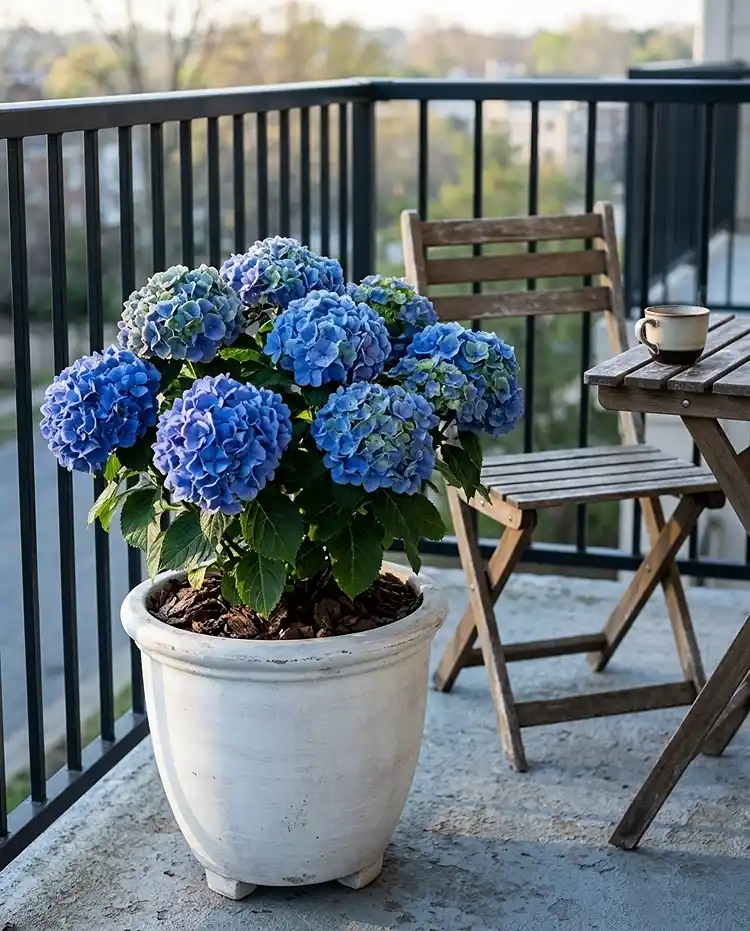
Idea 1: East-Facing Bistro Corner with Blue ‘Endless Summer’ in a Whitewashed Fiberglass Urn
Set a cobalt-blue ‘Endless Summer’ in an 18-inch whitewashed fiberglass urn beside your morning coffee chair. The reflective finish keeps roots cool and adds a Hamptons-style focal point.
Idea 2: Full-Sun West-Balcony Showstopper with ‘Bobo’ Panicle Hydrangea and Purple Verbena
‘Bobo’ stays about 30 inches tall and handles 6+ hours of baking sun. On my west rail, its white cones opened around July 10 and blushed pink through October. Trail purple verbena over the rim.

Idea 3: Shady North-Balcony Woodland Tub of ‘Little Quick Fire’, Tassel Ferns, and White Bacopa
Brighten a dim alcove with ‘Little Quick Fire’, an early-blooming white panicle. Add glossy tassel ferns and let snow-white bacopa (Sutera cordata) spill over the edge. It still needs 4 hours of direct light.
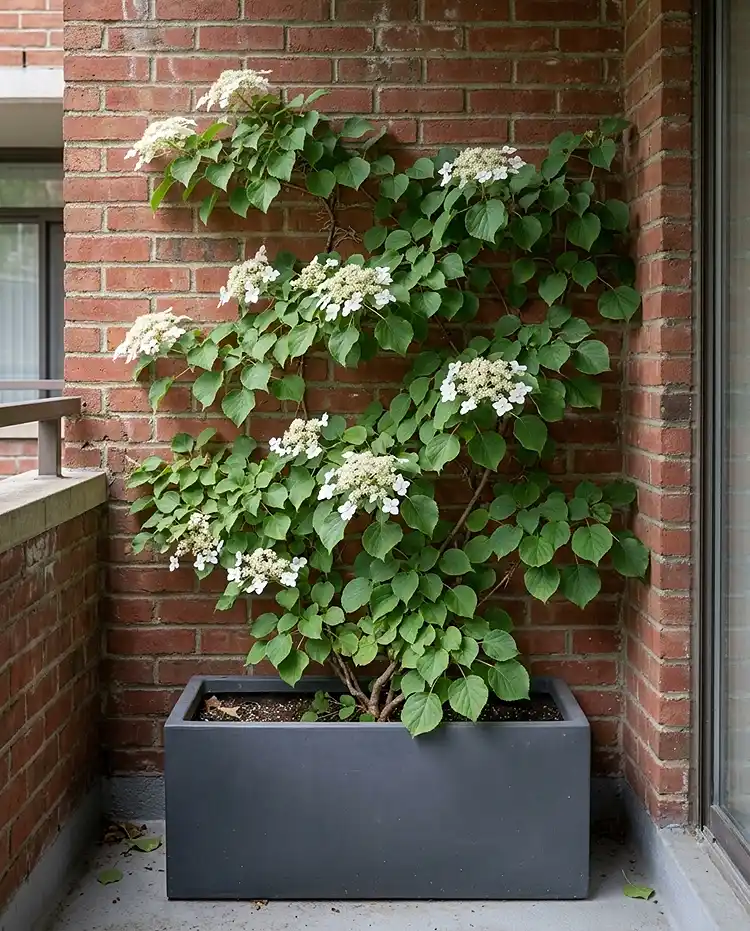
Idea 4: Self-Clinging Climbing Hydrangea Trained Up a Shaded Brick Apartment Wall
Plant climbing hydrangea (Hydrangea anomala subsp. petiolaris) or gold-leaved ‘Miranda’ in a 20-inch-deep wall trough. Growth is slow for two or three years. Aerial roots can mark brick, so check your lease.
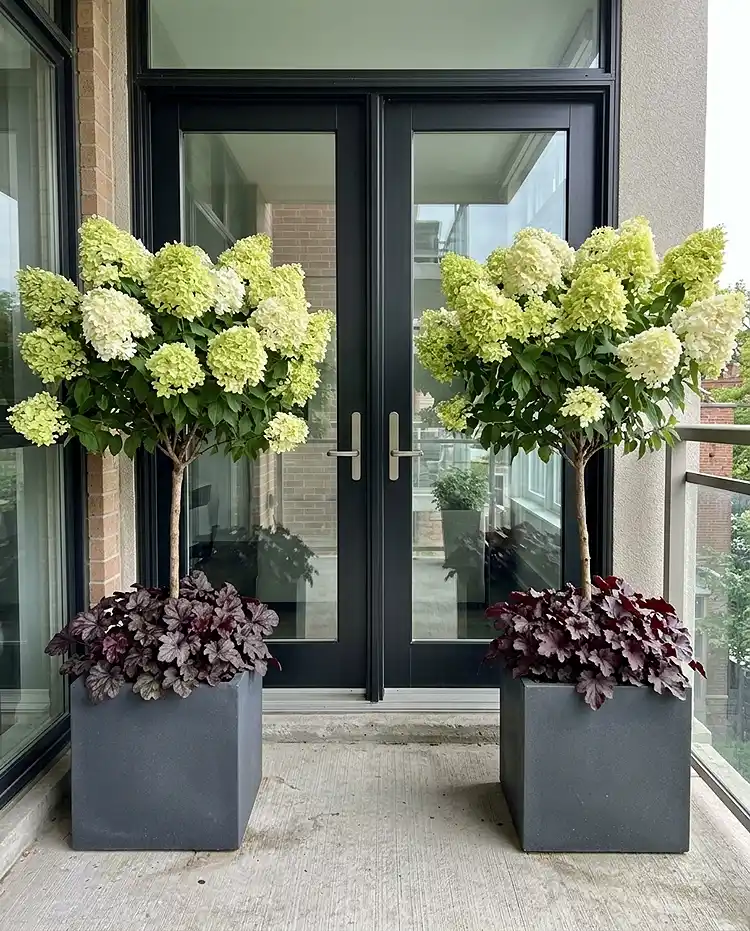
Idea 5: Formal Pair of Lollipop “Patio Tree” Standard ‘Limelight’ Hydrangeas Flanking the Door
Stem-trained ‘Limelight’ trees, about 4 feet tall, lift chartreuse-white flower globes to eye level. Use square charcoal cube planters and leave room for Heuchera underneath.
Idea 6: Compact ‘Little Lime’ and Burgundy Coral Bells (Heuchera) High-Contrast Trough
Pistachio-green ‘Little Lime’ blooms look sharp against deep plum Heuchera ‘Obsidian’. Add golden creeping Jenny along the edge of a rectangular trough, and trim yearly to keep it pot-sized.
Idea 7: Romantic Cottage Half-Barrel with Lacecap ‘Twist-n-Shout’ and Trailing Lobelia
Pink or periwinkle lacecaps on compact ‘Twist-n-Shout’ attract pollinators. Edge a rustic half-barrel with sapphire Lobelia erinus, and drill extra drainage holes. For a cottage look, pair it with a balcony rose garden.
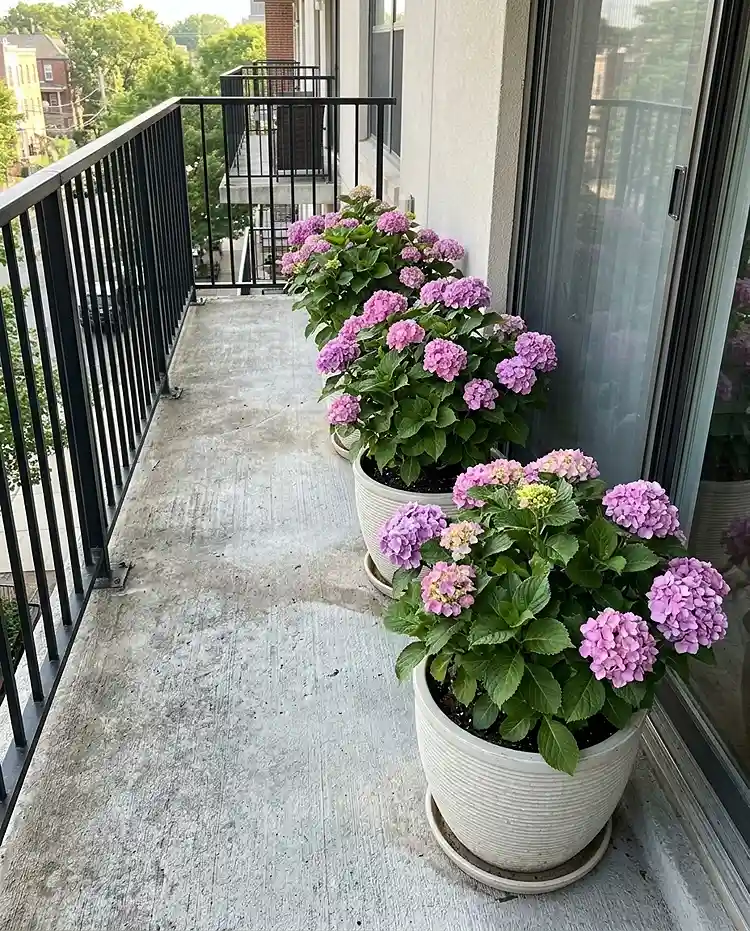
Idea 8: Narrow 3-Foot Balcony Galley Grouping Using 24-Inch Micro-Dwarf ‘Wee Bit Giddy’
A hydrangea on apartment balcony walkways needs to stay slim. ‘Wee Bit Giddy’ and ‘Cityline Paris’ stay near 24 inches in 14-inch pots tucked against the inner wall, leaving room to walk.
Idea 9: Four-Season Texture Pot with Dwarf Oakleaf Hydrangea (‘Pee Wee’ or ‘Ruby Slippers’)
‘Ruby Slippers’ (Hydrangea quercifolia) reaches about 3.5 feet. White summer cones deepen to rose-red, the oak-shaped leaves turn mahogany in autumn, and cinnamon bark peels through winter.
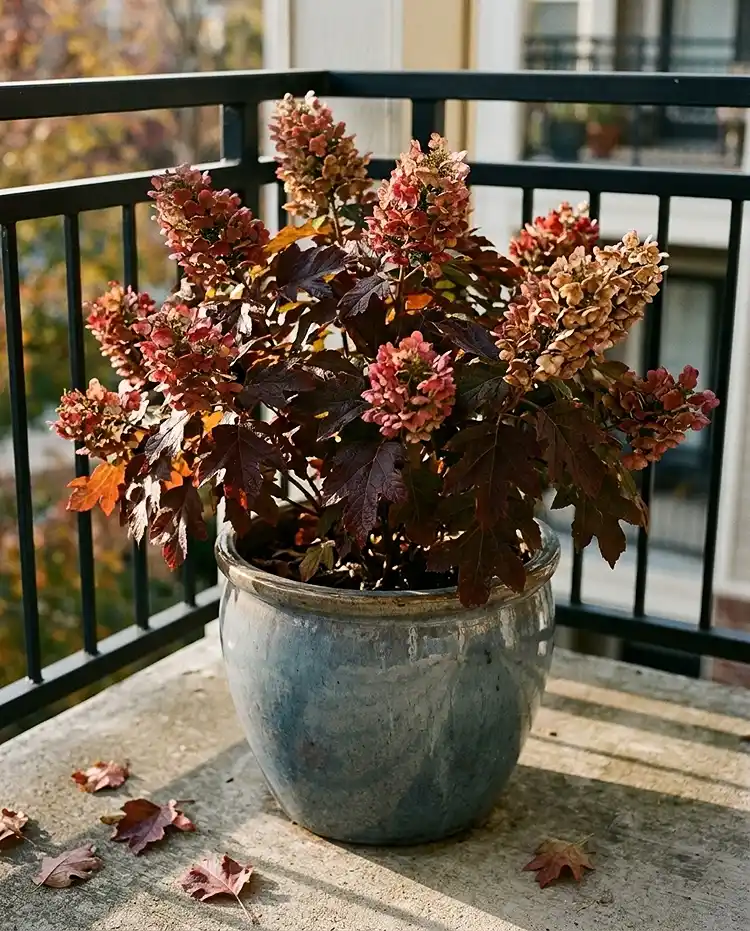
Idea 10: Sub-Irrigated Self-Watering Planter on Casters for Thirsty ‘Incrediball Blush’ Smooth Hydrangeas
A rolling planter with a wicking reservoir ends afternoon wilting on windy decks. Plant native Hydrangea arborescens ‘Incrediball Blush’, or choose smaller ‘Invincibelle Wee White’ for tight spots.
Idea 11: Japanese Zen Shade Sanctuary with Mountain Hydrangea (‘Tuff Stuff’) and Hakonechloa Grass
Ultra-hardy lacecap ‘Tuff Stuff’ (Hydrangea serrata) keeps its buds through chilly winters. Cascading golden Japanese forest grass (Hakonechloa macra ‘Aureola’) adds serene movement beneath it.
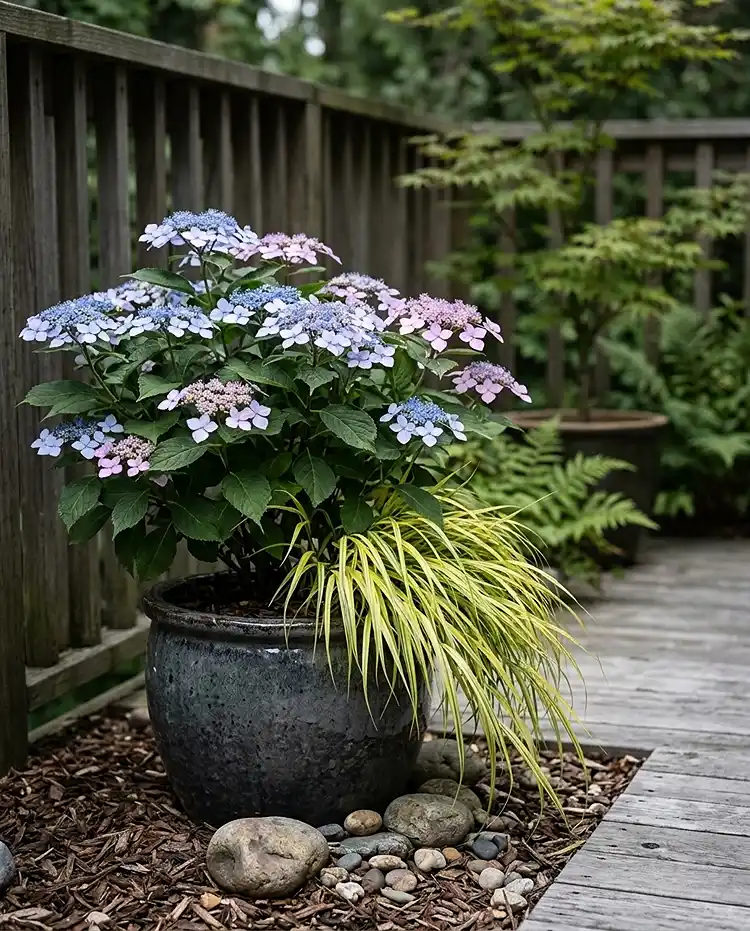
Idea 12: Moody Gothic Planter of Black-Stemmed ‘Zorro’ or ‘Eclipse’ Hydrangea with Silver Lamium
Dark-stemmed ‘Zorro’ or ‘Eclipse’ looks dramatic in a slate-gray pot. Contrast it with silver-variegated deadnettle (Lamium maculatum) trailing over the rim.
Idea 13: Cut-and-Dry Autumn Bouquet Tub with ‘Fire Light Tidbit’ and Ornamental Kale
‘Fire Light Tidbit’ mounds to roughly 2 feet, and its blooms shift from lime to watermelon-red by September. Cut stems once they turn papery and hang them to dry. Tuck ornamental kale around the base.
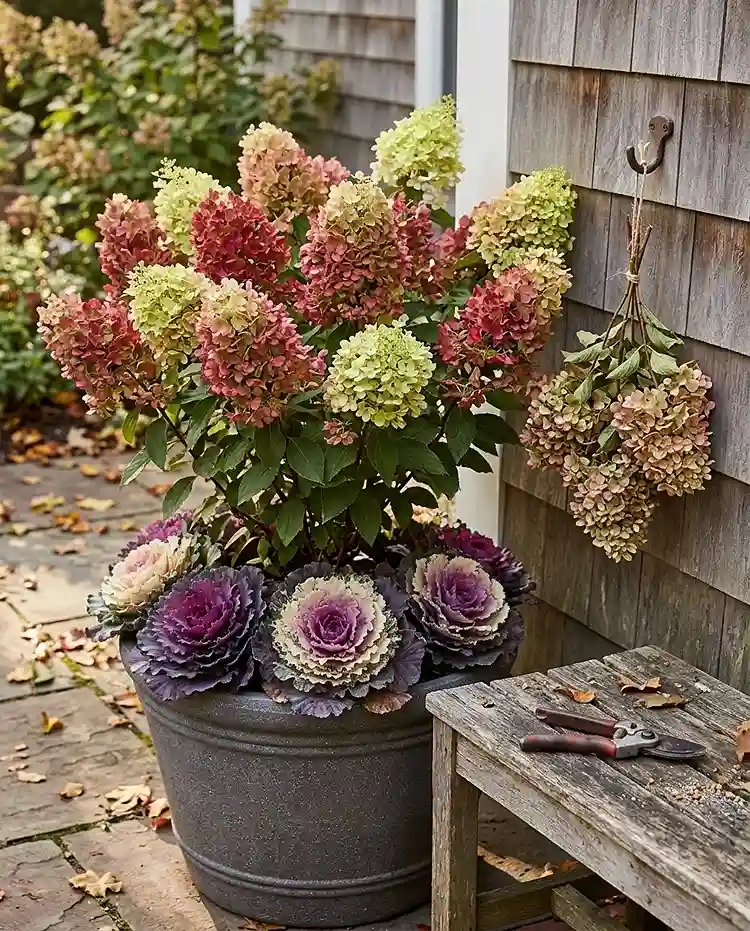
Idea 14: Tiered Corner Grouping: Potted Hydrangea Shaded Behind a Tall Bamboo or Olive Screen
On sunny balconies, line the western railing with a tall trough of clumping bamboo (Fargesia) or feather reed grass. It casts afternoon shade over a mophead pot tucked right behind it.
Mastering Balcony Hydrangea Care: Watering, Pruning Rules, and Overwintering
The number one mistake is pruning off next year’s flower buds. Follow this calendar: water daily in summer, feed in April and June, stop fertilizing by July 31, prune by type, and wrap pots in November.
Deep Morning Watering, Pine-Bark Mulching, and Slow-Release Spring Feeding
Water deeply at the soil line every summer morning until water drains from the bottom. Keep a 2-inch pine bark mulch blanket on top to cool surface roots.
Feed with an organic rose or azalea fertilizer in April and again in June. Stop all feeding by July 31 so stems harden before winter.
Pruning by Type (Mophead vs. Panicle) and Wrapping Pots for Winter Survival in Zones 4-7
Never cut bigleaf or oakleaf stems in fall or spring. Snip only dead wood after leaves emerge in May. Panicle and smooth hydrangeas bloom on new wood, so cut them back by one-third in late winter.
For winter in zones 4 to 7, push pots against the apartment wall and wrap them in burlap over bubble wrap.
Pro Tip: Label every pot “old wood” or “new wood” so you never prune a mophead by mistake.
Common Problems & Solutions
Three issues cause most trouble: leafy plants with no flowers, afternoon wilt, and damaged leaves.
Healthy Green Leaves With Zero Flowers (“Winter Bud Kill” or Wrong Pruning)
In winter 2023, I left an unwrapped ‘Endless Summer’ on my windy east side. It leafed out beautifully in May and gave me zero flowers. The August-formed buds at the stem tips had frozen.
Wrap upper stems in breathable frost fleece over winter. Or switch to new-wood ‘Bobo’ or ‘Little Lime’ panicles.
Dramatic 3:00 PM “Afternoon Wilt” Even When the Potting Soil is Still Wet
Big, thin leaves lose moisture faster than roots can pump it up in hot sun or wind. Don’t flood wet soil, because that causes root rot.
Wheel the pot into afternoon shade, or mist the balcony floor to cool the surrounding air. It usually perks up by evening.
Crispy Brown Leaf Edges, Yellowing Between Green Veins (Iron Chlorosis), and Spider Mites
Alkaline tap water locks out iron, which turns leaves yellow between green veins. Dry wind browns the tips. Flush the pot with plain water, then top-dress with chelated iron and acidic compost.
Rinse leaf undersides weekly to knock off spider mites.
Frequently Asked Questions
Can a potted hydrangea stay outside on my balcony all winter?
Yes. Hydrangeas are deciduous shrubs. They need a cold dormancy of about 35 to 45 F (1.7 to 7.2 C) to set flowers, and a warm living room will kill them. Leave the pot on pot feet against the building wall, wrapped in burlap, and water once a month during thaws.
How big of a pot does a dwarf hydrangea need on a balcony?
Dwarfs like ‘Bobo’, ‘Little Lime’, or ‘Cityline’ need a container 14 to 18 inches wide and 14 to 16 inches deep, roughly 7 to 10 gallons. Smaller pots dry out twice a day in July and can’t insulate roots in January.
Can I change the color of any balcony hydrangea from pink to blue?
No. Only bigleaf (Hydrangea macrophylla) and mountain (H. serrata) types change with soil pH. Acidic soil near pH 5.0 to 5.5 gives blue, while pH 6.5 to 7.0 gives pink. White varieties, panicles, and oakleafs like ‘Bobo’ and ‘Limelight’ ignore soil acidity.
What should I do with a foil-wrapped florist hydrangea to keep it alive on my balcony?
Remove the foil right away, because it traps water and rots roots. Repot into a 14-inch pot with coco coir and bark mix, and set it in morning sun with afternoon shade. Florist types lack cold-hardy genetics, so shelter it in an unheated garage or wrap it heavily for winter.
Which hydrangea is best for a balcony with only a few hours of sun?
Bigleaf, mountain, and climbing hydrangeas do best with 3 to 4 hours of morning light. Panicles bloom sparsely in deep shade, so keep them for balconies with 6 or more hours of direct sun.
Key Takeaways
- Growing hydrangea on balcony space takes three choices: species matched to your light, a 16 to 20 inch non-porous pot, and moisture-holding acidic soil.
- East and north balconies suit mopheads and lacecaps, while south and west balconies suit dwarf panicles like ‘Bobo’.
- Never prune mophead or oakleaf stems in fall or spring. Panicles take a one-third cut in late winter.
- Leave pots outdoors for winter dormancy, wrapped in burlap against the wall.