
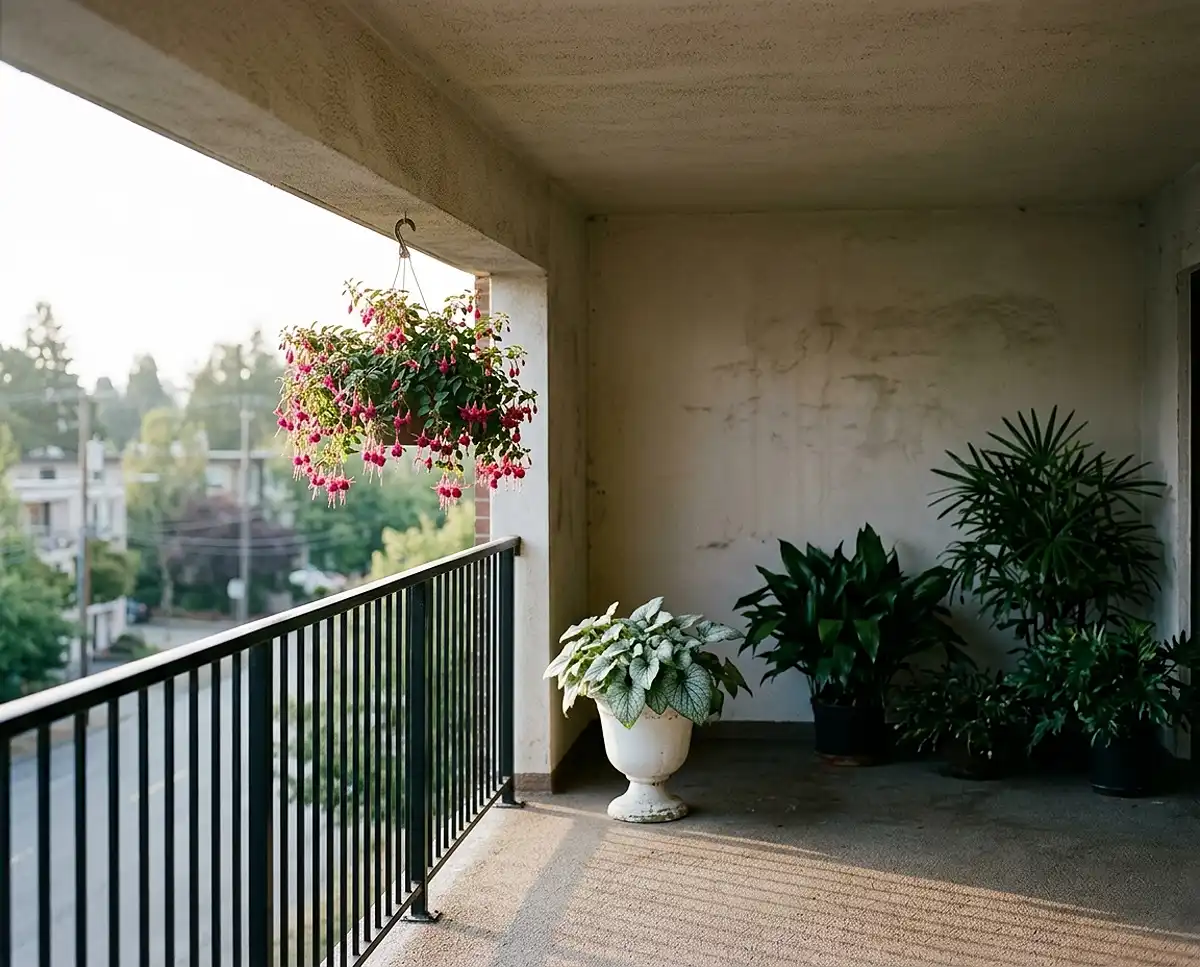
19 Covered Balcony Plants for Limited Rain and Light
Covered balcony plants get shelter, but no rain and only half the sky’s light. These 19 ideas show what thrives, from railing edge to back wall.
I garden on a third-floor, east-facing loggia in zone 7a, under a 5-foot roof overhang. As of the 2026 season I’m eight seasons in, and I’ve killed plenty of plants there.
The layout rule is simple: sun-lovers go at the railing, tough shade plants go in back. For more options by exposure, browse our full guide to balcony plants.
Table of Contents
Understanding the Covered “Loggia” Balcony Microclimate
A roofed or recessed balcony works like a hybrid indoor-outdoor sunroom. The ceiling shields plants from frost, hail, and pelting rain.
The trade-off is real. Overhead light is gone, rain never rinses the leaves, and plants lean toward the open edge. Design around that and a loggia becomes the most forgiving growing space in the building.
Mapping the Bright Railing Edge vs. the Deep Cave Back Wall
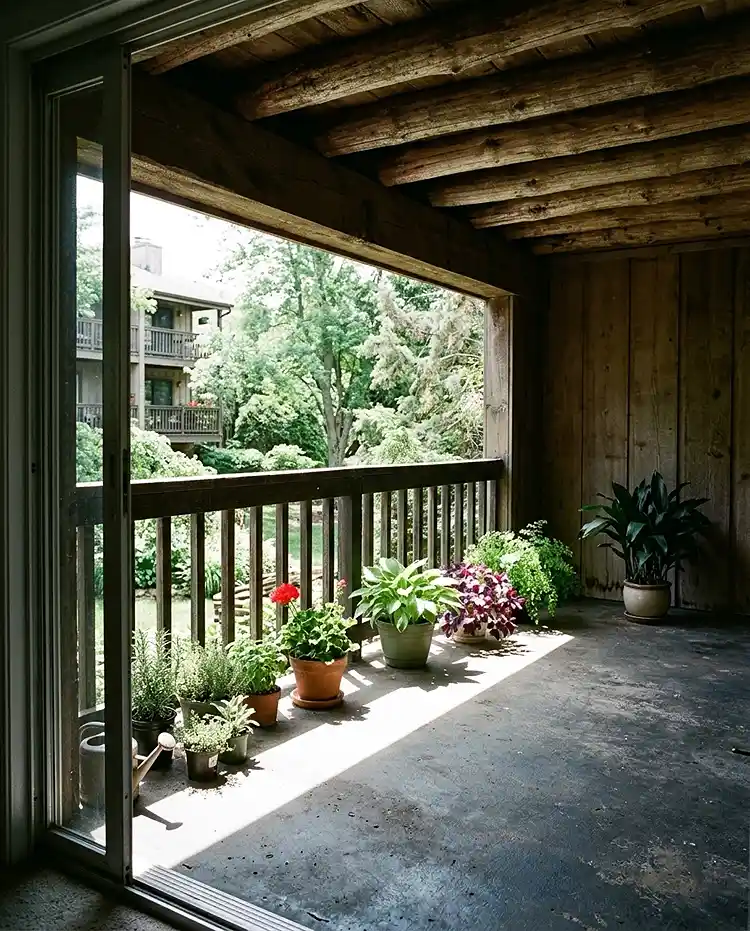
Quick Answer: A solid ceiling blocks high midday sun, so light drops fast from railing to wall. Back-wall light can fall roughly 70% or more versus the open edge. That is my estimate for my loggia, so check yours with a free phone light-meter app.
| Zone | Distance From Railing | Light | Best Plants |
|---|---|---|---|
| Railing lip | 0 to 18 inches | Full sun (south or west exposure) | Tomatoes, succulents |
| Bright edge | 18 inches to 3 feet | Bright, some direct sun | Herbs, geraniums |
| Middle floor | 3 to 5 feet | Bright indirect | Hostas, heuchera, ferns |
| Back wall | 5 feet and beyond | Deep shade | Aspidistra, lady palm |
These bands assume a balcony deeper than 5 feet. On a shallower one, the back-wall zone shrinks or disappears, so scale the bands to your own space.
The bright strip also shrinks with a deeper roof, a south exposure, or high summer sun. Pro Tip: Check shadow lines at 10 AM, noon, and 3 PM on one sunny day before buying a single plant.
Essential Prep: Sub-Irrigated Planters, Reflective Surfaces, and Moisture-Balanced Soil
Nature supplies no water here, so set up the hardware first. Your checklist:
- Self-watering planters with a 1- to 2-gallon reservoir
- Blumat clay-cone drip kits for pots without reservoirs
- White or pale pots, plus an outdoor acrylic mirror, to bounce light
- Wheeled caddies or pot feet for drainage and rotation
- A pump sprayer for foliage rinses
Why Covered Balconies Need 100% Manual Hydration + the “Clean Indoor/Outdoor” Potting Mix
Even a week of storms never wets pots under an overhang, so every drop is yours to supply. Sub-irrigated planters and Blumat cones can cover you for about a week away.
My mix is 40% coco coir, 25% perlite, 20% fine pine bark, and 15% worm castings. It drains fast, resists compacting, and the surface dries clean, which gives fungus gnats less to work with.
19 Covered Balcony Garden Ideas That Thrive With Limited Rain and Light
These ideas run from the bright railing lip back to the shaded corners. Several also work for winter, because the roof buffers frost.
Zones below are USDA hardiness zones for plants left outside year-round, using the current USDA Plant Hardiness Zone Map (updated 2023).
Containers run one to two zones colder than the map, because roots freeze from every side. A roof and wall buy back about one of those zones. So treat plants rated zone 7 as borderline in my zone 7a loggia, and protect them in hard freezes.
Idea 1: Ceiling-Hung Trailing Fuchsia and Begonia Chandeliers Just Inside the Railing
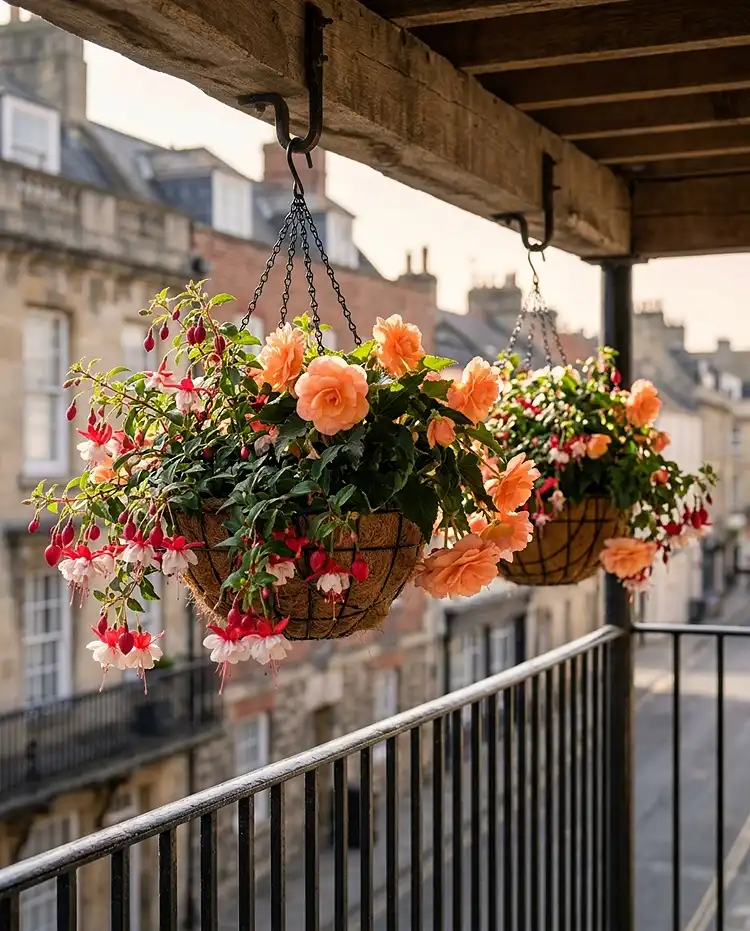
Hang ‘Swingtime’ fuchsias and tuberous begonias about 12 inches inside the railing, back from the roof’s drip line where runoff falls. They catch angled light, and rain can’t bruise the petals.
Screw heavy-duty hooks into structural joists or beams, never plaster, and check your lease first. A wet basket can top 15 pounds. Fuchsias sulk above 80°F, so the roof’s shade helps.
Idea 2: The Indestructible Back-Corner Anchor: Cast Iron Plants (Aspidistra) and Lady Palms

Glossy cast iron plant (Aspidistra elatior) and lady palm (Rhapis excelsa) thrive in the darkest corner with no direct sun. Aspidistra is hardy to zone 7. Lady palm is hardy in zone 9, borderline 8b, so it needs to come indoors in cold climates.
In zone 7, group aspidistra pots against the wall and wrap them in burlap during hard freezes. Both plants grow slowly, so buy the size you want. A pair of 3-gallon pots fills a 90-degree corner nicely.
Idea 3: Light-Bouncing Whitewashed Urns of Silver Brunnera ‘Jack Frost’ and White Astilbe
White fiberglass pots brighten a gloomy floor. Pair silver-veined Brunnera macrophylla ‘Jack Frost’ (zones 3 to 8) with feathery white Astilbe plumes (zones 4 to 8).
Both crave steady moisture, so plant them in sub-irrigated containers. Astilbe dries out fast in a rain-free spot.
Idea 4: Over-the-Rail Cantilevered Saddle Boxes for Sun-Seeking Herbs and Strawberries

Hang outward-facing saddle troughs on the exterior railing. This pushes herbs and alpine strawberries about 8 inches past the roof’s shadow line, into full sky light and rain.
Give each moisture type its own box. Rosemary wants dry, gritty soil. Basil and alpine strawberries want steady moisture, so they share a box with a richer mix.
Use rated brackets with a locking strap, keep each box under 20 pounds, and confirm building rules. A falling box is a serious hazard.
Idea 5: Tropical “Indoor-Outdoor” Summer Lounge With Monstera, Parlour Palms, and Caladiums
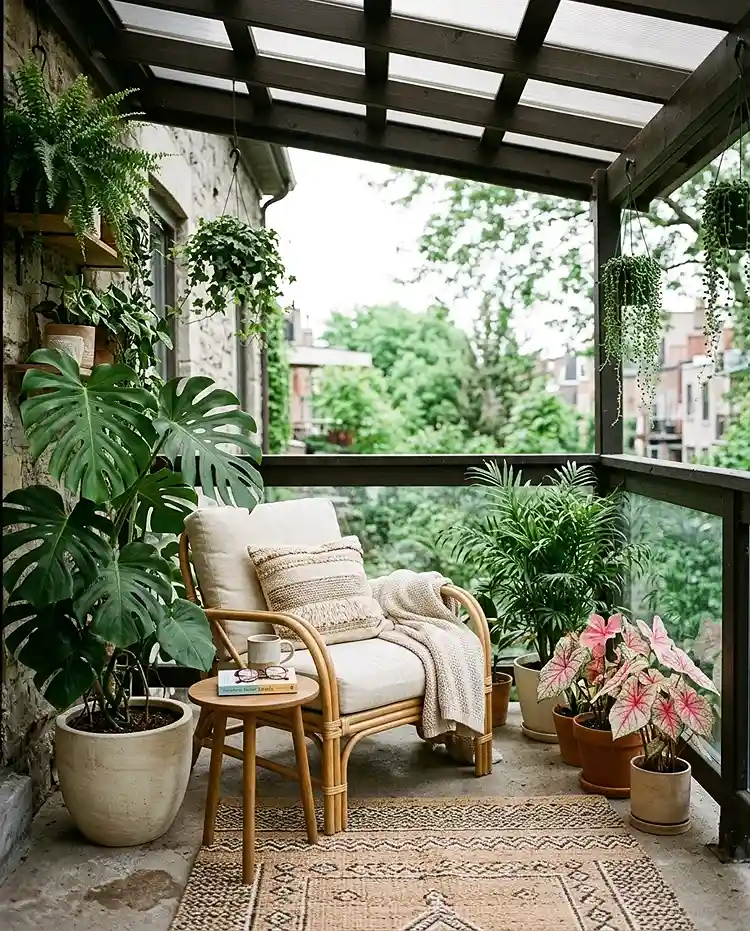
A covered balcony is the best summer home for houseplants. The roof blocks the harshest midday sun. Set out Monstera deliciosa and parlour palms (Chamaedorea elegans) once nights stay above 55°F, and caladiums once nights hold at 60°F.
Harden them off first. Even an east-facing loggia gets direct morning sun at the edge, which can scorch new arrivals. Start plants in back shade, then move them forward over 7 to 10 days.
I learned the temperature rule the hard way. One early May, I moved my Monstera out too soon, and a single 46°F night blackened two leaves.
Idea 6: Outdoor Mirror Trellis Panel Behind Variegated Hostas and Tassel Ferns
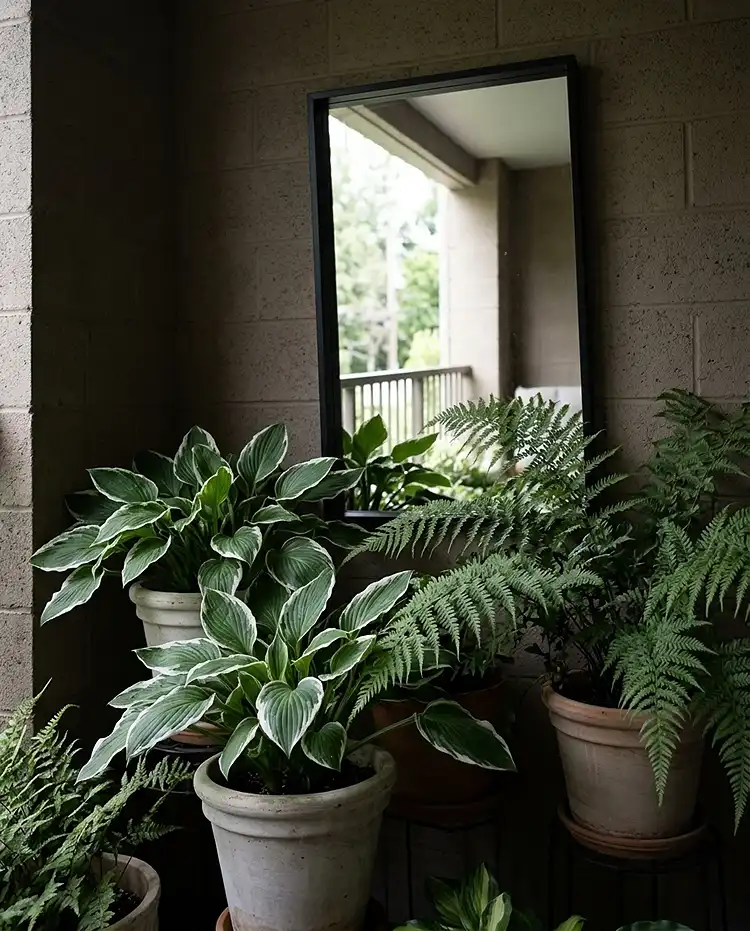
Mount a weatherproof acrylic garden mirror on the dark back wall. Stage white-edged hostas (‘Patriot’) and Japanese tassel ferns (Polystichum polyblepharum, zones 5 to 8) in front. The mirror doubles perceived depth and bounces railing light backward.
Tilt it slightly and plant in front of it so birds see an obstacle. For more shade picks, see our north-facing balcony plants.
Idea 7: Rain-Free Succulent and Cactus Display Along a Sunny South or West Railing Ledge
The dry overhang suits rot-prone Echeveria rosettes, String of Pearls (Curio rowleyanus), and Agave. They want 4 or more hours of direct sun, so keep them on the open ledge of a south- or west-facing balcony.
Echeveria is hardy only to zone 9, so bring it inside before frost. More sun-lovers are in our west-facing balcony plants guide.
Idea 8: Fragrant Shade-Loving Sweet Box (Sarcococca) and Star Jasmine Entryway Grouping
Position Sarcococca confusa (zone 7) and star jasmine (Trachelospermum jasminoides, zones 8 to 10) beside the sliding door. The ceiling traps their scent: sweet box perfumes January, jasmine perfumes June.
In zone 7, move the sweet box against the wall and wrap its pot in hard freezes. North of zone 8, wheel the jasmine indoors for winter.
Idea 9: Stepped Ladder Stand Angled Toward the Open Railing for Asian Salad Greens

Face a 3-tier cedar stand toward the railing opening. About 3 hours of angled morning sun is enough for baby bok choy, tatsoi, mizuna, and loose-leaf oakleaf lettuce.
Sow a new row every 2 weeks, and put the thirstiest greens on the top shelf, which dries fastest.
Idea 10: Self-Clinging Climbing Hydrangea or Variegated English Ivy on the Side Party Wall
Train climbing hydrangea (Hydrangea anomala subsp. petiolaris, zones 4 to 8) or gold-edged English ivy (Hedera helix) up the concrete divider wall. Cold masonry turns lush and green.
Both cling with aerial rootlets that can mark or damage masonry, so renters should check the lease before planting against a party wall. A freestanding trellis is a safer option.
Hydrangea takes 3 to 5 years to get going, so start with a 5-gallon plant. Ivy is invasive in parts of the US, so keep it potted and trimmed.
Idea 11: Jewel-Toned Foliage Trough of Burgundy Heuchera, Coleus, and Golden Creeping Jenny
Get nonstop color without direct sun. Layer plum Heuchera, chartreuse coleus (‘Wasabi’), and trailing golden creeping Jenny (Lysimachia nummularia ‘Aurea’) in a 24-inch mid-floor trough.
Pinch coleus tips every 2 weeks to keep it bushy.
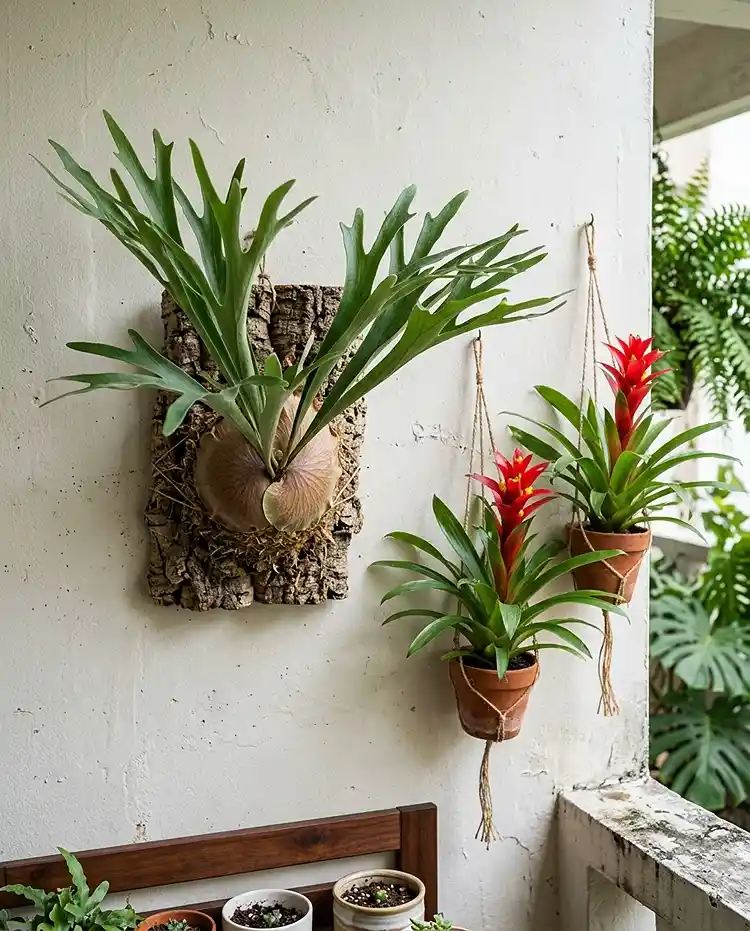
Idea 12: Cork-Mounted Staghorn Ferns and Bromeliads Hung on the Sheltered Back Wall
The wind- and rain-protected back wall suits epiphytes [plants that grow on bark, not in soil]. Mount a staghorn fern (Platycerium bifurcatum) on cork and hang Guzmania bromeliads nearby.
Soak the staghorn weekly in summer, and water bromeliads in their central cup. Bring both inside below 50°F.
Idea 13: The Low-Blight Covered Tomato and Chili Pepper Railing Station
A roof keeps rain off leaves, which cuts fungal problems like early blight. It doesn’t erase them, since spores still drift in. Tomatoes need 6 to 8 hours of direct sun, so this only works on a south- or west-facing railing lip.
Try dwarf ‘Tiny Tim’ cherry tomatoes (about 15 inches tall) and hot peppers in 5-gallon pots. My east-facing loggia gave one ‘Tiny Tim’ just 12 fruits in a full season. See our full-sun balcony plants for better exposures.
Idea 14: Japanese Zen Alcove With Fatsia Japonica, Golden Hakonechloa Grass, and Moss
Pair bold, palmate Fatsia japonica (or variegated ‘Spider’s Web’, zones 7 to 10) with golden Japanese forest grass (Hakonechloa macra ‘Aureola’, zones 5 to 9). The gold glows in dim light.
In zone 7, tuck the Fatsia against the wall and wrap its pot in hard freezes. Top the pots with pebbles and sheet moss for the finishing touch.
Idea 15: Rain-Free Zonal and Ivy Geranium Window Boxes on the Railing Lip
Rain mashes geranium blooms and invites botrytis [gray mold]. Under a roof, zonal (Pelargonium x hortorum) and ivy geraniums (Pelargonium peltatum) keep their flower umbels clean far longer.
Give them 4 or more hours of sun, and deadhead [remove spent flowers] weekly.
Idea 16: Low-Light Culinary Herb Cart on Casters (Mint, Flat-Leaf Parsley, Chives, and Cilantro)
Build a wheeled 2-tier cart of shade-tolerant herbs. Roll it to the railing on bright days, and tuck it beside the door when frost or strong wind is forecast.
Keep mint in its own pot, since it spreads. Cilantro bolts [flowers early] in heat, and partial shade slows that down.
Idea 17: Winter-Blooming Camellia (‘Yuletide’) and Hellebores in the Sheltered Thermal Pocket
Camellia sasanqua ‘Yuletide’ (zones 7 to 9) blooms red from October into December. Lenten roses (Helleborus x hybridus, zones 4 to 9) follow in late winter.
A roof can hold a few degrees of warmth against open sky, which helps protect the buds. In zone 7, move the camellia against the wall and wrap its pot in burlap.
Idea 18: Under-Shelf Waterproof LED Grow-Light Bar for a Dark Back-Wall Herb and Fern Rack
Clip a warm-white (3000K) full-spectrum IP65 LED strip under a back-wall shelf. Run it 12 to 14 hours daily on a timer. Basil grows well under it.
For ferns, choose hardy northern maidenhair (Adiantum pedatum, zones 3 to 8). Tropical maidenhairs aren’t outdoor-hardy. Even the hardy type wants constant moisture, so keep its tray wet.
Idea 19: Floor-to-Ceiling Tension Pole Tower of Pothos, Heartleaf Philodendron, and Spider Plants
Wedge a no-drill spring tension pole between floor and ceiling. Stack six cascading pots of pothos, heartleaf philodendron, and spider plants where angled light enters.
Stay under the pole’s weight rating, and bring all three indoors below 50°F.
Caring for Covered Balcony Plants: Leaf Washing, Rotation, and Watering
A ceiling blocks rain and forces plants to lean outward. Three habits fix that: rinse the leaves, rotate the pots, and water by touch rather than by calendar.
The Every-Two-Weeks “Rain-Replacement” Foliage Shower (Stopping Dust and Spider Mites)
Urban soot and pollen settle on leaves with no rain to wash them off. Dust dims the light each leaf receives and favors mites. Rinse foliage every two weeks at 7:00 AM with a pump sprayer so leaves dry by midday.
The 90-Degree Weekly Pot Rotation Rule and Winter Dry-Soil Checks
Light comes from one side, so give each pot a quarter-turn every Sunday. Skip it and stems lean toward the street.
In winter, push a finger 2 inches into the soil. Snow and rain never reach covered pots, so evergreens like camellia and fatsia still need water.
Common Problems & Solutions
Three problems hit roofed and recessed balconies harder than open ones.
Severe Two-Spotted Spider Mite Outbreaks in Dry, Rain-Sheltered Corners
Spider mites love dry, dusty air. In my first August, 2019, they stippled my parlour palm bronze in two weeks.
The UC IPM spider mite guide says damage is usually worst in hot, dusty conditions and on water-stressed plants. It lists water sprays, insecticidal soaps, and oils as the recommended tools.
Soap and oil must touch the mites to work, so cover leaf undersides and expect repeat applications. Rinse undersides weekly, keep plants well watered, spray soap at dusk, and use gravel water trays for a modest humidity boost.
Extreme Phototropism (Plants Stretching Sideways and Going Bare on the Back Side)
Plants under deep overhangs crane toward the railing opening. Stage pots on wheeled caddies or swivel turntables for effortless weekly rotation.
Hang a white sheet or mirror on the back wall to bounce light onto the bare side.
White Salt Crusts Building Up Because Rain Never Flushes the Potting Soil
Without storms to leach containers, minerals from tap water and synthetic fertilizer pile up as white crusts that burn roots.
Twice a year, set pots in the bathtub and run clean water through for about 3 minutes. Switch to worm castings for feeding.
Frequently Asked Questions
Why are my covered balcony pots bone-dry right after a huge rainstorm?
A standard 4- to 6-foot ceiling overhang creates a rain shadow over the inner two-thirds of a balcony. Dense plant canopies also shed stray drops away from the pot rim. Only wind-driven rain at about 45 degrees reaches the pots.
Does a south-facing covered balcony still count as full sun?
Only along the outer 12 to 18 inches of the railing. In midsummer the sun sits high, so the roof shades the interior floor during peak hours. That turns the back half into a bright-indirect or partial-shade zone.
What are the best flowering plants for a dark covered balcony with almost no direct sun?
Choose shade bloomers that flower on ambient sky light: impatiens (standard and New Guinea), tuberous and fibrous begonias, trailing fuchsias, torenia, astilbe, and hellebores. Peace lilies also bloom in warm summer months.
Can I put my indoor houseplants outside on a covered balcony for the summer?
Yes, once nights stay above 55°F (12.8°C). Monstera, pothos, fiddle leaf figs, snake plants, and orchids all summer well under a roof. Harden them off first: start in back shade and move forward over 7 to 10 days, because edge sun can scorch new arrivals.
How often should I water covered balcony plants?
Check the soil 2 inches deep every 2 to 3 days in summer and weekly in winter. Water most foliage plants when the top inch is dry. Self-watering planters stretch that to about a week.
Key Takeaways
- Covered balcony plants need hand watering, because roofs create a rain shadow over most of the floor.
- Map your light first: bright edge for sun-lovers, deep shade for cast iron plant and lady palm.
- Rinse leaves every 2 weeks, rotate pots weekly, and flush salts from soil twice a year.
- Bounce light with white pots and an outdoor mirror before reaching for a grow light.
- Pots run one to two zones colder than the USDA map, and a roof buys back about one, so protect zone-7 plants in zone 7.