
17 Rainy Balcony Garden Ideas
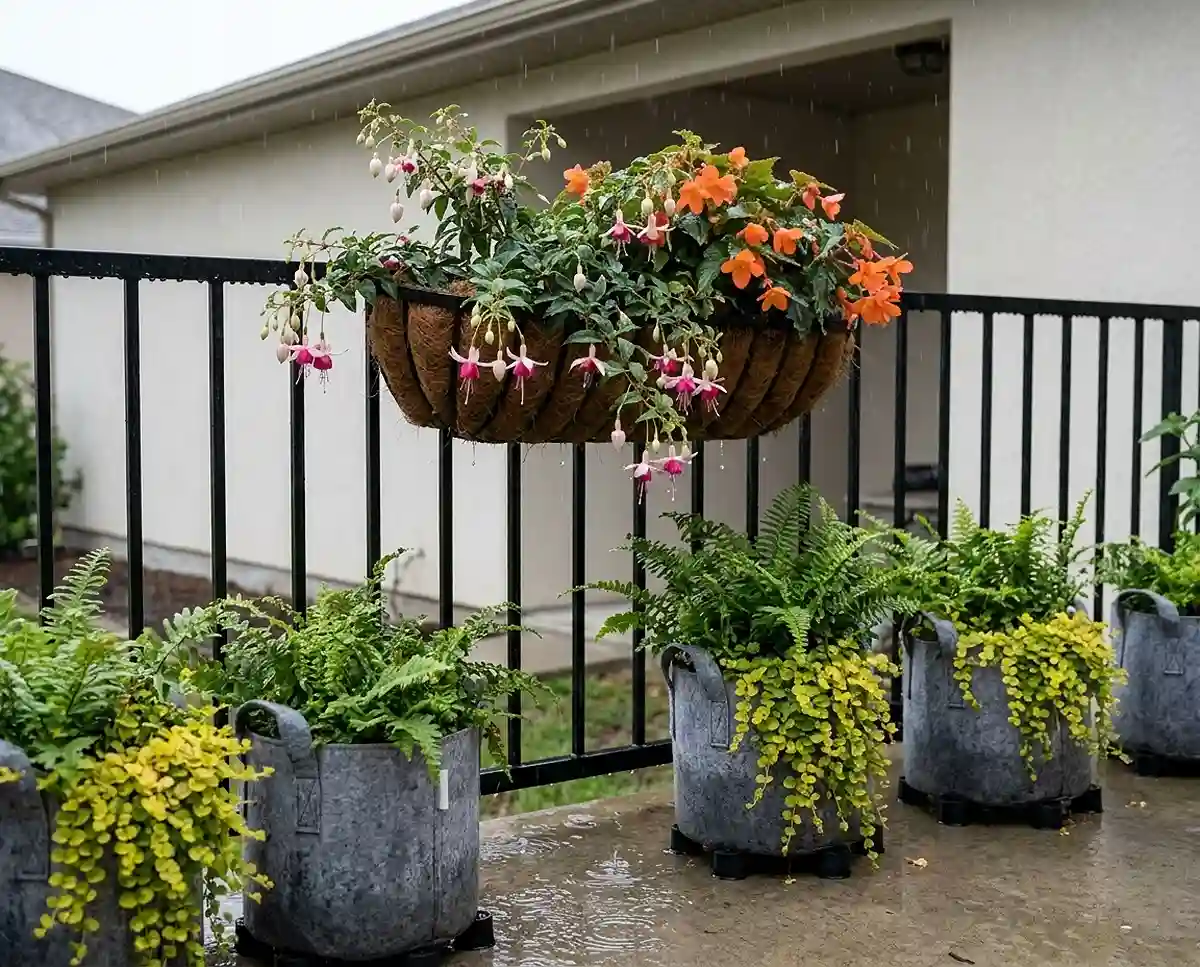
Fabric bags and ½-inch pot feet saved my rainy balcony garden. Ferns and fuchsias thrived through a wet season; glazed pots with saucers didn’t.
My test setup: 12 containers on a south-facing concrete patio in zone 8b, March 2025 to May 2026. That covered one full wet season (autumn 2025 to spring 2026) plus the spring and summer before it. Six containers sat under a 3-foot overhang. Six took full rain.
A patio is not a balcony, but rain, runoff and pot drying behave the same at pot level, so the results carry over. Wind and weight limits differ on a balcony, which is why the rail zone and weight sections below matter.
I did not test all 17 ideas in those 12 containers. Each idea below is labeled: tested, from experience, or worth trying.
Table of Contents
Reading a Rainy Balcony’s Microclimate
Verdict: Split the balcony into a drenched rail zone and a dry wall zone, then plant by zone. Saturated mix weighs roughly double dry mix, so heavy tubs go against the wall.
Mapping the Drenched Railing Edge in a Rainy Balcony Garden
Watch the next storm. The outer 2 feet along the rail takes blowing rain. The strip against the wall is the rain shadow [the dry pocket under an overhang]. Rail plants also need wind tolerance, so see these wind-resistant balcony plants.

Saturated Weight, Scuppers, and Runoff Rules
Dry potting mix runs 15–30 lb per cubic foot. Saturated, it hits 40–60. Most balconies are rated for 40–60 lb per square foot, so check yours.
Keep the scupper [the floor drain opening] clear of leaves. Backed-up water drips onto neighbors. This guide on balcony planters leaking downstairs covers the rest.
Rain-Proof Prep: Breathable Pots, Feet, and Gritty Mix
Verdict: Use breathable containers on ½-inch rubber pot feet, with no water-trapping saucer. My felt bags dried far faster than glazed pots.
| 5-gallon container | Days to dry after 1 inch of rain | Verdict |
|---|---|---|
| Felt grow bag | 2 | Best all-rounder |
| Unglazed terracotta | 3 | Good, but heavy |
| Plastic | 5 | Add extra holes |
| Glazed ceramic with saucer | 6+ | Skip it |
Fabric Bags, Terracotta, and Pot Feet
Felt walls and clay wick water outward [pull it through the wall]. Every pot gets ½-inch feet.
Mistake to avoid: a glazed pot in a saucer. My ‘Hidcote’ lavender died in six weeks in October 2025, roots brown and mushy. The fix is feet, no saucer, and three extra drainage holes.
The Never-Soggy Mix: 40% Bark Fines, 30% Perlite, 30% Coir
- 40% aged pine bark fines for chunky structure
- 30% coarse perlite or pumice for air
- 30% peat-free coco coir for moisture balance
- No vermiculite or dense compost. Both turn anaerobic [airless and swampy].
My blend read about pH 6.0.

The 17 Ideas for Handling Excess Water
Verdict: Pick two or three ideas, not seventeen. Put bog lovers on the rail and dry lovers on the wall. For more picks, see the balcony plants guide.
Labels: “Tested” means it grew in my 12 containers. “From experience” means I know the plants well but did not test this exact setup. “Worth trying” means I have not tested it.
Idea 1: Sword Fern, Heuchera, and Creeping Jenny Trough
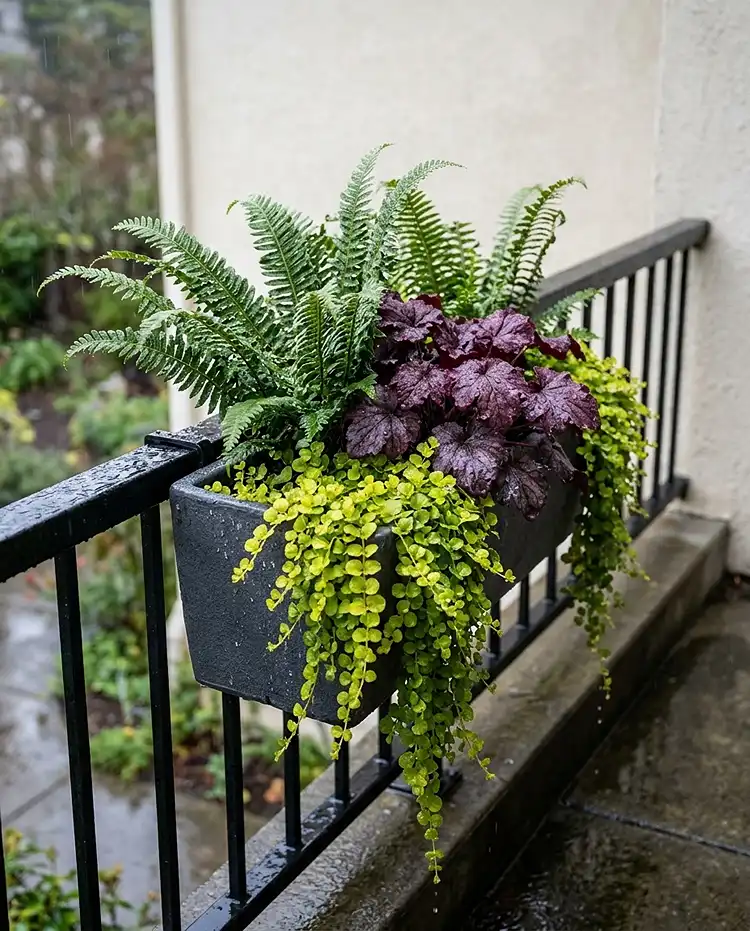
From experience. Pair Polystichum munitum (western sword fern), Heuchera ‘Plum Pudding’, and golden Lysimachia nummularia ‘Aurea’ in one 24-inch trough. All three like steady moisture. Put it on the rail.
Idea 2: Fatsia “Rain Umbrella” Over Cyclamen and Lamium
From experience. Plant Fatsia japonica in an 18-inch tub. Its wide leaves turn aside light rain. A hard downpour still gets through.
Tuck cyclamen and Lamium underneath, or a small fern. Thyme needs sun and dry soil, so it sulks in a Fatsia’s shade.
Idea 3: Bog Bowl With Horsetail and Dwarf Papyrus
Worth trying. Set Equisetum hyemale or Cyperus prolifer in a holeless glazed bowl with 2 inches of rainwater. Bog plants are the one exception to my no-glazed-pots rule, because they want standing water.
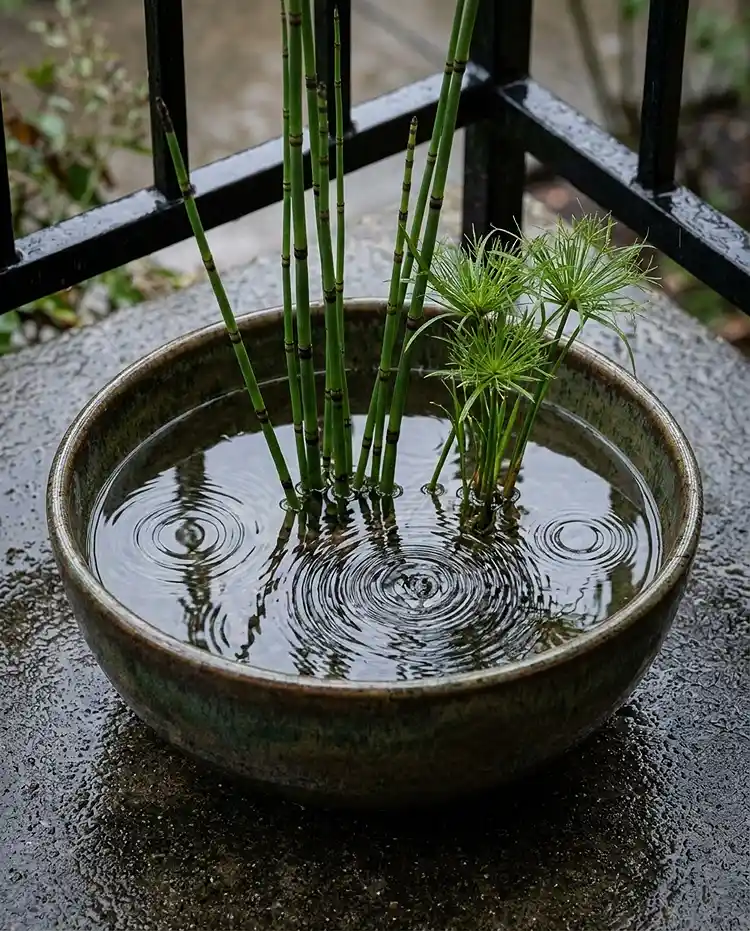
Change the water every 4 to 5 days, since mosquitoes can go from egg to adult in about a week. Or add a Bti mosquito dunk [a bacterial larvicide]. Dwarf papyrus is tender below zone 9, so bring it inside for winter.
Horsetail spreads hard. Keep it in its pot and never let it touch ground soil.
Idea 4: Hakonechloa and Astilbe in Felt Bags
Tested. Combine Hakonechloa macra ‘Aureola’ and Astilbe in 7-gallon felt bags. Water drains out every side without washing soil away. The mix stayed damp but never swampy through April 2026.
Idea 5: Camellia ‘Yuletide’ and Wintergreen Corner
From experience. Glossy camellia leaves shed rain. ‘Yuletide’ is a sasanqua (Camellia sasanqua, zones 7–10) that blooms in winter. In the ground it hits 6–10 feet, so use a 20-inch pot and prune.
Underplant with wintergreen (Gaultheria procumbens), a low evergreen that likes the same acidic, moist conditions. Check these cold-hardy balcony plants if frost is a worry.
Idea 6: Fuchsia and Begonia Hayracks Over the Rail
Tested. Trailing ‘Swingtime’ fuchsia and Begonia boliviensis hang their flowers downward, so rain rolls off. My coco-lined hayrack kept blooming through three straight rain days in April 2026, with no botrytis [gray mold].

Idea 7: Gutter Wall That Feeds a Fern Tub
Worth trying. Mount three vinyl gutters on the wall. Plant watercress in the top gutter and water forget-me-not (Myosotis scorpioides) in the lower two. Both want constant moisture.
Leave mint out. It spreads and does not need constant water, so it gets its own pot in Idea 15.
Drill an end hole in each gutter about an inch above the floor, so a little water stays behind for the watercress. Overflow drops to the next tier. The bottom tier empties into a fern tub.
Idea 8: Rain-Shadow Shelf for Rosemary and Lavender
From experience. Stand a narrow cedar ladder shelf flat against the dry wall. Put rosemary ‘Tuscan Blue’, lavender ‘Hidcote’, and sedum on it. Mediterranean herbs live here only if no rain reaches them.
Idea 9: Moss-Topped Hinoki Bowl
Worth trying. Carpet a shallow bowl with sheet moss (Hypnum) around a dwarf hinoki cypress and black mondo grass. The moss absorbs raindrop impact and stops mud splash. Hinoki hates wet feet, so raise the bowl.
Idea 10: Polycarbonate Rain Roof Over a Salad Box
Worth trying. Prop a clear twin-wall polycarbonate lid 8 inches above a salad trough. It blocks splash that spreads leaf disease and still passes most cloudy-day light. Leave both ends open for airflow.

Idea 11: Carex and Hosta Floor Grouping
Tested. Group Carex oshimensis ‘Evergold’ with Hosta ‘Halcyon’ in raised fiberglass pots. Thick blue leaves resist slugs but don’t stop them. Slugs chewed my ‘Halcyon’ to lace by June 2025.
Idea 12: Felt Pocket Wall Above a Pebble Trough
Worth trying. Hang a waterproof-backed felt pocket planter of ferns above a river-stone catch trough. Runoff drips into the stones, not onto the floor. Pothos and philodendron suit summer only. Bring them in below 50°F.
Idea 13: Colocasia and Canna Monsoon Oasis
From experience. In warm, wet zones (8–11), pair Colocasia esculenta ‘Black Magic’ with dwarf cannas in 15-gallon tubs. Big leaves pull water fast, so these pots dry sooner than most.
Colocasia is a heavy drinker, so the faster drying is a plus here. Mulch the crowns in zone 8b winters.
Idea 14: Deck Tiles Over a Drainage Channel
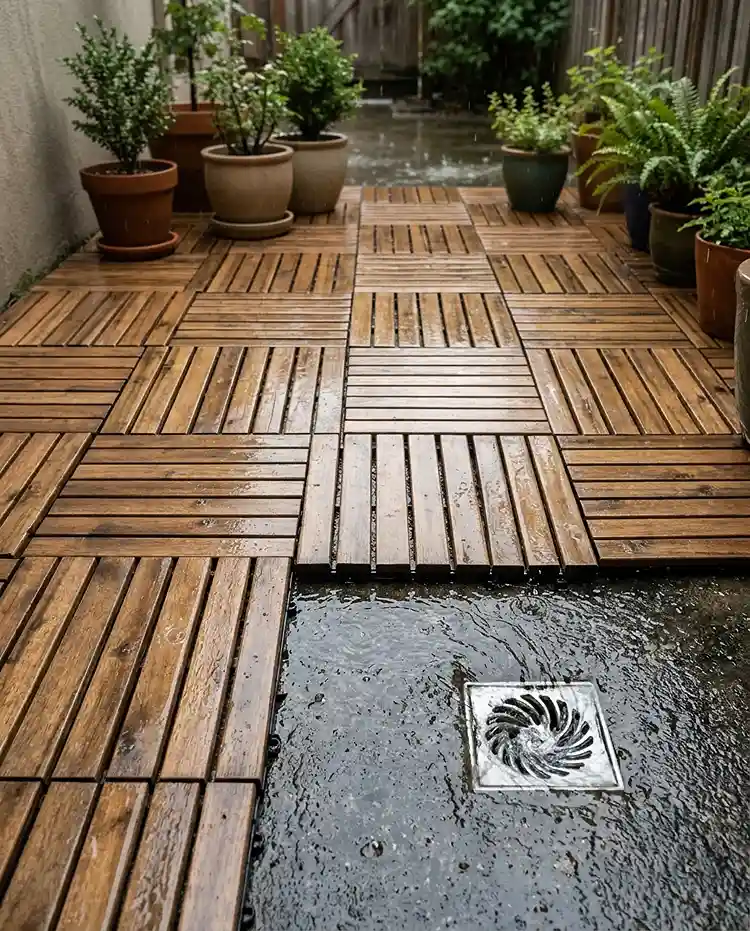
Worth trying. Lay slatted interlocking tiles on the concrete. They lift pots and shoes ¾ inch above sheet-flowing water. Leave a 6-inch gap around the scupper so the tiles never block it.
Idea 15: Wet-Weather Kitchen Box
From experience. Fill a 30-inch trough with watercress, chives, and French sorrel. Sink mint in its own pot inside the box, since it spreads. All of these tolerate wet soil through autumn drizzle.
Idea 16: Pieris and Skimmia Acid Urn
From experience. Rainwater runs near pH 5.6. That suits ericaceous [acid-loving] shrubs like Pieris japonica ‘Cavatine’ and Skimmia japonica. Use an ericaceous mix, not the bark blend above, and skip hard tap water.
Idea 17: Rain Chain and Gravel Splash Pot
Worth trying. Where a dripping overhang corner bangs on your floor, set a wide gravel-topped pot beneath it. Plant Iris versicolor or Juncus effusus ‘Spiralis’. Add a copper rain chain if your building allows it.

Wet-Season Care: Saucers, Feeding, and Airflow
Verdict: Flip saucers, feed with slow-release organics, and thin dense stems. Liquid feed just flushes out of a soaked pot.
Flip the Saucer and Feed Slow
- Do: flip saucers upside down, or drill an overflow hole 1 inch up the lip.
- Do: scratch 4-4-4 organic granules or worm castings into the top inch.
- Skip: liquid feed on soaked soil.
- Skip: deep saucers with no risers.
Prune for Airflow and Top-Dress With Grit
Thin 20% of the inner stems so leaves dry between showers. Then add a 1-inch layer of coarse horticultural grit or slate chips. It stops heavy drops from blasting mud onto leaves and walls. It is for splash, not slugs.
Common Problems and Fixes
Verdict: Most rain damage is rot, mold, or slugs. All three start with water that can’t leave. Fix drainage first.
Root Rot From Flooded Saucers
Pythium [a water mold that rots roots] moves in when roots sit in water for days. Yellow lower leaves come first. Siphon saucers with a turkey baster. Raise pots on feet inside the saucer. Poke dowel holes 6 inches deep.
Botrytis (Gray Mold) on Soaked Blooms
Gray fuzz on wet petals is botrytis. My ‘Wave’ petunias were covered within nine days of a wet October 2025. Snap off soggy blooms fast, space pots 6 inches apart, and move bloomers under the overhang.
Slugs, Snails, and Algae on Damp Pots
Copper tape let me down. In an older RHS slug and snail trial, copper tape, grit, eggshells, wool pellets and bark showed no measurable difference in lettuce damage versus no protection. That is one trial, and the researcher planned a repeat.
The RHS also advises against slug pellets, even organic ones, because of the risk to wildlife. Start with hand-picking at dusk and beer traps sunk into the soil. I keep iron phosphate bait as a last resort.
Clear hiding spots under pots. Scrub algae off with oxygen bleach.
People Also Ask
How do I fertilize balcony plants when the soil is already soaking wet?
Skip liquid feed. It flushes straight out the bottom. Scratch 4-4-4 organic granules or worm castings into the top inch, and the next rain releases them slowly. I fed every six weeks through the wet season.
Should I take saucers off my balcony pots when it rains for days?
Usually, yes. Use ½-inch feet instead, so roots never sit in water. But pots without saucers send runoff across the floor toward the scupper, so keep it clear of leaves and check what sits below you. If a neighbor does, keep shallow saucers on 1-inch risers inside and empty them within 24 hours.
What balcony plants survive heavy rain without turning to mush?
Waxy, small-petaled, or nodding flowers shed water. Trailing fuchsias, Bolivian begonias, and Astilbe held up for me. Skip large trumpet petunias, which molded in nine days.
How do I dry out a waterlogged balcony pot?
Move it under the overhang and tilt it so the drain hole angles down. Poke five deep holes with a chopstick. Wick the hole with folded paper towel. My 5-gallon felt bag recovered in about two days.
How heavy is a waterlogged balcony pot?
A 10-gallon pot holds about 1.3 cubic feet of mix. Saturated, that’s roughly 50–80 lb of soil before the pot itself. Keep it against the wall.
The Short Version
- Breathable bags or terracotta on ½-inch feet beat glazed pots in every rainy balcony garden I ran.
- Zone it: ferns and bog plants on the rail, Mediterranean herbs on the dry wall.
- Mix 40% bark, 30% perlite, 30% coir, and feed with slow granules.
- Keep heavy tubs by the wall and the scupper clear.