
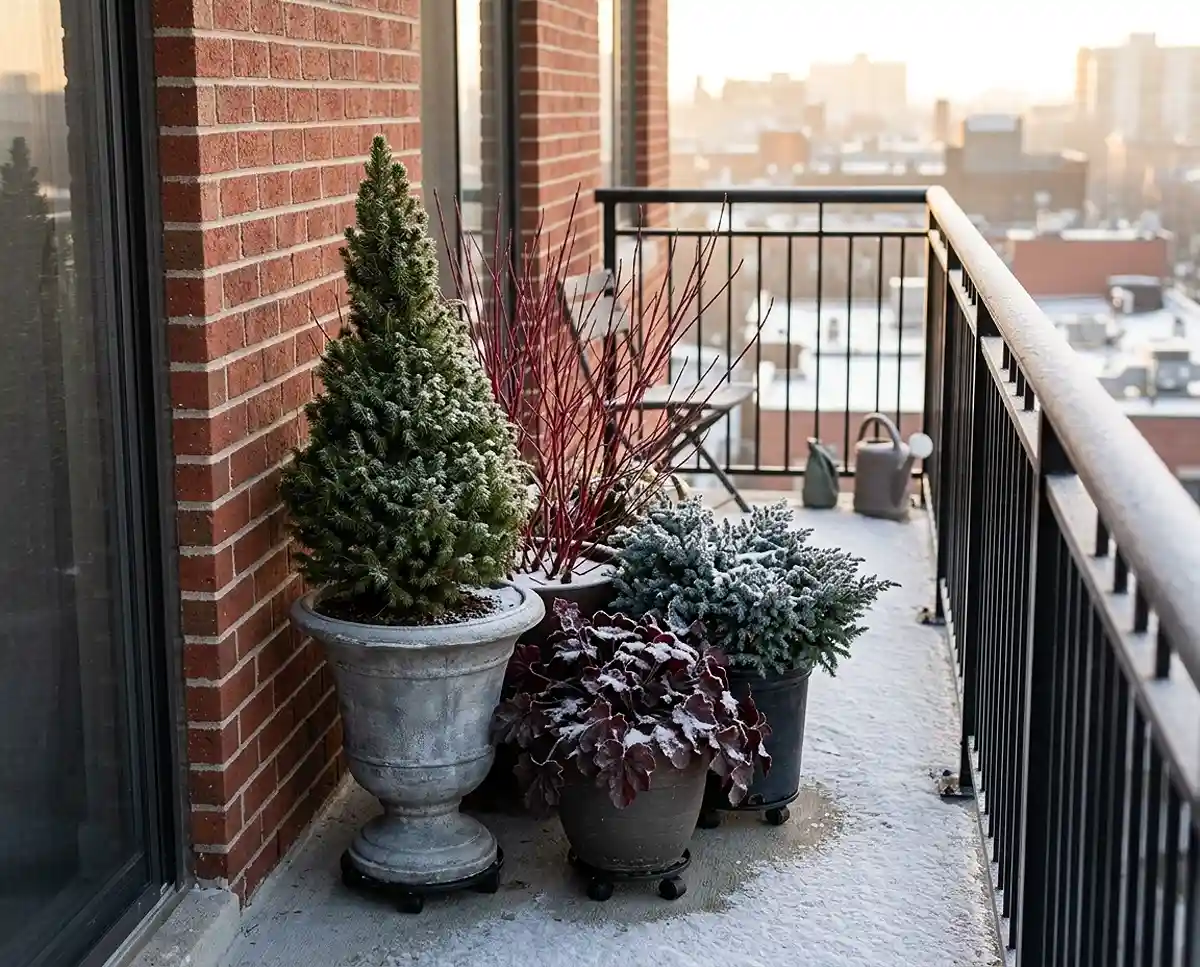
17 cold hardy balcony plants Ideas
These 17 cold hardy balcony plants ideas keep pots alive past October in Zones 3–6, and still look good in March. Here’s what survives, and what to skip.
I garden on a fourth-floor, east-facing balcony in USDA Zone 5b, where January nights can hit -10°F. After years of overwintering pots up here, I’ll flag what’s tough, what’s marginal, and why.
Table of Contents
Mastering the Cold-Climate Balcony Microclimate (Zones 3–6)
Container gardening doesn’t have to end in September. It just needs a different plan, because an elevated pot gets hit by cold air from every side, not only the top.
The “Two-Zone Colder” Container Rule (Why a Zone 5 Balcony Needs Zone 3 Plants)
Quick Answer: Choose plants rated at least two USDA zones colder than your location. A Zone 5 balcony needs Zone 3 plants, because pots lose the soil mass that insulates in-ground roots.
Ground soil below the frost line stays above freezing all winter. A pot has no such blanket, so roots feel the same air as the branches. Find your zone on the USDA Plant Hardiness Zone Map (updated in 2023), then subtract two.
| Your Balcony Zone | Plant Rating Needed | Reliable Picks |
|---|---|---|
| 3 | Zone 2, plus insulated pots | Mugo pine, Siberian cypress |
| 4 | Zone 2 | Red-twig dogwood, mugo pine |
| 5 | Zone 3 | Panicle hydrangea, bergenia |
| 6 | Zone 4 | Heuchera, Blue Star juniper |
For Zone 3, the rule calls for Zone 1 plants, which are rare. Heavy pot insulation makes up the second zone.
Mapping Low Winter Sun Angles, Thermal Wall Radiance, and High-Rise Wind Chill
Push pots flush against an east- or south-facing masonry wall. It soaks up low winter sun and radiates heat after dark, making that spot a few degrees warmer. It also blocks drying gusts.
Open railings do the opposite and funnel wind straight through your pots. Check these wind-resistant balcony plants before choosing anything tall.
Balance matters. Hot afternoon sun on dark pots can wake plants too early in March, so favor an east-facing wall and light-colored pots.
Essential Prep: Freeze-Proof Planters, Root Insulation, and Fast-Draining Grit Soil
Container overwintering comes down to three things: pots that won’t crack, roots that stay evenly cold, and soil that drains instead of freezing into a waterlogged block. Here’s my checklist.
- Pots rated to your zone’s low: rotomolded resin, fiberglass, or thick cedar
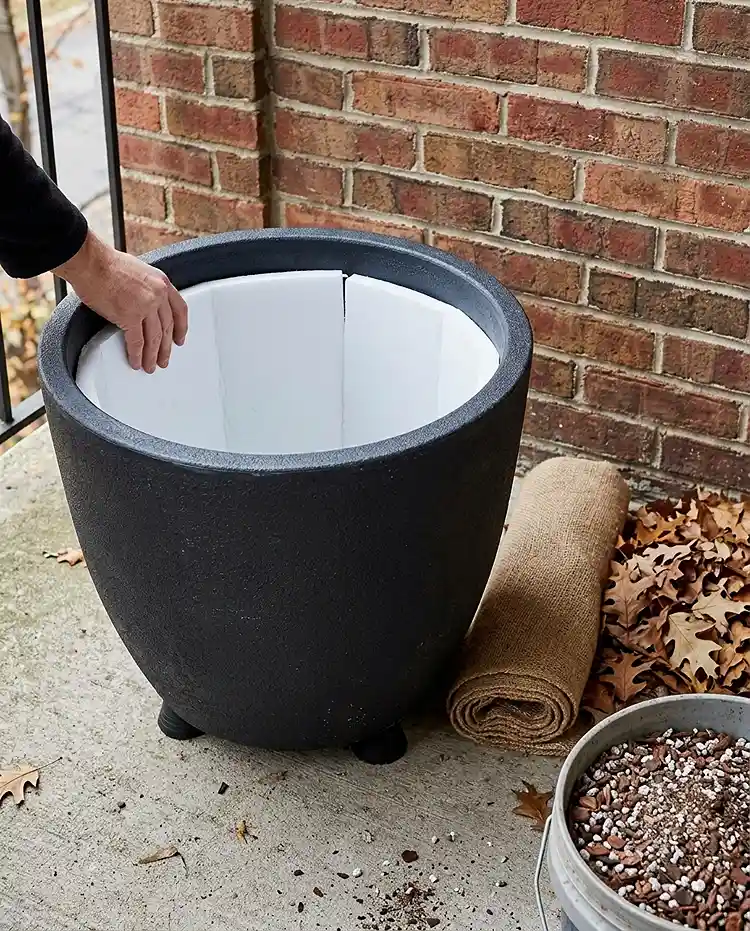
- 1/2-inch foam board or foil bubble wrap lining the inner walls
- Rubber pot feet so drain holes never freeze shut
- Gritty potting mix (recipe below)
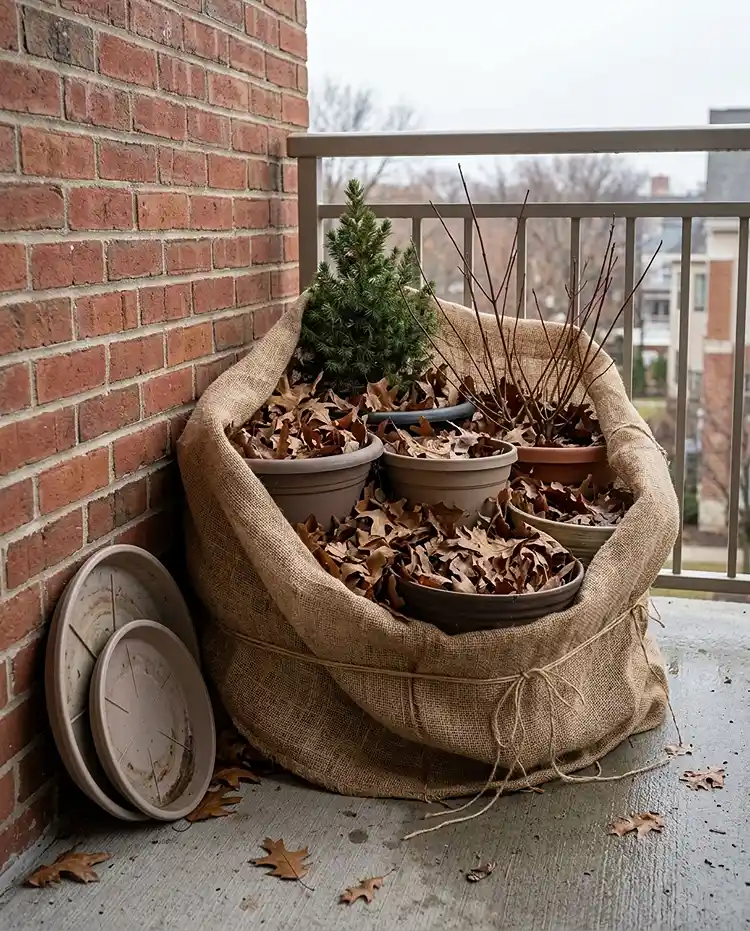
- Burlap and dry oak leaves for November wrapping
Choosing Sub-Zero Fiberglass, Rotomolded Resin, and Cedar Over Cracking Terracotta
Skip terracotta. Porous clay soaks up water, freezes, and splits. Choose resin or fiberglass rated to your zone’s low, or thick cedar, line the inside with insulation, and set every pot on rubber feet. Zone 3 winters hit -40°F, so wrap pots extra thick there.
Real Example: My first winter (2021-22), a $40 terracotta pot holding Sedum ‘Dragon’s Blood’ split down one side by early February 2022. The sedum survived. The pot didn’t.
The “Anti-Ice-Block” Cold-Climate Potting Mix Recipe (Pine Bark, Pumice, and Coir)
Quick Answer: A winter-safe mix is 40% composted pine bark fines, 35% peat-free coco coir, and 25% coarse perlite or pumice. It sheds cold rain fast, so dormant roots stay oxygenated.
Mix by volume. I prefer pumice because perlite floats to the surface after heavy rain. Any moist mix freezes; this one just won’t hold saturated ice.
17 Cold Hardy Balcony Plants and Pairings That Thrive Beyond Summer
These ideas cover conifers, frost-sweetened edibles, winter bloomers, and colorful stems, so something looks good every month from October through May. Each idea lists the balcony zones it suits.
On Zones 3–4, start with Ideas 4, 6, 11, 12, and 16. For more options, browse this balcony plants guide.
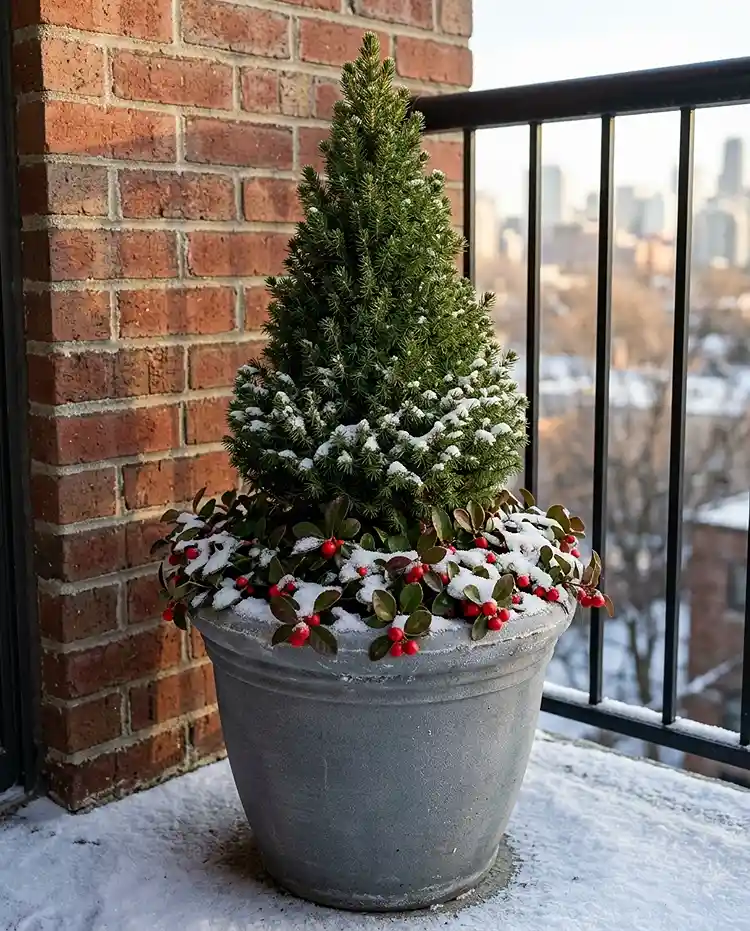
Idea 1: Sub-Zero Nordic Corner Pot with Dwarf Alberta Spruce and Creeping Wintergreen
Best for Zones 5–6. Dwarf Alberta spruce (Picea glauca ‘Conica’, Zone 3) makes a tidy green cone in an 18-inch insulated urn. Underplant with creeping wintergreen (Gaultheria procumbens, Zone 3) for scarlet berries.
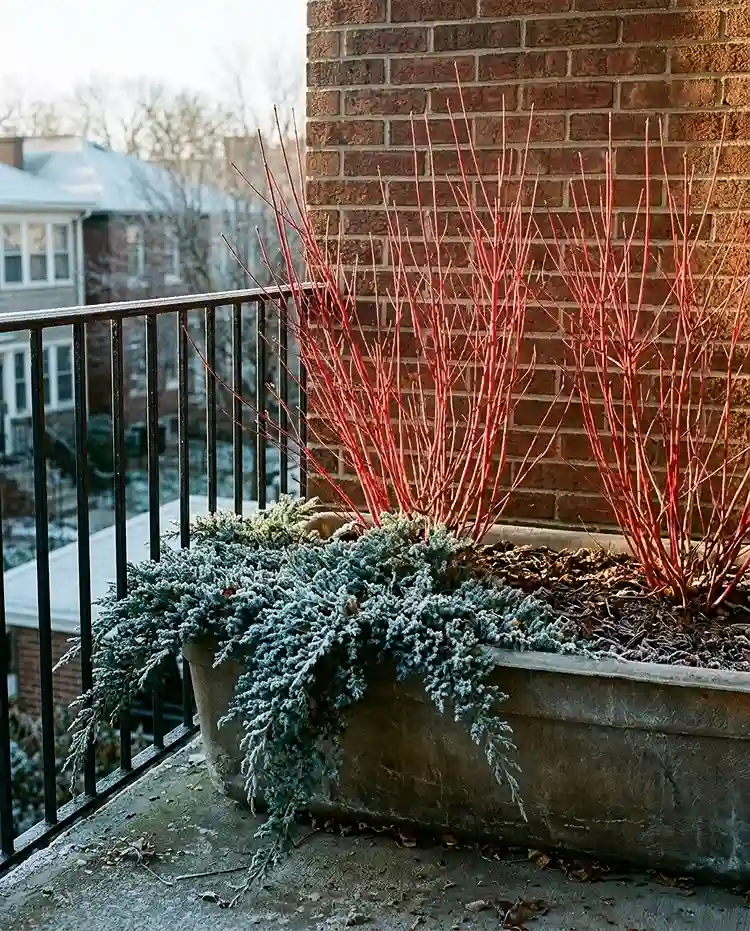
Idea 2: Fiery Red-Twig Dogwood (‘Arctic Fire’) and Blue Star Juniper Contrast Trough
Best for Zone 6 (the dogwood alone suits Zones 4–6). Pair 3-foot Cornus sericea ‘Farrow’ (sold as Arctic Fire, Zone 2) with steel-blue Juniperus squamata ‘Blue Star’ (Zone 4). Dogwood stems turn crimson after leaf drop in November.
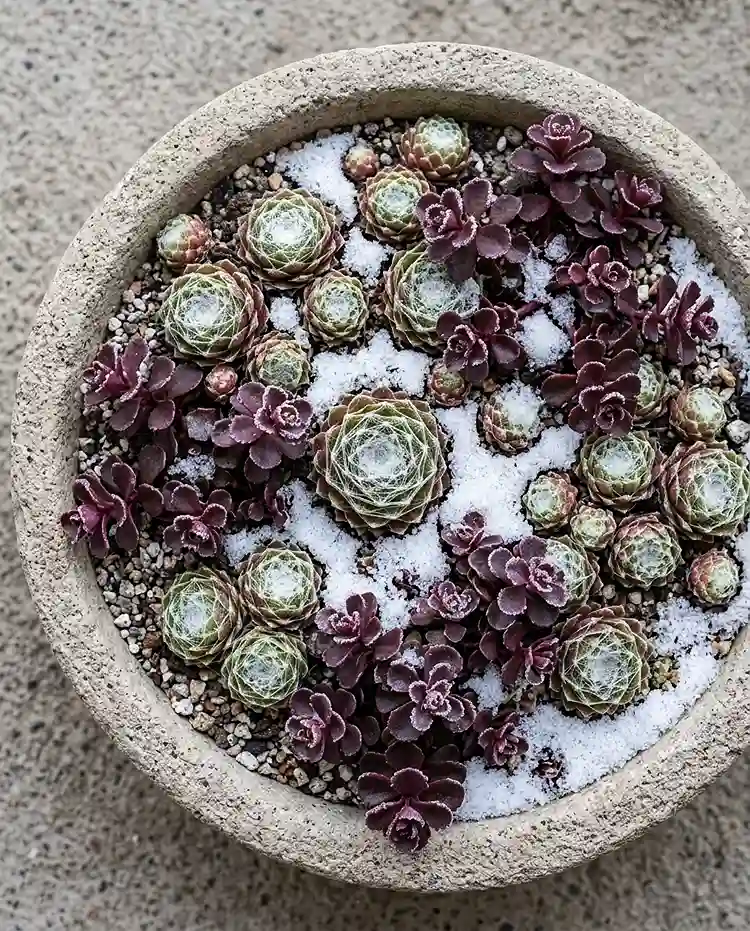
Idea 3: Alpine Stone Bowl of Zone-3 Sempervivum (Hens and Chicks) and Hardy Sedums
Best for Zones 5–6. Sempervivum arachnoideum and Sedum spurium ‘Dragon’s Blood’ (both Zone 3) turn burgundy-plum in frost. Use a shallow fiberstone bowl with gritty mix. Snow cover plus sharp drainage means no winter watering.
Idea 4: Frost-Sweetened Autumn-to-Winter Edible Crate of Toscano Kale and Brussels Sprouts
Best for Zones 3–6 (seasonal crops). Cold converts starches in kale and Brussels sprouts into sugar. Set transplants of both in a burlap-lined cedar crate in July, and sow ‘Winter Bloomsdale’ spinach in September. Kale handles lows near 15°F (-9.4°C). I picked my last Toscano kale on December 19, 2024.
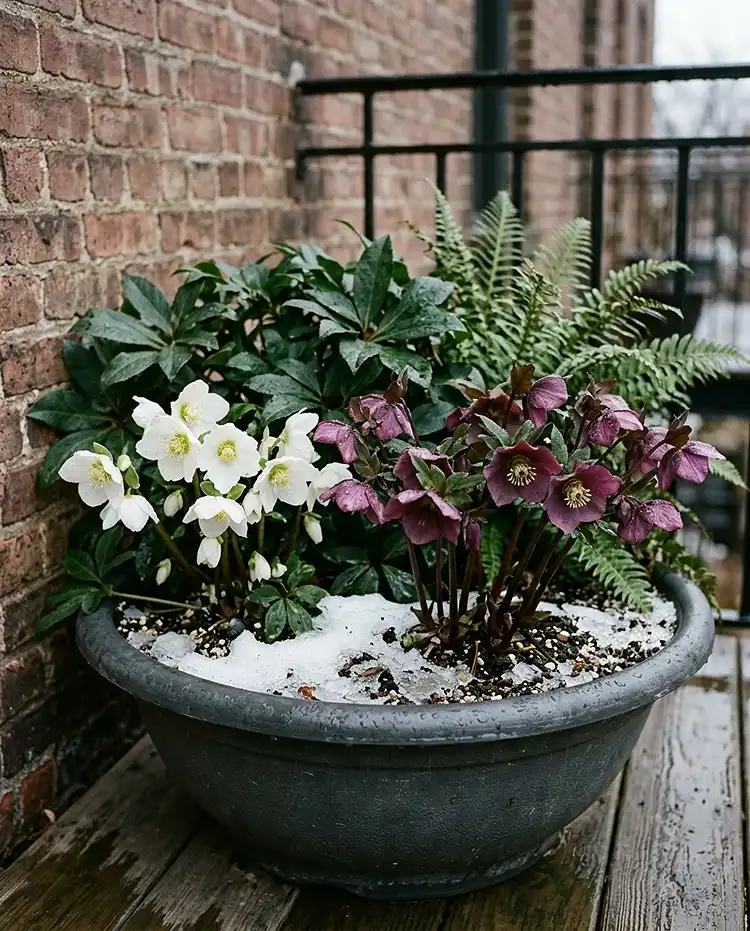
Idea 5: Late-Winter Blooming Hellebores (Christmas & Lenten Roses) and Evergreen Ferns in Shade
Best for Zone 6 (Christmas rose alone suits Zones 5–6). Helleborus niger (Zone 3) and H. × hybridus (Zone 4) push white and plum blooms through late-winter snow on shady north or east balconies. Pair them with Christmas fern (Polystichum acrostichoides, Zone 3).
Idea 6: Dwarf Mugo Pine (‘Mops’) and Winter Heath (Erica Carnea) Four-Season Railing Box
Best for Zones 4–6 (Zone 3 with extra wrapping); the heath needs Zone 6. Pinus mugo ‘Mops’ (Zone 2) forms a dense green cushion. Tuck in Erica carnea (Zone 5), whose pink bells open January to April. My mugo took a -12°F night in January 2024 without one brown needle.
Idea 7: Jewel-Toned Heuchera (Coral Bells) and Evergreen Carex Foliage Pairing
Best for Zone 6, with wrapped pots. Heuchera ‘Plum Pudding’, ‘Caramel’, and ‘Obsidian’ (Zone 4) hold purple and amber leaves deep into winter. Add Carex oshimensis ‘Evergold’ (Zone 5). Mulch in December to stop frost heave.
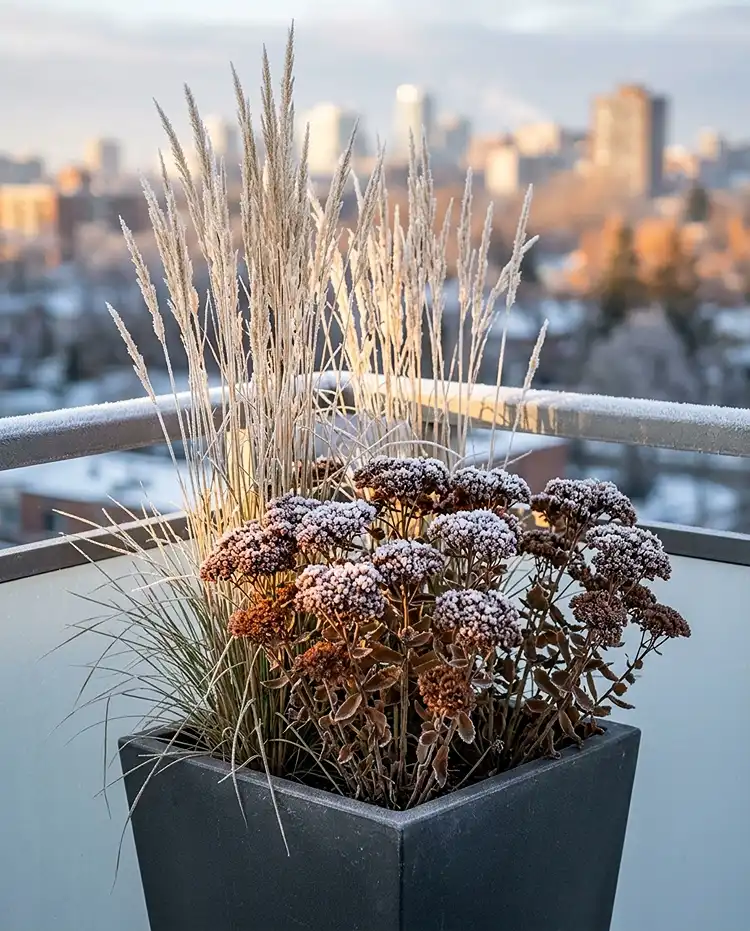
Idea 8: Kinetic Winter Plumes of Karl Foerster Feather Reed Grass and Sedum ‘Autumn Joy’
Best for Zone 6 (‘Autumn Joy’ alone suits Zones 5–6). Leave Calamagrostis × acutiflora ‘Karl Foerster’ (Zone 4) and Sedum ‘Autumn Joy’ (Zone 3) standing all winter. Tawny plumes and copper seed heads catch frost and low sun. Cut both back in late March.
Idea 9: Cold-Hardy Clumping Bamboo (Fargesia Rufa) Privacy Screen for Freezing Wind Tunnels
Best for Zone 6, heavily wrapped. Fargesia rufa and F. ‘Jiuzhaigou’ (Zone 5) are non-invasive clumpers that give rustling green privacy in wide fiberglass troughs.
Idea 10: Dwarf Panicle Hydrangea (‘Bobo’ or ‘Fire Light Tidbit’) for Autumn Crimson & Winter Cones
Best for Zones 5–6. Panicle hydrangeas (Zone 3) beat mopheads because they bloom on new wood. Flowers age from white to pink-red by September, then dry to parchment cones that last all winter.
Idea 11: Over-the-Rail Shoulder-Season Box of ‘Cool Wave’ Trailing Pansies and Ornamental Cabbage
Best for Zones 3–6 (seasonal color). Fill a rail box in late September with ‘Cool Wave’ pansies and ornamental cabbage. Magenta heads and ruffled violas bounce back after 20°F (-6.7°C) freezes. In Zones 3-4, expect to replace them after December.
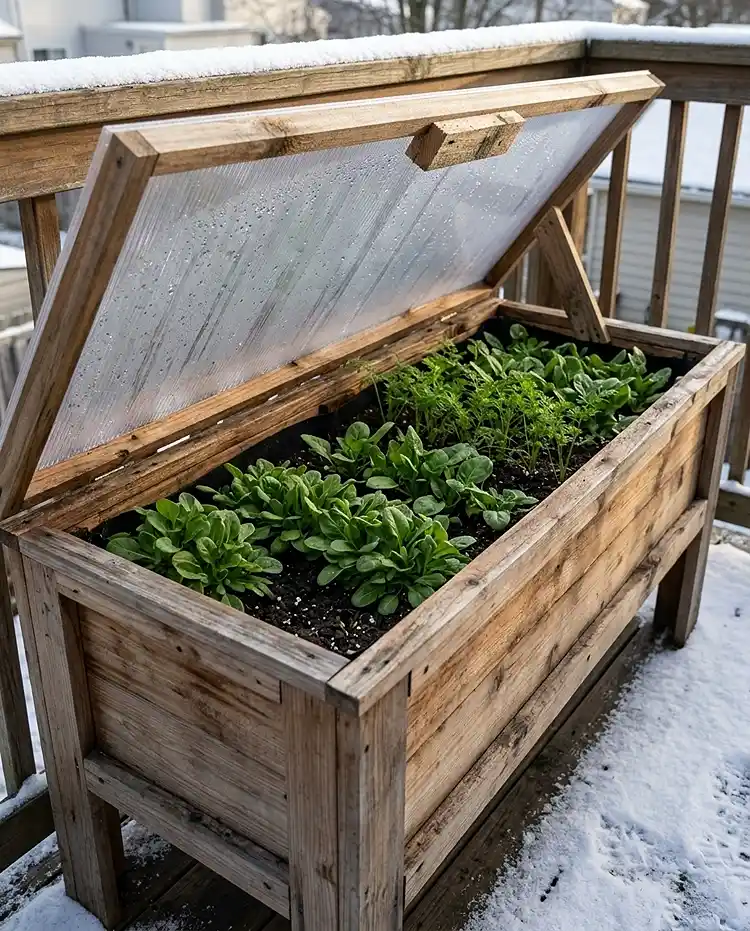
Idea 12: Mini Polycarbonate Cold-Frame Planter Box for Year-Round Mache, Spinach, and Carrots
Best for Zones 3–6 (seasonal crops). A slanted twin-wall polycarbonate lid on a deep cedar trough runs roughly 10-15°F (6-8°C) warmer on sunny days. Sow mache in September and ‘Napoli’ carrots in August for December harvests.
Idea 13: Variegated Emerald ‘n’ Gold Euonymus and Bergenias Shady Wall Trough
Best for Zone 6, with wrapped pots (bergenia alone suits Zones 5–6). Euonymus fortunei ‘Emerald ‘n’ Gold’ (Zone 5) pairs with Bergenia cordifolia (Zone 3), whose leaves turn burgundy-bronze in cold. Pink flowers follow in April.
Idea 14: The Boreal Berry & Pollinator Pot with Dwarf ‘Top Hat’ Blueberry and Lingonberry
Best for Zone 6 (lingonberry alone suits Zones 4–6). Plant ‘Top Hat’ blueberry (Vaccinium, 20 inches, Zone 4) over lingonberry (V. vitis-idaea, Zone 2). You get spring bells, summer fruit, and scarlet October leaves. Both need pH 4.5-5.5; the pine bark mix leans acidic, but test it.
Idea 15: Three-Tiered “Bulb Lasagna” Pot (Snowdrops, Tête-à-Tête Daffodils, and Muscari) Under Violas
Best for Zone 6; skip the Muscari and it suits Zones 5–6. In October, layer ‘Tête-à-Tête’ daffodils 6 inches deep, grape hyacinths (Muscari) at 4 inches, and snowdrops at 3 inches. Daffodils and snowdrops are Zone 3; Muscari is Zone 4. Top with violas for March and April blooms once the pot thaws.
Idea 16: Siberian Cypress (Microbiota Decussata) Cascading Over a Tall Corner Urn
Best for Zones 4–6 (Zone 3 with extra wrapping). Microbiota decussata (Zone 2) drapes feathery sprays over a tall urn and shifts from summer green to bronze in cold. It hates soggy roots, so the gritty mix matters.
Idea 17: Cold-Hardy Culinary Perennial Box with Chives, French Sorrel, Oregano, and Sage
Best for Zones 5–6 with chives and sorrel; oregano needs Zone 6. Chives and French sorrel (Zone 3) return reliably, and oregano (Zone 4) usually does. Sage (Zone 5) is the gamble; swap in creeping thyme (Zone 3) on colder balconies. Fresh leaves appear weeks before garden centers open.
Mastering Cold-Season Balcony Care: The August Cutoff, Thaw Watering, and Wrapping
In a cold climate balcony garden, dormant roots handle cold fine. Freeze-thaw swings and winter drought do the damage. This is my calendar, and the full balcony winterizing guide covers the rest.
The August 15 Fertilizer Cutoff, Autumn Deep-Soaking, and Midday Winter Thaw Watering Chart
Stop all nitrogen on woody plants and perennials by mid-August so stems lignify [turn woody] before frost. Cool-season crops like kale are exempt. Soak evergreens in November before the soil freezes. Then water every 3 to 4 weeks at midday, whenever air hits 40°F (4.4°C) and the soil has thawed.
The “Huddle & Wrap” November Protocol: Clustering Pots, Burlap Skirts, and Removing Saucers
Slide pots off exposed railings into a tight cluster against the warm wall. Pack dry oak leaves or bubble wrap into the gaps, wrap the group in breathable burlap, and remove every drip saucer so water can’t pool and freeze.
Common Problems & Solutions
Three things kill most cold-climate balcony plants between November and April.
Winter Desiccation Burn (Crispy Brown Needles on Sunny, Windy February Days)
Bright sun on snow wakes evergreen needles to lose water while the frozen root ball can’t resupply it. In late November, spray foliage with an anti-transpirant like Wilt-Pruf and shade south-facing conifers. Results are modest; burlap works better.
I learned this when my Alberta spruce browned on its sunny side in February 2025.
Fatal “False Spring” Freeze-Thaw Cycles Heaving Roots and Waking Buds Too Early
A warm 55°F (12.8°C) March week can wake sun-heated dark pots right before a 15°F (-9.4°C) blizzard. After the soil freezes in December, add 3 inches of pine bark mulch. Try shading pots on bright days to keep them dormant.
Soggy Crown Rot in Cold Autumn and Early-Spring Rainstorms
Cold, waterlogged soil kills more hardy perennials (heuchera, lavender, sedum, bulbs) than sub-zero air does. During winter rain, pull dormant pots under the balcony overhang and tilt unused troughs on their sides so water drains out.
Frequently Asked Questions
What is the hardest-to-kill evergreen plant for a freezing, windy balcony?
Mugo pine (Pinus mugo) and Siberian cypress (Microbiota decussata) are the toughest, hardy to USDA Zone 2 (-50°F). Dwarf Alberta spruce is Zone 3 but can winter-burn, and ‘Blue Star’ juniper is Zone 4.
Should I bring cold-hardy balcony perennials and evergreens inside for winter?
No. Pines, spruces, junipers, and most hardy perennials need roughly 8 to 12 weeks of cold dormancy. A 70°F (21°C) apartment dries them out and they usually die. Keep them outside, clustered and wrapped.
When should I unwrap my insulated balcony pots in the spring?
Wait until lows stay above about 20°F (-6.7°C), usually late March to April. Remove burlap gradually on a cloudy, mild day so new shoots aren’t shocked by wind or bright sun.
How can I tell in April if my overwintered balcony shrub is dead or dormant?
Scratch a tiny strip of outer bark on a mid-level branch with your fingernail. Moist, bright green cambium and a flexible stem mean the plant is alive and waiting for warmer soil.
Can I leave terracotta pots outside all winter on a cold balcony?
No. Porous terracotta absorbs water that expands when it freezes and cracks the pot. Use rotomolded resin, fiberglass, or thick cedar, or store terracotta indoors.
Key Takeaways
- Cold hardy balcony plants should be rated two USDA zones colder than your location, because pots lack the insulation of in-ground soil.
- Use non-porous pots, inner insulation, rubber feet, and a gritty mix to prevent cracked pots and ice-block roots.
- Stop nitrogen by mid-August, soak evergreens in November, and water only during winter thaws.
- Cluster and wrap pots against a warm wall.