
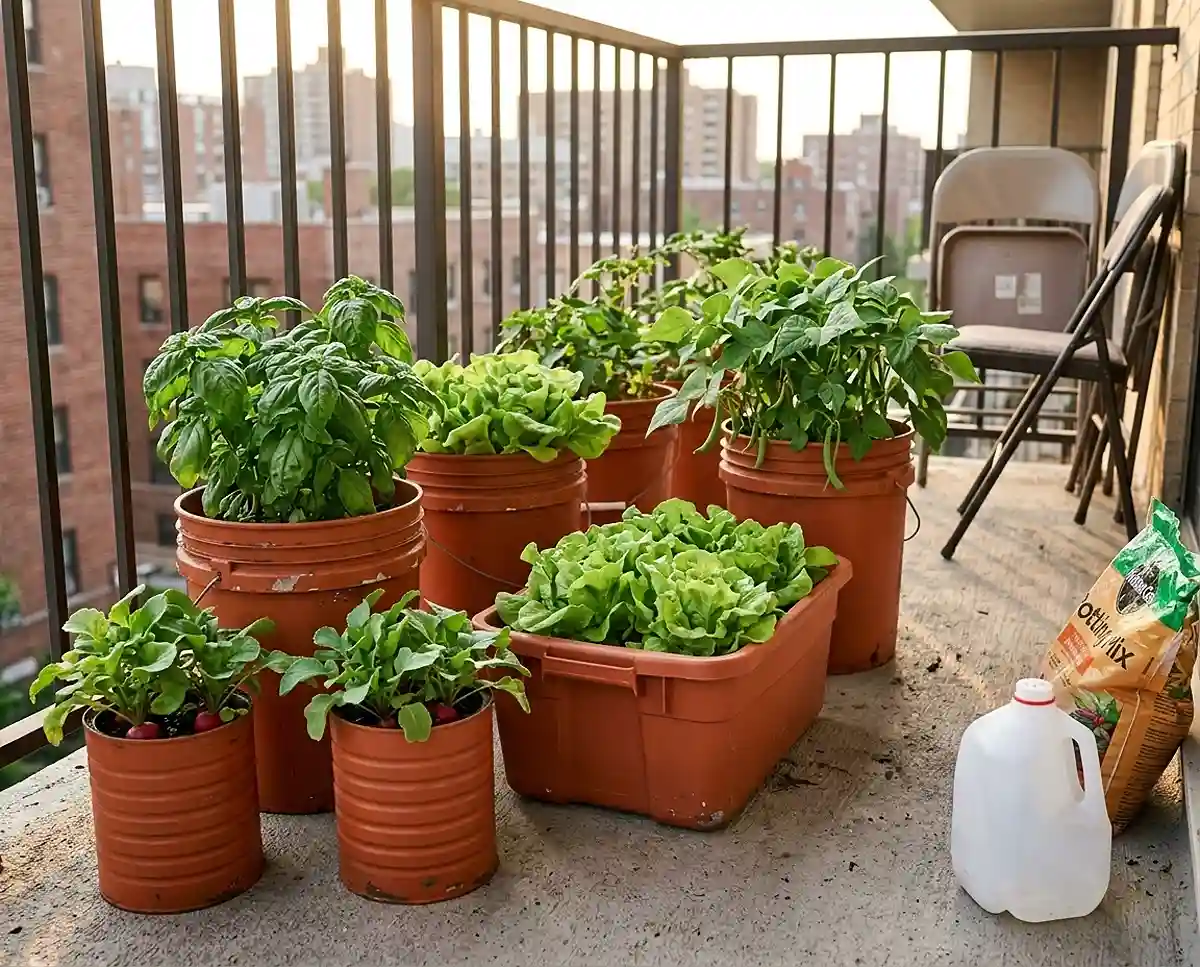
Balcony Garden on a Budget
Your balcony fits two chairs and fifty bucks. A balcony garden on a budget is doable, and this budget balcony garden plan shows you exactly how.
I’ve coached renters through tiny spaces for 12 years. Now I grow food and flowers on a sunny zone 7a rooftop terrace.
Table of Contents
Growing a Lush Balcony Garden on a Budget (Without Breaking the Bank)
Short Answer: Yes, you can grow a lush balcony garden for under $50. Spend on potting soil, buy seeds instead of plants, and upcycle every container you can find. Skip fancy pots and bottled fertilizer. A $50 plan works because plants don’t care what their pot cost.
My terrace gets about six hours of direct sun. I grow in eleven containers, from 2-gallon pails to a 20-gallon tote. The same rules work on any apartment balcony.
Check your own zone on the USDA Plant Hardiness Zone Map, since frost dates decide what you plant and when. New to this? My apartment gardening for beginners guide covers the basics.
These apartment balcony garden ideas share one rule: spend where the roots live, and save everywhere else.
Allocating Your $50 Budget: Where to Spend and Where to Save
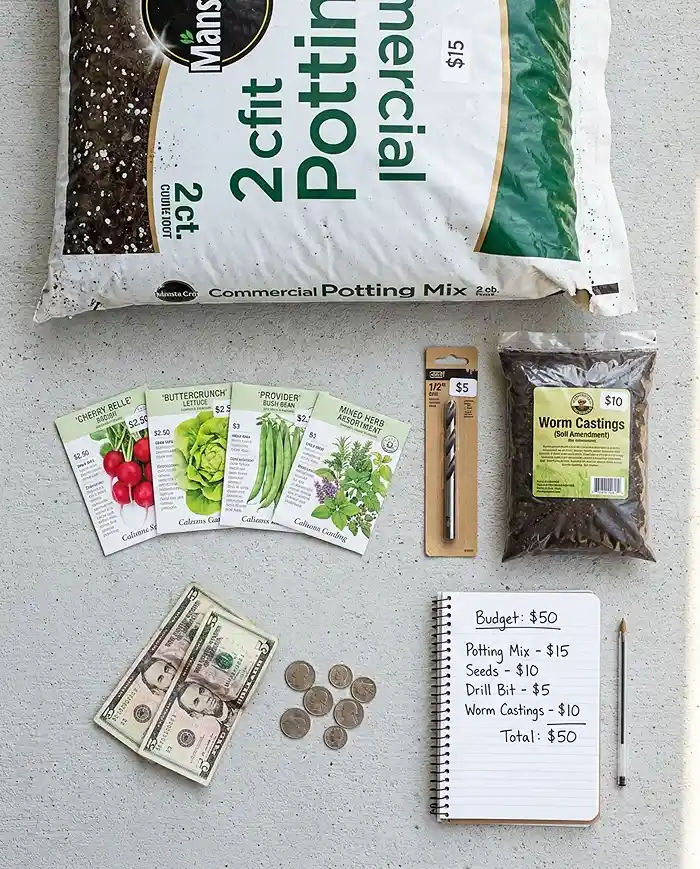
Short Answer: Put about a third of your $50 into potting mix and a sixth into seeds. Keep the rest flexible for fixes and a starter plant. Soil decides whether roots live or rot, so it gets the biggest slice. Everything else can be free or nearly free.
| Item | Cost | Notes |
|---|---|---|
| Potting mix with perlite (1 cubic foot) | $18 | Your one non-negotiable |
| Seed packets (4) | $8 | Radish, lettuce, bush bean, one herb |
| Drill bit, saucers, or stones | $6 | Skip if you own a drill |
| Plant food backup | $5 | Small bag of worm castings or similar |
| Starter plant plus cushion | $13 | One $4 plant, $9 for price swings |
| Total | $50 | Containers cost $0 |
The Golden Rule: Never Skimp on Potting Soil ($15-$20)
Short Answer: Buy sterile potting mix with perlite [light volcanic glass that keeps soil airy]. Treat it as your one non-negotiable expense. Container soil must drain fast and resist disease. Cheap fill dirt compacts, stays soggy, and can carry fungus that kills seedlings fast.
A 1-cubic-foot bag holds about 7.5 gallons. That fills three 2-gallon pots with a little left to top off.
As of fall 2026, good mix runs $15-$20 at most big-box stores. Check the bag says “potting mix,” not “topsoil” or “garden soil.”
Seeds vs. Starter Plants ($5-$10)
Short Answer: Seeds win on cost. One $2 packet gives you dozens of plants. A nursery transplant [seedling sold in a small pot] costs $4 or more. Start with radishes, loose-leaf lettuce, and bush beans. They sprout fast and forgive beginner mistakes.
This past April, I sowed ‘Cherry Belle’ radishes in a 6-inch-deep storage tote. Soil sat near 55°F, and sprouts showed in four days. One $2 packet gave me about 40 radishes in 24 days.
More apartment gardening tips for beginners help you match crops to your light.
Sourcing Free and Cheap Containers
Short Answer: Almost any food-safe container can hold plants if it has drainage holes. Look in your recycling bin, your cupboards, and your neighbors’ curbs before you buy anything. Paint everything one color, and mismatched containers look planned. Free containers are the cheapest of all small balcony garden ideas.
Upcycling Household Items (Buckets, Cans, and Plastic Tubs)
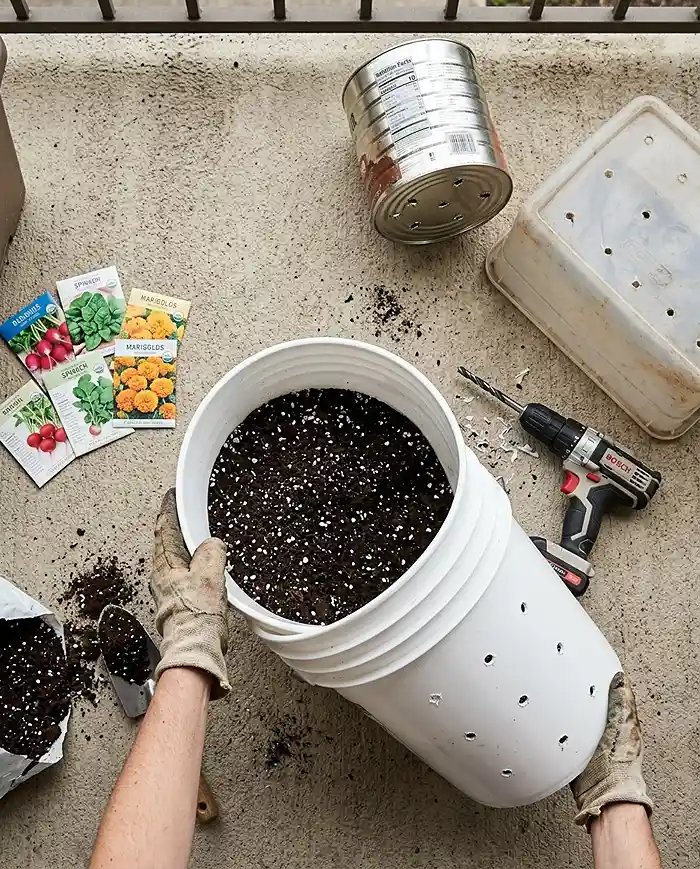
Short Answer: Food-grade 5-gallon buckets, large coffee cans, and plastic totes all work. Drill at least six to eight half-inch holes in the bottom of each before you add soil. No drainage means roots sit in water and rot, and no pot is worth that.
- 5-gallon bucket: Ask bakeries and delis for empties. Drill eight half-inch holes. Great for tomatoes and peppers.
- Large coffee can: Hammer a nail through the bottom five times. Tape over sharp edges. Good for herbs.
- Plastic storage tote: Drill ten holes. Six inches of depth suits radishes and lettuce.
Finding Free Nursery Pots and Pallets
Short Answer: Ask garden centers, hardware stores, and community garden groups for their discarded plastic nursery pots. Many toss them by the stack. Choose pallets stamped HT [heat-treated] and skip any marked MB. Bring a bag, ask politely, and offer a thank-you. Most are happy to hand them over.
Lean a pallet against a wall and tuck pots between the slats for a vertical garden. Check your lease before you hang weight from a railing.
Low-Cost DIY Fertilizers and Plant Foods ($5)
Short Answer: Kitchen scraps can feed container plants for almost nothing. Banana peels add potassium, eggshells add calcium, and used coffee grounds add a little nitrogen. These feeds are gentle, so use them regularly. Budget about $5 for a small bag of organic fertilizer as backup.
Every watering flushes nutrients out the drain holes. Most potting mixes carry starter food for four to six weeks. After that, your plants rely on you.
Making Banana Peel and Eggshell Teas
Short Answer: Steep one chopped banana peel and a spoonful of crushed eggshell in a quart jar of water for 48 hours. Strain it, dilute it half-and-half, and water tomatoes or peppers. It’s a mild boost, not a miracle. Use it every two weeks.
- Chop one banana peel and drop the pieces in a quart jar.
- Add a spoonful of eggshell ground to powder.
- Fill with water, cover loosely, and wait 48 hours.
- Strain, mix half tea and half plain water, and pour at the base of the plant.
Eggshell calcium dissolves slowly, so grind the shell fine.
Coffee Grounds for Nitrogen-Loving Plants
Short Answer: Top-dress [spread a thin layer over the soil] leafy greens with a quarter inch of used coffee grounds. Lettuce and spinach love it. Scratch it in lightly. Cafes often give grounds away free. Thick layers crust over and grow mold, so go thin.
Used grounds sit close to neutral, around pH 6.5 to 6.8. They release nitrogen slowly as they break down. That’s why they won’t swing your container’s acidity much.
Skip fresh, unbrewed grounds. They’re more acidic and can stunt seedlings.
Propagating Kitchen Scraps for Free Plants
Short Answer: Grocery produce you already bought can become free plants. Green onions, celery bases, romaine hearts, basil, and mint all regrow roots in plain water. Set them on a sunny windowsill, change the water every two days, and transplant once roots hit one to two inches.
Regrowing Green Onions, Celery, and Romaine
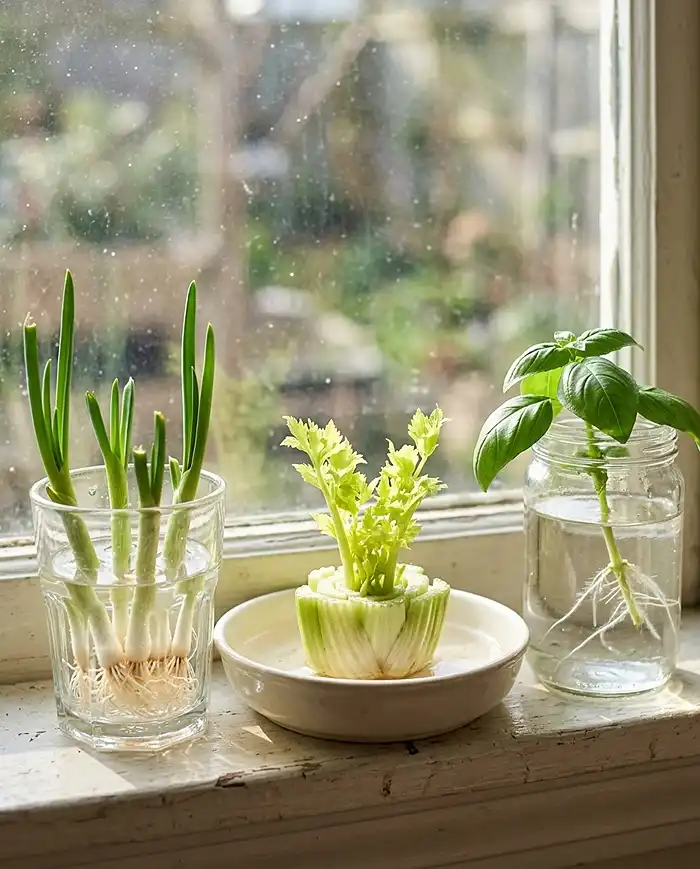
Short Answer: Stand green onion roots in a glass with an inch of water, and they regrow in about a week. Set celery and romaine bases, cut side up, in a shallow dish. Move them to soil once new roots appear. Expect small, tender regrowth rather than full heads.
Change the water every two days so it doesn’t turn slimy.
Rooting Supermarket Herb Cuttings (Mint and Basil)
Short Answer: Snip a 4-inch stem of basil or mint just below a leaf node [the bump where leaves join the stem]. Strip the lower leaves, then stand the stem in water. Roots show in 7 to 14 days. Plant it in a 1-gallon pot once roots reach an inch.
In May, I rooted a stem from the Genovese-type basil I’d bought for pasta. Roots hit one inch in 12 days. By July, that 1-gallon pot had given me three batches of pesto.
Give mint its own pot. It spreads like gossip.
Common Problems & Solutions
Short Answer: Budget containers fail in two predictable ways: they dry out fast or they stay too wet. Both fixes cost nothing. Mulch [a protective layer over soil] slows drying, and extra holes stop rot. Most mistakes in balcony gardening for beginners start here.
For more, read these apartment gardening mistakes for beginners before you plant.
Upcycled Containers Drying Out Too Quickly
Short Answer: Thin plastic and metal containers heat up and lose water fast on a sunny balcony. Cover the soil with two inches of dried leaves, shredded cardboard, or dry grass clippings. Mulch slows evaporation, so you water less often. Keep it off the stems.
Use only clippings from untreated lawns. Then poke a finger two inches into the soil each morning. Dry? Water. Damp? Walk away.
Poor Drainage in Repurposed Buckets Causing Root Rot
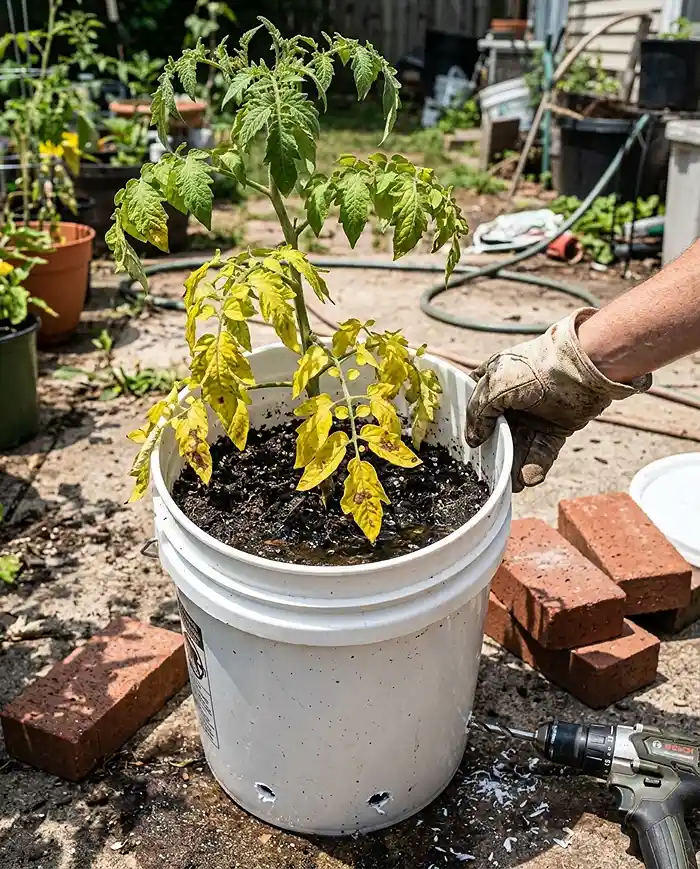
Short Answer: Yellow lower leaves and a soggy bucket usually mean poor drainage. Lift the pot, drill more half-inch holes, and prop it on stones or bricks so water can escape. Do it right away, because roots can start rotting within days.
My second summer on the terrace, I planted an ‘Early Girl’ tomato in a 5-gallon bucket with three pinhole drains. By mid-July, the lower leaves were yellow and the bottom 3 inches of soil was swamp.
I drilled eight half-inch holes and set the bucket on four bricks. New growth showed in 10 days. That plant still gave me 14 tomatoes by September.
Frequently Asked Questions
Can I use dirt from outside for my balcony garden?
Skip it. Yard dirt compacts in containers, drains poorly, and brings weed seeds, pests, and disease. Roots end up suffocating. Spend your $15-$20 on bagged potting mix instead.
What is the cheapest vegetable to grow in containers?
Radishes, spinach, and bush beans are your best bets. Seed packets run around $2, germination [seed sprouting] rates are high, and harvests come fast. Radishes can be ready in about 25 days.
Do I need to buy a watering can or garden tools?
No. A washed milk jug with holes poked in the cap makes a free watering can, and an old kitchen spoon works as a trowel. Save your money for soil.
How much does it cost to start a balcony garden?
You can start for under $50. Potting mix runs $15-$20, seed packets about $8 total, and the rest covers a drill bit, plant food, and a cushion. Free containers and kitchen-scrap regrowing keep the remainder at zero.
Where do I start with balcony gardening for beginners?
Start with good potting mix. Plant radishes, lettuce, and bush beans in free containers with drainage holes. Water when the top two inches feel dry, and add one new plant at a time.
How much sun does a balcony garden need?
Tomatoes, peppers, and beans want six or more hours of direct sun. Lettuce, spinach, and mint do fine with three to four.
Quick Recap
- Build your balcony garden on a budget around one bag of sterile potting mix with perlite.
- Sow radishes, lettuce, and bush beans from seed instead of buying transplants.
- Drill drainage holes in every free container before adding soil.
- Feed gently with banana peel tea and coffee grounds, and mulch to slow drying.
- Regrow green onions and root herb cuttings for free plants.