

Fall Balcony Railing Planters
Fall balcony railing planters turn a tired summer setup into a warm, layered display fast. I grow mine on a 4th-floor, north-east balcony in zone 6b, and swapping to cold-hardy mums and kale in late September changed everything.
Table of Contents
Elevating Your Balcony with Autumn Railing Planters
Summer annuals get leggy and tired by September. Pulling them and dropping in structured, cold-hardy plants makes a small balcony feel like a designed space instead of an afterthought.
Railing planters are the smart move here. They free up floor space, which matters most in a small balcony garden, and they put color right at eye level where you’ll actually notice it from your kitchen table.
Pre-Planning Your Balcony Railing Setup for Fall
Fall isn’t summer with a costume change. Wet soil weighs more, wind hits harder at height, and the sun sits lower in the sky. Plan for all three before you buy a single mum.
Assessing Weight Limits and Railing Types
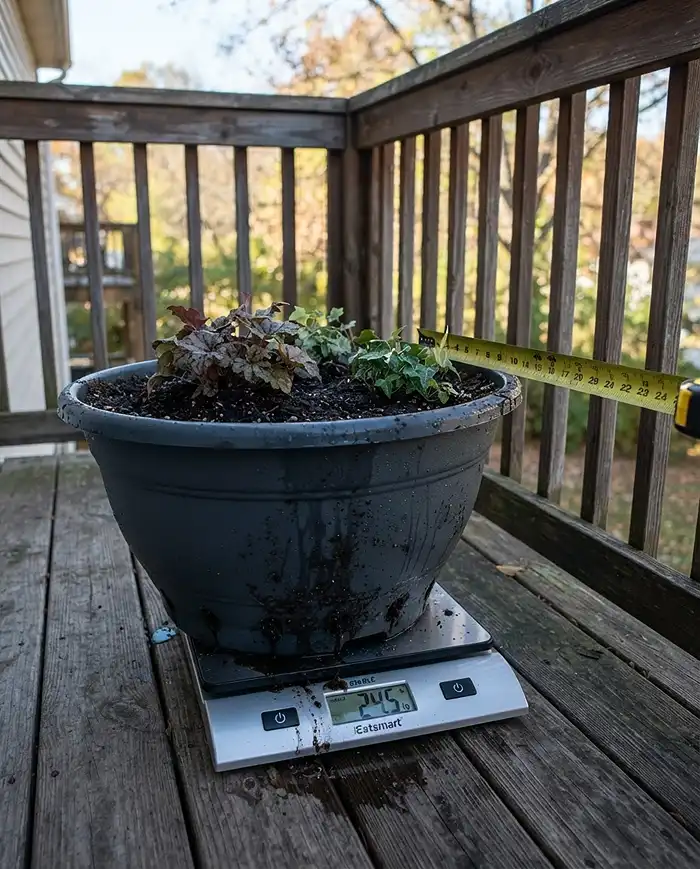
Quick Answer: Measure your railing’s exact width and shape (flat wood vs. round metal) before buying hardware, and check your lease for weight restrictions, since saturated autumn soil is much heavier than it looks.
A gallon of wet potting mix runs close to 8 pounds. Line up four 24-inch saddle planters after a rainstorm and you’re easily carrying 60-80 pounds on a railing that was never engineered for that.
- Flat-top wood railings: 2×4 or 2×6, need saddle-style planters with a flat base
- Round or square metal railings: need adjustable brackets with rubberized clamps
- Check your lease or HOA doc for a stated per-square-foot weight limit before you buy anything
Real Example: My first year, I ignored the lease clause on my Chicago rental and hung three saturated 30-inch boxes. My property manager flagged it during a routine inspection — not a disaster, but an easy mistake to avoid.
Pro Tip: Weigh one filled, watered planter on a bathroom scale, then multiply by how many you’re planning. The number is always bigger than you expect.
Mapping Fall Sunlight and Wind Exposure
Quick Answer: Track your balcony’s sun for a full day in late September, since the autumn sun sits lower and shifts most blooming plants to 4-6 hours of light instead of summer’s full-sun window.
A spot that got six hours of direct sun in July might drop to three by late October as the sun angle changes and neighboring buildings cast longer shadows.
- Check light at 10am, 1pm, and 4pm on the same day to catch the real pattern
- Mums and pansies tolerate partial shade better than summer annuals do
- Wind at height is 2-3x stronger than street level — apartment balcony garden ideas always undersell this
Real Example: My south-facing box got hammered by crosswinds every time a storm rolled through Lake Michigan. I lost an entire flat of unstaked celosia in one October gust.
Choosing the Best Railing Hardware and Planters
You want hardware that grips without drilling. Renters especially need options that come off clean at move-out with zero holes in the railing.
Saddle Planters vs. Adjustable Bracket Boxes
| Type | Best For | Watch Out For |
|---|---|---|
| Saddle planters | Flat wood or vinyl railings, seamless look | Gravity-only hold; needs a level railing top |
| Adjustable bracket boxes | Round metal rails, uneven widths | Rubber pads wear out; check yearly |
| Over-the-rail clip boxes | Thin balusters, quick seasonal swaps | Lower weight capacity, usually under 15 lbs |
Pro Tip: Anti-scratch rubber grips on bracket boxes aren’t cosmetic — bare metal-on-metal contact will scuff and eventually loosen the clamp.
The Importance of Drainage in Cool Weather
Quick Answer: Every fall railing planter needs open drainage holes plus an exact-fit drip tray, because freezing rain and slower evaporation waterlog roots fast and drip onto neighbors below.
Sealed decorative pots look nice but hold water at the roots. In a container that’s already shallow, that’s a direct route to root rot within two weeks of steady autumn rain.
Real Example: I switched to a drip-tray saddle planter after my downstairs neighbor mentioned muddy water hitting her patio furniture every time it rained. Problem solved in one swap.
Designing with Autumn Color Palettes
A cohesive palette is what separates an intentional fall balcony railing planter from a random grab-bag of whatever the garden center had left.
The Classic Harvest: Rust, Orange, and Gold
Quick Answer: Build a warm, traditional autumn look with rust-orange mums, golden Heuchera, and deep ochre kale for a cozy, classic feel.
Stick to three tones max. I use ‘Sedona Sunset’ mums as the anchor, then layer in bronze-leafed Heuchera and a golden ornamental grass for texture contrast.
Pro Tip: Add one near-black element (dark coral bells or bronze fennel) — it makes the warm tones read richer instead of flat.
The Moody Jewel Tone: Plum, Burgundy, and Silver
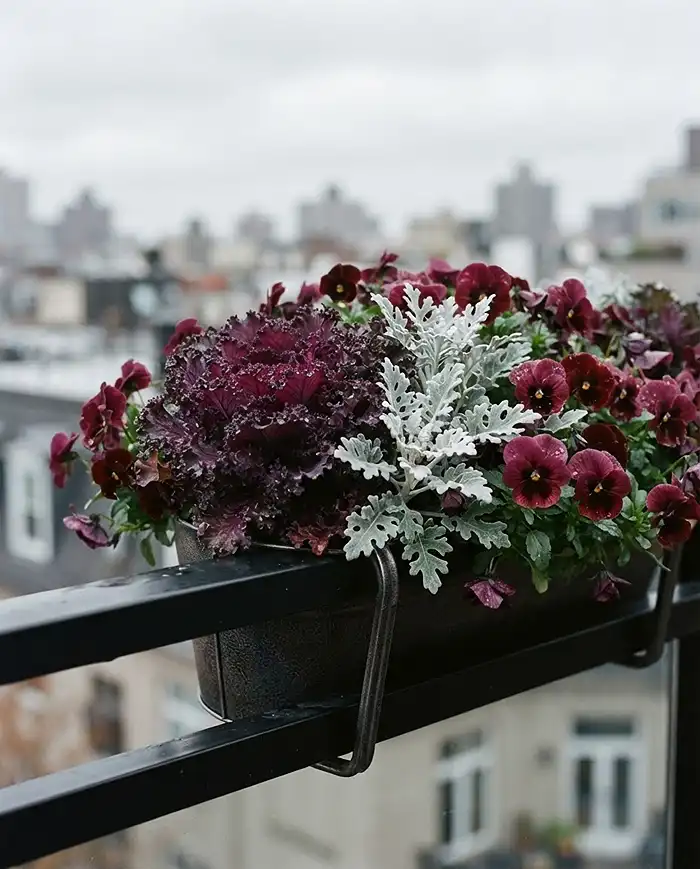
Quick Answer: Pair deep plum and burgundy foliage with icy silver accents for a modern, sophisticated look that suits cool weather better than traditional orange tones.
Burgundy ornamental kale next to silver-leafed Dusty Miller creates real depth. It photographs beautifully against gray city skies too, which matters if your balcony overlooks concrete rather than trees.
This palette also fits smaller, more minimalist small balcony garden setups where you want two or three plants doing a lot of visual work rather than a dozen competing colors.
Best Cold-Hardy Plants for Fall Railing Boxes
Structure your planting by role — thriller, filler, spiller — and the box reads as designed even in a narrow 8-inch-wide railing planter.
Thrillers: Ornamental Grasses and Upright Kale
Quick Answer: Use upright plants like Bronze Hair Sedge (Carex flagellifera) or ruffled ornamental kale as your focal point — kale’s colors actually intensify as temperatures drop toward freezing.
- Bronze Hair Sedge: 12-18 inches, holds structure through wind better than fountain grass
- Ruffled ornamental kale: purples and pinks deepen once nights hit the high 30s°F
- Dwarf Pampas or Fireworks grass: good movement for windy exposures
Real Example: The kale in my west-facing box looked pale pink in September and had turned a deep magenta-purple by mid-November, after three light frosts. No other plant in my rotation does that color shift on its own.
Fillers: Garden Mums, Pansies, and Heuchera
Quick Answer: Pack the center of the box with tightly-budded chrysanthemums, frost-tolerant pansies, and colorful Heuchera (coral bells) for a dense, unbroken mound of color.
- Garden mums: buy tight-budded, not fully open, for 4-6 weeks of color instead of one week
- Pansies: survive down to the mid-20s°F and rebound the moment it warms
- Heuchera ‘Caramel’ or ‘Fire Chief’: evergreen foliage color that outlasts the flowering plants
Pro Tip: Space fillers close enough to touch at planting — autumn is not the season to wait for fill-in growth.
Spillers: Trailing Ivy and Creeping Wire Vine
Quick Answer: Plant English Ivy or Creeping Wire Vine (Muehlenbeckia) along the front edge to spill over the rim and soften the hard line between the planter and the railing.
- English Ivy: fully evergreen, handles hard frost without damage
- Creeping Wire Vine: fine bronze-tinted texture, good against jewel-tone palettes
- Variegated vinca vine: adds a cream edge that lifts darker color schemes
Step-by-Step Planting Guide for Fall Railings
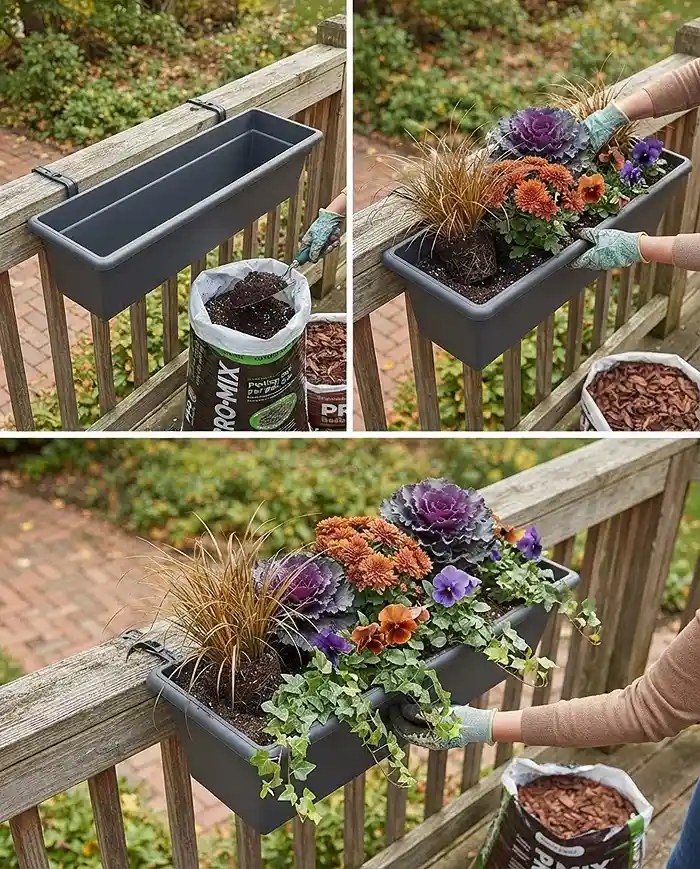
Do this in order and you’ll avoid the most common setup mistakes I made my first two seasons.
- Mount empty hardware first and confirm it’s level and locked before adding any weight
- Mix a fast-draining potting blend: standard potting soil plus 20% perlite for cold-weather drainage
- Set thrillers (grasses, kale) toward the back third of the box
- Pack fillers (mums, pansies, Heuchera) tightly through the center for instant fullness
- Tuck spillers along the front lip so they’ll trail down and over
- Top with a 1-inch layer of bark mulch to insulate roots and lock soil in place
Maintenance for Long-Lasting Autumn Color
Autumn plants slow their metabolism as temperatures drop, so your summer routine needs a real reset, not just a lighter touch.
Adjusting Watering for Cooler Temperatures
Quick Answer: Switch from daily summer watering to the finger-test method — water only when the top inch of soil is dry — since cool temperatures slow evaporation dramatically.
Overwatering is the number one killer of fall containers, not frost. Cold, saturated roots rot far faster than they freeze.
Real Example: I kept my October watering schedule from August one year and lost a full row of pansies to root rot before the first frost even hit.
Deadheading and Frost Protection Hacks
Quick Answer: Deadhead spent mum and pansy blooms regularly to push continuous flowering, and keep a lightweight horticultural fleece nearby for sudden hard-freeze nights.
Pinch spent blooms right at the stem base, not just the flower head, or the plant wastes energy on the leftover stem. Drape fleece loosely over the whole box before an unexpected overnight freeze.
Common Problems and Solutions
Root Freeze in Exposed Railing Pots
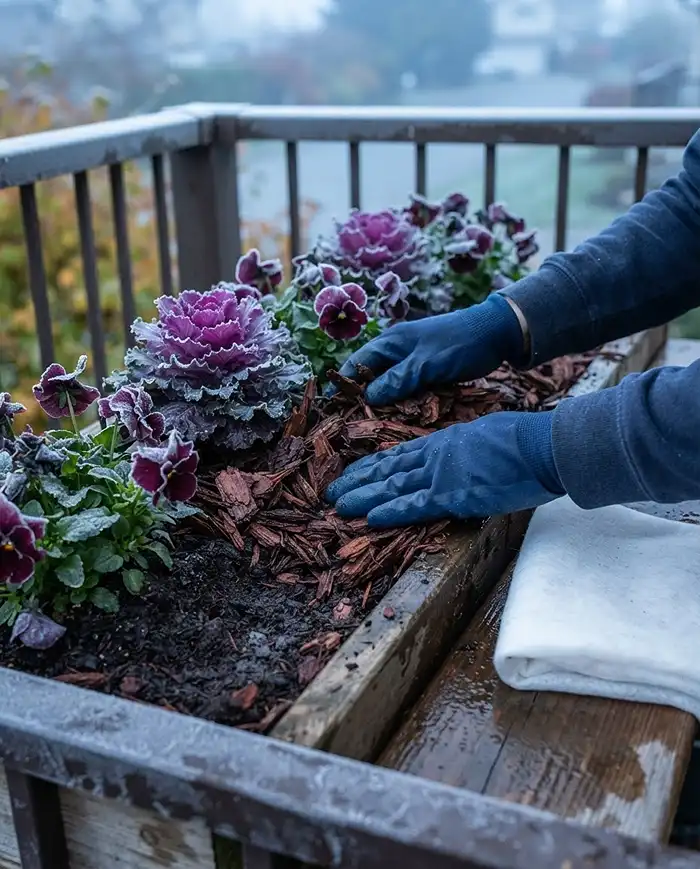
Quick Answer: Elevated railing planters have too little soil volume for geothermal insulation, so a heavy bark mulch layer on top is essential to keep shallow roots from freezing solid.
Ground-level beds borrow warmth from the earth below. A railing box has no such buffer — it’s exposed on all sides to wind and cold air, which is why the same plant survives longer in a ground bed than in a hanging box.
Wind Damage to Tall Floral Spikes
Quick Answer: Protect brittle upright plants from high-rise gusts by choosing low-profile varieties and packing the box tightly so root balls and foliage physically brace each other.
Loose, sparse planting leaves individual stems exposed to snap in wind. A dense, tightly packed box acts almost like a windbreak for itself. For more on protecting containers through sudden cold snaps, the Mississippi State Extension guide on cold protection is a solid reference.
Frequently Asked Questions
Can fall railing planters survive a hard frost?
Yes. Pansies, ornamental kale, and Heuchera are frost-hardy and easily survive light freezes down to 28°F (-2°C). They may droop at dawn but perk back up once the morning sun warms the balcony.
Should I change the potting soil before planting fall flowers?
Full replacement isn’t necessary unless the previous plant died of disease. Remove old root masses and amend the top third of the pot with fresh compost for enough nutrients to carry the display through fall.
How do I stop dirt from blowing out of my railing planters?
Keep soil level at least two inches below the planter rim, and top-dress with river stones or wood chips. This stops wind from lifting loose soil onto balconies or patios below.
How many plants fit in a standard railing planter?
A typical 24-inch railing box comfortably fits one thriller, three to four fillers, and two spillers planted tightly for immediate fullness, without needing to wait for fill-in growth.
Do railing planters need a liner?
A plastic liner isn’t required if the planter itself has drainage holes, but it does make swapping seasonal displays faster and protects wood or metal hardware from constant moisture exposure.
Conclusion
Fall balcony railing planters reward a little upfront planning — the right hardware, real drainage, and a tight color palette go further than an armful of random mums.
Start with your railing type and weight limits, then build outward from there. For more autumn balcony garden ideas, check out our seasonal balcony design guide, our full railing planter roundup, and our renter-friendly balcony setup tips.
Key Takeaways
- Fall balcony railing planters need hardware matched to your exact railing type, plus a confirmed lease weight limit
- Pick one cohesive autumn palette — classic harvest tones or moody jewel tones — rather than mixing both
- Structure plantings as thriller, filler, spiller for a full look even in a narrow box
- Switch to finger-test watering once temperatures drop; overwatering kills more fall plants than frost does
- Mulch heavily on top to insulate shallow roots against wind and freeze damage