

Best Windowsill Herbs for Winter
The best windowsill herbs for winter — chives, parsley, mint, thyme, and compact basil — can keep your kitchen fragrant and harvest-ready all season. Move them inside before the first hard frost and you won’t miss a single sprig.
Table of Contents
The Seamless Transition: Moving Your Herb Harvest Indoors
Freezing autumn nights don’t have to end your fresh herb supply. The right plants, moved at the right moment, will keep producing on a sunny windowsill long after your fall balcony garden has shut down for the year.
I grow herbs on a northeast-facing balcony in zone 6b. Every October, I stage a migration — certain plants come inside, others stay out wrapped in burlap. The ones that come in reliably outperform anything I’d buy from a supermarket in January.
The key is picking the right candidates and setting up the right indoor microclimate before the move. Get both right and you’ll have a fragrant, productive windowsill herb garden through the darkest months of winter.
Evaluating Your Winter Windowsill Microclimate
Before you carry a single pot inside, audit your window space. Glass blocks UV, creates cold air pockets right at the pane, and sits uncomfortably close to radiators. Your balcony and your windowsill are completely different growing environments.
Skipping this step is why most windowsill herb gardens fail by February. Spend 20 minutes assessing light and airflow first — it’ll save you from replacing dead plants in January.
Measuring Light and Identifying South-Facing Windows
South-facing windows are gold for a windowsill herb garden. They deliver the most direct winter sun and are your best shot at hitting the 4–6 hours of daily light most herbs need to stay productive and flavorful.
West-facing windows are a solid backup — good afternoon light from October through February. East-facing works only for shade-tolerant herbs like chives, parsley, and mint. North-facing means grow lights, full stop.
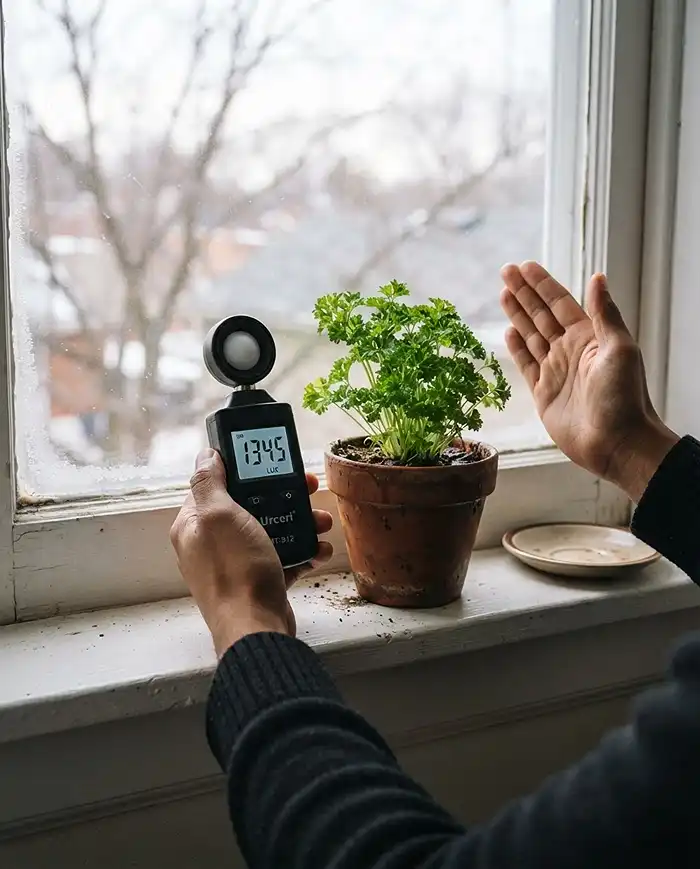
I use a cheap $12 lux meter from Amazon to measure light at the windowsill at noon. Anything below 2,000 lux in December tells me that window needs supplemental lighting for sun-loving Mediterranean herbs to survive winter.
Managing Winter Drafts and Radiator Heat
Hold your hand between the window glass and the pot on a cold night. If it’s noticeably cold, your herbs feel it too. Cold drafts stress roots and invite fungal issues — slide pots a few inches back from the glass if needed.
Radiators are equally problematic. Central heating destroys ambient humidity, and herbs sitting directly above a heat vent will dry out fast and attract spider mites. A pebble humidity tray — a shallow dish filled with gravel and water, pots resting on top — adds passive moisture back into the air around the plants.
I keep a small hygrometer near my herb shelf. Aim for 40–50% relative humidity. Below 30% and you’ll see leaf curl and browning tips on rosemary and thyme within two weeks.
Best Windowsill Herbs to Grow During the Cool Season
Not every outdoor herb deserves a spot on your windowsill. The varieties below are proven performers — they tolerate lower light, dry indoor air, and cramped container herb garden conditions without sulking. As of autumn 2025, these are the most reliable choices for a continuous winter harvest.
| Herb | Minimum Window Direction | Light Needed (Daily) | Main Indoor Risk |
|---|---|---|---|
| Chives | East-facing | 3–4 hours | Overwatering |
| Parsley | East-facing | 4–6 hours | Root rot in heavy soil |
| Mint | East-facing | 3–4 hours | Powdery mildew indoors |
| Thyme | South-facing | 6+ hours | Root rot, low humidity |
| Rosemary | South-facing | 6+ hours | Root rot, crispy leaves |
| Oregano | South-facing | 6+ hours | Leggy growth in low light |
| ‘Spicy Globe’ Basil | South-facing | 6–8 hours | Cold windowsill shock |
Low-Light Tolerant Herbs: Chives, Parsley, and Mint
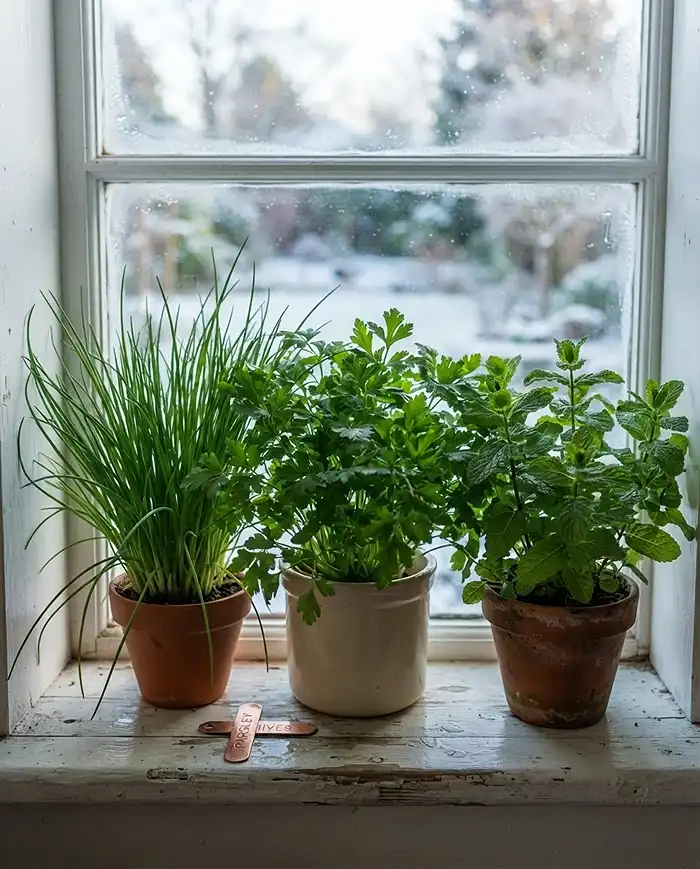
These three are your safety net herbs — the ones that’ll keep producing even in an east-facing window with just 3–4 hours of pale winter sun. They’re the backbone of any successful indoor herb setup.
Chives are almost indestructible indoors. Snip them back to 2 inches and they regrow reliably. I’ve harvested chives from a north-facing bathroom window in January — not thriving, but alive and usable.
Parsley (flat-leaf ‘Giant of Italy’ is my go-to cultivar) takes 4–6 hours. It’ll grow slowly but steadily. Don’t expect the lush outdoor growth — indoor parsley is leaner and just as flavorful.
Mint is the most aggressive of the three. Keep it in its own pot — it will crowd out everything else if you let it. ‘Mojito’ and ‘Spearmint’ both adapt well to indoor pots in lower light.
Sun-Loving Mediterranean Herbs: Thyme, Rosemary, and Oregano
These are your highest-reward, highest-risk group. Get the conditions right and they’ll be stunning all winter. Get them wrong and they’ll rot quietly in a pot you thought was fine.
Thyme, rosemary, and oregano are cool weather herbs for pots that evolved in rocky, sun-drenched Mediterranean hillsides. They need your brightest south-facing window and sharply draining soil — non-negotiable.
‘Creeping Thyme’ and ‘German Winter’ thyme both handle indoor conditions better than common thyme. For oregano, ‘Greek’ oregano is more compact and better suited to container life than Italian varieties.
Root rot is the silent killer here. These herbs would rather be slightly dry than slightly wet. If you’re second-guessing whether to water, wait another day.
The Basil Challenge: Why You Need Micro-Varieties Indoors
Standard sweet basil (‘Genovese’) is not your friend indoors in winter. It sulks at temperatures below 60°F, hates cold windowsills, and collapses in dry central heating. I’ve killed more Genovese basil on winter windowsills than I care to admit.
The solution is compact micro-varieties. ‘Spicy Globe’ basil is a genuine game-changer — it stays tight and bushy, tolerates drier air better, and recovers faster from the stress of indoor conditions.
‘Greek Columnar’ is another solid indoor pick. Keep either variety away from cold glass and directly on a south-facing sill, and they’ll produce through January.
How to Transition Herbs from the Balcony to the Indoors
You have two solid options: bring in the mature plants you already have, or take cuttings and start fresh. Both work — the right choice depends on the herb and the condition of your existing plants.
Start the transition process 2–3 weeks before your first expected frost. In zone 6b, that’s usually mid-October. Don’t wait until a frost warning — a stressed, cold-shocked plant takes weeks to recover indoors.
Taking Softwood Cuttings vs. Potting Up Mature Root Balls
Softwood cuttings work brilliantly for basil and mint. Snip a 4–6 inch tip cutting just below a leaf node, strip the lower leaves, and place it in a glass of water on your windowsill. Roots appear in 7–14 days — then pot up into a 4-inch container with fresh indoor mix.
Potting up root balls is better for chives and oregano. Dig up a clump, divide it into fist-sized sections, and pot into a 6-inch container. Chives especially respond well — they perk up fast once indoors and out of the cold.
For mature rosemary and thyme already in pots on your small balcony garden, just bring the whole pot in. Re-potting mid-season adds stress. Let them settle into indoor conditions first, then re-pot in early spring if needed.
The Mandatory Pest Quarantine Protocol
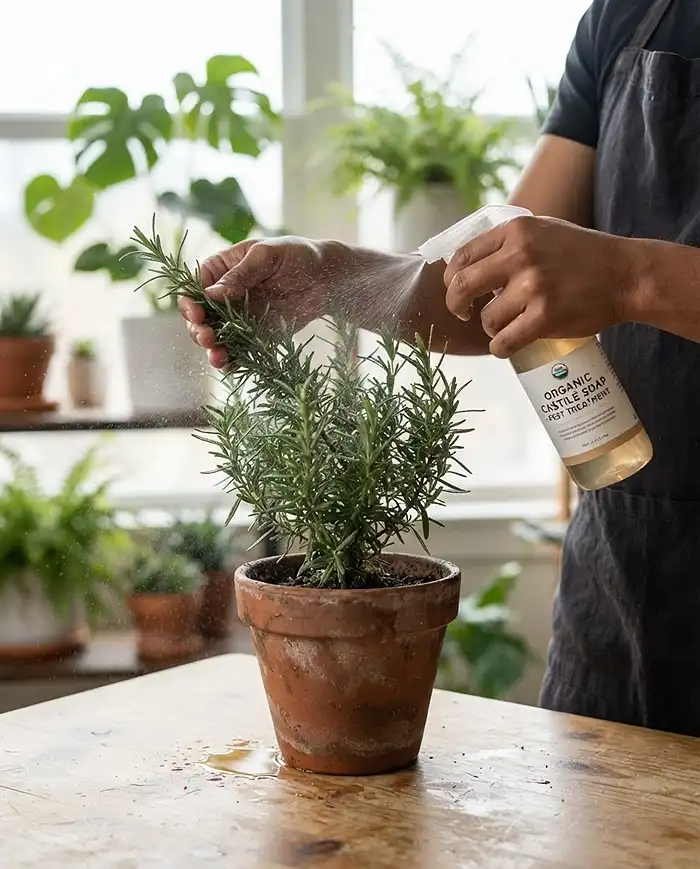
This step is non-negotiable. Every plant coming in from outside gets a two-week quarantine — isolated from your other houseplants — before it earns a spot on the windowsill.
Before the quarantine starts, give every plant a thorough wash. Mix 1 teaspoon of pure Castile soap (like Dr. Bronner’s unscented) into 1 quart of water. Spray every leaf surface, top and bottom, and wipe down the stems.
Aphids and spider mites are nearly invisible until they’re a full-blown infestation. One overlooked pest colony from a balcony plant can spread to every herb on your windowsill within three weeks of the warmth indoors.
During quarantine, check plants daily. Look at leaf undersides with a magnifying glass if you can. A second Castile soap spray after day seven is good insurance.
Essential Gear for Indoor Winter Herb Gardening
Indoor soil and lighting behave completely differently than your outdoor balcony setup. The right gear prevents the two most common failures: waterlogged roots and light starvation. Here’s the short, practical shopping list.
- Full-spectrum LED grow light (if your best window is north or east-facing)
- Sterile indoor potting mix — never outdoor garden dirt
- Perlite for drainage amendment (buy a small bag separately)
- Shallow pebble trays for humidity
- A small hygrometer to monitor room humidity
- 6-inch terra cotta pots — they breathe and reduce overwatering risk
Grow Lights to Supplement Short Winter Days
If your only usable window faces north, a grow light isn’t optional — it’s the difference between living herbs and slowly dying ones. A small, full-spectrum LED panel on a 12-hour timer does the job without running up your electricity bill.
Look for lights rated between 2,000–4,000 lux at plant level (around 12 inches from the bulb). The University of Maryland Extension’s guide on grow lights is a reliable, practical resource for matching light intensity to specific herbs.
Set the timer to run from 7am to 7pm to mimic a natural photoperiod. Herbs don’t need more than 12–14 hours of light — longer doesn’t mean better growth, and it can actually suppress flowering herbs like basil.
Fast-Draining Soil and Humidity Trays
Never bring outdoor garden soil inside. It compacts in pots, suffocates roots, and harbors dormant pests and fungal spores that thrive in warm indoor conditions.
My go-to indoor herb soil recipe: 70% sterile indoor potting mix + 30% perlite. That ratio keeps things loose and draining, even in smaller 4–6 inch pots. For Mediterranean herbs, bump the perlite to 40%.
For humidity trays, fill a shallow saucer with clean pebbles, add water just below the top of the pebbles, and sit your pots on top. The pot base never touches the water — just absorbs the passive evaporation rising up around it.
Winter Maintenance for Indoor Herbs
Indoor herbs in winter are running at a slower metabolic pace. They’re not pushing new growth like they do in July — they’re maintaining. Your care routine needs to match that slower rhythm, or you’ll kill them with kindness.
The two biggest mistakes? Overwatering and over-harvesting. Both stress plants that are already working harder to adapt to lower light and drier air. Dial both back and you’ll be rewarded with steady, reliable harvests through March.
Adjusting Watering for Slow Winter Metabolisms
Forget your outdoor watering schedule entirely. Indoor herbs with no wind and lower light evaporate soil moisture much more slowly. The leading cause of windowsill herb death is overwatering — by a significant margin.
Use the finger-test method: push your finger 1 inch into the soil. If it’s still damp, wait. Only water when the top inch is fully dry. For Mediterranean herbs, let it dry out even further — 2 inches down.
When you do water, water thoroughly until it drains out the bottom. Then don’t water again until the test says so. Inconsistent watering — a little, often — is worse than occasional deep watering done right.
Harvesting Techniques to Encourage Bushy Growth
The way you harvest directly determines how bushy and productive your plants stay all winter. Cut lazily and you’ll end up with tall, leggy stems and sparse leaves by December.
Always harvest from the top growth nodes — pinch or snip just above a pair of leaves. This signals the plant to branch out below the cut rather than keep stretching upward. Do it every time you harvest, even if you’re only taking a small amount.
- Never remove more than one-third of the plant at a single harvest
- Pinch off any flower buds that form — flowering redirects energy away from leaf production
- Rotate pots 90 degrees every 3 days so all sides get equal light exposure
- Remove yellowed or dead leaves immediately to keep airflow clean
Common Problems and Solutions
Two problems will hit most indoor herb gardeners before February: fungus gnats and etiolation (the technical name for leggy, pale, stretched-out stems). Both are fixable quickly if you catch them early.
Fungus Gnats in Warm, Damp Indoor Soil
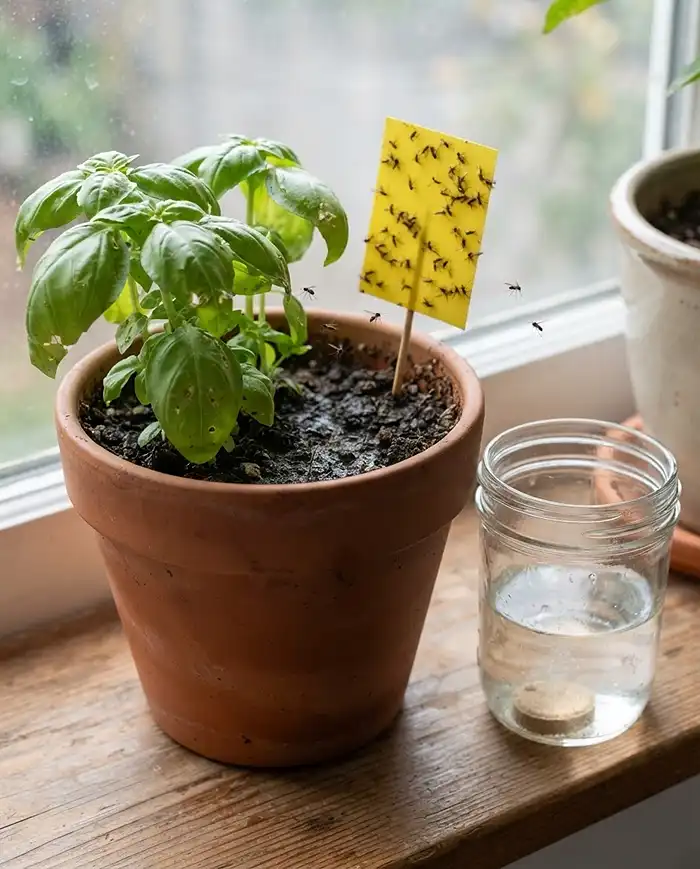
Fungus gnats look like tiny fruit flies hovering around your pots. The larvae live in the top inch of moist soil and feed on roots. Central heating + damp topsoil = a perfect breeding ground.
The two-step eradication protocol that actually works:
- Yellow sticky traps placed at soil level catch adult gnats and break the reproductive cycle
- BTI (Bacillus thuringiensis israelensis) mosquito dunk tea — soak a dunk in water overnight, then use that water to water your herbs. It kills larvae in the soil without harming plants or people
Let the soil dry out between waterings more aggressively than usual while treating. Larvae can’t survive in dry topsoil. Within two weeks of this protocol, the infestation should be gone.
Leggy, Pale Stems Reaching for the Glass
Etiolation — pale, stretched stems reaching desperately toward the window — is a light problem, not a watering problem. The plant is straining toward any available photons.
The fix has two parts: more light (add a grow light or move to a brighter window) and rotation. Physically turn pots 90 degrees every three days so no single side monopolizes the available sun.
Cooler room temperatures also help. Dropping the ambient temp from 72°F to 65°F at night slows the stretching noticeably. Plants grow more compactly in slightly cooler conditions — the same principle that makes greenhouses cooler at night on purpose.
best windowsill herbs for winter FAQs
Should I fertilize my windowsill herbs in winter?
Halt or drastically reduce fertilizing from November through February. Indoor herbs in winter grow slowly and cannot process high nitrogen doses — over-fertilizing burns roots and causes salt buildup in the soil. If you fertilize at all, use a half-strength liquid feed once a month at most.
Can I leave some herbs on the balcony to survive the winter?
Yes — cold-hardy herbs like thyme, oregano, and mint actually benefit from a period of cold dormancy outdoors. Wrap their pots in burlap or bubble wrap to insulate the roots from freeze-thaw cycles. They’ll bounce back vigorously in spring. Basil and parsley cannot survive frost and must come inside.
Why are my indoor rosemary leaves turning brown and crispy?
Counterintuitively, brown crispy rosemary leaves indoors usually mean root rot, not dehydration. When roots drown in heavy potting mix, they can no longer uptake water and the plant shows classic drought symptoms. Unpot immediately, trim any black or mushy roots, and repot into a sandy, perlite-heavy mix in a clean pot.
How often should I water herbs on a winter windowsill?
Much less often than you think. Without outdoor wind and with reduced light, indoor soil holds moisture far longer. Use the finger-test: water only when the top inch of soil is completely dry. For Mediterranean herbs like rosemary and thyme, wait until 2 inches down is dry before watering.
What size pot works best for a windowsill herb garden?
A 6-inch pot in terra cotta is the sweet spot for most windowsill herbs. It’s large enough to hold a viable root system but compact enough for a typical windowsill. Terra cotta breathes, which reduces overwatering risk significantly. Mint needs its own dedicated pot to prevent it crowding out neighbors.
Key Takeaways
- The best windowsill herbs for winter are chives, parsley, mint, thyme, oregano, and compact basil varieties like ‘Spicy Globe’ — chosen for their tolerance of lower light and dry indoor air.
- South-facing or west-facing windows are essential for Mediterranean herbs; east-facing works for chives, parsley, and mint. North-facing windows require a full-spectrum LED grow light on a 12-hour timer.
- Always quarantine balcony plants for two weeks with a Castile soap wash before bringing them into your home — one aphid colony can spread to every pot within weeks.
- Use a 70/30 mix of sterile indoor potting mix and perlite, and switch to the finger-test for watering — overwatering is the top cause of indoor herb failure in winter.
- Harvest by pinching top growth nodes, rotate pots every three days, and stop fertilizing heavily — match your care routine to the plant’s slower winter metabolism and you’ll harvest fresh herbs all season.