

Fall Mediterranean Balcony Ideas
Fall Mediterranean balcony ideas hit differently once you realize you don’t have to pack up the outdoor table the moment September arrives. With the right plants, pots, and a few cozy layers, you can keep dining outside well into October.
I grow herbs on a south-facing balcony in zone 7a, and autumn is honestly my favorite season out there. The light goes golden, the rosemary smells incredible, and a lit lantern at dusk makes the whole space feel like a Sicilian courtyard.
Table of Contents
Bringing Mediterranean Charm to Your Autumn Balcony Table
The trick to extending your outdoor dining season is treating the table as a living centerpiece, not just a surface. Cold-hardy herbs do double duty: they look gorgeous in terracotta and go straight into your fall roasting pan.
Layer in warm textiles, an unglazed pot or two, and a battery lantern, and your fall Mediterranean balcony setup becomes the kind of place you actually want to linger after dinner even when the air bites.
This isn’t about buying a lot of stuff. It’s about choosing materials and plants that belong together — rough terracotta, silver-green sage, olive wood, warm amber light. That combination is Mediterranean in its bones.
Planning Your Fall Balcony Microclimate for Mediterranean Plants
Before you buy a single pot, spend a week watching what your balcony actually does in early fall. Autumn light, wind, and temperature behave completely differently than July’s conditions — and Mediterranean plants, which evolved in dry heat, need you to account for that shift.
Tracking Shifting Autumn Sunlight for Tabletop Plants
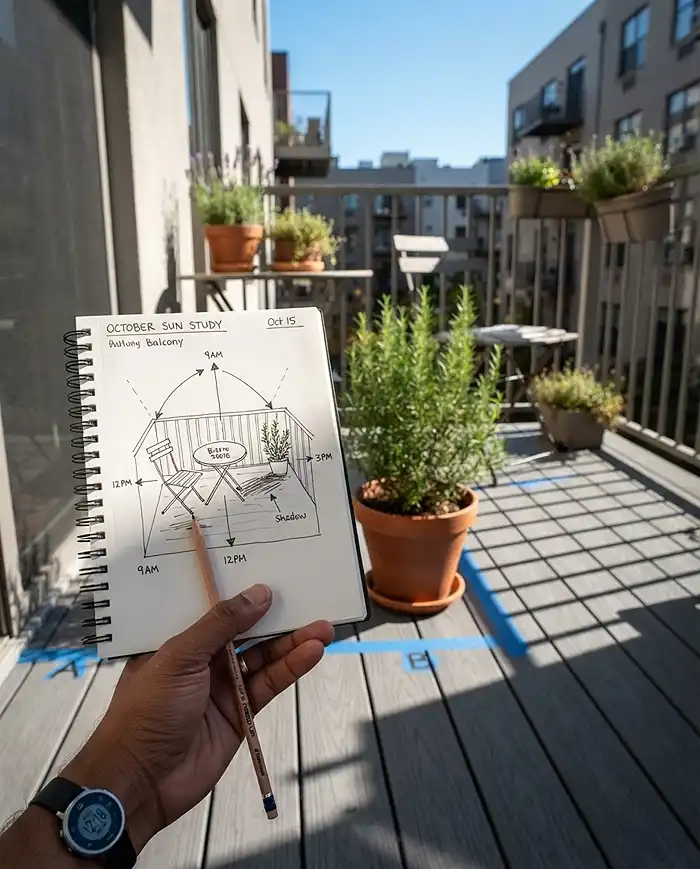
The sun sits much lower in the sky by September. A spot that got six hours of direct sun in June might only get three by October because the building shadow now cuts across at a different angle.
Spend three days marking where the sun actually hits your table between 9 AM and 3 PM. Olive trees and rosemary need a hard minimum of six hours of direct sun to stay healthy. If your table only gets four, move it toward the balcony railing.
I learned this the hard way when my ‘Tuscan Blue’ rosemary went woody and gray in October two years ago. It had shifted into shade I hadn’t noticed. Moving the whole setup eight inches forward fixed it immediately.
Pro tip: Use a free sun-tracking app like Sun Seeker to preview October sun angles before you commit to a table position.
Wind Protection and Thermal Mass for Chilly Evenings
Autumn wind is the real enemy of a Mediterranean balcony garden. It desiccates leaves faster than cold does, and on exposed apartment balconies, gusts can snap brittle rosemary stems or topple tall pots.
Position your table in the corner where two balcony walls meet. That right angle cuts wind from two directions and creates a surprisingly warm microclimate. Heavy concrete or brick planters along the railing also act as thermal mass — they absorb afternoon heat and slowly release it after sunset.
On my own balcony, a single large concrete planter along the west rail raised the ambient corner temperature by about 4°F on clear autumn nights. That’s often the difference between a frost-nipped sage and a healthy one.
Choosing Authentic Mediterranean Containers and Table Decor
Getting the Tuscan or Grecian vibe right is mostly about material choices. Plastic planters undercut the whole aesthetic. Stick to unglazed terracotta, aged stone, and natural wood, and the space assembles itself visually.
Layering Rustic Terracotta and Olive Wood Accents
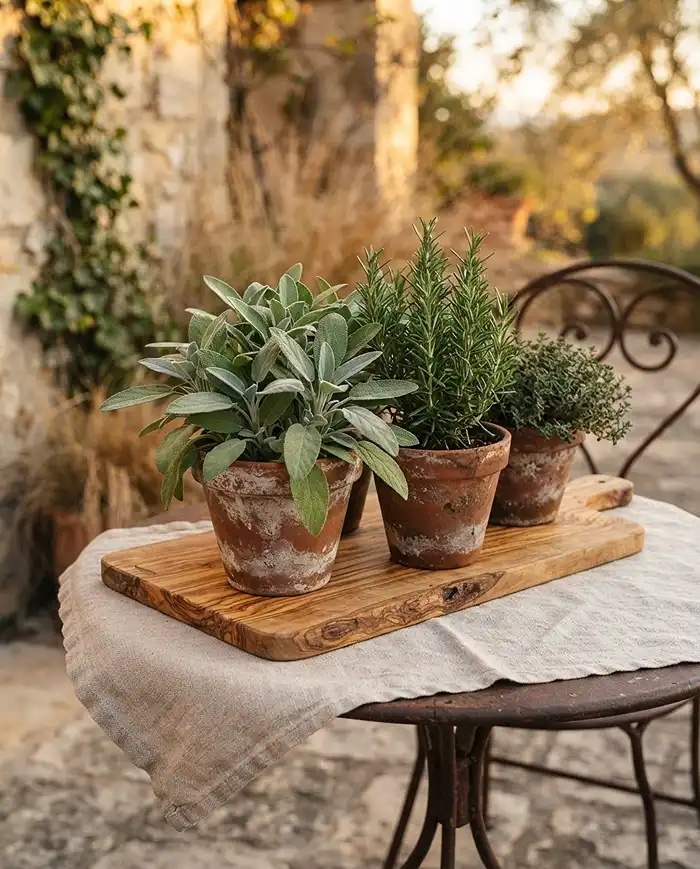
Unglazed terracotta is ideal for Mediterranean herbs in autumn because its porosity prevents water from pooling around roots. Cold, wet roots are the number-one killer of rosemary and thyme in containers — terracotta’s breathability fights that directly.
Mix pot sizes: one 12-inch pot as the centerpiece anchor, two or three 6-inch pots clustered beside it. Use an olive wood serving tray or board flat on the table as a base layer. It grounds the arrangement and protects the table surface.
I picked up a small olive wood board at a kitchen shop for about $18, and it immediately made my bistro table look intentional rather than improvised. Natural variation in the wood grain echoes the silvery texture of herb foliage.
Pro tip: Age new terracotta quickly by rubbing the outside with plain yogurt and leaving it in a shaded spot for a week. The organic matter encourages moss and mineral deposits that look years old.
Adding Cozy Autumn Textiles and Ambient Lanterns
A metal bistro table and hard chairs feel stark in autumn. Two additions fix this: a machine-washable outdoor blanket draped over each chair back, and a battery-operated LED brass lantern on the table.
Choose blankets in terracotta, burnt orange, or deep rust — colors that read as Mediterranean and warm simultaneously. Brands like Pendleton make outdoor-safe wool blends that hold up to morning dew.
For lanterns, avoid open-flame candles on a balcony if your lease prohibits them. A good LED lantern with a warm 2700K color temperature is indistinguishable from candlelight at dinner. The early sunsets of October make ambient lighting genuinely useful by 6 PM.
Check out more autumn balcony garden ideas for additional styling inspiration by season.
Best Cold-Hardy Mediterranean Plants for Autumn Tablescapes
The goal is plants that look architectural, smell amazing, and won’t perish the moment the temperature dips below 40°F. All of the varieties below fit that brief, and most can stay outside through a light frost.
Structural Centerpieces: Dwarf Olive Trees and Potted Fig
An ‘Arbequina’ dwarf olive tree is my first choice for a Mediterranean autumn centerpiece. It stays compact (3-4 feet in a 14-inch container), keeps its silver-green foliage all season, and tolerates overnight lows down to 20°F once established — though container roots need protection below 28°F.
For something with more drama, ‘Little Miss Figgy’ is a dwarf fig variety that tops out around 4 feet. The lobed leaves are unmistakably Mediterranean, and the plant goes into a graceful dormancy in late October rather than dying back ugly.
| Plant | Container Size | Cold Tolerance (roots exposed) | Best Feature |
|---|---|---|---|
| ‘Arbequina’ Olive | 14-16 inch | 28°F | Evergreen, silvery canopy |
| ‘Little Miss Figgy’ | 12-14 inch | 25°F (dormant) | Iconic foliage, compact size |
| ‘Patio’ Columnar Apple | 14 inch | 20°F | Upright form, fall fruit |
Pro tip: Wrap the outside of the container — not the plant — in burlap when overnight temps drop below 28°F. The roots are more vulnerable than the canopy in pot culture.
Aromatic Frost-Tolerant Herbs: Rosemary, Thyme, and Sage
Woody Mediterranean herbs are the workhorses of an autumn balcony garden. They look beautiful, they’re cold-hardy, and you can harvest them directly onto the dinner table. Rosemary, thyme, and sage are your core three.
- Rosemary ‘Tuscan Blue’ — upright form, very fragrant, hardy to 10°F in-ground (protect containers below 20°F). Reaches 18 inches in a 10-inch pot.
- Creeping Thyme ‘Elfin’ — low, cascading habit that spills beautifully over pot edges. Hardy to -30°F. Tiny pink flowers persist into October.
- Broad-leaf Sage ‘Berggarten’ — large silvery leaves, more ornamental than culinary sage. Hardy to 0°F in containers. Stunning paired with terracotta.
All three are perennials that get better with age. My ‘Berggarten’ sage is three years old now and looks like a small shrub — it’s the most reliable thing on my autumn table setup every single year.
A light frost (28-32°F) won’t faze any of these. Where most people go wrong is overwatering in autumn. Cut back to watering only when the top inch of soil is bone dry once October arrives.
Pro tip: Harvest herbs by pinching stems right before cooking, not by cutting large branches. Frequent small harvests keep the plants compact and bushy — exactly what you want visually on a small balcony garden setup.
Cool-Weather Floral Accents for a Pop of Color
Silver-green herb foliage is beautiful but monochromatic. Cyclamen and violas inject jewel-toned color that lasts from September through the first hard freeze.
Hardy Cyclamen hederifolium tolerates temperatures down to 14°F and produces pink or white flowers from September through November with almost no care. Violas in deep purple or russet orange echo the warm autumn palette perfectly and handle light frosts with ease.
Tuck two or three 4-inch viola pots around the base of your centerpiece olive tree. The color contrast between violet blooms and silver sage foliage is genuinely striking — and both plants are available at most garden centers through October as of autumn 2024 and 2025.
Step-by-Step Guide to Assembling Your Mediterranean Table Setup
Assembly order matters. Start with the base layer and work upward so nothing gets knocked over or shoved aside during setup.
- Lay the linen runner — use a weather-resistant outdoor linen in natural or cream. This anchors the arrangement and defines the space.
- Place the olive wood tray slightly off-center, toward one end of the table. This is your staging platform for the pots.
- Position the tallest centerpiece (olive tree or fig) at the back of the tray. It should be the visual anchor — everything else scales down from it.
- Cluster three herb pots asymmetrically in front of and beside the centerpiece. Use the rule of threes: one taller, one medium, one low-spreading.
- Fill gaps with viola or cyclamen pots to add ground-level color. Set these directly on the table runner, not on the tray.
- Place the lantern at the opposite end of the tray from the centerpiece to balance visual weight and spread the warm glow.
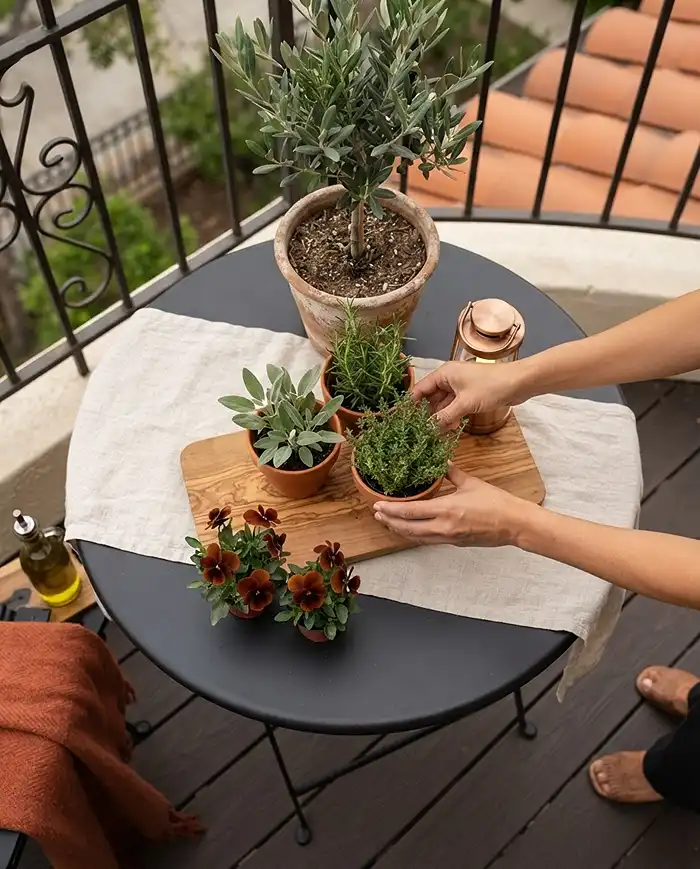
Step back and look from the dining chair perspective. The arrangement should feel layered, not cluttered. If it feels busy, remove one herb pot — less is almost always more with a mediterranean balcony garden table setup.
Autumn Maintenance for Tabletop Mediterranean Plants
The biggest mistake people make in fall is treating their plants the same as they did in August. Mediterranean plants evolved in summer-dry climates — autumn rain and dropping temperatures demand a completely different care approach.
Adjusting Watering Routines for Dropping Temperatures
As temperatures drop, soil evaporation slows dramatically. What took three days to dry out in August might take ten days in October. Overwatering is the leading cause of root rot in autumn container gardens.
Switch to the finger test as your only watering cue: push your finger two inches into the soil. Water only if it’s completely dry at that depth. For shallow tabletop pots (under 8 inches deep), you may only need to water once every 10-14 days in October.
Completely stop any liquid fertilizer by September 1st. Pushing new growth heading into cold weather leaves plants vulnerable to frost damage on tender young shoots.
Pro tip: Lift your pots. A wet pot is noticeably heavier than a dry one. After a few weeks, you’ll develop an intuitive sense of when water is actually needed without guessing.
Pruning and Harvesting Herbs for Fall Dining
Autumn herbs don’t need formal pruning — they need regular harvesting. Pinching stems before meals encourages bushy, compact growth that looks better on the table and keeps plants from getting leggy.
- Harvest rosemary by snipping 2-3 inch stem tips. Never take more than one-third of the plant at once.
- Pick thyme by stripping leaves from the bottom inch of stems upward. This naturally thins the plant and improves airflow.
- Harvest sage leaves individually from the outer growth. Leave the woody central stems intact — they’re the plant’s overwintering structure.
I keep a small pair of herb scissors on the table permanently in autumn. Guests love snipping their own rosemary directly into the olive oil dish — it makes the whole apartment balcony garden idea feel genuinely interactive.
Common Problems and Solutions
Most autumn balcony failures come down to two things: terracotta cracking in freezes and cold shock on the centerpiece trees. Both are preventable once you know what to watch for.
Terracotta Pots Cracking in Freezing Weather
Unglazed terracotta is porous. When autumn rain saturates the clay and temperatures then drop below freezing, the water inside expands and shatters the pot from within. It happens overnight and is permanent.
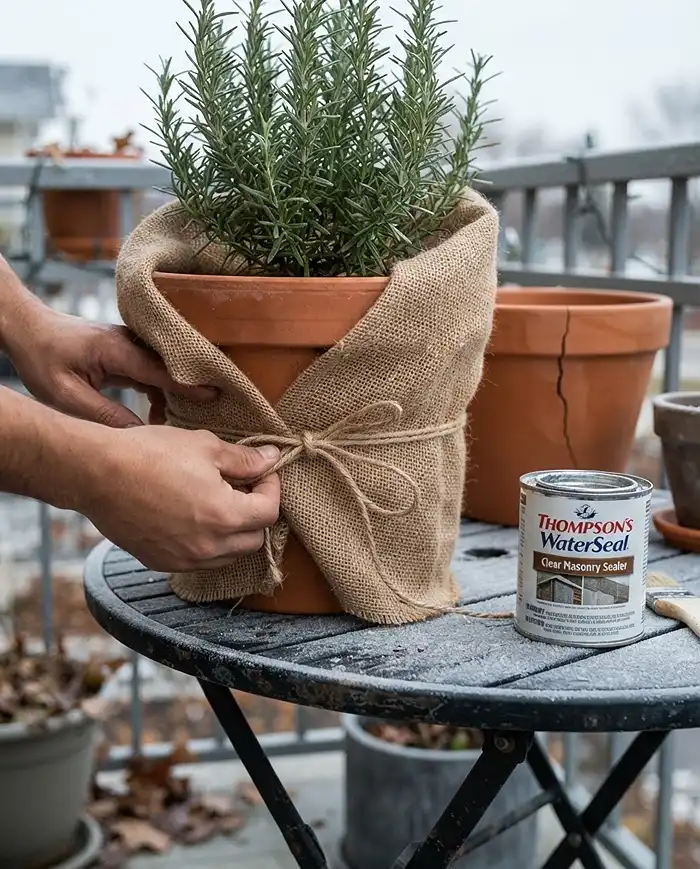
Two solutions: apply a clear masonry sealer to the outside of the pot before autumn rains start, which dramatically reduces water absorption. Or simply bring small tabletop pots (under 10 inches) indoors when overnight temperatures are forecast to drop below 28°F.
For renters who can’t store much inside, check out fall balcony ideas for renters for practical space-saving protection strategies.
Cold Shock and Leaf Drop on Mediterranean Centerpieces
Cold shock on a dwarf olive or fig shows up as sudden yellowing and mass leaf drop within 48-72 hours of an unexpected freeze. It looks alarming but isn’t always fatal if you act fast.
The emergency protocol: wrap the container (not the canopy) in horticultural fleece or burlap immediately. Move the pot against the warmest wall. If indoor space allows, bring the plant inside to a cool, sunny room — an unheated garage or spare bedroom near a window works well.
Don’t prune back cold-damaged growth until spring. Dead-looking stems sometimes resprout from the base once temperatures warm again. Cutting too early removes that potential.
fall Mediterranean balcony ideas FAQs
Can I leave my potted olive tree on the table outside all winter?
Mature olive trees tolerate light freezes down to around 20°F, but the exposed root systems in shallow tabletop containers are far more vulnerable than in-ground roots. In USDA Zones 7 and below, move the container to a sunny, unheated room before the first hard frost. A garage with a south-facing window or a cool spare room works well.
What is the best potting soil for autumn Mediterranean herbs?
Blend a premium organic potting mix with at least 30% coarse horticultural sand or pumice. This guarantees fast drainage — cold, damp autumn roots are highly susceptible to root rot. Never use straight garden dirt in containers, as it compacts and holds moisture too long for Mediterranean plants.
How do I protect my balcony table from water rings and stains?
Never place unglazed terracotta saucers directly on wood or metal table surfaces. The porous clay sweats moisture and leaves permanent rings. Instead, use glazed ceramic saucers elevated on small rubber pot feet. This allows air circulation under the pot and completely eliminates water transfer to the table.
Which Mediterranean herbs survive the coldest autumn nights?
Thyme is the most cold-hardy, surviving temperatures as low as -30°F. Rosemary and sage handle down to around 10-20°F in containers with some protection. All three are perennials that will return stronger each spring if their roots don’t freeze solid.
Can I build a Mediterranean balcony garden in a small apartment balcony?
Absolutely. A small balcony garden is actually ideal for this style — the tight space makes clustering pots around a bistro table feel intentional rather than cramped. Focus on one structural centerpiece, two to three herb pots, and a color accent. Vertical space with a wall trellis can extend the setup without adding floor footprint.
Key Takeaways
- The best fall Mediterranean balcony ideas combine cold-hardy structural plants like ‘Arbequina’ olive or ‘Little Miss Figgy’ with woody herbs and seasonal color accents like cyclamen or violas.
- Audit your balcony’s autumn sun angle before positioning your table — a spot that was sunny in summer may be in shadow by October.
- Unglazed terracotta is ideal for Mediterranean root health but must be sealed or moved indoors when temperatures drop below 28°F to prevent cracking.
- Cut watering dramatically in autumn and stop fertilizing by September 1st — overwatering in cool weather causes more herb deaths than frost does.
- Olive wood trays, weather-resistant linen, and warm-toned outdoor blankets are the styling foundation of an authentic mediterranean balcony garden table setup — and they work in even the smallest apartment balcony garden space.