

Best Windowsill Herbs to Grow at Home
The best windowsill herbs for balcony gardeners aren’t just nice to have — they’re a lifeline. One late frost, one brutal hailstorm, and your outdoor herb garden ideas can vanish overnight.
I grow herbs on a south-facing balcony in zone 6b, and I’ve lost entire basil crops to a single unexpected September cold snap. A well-planned indoor backup changes everything.
Table of Contents
Why Every Balcony Gardener Needs a Windowsill Backup
Urban microclimates are brutal and unpredictable. Buildings funnel wind into turbocharged gusts. Reflected heat from concrete can spike temperatures 15°F above the official forecast. Then a cold front rolls in and wipes everything out.
In spring 2023, I watched a neighbor lose every herb on her small balcony garden to a freak late-May frost. She had no backup. The season’s fresh supply was gone in one night.
A windowsill collection running parallel to your balcony setup solves this completely. You get continuous harvests regardless of what happens outside. It also extends your growing season by weeks on both ends of the calendar.
Think of it as crop insurance. You don’t hope you won’t need it — you build it before disaster strikes.
Assessing Your Windowsill Microclimate
Before you move a single pot indoors, audit your windows. Glass filters UV wavelengths that herbs depend on. Radiators and drafts create temperature swings that no outdoor plant ever experiences.
Treating your windowsill like a miniature outdoor balcony is the fastest path to dead herbs. They are genuinely different environments.
Measuring Sunlight and Window Direction
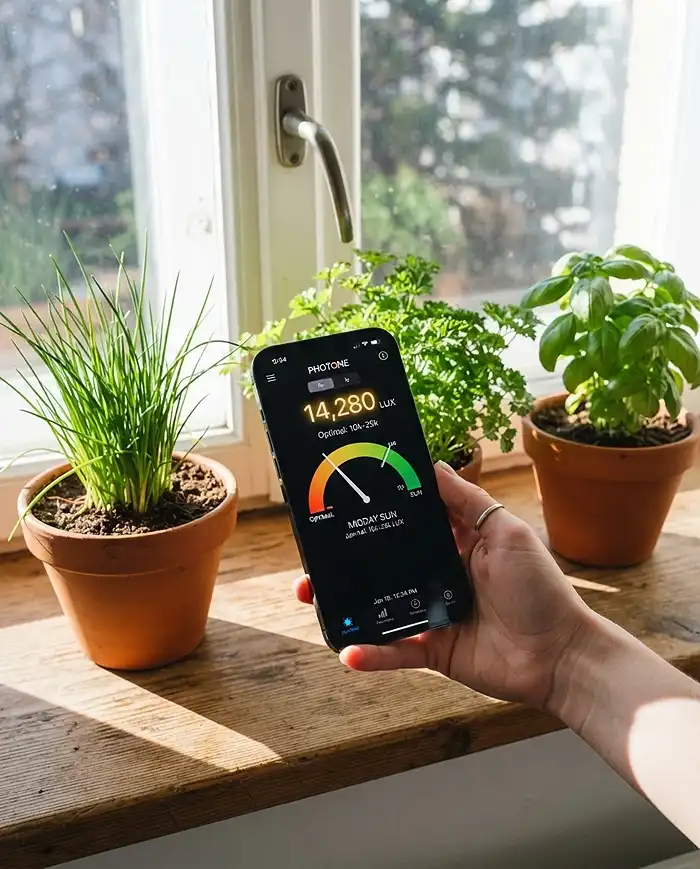
Quick Answer: South-facing windows are the gold standard for container herbs indoors. West-facing works well for most varieties. East-facing suits shade-tolerant herbs only. North-facing without a grow light won’t sustain culinary herbs through winter.
Use a basic light meter app (Lux Meter works well on iOS and Android) to measure foot-candles at the windowsill at noon. Most Mediterranean herbs need 800+ foot-candles to produce flavourful essential oils.
Track your readings for three consecutive days. Buildings, trees, and neighboring structures create shade patterns that shift dramatically with the season. What works in July may fail completely by November.
Pro Tip: Clean your windows in autumn — a film of city grime can block up to 20% of available light.
Managing Drafts, Radiators, and Indoor Humidity
Quick Answer: Central heating drops indoor relative humidity to 20–30% in winter — far below the 40–60% most herbs prefer. A pebble humidity tray costs almost nothing and fixes this immediately.
Hold a damp hand near the window frame on a cold day. Feel cold air seeping in? That draft will rot herb roots at the base. Use self-adhesive foam weather seal to close gaps before positioning any pots.
Keep pots at least 6 inches from radiators. The radiant heat desiccates soil and scorches lower leaves within days.
- Fill a shallow tray with pebbles, add water just below the pebble surface, and set pots on top
- The evaporation lifts ambient humidity by 10–15% immediately around the plants
- Top up the tray every 2–3 days — it evaporates faster than you’d expect in a heated room
Best Herbs for Indoor Windowsill Gardens
Not every herb makes a good indoor performer. Woody Mediterranean varieties demand intense sun. Tender tropicals hate cold glass. Knowing which container herbs are genetically suited for low-light, dry-air conditions saves you a lot of frustration.
Here’s a reliable breakdown by light tolerance as of winter 2024–25:
| Herb | Minimum Light | Best Window | Watch Out For |
|---|---|---|---|
| Chives | 4 hrs direct | East or South | Overcrowding |
| Mint | 4 hrs direct | East or West | Root-bound quickly |
| Flat-leaf Parsley | 5 hrs direct | South or West | Slow germination |
| Thyme | 6 hrs direct | South only | Root rot in wet soil |
| Oregano | 6 hrs direct | South only | Loses flavour in low light |
| Rosemary | 6+ hrs direct | South only | Powdery mildew indoors |
| Basil ‘Globe’ | 6 hrs direct | South, warm sill | Cold windowsill temps |
Low-Light Survivors: Chives, Mint, and Parsley
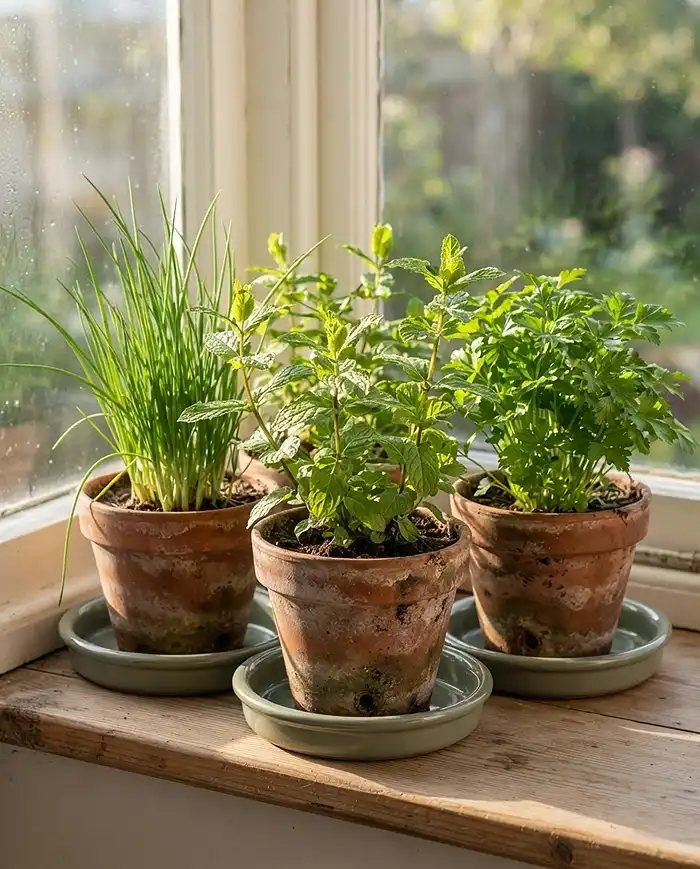
Quick Answer: Chives, mint, and parsley are the most forgiving best windowsill herbs for lower light situations. They’ll produce a usable harvest from east-facing or partially obstructed windows where Mediterranean herbs would give up.
Chives (‘Garlic Chives’ and the standard Allium schoenoprasum) tolerate as little as 4 hours of direct light. I’ve kept them productive on a partially shaded east-facing kitchen sill through January in zone 6b — not lush, but enough for regular harvesting.
Mint is a prolific root grower. Keep it in its own pot — it will invade neighboring containers within weeks.
For parsley, choose ‘Italian Giant’ flat-leaf over curly types. Flat-leaf produces more essential oils and handles indoor dryness better. Start from transplants rather than seed indoors — germination takes up to 4 weeks and seedlings are fragile in low-light conditions.
Pro Tip: Divide outdoor chive clumps in September, pot up the divisions, and let them establish for 2 weeks on the balcony before bringing them inside. They’ll transition far better than freshly dug plants.
Sun-Loving Mediterranean Herbs: Thyme, Oregano, and Rosemary
Quick Answer: Thyme, oregano, and rosemary need your brightest south-facing window and sharply draining soil. Without 6+ hours of strong direct light, they produce weak, flavourless growth that isn’t worth harvesting.
These are woody, drought-tolerant herbs that have evolved in rocky, sun-drenched Mediterranean hillsides. Replicating that indoors is ambitious, but doable with the right setup.
I grow ‘Broadleaf English’ thyme on my south-facing windowsill from October through April. It’s not vigorous, but it stays alive and harvestable. The key is the soil mix — see the supplies section below.
Rosemary is the trickiest of the three. ‘Arp’ and ‘Tuscan Blue’ are the most cold-tolerant cultivars and adapt best to indoor container conditions. Watch for powdery mildew — the low humidity that harms other herbs actually helps rosemary, but poor air circulation around the dense foliage causes fungal issues.
Pro Tip: Give rosemary a 15-minute outdoor airing once per week (weather permitting) to improve air circulation and reduce fungal pressure.
The Basil Challenge: Growing Tender Herbs Indoors
Quick Answer: Standard sweet basil is notoriously hard indoors. Choose compact varieties like ‘Globe’ or ‘Spicy Globe’ basil — their dense, small-leaf structure handles tight pots and dry air far better than large-leaf types.
The core problem with basil indoors is cold windowsill glass. Basil is a tropical plant and suffers physiological damage below 50°F. Even if the room is warm, the sill itself can sit 10–12°F colder on a winter night.
Slip a folded tea towel under the pots at night to insulate them from cold glass. It sounds basic, but it genuinely works.
For a deeper look at the best indoor herbs to grow on a windowsill, including basil variety comparisons, that guide covers the full spectrum.
Essential Supplies for Indoor Herb Success
Your outdoor balcony herb setup and your indoor windowsill setup need completely different kit. The biggest mistake new indoor growers make is using the same heavy soil and large containers they use outside.
Waterlogged roots kill more indoor herbs than any disease or pest. Get the fundamentals right before you bring a single plant inside.
Choosing the Right Pot Size and Drainage
Quick Answer: Use 4-to-6-inch unglazed terracotta pots with at least one large drainage hole. Terracotta wicks excess moisture through its walls, giving roots the breathable environment they need indoors where evaporation is slow.
Glazed ceramic or plastic pots hold moisture for far too long in low-light indoor conditions where the soil barely dries between waterings.
- Match saucer size exactly to the pot — undersized saucers overflow and damage window ledges
- Use glazed saucers, not terracotta, so water doesn’t wick through onto furniture
- For mint, go up to an 8-inch pot — it roots aggressively and goes root-bound fast
- Group pots close together to create a microclimate with slightly higher humidity
Formulating a Fast-Draining Indoor Soil Mix
Quick Answer: Mix a sterile indoor potting compost with 30% perlite by volume. Add a small handful of coarse horticultural sand per pot. This creates a fast-draining mix that mimics the rocky soil Mediterranean container herbs evolved in.
Never bring outdoor garden soil inside. It compacts completely in a pot, destroys root aeration, and introduces fungus gnats, slugs, and other pests into your home.
The 30% perlite ratio is the floor, not the ceiling. For thyme and rosemary, I push it to 40% perlite. Those two genuinely need near-perfect drainage to survive indoors through winter.
Pro Tip: Spread a thin layer of horticultural grit or coarse sand over the soil surface. It dries out quickly and breaks the fungus gnat breeding cycle before it starts.
Step-by-Step: Moving Balcony Herbs Indoors
You’ve got two options for creating your indoor backup: bring mature plants inside, or propagate fresh cuttings. Each method suits different herbs and different timing windows.
For a full guide to planning your outdoor setup before the transition, the balcony herb garden ideas guide covers seasonal planning in detail.
Taking Stem Cuttings vs. Transplanting Root Balls
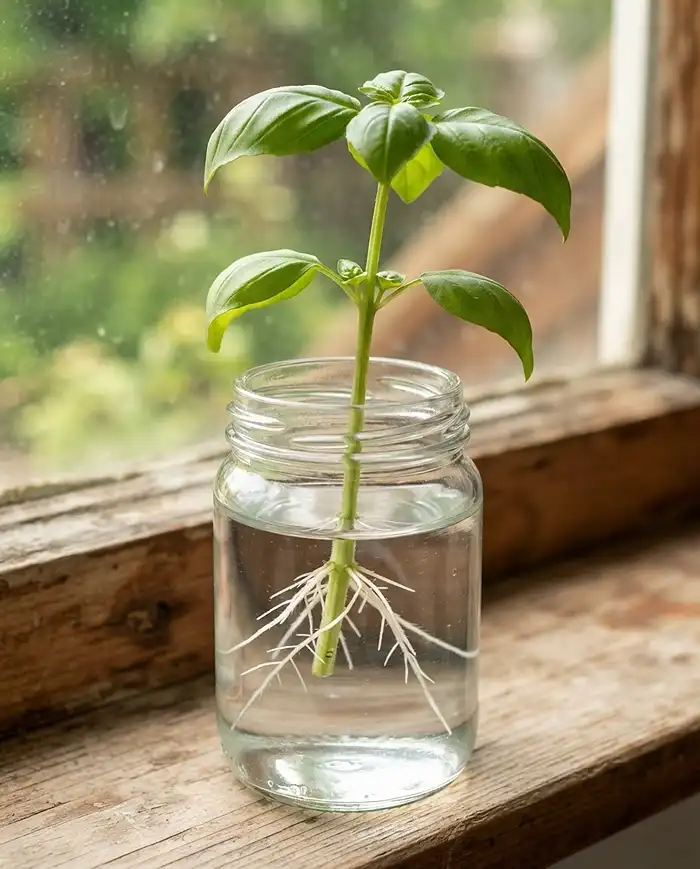
Quick Answer: Take softwood stem cuttings for basil and mint — root them in a glass of water in 7–14 days. Divide and pot up mature root balls for chives and oregano, which establish faster from divisions than from cuttings.
For stem cuttings: snip a 4-to-6-inch non-flowering tip just below a leaf node. Strip the lower leaves, leaving 2–3 sets at the top. Stand in a jar of water on a warm windowsill. Change the water every 2 days. Roots appear in 7–14 days for basil, 5–10 days for mint.
For root ball division: in early September, dig up outdoor chive clumps and split them into fist-sized sections. Pot each section into a 5-inch terracotta pot using the fast-draining mix above. Water once, then leave them to settle for 2 weeks on the balcony before the indoor move.
Pro Tip: Cut divisions to roughly half their original height when potting up. It reduces transplant shock and encourages the plant to push energy into root establishment rather than maintaining excess foliage.
Pest-Quarantine Protocol for Outdoor Plants
Quick Answer: Quarantine every plant brought in from the balcony for two full weeks in a room away from your other houseplants. Wash all foliage with a diluted Castile soap solution before the quarantine begins.
Aphids, spider mites, and fungus gnat eggs hitchhike indoors on the undersides of leaves and in outdoor soil. One unquarantined plant can infest an entire indoor herb collection within weeks.
Quarantine protocol, step by step:
- Mix 1 teaspoon of unscented Castile soap per litre of water in a spray bottle
- Spray all leaf surfaces top and bottom, then wipe down with a damp cloth
- Repot into fresh indoor mix — do not bring outdoor soil inside
- Isolate in a bright but separate room for 14 full days
- Check undersides of leaves daily — treat any sign of pests before the 14 days is up
This step feels overly cautious until the one time you skip it. I lost an entire indoor herb collection to spider mites in January 2022 because I rushed a rosemary indoors without quarantine.
Indoor Herb Maintenance and Harvesting
Indoor herbs have a slower metabolism than their wind-battered balcony counterparts. They need less water, less fertiliser, and more rotation. Adjust your maintenance routine the moment plants cross the threshold — don’t carry over outdoor habits.
For a broader look at managing both indoor and outdoor setups simultaneously, the indoor-outdoor herb pot guide is a useful companion reference.
Adjusting Watering for Indoor Environments
Quick Answer: Use the finger-test method exclusively for indoor container herbs. Push your finger 1 inch into the soil — only water if it’s dry at that depth. Overwatering is the leading cause of windowsill herb death.
Outdoors, wind and sun evaporate moisture quickly. Indoors, soil can stay damp for 4–7 days between waterings, depending on pot size and room temperature. A pot that needs daily watering on a July balcony may need watering only twice a week indoors in December.
When you do water, water thoroughly — until it drains from the bottom — then stop. Sipping small amounts daily keeps the top layer perpetually moist and encourages shallow roots and fungus gnats.
Common Problems and Solutions
Two problems hit indoor windowsill herb growers hardest: fungus gnats in the soil and etiolation from low light. Both are fixable once you know what you’re looking at.
Fungus Gnats in Indoor Soil
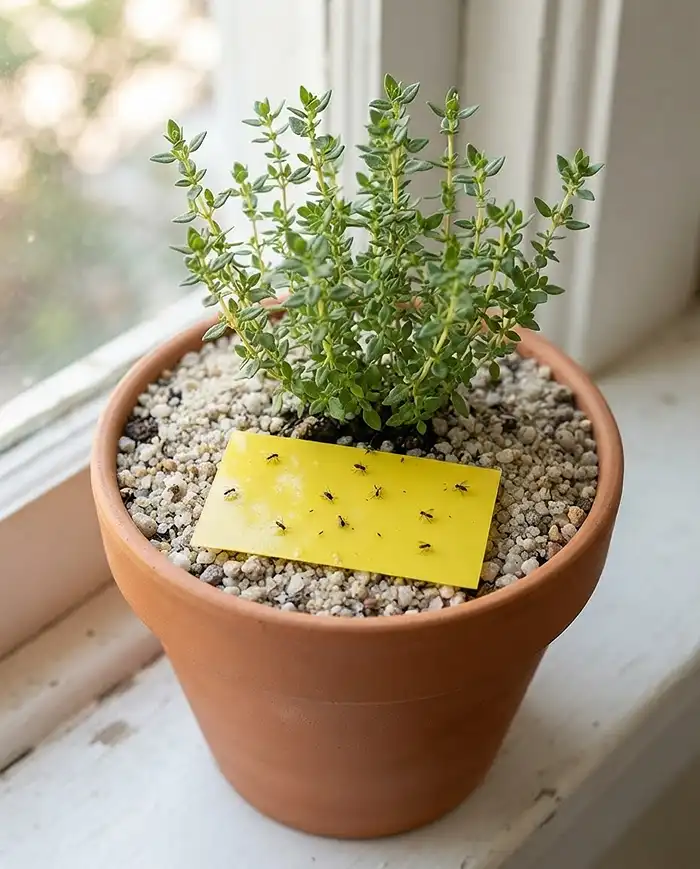
Quick Answer: Fungus gnats breed in persistently damp topsoil. Let the top inch of soil dry completely between waterings and use Bacillus thuringiensis israelensis (BTi) mosquito dunk tea to kill larvae in the root zone.
Make BTi tea by soaking one mosquito dunk ring in a gallon of water overnight. Use this as your regular watering solution for 2–3 weeks. It kills the larvae biologically without harming the plants, beneficial insects, or humans.
Set yellow sticky traps horizontally at soil level to catch adults. The combination of larval BTi treatment plus adult trapping breaks the cycle in 3–4 weeks. You can find BTi dunks at most garden centres or from suppliers like the RHS pest guidance pages for UK gardeners.
Leggy, Weak Growth from Low Light
Quick Answer: Etiolation — pale, stretched stems reaching toward the glass — signals inadequate light. Pinch back the top two sets of leaves immediately to force bushy growth, and rotate pots 90 degrees every three days.
Etiolated stems won’t recover their original compact form. But aggressive pinching redirects the plant’s energy into new lateral growth, which will emerge more compact if light improves.
Rotation is non-negotiable. The side facing the glass receives dramatically more light than the back. Without rotation, plants grow lopsided and the shaded side weakens badly within 2–3 weeks.
best windowsill herbs FAQs
Do I need a grow light for my windowsill herbs?
If your only available window faces north or is heavily shaded by adjacent buildings, a grow light is mandatory — not optional. Choose a full-spectrum LED panel delivering at least 2,000 lux at plant level. Run it for 14 to 16 hours daily to compensate for the missing natural light. Compact clip-on grow lights work well for a small windowsill setup without requiring new shelving.
Why are my indoor herb leaves turning yellow and dropping?
Yellowing base leaves that drop quickly are the classic symptom of root suffocation from overwatering or missing drainage holes. Check the drainage first — if water sits in the saucer for more than 30 minutes after watering, the root zone is staying too wet. Repot immediately into fresh, dry fast-draining soil and terracotta pots with clear drainage holes.
Can I keep my windowsill herbs in the kitchen next to the stove?
No. Cooking generates wild temperature swings and coats leaf surfaces with airborne grease that clogs the stomata herbs use to breathe and photosynthesize. Keep herbs on a separate well-ventilated windowsill well away from the cooking zone, then bring individual pots to the kitchen bench only when harvesting.
How often should I fertilise indoor windowsill herbs?
Indoor herbs in low winter light have very slow metabolisms and need minimal feeding. Apply a balanced liquid fertiliser at half the recommended strength once every four weeks from October through February. Increase to every two weeks from March onward as light levels and growth rates improve. Overfeeding in low light produces soft, flavourless growth that is susceptible to pest attack.
Can I use my indoor windowsill herbs as a pollinator container garden?
Indoors, most windowsill herbs won’t attract pollinators since bees and hoverflies don’t typically enter homes. However, if you let chives and oregano flower in a sunny outdoor spot before bringing cuttings inside, the flowers support pollinators outdoors. For a dedicated pollinator container garden, keep a separate outdoor pot of flowering herbs on the balcony year-round alongside your indoor backup collection.
Key Takeaways
- The best windowsill herbs for balcony backup are chives, mint, parsley, thyme, oregano, and compact basil varieties — chosen by your available light direction.
- Audit your window’s light hours, draft exposure, and distance from radiators before positioning a single pot — the indoor environment is genuinely different from your small balcony garden.
- Use 4-to-6-inch unglazed terracotta pots with a 30% perlite soil mix to prevent the root waterlogging that kills most indoor herbs.
- Quarantine every plant brought in from the balcony for two full weeks and wash all foliage with diluted Castile soap to block pest introduction.
- Switch to the finger-test watering method immediately — indoor herb garden ideas fail most often from overwatering, not neglect.