

Tall Balcony Planters for Privacy That Work
Tall balcony planters for privacy are the smartest upgrade a renter can make — no drilling, no permits, just a lush living wall that blocks neighbors and softens city noise instantly.
I grow a row of Fargesia ‘Rufa’ bamboo in 30-inch fiberglass troughs on my east-facing apartment balcony in zone 7a. By mid-June, I’m completely invisible from the unit next door. No tools, no landlord drama.
Table of Contents
Creating a Private Urban Oasis with Tall Balcony Planters
A well-placed row of tall planters does something a lattice panel never can — it moves. Leaves rustle, canes sway, and the whole setup feels alive rather than fenced-in.
The architectural effect is instant. Line four matching rectangular troughs along your railing, plant them densely, and you’ve built a living wall that also absorbs sound, filters dust, and adds serious curb appeal from the street below.
Best of all, it’s fully removable. This is the foundation of any balcony garden built for renters — no permanent modifications, no security deposit risk.
Pre-Planning Your Balcony Privacy Screen
Before you buy a single planter, spend 20 minutes on two things: check your lease for container or weight restrictions, and look up your building’s structural specs if you can get them.
A four-foot trough filled with wet soil and a mature bamboo plant can easily weigh 80–120 lbs. Multiply that by six planters and you’re adding serious load to a structure that was designed for furniture, not garden beds.
Assessing Wind Load and Structural Weight Limits
Tall rectangular containers act like sails. A 4-foot planter filled with dense bamboo catches wind the same way a billboard does — and in a summer thunderstorm, it can topple.
Most residential balconies in the US are engineered for 40–60 lbs per square foot. A single 36-inch trough with wet soil and a large plant can hit 100 lbs. Cluster six of them and you’re looking at serious structural math.
Contact your building manager for load specs if you’re unsure. If you can’t get numbers, stick to lightweight containers and keep planters positioned directly over load-bearing beams near the wall, not at the outer railing edge.
Mapping Sunlight and Microclimate Conditions
Spend one full day watching your balcony before you choose plants. Mark where the sun hits at 9am, noon, and 4pm. Most balconies get fewer hours of direct light than gardeners expect because the overhang above blocks the sky.
Also check for wind tunnels. Urban balconies between buildings can generate brutal crosswinds that shred leaves and dry out soil in hours. A north-facing balcony in deep shade needs completely different plants than a south-facing one baking in full sun.
For apartment balcony garden ideas to actually work, your plant choices have to match the real microclimate — not the one you wish you had.
Choosing the Right Tall Containers for Balconies
The planter itself matters as much as the plant. You need something tall enough to give roots room, narrow enough to preserve floor space, and light enough not to wreck your balcony structure.
Stick to trough-style planters — rectangular, 24 to 36 inches tall, and no wider than 12 to 14 inches front-to-back. They line up flush against railings, maximize planting depth, and look intentional rather than improvised.
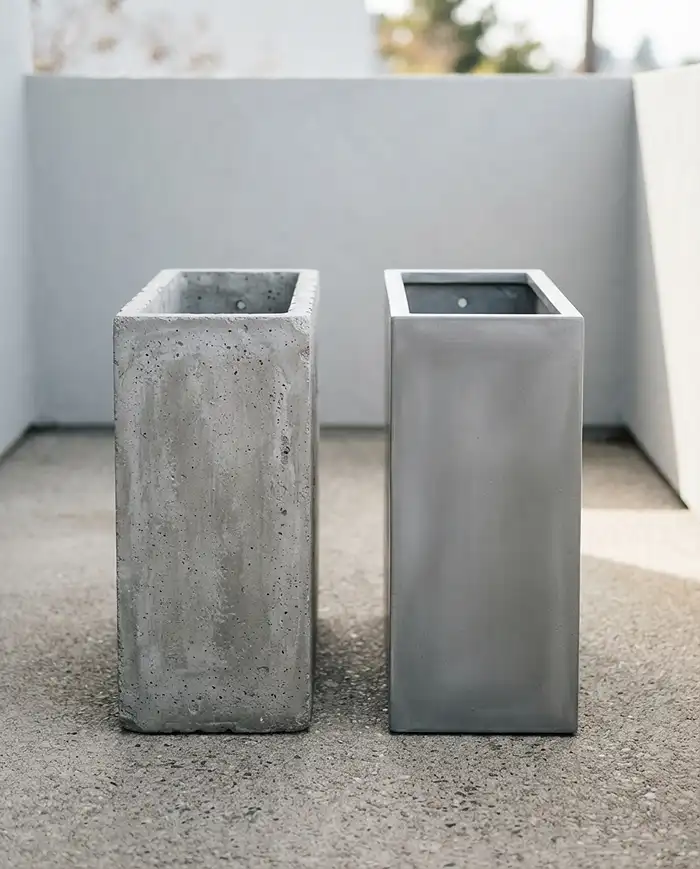
Fiberglass and Lightweight Resin Troughs
Fiberglass and double-walled resin troughs are the go-to for balcony privacy screens. They look like concrete or lead — genuinely architectural — but weigh a fraction as much.
A 36-inch concrete trough can weigh 90 lbs empty. The same size in fiberglass comes in at 8–12 lbs. That difference matters enormously when you’re stacking six planters on a structure with weight limits.
Brands like Veradek, Mayne, and Crescent Garden make commercial-grade resin troughs that hold up through zone 5 winters without cracking. Avoid cheap thin-walled plastic — it warps, fades, and fails within two seasons.
Self-Watering Systems for Deep Pots
Deep containers don’t water evenly. The top 6 inches dry out in a day while the bottom 12 inches stay saturated — and roots rot in the wet zone while the canopy wilts in the dry one.
Self-watering containers solve this with a bottom reservoir that wicks moisture up through the soil by capillary action. The plant draws water as it needs it, not as you guess it does.
In August, a 30-inch trough planted with Karl Foerster grass can transpire over a gallon of water a day. Without a reservoir, that means daily deep watering — or a dead screen by mid-month.
I switched to self-watering inserts in my Fargesia troughs two summers ago. I went from watering every day to every 3–4 days during heat waves. That alone was worth the upgrade.
Pro tip: If your containers don’t have built-in reservoirs, add a self-watering insert kit from Pathonor or Santino. They retrofit into most standard rectangular troughs.
Best Privacy Plants for Tall Balcony Containers
The best screening plants grow fast, stay upright, fill in densely, and don’t mind life in a container. That rules out most trees and many large shrubs, which resent root restriction and become stressed — then ugly — within a season or two.
Prioritize plants with a naturally clumping, columnar, or vining habit. Avoid anything that spreads aggressively at the root, since containment in a trough will stress it into decline.
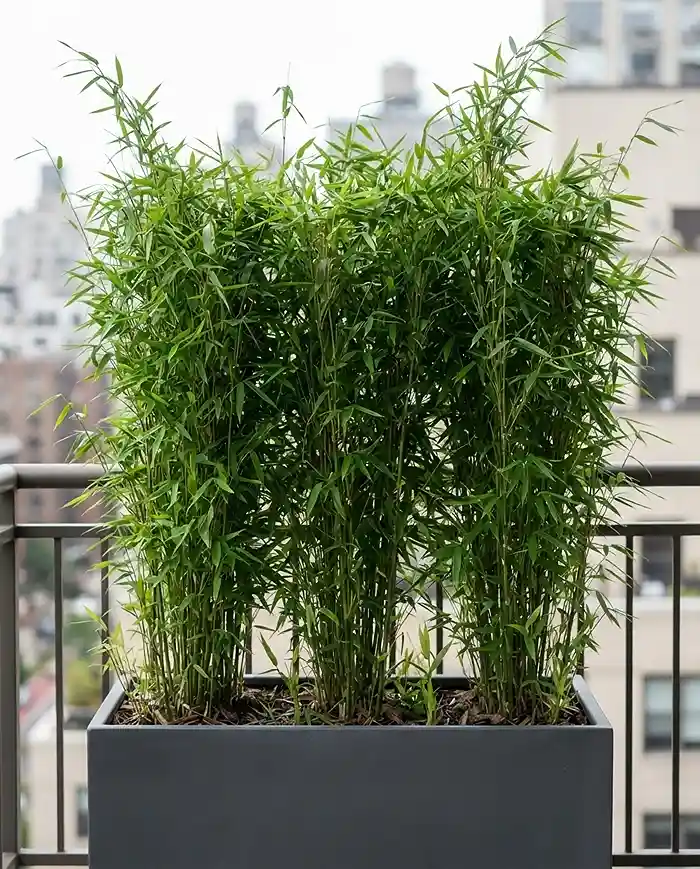
Clumping Bamboos for Modern Screens
Non-invasive clumping bamboos are the gold standard for balcony privacy. Unlike running bamboos — which will escape any container and colonize your neighbors’ space — clumping varieties stay tightly bunched and actually thrive in deep troughs.
Fargesia ‘Rufa’ and Fargesia ‘Scabrida’ are the two I recommend for most zones (5–9). Both reach 6–8 feet in a container, produce dense arching canes, and stay evergreen through mild winters.
They also filter wind better than a solid screen. Instead of creating a pressure wall that tries to blow over, the canes flex and dissipate the gust. As of spring 2025, 3-gallon Fargesia starts are widely available at specialty nurseries and online at FastGrowingTrees.com.
Pro tip: Plant three Fargesia per 30-inch trough for a solid visual block by the end of the first season.
Upright Ornamental Grasses and Evergreens
‘Karl Foerster’ feather reed grass is my second-most-used balcony screening plant. It’s strictly upright, reaching 5–6 feet tall, and the seed heads add movement and texture from July through December.
It does go dormant in winter, which is the honest tradeoff. If year-round screening matters to you, pair it with ‘Emerald Green’ Arborvitae in alternating planters.
‘Emerald Green’ Arborvitae grows slowly — about 3–6 inches per year — but stays dense, narrow (under 3 feet wide), and evergreen in zones 3–8. In a 36-inch trough, it holds well for 3–4 years before root-binding becomes an issue.
| Plant | Height in Container | Zones | Winter Interest |
|---|---|---|---|
| Fargesia ‘Rufa’ | 6–8 ft | 5–9 | Evergreen |
| ‘Karl Foerster’ Grass | 5–6 ft | 5–9 | Seed heads persist |
| ‘Emerald Green’ Arborvitae | 4–6 ft (slow) | 3–8 | Evergreen |
| Star Jasmine (trellis) | 4–6 ft | 8–10 | Semi-evergreen |
| Morning Glory (trellis) | 6–8 ft (annual) | All | None (annual) |
Climbing Vines on Container Trellises
For renters in warmer zones (8–10), Star Jasmine on an integrated trellis is the most efficient use of floor space on any small balcony garden. The vine grows up, not out, so a single 14-inch-wide trough can fill a 6-foot vertical panel.
Use a trough with a built-in trellis insert, or zip-tie a freestanding metal trellis directly to the planter. Keep the trellis leaning slightly into the railing rather than away from it — this distributes the wind load back toward the structure.
In cooler zones, swap Star Jasmine for Morning Glory or Scarlet Runner Bean. Both grow 8+ feet in a single season and create a complete visual block by August. They’re annuals, so pull them in fall and replant — no overwintering required.
Pro tip: Weave vines through trellis panels as they grow rather than letting them climb freely. It creates an even, gap-free coverage instead of a lopsided clump at the top.
Step-by-Step Guide to Planting Tall Privacy Screens
Getting the planting sequence right makes the difference between a stable screen and one that topples in July. Follow this order exactly.
- Bottom layer — ballast: Fill the bottom 4–6 inches with heavy drainage material. Coarse gravel or broken clay pot shards work well. This layer lowers the planter’s center of gravity and improves drainage.
- Soil layer — lightweight mix: Fill the rest with a 70/30 blend of quality potting mix and perlite. Never use garden soil — it compacts, cuts off oxygen, and adds unnecessary weight.
- Plant densely: Space screening plants 8–10 inches apart for fast coverage. Dense planting looks intentional and fills gaps before the season ends.
- Top-dress with mulch: Add 1–2 inches of bark mulch or decorative gravel over the soil surface. It prevents wind from blasting the top layer of soil out of the trough during storms.
- Anchor to railing: Use heavy-duty zip ties or Velcro strapping to loosely attach each planter to the balcony railing. This is your insurance against summer windstorms.
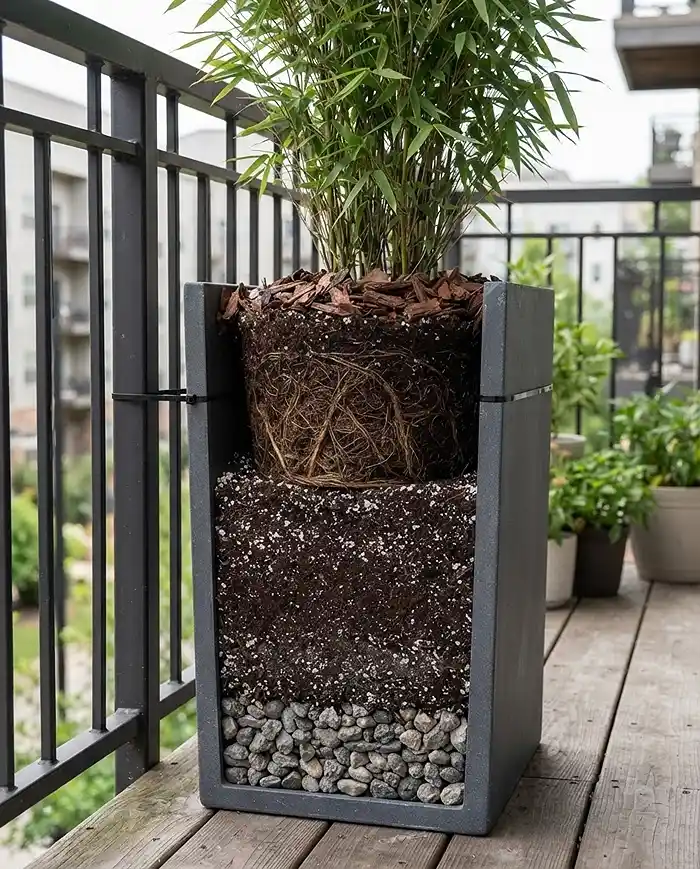
Water deeply immediately after planting until water runs freely from the drainage holes. Then let the top inch of soil dry before watering again — deep roots establish faster than constantly moist shallow ones.
Seasonal Maintenance for Dense Privacy Foliage
A privacy screen lives or dies by its maintenance routine. Neglect it for one month in August and you’ll lose the dense coverage that took all spring to build.
The goal is a wall of foliage that’s thick from top to bottom — not a canopy on stilts. That requires two things: strategic pruning in spring and consistent feeding from May through September.
Pruning Strategies for Maximum Thickness
Most screening plants — grasses, bamboo, arborvitae — naturally put their energy into vertical growth. Left alone, they get tall and thin, with bare legs at the bottom and a bushy top that does nothing for eye-level privacy.
In early spring, before new growth appears, selectively cut the top 10–15% of each main stem. This redirects energy into lateral branching lower on the plant, filling in the middle zone where it matters most.
For bamboo, remove any cane that has grown above the height you need. New canes will emerge from the base and fill in laterally over the season.
Watering and Fertilizing Heavy Feeders
A 6-foot bamboo or grass in a 30-inch trough is producing an enormous amount of leaf tissue. That takes nitrogen — more than most container potting mixes can provide after the first six weeks.
Start a high-nitrogen liquid fertilizer routine (something like 10-5-5 or 12-4-8) every two weeks from May through September. I use a fish emulsion blend diluted at half-strength — it’s gentler on roots than synthetic formulas and shows results within a week.
During August heat waves, check moisture levels daily. Stick your finger 2 inches into the soil — if it’s dry at that depth, water deeply until it drains. Don’t rely on a schedule; check the actual soil.
Common Problems and Solutions
Two problems kill most balcony privacy screens before the season ends: structural failure from wind and bare gaps at the bottom from foliage loss. Both are preventable.
Top-Heavy Planters Tipping in High Winds
If you didn’t ballast the bottom of your planters, a single summer storm can tip a 5-foot bamboo. The fix is filling the bottom 20% of each container with heavy drainage rock before adding soil — this drops the center of gravity below the tipping threshold.
For existing planters, add concealed anchors. Thread heavy-duty zip ties through the drainage holes and loop them around the balcony railing. Make them snug but not rigid — the planter needs to flex slightly in wind rather than wrench against a hard connection.
Pro tip: In zones with frequent severe storms, use stainless steel railing clips rated for outdoor use. Zip ties degrade in UV over time.
Bottom Foliage Dying and Leaving Gaps
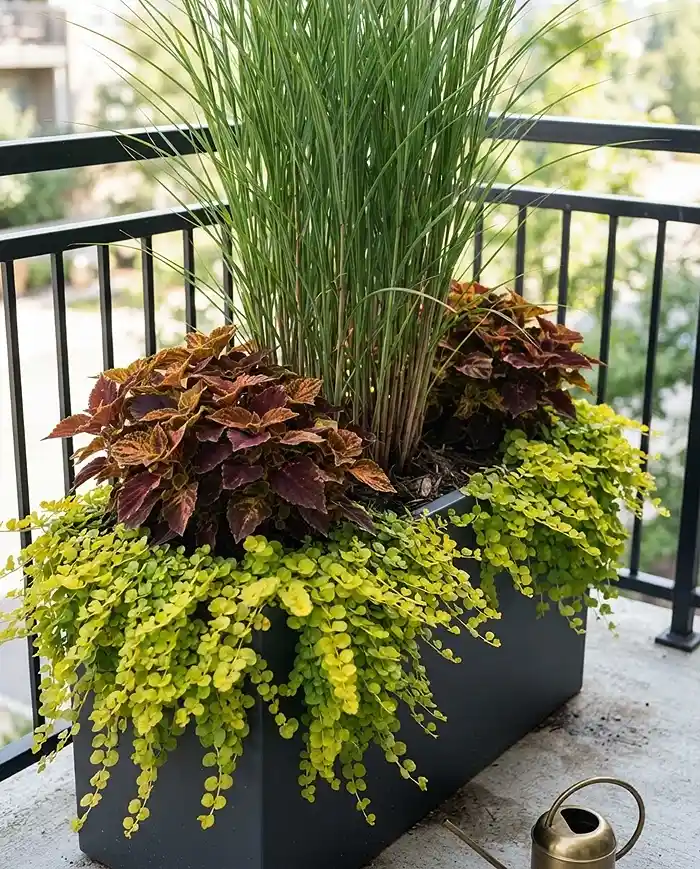
This is called “bare legs” — and it happens when upper canopy growth shades out the lower stems, which then drop their leaves. The result is a privacy screen that’s solid at the top and see-through at the bottom, exactly where it matters most.
The fix is underplanting. Fill the bottom 18 inches of visual space with shade-tolerant trailing plants: Creeping Jenny, Coleus, or Sweet Potato Vine work well in most climates. They cascade over the trough edge and visually seal the gap.
This is one of the best no-drill balcony garden layering tricks — it looks intentional and designed, not like a workaround.
tall balcony planters for privacy FAQs
How tall should a balcony privacy planter be?
A planter box height of 24 to 36 inches, paired with a plant reaching 3 to 4 feet tall, hits the standard 6-foot sightline needed to block views both standing and seated. Shorter planters restrict root depth too much for large screening plants to thrive beyond one season.
Do tall planters need drainage holes?
Yes, absolutely. Without drainage holes, the lower half of the soil turns anaerobic and roots rot within weeks. Every tall planter must have drainage holes. Use exact-fit silicone drip trays underneath to protect your balcony floor from water damage and staining.
What is the fastest-growing privacy plant for pots?
Clumping bamboo (Fargesia) is the fastest for a permanent evergreen screen, reaching 6 to 8 feet in the first season with consistent water and fertilizer. For an annual option, Morning Glory on a trellis can cover a 6-foot panel completely by August from a May sowing.
Can I use tall planters for privacy on a small balcony garden?
Yes. Tall, narrow trough planters are specifically designed for small balcony gardens because they grow up, not out. A single row of 12-inch-wide troughs along the railing takes minimal floor space while delivering full visual screening.
How do I keep tall planters from blowing over?
Fill the bottom 20% of the container with coarse gravel or heavy rock to lower the center of gravity. Then use heavy-duty zip ties or stainless steel railing clips to anchor each planter loosely to the balcony railing as a secondary failsafe.
Key Takeaways
- Tall balcony planters for privacy work best as a row of matching rectangular troughs — 24 to 36 inches tall, 12 to 14 inches wide — lined flush against the railing.
- Always ballast the bottom 20% of each container with heavy gravel and anchor planters to the railing before the first summer storm hits.
- Choose fiberglass or resin troughs over concrete or terracotta to stay within structural weight limits without sacrificing a modern aesthetic.
- For every balcony garden idea involving screening plants, pair a self-watering container system with a biweekly high-nitrogen fertilizer routine to sustain the dense foliage that makes privacy actually work.
- Fix bare-legged screens by underplanting with Creeping Jenny or Coleus — this also works beautifully as a layered design element for any apartment balcony garden.