

Grow Bag Size for Tomatoes Peppers and Cucumbers Guide
Choosing the right grow bag size for tomatoes, peppers, and cucumbers is the single biggest factor between a bumper harvest and a stunted, stressed plant. Get it wrong and you’ll see blossom drop, bitter fruit, and nutrient deficiencies — no matter how well you water.
I grow all three on a west-facing concrete balcony in zone 6b, and I’ve killed plenty of plants by undersizing. This guide gives you exact gallon ranges so you don’t repeat my mistakes.
Table of Contents
The Science of Air Pruning: Why Grow Bags Are Perfect for Summer Veggies
When roots hit the porous wall of a fabric bag, the exposed tips dry out and die back naturally. This is called air pruning, and it’s the opposite of what happens in plastic pots.
In plastic, roots circle the container endlessly, eventually strangling the plant. In fabric, those same roots respond to air pruning by branching into dense, fibrous networks.
That denser root mass pulls in more water, more nutrients, and more oxygen. The payoff is direct: more root surface area equals more fruit. For grow bags for vegetables like tomatoes and cucumbers, this isn’t a minor upgrade — it’s a structural advantage that plastic simply can’t match.
For a deeper look at whether fabric containers are worth the investment, check out this honest breakdown of fabric grow bags before you buy.
Decoding Grow Bag Sizes for Vegetable Gardens
Walk into any garden center or scroll through Amazon, and bag sizes look deceptively simple: 5 gallon, 10 gallon, 20 gallon. The problem is that not all gallons are equal, and the bag you think you’re buying may hold significantly less soil than you expect.
Matching the right volume to the right crop isn’t guesswork — it’s root architecture. Fruiting vegetables have specific depth requirements that a wide, shallow bag simply can’t satisfy.
True Gallons vs. Trade Gallons
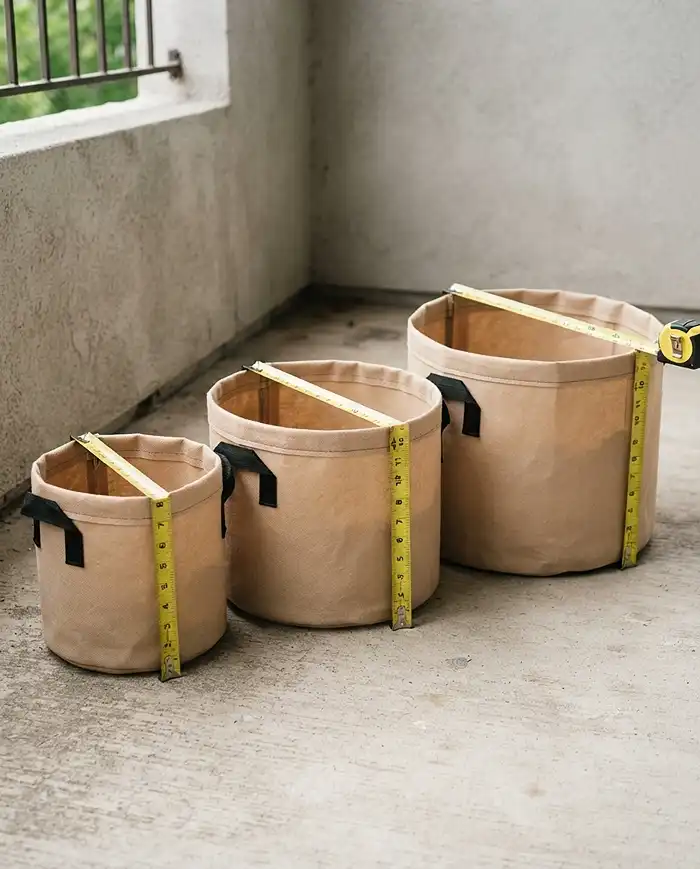
A standard liquid gallon is 231 cubic inches. A horticultural “trade gallon” — the measurement used loosely by many nurseries — is only about 0.71 liquid gallons.
That means a bag labeled “1 gallon” at a garden center may actually hold less than three-quarters of what you think. This gap matters enormously when you’re trying to hit a 20-gallon target for indeterminate tomatoes.
Always verify the physical dimensions (diameter x height in inches) before purchasing online. A bag listed as “20 gallon” that measures 14 inches wide by 12 inches tall is not delivering 20 true gallons of root space.
Soil Depth Requirements for Heavy Feeders
Tomatoes, peppers, and cucumbers are all fruiting plants with one thing in common: they push roots deep before they push fruit upward. A wide, shallow bag gives you volume on paper but starves the plant vertically.
Nightshades like tomatoes and peppers need at least 12 inches of soil depth, ideally 14 to 18 inches for indeterminate types. Cucurbits like cucumbers need at least 12 inches of depth to anchor their sprawling lateral roots.
Put a big plant in a shallow bag and you’ll see the symptoms fast: stunted top growth, yellowing lower leaves, and blossom drop midseason — even with perfect watering. Depth is non-negotiable for heavy feeders.
What Size Grow Bag for Tomatoes?
Tomatoes are the heaviest feeders in the summer garden. Their root systems can extend 3 feet deep in the ground, so container size isn’t a suggestion — it’s a hard constraint on how much the plant can produce.
The correct size depends entirely on one factor: whether your variety is determinate (bush) or indeterminate (vining). Get this distinction wrong and you’ll either waste expensive soil or choke the plant.
Determinate (Bush) Tomatoes: 10 to 15 Gallons
Quick Answer: Compact determinate varieties like ‘Roma’, ‘Patio Princess’, and ‘Rutgers’ grow well in 10-to-15-gallon fabric bags. They fruit in a concentrated window, then stop — so they don’t need endless root space to sustain months of continuous production.
In the summer of 2023, I grew four ‘Patio Princess’ plants in 10-gallon bags on my balcony. By mid-August, each plant had produced over 30 tomatoes. The bags were heavy enough to stay stable and deep enough (14 inches) to keep the roots from hitting bottom.
Go below 10 gallons with any determinate tomato and you’ll cap the yield. The plant will fruit — but fewer trusses, smaller fruit, and faster end-of-season decline.
Pro tip: For determinate varieties, choose a bag that’s taller than it is wide — a 12×14-inch bag outperforms a 16×10-inch bag even at the same stated volume.
Indeterminate (Vining) Tomatoes: 20 to 30 Gallons
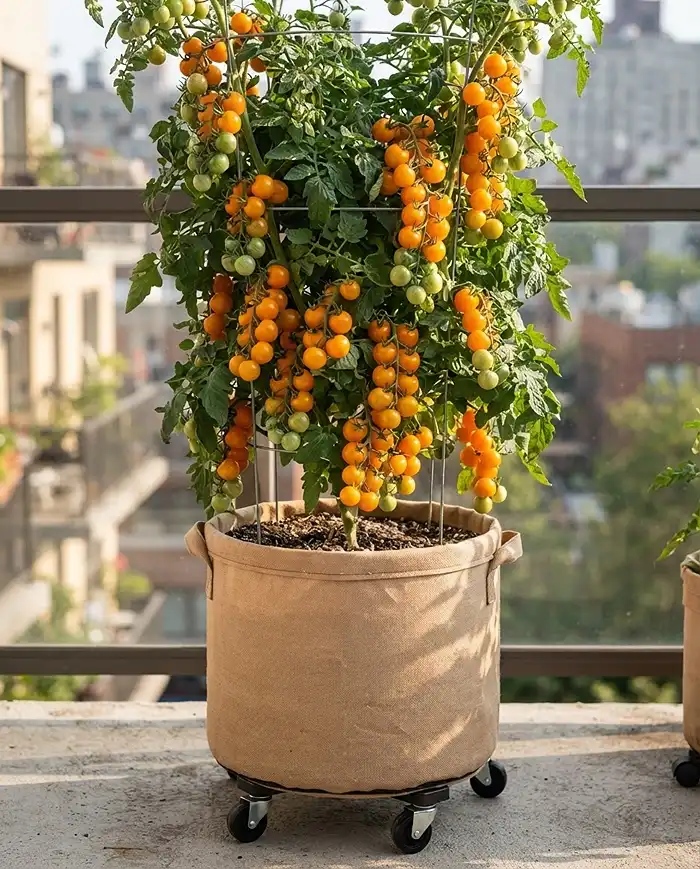
Quick Answer: Indeterminate varieties like ‘Sungold’, ‘Early Girl’, and ‘Cherokee Purple’ need 20 to 30 gallons. They grow continuously until frost and can reach 6 to 8 feet tall — they need the root mass and soil weight to support that structure.
| Variety Type | Recommended Size | Min. Depth | Examples |
|---|---|---|---|
| Determinate (Bush) | 10-15 gallons | 12 inches | Roma, Patio Princess, Rutgers |
| Indeterminate (Vining) | 20-30 gallons | 16-18 inches | Sungold, Early Girl, Cherokee Purple |
I made the classic mistake with ‘Sungold’ in 2022 — planted in a 15-gallon bag because it’s what I had. By July the plant was 5 feet tall, wilting every afternoon despite twice-daily watering, and dropping flowers. I repotted into a 25-gallon bag mid-season and lost two weeks of production.
Don’t try to save money on bag size with indeterminate tomatoes. A 25-gallon bag of quality potting mix costs around $15. One lost month of ‘Sungold’ production costs far more than that.
Pro tip: Place a 30-gallon bag on a rolling plant caddie before filling it — you will not be moving it once it’s loaded with 60-plus pounds of wet soil.
What Size Grow Bag for Peppers?
Peppers in containers are genuinely forgiving compared to tomatoes. Their root systems are more fibrous and compact, which makes them one of the most efficient crops you can grow in fabric bags — provided you match canopy size to container size.
A sprawling bell pepper plant will tip over in a 5-gallon bag. A jalapeño in a 15-gallon bag wastes expensive soil and stays too cool to fruit prolifically. Sizing matters, but the range is narrower than with tomatoes.
Small Hot Peppers (Jalapeños, Habaneros): 5 to 7 Gallons
Quick Answer: Compact hot pepper varieties like jalapeños, habaneros, and serranos thrive in 5-to-7-gallon fabric bags. The smaller soil volume heats up faster in the sun, which directly stimulates flowering and increases capsaicin production in the fruit.
I’ve grown ‘Lemon Drop’ habaneros in 5-gallon bags for three seasons running. In zone 6b, the dark fabric bag heats the root zone to around 75 to 80 degrees F on a sunny afternoon — right in the sweet spot for pepper root activity.
- 5-gallon bags: ideal for jalapeños, serranos, Thai hot, and pequin varieties
- 7-gallon bags: better choice for habaneros and other varieties that grow 24 to 30 inches tall
- Minimum soil depth: 10 inches for any hot pepper variety
- Group bags together to reduce moisture loss through fabric walls
Pro tip: Slight drought stress just before flowering pushes peppers in containers to produce hotter fruit — the plant concentrates capsaicin when mildly stressed.
Large Sweet Peppers (Bell, Poblano): 10 Gallons
Quick Answer: Bell peppers, poblanos, and cubanelles need 10-gallon bags. Large sweet peppers develop heavy, multi-lobed fruit on tall plants that can hit 36 inches — the extra soil volume provides stability and prevents tipping in summer wind.
Sweet peppers in containers have one specific failure mode: the plant grows perfectly, sets a full load of fruit, then topples in a thunderstorm and snaps at the base. A 10-gallon bag with 20-plus pounds of moist soil is your best insurance against that.
Pro tip: Drive a 4-foot bamboo stake to the bottom of the bag before adding soil — it anchors the plant without disturbing roots later.
What Size Grow Bag for Cucumbers?
Cucumbers are the thirstiest plants in this group. They’re roughly 95% water by weight, and they pull moisture from the soil at a rate that challenges even well-watered fabric bags on a hot afternoon.
Undersizing a cucumber bag doesn’t just stunt growth — it causes bitter fruit. Cucurbitacin, the compound responsible for bitterness, spikes when the plant experiences water or heat stress. Bigger bag equals more moisture buffer equals sweeter cucumbers.
Bush Cucumbers: 7 to 10 Gallons
Quick Answer: Compact bush cultivars like ‘Spacemaster’, ‘Pickle Bush’, and ‘Bush Pickle’ grow well in 7-to-10-gallon fabric bags. Their vines top out around 24 to 36 inches, making them ideal for balconies and small patios.
I’ve grown ‘Spacemaster’ in 7-gallon bags on a 6-foot-wide balcony for two seasons. The key is consistency — skipping even one watering in July heat will produce a bitter cucumber within 48 hours. The fabric bag forgives nothing.
- 7-gallon bags: works for ‘Spacemaster’, ‘Salad Bush’, and ‘Patio Snacker’
- 10-gallon bags: better for ‘Pickle Bush’ and any bush type you’re pushing hard for yield
- Minimum soil depth: 12 inches
- Check moisture morning and evening during heat waves — fabric bags in full sun can dry out in 4 to 6 hours at 90 degrees F
Pro tip: Even bush cucumbers produce more fruit when given a short 2-foot trellis — keeping fruit off the soil prevents rot and improves airflow.
Vining Cucumbers: 15 to 20 Gallons
Quick Answer: Traditional vining cucumbers like ‘Marketmore’, ‘Straight Eight’, and ‘Lemon’ cucumber need 15 to 20 gallons. Their vines can reach 6 feet and their leaf canopy is massive — that surface area loses water at a rate that smaller bags simply can’t sustain.
A 15-to-20-gallon bag also provides the anchor mass needed to support an A-frame trellis. Vining cucumbers loaded with fruit in a summer wind can generate real lateral force — a light bag will tip.
| Cucumber Type | Bag Size | Vine Length | Good Varieties |
|---|---|---|---|
| Bush | 7-10 gallons | 24-36 inches | Spacemaster, Pickle Bush, Salad Bush |
| Vining | 15-20 gallons | 48-72 inches | Marketmore, Straight Eight, Lemon |
Preparing and Planting Your Fabric Grow Bags
Fabric bags amplify every soil quality decision you make. Fill them with heavy garden topsoil and you’ll end up with a dense, waterlogged brick that smothers roots within two weeks. The porous walls need a mix light enough to drain freely but moisture-retentive enough to survive a hot afternoon.
Preparation also means thinking about structural support before you plant — not after.
The Ultimate Moisture-Retentive Soil Recipe
The best potting mix for fabric bags balances drainage, aeration, and water retention. Here’s the formula I’ve used for three seasons with strong results:
- 60% high-quality organic potting mix (avoid mixes with heavy bark chunks)
- 30% coco coir (pre-hydrated) — holds 8 to 10 times its weight in water
- 10% coarse perlite — maintains air pockets and prevents compaction
- Optional: 1/4 cup slow-release organic granular fertilizer per 10 gallons of mix
This blend drains freely through the fabric walls but retains enough moisture to buffer a missed watering. Avoid adding garden soil under any circumstances — it compacts into concrete in a container environment.
For more on building a productive setup from scratch, this guide to running a productive container garden covers the full system.
Installing Trellises Before Planting
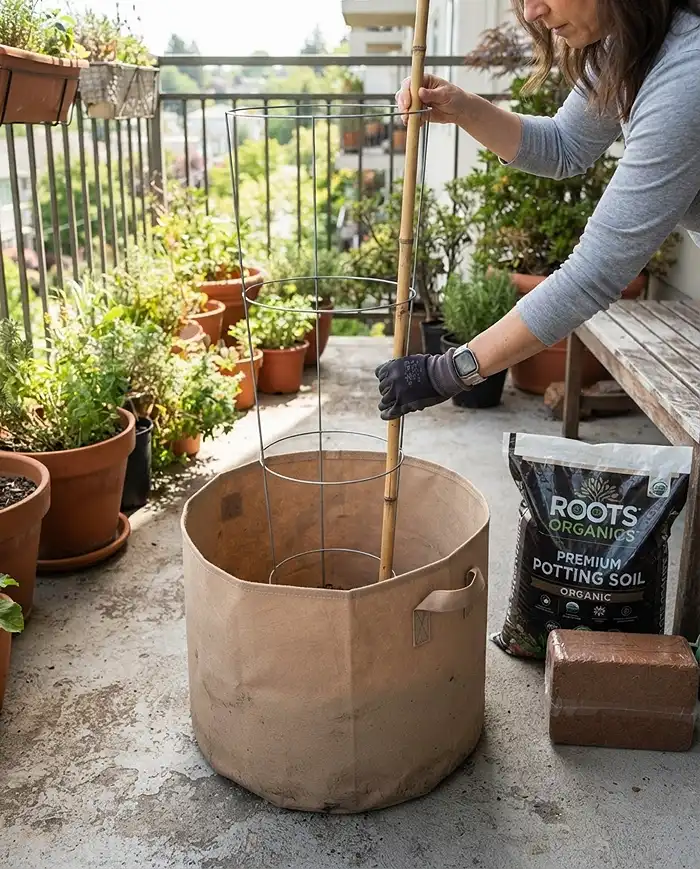
This is the step most gardeners skip — and regret. Always install tomato cages, bamboo stakes, and cucumber trellises before you add soil to the bag.
Push support structures all the way to the bottom of the empty bag. This creates a stable base that won’t wobble under a heavy plant. If you try to add a cage or stake after planting, you’ll slice through root balls and set the plant back by weeks.
For 20-to-30-gallon tomato bags, use a heavy-gauge wire cage at least 54 inches tall. Pound it through the empty bag so the bottom wire rings rest on the ground beneath the fabric.
Watering and Feeding Grow Bags During Peak Summer
Fabric bags need more water than plastic — full stop. The breathable walls wick moisture continuously, especially when air is moving. During a July heat wave in zone 6b, my 20-gallon tomato bags need a full gallon of water per plant, per day.
Check bags morning and evening during temperatures above 85 degrees F. Press your finger 2 inches into the soil. If it feels dry at that depth, water deeply until you see runoff from the bottom.
Fertilization is equally critical. Every deep watering flushes some nutrients out through the fabric. For heavy feeders like tomatoes in pots and peppers in containers, apply a balanced liquid organic fertilizer (like fish emulsion or kelp meal diluted per label) every 7 to 10 days from first flower through end of season.
As of summer 2025, slow-release granular fertilizers have improved significantly — look for formulas with 90-to-180-day release windows to supplement your liquid feeding schedule.
Common Problems and Solutions
Two problems show up constantly with fabric containers in summer heat. Both are fixable once you know what you’re looking at.
Rapid Soil Dehydration and Hydrophobic Mix
If water pours straight through the bag without being absorbed, the soil has gone hydrophobic — it’s dried out past the point where it can rehydrate from the top. This happens fast in fabric bags during heat waves.
Three fixes that actually work:
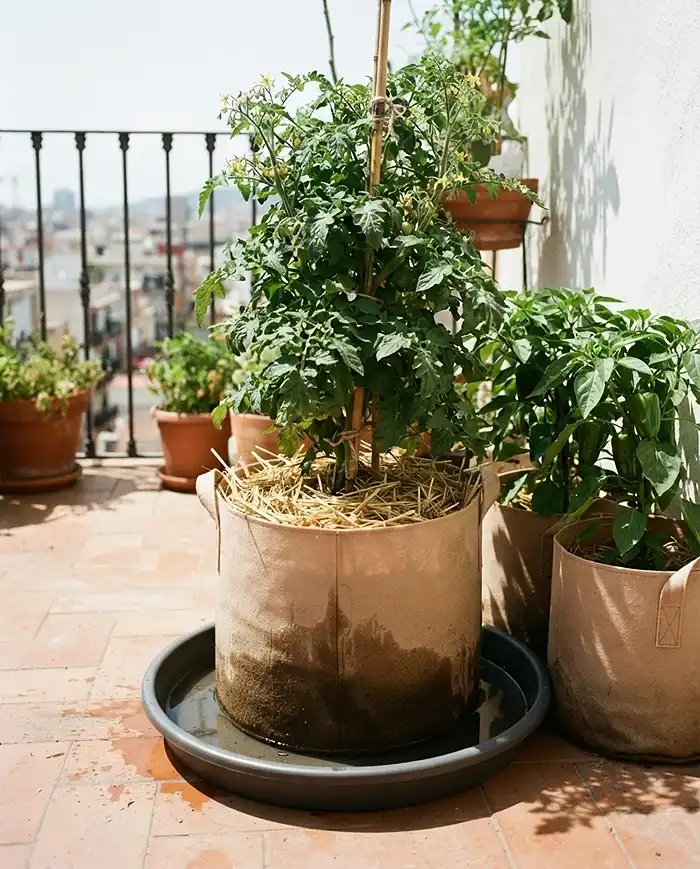
- Bottom-watering: Set the bag in a deep plastic saucer filled with water for 30 to 60 minutes — the soil rehydrates from below
- Group your bags: Clustering bags 2 to 3 inches apart creates a humid microclimate that slows evaporation through the sides
- Straw mulch: A 2-inch layer of straw across the top surface cuts evaporation by 30 to 40% and keeps roots cooler
White Crust and Mineral Buildup on Bag Exteriors
The powdery white residue that forms on the outside of fabric bags after a few weeks is harmless. It’s a combination of hard water minerals and fertilizer salts that have leached through the porous fabric walls.
It doesn’t affect plant health in any way. If you want to clean it for aesthetic reasons, mix one part white vinegar with three parts water and scrub the exterior gently with an old brush. Rinse with clean water afterward. That’s it — no special products needed.
grow bag size for tomatoes peppers and cucumbers FAQs
Can I plant multiple vegetables in one large 30-gallon grow bag?
Yes — companion planting works well in large 30-gallon bags. Pair one deep-rooted heavy feeder like a tomato with shallow-rooted companions like basil or marigolds. Avoid pairing two heavy feeders (like a tomato and a cucumber) in the same bag — root competition will limit both plants.
Do I need to put rocks at the bottom of a grow bag for drainage?
No — never add rocks to the bottom of a fabric grow bag. The entire surface area of the porous fabric already acts as a continuous drainage system. Adding rocks raises the perched water table inside the bag and creates a waterlogged zone at the bottom where roots rot fastest.
Can I reuse the soil in my grow bags next year?
You can reuse the physical soil structure, but heavy feeders like tomatoes and peppers strip nutrients aggressively. Remove the old root ball completely, then amend the remaining mix with 30% fresh compost and a generous application of slow-release organic granular fertilizer before replanting.
What is the minimum grow bag size for tomatoes in containers?
The absolute minimum for any tomato variety is 10 gallons, and only for compact determinate bush types. Indeterminate vining tomatoes should never go below 20 gallons. Anything smaller severely restricts root development and caps yield regardless of fertilization.
Do cucumber plants in containers need a trellis?
Vining cucumbers absolutely need a trellis — an A-frame or vertical net trellis anchored through a 15-to-20-gallon bag works well. Even bush cucumbers produce cleaner, straighter fruit on a short 24-inch trellis. Without support, fruit sits on moist soil and rots quickly.
Key Takeaways
- Choosing the right grow bag size for tomatoes, peppers, and cucumbers directly determines yield — undersizing is the most common and most costly mistake in container gardening.
- Determinate tomatoes in pots need 10 to 15 gallons; indeterminate varieties need 20 to 30 gallons with at least 16 inches of soil depth.
- Peppers in containers are the most forgiving: hot varieties thrive in 5 to 7 gallons, while large sweet peppers need 10 gallons for stability.
- Cucumber in containers requires more water than any other crop in this group — size up rather than down, and mulch the top surface to slow evaporation.
- Always verify bag dimensions in inches, not just stated gallon labels — trade gallons and true liquid gallons are not the same measurement.
If you’re still deciding which crops to prioritize in a limited space, this guide to the best vegetables for container gardening is a solid next step.