

Determinate vs Indeterminate Tomatoes in Pots
Picking the wrong tomato type for your balcony is the fastest way to ruin a container season. we’ll breaks down determinate vs indeterminate tomatoes in pots so you match the right plant genetics to your actual space — before you buy.
Table of Contents
The Great Balcony Tomato Debate: Determinate vs. Indeterminate
Every summer I see the same mistake at the garden center. Someone grabs a tomato plant because the tag shows a gorgeous, glossy beefsteak. They get it home, cram it into a 5-gallon bucket on a 6-foot balcony — and by August, it’s a tangled, wind-battered mess.
The picture on the tag tells you nothing useful. What matters is the plant’s growth habit: is it a compact bush that stops growing on its own, or an aggressive vine that will not stop until frost kills it?
That single genetic difference dictates your container size, support structure, pruning routine, and harvest window. Get it right first, and everything else is manageable. Get it wrong, and no amount of fertilizer saves you.
Understanding Tomato Growth Habits and Genetics
Tomato plants fall into two genetic categories based on how they regulate growth. One type is programmed to stop. The other is programmed to keep going. That difference shapes every decision you’ll make from planting day to first frost.
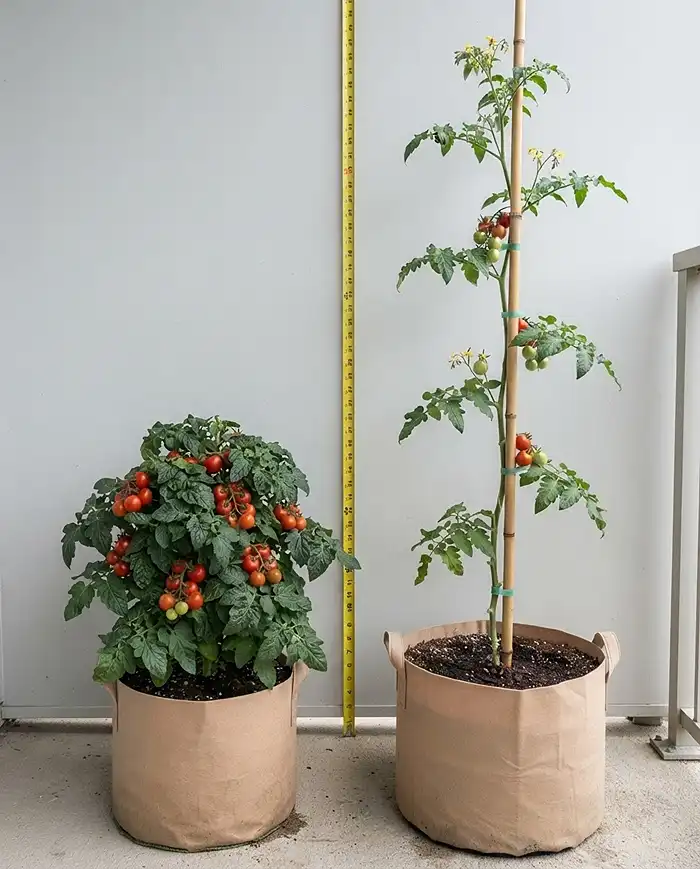
Both types produce delicious fruit. But they behave completely differently in a container vegetable gardening setup, and treating them the same way is where most balcony gardeners go wrong.
What is a Determinate Tomato? (The Bush Varieties)
Quick Answer: Determinate tomatoes are genetically programmed to grow to a fixed height — usually 3 to 4 feet — set all their blossoms at roughly the same time, then stop growing. They deliver one concentrated harvest window and require minimal vertical space.
The word “determinate” literally means “having a fixed limit.” Once the plant sets terminal flower clusters at the tips of its branches, it stops producing new vegetative growth. All its energy shifts to ripening that one flush of fruit.
For a small balcony garden, this is a huge advantage. You know exactly how tall the plant will get. You know roughly when it will produce. You can plan around it.
I grew ‘Patio Princess’ in a 7-gallon fabric pot on my east-facing balcony in zone 6b during the summer of 2023. It topped out at 28 inches, needed just a standard 3-ring tomato cage, and delivered about 4 pounds of fruit over three weeks in late July. Predictable, tidy, and perfect for the space.
Pro Tip: Never deadhead or heavily prune a determinate — you’ll explain why in a moment, but just know that restraint is the entire strategy here.
What is an Indeterminate Tomato? (The Vining Varieties)
Quick Answer: Indeterminate tomatoes never stop growing. They behave like vines, continuously setting new growth, flowers, and fruit right up until frost kills them. Left unchecked, they can reach 8 to 10 feet and will collapse any flimsy support structure.
The word “indeterminate” means there’s no built-in off switch. The plant keeps producing side shoots (suckers) and extending its main stem indefinitely. It will flower and fruit steadily, but it will also keep growing taller and wider all season long.
This is great if you want fresh tomatoes from July through October. It’s a problem if you have a 7-foot ceiling, a wobbly railing, or no patience for daily training and tying.
My first attempt at growing ‘Sungold’ in a 10-gallon pot on a high-rise balcony was a cautionary tale. By mid-August, the vine was over 6 feet and acting like a sail in the wind. The pot tipped twice. I had to rig a rope system off the ceiling. It worked — eventually — but I’d underestimated both the root volume and the vertical real estate this plant actually needed.
Pro Tip: If you’re committed to growing an indeterminate on a balcony, budget for at least a 15-gallon container and a ceiling-anchored string support before the plant even goes in the ground.
Assessing Your Balcony’s Structural and Spatial Limits
Before you buy a single plant, do a five-minute audit of your space. Measure ceiling height, check how much direct sun you get, and honestly assess how much wind your balcony takes. Those three factors will narrow your options fast.
Most balconies above the third floor deal with significant wind exposure. That alone may push you toward compact determinates regardless of your preference for continuous harvest.
Vertical Space and Trellising Requirements
Quick Answer: Determinates need a standard 18-to-24-inch tomato cage. Indeterminates need a serious vertical system — at minimum 6 feet of support, anchored against wind — or they’ll topple the pot and snap branches under the weight of fruit.
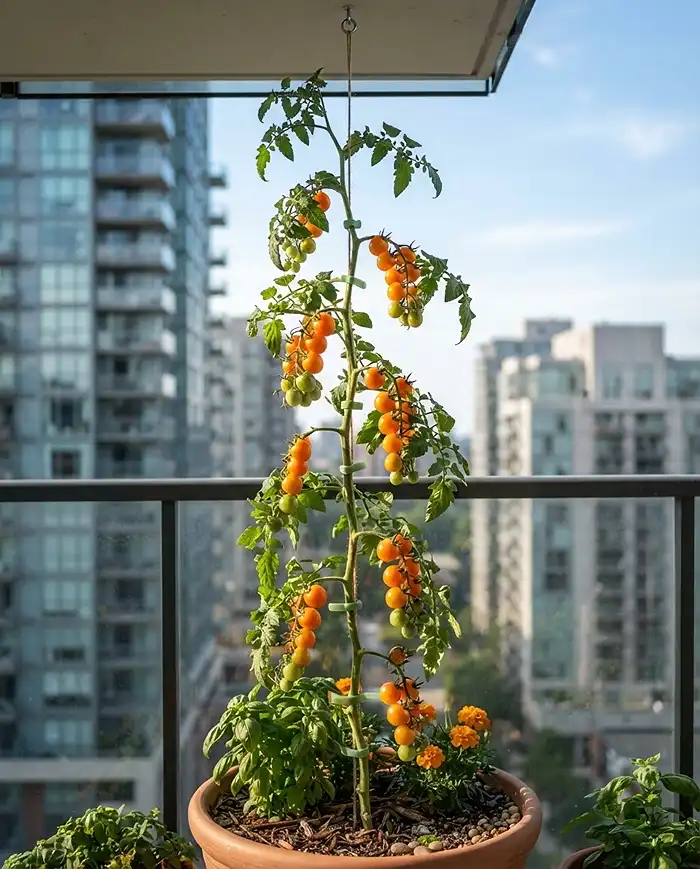
Check your ceiling or overhang height. If you’ve got less than 7 feet of clearance, an indeterminate variety will hit the ceiling or overhang by late summer and stall out awkwardly. Determinates max out at 3 to 4 feet and never create that problem.
For indeterminates, the most reliable system on a balcony is a vertical string or bamboo pole anchored to a ceiling hook or a very heavy pot base. Standard wire tomato cages rated for up to 4 feet simply aren’t built for plants that may triple that height.
- Determinates: standard 3-ring wire cage, 18–24 inches, is sufficient
- Indeterminates: minimum 6-foot bamboo stake or ceiling-anchored string support
- High-wind balconies: add a secondary anchor point midway up any tall support
- Both types: install support on planting day — never try to add it once roots are established
Container Size and Soil Volume Needs
Quick Answer: Determinates can thrive in 5- to 10-gallon containers. Indeterminates need 15 to 20 gallons minimum — less than that, and the restricted root zone will stunt the vine, require multiple daily waterings, and trigger blossom drop in peak summer heat.
Root volume directly limits how much fruit a plant can support. A tomato root system in a small pot hits the walls of the container by midsummer. Once that happens, the plant gets stressed every time the soil dries out — which in hot weather on a sunny balcony can be every 12 hours.
See our detailed pot size guide for vegetables for exact container volume recommendations by plant type.
| Tomato Type | Minimum Container | Ideal Container | Watering Frequency (Summer) |
|---|---|---|---|
| Determinate | 5 gallons | 7–10 gallons | Every 1–2 days |
| Indeterminate | 15 gallons | 20 gallons | Daily or twice daily |
| Semi-determinate | 10 gallons | 12–15 gallons | Every 1–2 days |
Choosing the Right Tomato for Your Harvest Goals
Space is one filter. How you actually plan to eat your tomatoes is the other. These two factors together will point you to the right type every time.
A backyard gardener with raised beds can grow both and use each for different purposes. On a balcony with two or three pots, you need to pick the type that matches your lifestyle — not just your ceiling height.
All-at-Once Harvests for Preserving and Sauces
Quick Answer: Determinate tomatoes are ideal if you want to batch-process your harvest. They deliver a concentrated 2-to-3-week flush of ripe fruit — perfect for making large batches of salsa, marinara, or anything you plan to freeze or can.
If you grow ‘Roma’ in two 7-gallon pots, for example, you’ll get a dense harvest window in late July or August where you can pull 10 to 15 pounds of paste tomatoes in a couple of weeks. That’s exactly the volume you need for a serious sauce-making session.
The tradeoff: once that flush is done, the plant is essentially done. You won’t get a trickle of fresh tomatoes for salads through September. If that matters to you, plant a small indeterminate cherry variety alongside your determinates in a larger container.
Continuous Grazing and Fresh Summer Salads
Quick Answer: Indeterminate varieties like ‘Sungold’ or ‘Sweet 100’ produce a steady stream of cherry tomatoes from mid-July through first frost, making them ideal for anyone who wants fresh tomatoes available daily throughout the summer.
This is the “patio grazer” use case. You don’t want a massive harvest all at once. You want to walk out every morning, pick a handful of cherry tomatoes, and add them to your breakfast or lunch. Indeterminates are built for exactly that.
The tradeoff is maintenance. These plants need weekly (sometimes more frequent) tying and training. If you travel frequently or just want a low-effort container vegetable gardening experience, the constant upkeep of an indeterminate can feel like a part-time job.
Best Tomato Varieties for Balcony Containers
Not every tomato variety performs equally well in pots. These picks are specifically chosen for compact root systems, disease resistance, and reliable production in the confined conditions of container growing. For a broader list, check out our guide to tomato varieties for container gardening.
Top Determinate Cultivars for Small Pots
Quick Answer: The most reliable compact bush tomatoes for balcony containers are ‘Patio Princess’, ‘Roma’, and ‘Tiny Tim’ — all disease-resistant, well-suited to 5-to-7-gallon pots, and proven producers in limited space.
- Patio Princess: 26-inch plant, heavy yield of 2-inch fruits, excellent heat tolerance — one of the best all-around balcony varieties
- Roma: Classic paste tomato, 4-foot max height, meaty low-moisture fruit perfect for sauces, tolerates neglect better than most
- Tiny Tim: True dwarf at 12–18 inches, perfect for 3-gallon pots or window boxes, produces 1-inch cherry tomatoes over a 3-week window
- Bush Early Girl: Earlier than most determinates (55 days), compact at 3.5 feet, great for short northern seasons in zones 4–5
Best Indeterminate Cultivars for Vertical Trellises
Quick Answer: ‘Sungold’, ‘Sweet 100’, and ‘Early Girl’ are the most rewarding indeterminate choices for a balcony trellis — but all three require diligent weekly training and staking. Without it, they become unmanageable fast.
- Sungold: Orange cherry tomato with exceptional sweetness, extremely prolific, reaches 6–8 feet — needs ceiling-height support on most balconies
- Sweet 100: Red cherry, produces clusters of 100+ fruits per cluster over the full season, vigorous climber — tie it weekly without fail
- Early Girl: Mid-size slicing tomato (55–65 days), handles cooler nights better than most indeterminates, good choice for zones 4–6
Step-by-Step Planting Guide for Potted Tomatoes
The planting sequence matters as much as the variety. Do these steps in order and you’ll build a root system strong enough to support a full season of fruit production in a confined container.
Step 1 — Prepare the container: Fill your pot with a premium potting mix (not garden soil, which compacts and restricts drainage). Mix in slow-release granular fertilizer and a tablespoon of garden lime or crushed eggshell for calcium — this prevents blossom end rot before it starts.
Step 2 — Plant deep: Strip all leaves except the top cluster, then bury the stem up to that top cluster. Tomatoes grow adventitious roots along any buried stem, which dramatically expands the root system and plant stability in a pot.
Step 3 — Install support immediately: Put your cage or stake in the pot on day one, before the roots spread. Driving a stake into an established root ball later in the season is one of the most common ways to fatally damage a container tomato.
Step 4 — Water in deeply: Give the newly planted tomato a slow, thorough soak until water drains freely from the bottom. This settles the soil and eliminates air pockets around the root zone.
Pruning and Maintenance Strategies
Here’s where most balcony gardeners make their biggest mistake: they apply the same pruning logic to both tomato types. The right approach for one type will actively harm the other. These routines are not interchangeable.
The No-Prune Rule for Determinate Tomatoes
Quick Answer: Never remove suckers from a determinate tomato. Every sucker on a determinate plant is a future fruit-bearing branch. Pruning them reduces your total harvest — sometimes by half — and there’s no second flush to make up for it.
Determinate plants produce fruit on all their branches simultaneously. Removing a sucker doesn’t redirect energy toward bigger fruit the way it does on an indeterminate. It just removes a branch that would have produced tomatoes.
The only pruning that’s appropriate on a determinate is removing clearly dead or diseased foliage at the base of the plant to improve airflow. That’s it. Beyond that, leave it alone and let it do what it’s genetically programmed to do.
Aggressive Sucker Pruning for Indeterminate Vines
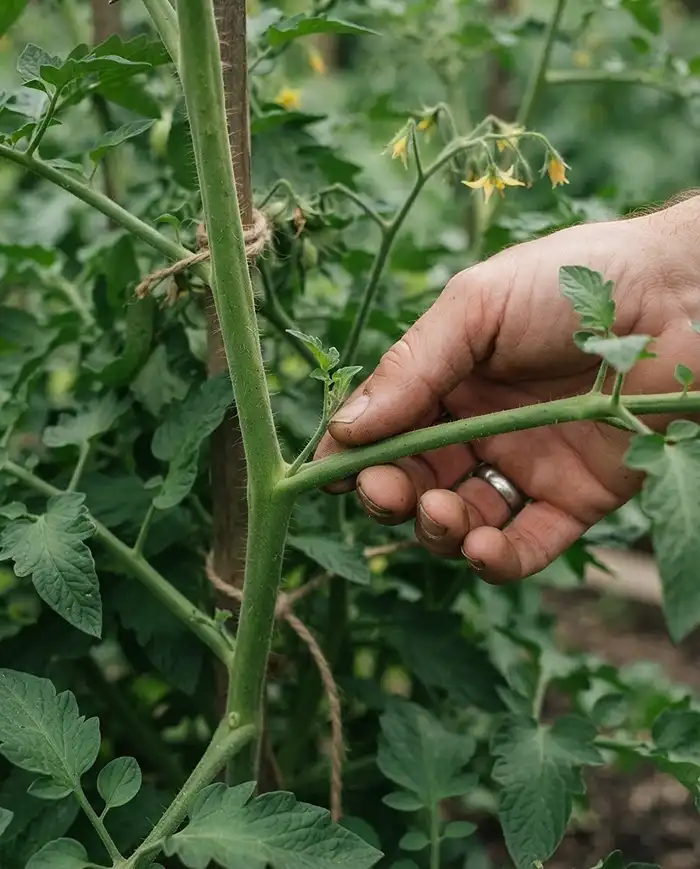
Quick Answer: On indeterminate tomatoes, pinch off all suckers — the shoots that emerge at a 45-degree angle between the main stem and a branch — to maintain a single central leader. This controls size, improves airflow, and concentrates fruit production on a manageable structure.
A sucker left unpruned on an indeterminate will become a full second stem, complete with its own suckers, within two weeks. On a balcony where space is finite, that’s how a plant goes from manageable to chaos in a single growing month.
Check for new suckers twice a week during the peak growing season (June through August). Pinch them out with your fingers when they’re small — under an inch. Once they’re over 2 inches, you’ll need clean pruning scissors to avoid tearing the main stem.
Aim for one or two main leaders maximum per plant. In a tight balcony space, one leader tied to a vertical string is almost always the cleanest, most productive approach.
Common Problems and Solutions
Two problems show up consistently in container tomato growing. Both are preventable with the right setup from the start, but both are also recoverable once you know what you’re dealing with.
Blossom End Rot in Confined Containers
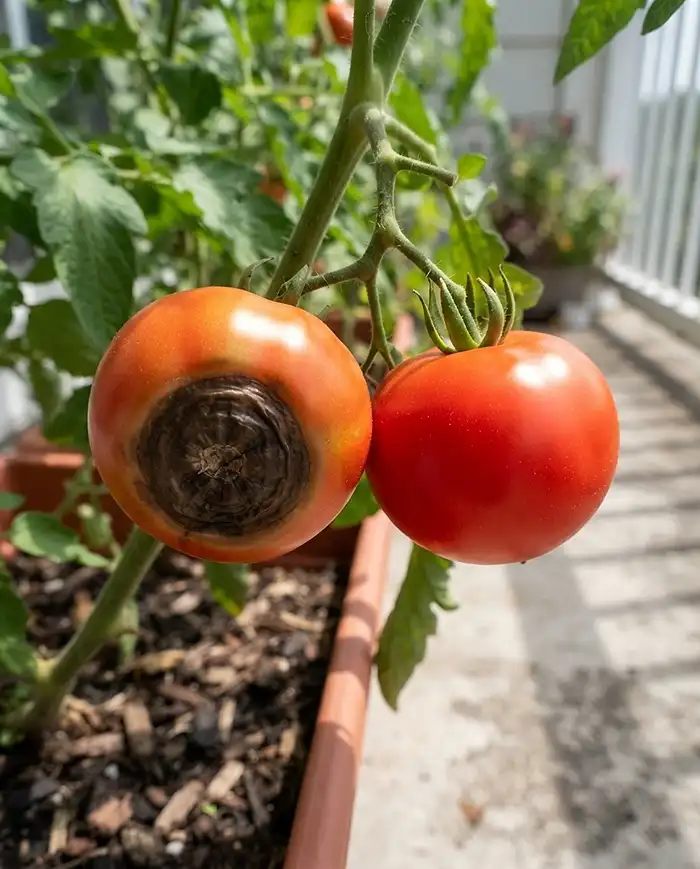
Quick Answer: Blossom end rot appears as a black, sunken, leathery patch on the bottom of the fruit. It’s caused by calcium deficiency triggered by uneven watering — not a lack of calcium in the soil. Consistent deep watering is the fix.
When container soil dries out completely between waterings, the plant can’t uptake calcium even if it’s present in the mix. On a sunny balcony in July, a pot can dry out in 12 hours. Once you see blossom end rot, it won’t reverse in affected fruits — but you can stop new fruits from developing it.
Water deeply and consistently. If you can’t maintain that schedule, top-dress the container with a small handful of gypsum (calcium sulfate), which releases calcium directly into the root zone without affecting soil pH. The University of Maryland Extension’s guide to blossom end rot confirms consistent irrigation is the primary prevention tool.
Wind Damage and Snapped Vines
Quick Answer: High-rise balcony wind snaps unsupported fruiting branches. Use soft silicone plant ties or strips of old pantyhose to secure stems to your trellis — never rigid wire, which girdles and cuts into the stem as it grows.
Fruiting branches get heavy fast. A cluster of six medium tomatoes can weigh over a pound. On a windy balcony, that weight plus wind load is more than most unsupported branches can handle.
Tie stems loosely in a figure-8 pattern — the loop around the stem should have room to fit two fingers. Tighten ties cut off circulation and can kill branches as effectively as wind damage. Check and adjust ties every two weeks as stems thicken through the season.
determinate vs indeterminate tomatoes in Pots FAQs
Can I grow an indeterminate tomato in a 5-gallon bucket?
Strongly avoid it. The plant may survive early in the season, but the restricted root zone will stunt the vine by midsummer, require multiple daily waterings, and trigger severe blossom drop during peak heat. A minimum of 15 gallons is required for indeterminate varieties to produce well.
Do determinate tomatoes need a cage or support?
Yes, always. Determinate bush tomatoes won’t climb an 8-foot trellis, but they absolutely need a sturdy standard tomato cage. The concentrated flush of heavy fruit will snap branches and drag them into the soil without support. A 3-ring wire cage rated for 18 to 24 inches is sufficient for most compact bush varieties.
What does semi-determinate mean for balcony gardeners?
Semi-determinate varieties like ‘Celebrity’ are a middle ground: bushier than a true vine but taller than a dwarf, usually reaching 4 to 5 feet. They produce a main flush of fruit, then continue with a smaller secondary harvest. They work well in 10- to 15-gallon containers and are a solid compromise if you want some of both habits.
How often should I water tomatoes in pots on a balcony?
Determinates in 7- to 10-gallon pots typically need watering every one to two days in summer. Indeterminates in 15- to 20-gallon pots need daily watering, sometimes twice daily during heat waves above 90 degrees F. Stick your finger 2 inches into the soil — if it’s dry at that depth, water deeply until it drains from the bottom.
Can I grow tomatoes in pots year-round?
In USDA zones 9b and warmer, yes — some determinate varieties can produce nearly year-round. In zones 6 and below, tomatoes are frost-sensitive annuals. Start seeds indoors 6 to 8 weeks before your last frost date and expect your season to run from late spring through first fall frost, typically May through October in most of the continental US.
Key Takeaways
- Understanding determinate vs indeterminate tomatoes in pots is the single most important decision before you buy — genetics dictates container size, support structure, pruning method, and harvest timing.
- Determinates stay compact (3–4 feet), need only a standard cage, thrive in 5- to 10-gallon pots, and deliver one concentrated harvest — ideal for most small balcony gardens.
- Indeterminates vine continuously to 8–10 feet, demand 15- to 20-gallon containers, need ceiling-height support, and reward you with steady fruit from mid-July through frost.
- Never prune suckers off a determinate; always prune suckers off an indeterminate — applying the wrong approach to either type will cut your harvest significantly.
- Consistent deep watering is the most important care habit for vegetables in pots — it prevents blossom end rot, maintains fruit size, and keeps container root zones healthy through peak summer heat.