

Minimalist Balcony Garden Ideas With Neutral Pots
Most balconies turn into a jumble of mismatched pots within a season. Minimalist balcony garden ideas fix that by pairing a tight neutral palette with a few structural plants for a space that reads calm, not cluttered.
I garden on a 7×11 foot west-facing balcony in Denver, zone 6a, and I used to own seventeen pots in every color a garden center sold. Once I pared down to five matte charcoal planters, the whole space suddenly looked like it belonged to a design magazine instead of a plant hoarder.
Table of Contents
Embracing the Minimalist Balcony Garden Aesthetic
Traditional container gardens grow outward and upward until the railing disappears under a chaotic tangle of trailing vines and clashing pot colors. It looks abundant, but it also looks busy, and busy reads as small on a balcony that’s already tight on square footage.
A minimalist approach flips that. A handful of neutral pots in matte black, warm beige, or crisp white instantly makes an apartment balcony feel like an extension of a considered, modern living room rather than an afterthought bolted onto the building.
I learned this the hard way after my first Denver summer, when six clashing terracotta and neon-glazed pots made a 77-square-foot balcony feel like a storage closet. Swapping to a single charcoal-and-white palette made the same footprint feel twice as large.
Core Design Principles of Minimalist Gardening
Minimalist landscape design isn’t about owning fewer plants for its own sake. It’s about self-discipline: resisting the impulse buy at the nursery and committing to a cohesive geometry before you fall for a pretty pot that doesn’t match anything else you own.
Every new plant or pot has to answer one question: does this reinforce the existing shape and color story, or does it introduce noise? If it’s noise, it stays at the store, no matter how good it looks in the moment.
The Power of Negative Space
Leaving the balcony floor and walls intentionally bare acts as a visual palate cleanser. Empty space isn’t wasted space here; it’s what makes the plants you do have look like deliberate focal points instead of one more thing crammed into a jungle.
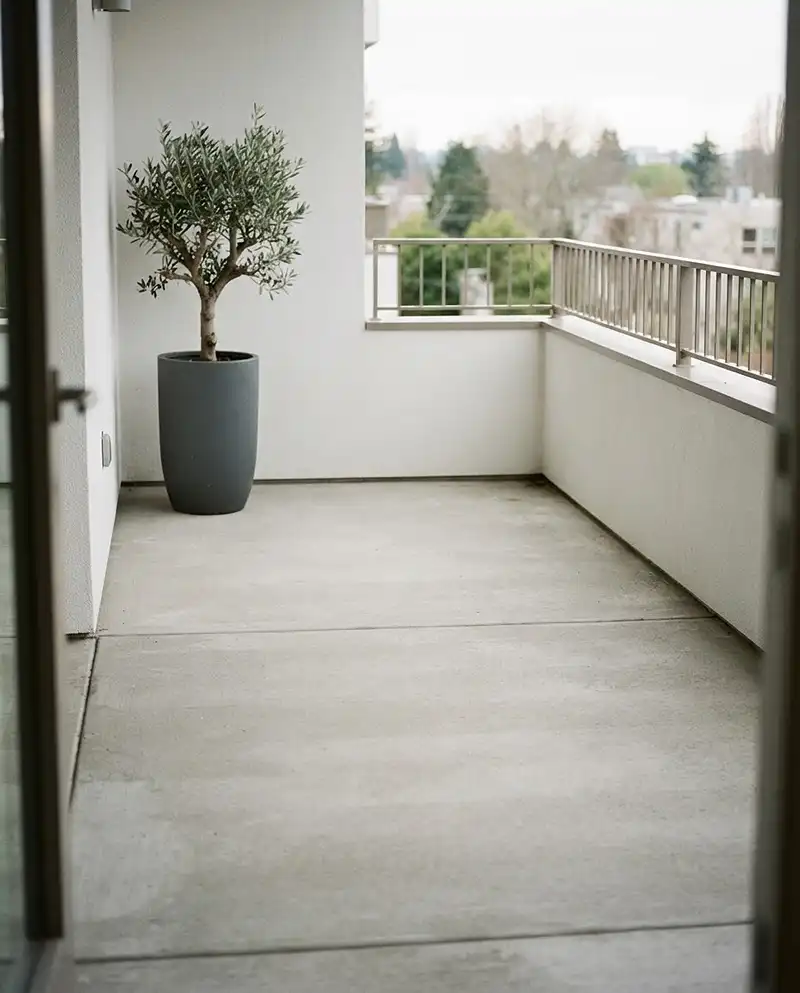
On my own balcony, I keep roughly 40% of the floor completely open. That bare stretch of concrete is doing as much design work as the dwarf olive tree standing in the corner, because it gives your eye somewhere to rest.
Selecting a Unified Neutral Color Palette
Pick one lane and stay in it: matte black, charcoal grey, crisp white, or warm beige. Mixing all four undoes the effect, since the goal is a seamless, architectural extension of an indoor space, not a curated gallery of neutrals.
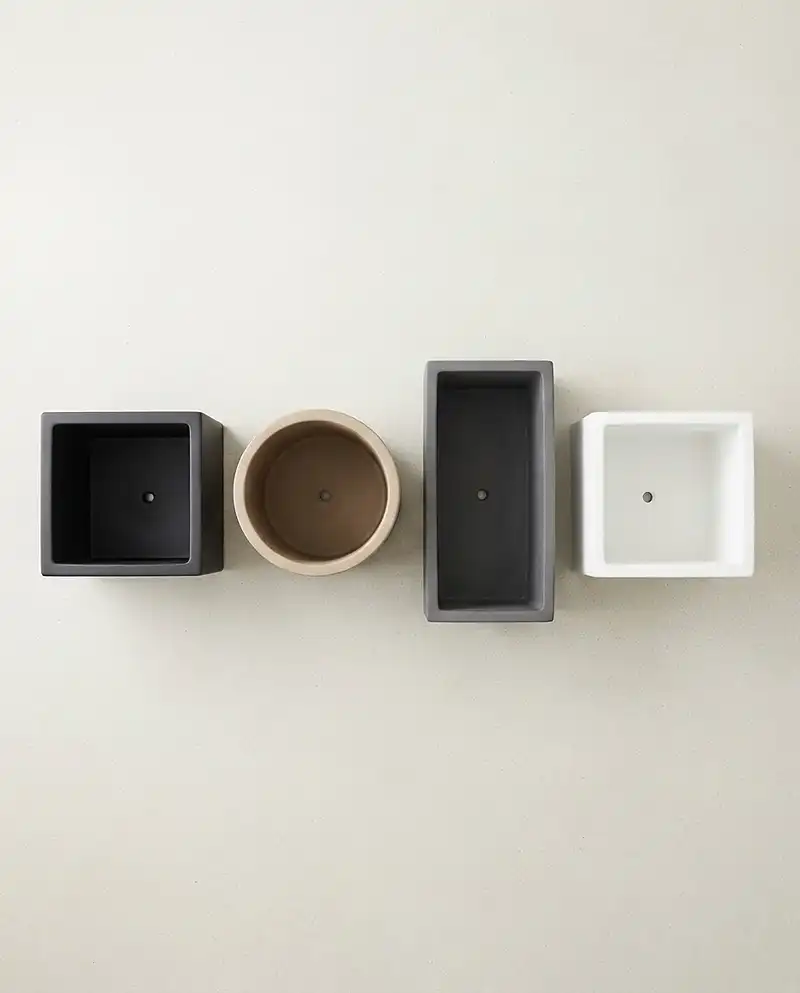
I run charcoal and warm beige on my balcony, echoing the same two tones from my living room rug. That repetition is what makes the balcony feel like a room instead of an accessory, and it’s a trick borrowed from these balcony color palette ideas with plants.
Choosing the Perfect Neutral Planters
Good minimalist pots look expensive whether they cost $30 or $300. What matters is clean lines and materials that age gracefully instead of fading, chalking, or cracking after one hard winter on an exposed apartment balcony.
Skip anything with molded texture, faux-stone printing, or a glossy shine that reads as plastic from six feet away. If it looks cheap in the store, it will look cheaper outdoors after a few months of sun and rain.
High-End Materials for a Modern Look
Frost-resistant fiberglass, faux-concrete, and matte resin are the three workhorses of modern balcony gardening, and each solves a different problem that ornate terracotta or shiny plastic can’t.
| Material | Best For | Watch Out For |
|---|---|---|
| Frost-resistant fiberglass | Windy, high-rise balconies (lightweight) | Can scratch; avoid abrasive cleaners |
| Faux-concrete | Ground-floor patios needing visual weight | Heavy; confirm weight limits before buying |
| Matte resin | Renters wanting an affordable, durable option | Cheaper lines can fade in full sun by year two |
| Traditional terracotta | Cottage-style gardens, not minimalist ones | Cracks below 20°F unless rated frost-proof |
I switched from real concrete troughs to faux-concrete fiberglass three years ago after my building’s HOA flagged the weight on my balcony’s load rating. Nobody can tell the difference from four feet away, and I saved my back hauling them up two flights of stairs.
Shapes and Silhouettes: Geometric vs. Organic
Container shape sets the mood as much as color does. Sharp cubes and tall rectangular troughs push a strict, contemporary look, while smooth cylinders soften things into a more Japandi-inspired retreat.
- Rectangular troughs (24-36 inches) for railing-mounted rows of herbs or low grasses
- Matte cube planters (14-18 inches) for anchoring a corner grouping
- Tall cylinders (28-36 inches tall) for a single statement tree like a dwarf olive
- Avoid scalloped rims, faux-carved detailing, or anything with a printed pattern
I mix one tall cylinder with two low cubes in my main corner grouping, which is the same trio approach covered in this guide to apartment balcony garden ideas for small footprints.
Top Architectural Plants for a Clean Aesthetic
Minimalist balcony garden ideas lean on structural plants with strong, defined shapes and minimal shedding. Messy flowering annuals that drop petals daily create visual noise and extra sweeping, which works against the whole point of the style.
Structural Trees and Shrubs
A dwarf Olive tree (‘Arbequina’ stays compact in a container) brings a muted silver-green that reads as expensive without any flowers to deadhead. Neatly clipped Boxwood or a container Japanese Maple gives you a strong, unwavering silhouette year-round.
My ‘Arbequina’ olive has lived in the same 30-inch faux-concrete cylinder for four winters now, wrapped in frost cloth below 25°F. It’s never bloomed and I’ve never wanted it to; the silver foliage alone earns its spot.
Minimalist Foliage and Ornamental Grasses
Upright Sansevieria (snake plant) and structural Agave add sculptural greenery without any mess. For softness, Mexican Feather Grass sways in the wind without ever looking chaotic, since its texture is fine and uniform rather than sprawling.
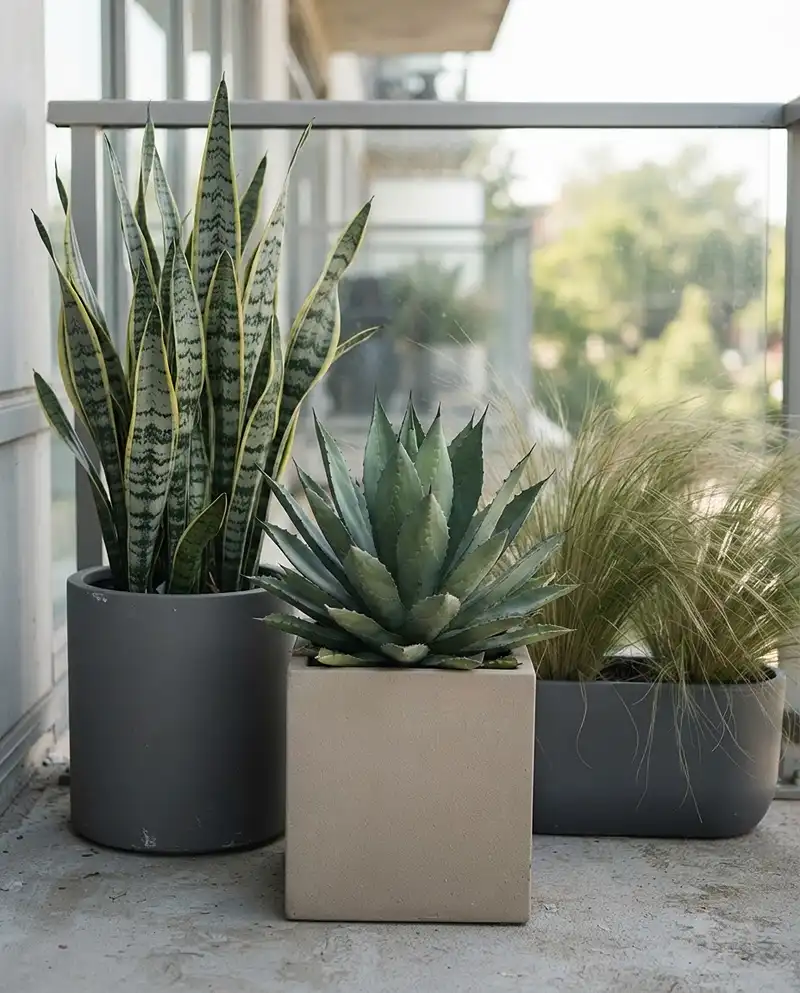
These same low-shed plants also do double duty in vegetables in pots setups, since a tidy Sansevieria or ornamental grass planted beside a trough of peppers keeps the whole grouping from looking like a mixed-up kitchen garden.
Step-by-Step Minimalist Balcony Layout Guide
Start with the rule of three: group three pots of varying heights (tall, medium, low) in a single corner instead of scattering single pots around the perimeter. This reads as one intentional vignette rather than five separate afterthoughts.
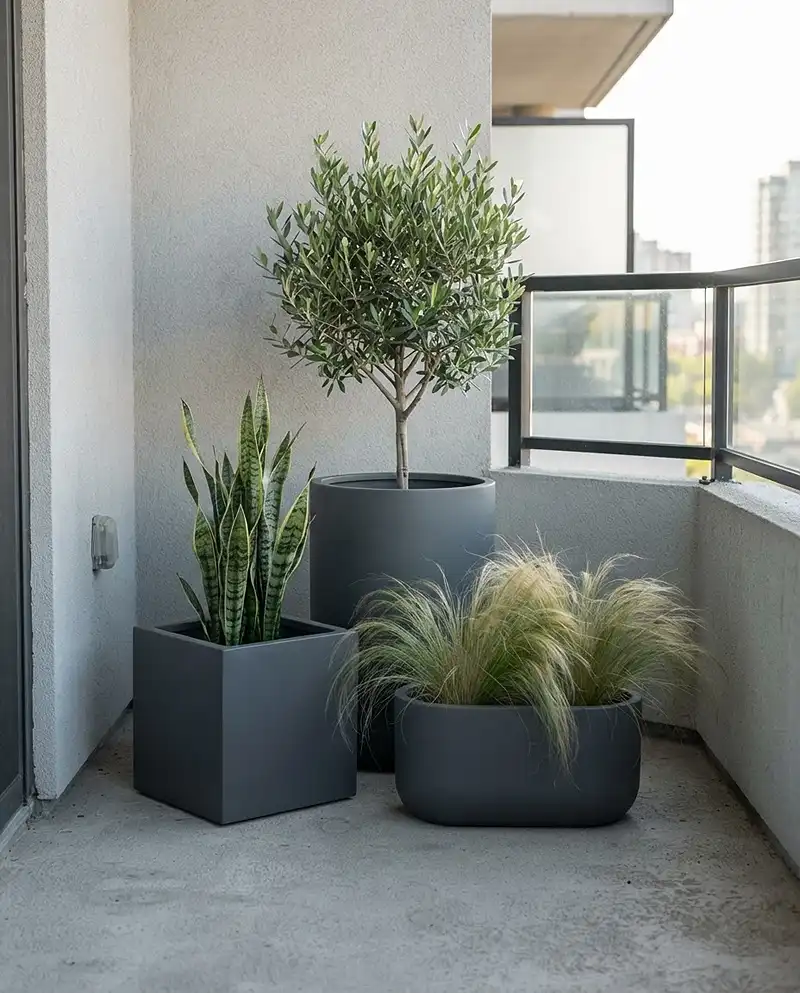
Next, align rectangular planter boxes flush against the railing so their edges disappear into the balcony’s own architecture. Finally, keep the central walking path completely bare; that negative space is what sells the whole look as a small balcony garden rather than a storage shelf.
- Corner one: tall cylinder (olive or Japanese Maple), medium cube (Sansevieria), low trough (feather grass)
- Railing: 2-3 matching rectangular boxes, evenly spaced, same height
- Center: nothing but a small bistro chair or bare floor
Seasonal Care and Pruning for a Tidy Aesthetic
A pristine look requires more discipline than a cottage-style jungle, not less. Aggressive aesthetic pruning keeps Boxwood and olive shapes crisp, and any yellowed or dead foliage needs to come off within a day or two of noticing it.
Concealed drip irrigation, run along the back of the troughs and hidden under a thin layer of stone top-dressing, eliminates the sight of a watering can and the splash marks it leaves on matte pots.
I run a battery-timer drip line on my railing boxes from May through October. It waters at 6 a.m. before I’m even up, and I haven’t hand-watered a single trough in three seasons.
Common Problems & Solutions
A stark, modern balcony shows every flaw a busy garden would hide. Mineral crusting and leggy, stretched-out plants are the two most common issues, and both have quick fixes once you know what’s causing them.
Preventing Mineral Stains on Neutral Pots
Hard water and fertilizer salts leave chalky white crusts on dark pots and yellowish stains on white ones. Wipe affected areas with a 1:1 mix of white vinegar and water, then rinse with clean water so the acid doesn’t linger on the finish.
Top-dress the soil surface with black river stones to stop splashback from staining the rim in the first place. The Colorado State University Extension container gardening guide also recommends watering until 10% drains out the bottom to flush excess salts before they build up.
Leggy Plants Disrupting the Clean Look
Etiolation, when a plant stretches thin and pale reaching for light, ruins the compact silhouette a minimalist design depends on. It shows up fastest on Sansevieria and Boxwood tucked into a shaded corner.
Prune leggy growth back hard as soon as you spot it, then sun-map your balcony over a weekend to confirm which corners actually get four or more hours of direct light before replanting there.
These same layout lessons apply directly to renter-friendly patio garden ideas, since sun-mapping matters just as much on a ground-floor patio as it does two stories up.
Frequently Asked Questions
How many pots should I put on a minimalist balcony?
Limit the design to 3 to 5 high-quality, large-scale planters rather than a dozen small ones. Fewer, larger pieces create an illusion of grandeur and expansive space instead of visual clutter.
Are white or black planters better for a minimalist design?
Matte black or charcoal pots make green foliage pop and hide dirt well, while crisp white pots make a cramped, shaded balcony feel larger and brighter. White pots do need more frequent exterior wiping to stay clean.
How do I hide ugly drainage trays under my pots?
Use the cachepot method: keep the plant in a slightly smaller plastic nursery pot elevated inside a waterproof decorative outer pot. Exact-match, flush-fitting saucers work too, keeping the lines clean from top to bottom.
What vegetables work well in a minimalist balcony garden?
Compact peppers, dwarf tomatoes, and upright herbs like rosemary fit the structural look without sprawling. Plant vegetables in pots that match your existing neutral palette so the edible section blends with the rest of the design.
Can apartment gardening work on a north-facing balcony?
Yes, but stick to shade-tolerant structural plants like Sansevieria and skip sun-hungry olives or Mexican Feather Grass. North-facing apartment gardening favors foliage plants over flowering or fruiting ones.
Conclusion
Minimalist balcony garden ideas come down to restraint: one neutral palette, a handful of structural plants, and enough bare space to let them breathe. That discipline is what turns a small balcony garden into a calm, high-impact retreat instead of another cluttered corner.
Start with three pots in one color family, add one statement plant, and resist the nursery impulse buy. The negative space you leave behind will do more for the look than any single plant ever could.
Key Takeaways
- Commit to one neutral color family (black, white, charcoal, or beige) and stop there
- Use the rule of three: group pots of varying heights instead of scattering single ones
- Choose frost-resistant fiberglass or faux-concrete over cheap plastic or ornate terracotta
- Pick structural, low-shed plants like Sansevieria, Boxwood, or dwarf olive over flowering annuals
- Great minimalist balcony garden ideas leave 30-40% of the floor completely bare on purpose