

Best Soil Mix for Leafy Greens in Containers
Stop guessing — these 3 DIY soil mixes grow crispier, faster leafy greens in any container. Includes organic options & a free depth chart. Try mix #2 →
Here’s a truth that took me way too many dead lettuce trays to learn: the best soil mix for leafy greens in containers isn’t soil at all. It’s a lightweight, soilless blend — roughly 60–70% moisture-retentive base (peat moss or coconut coir), 20–30% perlite for drainage, and about 10% worm castings or compost.
Keep it at a pH of 6.0–7.0, feed it nitrogen like your greens’ life depends on it (because it does), and you’ve got the foundation for spinach, lettuce, kale, and arugula that actually thrives instead of just… surviving.
I’ve killed enough container greens to know that fancy seeds and perfect sunlight don’t mean a thing if the stuff in your pot is working against the roots. So let’s fix that — with three DIY potting mix recipes, a no-nonsense ingredient breakdown, and the seasonal maintenance trick that saves you from buying new mix every year.
Table of Contents
Why Garden Soil Kills Leafy Greens in Pots (And What to Use Instead)
I get it. You’ve got perfectly good dirt in the backyard. It grows grass just fine. Why not scoop some into a pot?
Because your pot isn’t the ground, and physics doesn’t care about your logic.
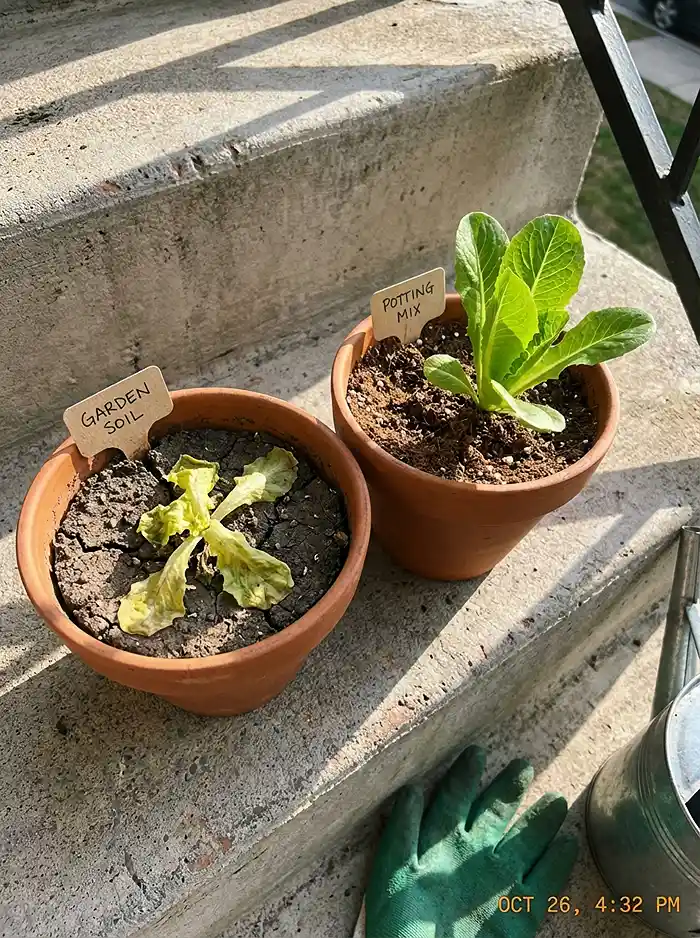
Every container has something called a perched water table — a saturated, soggy zone at the bottom where gravity simply can’t pull the water through the drainage holes fast enough. In the shallow 6–8 inch pots that leafy greens call home, that waterlogged layer can swallow half your root zone. Garden soil, with its fine clay particles, makes this dramatically worse.
It compacts under its own weight, collapses the air pockets roots need to breathe, and within days you’re staring at yellowing leaves, stunted growth, and damping-off — that frustrating fungal rot that kills seedlings right at the soil line.
As Mark Bolt, VP of EarthBox, puts it: “Soil is the make-or-break factor in container gardening. You can water and fertilize perfectly, but if your mix is wrong, plants won’t thrive.”
Here’s the side-by-side that convinced me to never cheat again:
| Factor | Garden Soil | Soilless Potting Mix |
|---|---|---|
| Compaction | High — collapses in pots | Low — holds its structure |
| Drainage | Slow, pools at the base | Fast, even flow-through |
| Pathogens | Weed seeds, fungi, nematodes | Sterile or near-sterile |
| Weight/gallon | ~10–12 lbs | ~4–6 lbs |
| Pore space (aeration) | ~30–40% | ~60–70% |
Bottom line? If you want the best soil mix for leafy greens in containers, it shouldn’t contain any actual soil. Soilless is the way. Always.
Anatomy of the Perfect Potting Mix for Leafy Greens
A great organic container soil for greens has three jobs: hold moisture, drain excess water, and feed the plant. Here’s how each ingredient pulls its weight.
Moisture-Retentive Base — Peat Moss vs. Coconut Coir
Peat moss is the old-school standard. It holds up to 20× its weight in water, which sounds amazing until you learn it’s naturally acidic (pH 3.5–4.5) and notoriously stubborn about re-wetting once it dries out. In shallow containers that dry fast on a hot afternoon, that’s a real problem.
Coconut coir is the newer, more forgiving option. It sits at a near-neutral pH (5.8–6.8), it’s renewable, and — here’s the big one — it rewets easily even after going bone dry. For fast-drying shallow pots, that reliability is huge.
My honest take for greens? Coir wins for beginners. Less pH fussing, better rehydration between daily waterings, and you’re not fighting the material to do its job.
Drainage & Aeration — Perlite vs. Vermiculite
Perlite (those white popcorn-looking bits) creates permanent air tunnels in your mix. It doesn’t break down, doesn’t absorb water, and prevents the compaction that suffocates fine lettuce roots. It’s the best default choice for most growers.
Vermiculite plays a different game. It absorbs and slowly releases moisture, and its cation-exchange capacity holds onto calcium and magnesium — nutrients greens love. That makes it ideal in hot, dry climates where pots dry out within hours.
Rule of thumb: Use perlite in cooler or moderate climates. If you’re growing in heat, try a 50/50 perlite-vermiculite split to balance airflow with moisture retention.
Organic Amendments — The Nitrogen Engine Leafy Greens Need
Leafy greens are leaf factories, and leaves run on nitrogen. Period. Your amendments should prioritize this macronutrient above everything else.
Worm castings are the MVP here — concentrated, slow-release nitrogen that’s gentle enough for seedlings and packed with humic acids that boost nutrient uptake in tight root zones. Finished compost adds beneficial microbes and improves moisture buffering. And for heavy feeders like kale and collards, you can optionally toss in alfalfa meal, feather meal, or fish meal — all slow-release and OMRI-listed.
3 Proven DIY Soil Mix Recipes for Container Leafy Greens
These aren’t theoretical — they’re the three DIY potting mix recipes I rotate through depending on what I’m growing and what’s on hand. Pick the one that fits your situation.
Recipe 1 — The University Standard (UNH-Style)
| Ingredient | Amount |
|---|---|
| Sphagnum peat moss | 1 part |
| Vermiculite | 1 part |
| Dolomitic lime | 2–4 tbsp per gallon of mix |
| Bone meal (organic) or superphosphate | Per label |
Best for: Gardeners who want a research-backed, no-guesswork soilless mix for leafy greens.
Heads up: This mix is intentionally nutrient-lean. You’ll want to top-dress with blood meal or liquid fish emulsion every 2–3 weeks if you’re doing continuous harvests. According to the University of Maryland Extension’s container media guide, soilless mixes lose nutrients and break down physically over time, so supplemental feeding isn’t optional — it’s essential.
Recipe 2 — The Organic Powerhouse (3:1 Mix)
| Ingredient | Amount |
|---|---|
| High-quality organic potting soil | 3 parts |
| Worm castings | 1 part |
Best for: The fastest setup on this list. Ideal for cut-and-come-again lettuce and mesclun mixes.
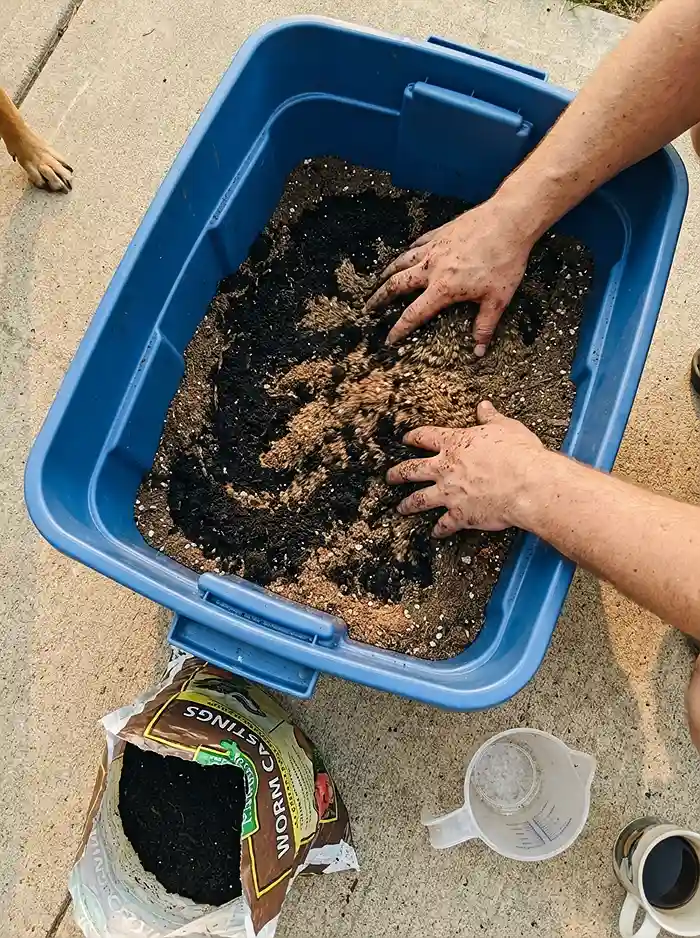
Why it works so well for greens: Worm castings deliver immediately available nitrogen plus humic acids that supercharge nutrient uptake in shallow root zones. You can literally be sowing seeds ten minutes after mixing. If you want a full walkthrough on pairing this mix with small planters, our guide on how to grow salad greens in small planters covers the whole process — vessel, substrate, cultivar selection, everything.
Recipe 3 — The Sustainable Coir-Based Blend
| Ingredient | Amount |
|---|---|
| Coconut coir | 80–90% |
| Perlite | 10–20% |
| Organic slow-release nitrogen (alfalfa or neem meal) | Per label |
Best for: Eco-conscious growers and hot-climate container gardens.
Fair warning: Coir is nutritionally inert. You must supply nitrogen and calcium externally. Add dolomitic lime (1 tbsp per gallon) and a balanced organic granular fertilizer at planting, or your greens will stall out and look sad.
Container Depth Guide for Leafy Greens in Containers
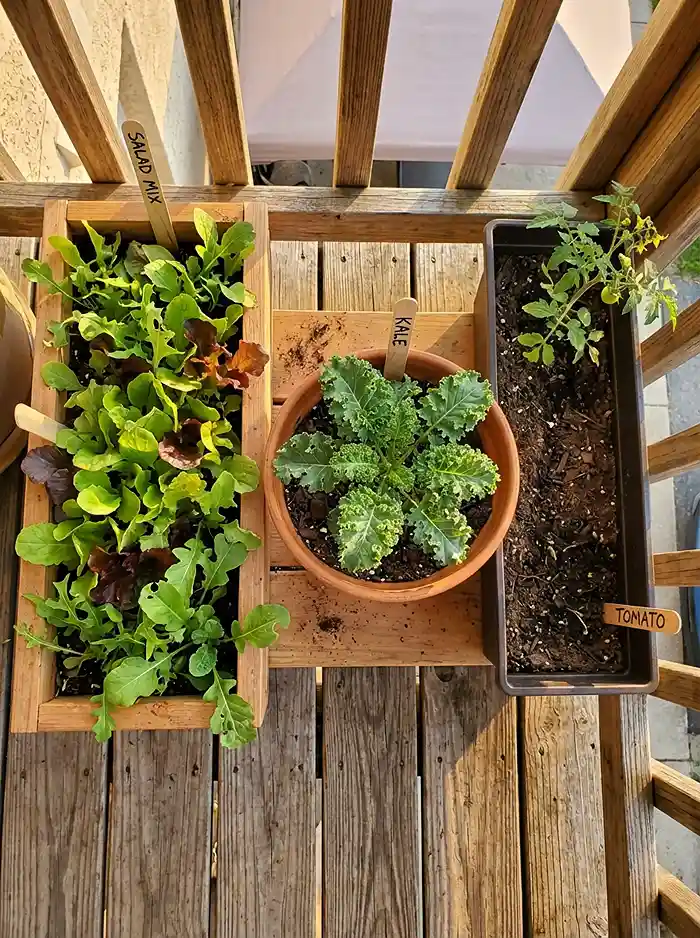
Here’s something that surprised me early on: with leafy greens, width matters more than depth. Their roots are shallow — a wide, low trough like a 24″ × 8″ window box will outproduce a tall, narrow pot every single time.
| Soil Depth | Crops | Notes |
|---|---|---|
| 6–8 inches | Lettuce (all types), spinach, arugula, mustard greens, most herbs | The sweet spot for greens — go wide, not deep |
| 8–10 inches | Kale, Swiss chard, bok choy, endive | Deeper roots + longer season = more soil volume |
| 10–12 inches | Beets (greens + root), radishes, bush beans | Dual-purpose crops |
| 18+ inches | Tomatoes, peppers, potatoes | For mixed container gardens |
If you’re mostly growing salad greens, don’t overthink this. Six to eight inches of a quality soilless mix for leafy greens is all you need.
Maintaining & Refreshing Your Soil Mix for Leafy Greens Season After Season
Here’s the maintenance trick that saves me money every year: don’t throw away old potting mix. Leafy greens are relatively light feeders compared to tomatoes or peppers. A seasonal refresh is all it takes to keep the same mix producing for another round.
The 3-Step Regeneration Protocol
Step 1 — Remove & inspect. Pull out the top 2–3 inches of spent mix and all old root balls. Give it a look for pest larvae, fungus gnats, or mold before reusing anything.
Step 2 — Replenish organic matter. Fold in 25% by volume of fresh worm castings or finished compost. This restores the three things leafy greens deplete fastest: nitrogen, microbial life, and water-holding capacity.
Step 3 — Reset pH. Add 2–4 tablespoons of dolomitic lime per gallon of mix. Decomposing organic matter slowly acidifies the soil over time, and lime nudges it back to the 6.0–7.0 sweet spot — while also delivering calcium, which prevents that annoying tip burn on lettuce and chard.
That’s it. Three steps, twenty minutes, and your containers are ready for another season without buying a single new bag of mix.
Frequently Asked Questions
What’s the ideal soil pH for leafy greens in containers?
6.0–7.0. Lettuce, spinach, kale, and chard all thrive in this slightly acidic to neutral range. Grab a $10 soil pH probe, test before each season, and adjust with dolomitic lime (to raise) or elemental sulfur (to lower). It’s the cheapest insurance you’ll ever buy.
What’s the most important nutrient for leafy greens?
Nitrogen — and it’s not even close. Nitrogen drives chlorophyll production and rapid leaf expansion. Look for a fertilizer where the first number is the highest (something like 10-5-5), or just top-dress with worm castings every 3–4 weeks. Simple, effective, hard to mess up.
Is Miracle-Gro potting mix safe for organic leafy greens?
Standard Miracle-Gro contains synthetic slow-release fertilizers and isn’t OMRI-listed. If organic matters to you, look for Miracle-Gro Performance Organics or alternatives like FoxFarm Ocean Forest, Coast of Maine Stonington Blend, or Espoma Organic Potting Mix — all carry the OMRI seal.
Can I use sand instead of perlite for drainage?
I wouldn’t. Sand dramatically increases container weight without matching perlite’s ability to create air pockets. In the shallow containers greens require, heavy sand also compresses the already-limited root zone. Perlite is cheap and does the job better in every way.
How often should I water leafy greens in containers?
Daily in warm weather, every 2–3 days in cool weather. Never let the top inch dry out completely. Greens are roughly 95% water — even brief drought makes them bitter and triggers bolting. Consistency beats volume, every time.
The Leafy Greens Container Soil Cheat Sheet
If you remember nothing else from this entire post, remember these three non-negotiables:
- Nitrogen-first fertility. Leafy greens are leaf factories. Starve them of nitrogen and nothing else you do — not perfect sunlight, not a flawless watering schedule — will save your harvest.
- pH between 6.0–7.0. Buffer it with dolomitic lime at every seasonal refresh. This also supplies the calcium that prevents tip burn in lettuce and chard.
- Lightweight, airy structure. A blend of 60–70% coir or peat plus 20–30% perlite eliminates the density that kills shallow roots in containers. That’s the best soil mix for leafy greens in containers, full stop.
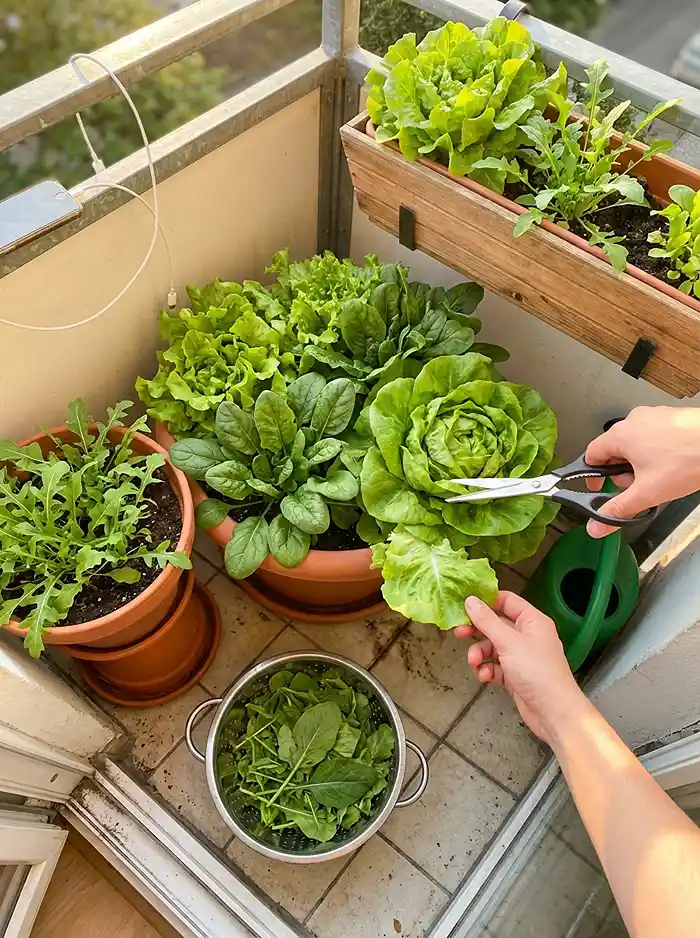
Get the soil right, and everything else — watering, feeding, pest management — falls into place almost automatically. Get it wrong, and you’ll fight the same frustrating battles every season wondering what you’re doing wrong.
Want to put this mix to work? Head over to our step-by-step guide on how to grow salad greens in small planters and start your first container harvest this weekend.