

12 Winter Balcony Planter Ideas Without Flowers
These 12 winter balcony planter ideas keep your balcony green, red, and gold all season, using hardy winter container plants instead of fragile flowers. I grow mine on a west-facing fourth-floor balcony in zone 6b, and the pots still look sharp in January.
Blooms quit by November. Bark, berries, needles, and leaf color don’t.
Table of Contents
Planning a Cold-Hardy Winter Balcony: Zones, Wind, and Root Survival
Quick Answer: Winter container gardening works differently because plants go dormant and exposed roots can freeze solid. Choose cold-hardy plants, protect the root ball, and let structure, texture, and foliage color replace summer blooms.
Dormant plants stop growing, so what you plant in November is what you’ll see until March. That’s why bark, needles, berries, and leaf color matter more than petals.
The real enemy is the root ball freezing solid, thawing, and freezing again. For more cold-season layouts, browse these seasonal balcony garden ideas.
The “Two-Zone Rule” for Selecting Winter-Hardy Balcony Plants
Quick Answer: Pick plants rated at least two USDA zones colder than yours. Balcony pots sit in open air on every side, so roots feel the full air temperature. In zone 6, that means zone 4 plants.
Ground roots get buffered by soil. Raised pots don’t. Check your zone on the USDA Plant Hardiness Zone Map (updated in 2023, with many areas shifting warmer), then shop two numbers lower.
Real Example: My first winter, I potted ‘Munstead’ lavender, rated zone 5. By February it was brown twigs. One zone of buffer wasn’t enough.
Assessing Winter Sun Angles, Freezing Wind Tunnels, and Snow Loads
Low winter sun makes south and west balconies tricky. Soil thaws at noon and refreezes by dusk, and that daily swing splits pots and heaves roots.
Wind is the other killer. Upper-floor gusts strip moisture from evergreen needles faster than frozen roots can replace it. Before you plan your January balcony garden, find out where the wind funnels through.
Snow adds weight, too. Park heavy pots against the building wall, away from the rail, where wind drops and snow slides off.
Essential Materials: Frost-Proof Planters, Insulating Liners, and Grit Soil
Winter pots fail three ways: cracked walls, frozen drainage holes, and soggy soil. This checklist prevents all three.
- Frost-proof planters: fiberglass, resin, or wood at least 1 inch thick
- Rubber pot feet: three per pot, lifting the base 1 inch off the deck
- Insulating liner: bubble wrap or burlap for the pot’s inner walls
- Fast-draining soil: pine bark fines, perlite, and peat-free coir
- Mulch: 2 inches of pine bark over the soil surface
Choosing Freeze-Proof Fiberglass, Resin, Thick Wood, and Pot Feet
Quick Answer: Choose non-porous containers like fiberglass, resin, or thick wood, which handle sub-zero expansion. Terracotta and thin ceramic absorb water, freeze, and crack. Add rubber pot feet to every pot.
| Material | Best For | Watch Out For |
|---|---|---|
| Fiberglass | Lightweight railing and corner planters | Dark colors absorb sun and trigger midday thaws |
| Resin | Budget-friendly, frost-proof pots | Very thin walls can turn brittle in deep cold |
| Thick wood (1 inch or more) | Natural root insulation | Needs a liner and eventual replacement |
| Terracotta or thin ceramic | Nothing in winter | Soaks up water, freezes, and cracks |
Without pot feet, drainage holes freeze to the deck and meltwater has nowhere to go. Lift every pot at least 1 inch.
Fast-Draining Winter Potting Soil Mix and Bubble-Wrap Root Insulation
Standard potting mix holds too much water, which turns into an ice block. Mix your own gritty blend:
- 2 parts pine bark fines (small, shredded bark pieces)
- 1 part perlite
- 1 part peat-free coir (coconut fiber)

This blend sheds icy water fast while still holding enough moisture for dormant roots. Line the inner walls of each pot with bubble wrap or burlap before filling, and leave the bottom open so water drains.
12 Winter Balcony Planter Ideas That Don’t Depend on Flowers
Each recipe below uses texture, color, and structure instead of petals. Expect sculptural conifers, neon twigs, and glossy berries. Zone notes are included wherever a plant needs milder winters.
Idea 1: Fiery Red-Twig Dogwood and Golden Hinoki Cypress Statement Pot
Anchor a tall corner planter with red-twig dogwood (Cornus sericea ‘Baileyi’ or compact ‘Arctic Fire’, zone 2). Surround it with dwarf golden hinoki cypress (Chamaecyparis obtusa ‘Nana Lutea’, zone 4) for fan-shaped gold foliage. Crimson stems glow against snow. Cut a third of the oldest stems each March for brighter growth.

Idea 2: Jewel-Toned Heuchera, Silver Dusty Miller, and Trailing Ivy Tapestry
Fill a window box with plum and caramel Heuchera (coral bells, zone 4) and silver dusty miller (Jacobaea maritima). Let variegated English ivy (Hedera helix) spill over the front. Dusty miller is only reliably hardy to zone 7, so treat it as a bonus in colder areas.
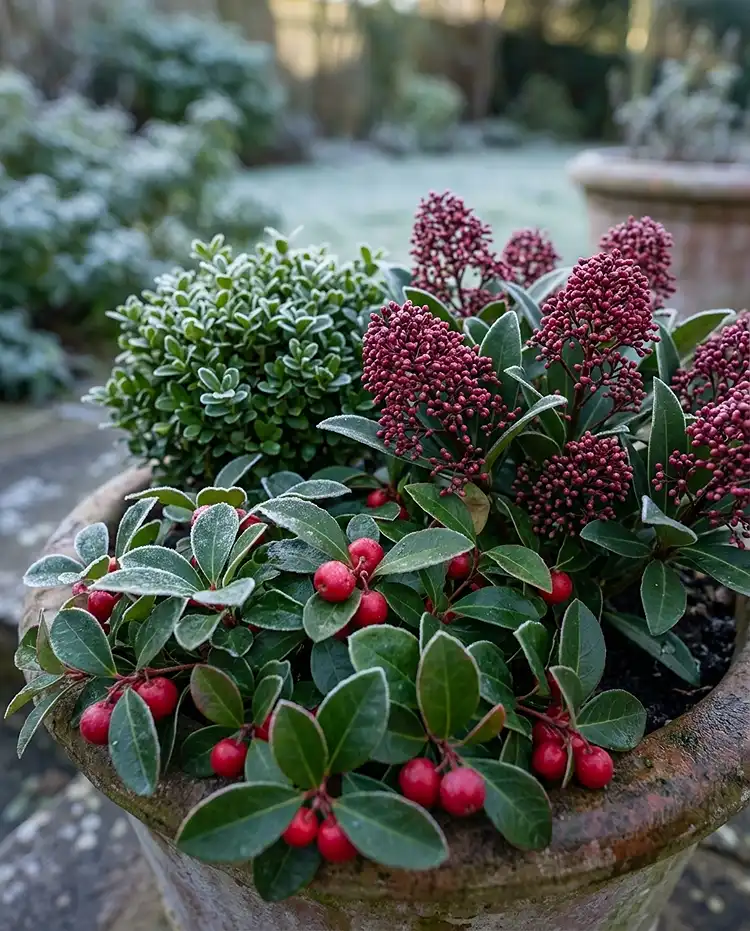
Idea 3: Berry-Bright Wintergreen, Skimmia Japonica, and Dwarf Boxwood
For partial shade, plant scarlet-berried creeping wintergreen (Gaultheria procumbens, zone 3), ruby-budded Skimmia japonica ‘Rubella’, and a dwarf boxwood like ‘Green Velvet’ (Buxus, zone 5). The berries and buds look festive through February. Skimmia is hardy to zone 7, so zone 6 gardeners should shelter it against a wall.
Idea 4: Architectural Alpine Bowl of Cold-Hardy Sempervivum and Blue Sedum
Plant frost-hardy hens and chicks (Sempervivum, zone 3) with Sedum reflexum ‘Blue Spruce’ in a shallow bowl of gritty mix. The rosettes flush burgundy in the cold. Tilt the bowl slightly so rain drains, because soggy soil kills succulents faster than frost.

Idea 5: Rustling Winter Ornamental Grasses and Bronzed Carex Sedge Trough
Bring movement to a windy balcony with feather reed grass (Calamagrostis ‘Karl Foerster’, zone 4). Its golden plumes rustle all winter. Underplant with Carex ‘Evergold’ (zone 5) and bronze Carex comans ‘Bronco’ (zone 7, so skip it in colder areas). Cut the grass back to 4 inches in late February.

Idea 6: The Nordic Woodland Pot with Dwarf Alberta Spruce and Living Sheet Moss
Center a dwarf Alberta spruce (Picea glauca ‘Conica’, zone 3) in a matte pot, then add silvery-blue ‘Blue Star’ juniper (Juniperus squamata, zone 4). Tuck living sheet moss and a few pinecones around the base. Spruce hates wind, so keep this pot against the wall.
Idea 7: Dramatic Black Mondo Grass, Variegated Euonymus, and Corkscrew Willow
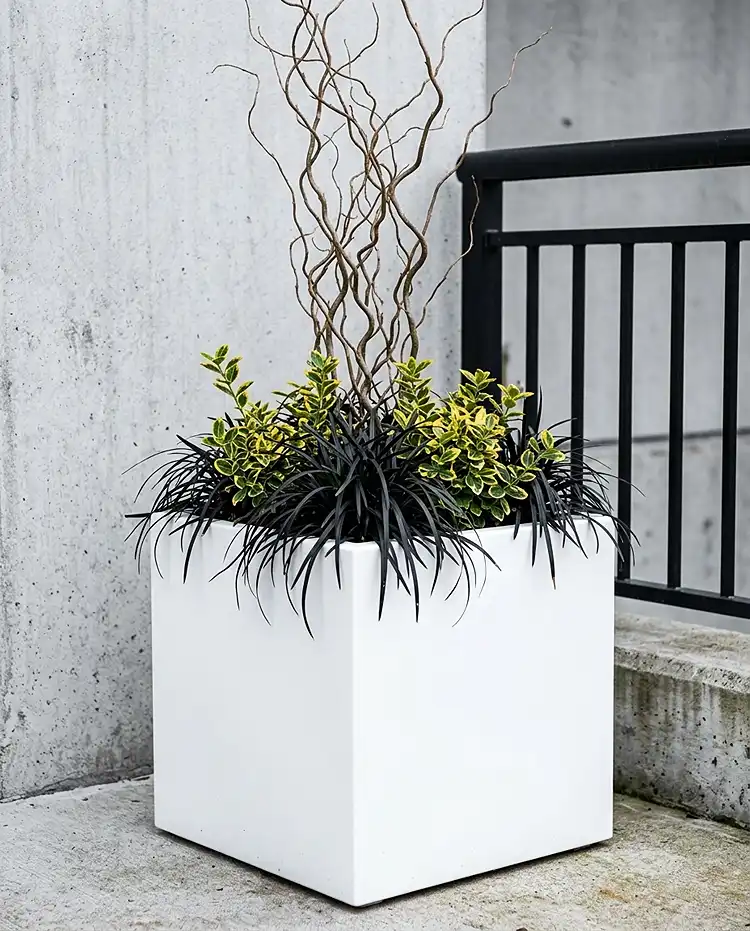
Build modern drama with jet-black mondo grass (Ophiopogon planiscapus ‘Nigrescens’, zone 5), gold-edged Euonymus fortunei ‘Emerald ‘n’ Gold’ (zone 5), and a twisted corkscrew willow (Salix matsudana, zone 4) as the vertical accent. Water the willow well, since it dries out fast.
Idea 8: Cold-Hardy Culinary Herb & Ornamental Kale Railing Box
Combine ruffled purple-and-ivory ornamental kale (Brassica oleracea, tough to about 10°F) with ‘Arp’ rosemary, silver thyme, and purple sage. ‘Arp’ is rated only to zone 6, so it’s a gamble in colder areas.
Real Example: My ‘Arp’ rosemary survived two zone 6b winters tucked against the wall in burlap. Moved to the rail one January, it browned within two weeks.

Idea 9: Shady Sanctuary of Evergreen Tassel Ferns and Spotted Laurel
For a shaded or north-facing balcony, pair glossy tassel fern (Polystichum polyblepharum, zone 5) with gold-splashed spotted laurel (Aucuba japonica ‘Gold Dust’). The leathery fronds stay green all winter. Aucuba is reliable only in zone 7 and warmer. In colder zones, swap in a dwarf Pieris japonica.
Idea 10: Cascading Creeping Jenny, Blue Rug Juniper, and Nandina Foliage Trio
Golden creeping Jenny (Lysimachia nummularia ‘Aurea’, zone 3) spills over the rim in chartreuse and bronze. Compact Nandina domestica (‘Fire Power’ or ‘Obsessed’, zone 6) flushes scarlet. ‘Blue Rug’ juniper (zone 3) forms the silver-blue base. These compact cultivars are considered non-invasive.
Idea 11: Faux-Living “Faux & Foraged” Cut Evergreen Bough and Birch Pole Arrangement
In zones 2 to 4, living plants struggle in pots, so fake the look with cuttings. Pack a pot with damp soil and let it freeze solid. Push in cut noble fir, cedar, white birch poles, dried hydrangea heads, and winterberry branches. Frozen soil holds everything upright, and the boughs stay fresh until March.

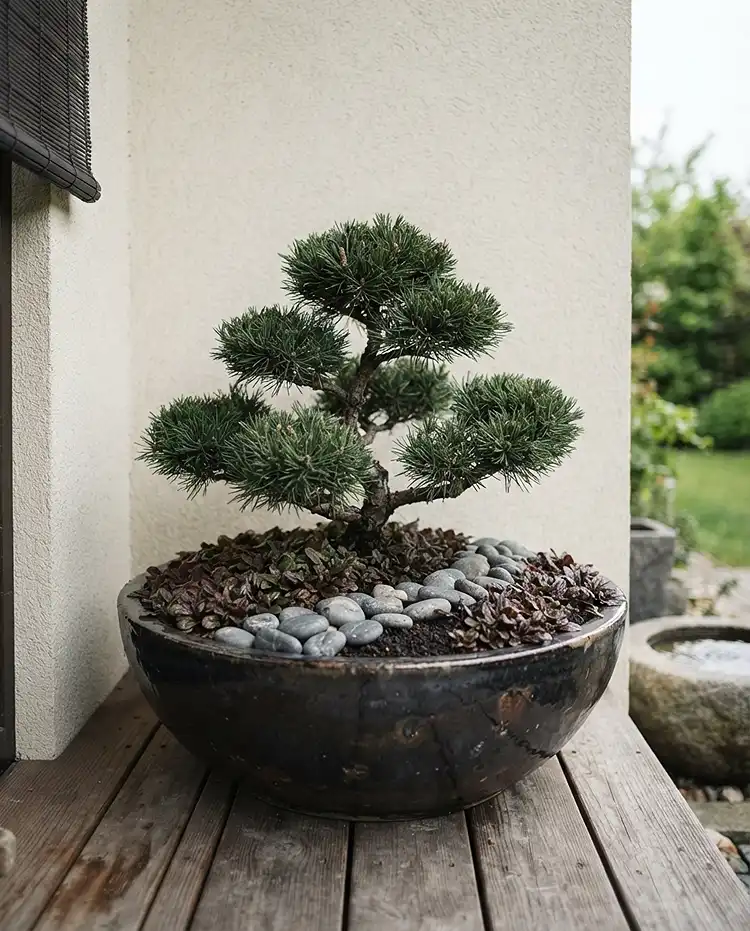
Idea 12: Miniature Japanese Zen Planter with Dwarf Mugo Pine and Ajuga
Center a cloud-pruned dwarf mugo pine (Pinus mugo ‘Mops’, zone 2) in a low, heavy bowl. Surround it with burgundy-bronze bugleweed (Ajuga reptans, zone 3) and smooth river stones. Pinch the new pine candles (fresh shoots) in May to keep the cloud shape tight.
Mastering Winter Balcony Maintenance and Seasonal Care
Quick Answer: The silent killer of winter container plants is drought during sunny thaws. Frozen roots can’t drink, but leaves and needles keep losing moisture. Check soil whenever air temperatures rise above 40°F (4.4°C) and water at midday.
The Above-Freezing Watering Schedule and Anti-Desiccant Sprays
| Condition | What to Do |
|---|---|
| Soil frozen, air below 32°F (0°C) | Don’t water; frozen soil can’t absorb it |
| Thaw above 40°F (4.4°C), top 2 inches dry | Water at midday so it drains before dusk |
| Cold snap coming, broadleaf evergreens | Spray anti-transpirant on a dry day above 40°F |
Use a pine-based anti-transpirant like Wilt-Pruf on boxwood, euonymus, skimmia, and Aucuba. It coats leaves with a thin film that slows moisture loss.
Grouping Pots for Thermal Mass and Transitioning into Early Spring
Cluster containers against a sunlit masonry wall. Brick and concrete absorb daytime heat and release it at night, which softens temperature swings.
Hold all fertilizer until April, since feeding dormant plants pushes tender growth that freezes. Then snip winter-burned tips back to healthy green tissue. These seasonal balcony garden ideas cover what comes next.
Common Problems & Solutions
Winter Burn and Browning Needles on Balcony Evergreens
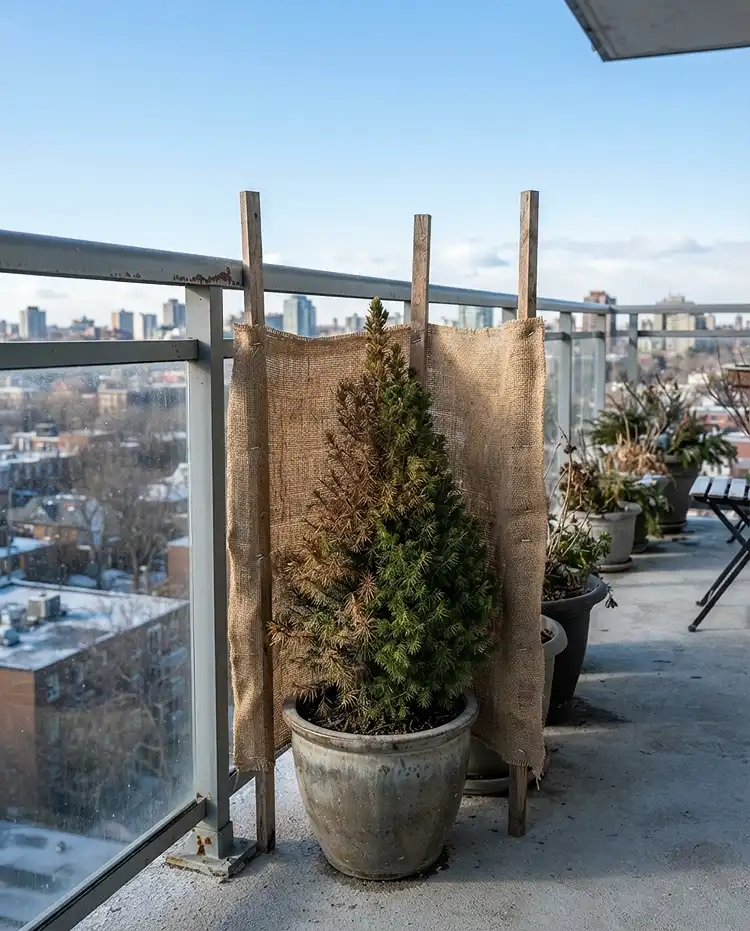
Quick Answer: Winter burn happens when bright sun and wind pull moisture from foliage while frozen roots can’t replace it. Fix it with temporary burlap windscreens and water during thaws.
Real Example: My dwarf Alberta spruce went rusty brown on its windy side one February after I skipped a thaw watering. With a burlap screen and thaw-day watering, it pushed new green buds by June.
Cracked Pots and Heaving Root Balls from Freeze-Thaw Cycles
Daytime melting and nighttime freezing pops shallow roots out of the soil and splits pots. Lay a 2-inch blanket of pine bark mulch over the soil to even out the swings. Remove bottom drip saucers for winter so water can’t pool and freeze.
Waterlogged Ice Blocks and Root Rot in Dormant Containers
Poorly drained soil soaks up winter rain and turns into a suffocating ice block that rots dormant roots. Raise pots on risers. Tilt unplanted or semi-dormant troughs slightly and slide them under the balcony overhang so rain and snow miss them.
Frequently Asked Questions
How often do you water balcony plants in the winter?
Dormant evergreens need water only once every 2 to 4 weeks, and only when the soil is thawed and air temperatures sit above 40°F (4.4°C). Water at midday so excess drains before nightfall.
What plants stay green all winter in pots on a freezing balcony?
Dwarf Alberta spruce, mugo pine, ‘Blue Star’ juniper, ‘Green Velvet’ boxwood, creeping wintergreen, and cold-hardy sedums and sempervivums stay green through freezing weather. Check each plant’s zone against the two-zone rule.
Should I leave saucers under my balcony planters during the winter?
Remove all saucers before the first hard freeze, or flip them upside down. Standing water freezes solid, seals off drainage holes, and rots dormant roots.
When should I plant my winter balcony containers so the roots survive?
Plant living winter arrangements in mid-to-late autumn, at least 4 to 6 weeks before the ground freezes, so roots can establish in the potting mix. Cut evergreen boughs can go in anytime in November or December.
Key Takeaways
- These 12 winter balcony planter ideas rely on foliage, bark, berries, and structure, so nothing depends on a bloom.
- Choose plants rated two USDA zones colder than yours, because raised pots expose roots to the full air temperature.
- Use fiberglass, resin, or thick wood containers on rubber feet, filled with a fast-draining bark and perlite mix.
- Water on thawed days above 40°F (4.4°C), since winter drought kills more evergreens than cold does.