
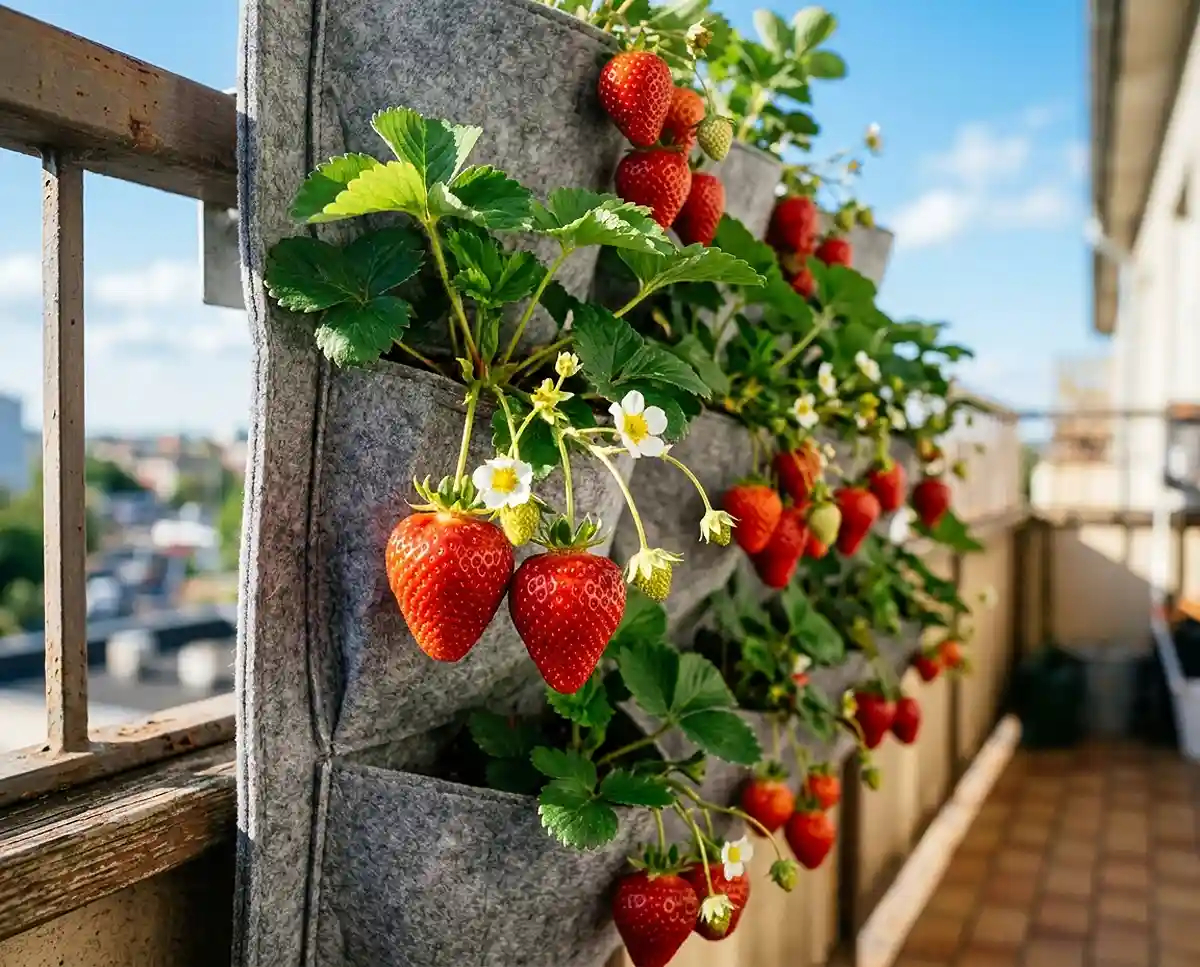
Vertical Strawberry Planter Ideas for Balconies
A vertical strawberry planter is the smartest move you can make for small space gardening — you get fresh berries without sacrificing a single square foot of floor space. Miss this setup and you’re leaving your best balcony real estate unused.
Table of Contents
Why Vertical Planters Are Perfect for Balcony Strawberries
Strawberries love to cascade. That trailing habit makes them natural candidates for vertical gardening — the fruit hangs clean, away from soil, and airflow around the leaves cuts fungal problems dramatically.
A standard vertical strawberry planter tower can hold 20–30 plants in the footprint of a single pot. That’s a game-changer when your “garden” is a 6-foot balcony.
Better airflow also means fewer slug and mold issues, which are the two biggest headaches in ground-level beds. We’ll cover the best planter styles, the right varieties, and how to keep them producing all season.
Check out our guide to building a minimalist balcony garden for more ideas on maximizing compact outdoor spaces.
Planning Your Vertical Strawberry Garden
Before you buy anything, assess three things: sun exposure, structural weight limits, and available wall or railing space. Get these right and everything else falls into place.
Rushing straight to a planter purchase is one of the most common small space gardening mistakes — a little planning saves a lot of dead plants.
How Much Sun Do Strawberries Need on a Balcony?
Quick Answer: Strawberries need 6–8 hours of direct sun daily. Less than 6 hours means fewer flowers, smaller fruit, and higher disease risk.
Track your balcony’s sun across a full day before choosing a planter location. South- and west-facing balconies in the Northern Hemisphere are your best bet.
- 6–8 hours direct sun: optimal for fruiting
- 4–6 hours partial sun: plants survive but yields drop by 30–50%
- Under 4 hours: skip strawberries, grow herbs instead
Pro Tip: Mount your vertical strawberry planter on the sunniest wall, even if it means a longer hose run — sun matters more than convenience.
Checking Weight Limits and Wall Support
Quick Answer: A fully watered vertical planter can weigh 30–80 lbs depending on size. Always check your balcony’s load rating and use proper wall anchors rated for at least double the expected weight.
Most apartment balconies are rated for 40–60 lbs per square foot, but wall mounting is different from floor loading. Use 3-inch structural screws into studs or masonry anchors — never just drywall plugs.
- Felt pocket planters (8-pocket): ~15–25 lbs when wet
- Terracotta tower (5-tier): ~40–60 lbs when wet
- PVC pipe vertical planter: ~20–35 lbs when wet
- Railing-mounted rail planter: distributes weight along railing — check rail load rating
Pro Tip: When in doubt, use a freestanding planter stand instead of wall mounting — zero drilling, fully moveable, and no landlord headaches.
Best Vertical Strawberry Planter Ideas
There’s no single “best” option — the right vertical strawberry planter depends on your balcony size, sun angle, and how hands-on you want to be. Here’s a breakdown of what actually works.
| Planter Type | Best For | Watch Out For |
|---|---|---|
| Felt pocket tower | Maximum plants, small footprint | Dries out fast, needs daily watering |
| Stacked terracotta | Classic look, good drainage | Heavy, can tip in wind |
| Railing planter | No floor space used | Limited soil volume per plant |
| Hanging basket | Easy access, great airflow | Needs frequent watering and feeding |
| DIY gutter planter | Budget-friendly, customizable length | Shallow roots, higher watering frequency |
Stacking Pots, Towers, and Pocket Planters
Quick Answer: Stacking systems and felt towers are the most space-efficient option, fitting 15–30 plants in under 2 square feet of floor space.
Felt pocket planters are lightweight, breathable, and cheap. An 8-pocket design holds one plant per pocket and can be hung from a single hook. The vertical gardening payoff is immediate — you go from 1 plant per pot to 8 in the same wall space.
- Stacking terracotta pots (5-tier): 15–20 plants, classic look, heavy
- Felt tower (20-pocket): 20 plants, lightweight, best for renters
- Plastic tower with drip tray: 30 plants, self-contained, easiest to water
Real Example: Last spring I ran a 20-pocket felt tower on my north-facing wall (only 5 hours of sun) — the top 12 pockets fruited reasonably well, but the bottom 8 barely flowered. Sun distribution matters in towers.
Pro Tip: Rotate a freestanding tower 90 degrees every week so all sides get equal sun exposure.
Hanging Baskets, Rail Planters, and DIY Options
Quick Answer: Hanging baskets and railing planters are ideal for renters who can’t drill walls — they need no permanent installation and can move with you.
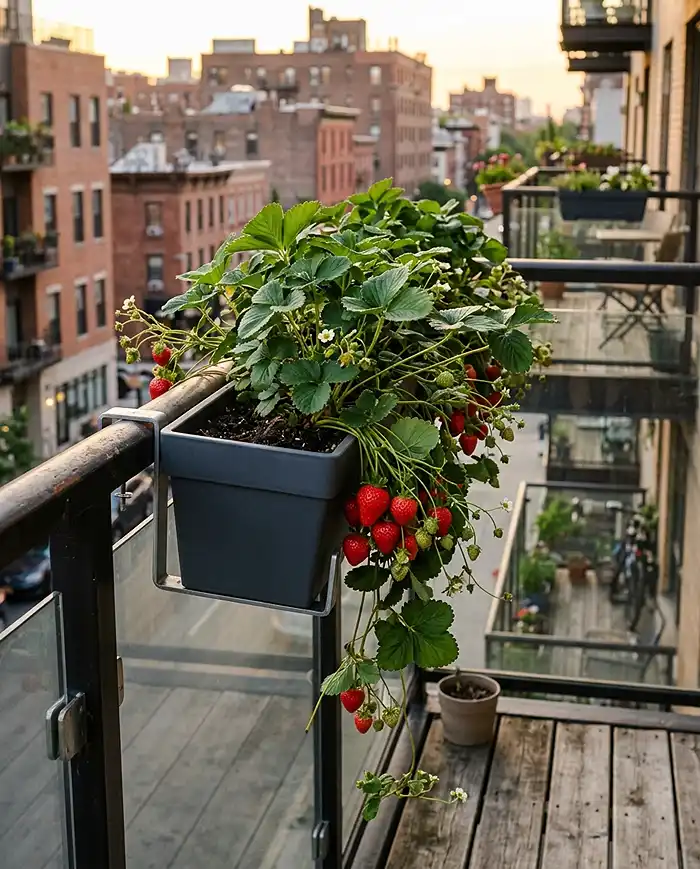
A 12-inch hanging basket fits 3–5 strawberry plants and looks spectacular when runners cascade over the sides. Rail planters clip directly onto standard 2-inch railings and hold 4–6 plants per meter of railing.
DIY gutter planters mounted horizontally at different heights are a brilliant low-cost option. Use 4-inch PVC gutters, drill drainage holes every 6 inches, and stack 3–4 tiers on a simple wooden frame.
Pro Tip: For DIY setups, line the inside of wood pallets with landscape fabric before filling with soil — it keeps the mix in while still draining freely.
Choosing the Right Strawberry Varieties
Variety choice is where most balcony growers go wrong. Not all strawberries suit container vertical gardening — you want compact plants with a long fruiting window.
| Type | Fruiting Season | Best For Containers? | Recommended Varieties |
|---|---|---|---|
| June-bearing | One big flush, 3–4 weeks | Fair — lots of fruit at once, then nothing | Honeoye, Earliglow |
| Everbearing | Spring + fall flushes | Good — two harvests per year | Ozark Beauty, Quinault |
| Day-neutral | Continuous May–October | Excellent — keeps producing all season | Seascape, Albion, Tristar |
For a balcony vertical garden, day-neutral varieties are the clear winner. They ignore day length and fruit continuously from late spring through first frost.
Everbearing vs. Day-Neutral vs. June-Bearing
Quick Answer: Day-neutral varieties like Seascape and Albion are the best choice for vertical containers — they produce fruit all season rather than in a single burst.
June-bearing varieties produce a spectacular harvest over 3–4 weeks, then stop. That’s fine in a large garden but frustrating in a small space gardening setup where you want steady returns on limited soil volume.
- Day-neutral (Seascape, Albion): fruits May–October, ignores photoperiod, best for balconies
- Everbearing (Ozark Beauty): two flushes (spring + fall), compact habit, reliable
- June-bearing (Honeoye): one big harvest — only choose if you want to make jam in bulk
Pro Tip: Alpine strawberries (a day-neutral type) are tiny but incredibly productive and drought-tolerant — perfect filler plants for the edges of pocket planters.
Soil, Drainage, and Setup Essentials
Standard garden soil is too heavy and compacts quickly in vertical containers. You need a mix that stays loose, drains fast, and holds just enough moisture to keep roots happy between waterings.
The ideal mix for a vertical strawberry planter: 60% quality potting mix, 30% perlite or coarse sand, 10% compost. This keeps the weight down and prevents the waterlogging that rots crowns.
- Avoid garden soil entirely — it compacts and blocks drainage holes
- Add slow-release granular fertilizer (10-10-10) at planting: 1 tbsp per gallon of mix
- For felt towers, add extra perlite (up to 40%) since fabric dries faster than plastic
- Fill from the bottom up, tamping lightly every 6 inches to eliminate air pockets
The University of Minnesota Extension strawberry guide recommends slightly acidic soil (pH 5.5–6.5) for best fruiting — add a handful of sulfur chips if your tap water is alkaline.
Tools and Materials You’ll Need
Quick Answer: Here’s everything you need before planting day — gather it all first so you’re not making three hardware store runs.
- Vertical strawberry planter (tower, pocket planter, or rail system)
- Quality potting mix: 1–2 cubic feet per 20-pocket tower
- Perlite: 1 bag (8 quarts) per tower
- Slow-release granular fertilizer (10-10-10 or 5-10-10)
- Liquid strawberry or tomato fertilizer for weekly feeding
- Wall anchors, hooks, or railing clips depending on mounting style
- Watering can with a narrow spout, or drip irrigation kit
- Bird netting (trust me — you’ll need it before the first berry ripens)
If you’re using grow bags as part of a hybrid setup, our guide on using grow bags for tomatoes covers soil prep and drainage principles that apply directly to strawberries too.
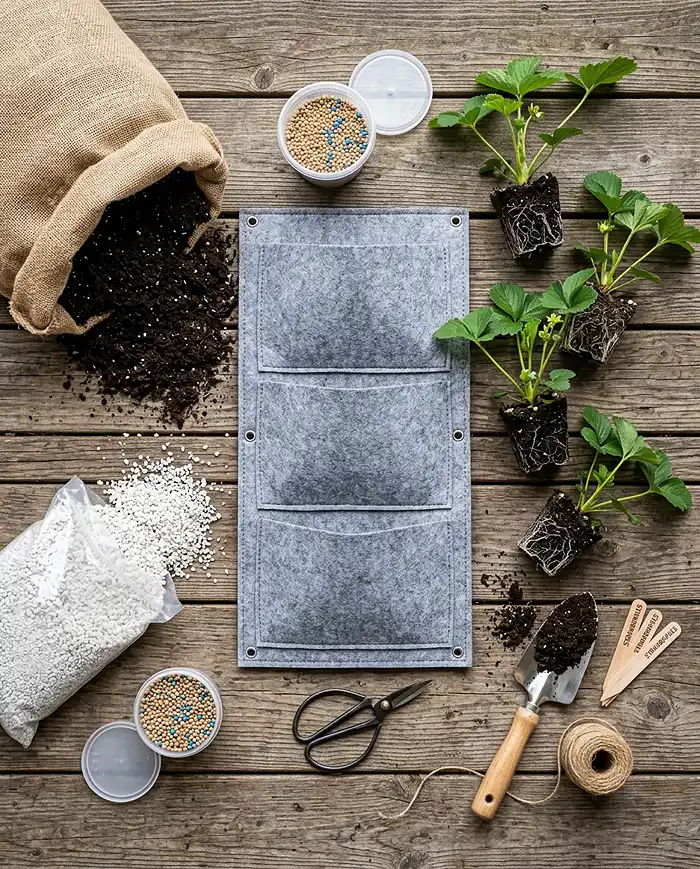
Step-by-Step: Planting Your Vertical Strawberry Planter
Planting correctly from the start makes everything easier — watering, feeding, and eventual harvest. The most critical step is crown depth, and it’s the one most beginners get wrong.
- Fill the planter to the first pocket or planting hole with your soil mix
- Tamp the mix lightly — firm but not compacted
- Insert the plant with roots spread downward, crown sitting exactly at soil level
- Continue filling and planting upward, pocket by pocket
- Water thoroughly from the top until water runs from the bottom drainage holes
- Hang or mount the planter in its final sunny position
- Check crown depth on all plants after initial watering — soil settles and can bury crowns
Space plants 8–10 inches apart if planting in rows or wide containers. In tower systems, one plant per pocket is the rule — overcrowding kills airflow and invites disease.
Correct Planting Depth for Strawberry Crowns
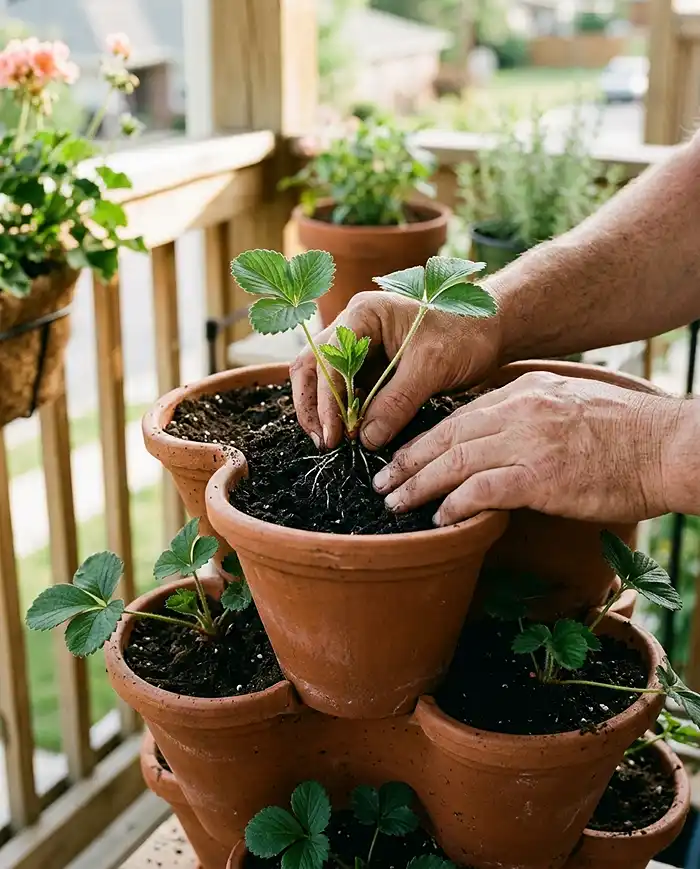
Quick Answer: The crown — the short, woody stem between roots and leaves — must sit exactly at soil level. Too deep causes crown rot; too shallow causes the plant to dry out and die.
It sounds simple, but soil settles after watering and suddenly crowns are buried. Check every plant 24 hours after first watering and lift any that got covered.
- Crown buried: rot sets in within days, especially in damp weather
- Crown exposed: roots dry out, plant wilts and struggles to establish
- Crown at soil level: optimal — you can just see the base of the lowest leaves
Pro Tip: The RHS strawberry planting guide describes the correct depth as “midpoint buried, midpoint exposed” — a helpful visual for beginners.
Watering and Feeding for Maximum Fruit
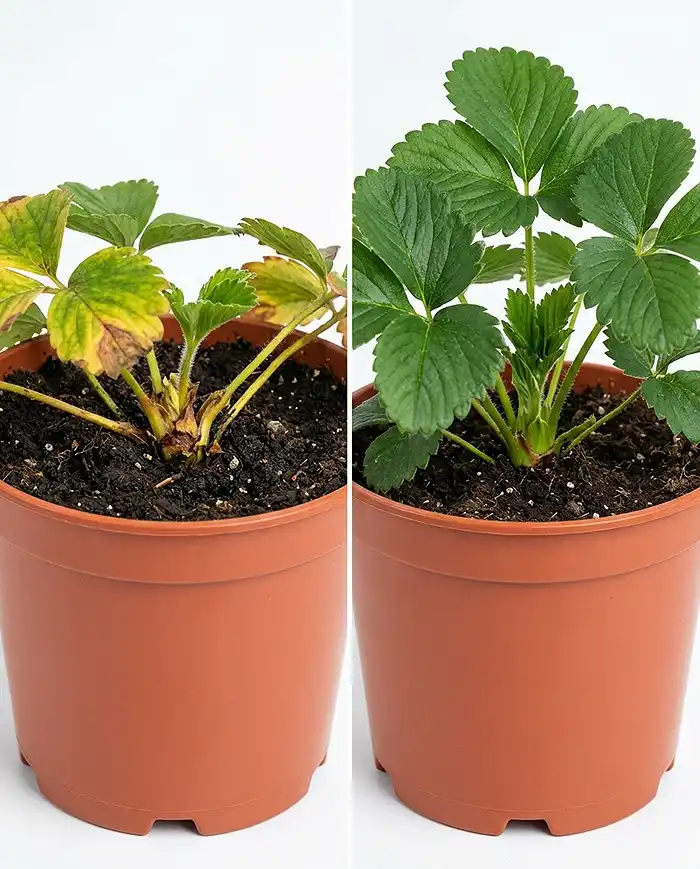
Vertical planters dry out 2–3 times faster than ground beds. On a sunny balcony in summer, that can mean daily watering. Miss a day and the top pockets stress while the bottom ones stay damp — a maddening imbalance.
Aim to keep soil consistently moist (not wet) throughout the planter. Stick a finger 2 inches deep into a middle pocket — if it’s dry, water now.
- Summer watering frequency: once daily in heat above 80°F (27°C)
- Spring/fall frequency: every 2–3 days
- Feeding: liquid 5-10-10 fertilizer every 2 weeks during active growth
- Avoid high-nitrogen fertilizers once flowers appear — they push leaves, not fruit
- Stop feeding in late fall to let plants harden before winter
Even Watering in Stacked Systems
Quick Answer: Water slowly from the top in stages, not all at once. Pouring fast pushes water down the outside of the soil column and the top pockets stay dry while lower ones flood.
The fix: water the top pockets, wait 60 seconds, water again. Repeat 3–4 times. This gives water time to absorb laterally before continuing down.
- Install a slow-drip top cap (sold for tower planters) for hands-free even watering
- Water in the morning — evening watering on foliage invites mold overnight
- A self-watering tower with a reservoir at the base is worth the extra cost if you travel
Pro Tip: Drop a 1-inch PVC pipe down the center of a DIY tower planter with holes drilled every 4 inches — pour water into the pipe and it distributes evenly at every level.
Seasonal Care and Overwintering
Summer care mostly means watering, feeding, and cutting off runners [the long shoots strawberries send out to propagate]. In a vertical strawberry planter, runners have nowhere to root — pinch them off to redirect energy into fruit production.
In fall, cut back old foliage, stop feeding, and reduce watering. Container plants are more vulnerable to freeze damage than ground plants because their roots are above ground level and exposed to cold air on all sides.
- USDA Zones 7–10: leave planters outside, reduce watering, mulch the top of the planter
- USDA Zones 5–6: move planters to an unheated garage or shed for winter
- USDA Zones 3–4: bring indoors or insulate with bubble wrap and fleece
- Refresh soil mix every 2–3 years as it degrades and loses drainage capacity
Strawberry plants are perennial and will fruit for 3–5 years with good care. Replace individual plants that stop producing rather than replanting the whole tower at once.
Common Problems and Solutions
Top Plants Drying Out, Bottom Staying Wet
Quick Answer: This is the most common vertical planter problem — gravity pulls water down, starving top pockets and drowning bottom ones.
- Add extra perlite to the bottom third of the planter mix to improve lower-level drainage
- Use the slow top-watering technique described above
- Add moisture-retentive crystals to the top pockets only
- Check bottom drainage holes aren’t blocked — clear them with a skewer if needed
Few or No Strawberries Forming
Quick Answer: Low yields almost always trace back to one of three causes: not enough sun, wrong variety, or too much nitrogen fertilizer.
- Less than 6 hours sun: move the planter or accept reduced yield
- June-bearing variety: it fruited once and is done — switch to day-neutral next season
- Over-fertilizing with nitrogen: leaves go lush green, flowers don’t set — switch to 5-10-10
- Poor pollination: hand-pollinate with a small paintbrush if bees aren’t reaching your balcony
Pests and Birds Eating the Fruit
Quick Answer: Birds and slugs are the biggest threats. Net the planter before the first berries color up — birds are faster than you think.
- Birds: drape lightweight garden netting over the planter, secured with clips
- Slugs: apply copper tape around the base of the planter — slugs won’t cross it
- Aphids: spray with diluted neem oil (2 tsp per liter of water) every 7 days
- Spider mites (in hot, dry weather): mist leaves with plain water daily
Frequently Asked Questions
How many strawberries can I grow in a vertical planter?
A standard 20-pocket felt tower holds 20 plants. Expect 150–200 berries per season from a well-managed day-neutral tower in 6+ hours of sun. Stacking pot systems with 5 tiers typically hold 15 plants and yield slightly less due to the deeper but narrower pockets.
What is the best vertical planter for strawberries?
For most balconies, a felt pocket tower (20–30 pockets) is the best combination of price, weight, and plant capacity. If you want something more permanent-looking, a terracotta stacking tower is attractive but heavier. Railing planters work best when floor and wall space are both off-limits.
How do I water a vertical strawberry planter evenly?
Water slowly in 3–4 passes from the top, waiting 60 seconds between each pass. This lets water absorb sideways before trickling down, hydrating every pocket rather than just the lowest ones. A PVC pipe with drilled holes down the center of DIY towers distributes water even more evenly.
Do strawberries come back every year in containers?
Yes — strawberries are perennial and can live 3–5 years in containers. In Zones 5 and below, you’ll need to move the planter to a sheltered, frost-free location for winter. Refresh the top layer of soil each spring and replace any plants that stopped producing the previous season.
Key Takeaways
- A vertical strawberry planter fits 15–30 plants in under 2 square feet — the best ROI in small space gardening
- Day-neutral varieties (Seascape, Albion) are the top choice for balcony vertical gardens — they fruit continuously all season
- Crown depth is non-negotiable: exactly at soil level, never buried, never exposed
- Water slowly and in stages from the top to prevent the classic top-dry, bottom-wet problem in stacked systems
- Check balcony weight limits before mounting any soil-filled vertical gardening system — a full planter is heavier than it looks