

How to Reset Overgrown Balcony Garden in a Day
Can’t squeeze past the pots? Here’s how to reset overgrown balcony garden chaos and reset overgrown apartment balcony garden space in one afternoon. No dumpster, no starting over, no buying all new soil.
I garden on a sunny rooftop terrace in zone 7a. It gets about 8 hours of sun, and I grow in 5-gallon fabric pots and 14-inch ceramic tubs. After 12 years coaching renters, I’ve untangled plenty of jungles, mine included.
Seeing a balcony garden before and after makes the payoff real. Let’s get you there.
Table of Contents
Phase 1: The Triage Audit for Deciding What to Keep, Divide, or Compost

Short Answer: Sort every pot into three piles before you cut anything: Keep & Rejuvenate, Divide & Multiply, or Pull & Compost. Healthy perennials and shrubs stay, crowded crowns get split, and spent or bolted annuals go to compost. Sorting first stops you from hacking at plants you’d have saved.
Overgrown pots hide the truth. Dense leaves shade stems and roots, so a plant can look fine while it quietly starves. Walk the whole balcony first with painter’s tape and a marker. Tape each pot green to keep, yellow to divide, or red to pull.
How Do You Tell Exhausted Annuals From Salvageable Perennials?
Pull anything finished: bitter lettuce that has bolted [sent up a flower stalk and turned harsh], powdery-mildewed squash, and seeded-out spring annuals. Flag lavender, hydrangea, and other woody plants with green tape. They only need structural pruning and a little root relief.
Checking Weight Loads, Hidden Water Damage, and Blocked Drains
Shift the pots aside and look underneath. Check for soft deck tiles, clogged scuppers [the openings that let rain drain off], and waterlogged tubs. A 14-inch tub of wet soil can weigh 50 pounds or more.
Confirm your building’s load limit before stacking anything on shelves. Clear any blocked drain right now, before you move a single plant.
Essential Reset Toolkit: Sanitized Blades, Soil Amendments, and Containment Tarps
Short Answer: You need sharp bypass pruners, a serrated Hori-Hori knife, rubbing alcohol, and a folding potting tarp. Add soil amendments like worm castings and perlite. Gather everything before the first cut so you’re not hunting for tools with a root ball in your hands.
The Pruning and Root-Surgery Kit
Wipe your blades between every pot. It stops plant viruses from hopping from one plant to the next.
- Bypass pruners for stems up to half an inch thick
- A serrated Hori-Hori soil knife [a Japanese digging knife] for slicing root-bound balls
- 70% isopropyl alcohol and a rag for wiping blades
- Velcro plant ties for tamed vines
- A folding potting tarp to keep the mess off the neighbors
The “Zero-Dumpster” Soil Rejuvenation Recipe
Don’t haul tired soil to the trash. Blend 4 parts old soil, 1 part worm castings, 1 part pine bark fines, and 1 part coarse perlite. Add rehydrated coco coir if the mix sheds water. Stir in 1 tablespoon of organic 5-5-5 granules per gallon.
As of fall 2026, a small bag of worm castings usually runs $12 to $20, and it goes far. Skip reusing soil from plants that died of disease. Oklahoma State University Extension explains why pathogens linger in used potting soil.
More frugal fixes like this live in our low-budget balcony ideas.
Step-by-Step: Reset Overgrown Balcony Garden Pots in One Afternoon
Short Answer: Work top to bottom. Untangle and prune the canopy, split crowded combo pots, and root-prune bound plants. Then scrape the soil, scrub and elevate pots, and re-stage the layout. Six steps take about four hours for a dozen pots. Finish by 3 p.m. to dodge the afternoon heat.
Step 1: The “Rule of Thirds” Pruning for Leggy Stems and Tangled Vines
Start at the top. Unhook climbers like star jasmine, clematis, or tomato vines, and tie them loosely with Velcro. Cut the Three Ds [dead, damaged, and diseased stems] at the base.
Then shear leggy annuals and herbs back by one-third. Cut just above an outward-facing leaf node [the bump where a leaf meets the stem].
What happened to me: In July 2024, I gave my ‘Wave Purple’ petunias that one-third haircut. Fourteen days later, each pot carried about 30 fresh blooms.
Step 2: Separating Combo Pots Where Fillers Choked Out the Star
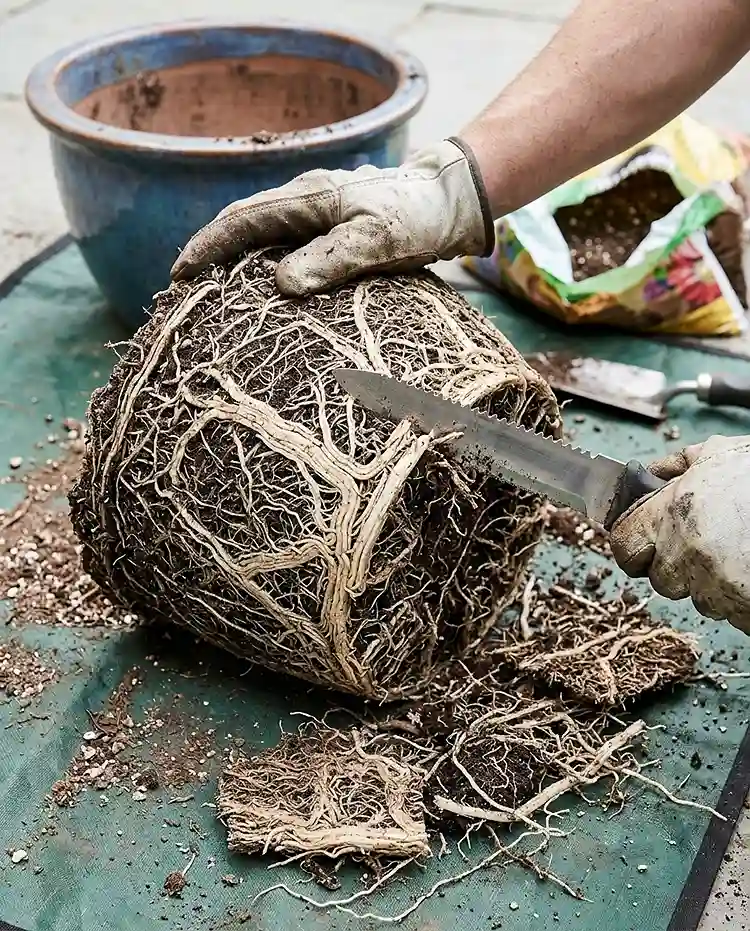
Slide the whole root ball onto your tarp. Tease or slice apart aggressive trailers like sweet potato vine, mint, or creeping Jenny. Repot the focal plant in its own pot with room to breathe. Give mint a pot of its own, always.

Step 3: In-Pot Root Pruning and Crown Division
Shave 1 to 2 inches off the outside and bottom of a circling root ball with your serrated knife. For hosta, fern, and ornamental grass, slice the crown in half instead. Everything goes back into the same pot with fresh soil packed around the edges.
What happened to me: In April 2025, my ‘Sum and Substance’ hosta was jammed in a 14-inch tub. I split it into three. The original pot leafed out in 3 weeks, and two divisions went to neighbors.
Step 4: The Top-3-Inch Soil Scrape and Deep Aeration
For heavy tubs you can’t lift, poke 6-inch aeration channels into the root ball with a wooden dowel. Scrape off the top 3 inches of salt-crusted soil. Backfill with worm castings and a bark-rich potting mix.
Step 5: Scrubbing Algae, Clearing Drainage Holes, and Adding Pot Feet
Brush algae and white mineral crust [efflorescence] off the rims with a 1:1 vinegar-water mix. Poke out root-plugged drainage holes with a screwdriver. Set every pot on half-inch rubber risers so water can escape and your deck can breathe.
Step 6: Re-Staging by Height and Light to Restore Your 18-Inch Walkway
Follow one rule: tall in back, trailing on railings, open in center. Move about 30% of your floor pots onto vertical shelves or railings. Keep an 18-inch lane clear so you can reach every pot and your chair.
Need layout inspiration? Browse these small balcony decor ideas.

Post-Reset Recovery Care and Seasonal Reset Timing Calendar
Short Answer: Give reset plants 14 days of gentle care: a morning kelp drench, afternoon shade, and no strong fertilizer until buds break. Time bigger cuts for early spring or September. Save mid-July for shearing and pulling bolted greens, across USDA zones 4 through 9.
Liquid Kelp Recovery Drench, Shade, and Holding Off on Nitrogen
Give root-pruned plants a deep morning soak with liquid kelp [seaweed extract] diluted to the label’s rate. It eases transplant shock and encourages fine root hairs. Park the pots in shade for 5 days.
Skip strong fertilizer for 2 weeks, until you see new green buds. Nitrogen pushes leaves before the roots can feed them.
Seasonal Reset Timing Chart: Early Spring vs. Mid-July vs. Late Fall
As of fall 2026, check your local frost dates with your extension office, since they shift year to year.
| Season | What to cut or move | What to skip |
|---|---|---|
| Early spring (zones 4-9) | Woody shrub pruning, perennial divisions, soil scrape | Heavy feeding before buds break |
| Mid-July | Shear leggy petunias and herbs, pull bolted greens, tuck in heat-tolerant plugs | Dividing shrubs and perennials in peak heat |
| September and late fall | Divisions in cool September weather, cleanup of dead annuals, pot scrubbing | Hard pruning of woody herbs before frost |
Common Problems and Solutions
Short Answer: The three biggest setbacks are wilting after root pruning, cutting into dead brown wood, and hidden pests in dense growth. Match leaf loss to root loss, cut only above green shoots, and rinse and spray plant interiors during the reset.
Why Is My Plant Wilting After Root Pruning?
Root pruning cuts the feeder roots, so the plant can’t drink as fast as its leaves lose water. Balance the books. If you shaved 25% of the roots, remove about 25% of the leaves, then shade the pot for 5 days. Most plants perk up within a week.
What If I Cut Into Old Brown Wood on Lavender, Rosemary, or Sage?
I learned this the hard way. In March 2022, I sheared my ‘Tuscan Blue’ rosemary down to bare brown stems, and it never grew back. Three years of babying, gone. Old brown wood has no dormant buds.
Now I cut just 1 inch above the lowest green shoots. For rescue, I root 4-inch green tip cuttings in water or perlite, which takes about 3 to 6 weeks.
Are Pests Hiding Deep Inside the Tangle?
Dense interior stems shelter white cottony mealybugs, scale, spider mites, and ant nests. During the reset, rinse each plant with a strong shower spray. Spray insecticidal soap at dusk so sun won’t scorch wet leaves.
Finish with a light dusting of diatomaceous earth or cinnamon on the soil surface, and repeat the soap in 7 days.
Frequently Asked Questions
Is it too late in summer to cut back overgrown, leggy balcony plants?
No. Mid-to-late summer, from July through mid-August, is a great time for a mid-season haircut on leggy petunias, calibrachoa, verbena, coleus, basil, and mint. Cut stems back by a third and feed with diluted liquid kelp. Most plants push a lush second flush within 14 days.
How do I get a root-bound plant out of a pot when the roots are stuck?
Water the pot first so the soil slides. Run a long serrated knife or Hori-Hori blade around the inside wall to cut clinging roots, then tap the rim firmly on its side. Slice off any roots matting out of the drainage hole.
Can I reuse old potting soil from pots where plants died or bolted?
Yes, unless the plant died of fungal wilt or root rot. Dump the pot onto a tarp, shake the soil off the dead roots, and mix in 25% fresh compost or worm castings plus a handful of perlite. That restores air space and nutrients right away.
What should I do with extra divisions and cuttings after a balcony reset?
Pot hosta, fern, and sedum divisions and rooted herb cuttings into 4-inch nursery pots. Use them to fill bare spots on vertical shelves, trade them in a local Buy Nothing plant group, or bring them indoors as windowsill plants for fall.
How long does it take to reset an overgrown balcony garden?
Plan on about four hours for a dozen pots, including cleanup. Triage takes the first 30 minutes, and the hands-on steps fill the rest. If it’s hot, split the job across two mornings.
How often should I reset my balcony garden?
Once a year is enough for most balconies, plus a light mid-July trim for leggy annuals and herbs. Reset woody shrubs and perennials in early spring or cool September weather. Root-bound pots may need attention every two to three years.
Quick Recap
- Sort every pot into keep, divide, or pull before you make a single cut.
- Wipe blades with 70% isopropyl alcohol between pots.
- Reset overgrown balcony garden pots from the top canopy down to the roots, then re-stage the layout.
- Match leaf removal to root loss, and shade pots for 5 days.
- Hold strong fertilizer for 2 weeks and keep an 18-inch walkway clear.