
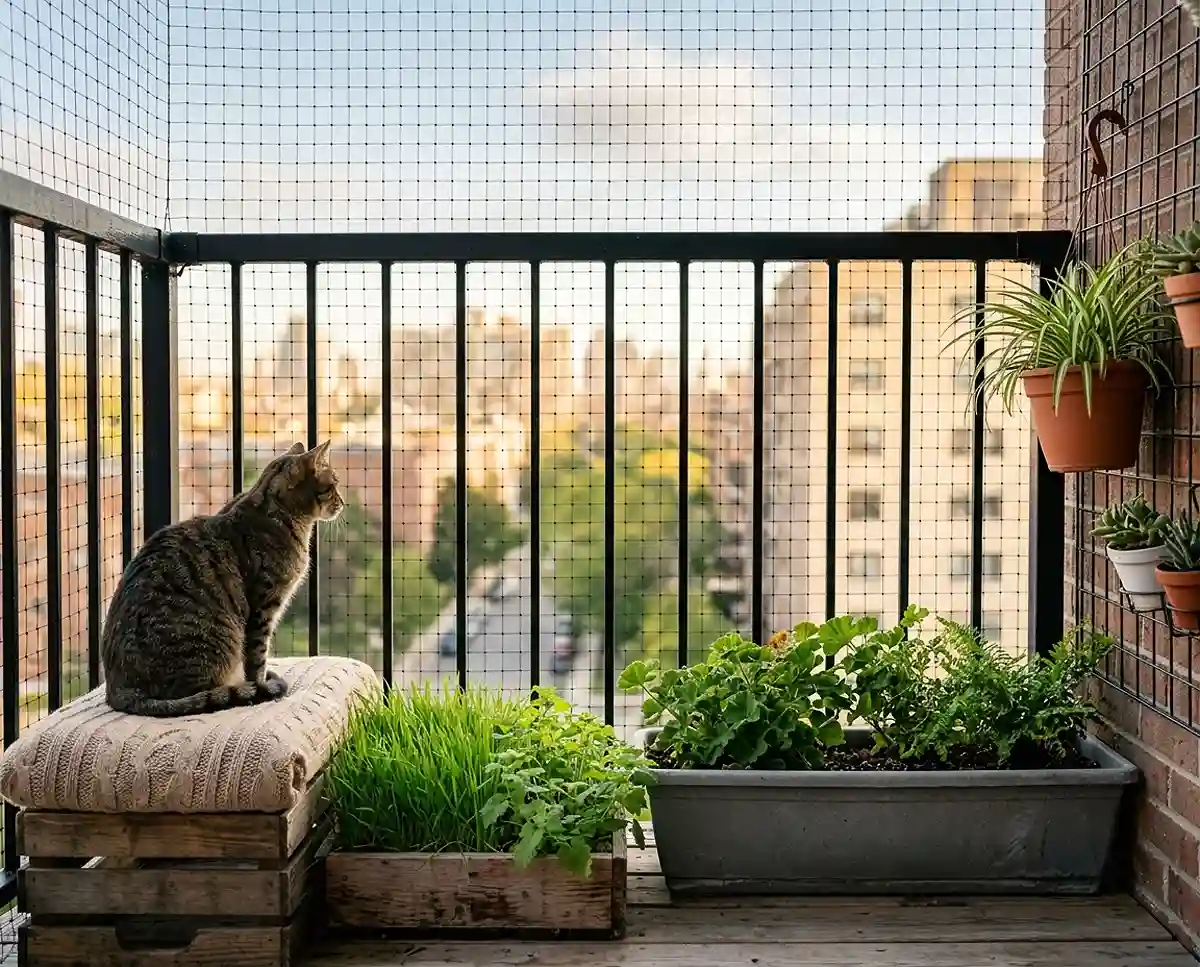
Balcony Cat Netting Without Drilling
Your cat eyes the pigeons while your lease bans drilling. Balcony cat netting without drilling solves both in one weekend, with a few clamps and a smart pitch to your landlord.
I garden on a sunny zone 7a rooftop terrace, mostly in containers from 5-gallon buckets to 24-inch troughs. The netting stories below come from neighbors’ and friends’ balconies, which I helped set up. After 12 years of helping renters, I’ve seen every balcony cat enclosure mistake there is. Let’s skip those.
Table of Contents
Phase 1: Permissions, HOA Rules, and Auditing Your Balcony for Cat Safety
Short Answer: Ask your landlord or HOA in writing before you buy anything. Frame the netting as reversible, low-glare, and mounted inside the railing line. Then check every gap on the railings, floor, and overhead. Any opening wider than 2 inches can trap a cat’s head or let a small body slip out.
The Why: Landlords worry about damage, looks, and liability. A zero-drill, renter friendly catio answers all three. Cats also squeeze through gaps that seem impossible, so the audit matters as much as the permission.
One more check: ask whether your building treats the balcony as part of a fire escape route. If it does, build one side from carabiner-clipped panels so the net opens in seconds.
How to Pitch No-Drill Cat Netting to Your Landlord or HOA (The “Invisible & Reversible” Script)
Send the email below with two photos: your railing today, and a product photo of matte black mesh. Photos calm nervous managers faster than paragraphs do.
Subject: Request to install removable cat safety netting on my balcony
Hello,
I’d like permission to install removable safety netting on my balcony. It lets my cat enjoy fresh air without any risk of escaping or falling.
The setup uses no drilling and no permanent fasteners. It mounts inside the railing line with tension poles and clamps, so nothing changes your building’s exterior.
The mesh is matte black, low glare, and nearly invisible from the street. I can remove it in about 15 minutes, and I’ll leave the balcony exactly as I found it when I move out.
I’ve attached two photos. Could you confirm in writing that this is acceptable? Thank you,
Add your name and unit number at the bottom. It’s also worth rereading your lease or HOA handbook for any rule changes since your last renewal.
Measuring the “Zero-Gap” Perimeter: Recessed Loggias vs. Open-Top Balconies and Plant Sun Zones
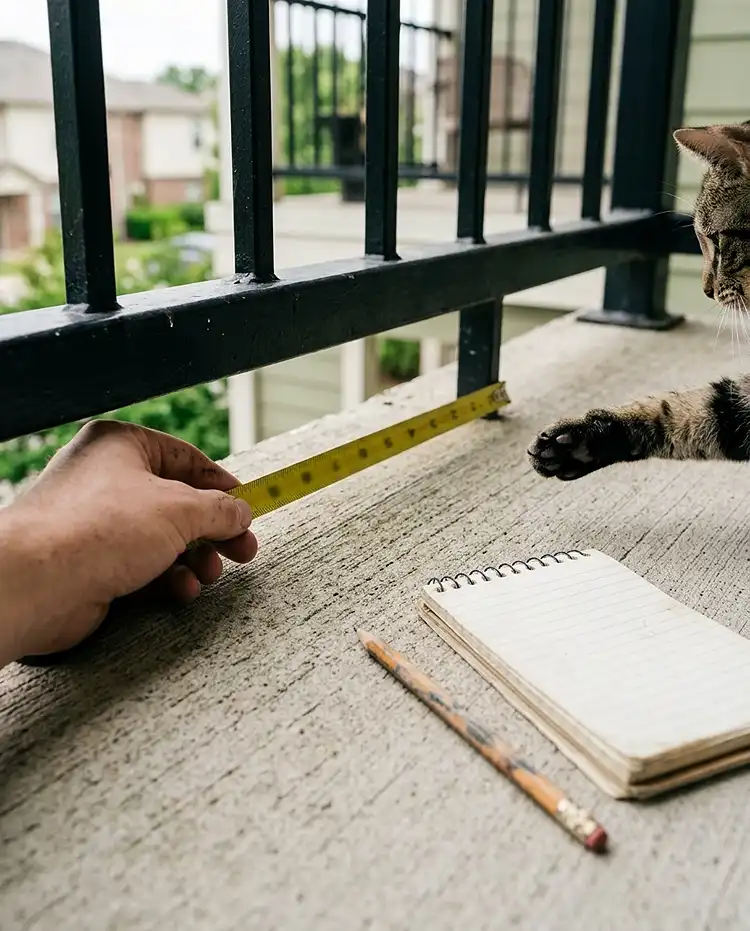
Grab a tape measure and a notebook. Recessed loggias have a ceiling to brace against. Open-top balconies need a netted roof, which is safer than inward-angled arms alone. Walk the whole space once, cat-eye view.
- Measure floor to ceiling, or floor to the top of the open frame, at every corner.
- Check the toe gap under the railing. Any opening over 2 inches needs blocking.
- Look at spindle spacing, wall seams, and the overhead edge.
- Note where sun lands at 10 a.m., noon, and 4 p.m.
In my experience, fine dark mesh blocks only a small share of light, so sun-loving plants rarely notice it.
Kittens and small adults can slip through gaps under 2 inches. If you have one, choose the smallest mesh you can find and close every gap you can.
Essential Materials: Bite-Proof Netting, Zero-Drill Poles, and Cat-Safe Soil Prep
Short Answer: You need wire-reinforced HDPE cat netting with 1.2-inch mesh, tension poles or railing clamps, and pet-safe container supplies. Skip garden bird netting. Cats tear it fast. Add black UV-rated zip ties, a small turnbuckle, and heavy troughs to pin the bottom edge.
- Wire-reinforced HDPE cat netting, 1.2-inch (30 mm) mesh, matte black
- Spring-loaded telescopic aluminum poles with rubber feet
- Clamp-on railing post extenders
- Black UV-stabilized nylon or stainless steel zip ties
- 2 mm vinyl-coated steel cable and a small turnbuckle
- Heavy fiberglass trough planters
- Coco coir, composted pine bark, washed pumice, and 2-inch river cobbles
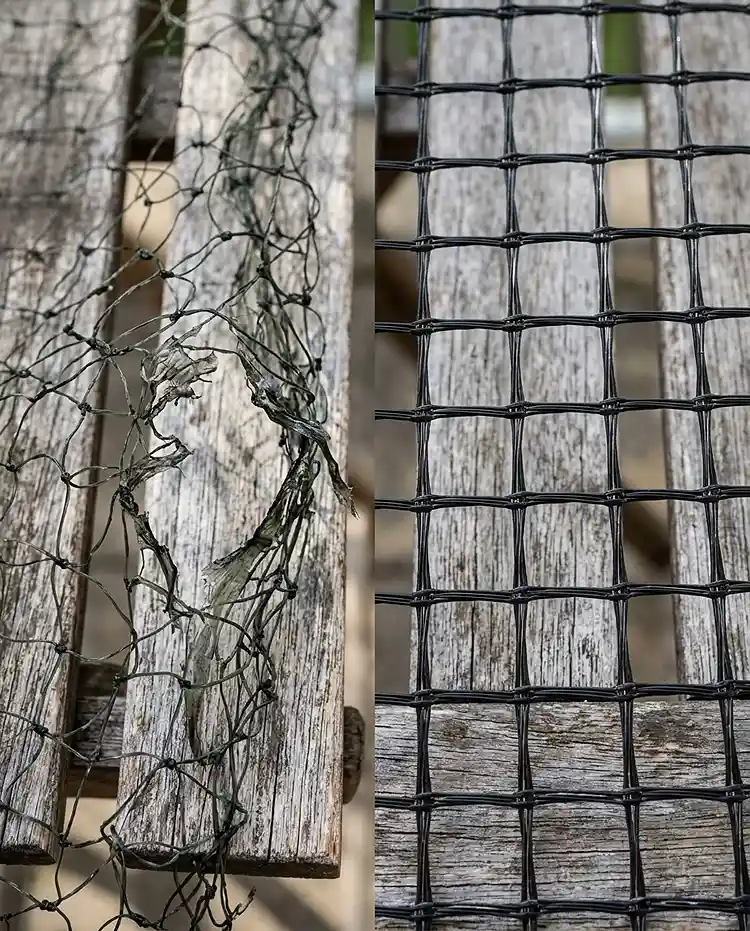
Choosing Wire-Reinforced HDPE Cat Netting (1.2×1.2 Inch Mesh) Over Flimsy Bird Netting
What Happened to Me: In June 2023, my neighbor Dana hung $12 plastic bird netting for her tabby, Biscuit. He chewed through it in about ten minutes. Her ‘Sungold’ tomatoes in 5-gallon buckets became his new playground.
We swapped in wire-reinforced mesh. Over the next 90 days, we found zero new chew holes.
Bird netting is thin and knotted. Claws snag it and teeth cut it. UV-stabilized HDPE with stainless wire woven through resists both. Pick matte black, which fades into building shadows from the street.
The 4 No-Drill Mounting Systems: Telescopic Tension Poles, Railing Clamps, Polycarbonate Base Clips, and Planter Ballast
Most balconies need two of these four systems working together. Here’s how they compare.
| System | Best for | Watch out for |
|---|---|---|
| Telescopic tension poles | Recessed loggias with a smooth ceiling | Can slip on concrete, so clamp the lower half |
| Railing clamps with 45-degree inward arms | Open-top balconies with no roof | Don’t overtighten on thin railings |
| Polycarbonate base clips (adhesive) | Smooth brick or concrete edges, only with landlord approval | Adhesive can mark surfaces, so test a hidden spot |
| Planter ballast | Sealing the bottom edge of the net | Needs heavy, gravel-weighted troughs |
Pet-Safe Potting Mix (No Cocoa Mulch or Perlite Dust) and Dig-Proof Pebble Top-Dressings
Here’s my cat-safe container mix, by volume: 2 parts pure coco coir, 1 part composted pine bark, 1 part heavy washed pumice. Top every pot with 2-inch river cobbles.
Skip cocoa hull mulch. It contains theobromine, the same compound that makes chocolate risky for pets. Skip dusty perlite too, since cats kick up the dust and make a mess. Skip synthetic fertilizer prills, which aren’t meant to be eaten.
What Happened to Me: Biscuit dug up Dana’s ‘Tuscan Blue’ rosemary almost daily. After we topped the 14-inch pot with cobbles, the digging stopped within a week.
Designing a Cat-Safe Balcony Garden Inside Your Netted Enclosure
Short Answer: Choose only plants listed non-toxic for cats by the ASPCA, and stage them so nothing becomes a launch pad. Keep low grazing troughs near a perch, put delicate plants on high wall grids, and ban lilies completely. Check every new plant’s Latin name before it enters the enclosure.
The ASPCA’s searchable toxic and non-toxic plant list is my first stop before any purchase. Common names lie. Latin names don’t.
Non-Toxic Balcony Plants: Catnip, Cat Grass, Spider Plants, Boston Ferns, and Parlour Palms
These all rate as non-toxic for cats on the ASPCA list. Non-toxic doesn’t mean stomach-proof, though, so a big nibble can still cause an upset.
- Catnip (Nepeta cataria) and wheat or oat grass in grazing troughs
- Spider plant (Chlorophytum comosum)
- Boston fern (Nephrolepis exaltata)
- Parlour palm (Chamaedorea elegans)
- Calathea, rosemary, basil, and petunias
Parlour palms, calathea, and Boston ferns can’t take a zone 7a winter outside. Bring them indoors before the first frost, which usually arrives in late October or early November here.
Deadly Balcony Plants to Ban Immediately (True Lilies, Sago Palms, Oleander, and English Ivy)
Some plants don’t belong on any cat balcony. Remove them before the net goes up.
- Lilium lilies and Hemerocallis daylilies
- Sago palm (Cycas revoluta)
- Oleander, foxglove, lantana, and English ivy
- Tulips and other bulbs, especially exposed bulbs
- Lily of the valley (Convallaria), which can affect the heart
- Clematis, which the ASPCA lists as toxic to cats
Lilies are the scariest. Even small exposures, like grooming pollen off fur, can cause severe kidney injury in cats. Read the ASPCA’s guide to toxic lilies and never bring a bouquet into the home.
If your cat touches a lily: call your vet or ASPCA Poison Control at (888) 426-4435 right away. Fast, aggressive vet treatment can prevent kidney injury. It’s often fatal if treatment waits more than 18 hours.
Staging “Grazing Troughs” at Floor Level While Hanging Delicate Blooms Out of Paw’s Reach
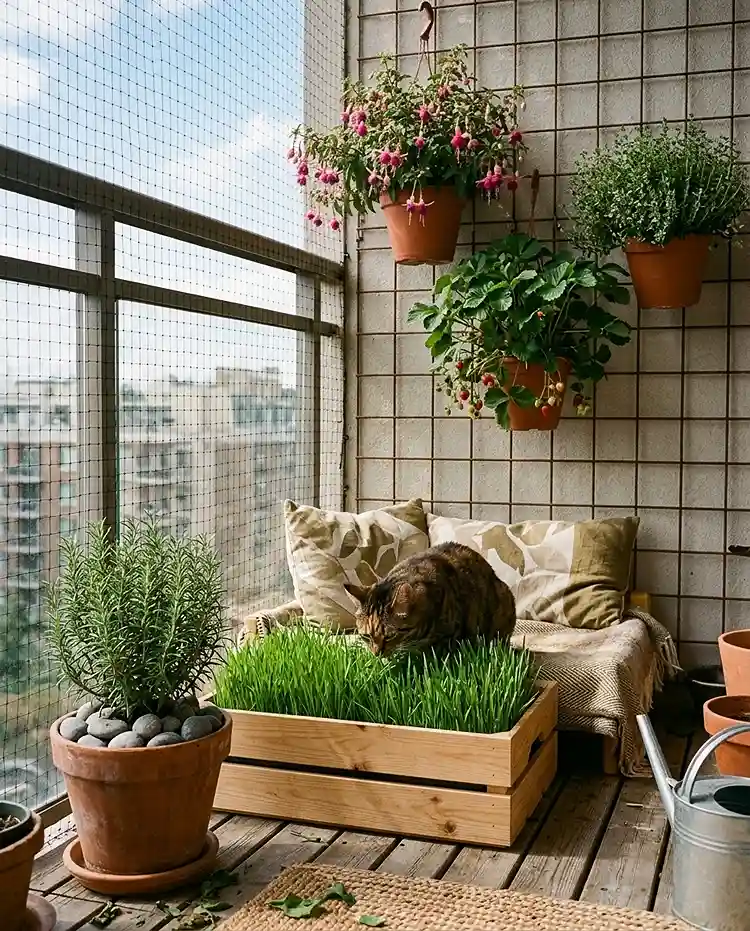
Put a low, wide wooden crate of cat grass and catnip right beside a sunny perch. Give your cat one obvious thing to chew.
Then go vertical. Hang trailing fuchsias, strawberries, and culinary herbs like thyme and basil on upper wall grids. Skip chives, garlic, parsley, and mint, which the ASPCA lists as toxic to cats.
What Happened to Me: In March 2025, I sowed oat grass in a 24-inch crate for a friend’s cat, Pickle. Seeds sprouted in 5 days. By day 12, it was grazing height, and the nearby spider plant stayed intact.
Installing Balcony Cat Netting Without Drilling, Step by Step
Short Answer: Wedge tension poles into the corners, clamp them to the railing, and thread a taut perimeter cable through the mesh. Zip-tie the net every 6 inches, pin the bottom edge under heavy planters, and add a small access flap. Work in order, and tug-test each step.
Step 1: Wedging Telescopic Tension Poles Into Corners and Clamping Railing Post Extenders
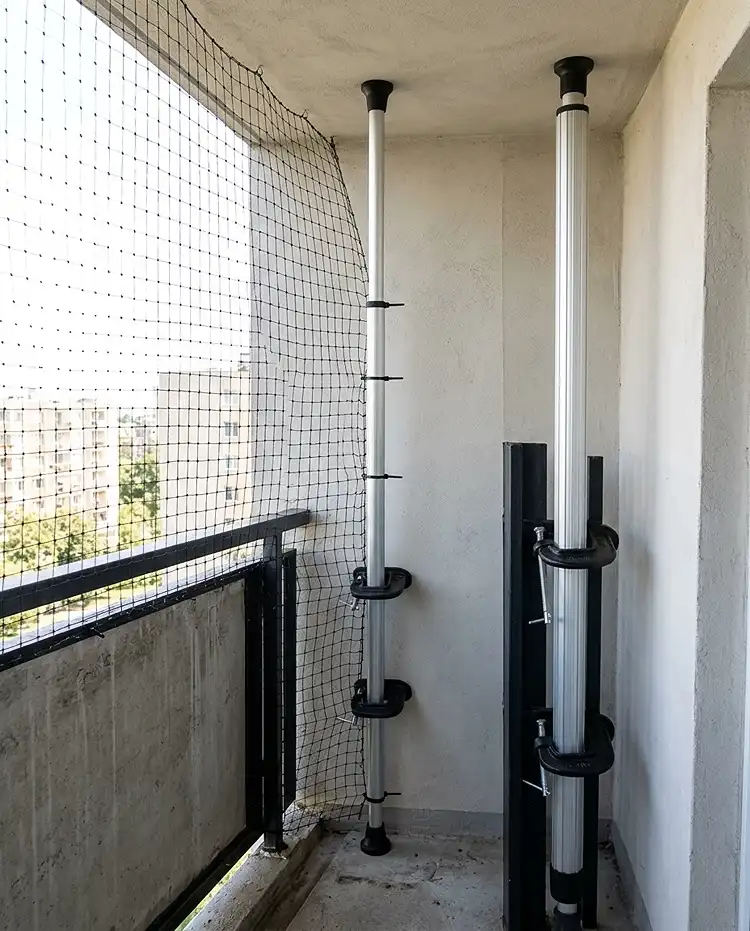
Set rubber-footed tension poles vertically in the four corners. Then add backup C-clamps or stainless steel zip ties to secure the lower half of each pole to the railing posts. Do this in at least two places per pole, so a pole can never slip.
If your balcony has no ceiling: poles have nothing to press against. Use clamp-on railing post extenders instead, with a netted roof stretched across the top. A roof is safer than angled arms alone, because a strong jumper can clear a 45-degree overhang.
Step 2: Threading the Perimeter Tension Wire and Zip-Tying the Net From Top to Bottom
Weave 2 mm vinyl-coated steel cable through the outer mesh squares. Use a small turnbuckle to pull each edge tight, like a tennis net. Then cinch the net to the railing spindles every 6 inches, working top to bottom.
Keep the sides and bottom taut. Leave the top foot slightly springy and angled inward.
If your balcony has no ceiling: run a second cable along the top of the extenders and across the span. Zip-tie a roof panel to it every 6 inches, with no gaps where it meets the wall netting. Tug-test the roof first, because it takes the most strain.
Step 3: Sealing the Bottom Toe-Kick Gap Using Heavy Rectangular Trough Planters
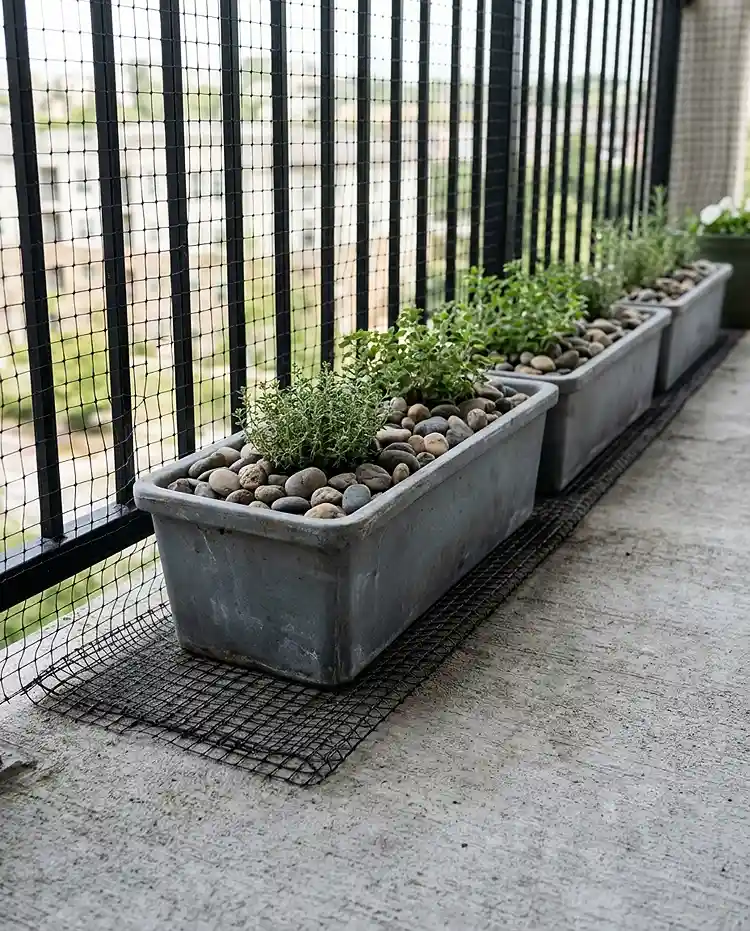
Here’s the gardener’s hack. Wrap the bottom 6 inches of extra netting inward, then set a continuous row of heavy fiberglass troughs on top of it. Ballast each trough with gravel. No cat can push under that edge.
Want more ideas for heavy, rail-friendly containers? Check these renter-friendly balcony planter solutions.
Step 4: Adding a Zippered or Carabiner “Access Flap” While Keeping Planters Inside the Net
Keep every planter inside the net, so you never lean over the railing to water. Leaning out is a fall risk on a high balcony, and many leases ban outer railing boxes.
For reaching a tight corner or passing in supplies, add a small flap at waist height. Use a heavy-duty marine zipper or a carabiner-clipped flap. Wire-reinforced mesh is tough to sew, so the carabiner version is easier.
An open flap is an escape gap. Shut the balcony door with your cat inside the apartment before you open it. Close the flap with a clip your cat can’t nose open.
Ongoing Safety Inspections, Plant Care, and Seasonal Net Maintenance
Short Answer: Inspect the enclosure monthly, and again after every big temperature swing or storm. Check pole tension, zip ties, and chew spots. Feed plants with worm castings and diluted kelp only. Prune vines away from the net so nothing hides damage.
The Monthly “5-Point Tug & Chew Inspection” and Pruning Vines Away From the Net
Metal contracts in winter cold, so poles loosen after temperature swings. Tug everything once a month.
- Push each tension pole. It shouldn’t shift.
- Squeeze zip ties. UV makes them brittle.
- Scan the mesh for chew holes and fraying.
- Press the bottom edge under the troughs.
- Test the access flap clips.
Keep vigorous climbers like star jasmine pruned 6 inches off the net. Vines can pull the mesh down or hide chew holes.
Pet-Safe Organic Pest Control and Fertilizing Rules Inside a Cat Enclosure
Stick to worm castings, diluted liquid kelp, and plain water or a mild Castile soap rinse for pests. Rinse the soap off after a few hours.
Ban systemic neonicotinoids, blood meal, bone meal, and metaldehyde snail pellets. Cats dig up and eat the meals, and metaldehyde is poisonous to pets.
Common Problems & Solutions
Short Answer: Three problems show up most after installing balcony cat netting. Cats climb the mesh, cats dig in pots, and poles loosen in wind. Each has a simple fix. Angle the top inward, cover the soil with stone, and clamp every pole to the railing in two places.
Cats Trying to Climb Up the Netting Like a Ladder (The “Loose-Tension” Fix)
A drum-tight wire grid works like a ladder for a determined climber. Angle the top 12 inches inward at about 45 degrees with inward brackets, and leave a little springy slack up there. A flexing, overhanging top is hard to grip. Adjust it the moment you see climbing.
Cats Digging Up Potting Soil, Knocking Over Small Pots, or Using Planters as Litter Boxes
Pin ½-inch plastic garden mesh flat over the soil, or lay 2-inch river stones around plant stems. Anchor small pots to shelves with museum putty. Some cats dislike citrus smells, so lemon thyme around pot edges might help. Don’t count on it.
High-Rise Wind Whistling or Loosening Telescopic Tension Poles Over Time
Thermal expansion and 30-mph gusts vibrate friction-fit poles loose on smooth concrete ceilings. Never rely on spring tension alone. Always clamp the lower half of every pole to the structural railing in at least two places. In April 2025, one stubborn gust taught me this lesson on a friend’s balcony.
Frequently Asked Questions
Is clear transparent cat netting or black cat netting less visible from the street?
Thin matte black or dark olive netting is usually less visible than clear monofilament. Clear mesh catches sunlight and glares like a shiny sheet. Matte black absorbs light and disappears against building shadows.
Can I grow climbing plants directly on my balcony cat netting?
Wet vine weight drags the net down, traps moisture against zip ties, and hides chew holes. Give climbers their own wall trellis about 6 inches inside the net. Star jasmine (Trachelospermum jasminoides) is on the ASPCA’s non-toxic list, but check the Latin name. Several different plants are sold as jasmine. Clematis is toxic.
Will no-drill tension poles and cat netting hold up in winter snow and high winds?
Open-weave HDPE netting catches little wind and tolerates freezing temperatures. Swap white plastic zip ties for black UV-stabilized nylon or stainless steel ones, which resist snapping in the cold. Brush off heavy, wet snow so the mesh doesn’t sag.
Can I leave my cat unsupervised on the balcony once no-drill cat netting is installed?
Treat a netted balcony as a supervised outdoor sanctuary, even with wire-reinforced mesh and double-clamped poles. Close the balcony door when you leave or go to sleep. A determined chewer or sudden windstorm shouldn’t ever create an unmonitored hazard.
Is regular garden bird netting okay for a balcony cat enclosure?
No. Bird netting is thin and knotted, so claws and teeth tear through it quickly. Use wire-reinforced HDPE with 1.2-inch mesh instead. It costs more, but it won’t fail when your cat leans on it.
What should I do if my landlord says no to cat netting?
Ask what worries them most. Then offer a freestanding frame or a smaller screen on just one section. Reassure them with the 15-minute removal promise.
Which balcony plants are safe if my cat chews them?
Spider plants, Boston ferns, parlour palms, rosemary, petunias, basil, and catnip are on the ASPCA’s non-toxic list. Non-toxic doesn’t mean stomach-proof, so a big nibble can still cause an upset. Avoid lilies of every kind, lily of the valley, parsley, sago palms, oleander, and English ivy.
Quick Recap
- Get written permission first, using the reversible, no-drill pitch.
- Close every gap wider than 2 inches, including the toe gap under the railing.
- Use wire-reinforced HDPE mesh and clamp every pole in two places.
- Plant only ASPCA-listed non-toxic species, and ban lilies outright.
- Balcony cat netting without drilling stays safe with a monthly tug-and-chew inspection.