
Bougainvillea on Balcony: What to Plan First
Bougainvillea on balcony gives huge color if you plan sun, thorns, and container care first. Skip that and you get leafy green vines and scratched arms.
I grow bougainvillea on a west-facing balcony in zone 8b, so mine winter indoors. Everything below comes from three seasons of wins and one ugly failure, starting in 2024.
Table of Contents
What to Plan First: Sun Orientation, Thorn Clearance, and Dwarf Varieties
Bougainvillea is the heat-loving, drought-tough statement plant for a sunny balcony, and one of the boldest balcony plants you can grow. But it comes with razor-sharp thorns, brittle roots, and a strict need for unfiltered sun. Plan around all three before you buy a pot.
The Non-Negotiable 6-to-8-Hour Blazing Sun Rule (Why South & West Balconies Win)

Quick Answer: Bougainvillea needs 6 to 8 hours of direct sun daily to form bracts. Put it in the hottest south- or west-facing spot, ideally beside a heat-radiating brick wall or outer railing. Less sun gives leaves, not color.
Bracts are the papery “petals” you actually want. UF/IFAS says it needs full sun and won’t flower without direct sun. Under 6 hours, you get lush green leaves and nothing else.
In summer 2024, my first plant was a standard ‘Barbara Karst’ in a 20-inch glazed pot on a shaded corner. I watered it daily. By September 2024 it was a 6-foot green monster with zero bracts.
Pro Tip: Check your spot at 10 a.m., 1 p.m., and 4 p.m. If shade touches the pot at any of those times, move it.
Planning Foot-Traffic Clearance and Choosing Compact/Thornless Cultivars (‘Helen Johnson’ & ‘Miss Alice’)
Standard landscape bougainvillea can climb 20 feet and grab anything that walks past. Don’t park one next to a narrow balcony chair or doorway. Choose a genetically dwarf, low-thorn cultivar instead. These are the container cultivars I’d look for as of 2026.
| Cultivar | Habit and Size | Watch Out For |
|---|---|---|
| ‘Helen Johnson’ | Magenta mound, about 3 ft in a 12-to-16-inch pot | Still has thorns |
| ‘Miss Alice’ | White bracts, semi-thornless | Fewer thorns, not zero |
| Sunvillea series | Compact, pot-friendly | Check the tag for mature height |
| Bambino series | Genetically dwarf | Slower to fill a trellis |
Pro Tip: No bougainvillea is truly thornless. Keep the pot at least 2 feet from seating and doorways.
Essential Prep: Snug Breathable Pots, Gritty Acidic Soil, and Heavy-Duty Trellises
Good bougainvillea container care starts before planting. Gather three things first: a snug porous pot, a gritty fast-draining soil mix, and a trellis that won’t tip over in wind.
Why Bougainvillea Blooms Best Slightly Root-Bound in Unglazed Terracotta (Never Self-Watering Pots)
Bougainvillea has fine, thread-like roots that rot fast in oversized pots. Self-watering pots are even worse because the roots sit in constant moisture. A slightly snug pot dries out evenly and pushes the plant toward flowering.
Pick a 12-to-16-inch unglazed terracotta or fiberstone pot with extra drainage holes. Raise it on pot feet and skip the saucer so water escapes freely.
The “Zero-Soggy” Acidic Gritty Potting Soil Recipe (pH 5.5–6.5)
Bougainvillea likes slightly acidic soil that drains in seconds, a bit like the gritty mixes used for lavender in balcony pots. Mix this blend by volume:
- 50% high-quality peat-free potting mix
- 30% coarse perlite or pumice for oxygen pockets
- 20% aged pine bark fines for natural, mild acidity
Skip vermiculite. It holds water, and wet roots are the fastest way to lose this plant.
Selecting Puncture-Proof Leather Gloves, Obelisks, and Soft Figure-Eight Ties
Bougainvillea doesn’t twine. It hooks onto supports with its thorns, so you have to tie canes in place. Buy this gear before the plant comes home:
- Thorn-proof gauntlet gloves
- Bypass pruners
- A pot-anchored cedar trellis or metal obelisk
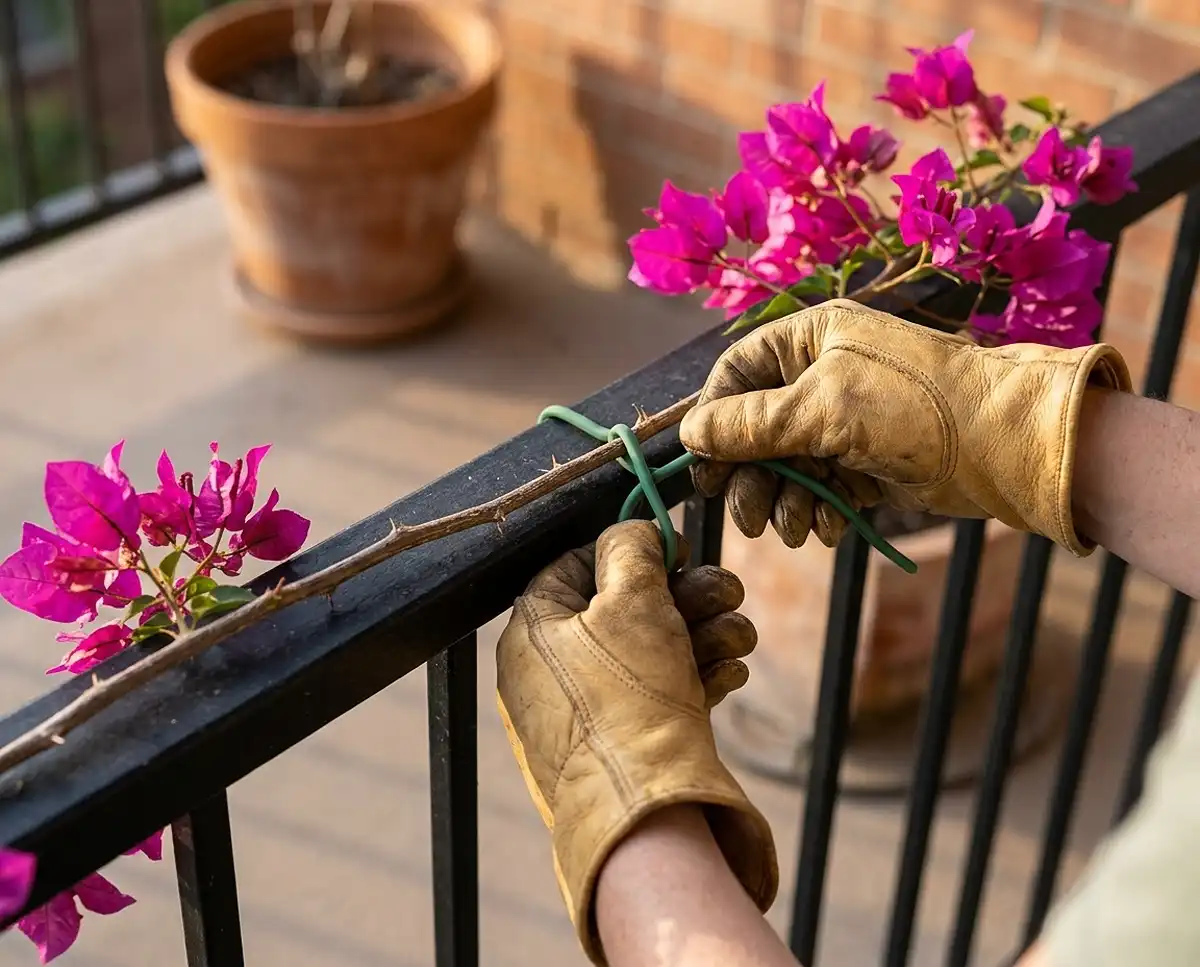
- Soft rubber ties for figure-eight loops that won’t cut into canes
Step-by-Step Guide to Planting and Training Bougainvillea on a Balcony
The first step matters most, because transplant shock is where most balcony bougainvillea die.
Step 1: The “Zero-Root-Disturbance” Repotting Technique (Never Tease or Wash the Root Ball!)
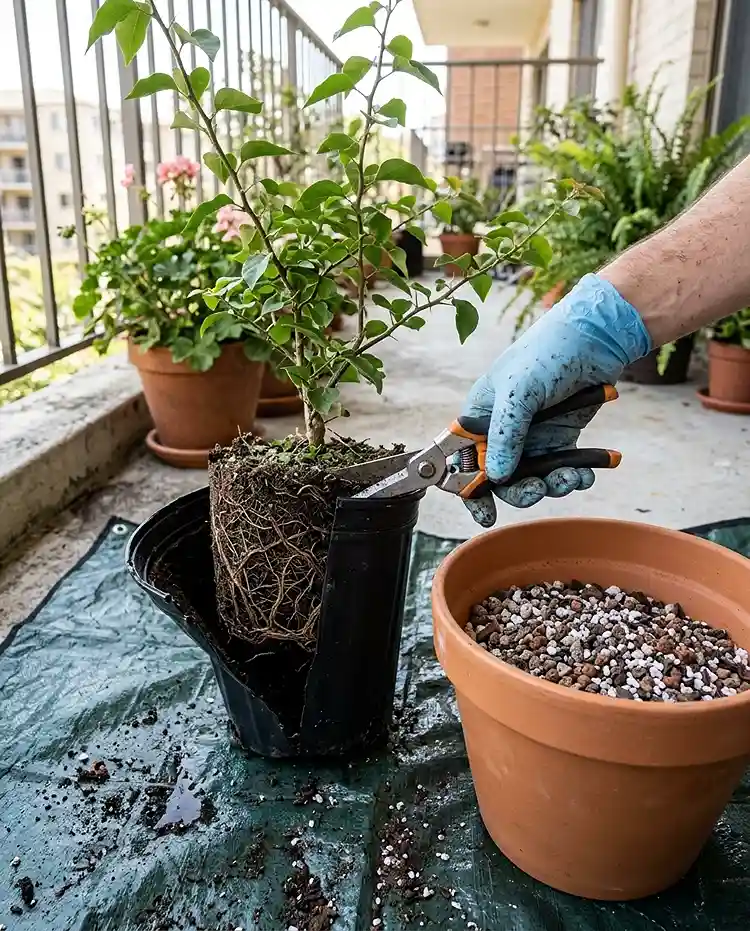
Quick Answer: Never loosen or wash the roots. Cut the plastic nursery pot down both sides with utility shears and lift the intact root ball into the new pot. Bougainvillea roots are brittle, hair-thin, and don’t recover from rough handling.
The Arizona State University plant library notes that these roots don’t bind soil well, so established plants rarely survive being moved. Set the ball at the same depth it grew at and fill gaps with your gritty mix.
Step 2: Positioning the Pot on a Wheeled Caddy and Anchoring the Trellis Before Backfilling
A planted 14-inch terracotta pot weighs roughly 25 to 40 pounds. Stage it on a locking caster caddy before filling, and check the caddy’s weight rating. You’ll thank yourself at the first cold snap.
Set the trellis legs against the pot floor, then firm the gritty soil around the root ball in layers. Don’t add rock ballast inside the pot, since it takes root space. Lash the trellis to the railing with soft ties instead.
Step 3: Horizontal & Fan Cane Training Along Railings and Walls to Multiply Bract Clusters
Long upright canes put their energy into the tip. Tie them horizontally along a railing, or fan them at roughly 45 degrees across a wall trellis. This slows tip growth and pushes out side shoots.
Bougainvillea blooms on new growth, so every side shoot is a new bract cluster.

Step 4: Hanging Basket & Over-the-Rail Cascade Setup for Trailing Dwarf Varieties
You can skip trellises entirely. Plant mounding or trailing cultivars like ‘Rosenka’, ‘La Jolla’, or ‘Raspberry Ice’ in a deep over-the-rail saddle trough or a heavy-duty 14-inch hanging basket. Let them spill over the edge.
Baskets dry out faster than pots. In July heat, I check mine every morning.
Mastering the Bloom Cycle: The “Dry-Stress” Watering Trick, Feeding, and Pruning
Here’s the counter-intuitive part: bougainvillea blooms because you neglect it a little. A steady routine of drying, soaking, feeding, and pinching gives repeat waves of magenta, coral, purple, and gold bracts from spring through autumn.
How to Use “Controlled Drought Stress” Between Waterings to Trigger Massive Bract Flushes
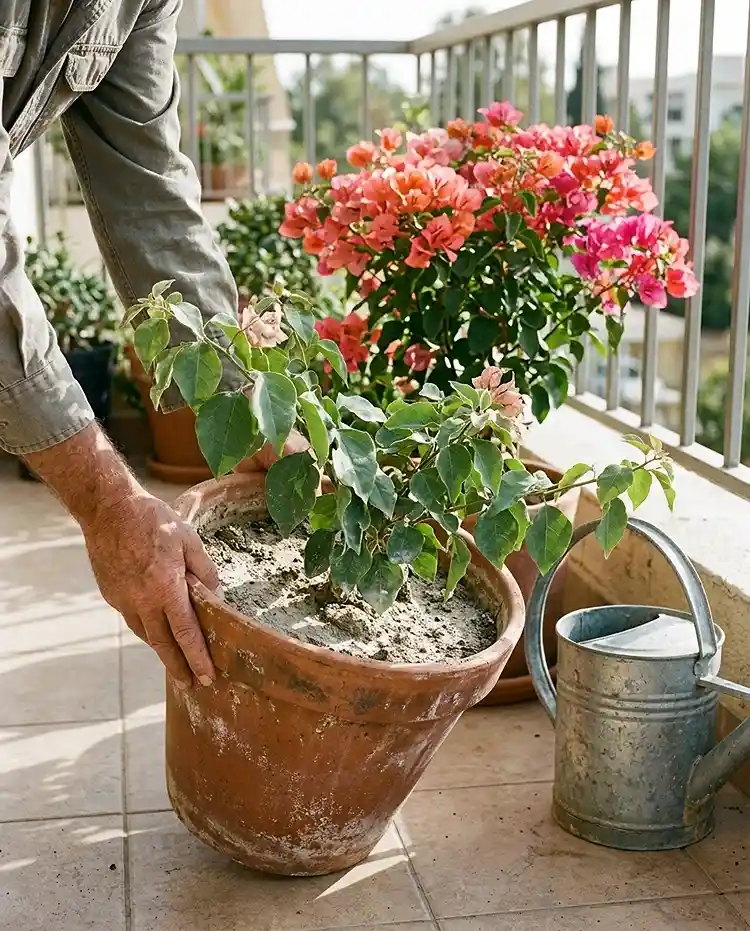
Quick Answer: Let the pot dry until it feels light when tilted and leaves show slight midday softening. Then soak it deeply and feed with a high-potash bloom food. Constant moisture keeps bougainvillea green and leafy.
The University of Florida’s extension team says to neglect it rather than baby it, and notes it performs better slightly dry. You can read their advice on UF/IFAS bougainvillea care.
| Season | Water When | Feed With |
|---|---|---|
| Peak summer (85°F+ / 29.4°C+) | Pot feels light and leaves soften at midday, often every 4 to 7 days | 4-12-12 or iron-enriched hibiscus food, monthly |
| Spring and autumn | Same cue, as needed, often every 7 to 14 days | Half-strength bloom food, monthly |
| Winter indoors | Pot feels light, roughly once a month | Nothing |
Don’t push the dryness too far. Severe drying drops leaves, so water as soon as that midday softening shows.
My 14-inch terracotta ‘Helen Johnson’ was all leaves in June 2025. I held back water for ten days, soaked it once, and had bracts in about three weeks.
Pinching After Each 6-Week Bloom Wave (New-Wood Rule) + Winterizing Pots Indoors
Because bougainvillea blooms on new wood, a light tip pinch of about 1 inch as each bract flush fades keeps side shoots coming.
Save heavy cuts for late winter or early spring. UF/IFAS warns that pruning in late summer or fall can reduce the next winter’s flowers. That winter bloom peak applies to Florida. My pot blooms in summer and goes dormant indoors.
Winter rule by zone: zone 10 and up can stay outside year-round. Zone 9 needs cover, because pots run colder than the ground. Zone 8 and colder go indoors. Bring any pot in before lows fall below 40°F (4.4°C).
A cool 50°F (10°C) sunny window works. So does a frost-free garage, though the plant will likely drop leaves and go dormant.
Common Problems & Solutions
Here are the four problems I see most often, each with a fast fix.
Giant Green Vines With Zero Colorful Bracts (“Too Much Water & Nitrogen” Syndrome)
Pampered plants stay green. Daily watering, shade, or all-purpose high-nitrogen fertilizer locks bougainvillea into vine growth.
Withhold water until the pot feels light and leaves soften at midday, move it into scorching sun, and pinch all shoot tips. UF/IFAS also notes that too much nitrogen reduces flowering.
I fixed my ‘Barbara Karst’ by changing three things at once in spring 2025. I moved it to a west rail, repotted into 14-inch terracotta, and cut watering. Bracts showed up that July, though I can’t say which change mattered most.
Sudden Total Leaf and Bract Drop Right After Bringing It Home From the Nursery
Don’t panic. Bougainvillea often drops most of its leaves and bracts after moving from a humid greenhouse to a breezy balcony. Keep the soil barely damp in full sun, and new buds should appear along the bare stems.
My ‘Miss Alice’ went nearly bare within a week of coming home in late May 2025. New buds showed up about two weeks later.
Yellowing Young Leaves With Green Veins (Iron/Magnesium Chlorosis in High-pH Tap Water)
Alkaline tap water can push container pH above 7.0 and lock out iron. Only when you see yellowing between the veins, treat with chelated liquid iron. Add 1 teaspoon of Epsom salts (magnesium sulfate) per gallon if it persists. Then flush the pot with plain water so salts don’t build up.
Bougainvillea Looper Caterpillars, Aphids, and Paper-Bract Litter Blowing Downstairs
Tiny green inchworms called loopers scallop leaf edges. Spray with organic Bacillus thuringiensis (Bt) and they stop feeding. Hose off aphids with a firm stream of water.
Snip fading, dry bract clusters about a week early. That keeps papery petals from snowing onto your downstairs neighbors.
bougainvillea on balcony FAQs
These are the questions apartment gardeners ask most.
Can a potted bougainvillea stay outside on my balcony over the winter?
Only in USDA zone 10 and up. Clemson Extension says it survives zone 9 only if protected, and pots run colder than ground. In zone 8 and colder, bring it in before the first frost. Trim only what you must, and water about monthly.
Are there low-thorn or small bougainvillea varieties for a tiny apartment balcony?
Yes. Skip giant landscape climbers and look for dwarf ‘Bambino’ cultivars, ‘Helen Johnson’, ‘Sunvillea Rose’, or semi-thornless ‘Miss Alice’ and ‘Singapore Pink’. These typically stay 2 to 4 feet tall in a 12-to-16-inch pot, with fewer and blunter spines.
How often should I water a bougainvillea in a pot on a hot sunny balcony?
Water deeply when the pot feels light when tilted and leaves show slight midday softening. That’s often every 4 to 7 days in 85°F+ (29.4°C) summer heat, and every 7 to 14 days in cool weather. Check by weight, not the calendar.
Why are the “flowers” on my bougainvillea turning white or green instead of bright pink?
The showy pink, purple, or orange “petals” are modified leaves called bracts. The true flower is the tiny white trumpet inside. Bracts fade to pale greenish-white when they’re 4 to 6 weeks old, or when the plant isn’t getting enough direct sun.
Is bougainvillea safe around kids and pets on a balcony?
Bougainvillea isn’t regarded as seriously poisonous, but the thorns can cause painful scratches and the sap may irritate skin. Keep the pot out of reach of pets and children, and wear gloves when pruning.
Key Takeaways
- Bougainvillea on balcony pots needs 6 to 8 hours of direct sun, so claim your hottest south- or west-facing spot.
- Choose compact, low-thorn cultivars like ‘Helen Johnson’, ‘Miss Alice’, Sunvillea, or Bambino.
- Use a snug terracotta pot, a gritty acidic mix, and never disturb the root ball at planting.
- Let the pot get light between deep soakings, feed high-potash food, and pinch tips lightly after each bract wave.
- Move pots indoors before lows drop below 40°F (4.4°C), and keep them outside year-round only in zone 10 and up.