
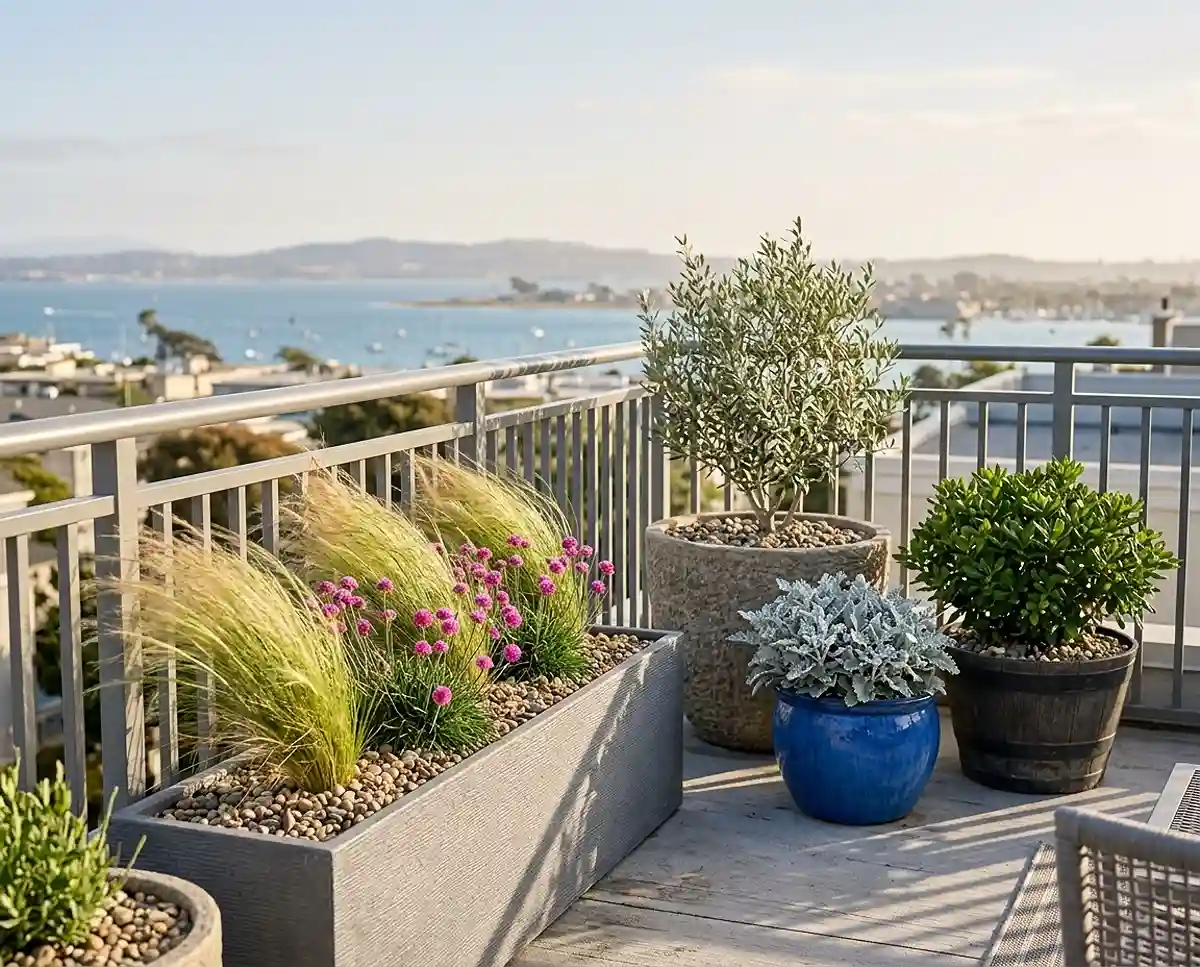
19 Coastal Balcony Plants for Salt and Wind
One salty gale crisped my rooftop pots overnight. These 19 coastal balcony plants and combos handle salt, gusts, and glare.
I grow on a sunny rooftop terrace in zone 7a, a few blocks from a bay. My containers take southwest sun and steady onshore wind. They’re a mix of fiberglass troughs, glazed ceramic, and resin tubs.
After 12 years of coaching renters and first-timers, I’ve learned that salt trips up more seaside gardeners than cold does. Here’s what works, what flopped, and what I’d plant again.
New to containers? Start with my overview of balcony plants, then come back for the salty-air tricks.
Table of Contents
Understanding the Coastal Balcony Microclimate: Salt Spray, Gale Winds, and Glare
Short Answer: A coastal balcony hits plants three different ways at once. Airborne salt pulls water straight out of leaves, wind batters stems, and reflected light adds glare. Choose plants built to handle all three, and you’ll skip most of the seaside heartbreak.
Here’s what’s happening. Salt landing on a leaf draws moisture out through osmosis [water moving toward the saltier side]. Edges turn brown even when the pot is soaked.
Gusts twist stems and shred soft leaves. Water, glass, and pale walls bounce extra light and heat back at the foliage. If heat is your bigger headache, my guide to protecting balcony plants from heat helps.
Height won’t save you, either. The University of Florida’s guidance on salt exposure says trees planted within about eight miles of a salt water coastline should have some tolerance to salt spray.
For gusty spots, pair this list with my wind-resistant balcony plants.
The Botany of Salt Tolerance (“Halophytes”): Waxy Cuticles, Silver Hairs, and Succulent Leaves
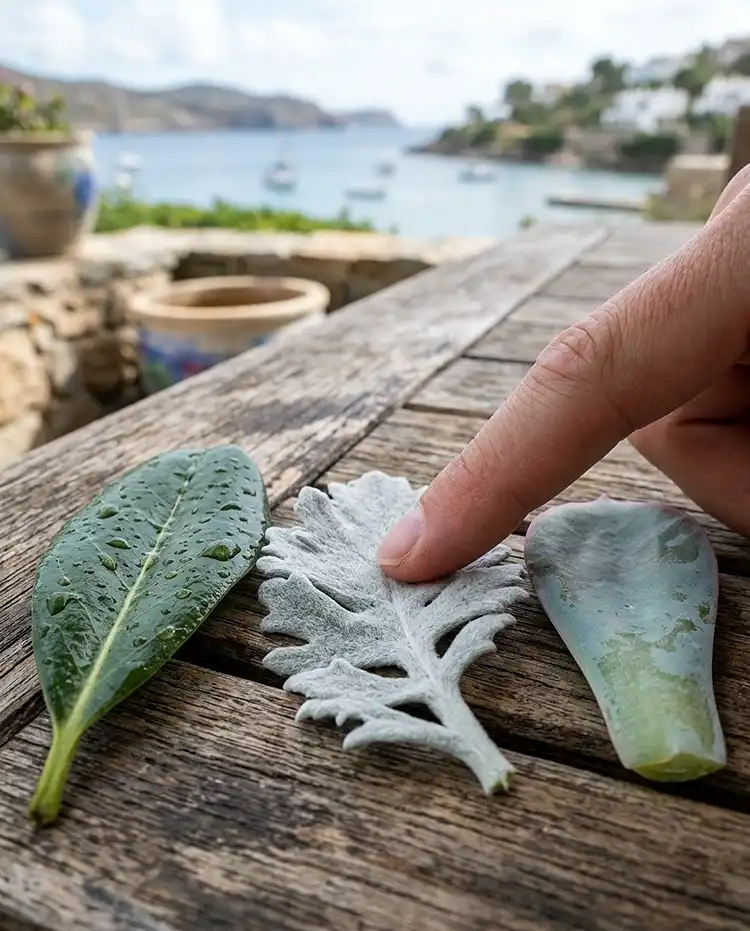
Short Answer: Look for thick, leathery, waxy leaves that shed salt droplets, or silvery, fuzzy foliage that traps air and reflects glare. Succulent leaves store water to ride out salt stress. If a leaf feels thin and floppy, leave it on the shelf.
The Why: True halophytes [plants adapted to salty ground] manage salt in clever ways. UGA Extension’s salt-tolerance bulletin notes that plants with a thick, waxy cuticle [the leaf’s waxy outer skin] tolerate salt spray better than thin-skinned ones.
Silver plants wear tomentose [fuzzy, felted] foliage that traps still air and bounces glare. Mature plants also outlast seedlings, so buy established ones.
Try This: Pinch a leaf at the garden center and look for one of these three armors:
- Thick, glossy, or waxy leaves that feel like leather
- Silver or gray leaves with a soft, fuzzy coat
- Fleshy, succulent leaves that squeak when squeezed
Clemson Extension’s salt-tolerant plant list rates plants from highly to moderately tolerant, which helps when you shop.
Essential Prep: Corrosion-Proof Planters, Anchoring Hardware, and Soil Mix
Short Answer: Before you plant, fix the hardware. Choose fiberglass or glazed containers, 316 marine-grade stainless fasteners, and a gritty, fast-draining soil that won’t crust with salt. Cheap metal rusts within a season or two once its coating chips, and porous clay flakes apart.
- Fiberglass, resin, or glazed ceramic planters with drainage holes
- 316 marine-grade stainless screws, brackets, and zip ties
- Anodized aluminum or teak stands and trellises
- Heavy tubs of 15 gallons or more for anything tall
- A gritty, non-crusting soil mix topped with pea gravel
Check the Load Limit: Wet soil is heavy, and a 15-gallon tub can weigh 100 pounds or more. Before you stack up big pots on a rooftop or balcony, check your building’s load rating with the landlord or management.
Choosing Marine-Grade Fiberglass, Glazed Ceramic, and 316 Stainless Hardware + The Coastal Soil Recipe
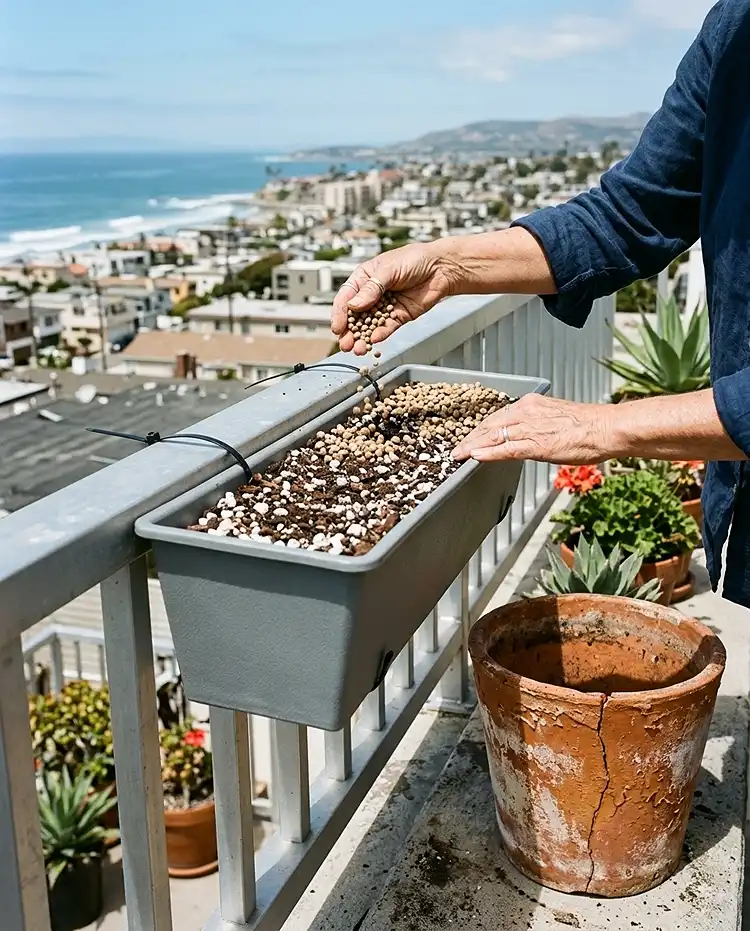
Short Answer: Skip unsealed terracotta and cheap coated hardware. Salt crystals expand inside clay pores and cause spalling [surface flaking apart], while chipped coatings let rust start. Fiberglass troughs anchored with 316 stainless ties and filled with coir, pine bark, and pumice handle spray season after season.
What Happened to Me: My first summer, in 2024, I planted ‘Arizona Sun’ gaillardia in five unsealed 12-inch terracotta pots on the windward rail. By late October, all five were flaking and two had cracked. I switched to 14-inch fiberglass troughs and haven’t lost a pot since.
Try This: Mix 4 parts washed coco coir, 3 parts composted pine bark, and 3 parts pumice [lightweight volcanic rock]. Unwashed coir can carry its own salt, so buy washed or buffered coir.
Coir, bark, and pumice hold very few nutrients, so blend in a slow-release fertilizer at the label rate. Finish with 1 inch of pea gravel on top, and you’ve got a mix that drains fast and resists crusting.
19 Coastal Balcony Plants Built for Salt Air and High Winds
Short Answer: These 19 ideas pair salt-armored foliage with sturdy containers for sunny, exposed spots and sheltered corners. Each lists a zone range, so you can match it to your coast. Put the toughest plants on the windward rail and tuck fussier ones behind a screen.
About half the country shifted a half-zone warmer in the 2023 USDA map update, so recheck your zone before you buy. Potted roots freeze harder than ground soil, so treat tender picks with care.
| Your coast | Ideas that fit | Winter note |
|---|---|---|
| Cold (zones 4–7) | 9, 11, 15 | Wrap pots and cluster them against a wall |
| Mild (zones 7–9) | 1, 2, 5, 8, 12, 13, 16, 17, 18 | Move the zone 8-only plants indoors |
| Warm (zones 9–11) | 3, 6, 7, 19 | Leave them out year-round |
| Any zone (annuals) | 4, 10, 14 | Replant each spring |
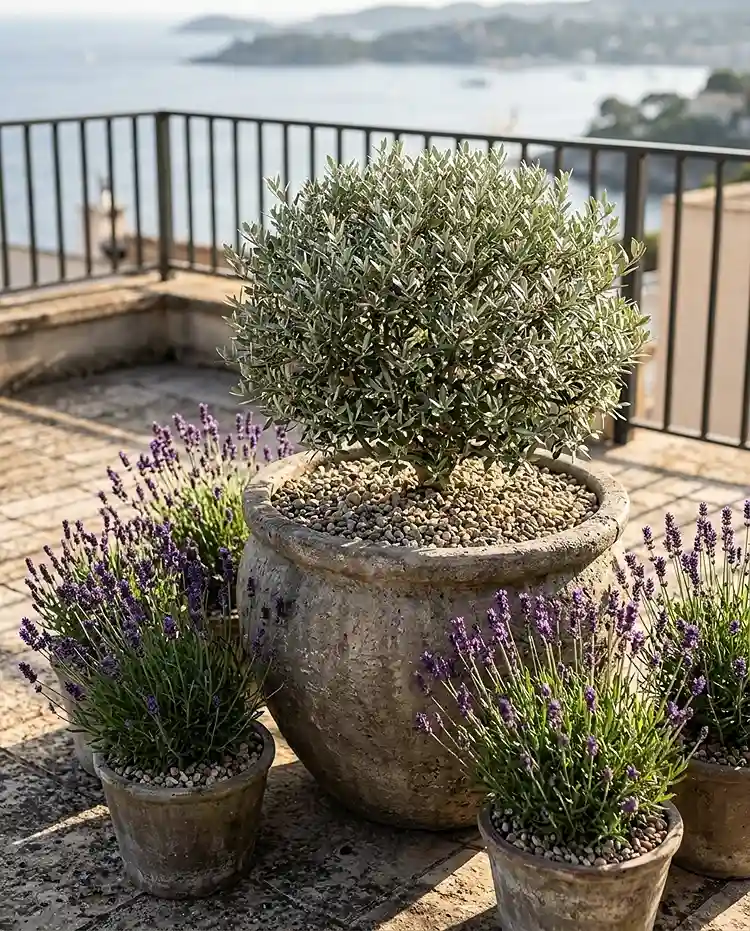
Idea 1: Sculptural Dwarf Olive Tree and English Lavender Mediterranean Corner
Short Answer: Silvery ‘Little Ollie’ dwarf olive and ‘Munstead’ English lavender handle dry, salty gusts. Anchor them in a heavy 18-inch fiberstone pot set on a locking caddy, so wind can’t tip the tree. Zones 8–10; in zone 7a, I roll mine indoors from December through March.
Try This: Lock the caddy’s wheels and strap the pot to the railing whenever the wind picks up.
Idea 2: Kinetic Dune Grass Trough with Mexican Feather Grass and Sea Thrift (Armeria)
Short Answer: Mexican feather grass (Nassella tenuissima) sways beside pink pom-pom Sea Thrift (Armeria maritima), a true cliffside halophyte. Plant both in a long trough along an exposed railing, zones 7–9. Snip feather grass seedheads before they drop, since it can self-seed in mild climates.
Idea 3: Salt-Armor Evergreen Screen of ‘Wheeler’s Dwarf’ Pittosporum and Blue Chalksticks
Short Answer: Compact ‘Wheeler’s Dwarf’ pittosporum has glossy leaves clustered at the stem tips, while blue chalksticks (Senecio serpens) adds icy fingers at its feet. Together in a trough, they form a low windbreak for smaller pots. Pittosporum is hardy in zones 8b–10 and chalksticks in zones 9–11, so plan on zones 9–10.
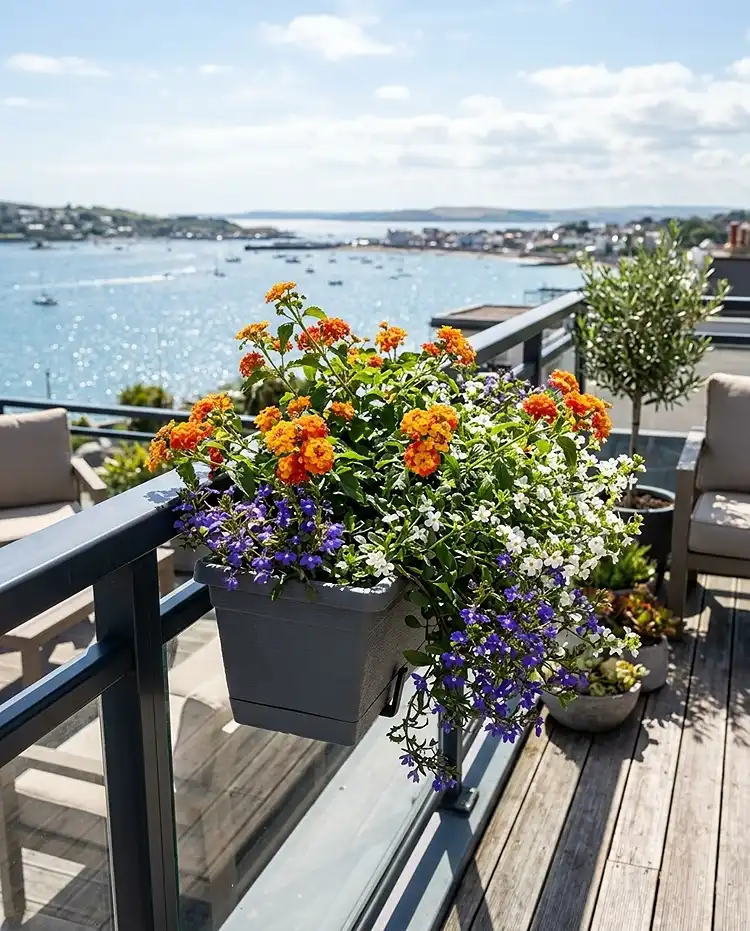
Idea 4: Cascading Railing Box of Trailing Lantana, Scaevola (Fan Flower), and White Bacopa
Short Answer: Trailing lantana, fan flower (Scaevola aemula), and white bacopa fill a railing box all summer. Fan flower is an Australian native that flexes in strong breezes instead of snapping. Zones 9–11; grow them as annuals in zone 7a.
Try This: Clemson rates lantana as only moderately salt tolerant, so treat it as a sheltered-side plant and keep bacopa there too. On warm coasts, choose sterile lantana cultivars, since common lantana can escape gardens and self-seed.
Idea 5: The Seaside Kitchen & Cocktail Box: Prostrate Rosemary, Sea Kale, and Creeping Thyme
Short Answer: Prostrate rosemary (Salvia rosmarinus ‘Prostratus’) drapes over container edges, and its Latin name means “dew of the sea.” Pair it with creeping thyme and sea kale (Crambe maritima), a blue-leaved edible that grows wild on shingle beaches. Zones 8–9; pinch sprigs straight into cocktails.
Try This: Clemson rates rosemary as only moderately salt tolerant, so keep this planter on the sheltered side. Sea kale grows a deep taproot, so choose a planter at least 16 inches deep.
Idea 6: Sun-Drenched Succulent Bowl of Agave Attenuata, Echeveria, and Ice Plant (Delosperma)
Short Answer: Wide, low bowls keep wind from tipping succulents. Fill one with spineless Agave attenuata, echeveria, and ice plant (Delosperma cooperi), whose magenta flowers spill over the rim. Fat leaves store water, which helps in dry, salty wind.
Agave attenuata is generally hardy only in zones 10–11, and echeveria in zones 9–11. In zone 7a, move both indoors well before frost.
Idea 7: Glossy Mirror Bush (Coprosma) and New Zealand Flax (Phormium) Sunset Planter
Short Answer: Compact mirror bush (Coprosma repens ‘Evening Glow’) has coral-bronze, glossy leaves that stand up to spray. Pair it with dwarf New Zealand flax (Phormium ‘Jack Spratt’), whose bronze blades add vertical drama. Both are New Zealand natives built for windy coasts. Zones 9–11; it’s borderline in zone 8.
Idea 8: Fragrant Coastal Climber: Star Jasmine Woven Into a Slatted Teak Privacy Trellis
Short Answer: Star jasmine (Trachelospermum jasminoides) has leathery leaves that stand up to salty air and fragrant white flowers in late spring. Train it up a slatted teak trellis, and wind passes through instead of pulling the plant down. Zones 8–10; dwarf ‘Helen Johnson’ bougainvillea is the hotter-coast alternative, hardy in zones 9–11.
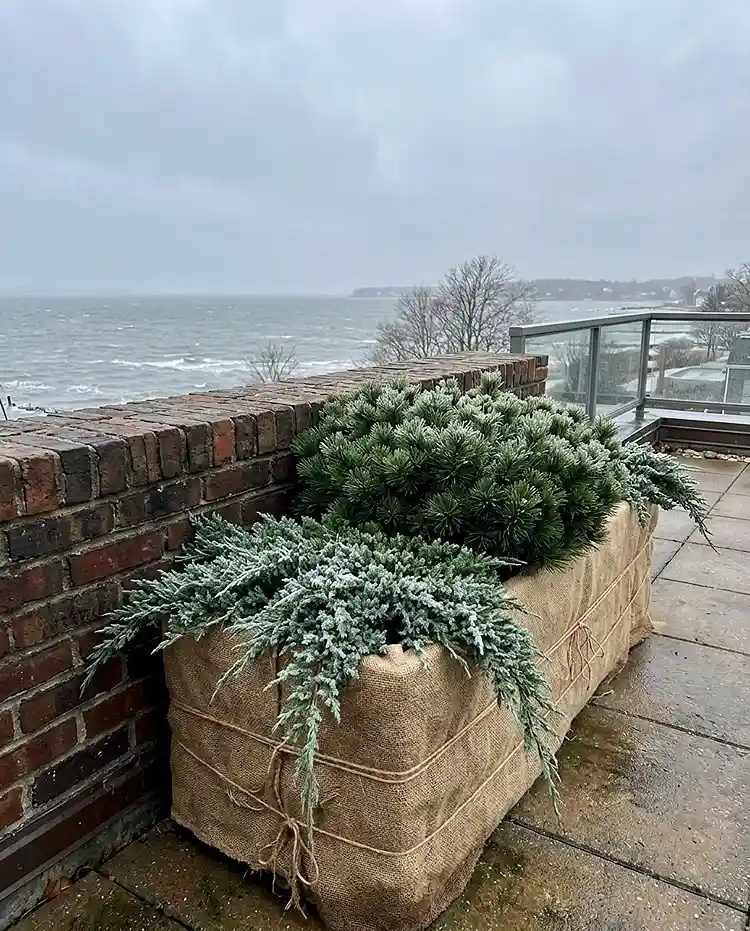
Idea 9: Cold-Coast Northern Balcony Trough of Dwarf Mugo Pine and Shore Juniper (Zones 5–7)
Short Answer: On cold northern coasts, ‘Blue Pacific’ shore juniper (Juniperus conferta) and cushion-shaped mugo pine (Pinus mugo) take salt and winter wind in stride. Zones 5–7. Because potted roots freeze harder than ground soil, wrap pots in burlap and bunch them against the wall.
For more winter-proof options, see my list of cold-hardy balcony plants.
Idea 10: High-Contrast Silver Dusty Miller, Red Ivy Geraniums, and Licorice Plant Window Box
Short Answer: Silver dusty miller (Jacobaea maritima), licorice plant (Helichrysum petiolare), and red ivy geraniums make a high-contrast window box. Fuzzy silver coats help leaves resist salt burn and glare. Ivy geraniums (Pelargonium peltatum) add thick, glossy leaves. Treat all three as annuals outside zones 9–11.
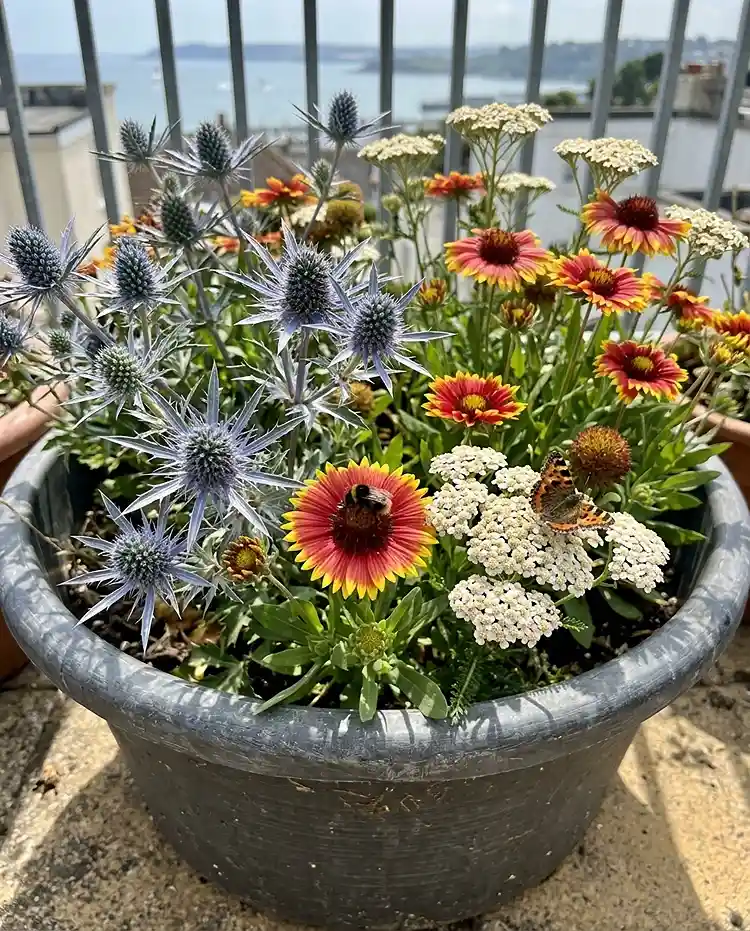
Idea 11: Pollinator Beach Haven with Blanket Flower (Gaillardia), Yarrow, and Sea Holly (Eryngium)
Short Answer: Steely-blue sea holly (Eryngium planum), blanket flower (Gaillardia ‘Arizona Sun’), and yarrow draw bees and butterflies to a windy balcony. All three tolerate drought and salt exposure. Deadhead [snip off spent flowers] to keep blooms coming until frost. Zones 4–9, the widest range of any mix here.
Idea 12: Shady Leeward Corner Sanctuary with Cast Iron Plants (Aspidistra) and Holly Ferns
Short Answer: Tuck Japanese holly fern (Cyrtomium falcatum) and cast iron plant (Aspidistra elatior) into the shaded, wind-sheltered corner behind a wall. Both have leathery leaves that tolerate salty air and low light. Zones 7–10; in zone 7a, shove the pots against a warm wall for winter.
Idea 13: Subtropical Resort Tub with Dwarf Palmetto (Sabal minor) or Mediterranean Fan Palm and Liriope
Short Answer: Anchor a big corner tub with a stiff-fronded fan palm that won’t shred like a parlor palm. Clemson Extension rates dwarf palmetto (Sabal minor) as highly salt tolerant. Mediterranean fan palm (Chamaerops humilis) is another sturdy choice. Edge the tub with liriope for a grassy skirt; zones 7b–11.
Try This: Sabal minor’s fronds can reach up to 3 feet across, which is big for most balconies. Give it a wide corner with room to spread.
Idea 14: Neon Portulaca (Moss Rose) and Gazania Treasure Flower Tabletop Trio
Short Answer: Fill three low, terracotta-look resin bowls with moss rose (Portulaca grandiflora) and treasure flower (Gazania rigens). Both open wide in intense glare and handle dry, salty wind. Grow them as annuals, and water when the top inch of soil is dry.
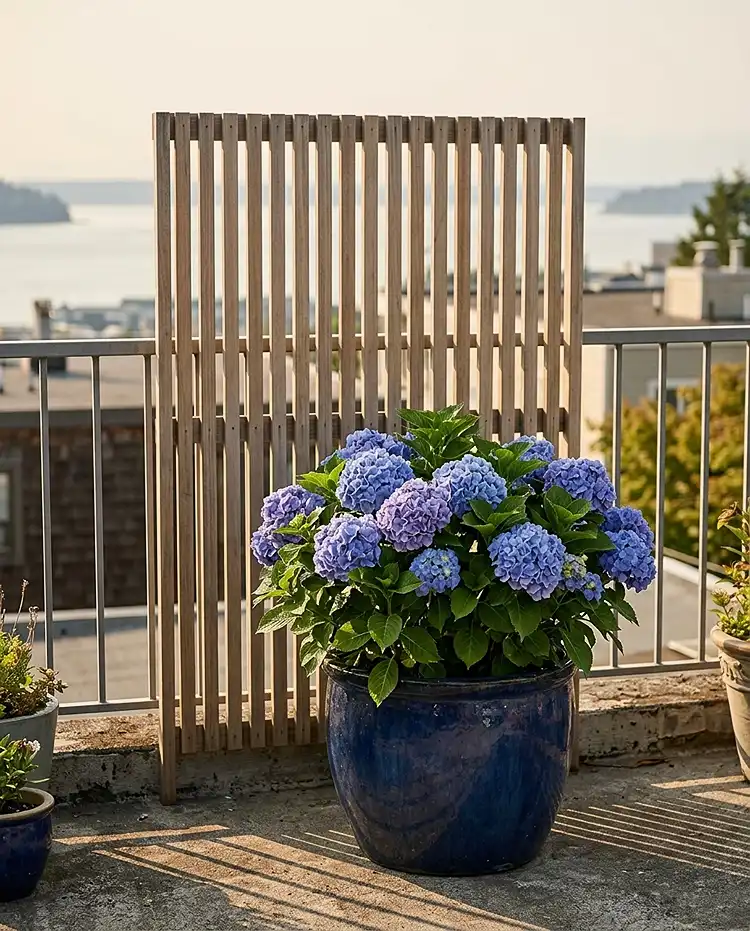
Idea 15: Coastal Cottage Hydrangea Tub (‘Endless Summer’ or ‘Seaside Serenade’) Behind a Wind Screen
Short Answer: Bigleaf hydrangeas (Hydrangea macrophylla), including ‘Endless Summer’ and the Seaside Serenade series, tolerate salt spray better than panicle or smooth hydrangeas. Even so, tuck the tub behind a glass or slatted screen out of direct gales. Zones 5–9, and plan on daily watering in July.
Idea 16: Indian Hawthorn (Rhaphiolepis) and Trailing Sedum ‘Angelina’ Four-Season Box
Short Answer: Indian hawthorn (Rhaphiolepis indica) brings pink spring blossoms and leathery dark leaves, while golden ‘Angelina’ sedum (Sedum rupestre) spills over the edge in gold. Zones 8–9. Keep the sedum on the sheltered side as a precaution, since its spray tolerance is less proven.
Idea 17: Edible Coastal Patio Pot of Dwarf Fig (‘Little Miss Figgy’) and Alpine Strawberries
Short Answer: A dwarf fig like ‘Little Miss Figgy’ tolerates mild salty breezes, and a south-facing wall bounces heat that ripens fruit. Plant it in a wheeled 15-gallon tub, with alpine strawberries tucked on the sheltered side, since strawberries are salt-sensitive. Zones 7–10. Wheels let you roll it behind the wall before a storm.
Idea 18: Silver Bush Morning Glory (Convolvulus Cneorum) and Blue Fescue Modern Cube
Short Answer: Silver bush morning glory (Convolvulus cneorum) has shimmering, silky leaves and white funnel flowers. Pair it with spiky blue fescue (Festuca glauca) in a charcoal fiberglass cube for a modern, wind-ready look. Zones 8–9; both hate wet feet, so add extra pumice.
Idea 19: Natal Plum (‘Boxwood Beauty’ Carissa) and Trailing Blue Daze for Tropical Oceanfronts (Zones 9–11)
Short Answer: Dwarf natal plum (Carissa macrocarpa ‘Boxwood Beauty’) is spineless, with fragrant white star flowers and glossy leaves that handle heavy salt spray. Trail blue daze (Evolvulus glomeratus) at its feet. Zones 9–11.
I skipped wedelia, a common trailer, because it’s a Florida Category II invasive.
Mastering Coastal Balcony Maintenance: Salt Leaching and Storm Prep
Short Answer: Two habits keep a seaside balcony alive. Rinse salt film off leaves with fresh water, and flush built-up sodium out of every pot. That flush is called leaching [pushing salts out with extra water]. Add a storm checklist and you’re covered.
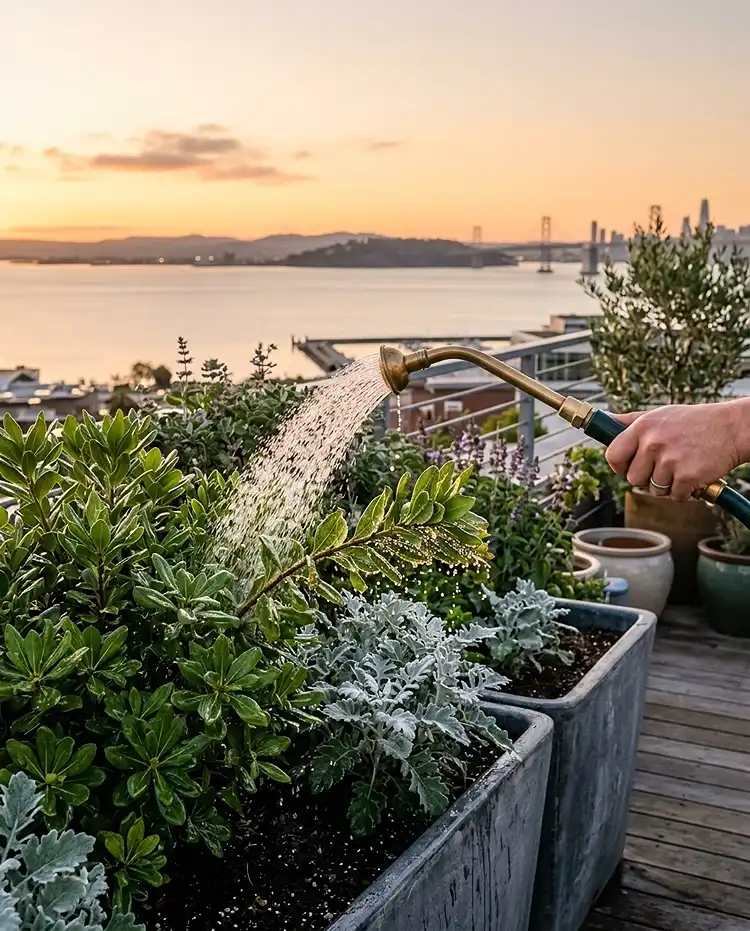
The “Freshwater Foliage Rinse & Soil Flush” Routine + Watering Chart
Short Answer: Spray leaves with fresh tap water every two weeks in the early morning to dissolve salt crystals. Once a month, pour enough water through each pot that about 20 percent drains out the bottom, carrying sodium with it. Skip the flush if heavy rain just soaked every pot.
| Task | How often | How to do it |
|---|---|---|
| Foliage rinse | Every 2 weeks, plus within 24 hours after an onshore storm | Early morning, gentle fresh-water spray on tops and undersides |
| Soil flush | Once a month | Pour slowly until about 20 percent drains out |
| Moisture check | Daily in summer wind | Poke a finger 2 inches down and water if dry |
| Gravel refresh | Each spring | Top up to 1 inch and rake out any salt crust |
What Happened to Me: In spring 2024, my 15-gallon ‘Little Miss Figgy’ had yellowing leaves and a white crust on the soil. I poured about 3 gallons of fresh water through until the runoff ran clear. Within three weeks, new growth came in green.
Pea-Gravel Top-Dressing and the 15-Minute Tropical Storm / Nor’easter Lockdown Checklist
Short Answer: A 1-inch top-dressing [layer spread on the soil surface] of pea gravel keeps bark and soil from blowing away and slows evaporation. Before a gale, spend 15 minutes on lockdown. Do it the day before, not during.
- Take down hanging baskets and wall planters
- Lay tall grasses flat against the inner wall
- Cinch troughs to railings or stands with heavy-duty Velcro straps
- Roll wheeled tubs behind a solid wall, lock the caster brakes, and move bistro furniture inside
- Rinse every plant with fresh water within 24 hours after the storm
Common Problems & Solutions
Short Answer: Three problems cause most seaside balcony casualties: salt burn on leaf tips, sodium buildup in pots, and hardware that falls apart. Each has a straightforward fix that costs less than replacing the plant. Catch them early, and most plants bounce back.
“Salt Burn”: Why Are My Leaf Tips Crispy and Brown on the Ocean-Facing Side?
Short Answer: That’s salt burn. Dry salt spray pulls moisture from leaf margins within a day or two of an onshore windstorm. Rinse foliage with fresh water right away and prune dead tips back to green tissue. Then add a windbreak that’s about 50 percent open, such as glass or HDPE [a tough plastic] panels.
Sodium Toxicity and Soil Compaction From Salt-Laden Sea Mist
Short Answer: Sodium from salty mist crowds out calcium in potting soil, which stunts growth, yellows leaves, and packs the mix tight. Top-dress pots twice a year with garden gypsum, then flush deeply with fresh water. Gypsum adds calcium without changing soil pH.
Try This: Use about 2 tablespoons of gypsum for a 12-inch pot (roughly 3 gallons of mix), and scale up for larger tubs.
The Why: Gypsum is calcium sulfate. Its calcium displaces sodium on soil particles, and the flush carries the sodium out the drainage holes.
Spalling Terracotta Pots and Rusted Plant Stands Collapsing in Sea Air
Short Answer: Salt crystals expand inside porous clay and shatter it from within. Powder-coated iron rusts within a season or two once the coating chips. Seal terracotta inside and out with a breathable masonry silane sealer, or switch to anodized aluminum, teak, and fiberglass.
Try This: Brush on two coats of silane [a clear sealer that repels water but lets clay breathe], and let it cure fully before planting.
Frequently Asked Questions
Does ocean salt spray still affect balcony plants on the 10th or 20th floor?
Yes. Heavy wave splash mostly hits low floors, but fine salt mist drifts well above street level. University of Florida guidance says trees within about eight miles of salt water should have some tolerance to salt spray. Stronger wind on upper floors also dries leaves faster.
What are the toughest plants for a direct oceanfront balcony?
On warm coasts (zones 8-11), try dwarf pittosporum, natal plum, coprosma, scaevola, and agave. On colder coasts (roughly zones 4-7), choose shore juniper, mugo pine, sea thrift, blanket flower, and sedum. Rosemary and lantana are only moderately tolerant, so keep them on the sheltered side. Even tough plants do better with a windbreak.
Can I grow vegetables and tomatoes on a windy coastal balcony?
Tall tomatoes and tender lettuce shred and burn on an exposed railing. Bush cherry tomatoes, chili peppers, rosemary, thyme, kale, and Swiss chard do far better behind a solid half-wall or windbreak. Chard descends from wild sea beet, which grows along shorelines.
Why do my coastal balcony pots need watering so often even when the air is humid?
Humid air doesn’t stop steady onshore wind from stripping moisture off leaves, and reflected light heats the pots. Switch to glazed or double-walled resin containers, add a pebble mulch layer, and check the soil 2 inches down before watering.
Can I use terracotta pots on a seaside balcony?
Unsealed terracotta is a gamble, because salt crystals can flake it apart. If you love the look, seal the pot inside and out with a breathable masonry silane sealer. Terracotta-look resin bowls are a safer choice.
How often should I rinse salt off my balcony plants?
Rinse leaves with fresh water every two weeks, early in the morning so they dry by afternoon, and again within a day after any onshore storm. Flush the soil once a month until about 20 percent of the water drains out the bottom.
Quick Recap
- Choose coastal balcony plants with waxy, leathery, silvery, or succulent leaves.
- Pick fiberglass, glazed, or resin containers and 316 stainless hardware.
- Check your building’s load rating before filling a roof or balcony with heavy tubs.
- Rinse leaves every two weeks and flush pots monthly to move salt out.
- Add a windbreak that’s about 50 percent open, and keep sensitive plants on the sheltered side.
- Strap down troughs and take down baskets before any big blow.