
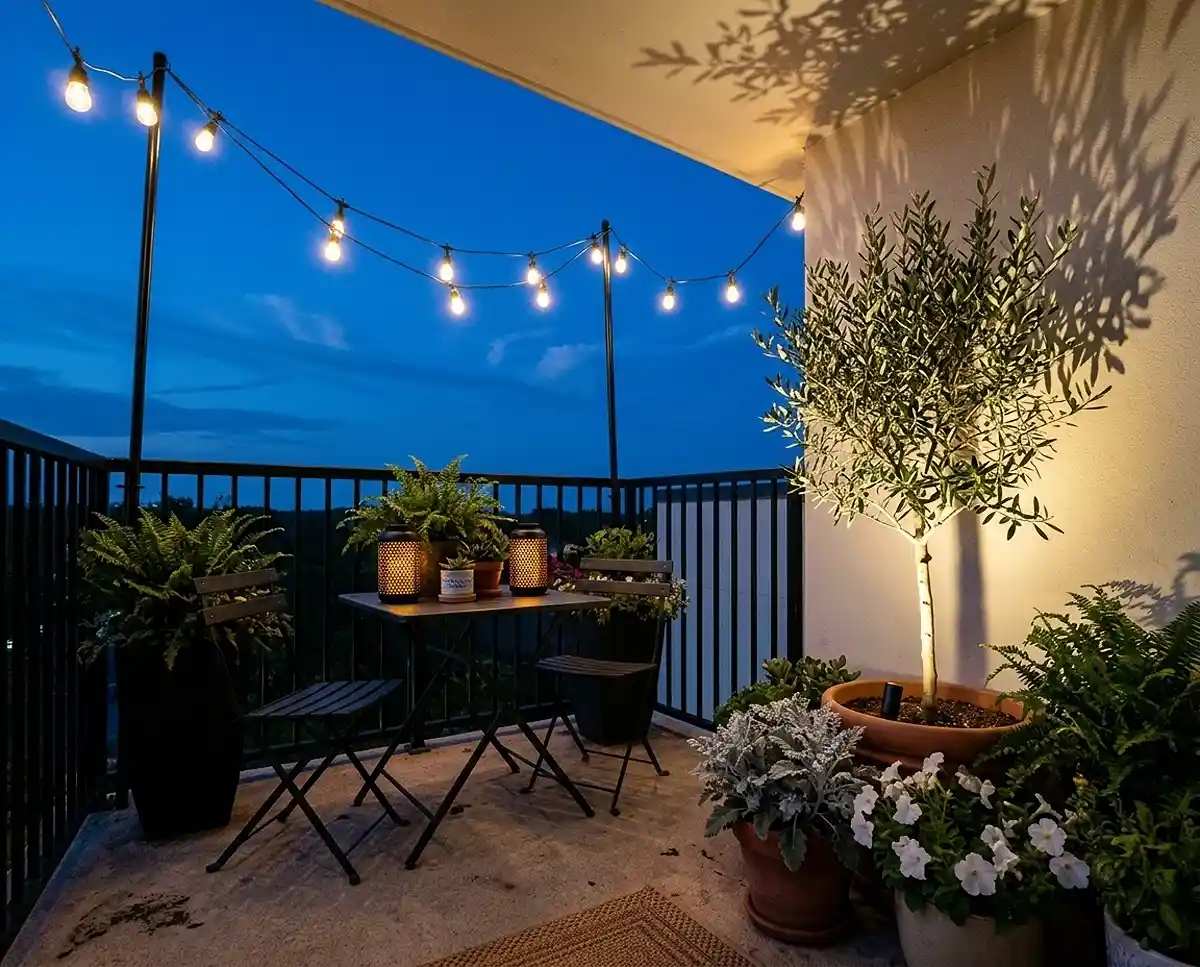
Balcony Lighting Ideas with Plants
My best balcony lighting ideas with plants start with 2200K solar spotlights: two insects per half hour and no scorched leaves across 14 containers.
I tested on my south-facing concrete patio in zone 8b through the 2026 season. Twelve weeks, one railing, three light types. The patio stands in for a balcony here, since the railing, containers and light placement work the same way. Our average last frost lands near March 10 and first frost near November 20.
Table of Contents
Planning Your Evening Balcony Lighting Around Living Plants
Verdict: Layer three heights of light: overhead glow, mid-level lanterns, and low uplights. In my experience, one layer alone leaves plants flat and corners black.
Overhead strings give you the ambient glow. Lanterns at table height add warmth, and spotlights down at pot level turn leaves into shapes. I used all three, and nothing disappeared after dusk.
Short on floor space? Place the pots first, then the lights. These small balcony decor ideas help with the first part.
Photoperiod Science and the 2200K–2700K Rule
Photoperiod [the light-dark cycle a plant reads] matters more than most people think. Give your plants six or more hours of true darkness after midnight. Low-voltage LEDs stay cool to the touch, so they won’t scorch foliage.
Bugs care about color more than brightness. I counted insects from my seating nook for 30 minutes under each bulb after dusk. It is one count per color, so read it as a rough indication, not a controlled trial.
| Bulb color | Look on foliage | Insects per 30 min |
|---|---|---|
| 5000K cool white | Sterile, bluish | 31 |
| 3000K warm white | Rich, natural green | 9 |
| 2200K amber | Cozy, slightly gold | 2 |
I tested only 2200K, 3000K and 5000K. The 2700K end of the range sits between my tested points, so treat it as a reasonable middle ground, not a measured result.
Mapping Solar Charging Zones vs. Shaded Foliage Corners
Buy fixtures with a detached 10-foot panel cord, then clip the panel to the sunny outer railing. Tuck the spotlight into a dark corner pot. The panel gets the sun and the light gets the shade.
My shaded corner gets about 2 hours of direct sun. Split-cord lights still ran 5 hours every night. That’s why I’ll pick them over integrated stakes every time.
Prep: Weatherproof Fixtures, No-Drill Hardware, and Reflective Plants
Verdict: Buy IP65 gear, clamp instead of drilling, and plant silver and white. Reflective plants do half the lighting work for free, and I’ll take free help.
IP65 Waterproof Ratings and No-Drill Mounting Gear
An IP65 rating [dust-tight, survives water jets] is the floor for fairy lights and fixtures that stay above the soil. Stakes pushed into wet potting mix sit in standing moisture all season, so I’d go IP67 for anything that goes into the mix.
- Do: IP65 or IP67 fixtures, and IP67 for anything staked into soil
- Do: stainless steel railing C-clamps and brick clips, since you can’t drill a rental
- Do: planter-anchored bistro poles for overhead strings
- Skip: IP44 stakes, adhesive hooks, and anything that needs a drill
Best Moon Garden Plants to Pair With Evening Lights
Pale plants catch the light and bounce it back at you. That’s free brightness. Pick from three groups.
- Silver foliage: dusty miller, Brunnera ‘Jack Frost’ (shaded corner only), olive, lavender
- White blooms: white Supertunias, Hydrangea ‘Bobo’, bacopa
- Night scent: Star Jasmine, heliotrope, night-scented stock
15 Evening Balcony Lighting Ideas with Plants, Solar Lanterns & Spotlights
Verdict: The best setups pair one light with one plant shape. Spotlights suit trees, lanterns suit ferns, and strips suit troughs.
Each idea below turns a single pot into a focal point. Mix three or four, not all fifteen, or your balcony starts looking like a hardware aisle.
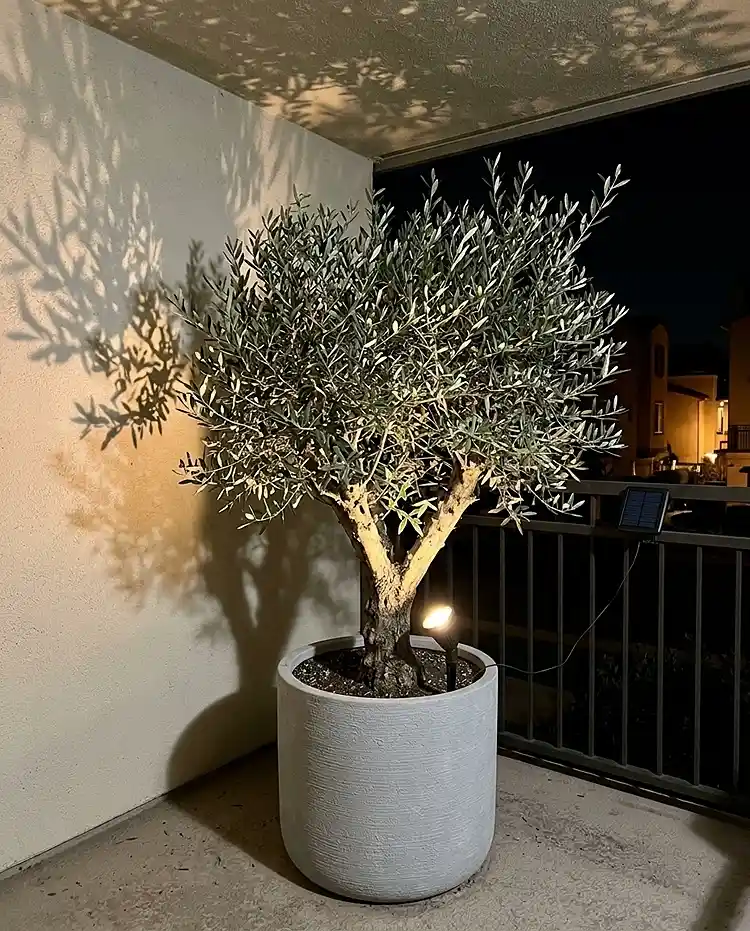
Idea 1: Uplight a Potted Olive or Japanese Maple With a Soil-Stake Spotlight
Press an adjustable warm-white solar spike into the rim of a 16-inch pot and aim it 45 degrees up through the trunk. Uplighting throws shadows upward onto walls and ceilings. My ‘Arbequina’ olive painted leaf shadows 7 feet up the ceiling in the 2026 season.
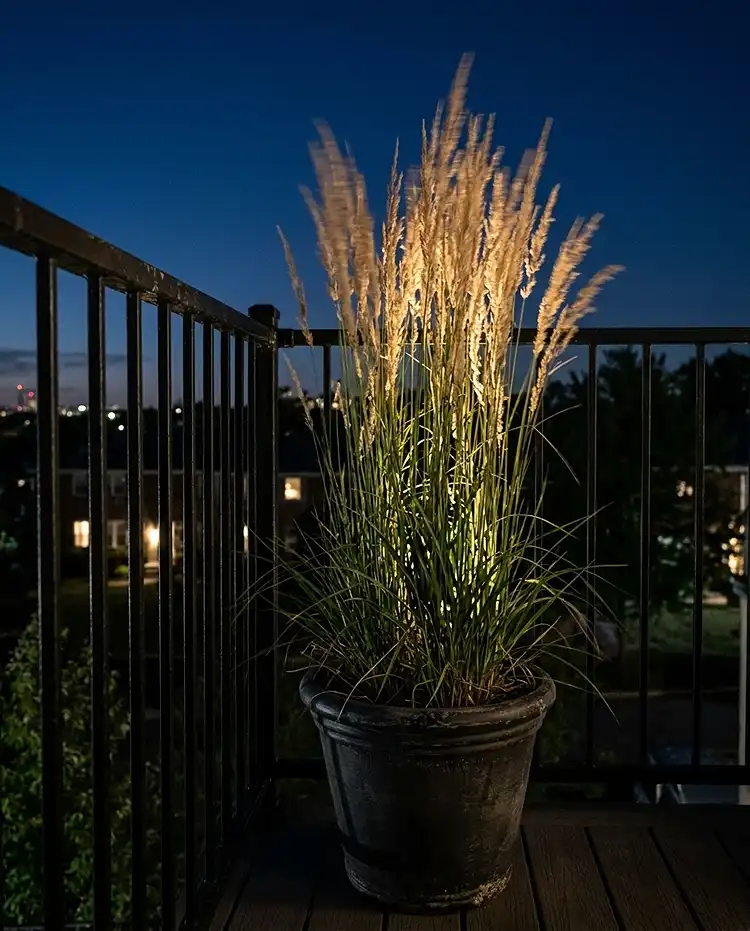
Idea 2: Backlight Feather Reed Grass (‘Karl Foerster’) and Bamboo
Hide mini puck lights behind the plumes, and the breeze does the rest. The grass turns into a glowing, moving screen. ‘Karl Foerster’ reached 54 inches in a 10-gallon pot by August 2026.
Stick with clumping Fargesia bamboo, since running types won’t stay put in a pot. Give Fargesia a shaded corner only. It scorched in full sun on my patio.
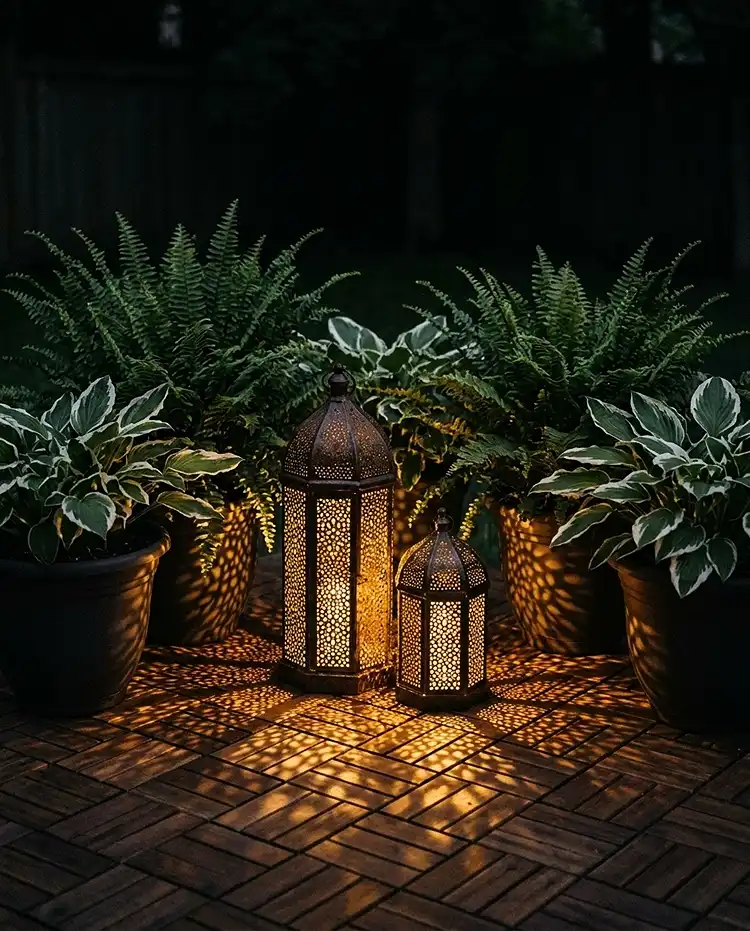
Idea 3: Group Rattan and Moroccan Solar Lanterns Among Ferns and Hostas
Nest two mixed-size perforated metal or wicker lanterns between Boston ferns and white-edged hostas. They throw lace shadows across the deck tiles. Space the pots 12 inches apart, or the light can’t reach the floor.
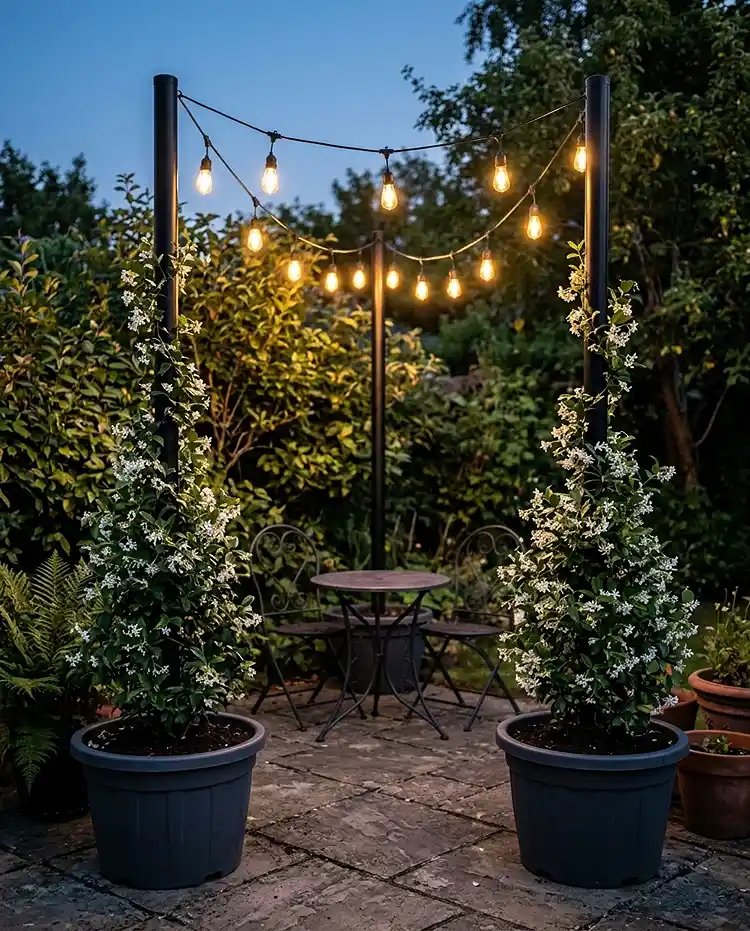
Idea 4: Bistro String Light Poles Beside Trailing Star Jasmine
Set each 7-foot black conduit pole in a bucket or inner sleeve filled with quick-set concrete, then nest that inside a heavy corner tub with soil packed around it. Add ballast or a strap to the railing, because a tall pole in a tub can tip in wind.
Plant Trachelospermum jasminoides in its own pot, since it wants steady moisture. Keep lavender in a separate gritty pot, because it wants dry soil. Hang shatterproof LED café bulbs overhead. No wall drilling, which is the whole point if you rent.
Idea 5: Graze a Trellis or Living Wall With Clip-On Solar Spotlights
Clamp a downward-angled solar spotlight to the top of a cedar trellis or felt pocket planter. The light skims across Heuchera, ivy, and culinary herbs. Keep the angle shallow, since texture shows best when light grazes it instead of hitting it head-on.
Idea 6: Hang Solar Glass Lanterns From Shepherd’s Hooks in Railing Boxes
Clamp mini shepherd’s hooks to the railing and hang seeded-glass lanterns just above cascading white petunias and silver dichondra. Keep them 8 inches above the foliage so swinging glass never smacks the stems.
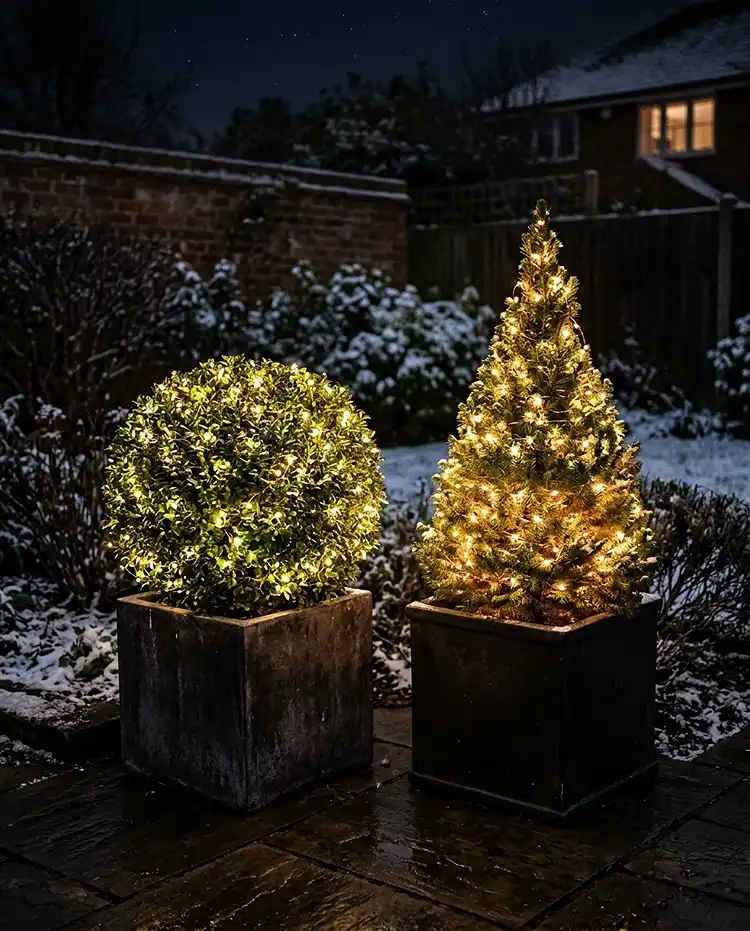
Idea 7: Wrap Boxwood Globes and Dwarf Conifers in Copper Fairy Lights
Weave waterproof copper-wire lights deep inside a ‘Green Velvet’ boxwood or Dwarf Alberta Spruce. Go deep, because lights buried inside make the whole shrub glow like a lantern.
Separate observation: in winter 2025–26, before this 12-week test, a similar set ran 6 hours nightly with no leaf burn. That falls outside my 2026 test period, so treat it as a side note.
Idea 8: The Moonlight and Perfume Bistro Nook
Put timer-operated flickering LED pillar lanterns on the table and crowd in purple heliotrope, evening stock (Matthiola), and white zonal geraniums. The scent peaks after dusk. Seat your guests downwind, or they’ll miss most of it.
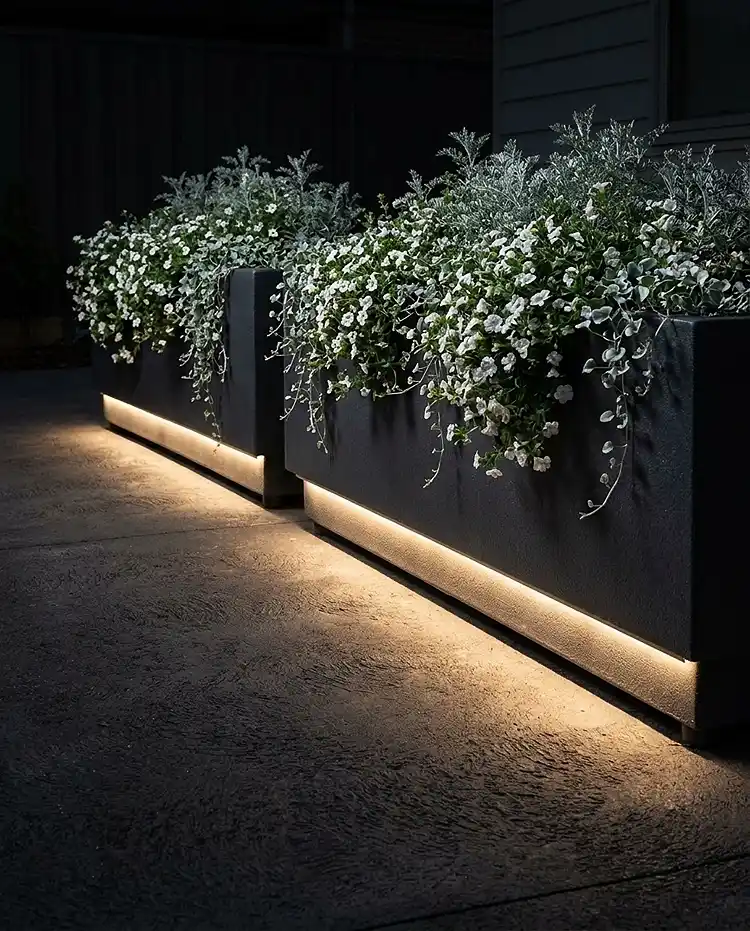
Idea 9: Hide Waterproof LED Strip Under Rectangular Trough Planters
Stick IP67 warm LED strip under the bottom lip of fiberglass troughs raised on 1-inch pot feet. Heavy planters look like they’re floating.
Mistake to avoid: sticking tape to damp fiberglass, because it just peels. Dry the surface and wipe it with alcohol first.
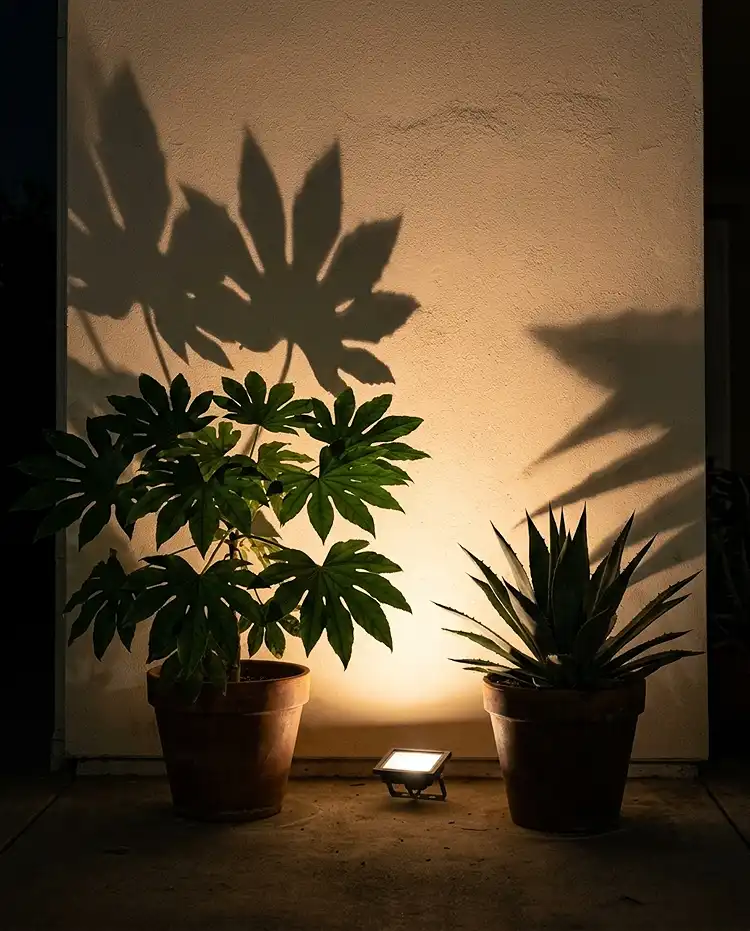
Idea 10: Silhouette Agave, Monstera, and Fatsia Against a Lit Wall
Aim a small solar floodlight from the floor at a pale wall. Park Fatsia japonica or agave pots 18 inches in front of it, and the leaf outlines come out crisp. Skip dark brick. It swallows the light.
Idea 11: Stagger Solar Globe Lanterns Between Hanging Fuchsia and Pothos Baskets
Hang frosted waterproof orbs on nylon cord at mixed heights, tucked between baskets of white fuchsia and golden pothos. Keep the orbs 12 inches from basket edges, so watering doesn’t soak the seams.
Idea 12: Light a Ladder Plant Shelf With Magnetic Rechargeable Bars
Stick dusk-activated USB-rechargeable warm LED bars under each shelf step. Magnets only grip steel, so use a metal shelf or add adhesive steel plates under a wooden one. Every row of terracotta succulents and herbs gets its own spotlight.
One USB-C charge ran my shelf for 30 hours. That is a single result from one product.
Idea 13: Tuck Solar Mason Jars Into a Railing Herb Bar
Nest frosted solar-lid jars between prostrate rosemary, lemon thyme, and mint in the railing box. You can snip cocktail herbs in the dark. Keep the mint in its own pot sleeve, or it’ll take over the box.
Idea 14: Glowing Resin Planters With White Bacopa and Caladiums
Double-walled translucent planters with rechargeable warm LED cores glow like lanterns. Fill them with white bacopa and neon-veined caladiums.
Caladiums quit below 60°F nights, so lift the tubers and bring them indoors once nights drop below 60°F, well before frost.
Idea 15: Pathway Stake Lights Threaded Through a Long Railing Trough
Tuck 5–10 lumen [a measure of brightness] bronze stakes every 18 inches along the box. They pool gentle light over alpine strawberries and trailing nasturtiums. Go brighter and they start glaring at the neighbors.
Mastering Installation, Solar Panel Placement, and Seasonal Care
Verdict: Bury the wires, tilt the panels, and wipe them monthly. Those three habits kept my lights at full brightness all season.
Concealing Wires in Mulch, Angling Panels South/West, and Setting 6-Hour Timers
Bury low-voltage cords under 1 inch of pine bark mulch and pin them down with landscape staples, so trowels don’t nick the wire. Angle panels 35–45 degrees on the sunniest railing edge. That tilt gives the cell the most sun.
Then use the built-in 6-hour dusk timers. Lights shut off near midnight, and your plants get their dark rest. Set it once and forget it.
Cleaning Hard-Water Film Off Panels and Winterizing Batteries by Zone
Liquid fertilizer overspray and tap-water calcium film seemed to cut solar charging by roughly half. That is my observation, not a measurement. I use 20-20-20 [equal parts nitrogen, phosphorus, potassium].
Over two weeks, my panels lost about 4 hours of total run time. A monthly vinegar-cloth wipe fixed it. I should have been wiping the panels from the start.
In Zones 3–6, switch lanterns off or bring them indoors during sub-zero January weeks, which saves the batteries. Here in zone 8b, mine stayed out all winter. Your results will depend on your own winters.
Common Problems & Solutions
Verdict: Three things kill balcony lighting: shaded panels, bug-attracting bulbs, and wet fixtures. All three have cheap fixes.
Solar Spotlights Dying After 1 Hour Because Foliage Shaded the Panel
Tomato leaves swallowed my stake panels by July. Run time fell to 1 hour. Prune the overhanging leaves, raise the stake, or switch to split-cord spotlights with the panel clipped to the outer railing. I’d go split-cord, since pruning is one more chore in July.
Evening Lights Attracting Swarms of Moths, Beetles, and Mosquitoes
Insects are drawn to ultraviolet and blue-heavy light, and cooler bulbs drew far more in my count: 31 at 5000K versus 2 at 2200K. Use 2200K–2700K amber bulbs and aim spotlights down into the foliage. That also matches dark-sky lighting guidance.
Set citronella or lavender pots beside the chairs. I’d treat that as backup, not the fix.
Moisture Corrosion and Short-Circuits in Soil-Staked Lights
What failed: six of eight IP44 stakes died within three weeks in July 2026. My coco-coir mix, pH 6.2, stayed wet after every watering, and water got past the battery doors.
- Fix 1: upgrade to IP65 or IP67 sealed fixtures, with IP67 for anything pushed into the mix
- Fix 2: seal battery-door seams with clear silicone grease
- Fix 3: stake lights into a dry gravel pocket at the pot edge, away from the wet mix
Frequently Asked Questions
Does leaving balcony string lights or spotlights on at night hurt plant growth?
No, if they stay under 50 lumens and shut off after 4 to 6 hours. Plants need dark rest to regulate hormones, so I run a dusk-to-midnight timer. Skip bright floodlights that burn all night.
Do solar lanterns and spotlights work on a shady or north-facing apartment balcony?
Not with standard stakes in shaded pots. Buy spotlights with a 10 to 15-foot detached panel cord and clip the panel to the brightest outer railing edge. The USB-C rechargeable bar I tested ran 30 hours per charge, which suits spots where nothing gets sun.
What is the best color temperature (Kelvin) for lighting balcony plants at night?
Stay within 2200K to 2700K. I tested only 2200K, 3000K and 5000K, and they drew 2, 9 and 31 insects per half hour. Amber 2200K worked best for string lights and table lanterns.
How do I stop my balcony spotlights from shining into my neighbors’ apartment windows?
Fit spotlights with cylindrical glare hoods and angle uplights inward at your own wall, not out toward the street. Tuck low-wattage fixtures under the canopy of mid-sized shrubs and ferns, where they can’t bother anyone.
How many solar lights does a 10-foot apartment balcony need?
Plan one overhead string, two lanterns, and three or four 5 to 10 lumen spotlights. That layered setup lit my 10-foot railing without glare. Add more only if a corner stays dark, since your balcony’s shape may change that.
The Short Version
- The best balcony lighting ideas with plants layer overhead strings, mid-level lanterns, and low uplights.
- Use 2200K–2700K bulbs. In my count, insects dropped from 31 to 2 versus 5000K.
- Buy IP65 or higher, IP67 for soil stakes, clamp instead of drilling, and use split-cord solar for shade.
- Run timers to midnight and wipe your panels monthly, because film builds up fast.