
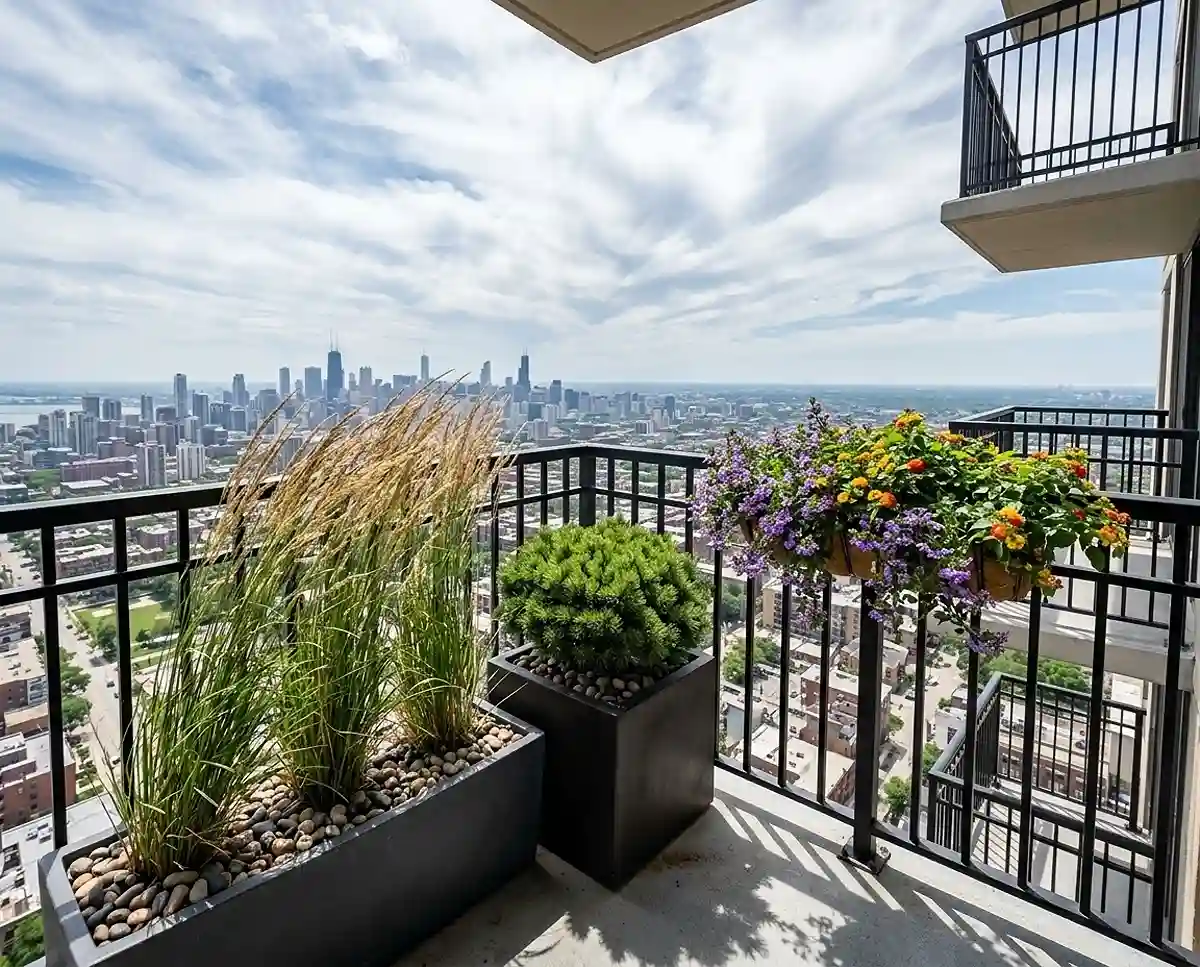
15 Wind Resistant Balcony Plants
Wind resistant balcony plants survive 30-mph gusts when you pick the right traits. Here are 15 wind resistant apartment balcony plants I’ve tested up high. I garden on a 22nd-floor corner balcony in zone 7b, where gusts shredded my first banana plant in nine days.
Below you’ll find the traits, containers, soil, and 15 plant combos that stay put. I’ve included my failures too.
Table of Contents
Understanding the High-Rise Wind Tunnel Microclimate
Quick Answer: Above the 4th floor, wind speeds up as it squeezes along building faces. Canyon updrafts and corner eddies shred broad leaves, topple tall pots, and dry soil about three times faster than a ground-level garden.
Ground-level gardens get friction from fences and trees. Your balcony gets none. Gusts hit the tower, spill sideways, and funnel through your railing at full speed.
My 5-foot ‘Dwarf Cavendish’ banana lost every leaf in nine days. The plant wasn’t weak. The site was simply too exposed for it.
The Botany of Wind Survival: Flexible Stems, Waxy Needle-Like Leaves, and Low Profiles
At the nursery, look for foliage that lets gusts pass through. Fine, feathery, silvery, or leathery succulent leaves create almost no drag. Broad, brittle leaves act like sails and tear along the veins.
- Thin, flexible stems that bend and spring back
- Small, waxy, or needle-like leaves
- Silvery or felted foliage that resists drying
- Low, mounded growth below the wind shear line
Mapping Wind-Buffer Zones, Structural Weight Limits, and the Two-Zone Winter Chill Factor
Solid parapet corners can slow wind by about 50%, so tuck your tallest pots there. Balconies are often rated for 40 to 60 lbs per sq. ft. Confirm your limit with building management before adding ballast.
Freezing winter wind kills what cold alone wouldn’t. Choose perennials rated two USDA Hardiness Zones colder than your city, using the USDA Plant Hardiness Zone Map.
Essential Wind-Proofing Gear: Low-Center-of-Gravity Pots, Ballast, and Soil Mix
Wind-proofing starts with the container, not the plant. A heavy, wide, moisture-holding setup lets average plants survive. Here’s my checklist:
- Wide-footprint square or rectangular containers
- Non-drill anchoring straps for railings
- River-pebble ballast and mulch
- Screw-lock carabiners for anything hanging
Choosing Square Troughs, Heavy-Bottomed Planters, and Locking Railing Brackets
Flat-bottomed square cubes and low fiberglass troughs never roll or tip like tapered cone pots. Their wide base lowers the center of gravity.
| Container | Best For | Watch Out For |
|---|---|---|
| Square cube planter | Shrubs and tall grasses | Heavy when wet; check load limit |
| Low fiberglass trough | Railing-side screens | Needs ballast when dry |
| Tapered cone pot | Sheltered corners only | Rolls and tips in gusts |
| Hanging basket | Trailing annuals | Needs 3-point swivel chain |
Hanging baskets need 3-point swivel chains and locking carabiner clips. Open S-hooks pop loose in the first real gust.
The “Moisture-Locking Ballast” Potting Soil Recipe for Gusty Balconies
This is the exact blend I use in every windy container, measured by volume:
- 35% rehydrated coco coir
- 20% vermiculite for water-holding
- 20% composted pine bark fines
- 10% worm castings
- 15% horticultural pumice, instead of floaty perlite
Top it with a 1-inch layer of river pebbles. Pro Tip: soak the coir fully before mixing, because dry coir repels water.
15 Wind Resistant Balcony Plants for Exposed High-Rise Spaces
These fifteen combinations cover kinetic grasses, tough evergreens, trailing railing flowers, and sturdy edibles. Think of them as wind resistant apartment balcony plants grouped into teams. Browse more balcony plant ideas for every exposure if you need extras.
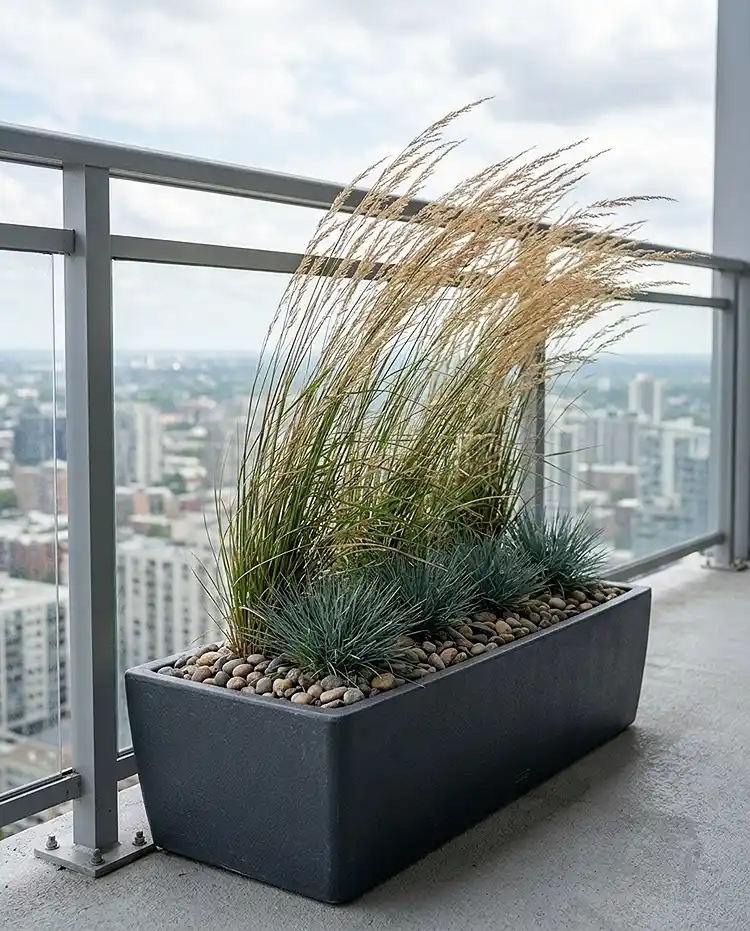
Idea 1: Kinetic Feather Reed Grass (‘Karl Foerster’) and Blue Fescue Trough Screen
Quick Answer: Upright Calamagrostis × acutiflora ‘Karl Foerster’ (zones 4 to 9) bends 45 degrees in 30-mph gusts and springs back. Underplant it with steel-blue Festuca glauca ‘Elijah Blue’ mounds in a 30-inch trough.
I planted this trough in April. In May, a 35-mph gust laid the grass nearly flat. It stood upright again by dinner.
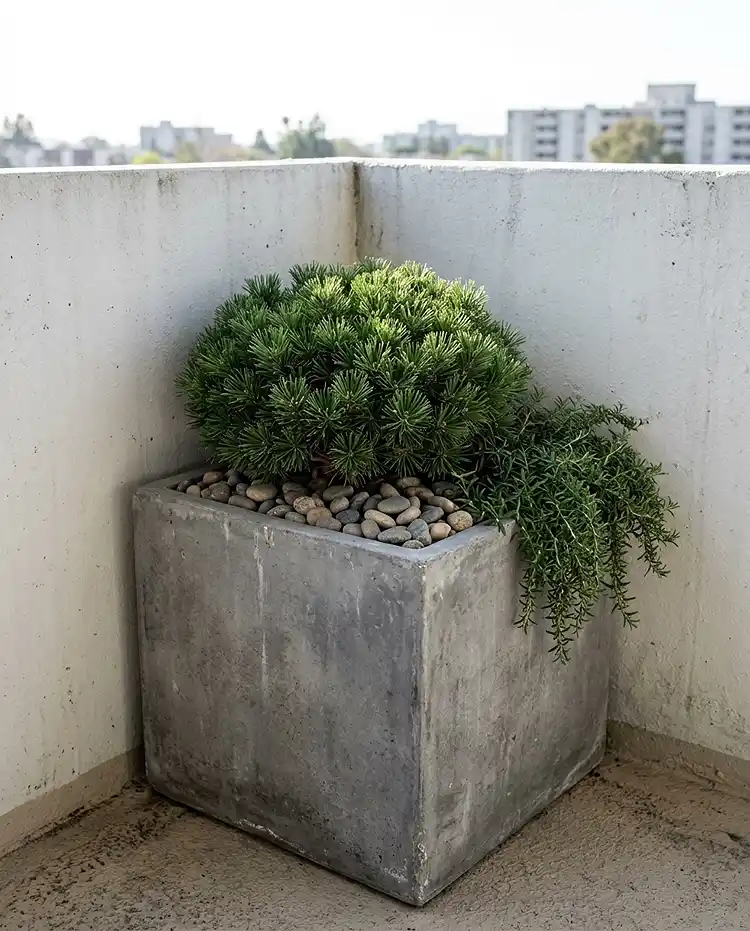
Idea 2: The Mediterranean Windbreak Pot with Dwarf Mugo Pine and Creeping Rosemary
Plant a low, cushion-shaped Pinus mugo ‘Mops’ in a heavy cube planter. Its stiff needles ignore gales and −30°F (−34.4°C) winters. Let prostrate rosemary (Salvia rosmarinus ‘Prostratus’) spill over the edge. It’s hardy only to about zone 8, so replace it yearly in colder zones.
Idea 3: High-Rise Railing Box of Trailing Lantana, Scaevola (Fan Flower), and Portulaca
Combine woody-stemmed trailing Lantana montevidensis, purple Scaevola aemula, and succulent-leaved moss rose (Portulaca). In a sunny railing trough, this trio rarely shreds or wilts. All three are annuals below zone 9, so replant each spring.

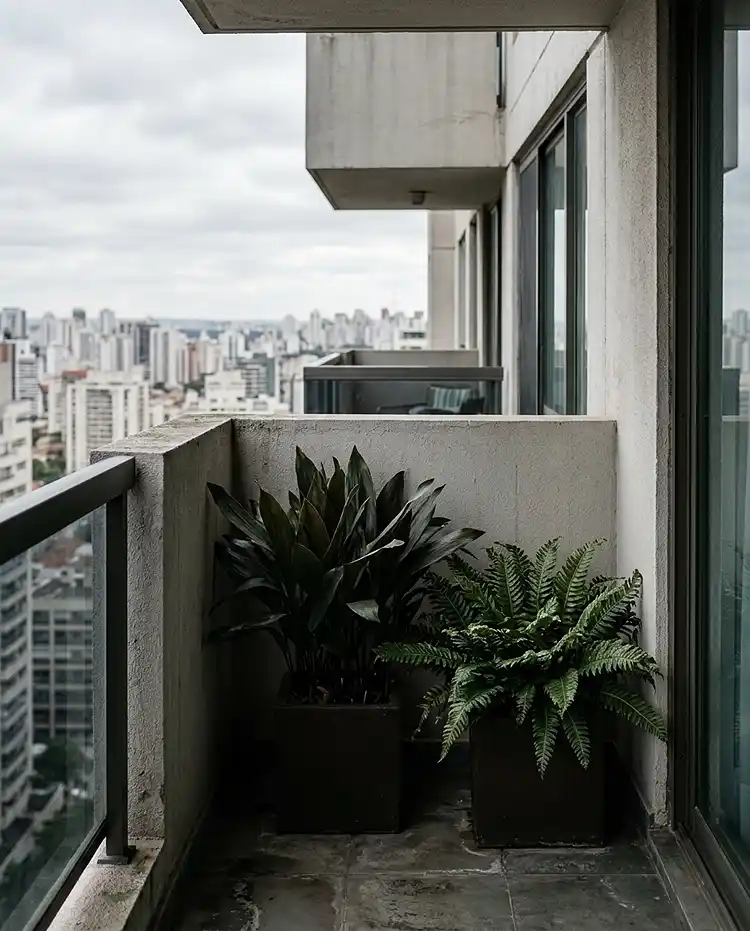
Idea 4: Shady Gust-Proof Corner with Cast Iron Plants (Aspidistra) and Tassel Ferns
North- and east-facing towers need a low-light option. Use leathery cast iron plant (Aspidistra elatior, zones 7 to 11) with stiff-fronded tassel fern (Polystichum polyblepharum, zones 5 to 9). Skip Boston ferns. Their delicate fronds fray within weeks.
Idea 5: Coastal-Tough Shrub Grouping of ‘Green Velvet’ Boxwood and Yarrow (Achillea)
Small-leaved ‘Green Velvet’ boxwood (zones 5 to 9) and ferny yarrow (Achillea millefolium, zones 3 to 9) shrug off drying drafts. Plant them together in a wide 16-inch floor tub. The boxwood holds structure year-round.
Idea 6: Architectural Desert Bowl of Agave Parryi, Sempervivum, and Blue Chalksticks
These low, heavy-tissued succulents hug the pot rim below the wind shear line. Combine Agave parryi (zones 5 to 10), hens and chicks (Sempervivum, zones 3 to 8), and blue chalksticks (Senecio serpens, zones 9 to 11). Use a shallow bowl.

Idea 7: Waxy-Leaved Ivy Geraniums (‘Ville de Paris’) and Silver Licorice Plant Railing Cascade
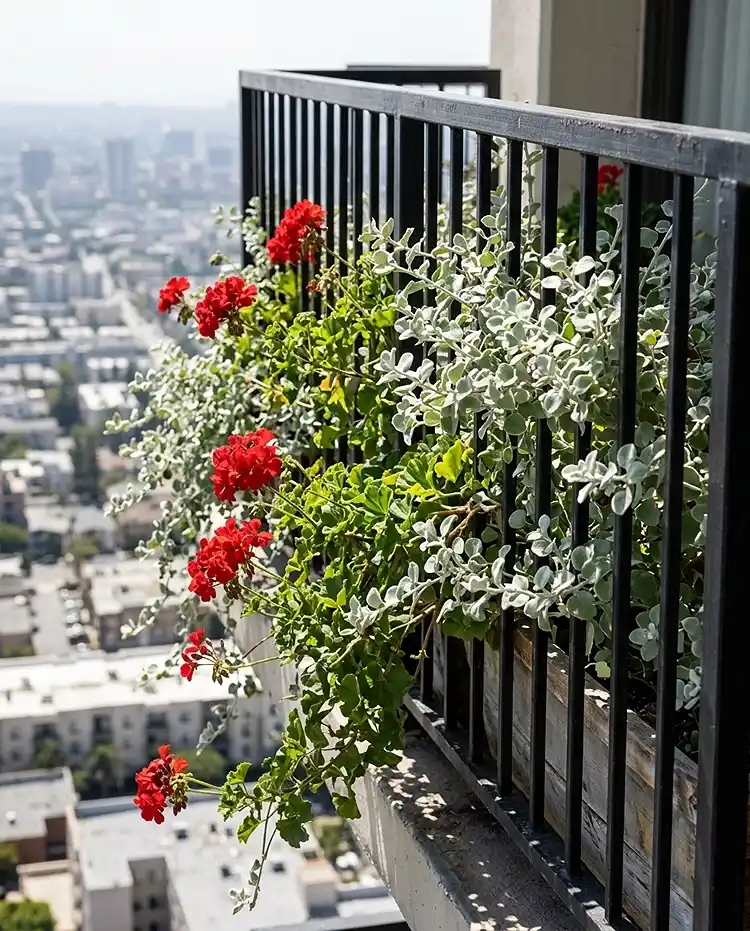
Upright zonal geraniums snap at the stem nodes in steady wind. Trailing ivy geraniums (Pelargonium peltatum ‘Ville de Paris’) flex instead. Weave them with felted silver licorice plant (Helichrysum petiolare) through the railing spindles. Both are annuals in most zones.
Idea 8: The High-Altitude Herb & Edible Box: Thyme, Winter Savory, Chives, and Alpine Strawberries
Build a low kitchen garden from tiny-leaved creeping thyme, woody winter savory (Satureja montana), hollow-tubed chives that flex like reeds, and ground-hugging alpine strawberry (Fragaria vesca). All four are hardy in zones 5 to 8 with a gravel top-dress.
Idea 9: Golden Japanese Forest Grass (Hakonechloa) and Heuchera Shady Movement Trough
Cascading Hakonechloa macra ‘Aureola’ (zones 5 to 9) pairs with low-mounding coral bells (Heuchera ‘Palace Purple’, zones 4 to 9). Shady balcony drafts become soothing, rustling motion without stem breakage.
Idea 10: Salt- and Wind-Proof Pittosporum (‘Wheeler’s Dwarf’) and Gazania Sun Planter
Glossy, thick-leaved mock orange (Pittosporum tobira ‘Wheeler’s Dwarf’, zones 8 to 11) tolerates salt and sky-high wind. Pair it with low, daisy-like Gazania rigens in full sun. Gazania closes on cloudy days.
Idea 11: Self-Twining Star Jasmine Woven Tight Into a Railing-Clamped Wire Grid
Twining, woody star jasmine (Trachelospermum jasminoides, zones 8 to 10) grips a wire grid like rope. Heavy-headed clematis and climbing roses get ripped off their supports. Weave new stems into the grid every two weeks.
Idea 12: Compact Micro-Dwarf Tomatoes (‘Orange Hat’) and Bush Hot Peppers in Weighted Tubs
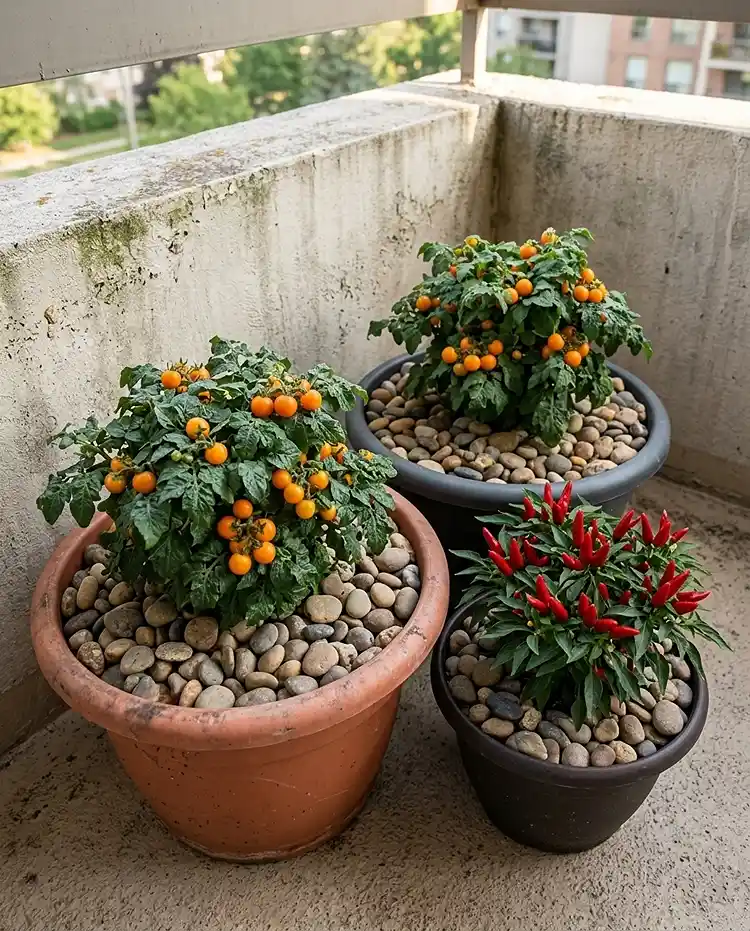
Stocky 10-inch ‘Orange Hat’ tomatoes and small-leaved peppers (‘Thai Hot’ or ‘Serrano’) carry heavy fruit in wind. Anchor them in weighted 5-gallon tubs. A 6-foot indeterminate tomato snapped in half on my balcony, but ‘Orange Hat’ set fruit all summer.
Idea 13: Silvery Conifer & Sedum ‘Autumn Joy’ Four-Season Anchor Planter
Pair ground-hugging Juniperus procumbens ‘Nana’ (zones 4 to 9) or ‘Blue Star’ juniper (zones 4 to 8) with thick-stemmed Hylotelephium ‘Autumn Joy’ (zones 3 to 9). The juniper stays evergreen while the sedum adds fall color.
Idea 14: Pollinator Wind-Haven of Compact Catmint (Nepeta ‘Cat’s Pajamas’) and Blanket Flower
Aromatic, small-leaved catmint (Nepeta ‘Cat’s Pajamas’, zones 3 to 8) and prairie-tough blanket flower (Gaillardia) form low, flexible flower cushions. Bees can cling to them on breezy days.
Idea 15: Broadleaf Evergreen Privacy Trough with Spotted Laurel (Aucuba) and Dwarf Nandina
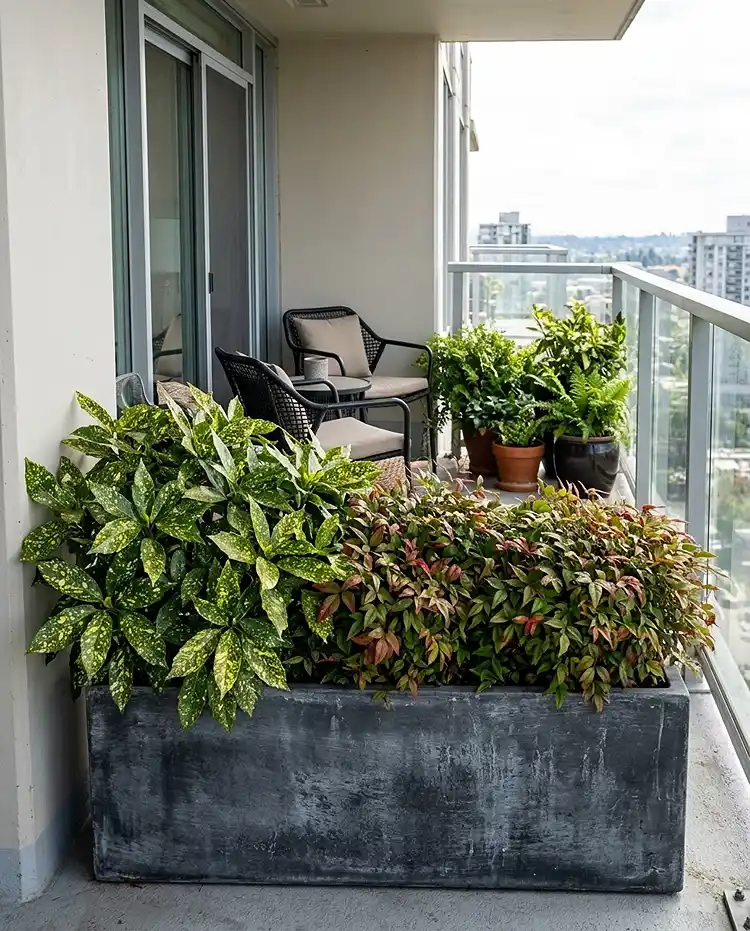
Thick, leathery Aucuba japonica ‘Gold Dust’ (zones 7 to 10) and compact, non-invasive Nandina ‘Fire Power’ (zones 6 to 9) build a dense hedge in a long trough. Place it upwind of your seating nook so it filters gusts before they hit delicate pots.
Mastering Wind-Proof Installation, Watering, and Seasonal Care
Anchoring, watering, and winter care decide whether these plants survive. Here’s how I handle all three.
4 Renter-Safe Pot Anchoring Hacks: River-Rock Ballast, Museum Putty, and Velcro Straps
- River-rock ballast: lay a 3-inch layer of heavy stones in the pot bottom, under landscape fabric so drainage stays clear.
- Museum putty: stick small tabletop pots down with outdoor quake putty.
- Velcro straps: cinch tall planters to railing posts with UV-rated straps.
- Tight clusters: group pots together so they brace each other.
Counteracting Wind Transpiration: Deep Morning Soaks, Pebble Mulch, and Winter Wilt-Pruf
A 15-mph breeze doubles water use, even on a cloudy 65°F (18.3°C) day. Soak deeply each morning, then check soil depth with a finger.
| Conditions | Soil Check |
|---|---|
| Under 10 mph, mild | Every 2 to 3 days |
| 15 mph, cloudy, 65°F (18.3°C) | Daily; water use doubles |
| 25+ mph, sunny | Morning soak plus evening check |
Top-dress soil with 1 inch of pea gravel, since bark mulch blows away. In November, spray evergreens with a pine-oil anti-desiccant like Wilt-Pruf, following label directions.
Common Problems & Solutions
Three problems cause most wind damage. Each has a simple fix.
“Wind Scorch” (Crispy Brown Leaf Margins and Tatters Even When Soil is Wet)
Dry wind pulls moisture from leaf stomata faster than roots can replace it. Zip-tie a 50%-permeable bamboo or HDPE screen to the railing, which slows wind without creating turbulent eddies. Cluster pots together to raise humidity.
Newly Planted Transplants Snapping at the Soil Collar (“Wind Rocking” Root Damage)
Constant buffeting rocks unestablished stems in loose mix and severs new feeder roots at the collar. Double-stake stems with soft figure-eight rubber ties. Then firm gravel mulch around the base.
Potting Soil and Perlite Blowing Out of Dry Containers Onto Balcony Furniture
Featherweight dry peat and white perlite become a dust storm on the 15th floor. Switch to pumice for aeration. Then cover 100% of bare soil with river stones, slate chips, or living sedum groundcovers.
Frequently Asked Questions
Which plants should you never put on a windy high-rise balcony?
Avoid tall, hollow-stemmed, or huge-leaved plants that act like sails. That includes standard banana plants (Musa), elephant ears (Colocasia), tall delphiniums, cosmos, indeterminate beefsteak tomatoes, and double-flowered tuberous begonias.
Is a solid tarp or a slatted screen better for blocking wind on a balcony?
Choose a screen that is 50% to 75% permeable, such as slatted cedar, rolled reed fencing, or knitted HDPE mesh. A solid tarp creates violent, downward-swirling eddies behind the railing that rip plants upward and can bend metal railings.
How do I keep hanging baskets safe on a windy apartment balcony?
Replace open S-hooks with screw-lock stainless steel carabiners and swap plastic chains for heavy 4-strand metal chains. Line baskets with coco coir to hold moisture, and set them on the floor before severe gale warnings.
Why do my windy balcony plants dry out so fast even when it isn’t hot outside?
Moving wind strips the thin boundary layer of humid air around leaves and soil, which forces nonstop transpiration. Switching from porous terracotta or fabric bags to glazed or double-walled resin pots can cut wind moisture loss in half.
Key Takeaways
- The best wind resistant balcony plants have flexible stems, small or waxy leaves, and low, mounded growth.
- Stability comes first: use wide, flat-bottomed containers with ballast, and stay within your 40 to 60 lbs per sq. ft. load limit.
- Block wind with a 50% to 75% permeable screen, never a solid tarp.
- A 15-mph breeze doubles water use, so soak deeply each morning and mulch with pebbles.
- Choose perennials rated two USDA Hardiness Zones colder than your city.