
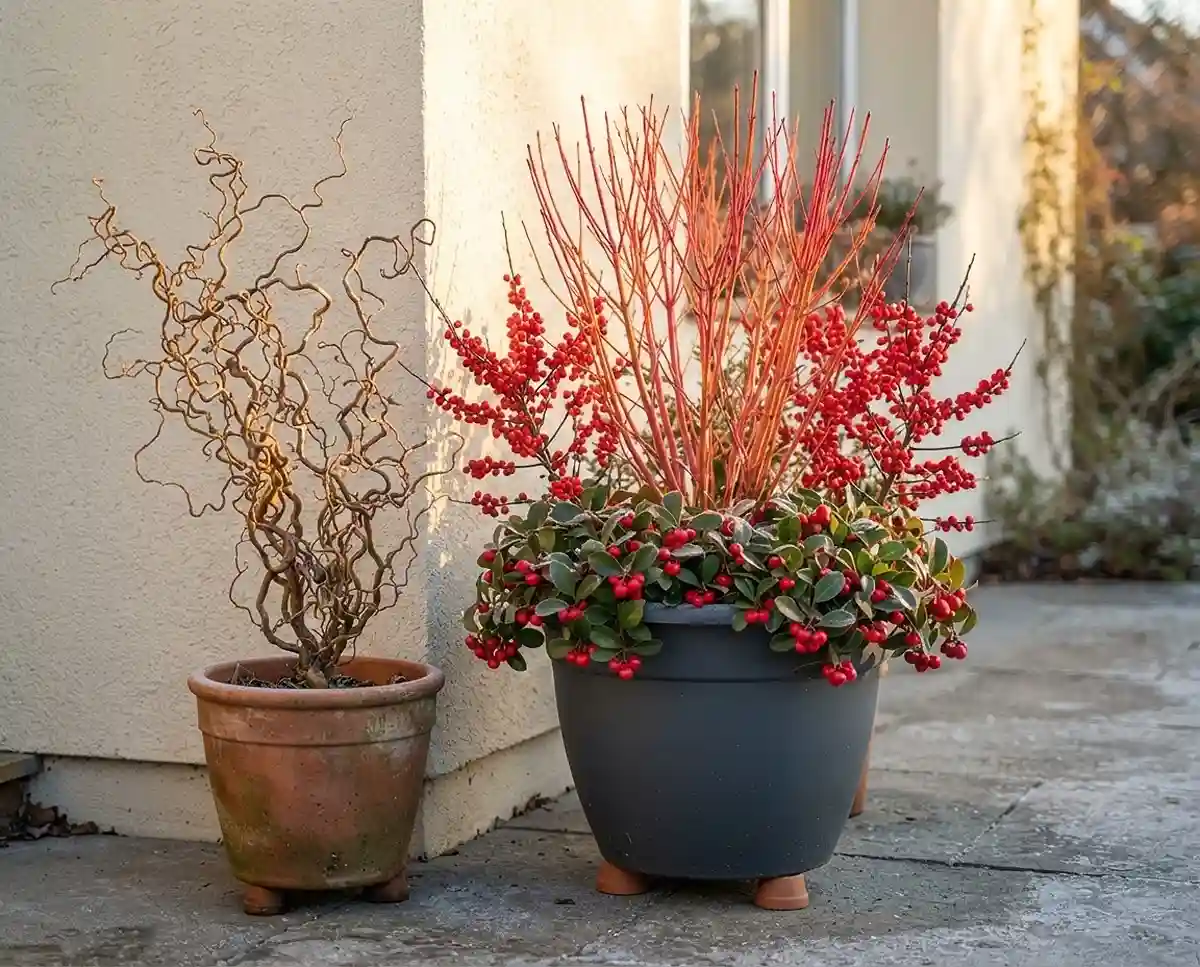
Winter Interest Container Plants
Red-twig dogwood was the best of my winter interest container plants: 4 of 4 pots held color through January. These winter balcony ideas come from 12 pots. Everything below worked, or failed, in real winters.
My test setup: 12 containers on a south-facing concrete patio in zone 8b, over three winters (2023-24 through 2025-26). Lows hit 17°F in January 2024. Average first frost is November 15. Last frost is near March 10. A balcony gets the same wind and sun, so the results carry over. Notes are current as of the 2026 season.
Table of Contents
Rethinking Winter Balcony Color Beyond Evergreens
Verdict: Evergreens give you green. Dormant shrubs give you red, orange, and berries. For real winter color, build around shrubs that drop their leaves.
Winter interest means a plant looks good while dormant (resting, with no active growth). Once the leaves fall, red stems, twisted branches, and berries show against gray skies. That turns a small balcony garden into a focal point.
Most winter balcony ideas lean on conifers. I tested deciduous (leaf-dropping) shrubs instead. Their color peaks from December through February. New to pots? Start with this guide to container gardening for beginners.
Assessing the Winter Balcony Microclimate
Verdict: Wind and frozen roots kill more potted shrubs than cold air does. Check your exposure first. Then buy plants hardy two zones colder than yours.
Spend one windy, sunny afternoon in January on your balcony. Note where wind funnels, where ice lingers, and where sun lands at noon. Look up your zone on the USDA Plant Hardiness Zone Map.
Brand new to balcony growing? This balcony gardening for beginners guide covers the basics. Your microclimate (local conditions on your balcony) matters more than your zone.
Wind Chill and Container Freeze
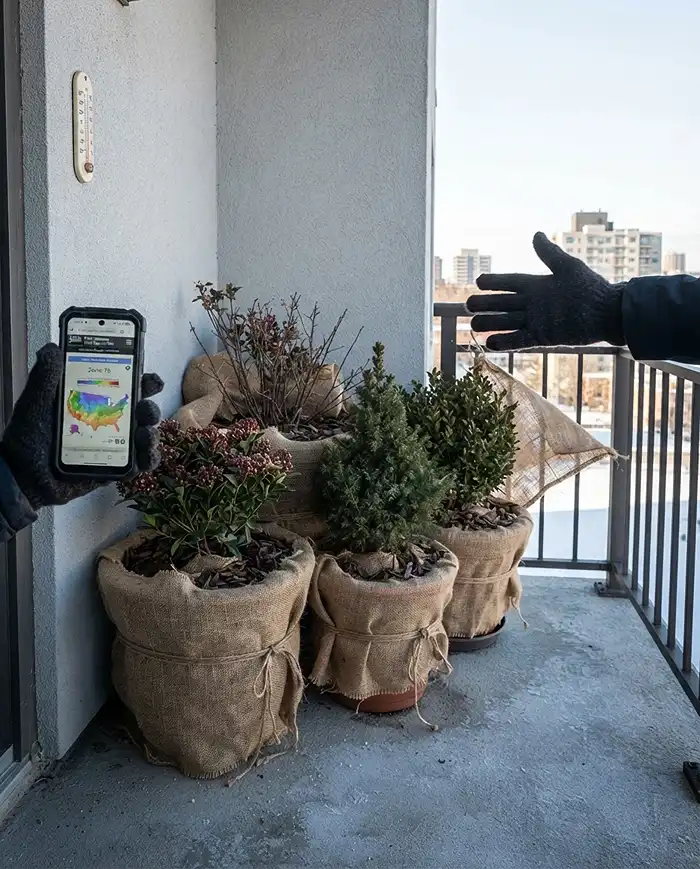
A raised balcony gets wind from every side. A pot also freezes on every side, while ground roots sit insulated. That’s why I follow the two-zone rule: pick plants hardy two USDA zones colder than yours. In zone 8b, that means zone 6.
- Do: group pots against the wall, sides touching, so they share heat.
- Do: wrap pots in burlap when lows drop below 20°F.
- Skip: railing planters and stands that expose the pot bottom to wind.
Mistake to avoid: parking pots at the rail edge. In winter 2023-24, wind dried out two of my first four pots by February. Pushing them against the wall fixed it.
Maximizing Low Winter Sunlight
In December the sun sits low and rakes in sideways. That light makes berries glow and bark look lit from inside. Put your color pots at the sunny end of the balcony, about 12 inches off a light-colored wall.
Red-twig dogwood needs 6 hours of direct sun for its best color. Berries need less. Skip spots behind solid railings, which cast shade from November to February.
Best Container Plants for Colorful Winter Bark and Stems
Verdict: Red-twig dogwood wins for color per pot. Contorted filbert wins for shape. Coral bark willow looks great, then outgrows its container fast.
| Plant | Hardiness | Pot size | Winter color | My result |
|---|---|---|---|---|
| Cornus sericea ‘Arctic Fire’ | Zones 2-8 | 7 gallons | Red stems | 4 of 4 held color |
| Cornus sericea ‘Arctic Sun’ | Zones 3-8 | 7 gallons | Orange-yellow stems | Good, paler in shade (1 pot) |
| Salix alba ‘Britzensis’ | Zones 4-9 | 7 gallons | Orange-red stems | Failed (2 pots) |
| Corylus avellana ‘Red Dragon’ | Zones 4-8 | 10 gallons | Twisted brown stems | Slow but reliable (1 pot) |
Red and Yellow Twig Dogwoods (Cornus)
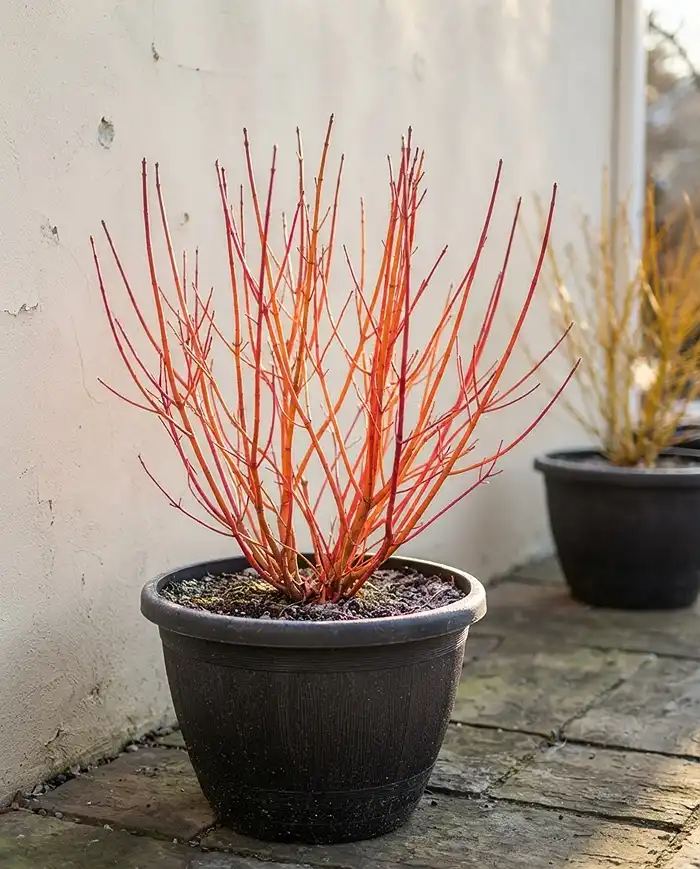
Compact red-twig ‘Arctic Fire’ (also sold as ‘Farrow’) stays near 3.5 feet. In winter 2024-25, my four pots turned coral-red by December 1. Color held into March.
‘Arctic Sun,’ the yellow-twig type, gave orange-yellow stems. It paled in my one shadier spot. Use either as the thriller (the tall center plant) in a mixed pot.
Mistake to avoid: planting dogwood in shade. Stems fade to olive-green. Give it 6 hours of sun.
Coral Bark Willow (Salix) and Contorted Filbert
Coral bark willow failed in my pots. Two 7-gallon containers hit 5 feet in one summer and needed water daily. In February 2024, dry wind killed about half the stems. Likely cause: thirsty roots and too little pot.
Contorted filbert (Harry Lauder’s Walking Stick) did better. My ‘Red Dragon’ stays near 4 feet after three years in a 10-gallon pot. The twisted brown stems look like sculpture. Growth is slow, but it never sulked.
Top Potted Shrubs for Bright Winter Berries
Verdict: Winterberry holly gives the most berries per pot, but only with a male nearby. Wintergreen is the easy low layer. Skimmia is borderline below zone 7.
Wintergreen (Gaultheria procumbens)
This creeper stays 4-6 inches tall. It carries red, mint-scented berries and purple-tinged leaves through snow. It wants acidic soil (pH 4.5-5.5) and part shade. Full south sun scorched mine in August. Shade from the dogwoods fixed it.
- Do: use ericaceous (acid-loving) potting mix.
- Skip: lime, wood ash, or any fertilizer that raises pH.
Skimmia japonica and Dwarf Holly
Skimmia ‘Reevesiana’ is self-fertile, so one plant sets berries. It’s hardy only to zone 7, so it fails the two-zone rule in 8b. Mine survived 17°F, but the windward leaves browned. Treat it as a sheltered-spot plant.
Dwarf winterberry ‘Red Sprite’ drops its leaves and shows red berries on bare stems. In winter 2025-26, I paired one in a 5-gallon pot with a male ‘Jim Dandy’ 12 inches away. Berries colored by mid-October. Birds stripped them by mid-February.
Mistake to avoid: buying a female holly with no male. You’ll get leaves and zero berries. Keep a male within 6 feet.
Step-by-Step Guide to Designing Your Winter Display
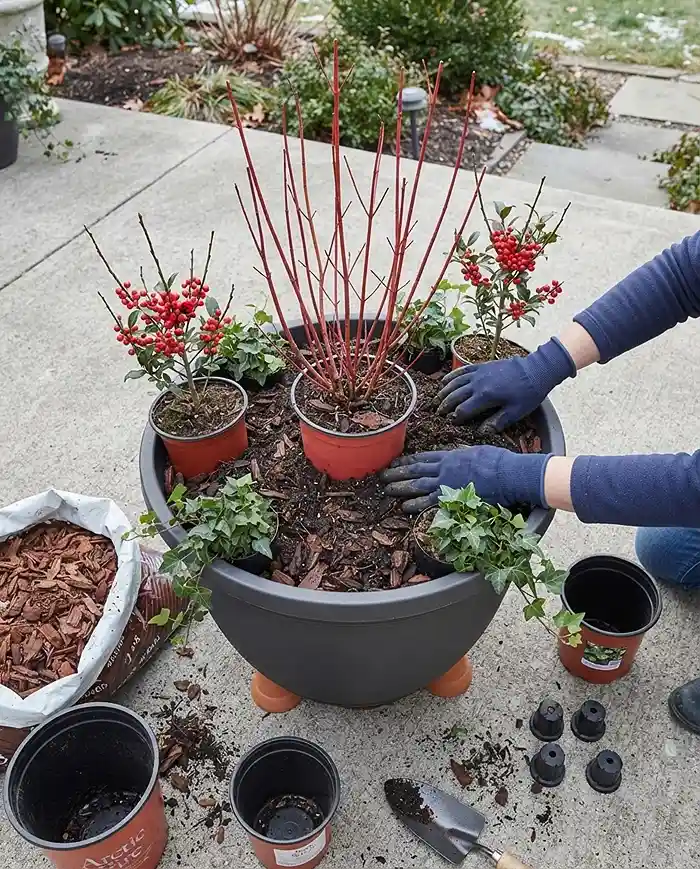
Verdict: Buy frost-proof pots, plant in October, and put one tall stem plant in the center. Berries go around it. Ivy goes at the edge.
- Pick frost-proof pots, 16-18 inches wide, with drain holes.
- Mix 2 parts potting mix with 1 part pine bark fines (pH 6.0-6.5). Use acid mix for wintergreen and skimmia.
- Plant in October. Fall balcony ideas like this pay off because roots settle before the November 15 frost.
- Space shrubs 12 inches apart and ivy 8 inches from the rim.
- Water until it drains, then add 2 inches of shredded bark mulch.
Short on space? See these beginner small space gardening tips.
Choosing Frost-Proof Containers
Terracotta failed. A 14-inch pot cracked in January 2024 after a thaw and refreeze. Wet soil expands as it freezes, and clay can’t flex. Use resin, fiberglass, or wood at least 3/4 inch thick.
Lift pots on 1-inch feet and skip saucers. Standing water freezes into a block under the roots.
Styling Winter Interest Container Plants
I use a modified thriller-filler-spiller (tall center plant, mid-height plants, trailing edge plants). Dogwood or filbert is the thriller. Winterberry or skimmia is the filler. Hardy English ivy is the spiller.
On a small balcony, one big pot beats five small ones. One 18-inch pot holds all three layers.
Winter Maintenance for Bark and Berry Plants
Verdict: Water on thaw days, never fertilize in winter, and prune hard in early March. That’s the whole routine.
Watering Dormant Plants
Dormant roots still dry out in wind. Every 10-14 days, check the soil 2 inches down on a sunny day above 40°F. If it’s dry, water at midday so excess drains before night.
Mistake to avoid: watering at dusk or on frozen soil. The water sits and freezes. Wait for a warm afternoon.
Pruning for Maximum Stem Color
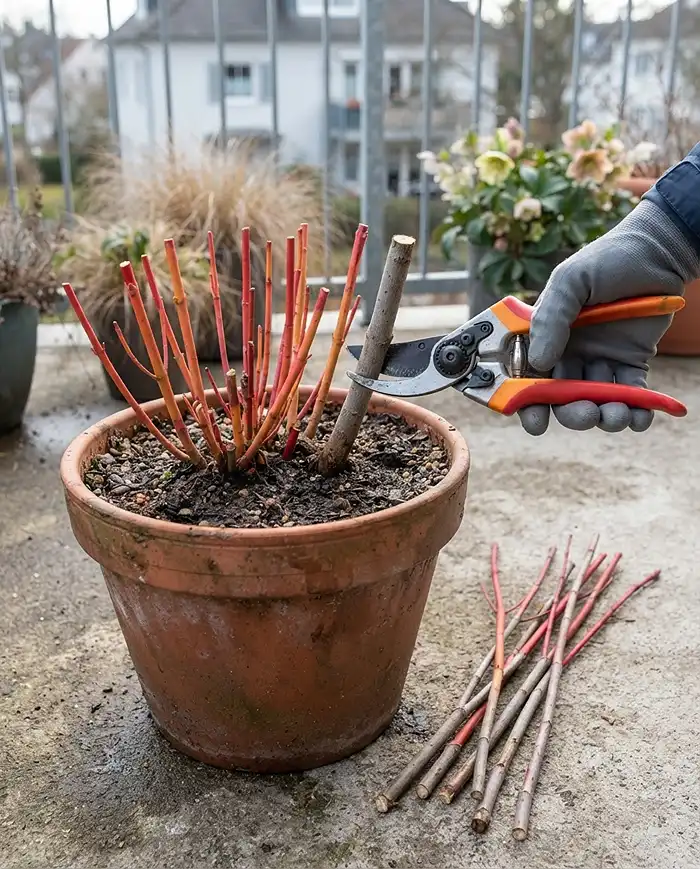
The brightest bark grows on new stems. In early March, after the last frost, I cut my ‘Arctic Fire’ pots back to 8 inches. The next winter’s stems were noticeably brighter than in the unpruned year.
For filbert, prune lightly to keep the twist. After pruning, feed once in April with a 10-10-10 slow-release fertilizer (equal nitrogen, phosphorus, potassium).
Common Problems & Solutions
Verdict: Most problems trace to dry roots, old wood, or too little sun. Fix those three and the color comes back.
Berries Shriveling and Dropping Early
Early drop usually means root dehydration or a sudden temperature swing. One winterberry lost about 30 percent of its berries after a 62°F afternoon followed by a 24°F night. On warm spells, check soil and water once the top 2 inches are dry.
Bark Losing Its Bright Color
Dull or browning bark means old wood or too little light. Stems older than three years turn gray-brown. Prune out the oldest third each March and move the pot to a spot with 6 hours of direct sun.
People Also Ask
Will birds eat the berries on my balcony?
Yes, usually in late winter when other food runs short. My ‘Red Sprite’ winterberry berries were stripped by mid-February, about four months after they colored.
Can these shrubs survive permanently in pots?
Yes. Dogwood and winterberry holly live five or more years in 15 to 20 gallon containers. Every two to three years, trim one third of the root ball or move up 2 to 4 inches in pot diameter.
Do I need to fertilize winter interest plants?
Not in winter. Dormant shrubs can’t use it, and forced growth in freezing weather gets killed by frost. Feed once in April with a 10-10-10 slow-release fertilizer after pruning.
How heavy are these pots on a small balcony garden?
A wet 7-gallon pot runs about 40 pounds. Check your building’s load limit before placing more than three or four. Resin and fiberglass pots weigh far less than ceramic.
Which of these plants handle a zone 5 balcony?
Under the two-zone rule, zone 5 means plants hardy to zone 3. Red-twig dogwood ‘Arctic Fire’ (zone 2), winterberry ‘Red Sprite’ (zone 3), and wintergreen (zone 3) qualify. Skip skimmia, which is hardy only to zone 7.
The Short Version
- Start with winter interest container plants hardy two zones colder than yours.
- Use dogwood for stems, winterberry plus a male for berries, and wintergreen underneath.
- Choose resin, fiberglass, or thick wood pots. Terracotta cracked on me.
- Water on thaw days, skip fertilizer until April, and prune hard in March.