
Pot Size for Peppers
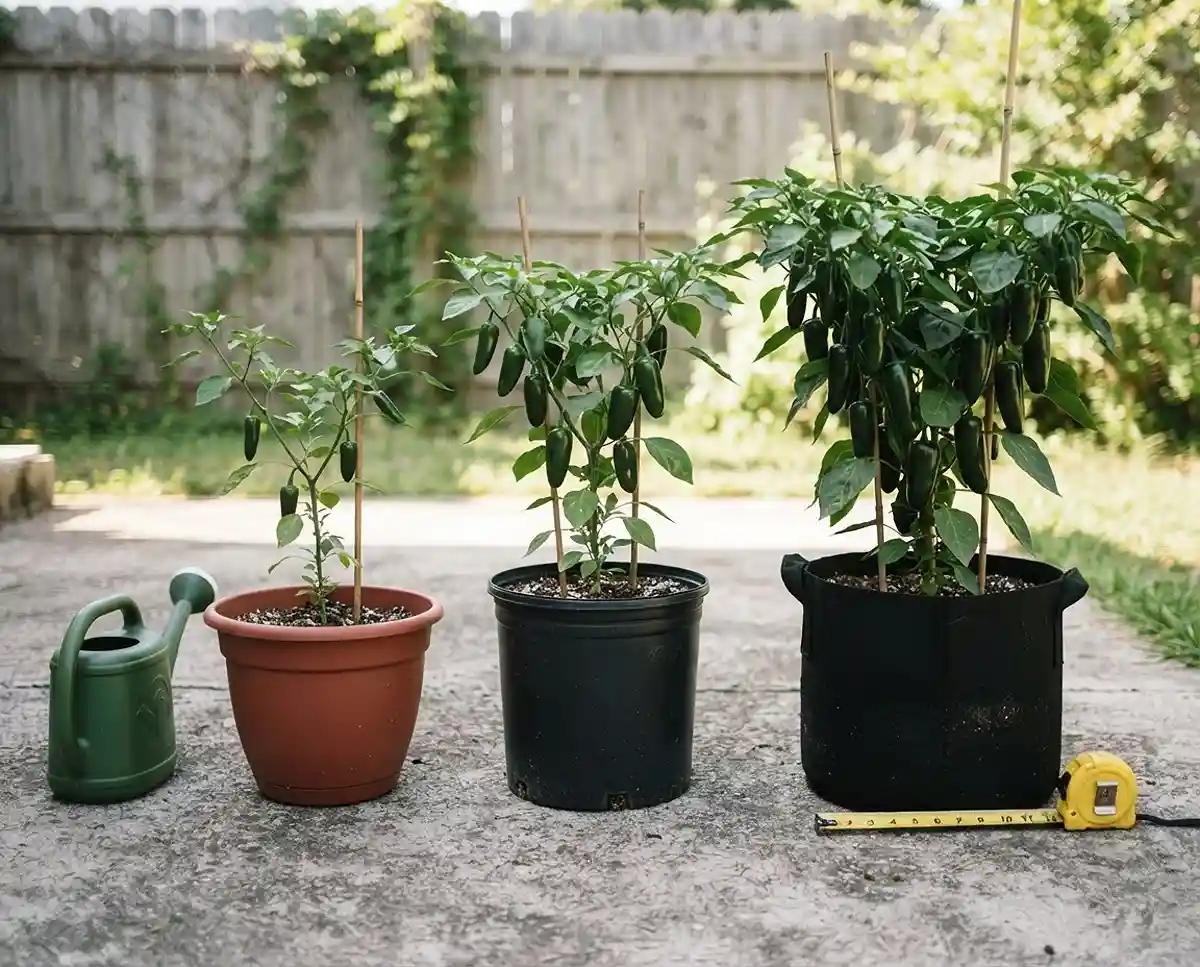
The best pot size for peppers is 5 gallons for most varieties. Across 24 peppers in containers on my patio, 3-gallon pots cut yields by about a third. Here’s the sizing that held up.
My setup: a south-facing concrete patio in zone 8b, 24 containers, one 2026 season. I transplanted on April 4, after our March 28 average last frost. First frost usually lands around November 20.
Table of Contents
Why Pot Size Decides Your Pepper Yield
Verdict: Pot volume caps plant size and fruit count. Too small and roots choke. Too big and the soil stays wet. Five gallons hits the sweet spot for most peppers.
Container vegetable gardening is a simple trade. More soil means more roots, and more roots feed more fruit. ‘Early Jalapeño’ gave me 2.4 lb in a 3-gallon pot, 3.6 lb in a 5-gallon, and 3.7 lb in a 7-gallon.
That last gain is noise. Past 5 gallons, a jalapeño just eats patio space. If you also grow tomatoes and cucumbers, this pot size guide for tomatoes, peppers and cucumbers lines up all three crops.
| Pot size | Width | ‘Early Jalapeño’ yield | Peak July watering |
|---|---|---|---|
| 3 gallons | 10 in | 2.4 lb | Daily |
| 5 gallons | 12 in | 3.6 lb | Every 1 to 2 days |
| 7 gallons | 14 in | 3.7 lb | Every 2 days |
How Pepper Roots Behave in a Pot
Verdict: Peppers need depth for one main root and width for a mat of feeder roots. Treat 12 inches deep as the floor. Shallower pots curl roots and stunt the plant.
The Taproot and Feeder Roots
A taproot [the thick central root that grows straight down] anchors the plant. Feeder roots branch off it near the surface. They do the real work of absorbing water and nutrients.
In a pot, feeder roots hit the walls fast. That’s why width matters as much as depth. A narrow, tall pot starves the surface roots even when the taproot has room.
The 10 to 12 Inch Minimum Depth
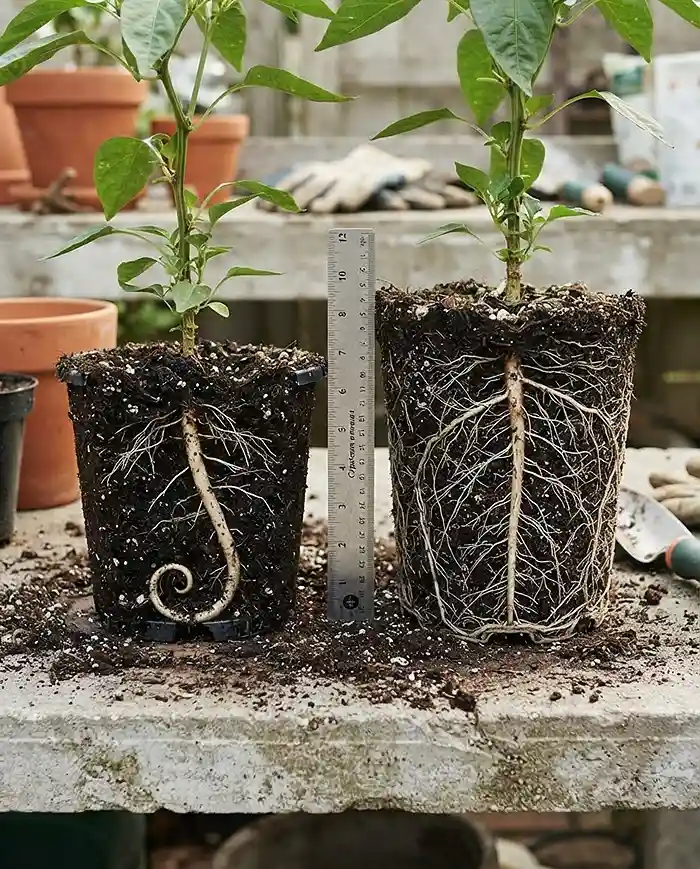
I cut open pots in October. In 8-inch-deep containers, the taproot had curled into a hook at the bottom. In 12-inch-deep pots, it ran straight and the canopy was visibly fuller.
Penn State Extension says a 14-inch pot works for peppers. That matches what I saw. My rule is 12 inches deep for everything, 14 inches for bells.
Pot Size for Peppers by Variety: Container Sizes Explained
Verdict: Match volume to mature plant size. Compact types need 2 to 3 gallons, hot chilis 3 to 5, and big sweet peppers 5 to 10. When unsure, round up one size.
Container sizes explained: a standard 10-inch-wide pot holds roughly 3 gallons, a 12-inch pot about 5, and a 14-inch pot about 7. Nursery “gallon” labels often run small, so measure the pot.
| Pepper type | Examples | Pot volume | Min depth |
|---|---|---|---|
| Compact and ornamental | ‘Mini Belle’, ‘Black Pearl’ | 2 to 3 gal | 10 in |
| Hot peppers | Jalapeño, Serrano, Habanero | 3 to 5 gal | 12 in |
| Large sweet | ‘California Wonder’, Poblano | 5 to 10 gal | 14 in |
Compact and Ornamental Peppers (2 to 3 Gallons)
‘Mini Belle’ tops out near 18 inches. In 2-gallon pots it gave me 1.2 lb per plant, plenty for a small patio. It needed water every day from late June through August.
- Do this: Use 2 to 3 gallons and keep pots 12 inches apart.
- Skip this: Anything under 2 gallons. Roots fill it by June.
Hot Peppers and Chilis (3 to 5 Gallons)
Jalapeños, Serranos, and Habaneros grow well in 5-gallon pots. Roots get enough room, and the pots still fit on a crowded patio. The 3-gallon pots worked, but yields dropped and watering doubled.
Habanero ripens slowly. Mine took 95 days from transplant to first orange fruit. Don’t judge it early.
Pot Size for Peppers With Big Fruit: Bells and Poblanos (5 to 10 Gallons)
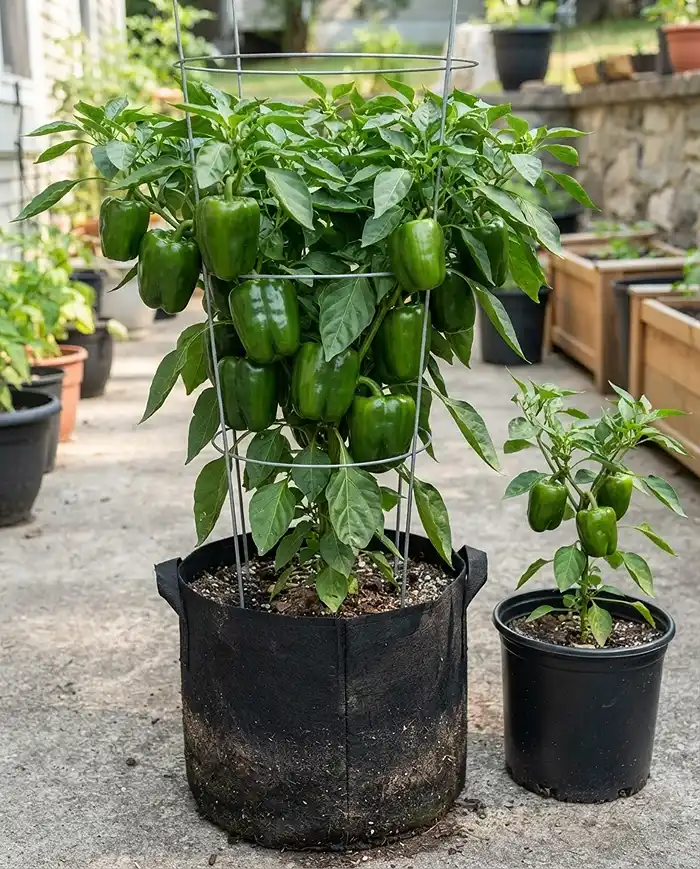
Heavy fruit needs a heavy root system. ‘California Wonder’ gave 2.6 lb in a 5-gallon pot and 4.2 lb in a 10-gallon. First green bells came 78 days after transplant.
For smaller yields, 5 gallons is fine. For maximum fruit, go 10 gallons and space pots 18 inches apart. My best pot size comparison for tomatoes, peppers and cucumbers notes the same top-end range.
Mistake to avoid: Putting a bell in 3 gallons because the plant looks small in May. It won’t stay small. Start with 5 gallons minimum.
Pot Materials: What Works Best for Peppers
Verdict: Fabric grow bags gave the best yields. Plastic is the easy default. Terracotta failed on my hot concrete patio because it dries too fast.
| 5-gallon pot | ‘California Wonder’ yield | July watering |
|---|---|---|
| Fabric grow bag | 2.9 lb | Daily, twice above 95°F |
| Black plastic | 2.6 lb | Every 1 to 2 days |
| Terracotta | 1.6 lb | Daily, soil dry by 2 p.m. |
Fabric Grow Bags for Air Pruning
Air pruning [roots stop growing when they hit air, then branch back inward] builds a dense root ball. It also prevents circling. My fabric bags stayed cooler too: 94°F soil at 3 p.m. in July, versus 104°F in black plastic.
The catch is water. Fabric breathes, so it dries fast. See my grow bag size chart for tomatoes, peppers and cucumbers if you go this route.
Plastic vs. Terracotta Pots
Plastic holds moisture in a hot summer. Use it in zones 8 and warmer, and paint dark pots white to cut heat. Terracotta suits cooler, wetter climates.
The failure: 7 of 15 bells in terracotta developed blossom end rot [dark, sunken rot on the fruit bottom]. The likely cause was swings between bone-dry and soaked soil, not a calcium shortage.
Potting Up Peppers Step by Step
Verdict: Grow seedlings in stages and move them to the final pot after frost. Skipping stages is the most common way to lose a seedling.
- Sow in 1.5-inch cells about 10 weeks before last frost. Mine went in January 20.
- Move to 4-inch pots at the third set of true leaves.
- Transplant to the final pot when the seedling is 6 to 8 inches tall and nights stay above 55°F.
Preparing Drainage and Soil Blends
Every pot needs drainage holes. Don’t add gravel at the bottom. It raises the soggy layer instead of fixing it. My blend:
- 2 parts quality potting mix, 1 part perlite.
- 1/2 cup bone meal [roughly 3-15-0, a slow calcium source] per 5 gallons.
- Target soil pH of 6.2 to 6.8.
- Switch to a 4-6-6 fertilizer at first flowers. High nitrogen gives leaves, not fruit.
Bone meal helps, but steady watering prevents blossom end rot far more than any amendment.
Deep Planting and Installing Supports
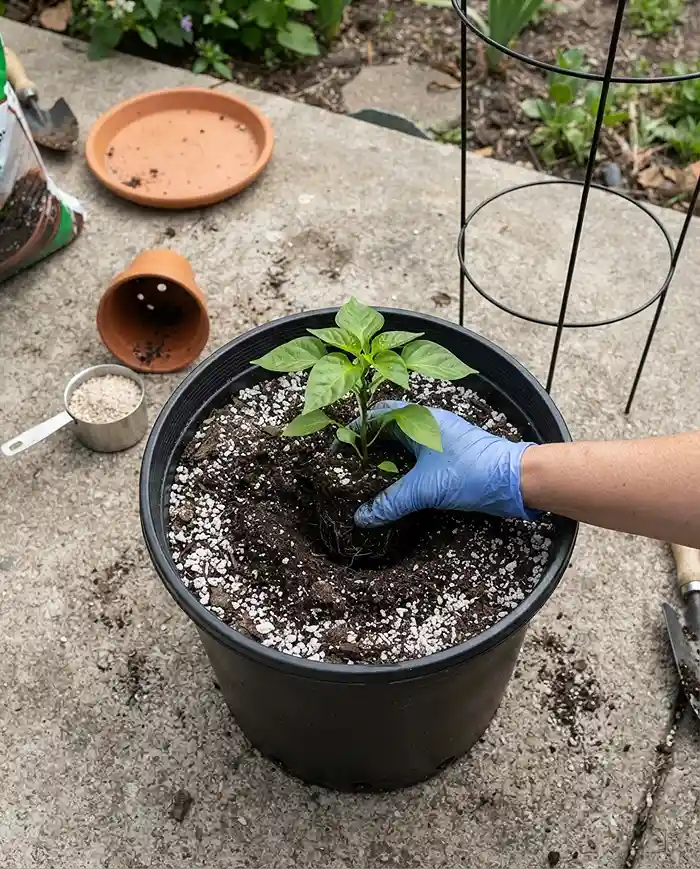
Set the seedling about 1 inch deeper than it sat in its nursery pot. Peppers root from the stem less readily than tomatoes, so don’t bury more.
Add a 42-inch tomato cage at planting. Two uncaged ‘California Wonder’ plants in 5-gallon plastic tipped over in a June storm. One snapped at the stem.
Maintenance for Container-Grown Peppers
Verdict: Smaller pots dry faster, so water by pot size, not by calendar. A finger test beats a schedule every time.
Adjusting Watering Routines by Pot Size
July highs hit 96 to 99°F on my patio. The 3-gallon pots needed water daily, and twice on 98°F days. A 10-gallon pot only needed a deep soak of about 2 gallons every 2 to 3 days.
Push a finger 2 inches into the soil. If it’s dry, water until it runs out the bottom. Skip afternoon sprinkles. They wet leaves, not roots.
Common Problems and Solutions
Verdict: Wrong pot size shows up as two opposite problems. Too small gives stunting and fast drying. Too big gives rot and slow starts.
Stunted Growth from Being Root-Bound (Too Small Pot)
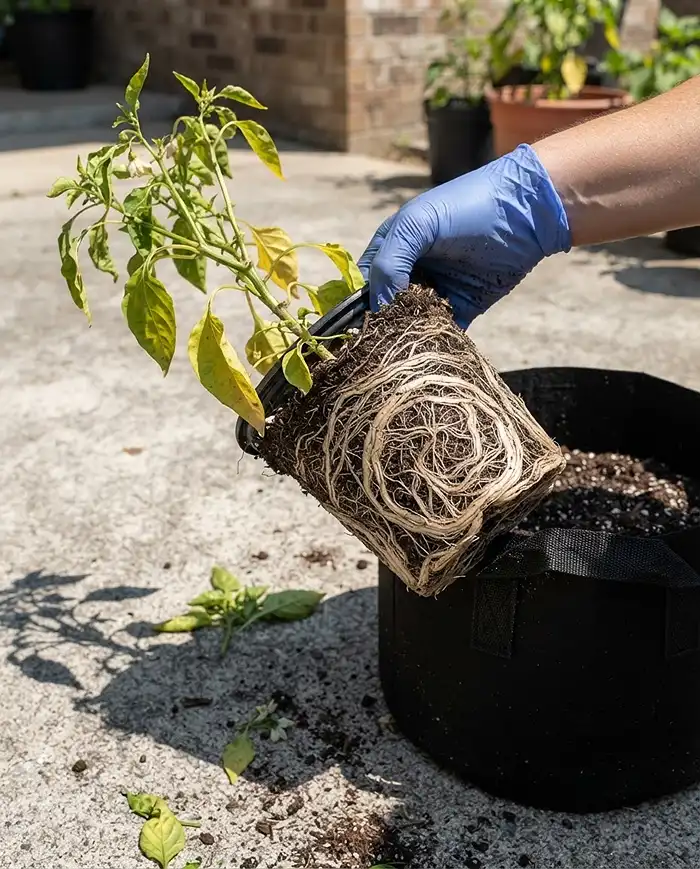
Signs: yellowing lower leaves, a plant stalled in height, and soil that dries within hours. My ‘Poblano’ in 3 gallons stalled at 14 inches in July and dropped flowers. It yielded 0.8 lb, versus 2.9 lb in a 7-gallon.
The fix is emergency up-potting. Move to 7 gallons, trim circling roots by a third, and shade it for 3 days. Mine recovered and gave another 1.1 lb.
Root Rot and Soggy Soil (Too Large Pot)
I put three March seedlings straight into 10-gallon pots. Two rotted. Tiny roots can’t drink fast enough, so the surrounding soil stays wet.
If you must use a big pot early, water only a 6-inch ring around the stem. Widen it as roots spread, usually over 6 weeks.
People Also Ask
Can I grow two pepper plants in one pot?
Not in anything smaller than 15 gallons. In smaller pots the plants fight for water and nutrients, and both produce less fruit. One plant per 5-gallon pot out-yielded two plants in a 10-gallon pot in my trial.
How deep does a container need to be for bell peppers?
Bell peppers need at least 12 to 14 inches of depth. Deep pots hold the taproot and keep a heavy, fruit-laden plant from tipping. A 12-inch-deep pot gave better stability than an 8-inch one in my patio test.
Should I start my seeds in the large final container?
No. Start seeds in 1.5-inch cells and up-pot in stages. A tiny seedling can’t absorb water fast enough in a 10-gallon pot, and fungal rot follows. I lost 2 of 3 March seedlings that way.
What pot size do super-hot peppers like Carolina Reaper need?
Plan on 7 to 10 gallons. These plants reach 3 to 4 feet and often need 100 days or more from transplant to ripe fruit. A 5-gallon pot works but limits the harvest.
How many gallons is a 12-inch pot?
A standard 12-inch-wide pot holds about 5 gallons of soil. A 10-inch pot holds roughly 3 gallons and a 14-inch pot about 7. Check the depth too, since squat pots hold less than their width suggests.
The Short Version
- The right pot size for peppers: 2 to 3 gallons for compact types, 3 to 5 for hot chilis, 5 to 10 for bells and poblanos.
- Keep every pot at least 12 inches deep. Go 14 inches for bells.
- Choose fabric or plastic over terracotta in hot climates, and water by pot size.
- Up-pot seedlings in stages. Never start in the big final container.