

Best Balcony Storage Plant Stands
Balcony storage plant stands solve two apartment headaches at once: nowhere to stash your gear, and nowhere to put your pots. Here’s how to pick or build one that actually holds up outside.
Table of Contents
Maximizing Small Spaces with Balcony Storage Plant Stands
I’ve gardened on three different apartment balconies over the past decade, and every single one had the same two problems: not enough floor space, and zero hidden storage for the messy stuff.
Bags of potting mix, half-empty fertilizer bottles, trowels, watering cans — it all ends up cluttering the one spot you actually want to sit in. A dual-purpose stand fixes that by hiding the mess while lifting your plants up where they belong.
The Dual-Purpose Balcony Garden Concept
The idea is simple: build storage into the base of your plant display instead of treating them as separate purchases.
A closed cabinet at the bottom keeps soil dry and tools out of the rain, while the open shelving above lifts pots into better sun and airflow. On my old north-facing balcony in zone 6b, moving my basil off the ground and onto a two-tier stand cut leaf mold by more than half in one humid Ohio summer.
That’s the whole appeal of a dual-purpose balcony garden setup — you’re not choosing between storage and display, you get both from the same footprint.
Planning Your Balcony Layout and Assessing Limitations
Before you buy or build anything heavy, walk your balcony with a tape measure and a notepad. Structural limits and sun exposure will decide what furniture actually works here, not what looks good in a catalog photo.
Calculating Weight Limits for Planters and Storage
Most residential balconies are rated for roughly 40 to 60 pounds per square foot, according to DrBalcony’s load capacity guide. That sounds like a lot until you add up wet soil.
A 14-inch ceramic pot filled with saturated potting mix can weigh 25 to 35 pounds on its own. Multiply that by four or five pots, plus a wooden bench and a bag of stored soil, and you can hit your limit fast on a small footprint.
- Weigh one filled pot on a bathroom scale, then multiply by how many you plan to keep
- Add the stand’s own weight — check the manufacturer spec sheet, not a guess
- Include stored items: a 20-lb bag of soil, a full watering can, a bottle of fertilizer
- Leave a 20% safety margin below your balcony’s rated capacity
When I moved into a 1970s building in Pittsburgh, my landlord couldn’t produce a load rating for the balcony. I stuck to lightweight resin pots and grow bags instead of my beloved terracotta collection — better safe than explaining a collapsed railing to the property manager.
Sun Mapping to Position Your Dual-Purpose Furniture
Track your balcony’s light for a few days before you commit to a spot. Sun-lovers like cherry tomatoes need six-plus hours of direct light, while ferns and pothos tolerate bright shade just fine.
Note the time the sun hits each corner, morning and afternoon, and mark it down. Most balconies have one bright zone and one shadier corner near the wall — put your stand where it won’t block that light from reaching a seating area too.
My current balcony gets full sun from 11am to 4pm along the railing, so that’s where the tomato-and-herb stand lives. The shaded corner by the door holds a smaller storage cart with ferns and a fiddle-leaf fig cutting.
Top Multi-Functional Balcony Storage Ideas
Once you know your weight budget and light pattern, here are the designs that consistently earn their keep on a small footprint.
Wooden Storage Benches with Built-In Planters
Quick Answer: A weather-treated cedar or teak deck box works as seating, holds bulky supplies inside, and has flanking side-planters for trailing plants — all in one footprint.
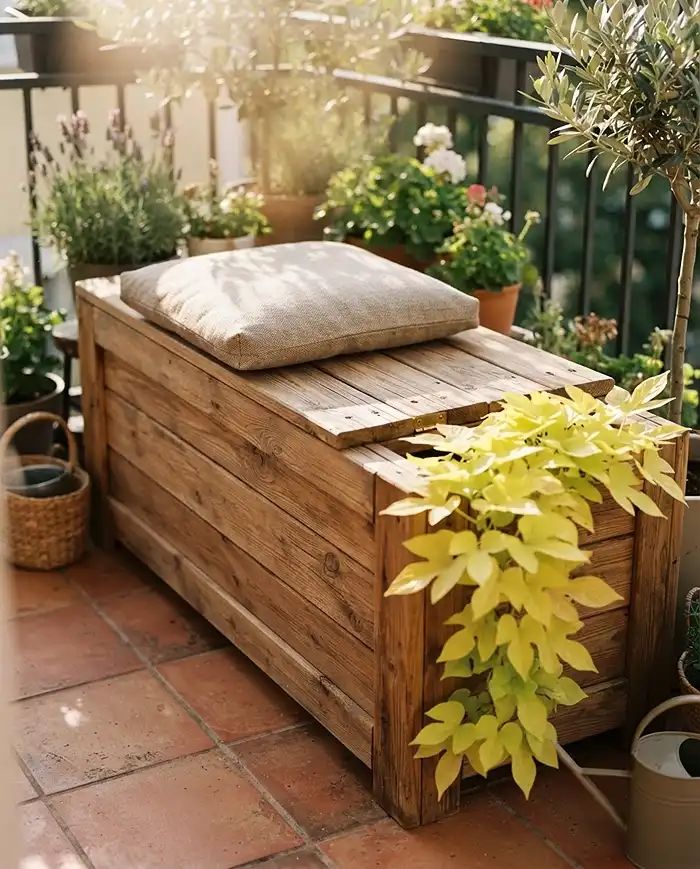
Look for a deck box rated for outdoor use with a hinged lid that seals against rain. The internal cavity fits a bag of potting soil, a folded tarp, and hand tools with room to spare.
I run a cedar deck box with built-in side planters for sweet potato vine, and by August the trailing foliage nearly hides the bench entirely. It’s one of the better balcony garden ideas for renters because most versions need zero tools to assemble.
Vertical Tiered Shelving with Hidden Bottom Cabinets
Quick Answer: A ladder-style shelf with a locking, waterproof base cabinet keeps liquid fertilizer and pest sprays secured, while ascending tiers display herbs or succulents in a narrow footprint.
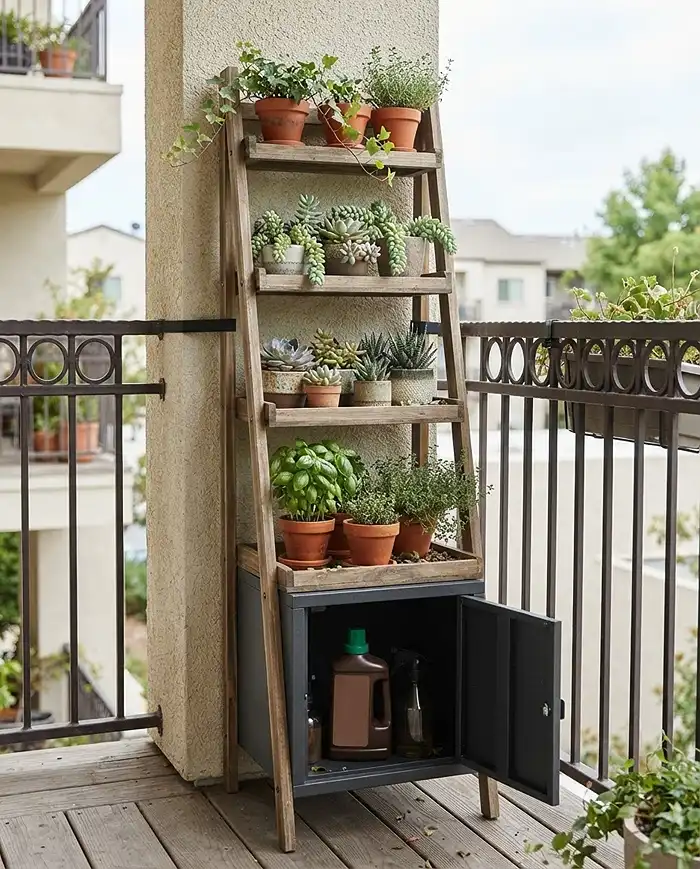
This is the design I’d recommend first for anyone under 30 square feet of balcony space. The vertical profile uses almost no floor area, and the closed bottom cabinet is the one place I’ll actually store liquid fertilizer, since it’s out of direct sun and out of a curious dog’s reach.
| Stand Type | Best For | Watch Out For |
|---|---|---|
| Wooden storage bench | Seating plus storage, larger balconies | Heaviest option, needs weatherproofing |
| Tiered shelf with base cabinet | Narrow balconies, herb collections | Top-heavy if not anchored |
| Upcycled crates or pallets | Budget DIY, rustic look | Untreated wood rots fast outdoors |
Upcycled Wooden Crates and Modular Pallet Systems
Quick Answer: Stack and secure treated wooden crates to create cubby storage for watering cans and hand tools, then use the reinforced top surface as a pedestal for heavier terracotta pots.
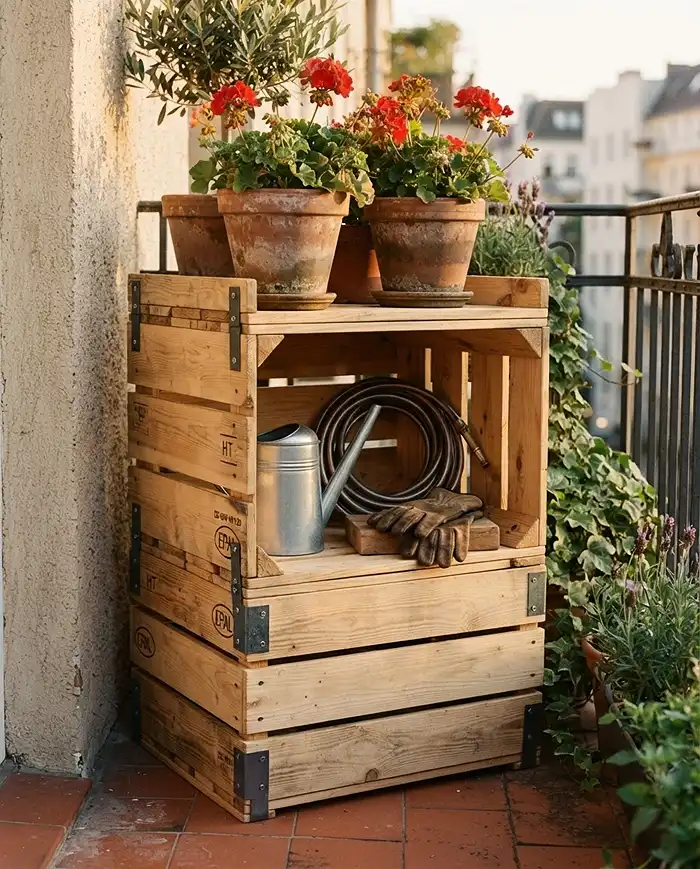
This is the cheapest route into a balcony garden shelving setup, but only if you start with kiln-dried, heat-treated pallets, not ones pulled off the curb.
My first attempt at this used untreated crates I found for free, and they were soft and splintering within four months of Pittsburgh humidity. Lesson learned: spend the extra ten dollars on treated lumber or a sealed exterior-grade crate.
Essential Features and Material Selection
Standard indoor furniture fails outdoors fast. Untreated wood swells and cracks, plain steel rusts within a season, and particleboard disintegrates the first time it gets rained on.
Weatherproofing and Rust-Resistant Materials
Powder-coated steel, marine-grade polymer, and sealed acacia wood are the three materials that hold up to real seasonal weather without warping or rusting.
- Powder-coated steel: rust-resistant, holds heavy loads, gets hot in direct summer sun
- Marine-grade polymer (HDPE): won’t rot or rust, lightweight, moderate weight capacity
- Sealed acacia or teak: natural look, needs re-oiling once or twice a year
Skip pressed wood or particleboard entirely, even if the price tag is tempting — it has zero tolerance for the freeze-thaw cycles most small balcony gardens go through each winter.
Managing Drainage Runoff to Protect Stored Goods
Nothing ruins stored fertilizer or a bag of soil faster than water dripping down from the shelf above. Hidden drip trays under every planted tier are non-negotiable on a storage stand.
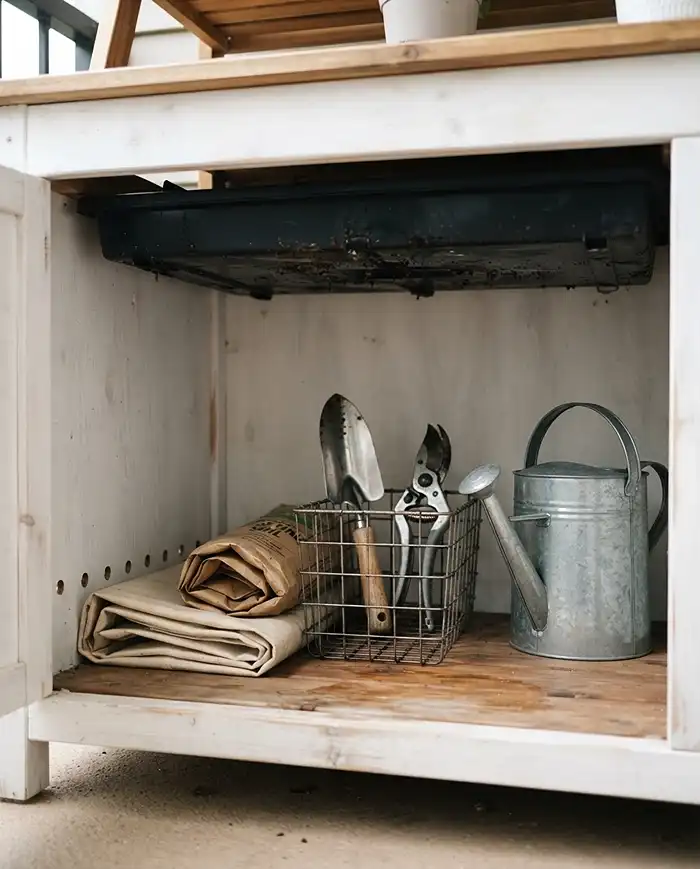
Silicone shelf liners or a routed drainage channel that directs runoff to the outer edge, away from the cabinet, work well too. Test it with a full watering can before you trust it with anything you actually want to stay dry.
Step-by-Step Setup Guide
Assembly, Sealing, and Wind Stabilization Process
Getting a storage plant stand ready for real outdoor use takes a bit more than unboxing it. Follow this order and you’ll avoid the two most common failure points: rot and tipping.
- Assemble on a flat surface and check every joint is snug before adding weight
- Apply two coats of exterior polyurethane sealant to any raw wood joints, letting each coat cure 24 hours
- Level the feet using shims if your balcony floor isn’t perfectly flat
- Anchor tall shelving units to the railing with weather-rated straps to resist wind gusts
- Load the heaviest items first, into the lowest, most central position
As of this year, most hardware stores carry exterior polyurethane in small sample sizes, so there’s no need to buy a full can for one small bench.
Common Problems and Solutions
Water Damage and Mold Inside Storage Bins
If you open your storage cabinet and catch a musty smell, condensation is building up faster than it can escape. This is the single most common complaint I hear about closed balcony storage.
Drill three or four small cross-ventilation holes low on each side of the cabinet, and caulk any gaps in the seams of the planter shelf directly above it. That combination lets air move through while still keeping rain out.
Wind Instability and Tipping Hazards
Tall, narrow stands catch wind like a sail, especially once they’re a few stories up. The fix is almost always about weight placement rather than the stand itself.
Put your heaviest items — a full bag of wet soil, a stack of terracotta pots — in the bottom compartment. Save lightweight resin pots for the top shelf, and you’ll lower the center of gravity enough to handle most gusts without anchoring at all.
Frequently Asked Questions
How do I waterproof an existing balcony storage bench?
Sand the surface down and apply two coats of marine-grade varnish, letting each coat cure fully. Staple heavy-duty plastic sheeting inside any built-in planter boxes before adding soil, to keep moisture away from the wood.
What is the best lightweight potting mix for balcony stands?
A blend of coconut coir, perlite, and vermiculite cuts weight significantly compared to heavy compost-based topsoil, while still holding moisture well for containers.
Can I keep fertilizer and soil in my outdoor storage stand year-round?
Dry potting soil can generally overwinter outside without issue. Liquid fertilizers and organic pest sprays should come indoors before the first freeze, since they can separate or expand and rupture their containers.
Conclusion
A good balcony storage plant stand does double duty: it hides the clutter and lifts your plants into better light. Start with your weight limit and sun pattern, then pick materials built for real outdoor weather.
Whether you go with a cedar bench, a tiered shelf, or upcycled crates, the small balcony garden approach is the same — protect what’s stored, drain what’s watered, and anchor what’s tall.
- Confirm your balcony’s weight rating before adding heavy furniture or filled pots
- Choose powder-coated steel, marine polymer, or sealed acacia over untreated wood
- Add drip trays or drainage channels under every planted tier
- Drill ventilation holes in closed storage to prevent mold and condensation
- Put the heaviest items lowest and most central to prevent tipping