

Fall Fertilizer for Container Vegetables: What to Use
The right fall fertilizer for container vegetables can double your late-season harvest — or burn your roots to nothing. Potted autumn crops face nutrient challenges that in-ground beds never see.
Summer’s constant watering flushes minerals straight out the drainage holes. By September, that “premium potting mix” you started with is nutritionally spent. Here’s exactly what to apply and when.
Table of Contents
Why Fall Container Vegetables Need a Specialized Fertilizer Routine
I grow kale, radishes, and spinach on a north-facing balcony in zone 6b, and every September I see the same thing: yellowing lower leaves within three weeks of replanting.
It’s not the cold. It’s starvation. Summer’s twice-daily watering cycle leaches water-soluble nutrients faster than roots can absorb them.
Fall container vegetables grown in confined pots can’t reach into surrounding soil to find reserves. The pot is the entire world for that plant’s roots.
Add shorter daylight hours into the mix and you’ve got crops racing a biological clock with an empty tank. A targeted fall feeding schedule is what closes that gap.
Generic summer fertilizer routines don’t translate here. Autumn crops need a completely different timing, formulation, and application method to thrive in pots as temperatures drop.
Understanding the Nutritional Demands of Autumn Crops
Plant metabolism slows as days shorten — but it doesn’t stop. Fall crops are still actively building tissue, just at a different pace and with different priorities than summer fruiting plants.
Summer tomatoes want phosphorus and potassium to push fruit. Fall greens want nitrogen to push leaves. Root vegetables want phosphorus to swell underground. Getting this ratio wrong means weak, spindly growth right when you need it most.
Nitrogen for Leafy Greens vs. Phosphorus for Root Crops
For leafy greens like ‘Winterbor’ kale, ‘Bloomsdale’ spinach, or ‘Black Seeded Simpson’ lettuce, you want a nitrogen-heavy blend. Think a 10-5-5 or similar N-dominant ratio.
Nitrogen drives rapid foliage expansion — exactly what you need when you’re harvesting leaf by leaf through October and November.
For root crops — radishes like ‘Cherry Belle’ or baby carrots like ‘Babette’ — switch to a phosphorus-rich amendment like bone meal (3-15-0). Phosphorus supports root cell development and swells those underground bulbs.
Using a high-nitrogen fertilizer on radishes pushes lush tops at the expense of the actual root you’re eating. I made that mistake in fall 2022 and harvested beautiful greens over tiny, forked radishes.
The fix is simple: identify your crop type first, then choose your formulation. Don’t use one fertilizer for everything in your fall containers.
How Cooler Soil Temperatures Affect Nutrient Uptake
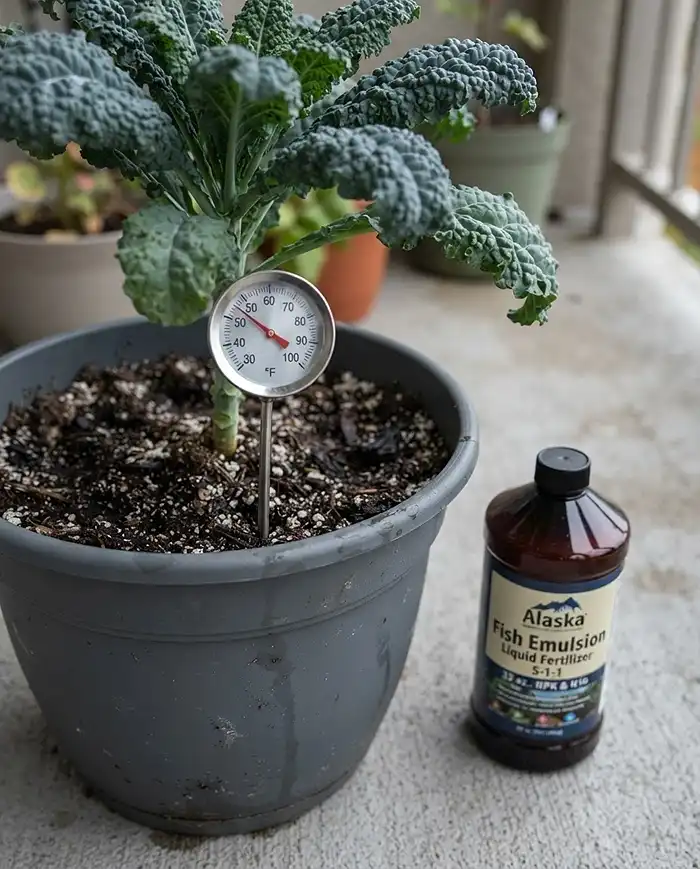
Here’s the biology most guides skip: soil microbial activity drops sharply once soil temperatures fall below 50°F (10°C). Those microbes are what break down organic granular fertilizers into plant-available forms.
A slow-release granular fertilizer that worked perfectly in August may just sit inert in your pot through a cold October week, doing nothing.
Synthetic fertilizers aren’t immune either. Cold, wet soil reduces root membrane permeability, slowing ion uptake even when nutrients are technically present.
This is why container vegetable gardening in fall demands a liquid-first strategy. Liquid organics bypass the microbial middle step and deliver nutrients in already-available form, regardless of soil temp.
Check your soil temperature with a cheap probe thermometer. Once it reads below 50°F consistently, granular-only feeding is largely a waste of fertilizer.
Choosing the Best Fertilizers for Fall Containers
The best fertilizer for container vegetables in fall isn’t one product — it’s a two-layer system. A liquid organic for fast absorption and a granular or amendment for background nutrition. Here’s how each one works.
Liquid Organics for Fast Absorption (Fish Emulsion and Kelp)
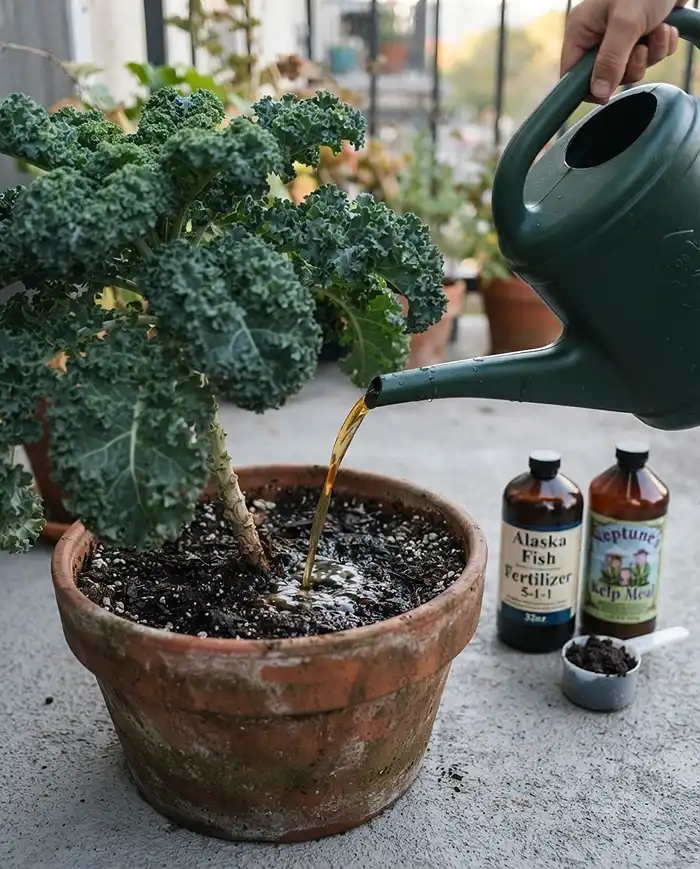
Fish emulsion (typically 5-1-1) is my go-to for fall leafy greens. It’s nitrogen-forward, immediately available, and cold-tolerant because it’s already broken down before it hits the soil.
I dilute it to half-strength — about half a tablespoon per gallon of water — and apply it every 10 to 14 days through October. The smell fades within a few hours outdoors.
Liquid kelp extract (0-0-1 roughly) is different. It’s not about NPK — it’s about micronutrients and natural plant hormones (cytokinins) that improve stress tolerance and root development in cold conditions.
I alternate fish emulsion and kelp week by week rather than mixing them. Each addresses a different need. As of fall 2024, my go-to brands are Neptune’s Harvest fish emulsion and Maxicrop liquid kelp.
Both products bypass sluggish cold-soil microbes entirely, feeding your vegetables in pots through direct root absorption.
Slow-Release Granulars and Worm Castings
Worm castings are the unsung hero of fall container gardening. Work 20-25% castings into your potting mix at planting time. They won’t burn roots at any concentration and release nutrients slowly over weeks.
Castings also improve soil structure, which matters in pots that compact over time and restrict root development.
For a granular fertilizer, I use a 5-5-5 balanced organic granular scratched into the top inch at planting. Brands like Espoma Garden-Tone or Dr. Earth Vegetable work well at half the label rate for fall.
The slower breakdown rate is actually an advantage at planting time — you want a low, steady release over weeks, not a big nitrogen spike that pushes growth the plant can’t sustain as days shorten.
| Fertilizer Type | Best For | Application Rate | Watch Out For |
|---|---|---|---|
| Fish Emulsion (5-1-1) | Leafy greens, fast nitrogen | Half-strength every 10-14 days | Odor; don’t apply in hot sun |
| Liquid Kelp | All crops, stress relief | 1 tsp/gallon, every other week | Low NPK — use alongside other feeds |
| Bone Meal (3-15-0) | Root crops (carrots, radishes) | 1 tbsp per 6-inch pot at planting | Slow to break down in cold soil |
| Worm Castings | All crops, soil amendment | 20-25% of total mix volume | Low NPK — must pair with liquid feeds |
| Balanced Granular (5-5-5) | All crops, baseline nutrition | Half label rate scratched in at planting | Slow release slows further in cold soil |
Step-by-Step Fall Fertilizer Schedule
Timing is everything with fall container fertilizer schedules. Feed too early and you push soft growth that can’t harden before frost. Feed too late and you’ve wasted nutrients on a slowing plant. Here’s the exact window-by-window breakdown.
Early Fall: The Initial Growth Push
This phase runs from late August through mid-September in most zones (zone 5-7). Daylight is still 12+ hours and soil temperatures are warm enough for good microbial activity.
At planting, mix worm castings and a half-rate granular into your potting mix. Water it in thoroughly.
When seedlings show their first true leaves (not the seed leaves — the second set), apply half-strength fish emulsion. This is the trigger, not a calendar date.
- Week 1 after true leaves appear: half-strength fish emulsion drench
- Week 2: liquid kelp at 1 tsp per gallon
- Week 3: return to half-strength fish emulsion
- Continue alternating through mid-October
The goal here is aggressive vegetative growth while the plant still has the daylight and temperature to use it. Don’t be shy with feeding during this window.
Mid-Fall: Sustaining the Harvest
Mid-October through early November is the “cut-and-come-again” peak for most fall greens. You’re harvesting outer leaves of kale and spinach every few days.
Each harvest pulls nitrogen out of the system with the leaves. Replace it. Scratch one tablespoon of slow-release organic granular per 10-inch pot into the soil surface after each significant harvest.
Don’t dig deep — you’ll damage shallow roots. Just scratch the top half-inch with a fork, apply the granules, and water in with at least a half-inch of water to activate them.
Continue the liquid feed rotation, but watch your plants closely. If you see dark, slightly curled leaves rather than healthy medium green, you’re overfeeding. Skip a week.
Pro tip: Weigh your pots before and after watering. A pot that dries out in 24 hours is losing nutrients fast and needs more frequent, smaller liquid feeds rather than larger, less frequent ones.
Late Fall: Tapering Off as Growth Slows
Two to three weeks before your average first hard frost date, stop all nitrogen fertilization completely. In zone 6b, that means I stop nitrogen by October 25th at the latest.
Here’s why this matters: nitrogen pushes tender, water-rich new growth. That exact growth is the most frost-sensitive tissue on the plant.
A kale plant that’s been pushing soft new leaves right up to a 28°F night will collapse overnight. The same plant that hardened off for two weeks will shrug it off and keep producing.
During this tapering phase, you can still apply a diluted kelp foliar spray for micronutrient support. Kelp doesn’t drive new growth — it just maintains what’s there.
- 3 weeks before first frost: stop all nitrogen feeds
- 2 weeks before: stop all granular applications
- 1 week before: foliar kelp only if needed for visible deficiency
- After first frost: no fertilization at all
Application Techniques for Confined Roots
Getting the right product is half the job. Applying it correctly in a confined pot is the other half. Poor technique wastes fertilizer and can damage the roots you’re trying to feed.
Top-Dressing and the “Scratch and Water” Method
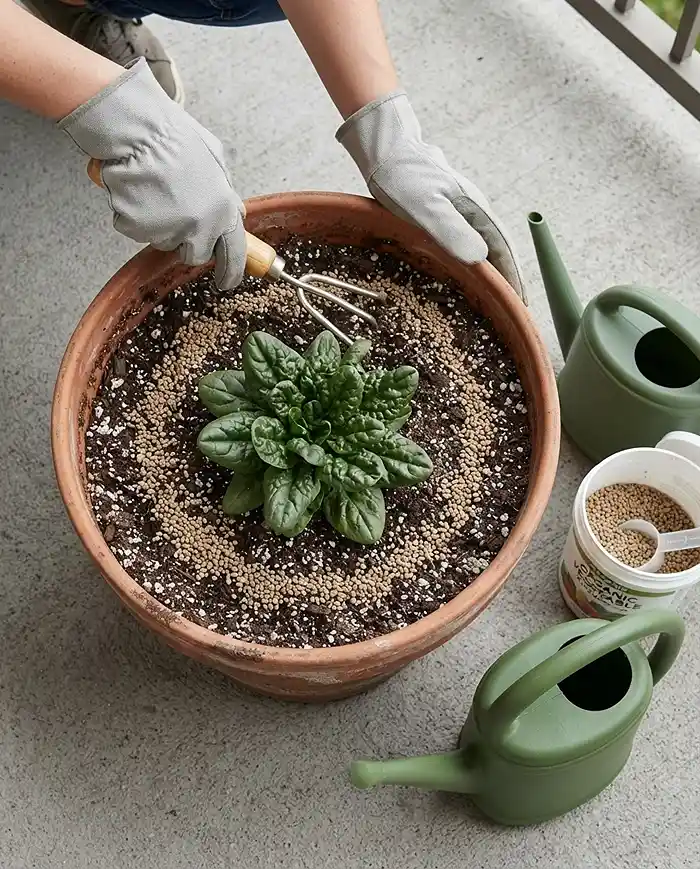
For dry granular fertilizers and worm castings, this is the method that protects roots while activating nutrients effectively.
Step 1: Measure the correct amount (err low — you can always add more, you can’t take it back).
Step 2: Spread granules in a ring around the plant, keeping them at least an inch away from the stem or crown. Direct contact with the crown causes rot and chemical burn.
Step 3: Use a fork or chopstick to scratch granules into the top half-inch of soil only.
Step 4: Water deeply until liquid runs freely from the drainage holes. This activates the nutrients and pushes them toward the root zone. A dry application just sits on the surface and may burn if concentrated rain hits it suddenly.
Foliar Feeding to Bypass Cold Roots
When soil temperatures drop below 50°F and root uptake slows, foliar feeding with liquid kelp keeps your plants supplied with trace minerals directly through leaf absorption.
The key is timing and targeting. Spray the undersides of leaves in the early morning, when stomata (the microscopic pores leaves use for gas exchange) are fully open.
Mix kelp at 1 tsp per gallon. Use a fine-mist sprayer — coarse droplets run off without absorbing. Mist until leaves are evenly coated but not dripping.
Don’t foliar feed in midday sun or when frost is expected within 12 hours. Wet leaves in freezing temperatures suffer cell damage.
According to Utah State University Extension’s fall vegetable gardening research, foliar applications of micronutrients can be measurably effective when root zone temperatures restrict normal uptake.
Common Problems and Solutions
Even a good fertilizer routine goes wrong sometimes. Knowing what to look for means you catch problems before they wipe out a harvest.
Nitrogen Burn on Tender Fall Greens
What it looks like: Crispy brown leaf tips that look like they were singed. Or excessively dark green, tightly curled leaves that seem to be “clenching.” Both signal too much concentrated nitrogen.
This most often happens when full-strength liquid fertilizer is applied to dry soil, concentrating the solution at the root zone.
Rescue protocol: Water the pot heavily — pour at least three times the pot’s volume through it over the next hour. This flushes excess fertilizer salts through the drainage holes.
Skip the next two liquid feeding cycles. Resume at quarter-strength before returning to half-strength. Always water the soil before applying liquid fertilizer — never to dry roots.
Nutrient Lockout from Cold, Wet Soil
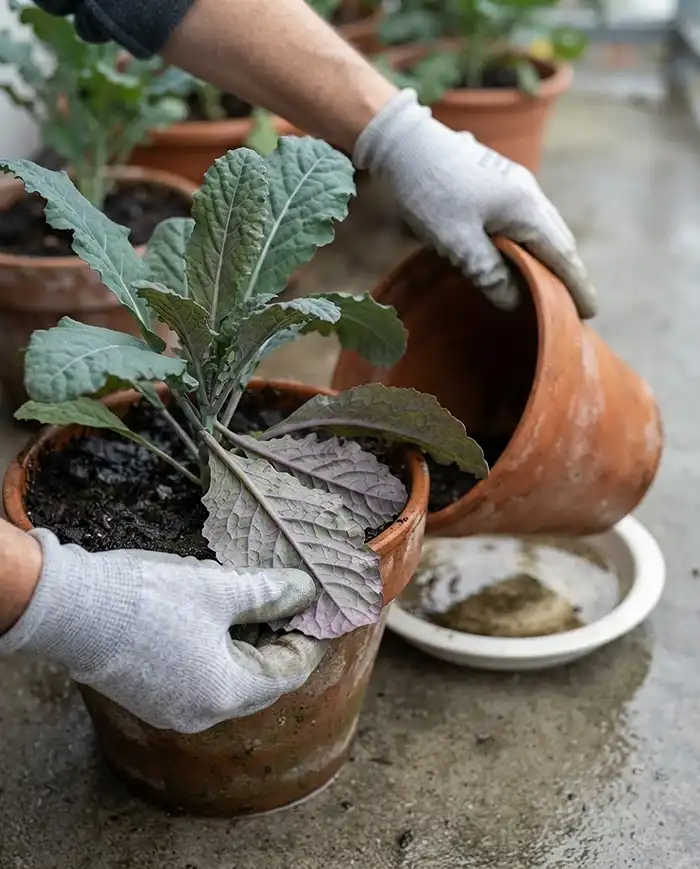
What it looks like: Purple or reddish tinting on the undersides of leaves, especially on brassicas like kale and broccoli raab. This is phosphorus deficiency caused by cold, waterlogged soil preventing uptake — not by a lack of phosphorus in the soil.
The fix isn’t adding more fertilizer. The fix is improving drainage first.
- Elevate pots on pot feet or rubber feet to improve airflow under the drainage holes
- Check that drainage holes aren’t blocked with compacted soil or debris
- Skip all soil-drench fertilization until the mix dries out between waterings
- Switch exclusively to foliar kelp spray until drainage improves
In zone 5-6, this problem peaks in October when cold autumn rains saturate containers that have nowhere to drain. A saucer that holds standing water makes it dramatically worse — remove saucers or drain them after every rain.
fall fertilizer for container vegetables FAQs
Can I use leftover summer tomato fertilizer on my fall crops?
Technically yes, but it’s not ideal. Tomato fertilizers are typically high in phosphorus and potassium (like 4-7-10), which supports fruiting. Fall leafy greens like spinach and lettuce need a much higher nitrogen ratio to push leaf production. Use your tomato fertilizer on root crops like radishes, where the extra phosphorus helps swell the roots. Buy a nitrogen-forward liquid for your greens.
How often should I fertilize potted fall vegetables?
Apply a diluted, half-strength liquid fertilizer every 10 to 14 days. Frequent autumn rains and regular watering flush water-soluble nutrients out the drainage holes quickly. Don’t try to compensate with stronger doses — that causes burn. More frequent, weaker applications are always safer and more effective in containers than occasional heavy feeds.
Should I fertilize my fall containers after a frost?
No. Never fertilize immediately after a frost. The plant is in biological shock — cell membranes are damaged and roots are compromised. Applying fertilizer salts to a damaged root system dehydrates plant tissue and can kill the vegetable outright. Wait until the plant has recovered visibly — usually 3 to 5 days of above-freezing temperatures — before resuming any feeding.
Can I start fall container vegetables in August?
Yes, and you should. Most fall crops need 45 to 70 days to maturity. Count back from your first frost date and plant accordingly. In zone 6, that means starting seeds or transplants by late August for a late October to November harvest. Check out the guide to fast fall root vegetables in pots for short-season crop options.
Do I need to fertilize if I used fresh potting mix?
Yes, but less aggressively. Fresh potting mix contains starter nutrients that typically last 4 to 6 weeks. For fall crops planted in fresh mix, skip the granular at planting and begin liquid feeding when you see the first true leaves. Slow-release starter nutrients plus a heavy liquid feed is a common cause of over-fertilization in early fall containers.
Key Takeaways
- The best fall fertilizer for container vegetables is a two-layer system: liquid organics (fish emulsion and kelp) for fast absorption, plus worm castings or balanced granular as a background baseline.
- Match your fertilizer to your crop: nitrogen-forward feeds for leafy greens, phosphorus-rich bone meal for root vegetables like radishes and carrots.
- Once soil temperatures drop below 50°F, shift to foliar kelp spray to bypass cold-slowed roots and microbial activity.
- Stop all nitrogen feeding two to three weeks before your first hard frost to let plants harden off — soft new growth is the first to die when temperatures drop hard.
- Diagnose before you feed: brown leaf tips mean over-fertilization and need flushing; purple-tinged leaves mean phosphorus lockout from cold, wet soil and need improved drainage first.