

Small Balcony Garden Layout
Want a small balcony garden layout that fits a comfy chair AND fifty pots? I grow on a 6×9-foot north-facing balcony in zone 6b, and yes, both can coexist without feeling cramped.
Table of Contents
Balancing Relaxation and Plant Obsession on a Tiny Balcony
Every urban gardener hits this wall eventually: you want a quiet spot to drink coffee and read, but you also can’t stop buying pots. My first summer here, I crammed 30 containers onto a 54-square-foot balcony and had nowhere to sit without a leaf brushing my ear.
The fix isn’t fewer plants. It’s a small balcony garden layout that treats seating and containers as one design problem, not two competing ones. Once I mapped sun, wind, and walking paths before buying anything, I fit one chair and 40+ pots comfortably.
Assessing Your Space for Seating and Containers
Before you drag a single planter outside, spend 20 minutes with a tape measure and a notebook. This prep phase is where most small space gardening plans go wrong, and it costs nothing to get right.
Measuring Footprints and Navigable Walkways
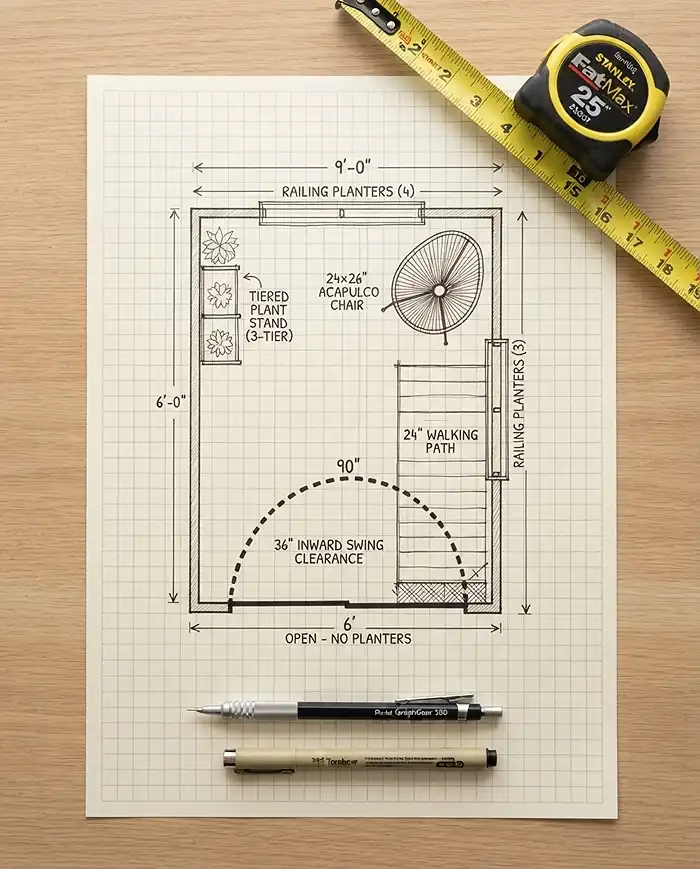
Grab a tape measure and sketch your balcony to scale on graph paper, one square per foot. Mark the door swing, the railing height, and any structural columns first, since those are fixed and everything else works around them.
Here’s the rule I break for no one: leave a clear 24-inch path from the door to the chair. Anything narrower and you’ll clip pots with your hip while carrying a full watering can, which is exactly how I cracked a glazed terracotta pot in April 2024.
Measure twice before ordering furniture, too. A chair that looks compact online can eat 30 inches of depth once the arms and cushion are accounted for.
Mapping Microclimates to Position the Chair
Spend one full day watching where sun and shadow fall, checking hourly if you can. On my balcony, the back-left corner stays shaded until 2pm, while the outer railing gets six hours of direct light by June.
Put your chair in the coolest, most sheltered corner. That’s usually against the building wall, away from wind funnels created by adjacent balconies. Reserve the sun-drenched perimeter for heat lovers like ‘Tumbling Tom Red’ tomatoes and zinnias.
Wind matters as much as sun in small space gardening. My balcony faces a wind tunnel between two buildings, so I lost a whole tray of seedlings before I started tucking the chair and tender plants behind a windbreak of taller pots.
3 High-Density Balcony Layouts for One Chair
These three floor plans are the ones I’ve actually tested, torn apart, and rebuilt over four seasons. Each fits a single seat inside a dense plant collection without triggering that boxed-in, claustrophobic feeling.
Layout 1: The Corner Sanctuary (L-Shaped Plan)
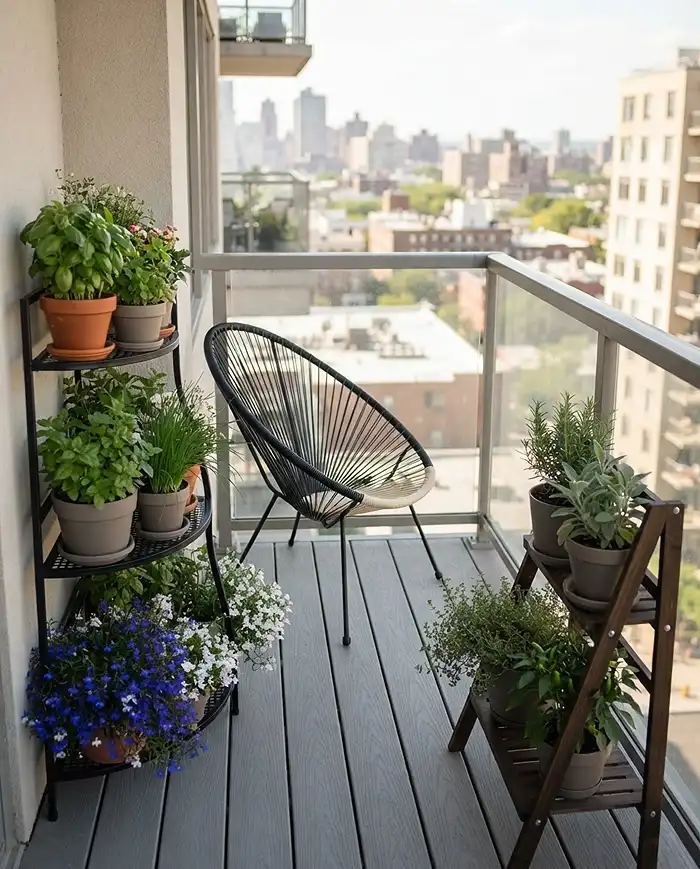
Quick Answer: Push the chair into a back corner and flank it with an L-shaped run of tiered plant stands along both adjacent walls, leaving the front railing completely open.
This is the layout I run every year now. The chair sits diagonally in the back corner, with a three-tier metal stand on one wall and a narrower two-tier stand on the other, holding herbs and trailing lobelia at eye level.
Because the front railing stays bare, the whole balcony reads as open even with 25+ pots tucked into the L. It’s the easiest layout for a first-time small balcony garden layout attempt.
Real Example: I rebuilt my own balcony into this shape in May 2023 after the overcrowded mess of year one, and it instantly felt 40% bigger just by clearing that railing sightline.
Pro Tip: Angle the top shelf of your tallest stand slightly inward, toward the chair, so overhanging foliage frames your view instead of blocking it.
Layout 2: The Immersive U-Shape (Perimeter Hug)
Quick Answer: Center the chair against the back wall and line both side walls plus the front railing with rectangular troughs and saddle planters, forming a green horseshoe around the seat.
This layout maximizes linear growing space, which matters if you’re doing productive container gardening and want herbs, greens, and cherry tomatoes all within arm’s reach. A 900mm trough along each side wall plus railing planters can hold 15-20 plants total.
The tradeoff: you lose the open view Layout 1 keeps, since plants surround you on three sides. It suits gardeners who want to feel fully enclosed in greenery rather than looking out at the skyline.
Real Example: A friend in a zone 7a apartment ran this setup with ‘Bright Lights’ cosmos and Genovese basil packed along both walls, and her balcony reads as a jungle nook rather than a storage shelf.
Pro Tip: Use one trough depth (12 inches minimum for tomatoes and peppers) on all three sides so the horseshoe looks intentional instead of mismatched.
Layout 3: The Vertical Canopy (Wall-Focused Plan)
Quick Answer: Install floor-to-ceiling tension poles and modular living walls behind and beside the chair, using tall climbing vines to build a shaded overhead canopy while keeping the floor almost entirely clear.
If your balcony is narrow, under 4 feet deep, this is the only layout of the three that actually works. Nearly all the growing happens vertically, so the floor stays open for the chair and a small side table.
I tried this the year after a shoulder injury made bending down to floor pots painful, and it turned out to be my favorite layout for tiny garden ideas that still deliver a lush, jungle feel.
Real Example: A ‘Little Gem’ clematis and a golden hops vine climbed a tension pole behind my chair within one season, creating dappled shade by mid-July without a single floor pot in the walkway.
Pro Tip: Bolt tension poles into a stud or use a weighted base rated for at least 40 pounds; wind gusts on upper floors will topple anything lighter.
Selecting the Perfect Chair and Container Styles
Bulky furniture and mismatched pots are the fastest way to shrink a small balcony visually. Streamlined, see-through pieces do the opposite, making a tight footprint feel roomier than it measures.
Choosing “Airy” Furniture Over Bulky Seating
Solid wood armchairs eat visual space even when they’re physically small. Instead, look at a slim Acapulco chair, a woven rattan egg chair, or an open-wire bistro seat, since you can see through the frame to the plants behind it.
I switched from a padded wicker chair to an Acapulco-style PVC-cord chair in year two, and the whole balcony felt lighter immediately, even though I hadn’t removed a single pot.
For urban gardening in tight footprints, one rule beats every other: if you can’t see light through the chair’s structure, it’s too heavy for a small space.
Utilizing Tiered Stands and Railing Planters
Wide, round floor pots are the single biggest space-waster on a small balcony. Swap them for containers that stack vertically instead of spreading horizontally.
- Tall column planters (30-36 inches) for single specimen plants like dwarf citrus
- Multi-level corner shelves that hold 4-6 small pots in the footprint of one
- Over-the-railing saddle pots, rated for your exact railing width, for trailing petunias and strawberries
- Hanging baskets on shepherd hooks for anything with a trailing habit
Check the weight rating on your railing before hanging saddle pots. Mine holds 15 pounds per linear foot, which limits me to lightweight coir liners rather than soaked ceramic.
Step-by-Step Assembly of Your Single-Chair Oasis
Order matters here more than people expect. Doing this out of sequence is exactly how I ended up with a chair wedged behind a pot I couldn’t move without help.
- Place the empty chair first, exactly where you want to sit, to establish your primary sightline
- Install wall trellises and railing planters next, since they’re fixed and hardest to reposition later
- Position heavy anchor pots (dwarf trees, large troughs) into the remaining corners
- Fill gaps with small accent plants and trailing pieces last, adjusting for balance
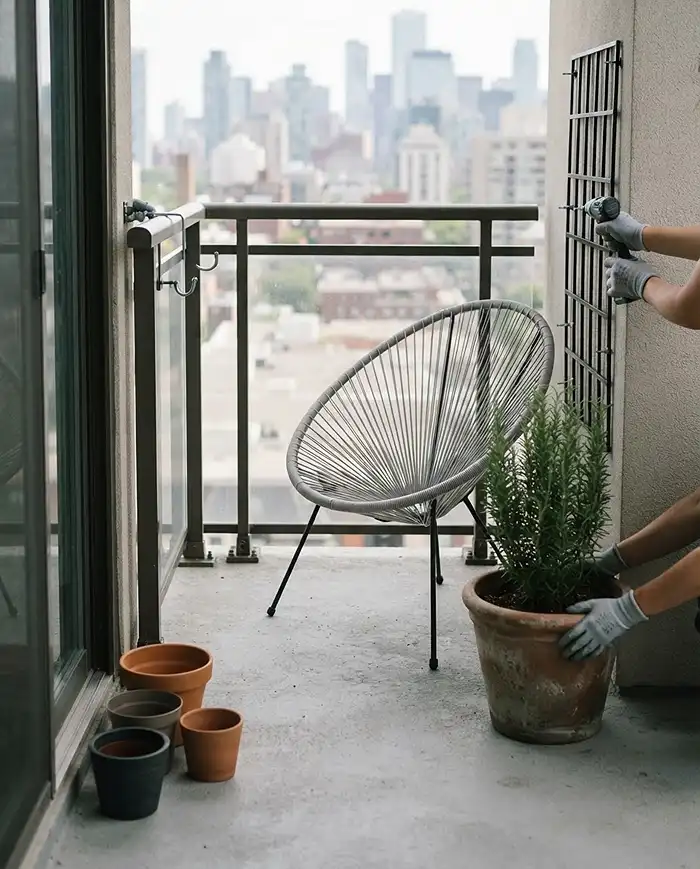
This sequence keeps your seating zone protected from being an afterthought squeezed in around plants you already bought.
Maintenance Strategies for High-Density Layouts
Packing dozens of pots close to fabric furniture changes your care routine. A few adjustments protect both the plants and your cushions.
Drip-Free Watering and Aesthetic Pruning
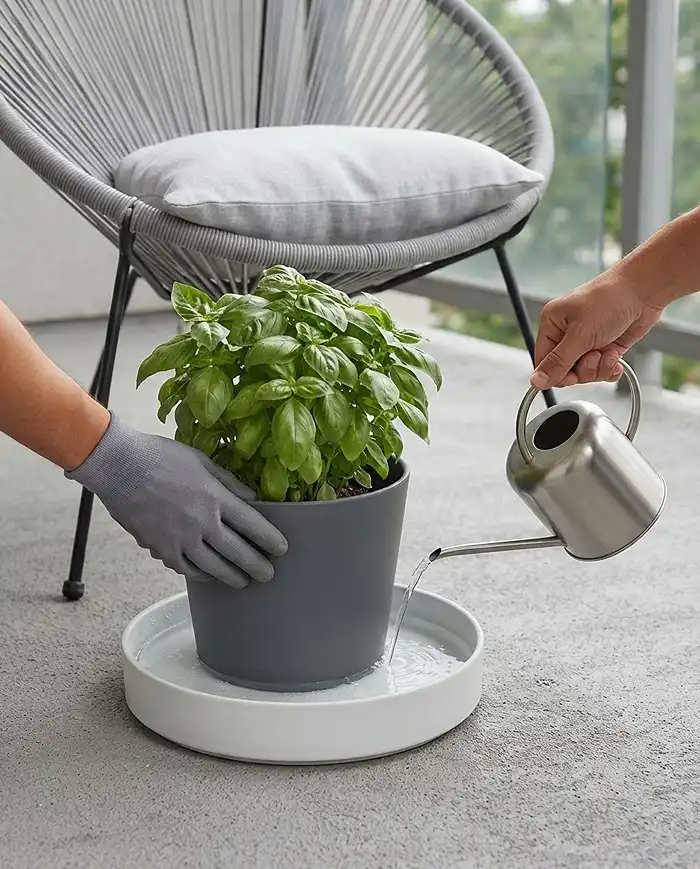
Use exact-fit glazed drip trays under every pot near the chair, not the generic universal ones. A tray even a half-inch too small lets muddy runoff spill straight onto cushions.
Bottom-watering trays for smaller pots eliminates splash-back entirely. I switched my herb pots to self-watering trays after ruining a cushion cover with soil splatter twice in one month.
Prune trailing vines weekly during peak growing season, June through August in zone 6b. Left unchecked, sweet potato vine and trailing petunias will reach the chair arm within two weeks.
Common Problems & Solutions
Two issues come up constantly once you cram this many pots around one seat: visual clutter and pests. Both have simple fixes.
Claustrophobia and Visual Clutter
A wall of mismatched pots in five different colors reads as chaotic clutter, not lush greenery, and it can make a small space feel smaller and more stressful rather than relaxing.
Fix it by unifying containers under a strict two-color palette. I moved everything to plain terracotta and white ceramic in year two, and the same plant count suddenly looked curated instead of cluttered.
Remove dead or yellowing foliage immediately rather than letting it accumulate. This single habit does more for the “calm nook” feeling than any furniture change.
Managing Pests Near the Seating Area
Nobody wants mosquitoes landing on them mid-relaxation. Place fragrant, mosquito-repelling herbs like lemon balm and rosemary in pots directly beside the chair.
Push sweet, bee-attracting blooms like lavender and zinnias toward the outer railing instead, away from the seating zone. This keeps pollinators working the garden without buzzing around your book.
I added a lemon balm pot on each side of my chair in 2024 and noticed a real drop in mosquito landings during evening reading sessions, without a single spray.
Frequently Asked Questions
How much space should I leave between the chair and the pots?
Keep a minimum clearance of 12 to 18 inches between the edge of the chair and the nearest foliage canopy. This prevents wet or soil-covered leaves from constantly brushing against your clothing while you sit.
Should my chair face the view or face the plants?
Angle the chair diagonally toward the outer corner of the balcony. This lets you enjoy the open view while keeping your container garden in your peripheral vision at the same time.
How do I protect my fabric chair cushions from dirt and rain?
Choose outdoor-grade acrylic fabrics like Sunbrella, which resist mildew and soil stains far better than standard cotton blends. Keep a small waterproof deck box tucked under a tall planter to store cushions during watering or storms.
What is the best small balcony garden layout for a narrow space?
The Vertical Canopy layout works best under 4 feet of depth, since tension poles and wall-mounted planters keep the floor clear for a chair and small side table.
How many pots can realistically fit around one chair?
Most balconies between 50 and 70 square feet can hold 25 to 40 pots around a single chair when using vertical stands and railing planters instead of only floor pots.
Layout Comparison at a Glance
| Layout | Best Balcony Shape | Watch Out For |
|---|---|---|
| Corner Sanctuary (L-Shape) | Square or wide balconies, 6ft+ deep | Needs two clear walls for stands |
| Immersive U-Shape | Rectangular balconies, 5-8ft deep | Blocks the outward view on three sides |
| Vertical Canopy | Narrow balconies, under 4ft deep | Requires sturdy wall or stud anchoring |
Whichever layout fits your footprint, pairing the right containers with the right structure is what makes small space gardening feel effortless instead of crammed.
For more on picking pots that support this kind of density, see this guide to choosing the right containers for small space gardening.
If you want your harvest to justify the pot count, this breakdown of a productive container garden pairs well with any of the three layouts above.
And for more layout inspiration beyond seating-focused plans, browse these apartment balcony garden ideas.
Before buying heat-loving plants for the sunny perimeter, check your exact growing zone on the USDA Plant Hardiness Zone Map, since microclimates on upper-floor balconies often run a half-zone warmer than ground level.
Conclusion
A workable small balcony garden layout comes down to sequence: measure first, map your microclimates, then build outward from the chair instead of around leftover space.
Whether you choose the Corner Sanctuary, the Immersive U-Shape, or the Vertical Canopy, the same three habits carry every successful tiny garden idea: keep a real walkway, unify your containers, and prune before vines reach the seat.
Key Takeaways
- A tested small balcony garden layout starts with measuring a 24-inch walkway before buying any furniture or pots
- Match your layout to balcony shape: L-Shape for square spaces, U-Shape for rectangles, Vertical Canopy for anything under 4 feet deep
- Choose see-through furniture like an Acapulco or rattan egg chair to keep small space gardening from feeling boxed in
- Unify pot colors and prune weekly to prevent the visual clutter that turns urban gardening into a stress source instead of a relief
- Place mosquito-repelling herbs like lemon balm right beside the chair to keep the seating zone pest-free